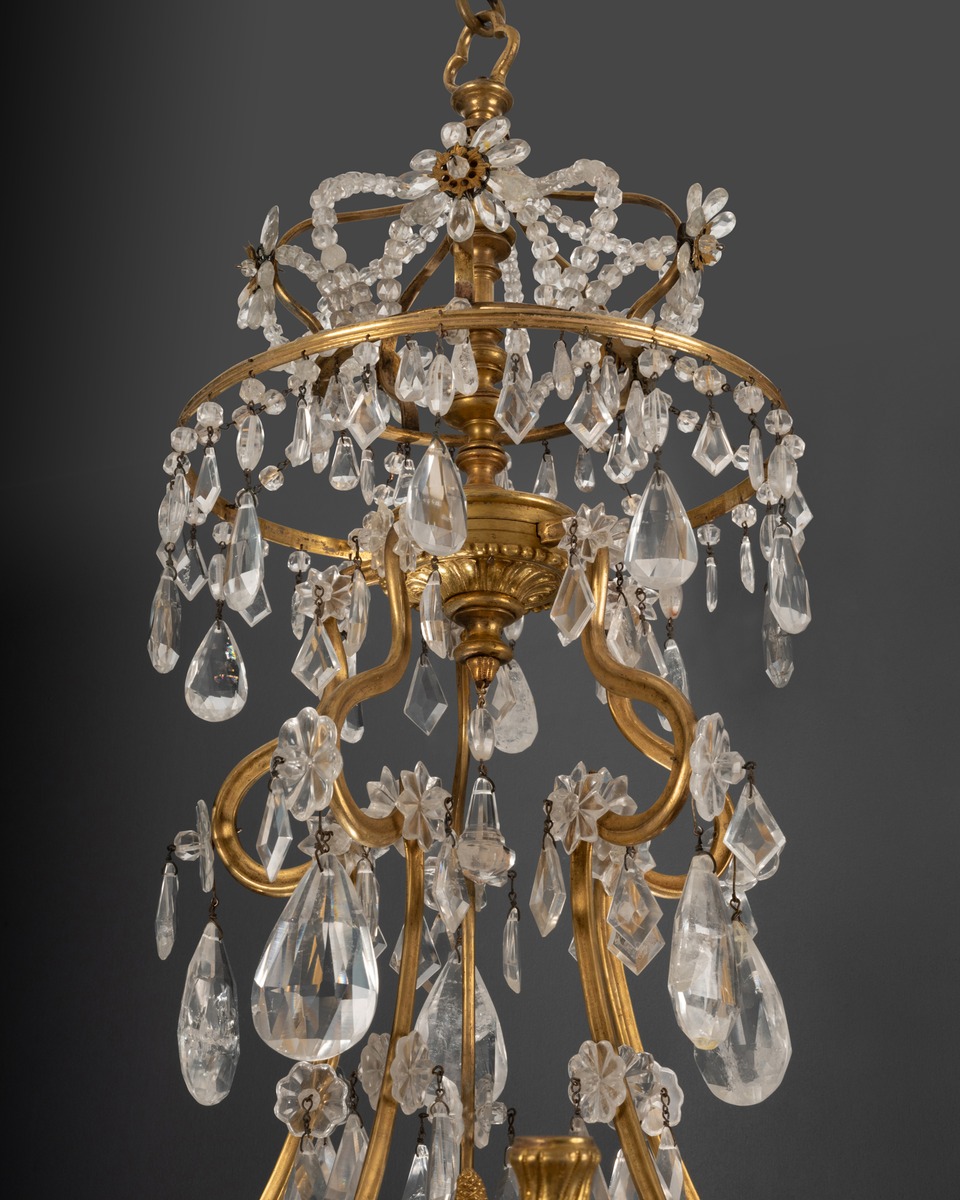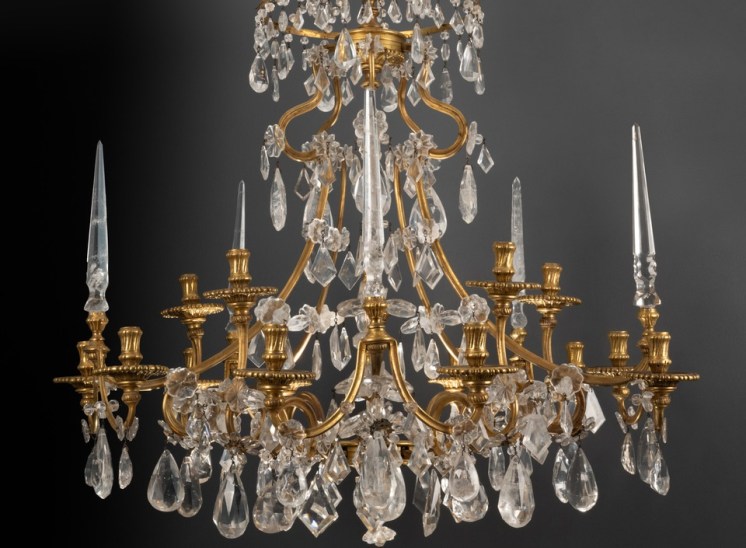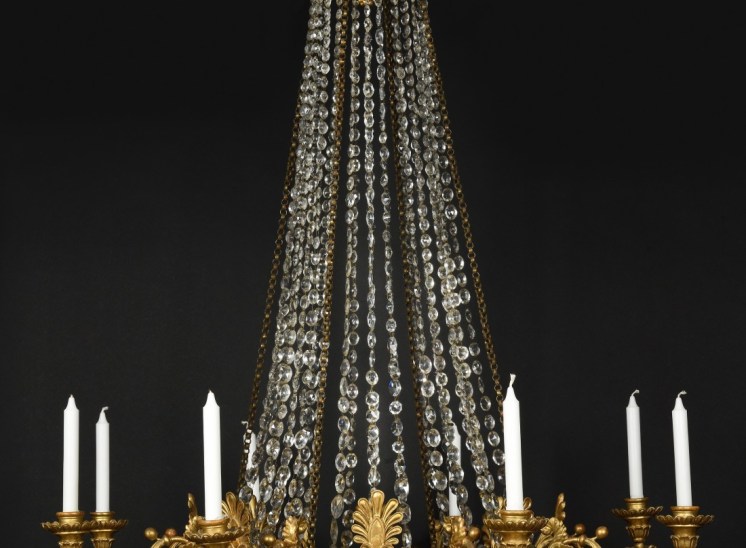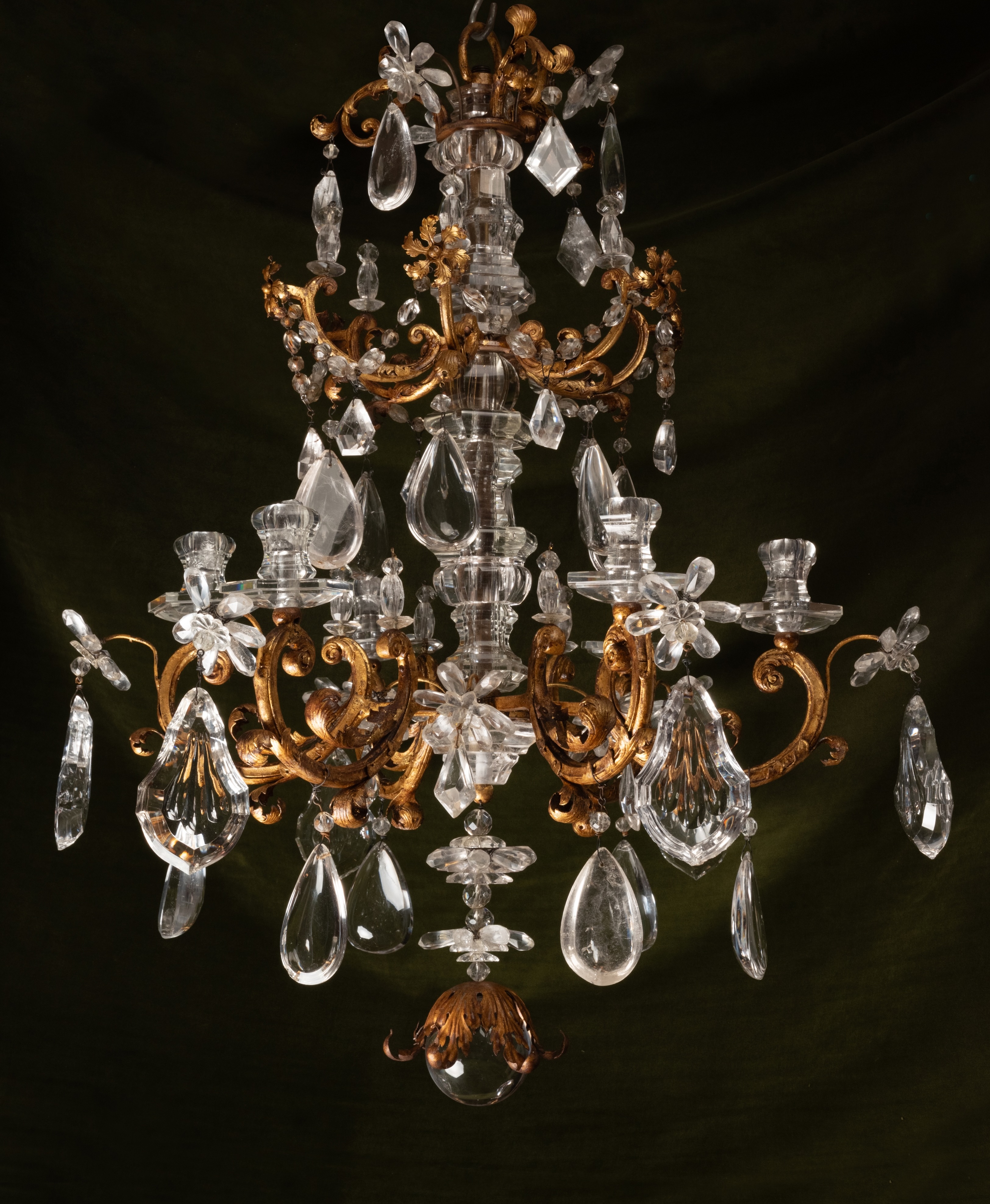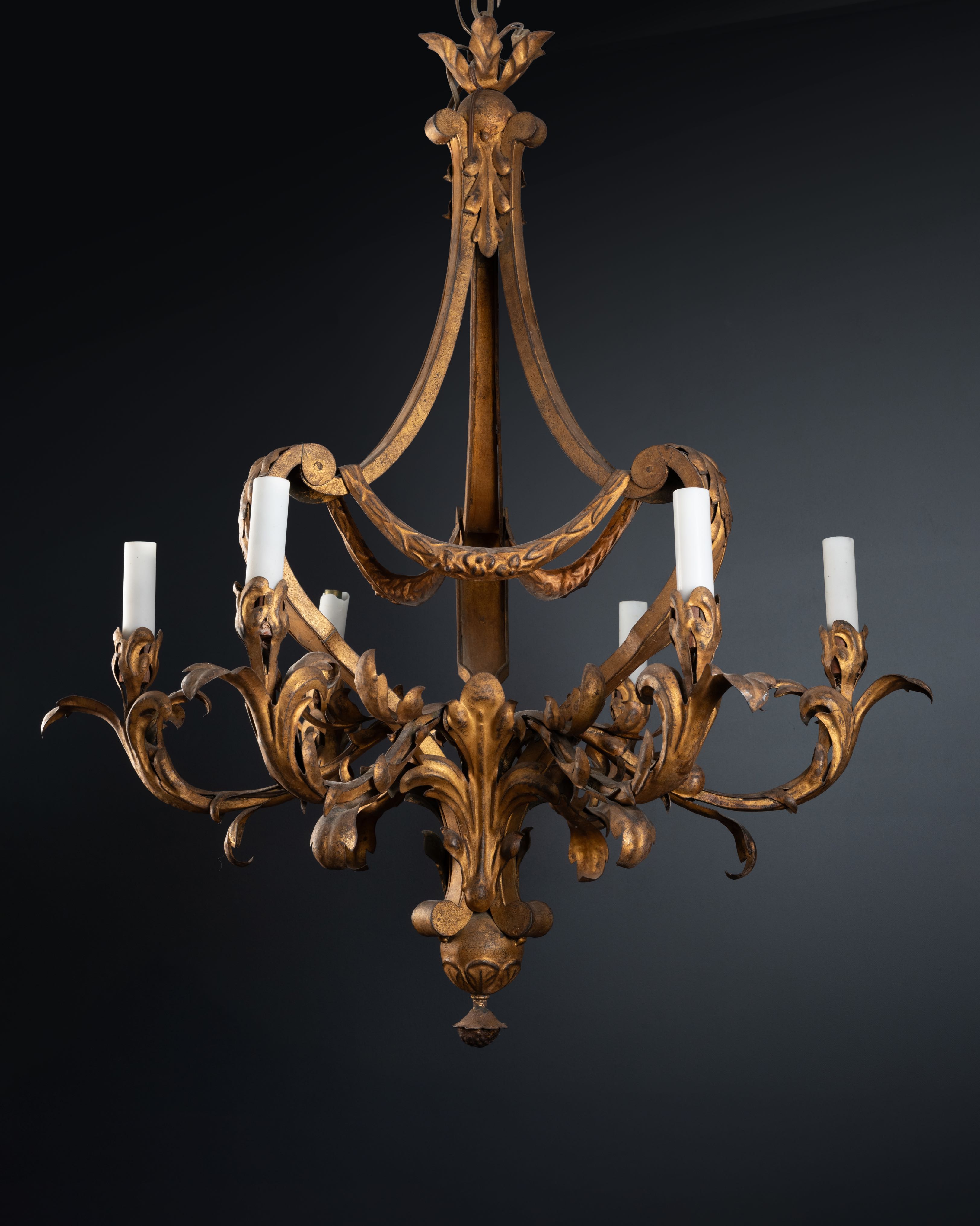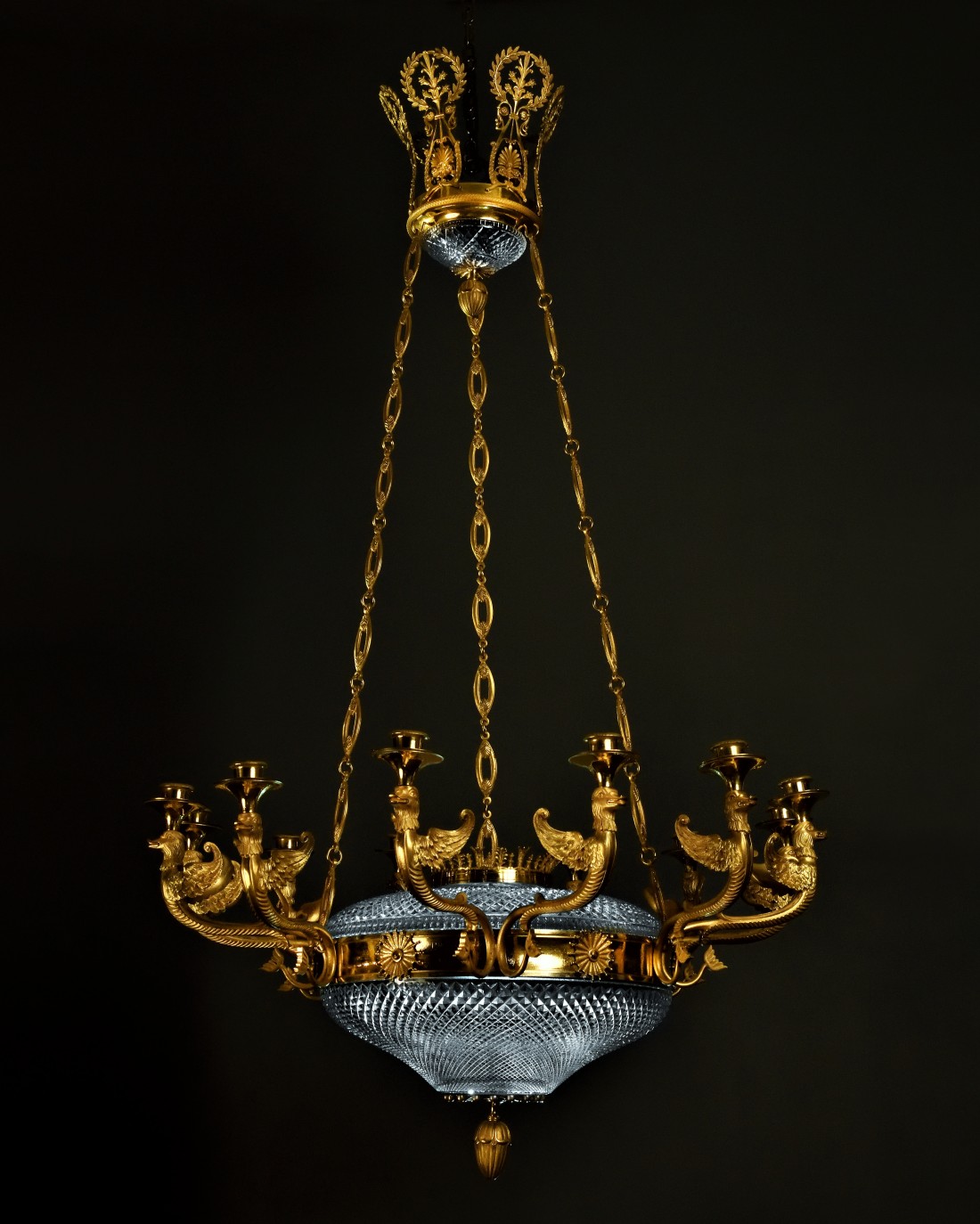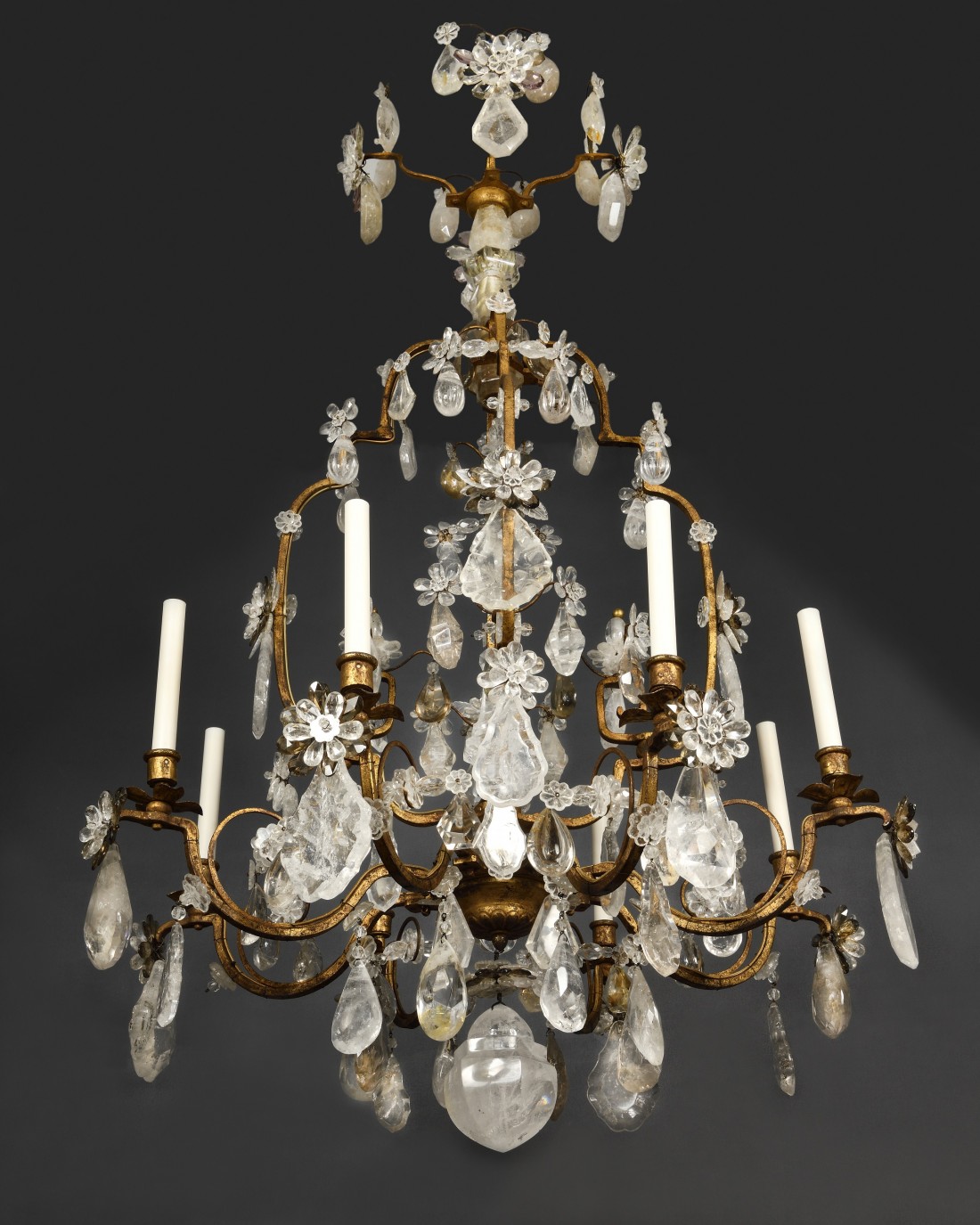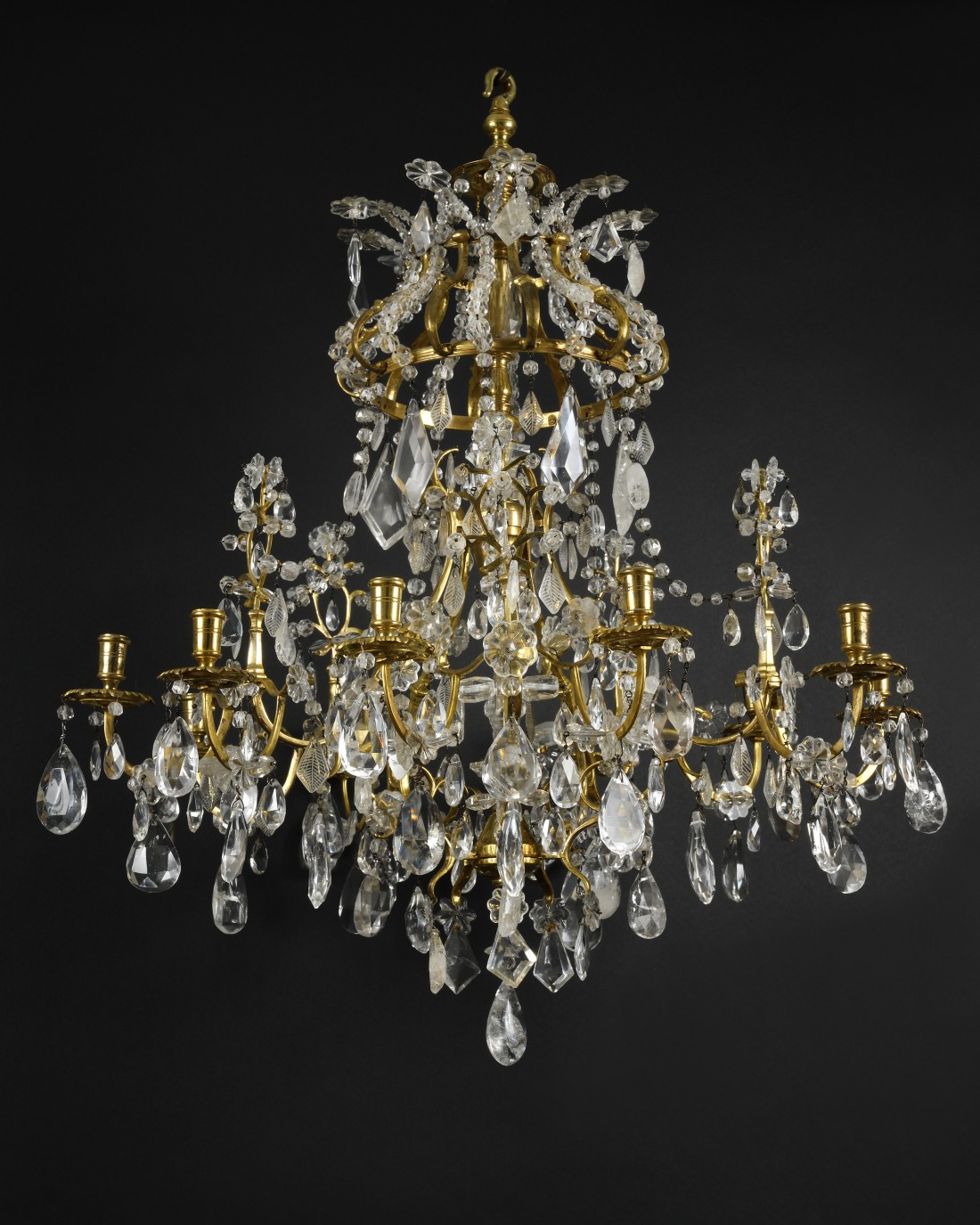

Barocchetto Chandelier with Crown and Fourteen Lights.
Gilt bronze, rock crystal.
Northern Italy.
First third of the 18th century.
h. 45,3 in. ; w. 31,5 in.
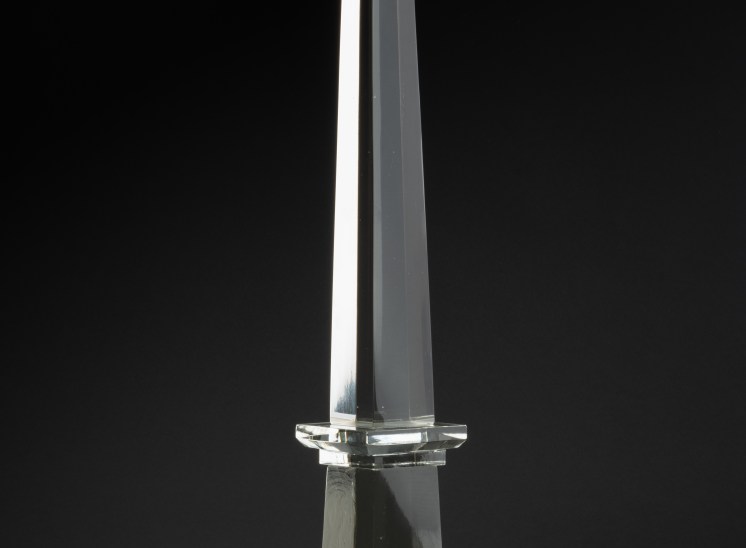
This gilt-bronze chandelier, topped with a crown and featuring fourteen lights, belongs to a family of barocchetto light fixtures designed in the first third of the 18th century in Northern Italy. Its mercury-gilded bronze structure supports a rich decoration of rock crystal, made up of faceted prisms, rosettes, long dagger-shaped drops, pear- and star-shaped pendants, and strands of faceted crystal beads adorning the crown.
This type of chandelier gained popularity with the Ligurian and Piedmontese aristocracy, as well as the Savoy Court, as early as the late 17th century. The crown that often tops these fixtures is one of the hallmarks of this noble and royal clientele. Several similar chandeliers are still preserved in the Royal Palace of Turin, some of which were showcased during the Mostra del Barocco Piemontese held in 1937 at the Palazzi Carignano and Madama in Turin, as well as at the Stupinigi Hunting Lodge.
These chandeliers stand out for their extensive use of rock crystal, offered in a wide variety of cuts and shapes designed to amplify the optical effects produced by light refraction. The use of natural quartz—valued for its transparency and high refractive index—remained limited until the 17th century due to its rarity and cost. Only in the 18th century, following the discovery of large quartz deposits in Central Europe, did its use significantly expand.
Northern Italian workshops began working with this material in the first quarter of the 18th century, developing the craft of cutting and shaping crystal. The chandelier’s abundant crystal ornamentation suggests it was likely made for an important client, given the quality of the crystals. Its value was determined by two main criteria: weight—measured in marcs, ounces, and gros, as with silverware—and water, meaning the clarity of the crystal. The clearest pieces, described as being of “very fine water,” could fetch prices up to three times higher than those of less clear crystals.