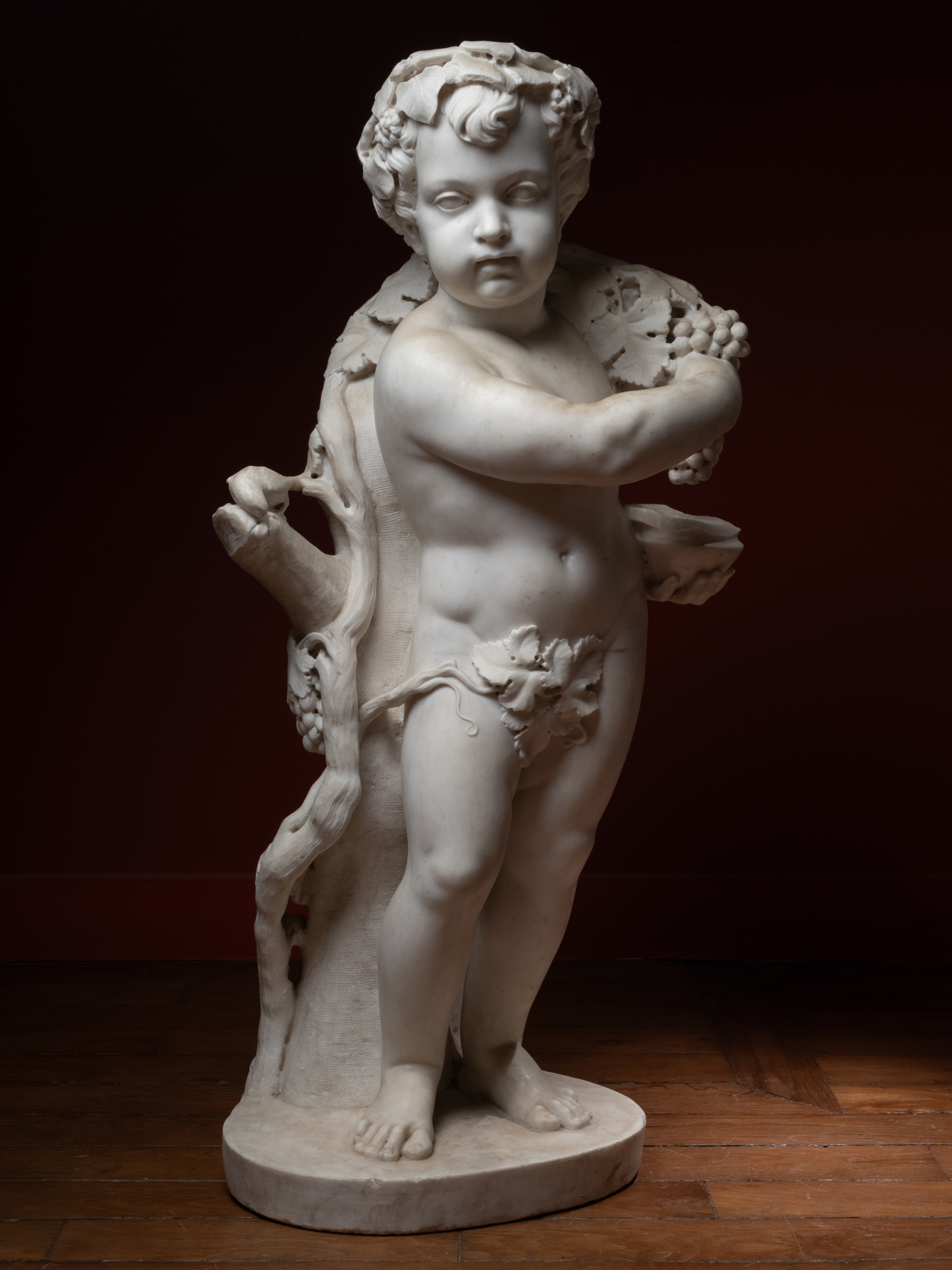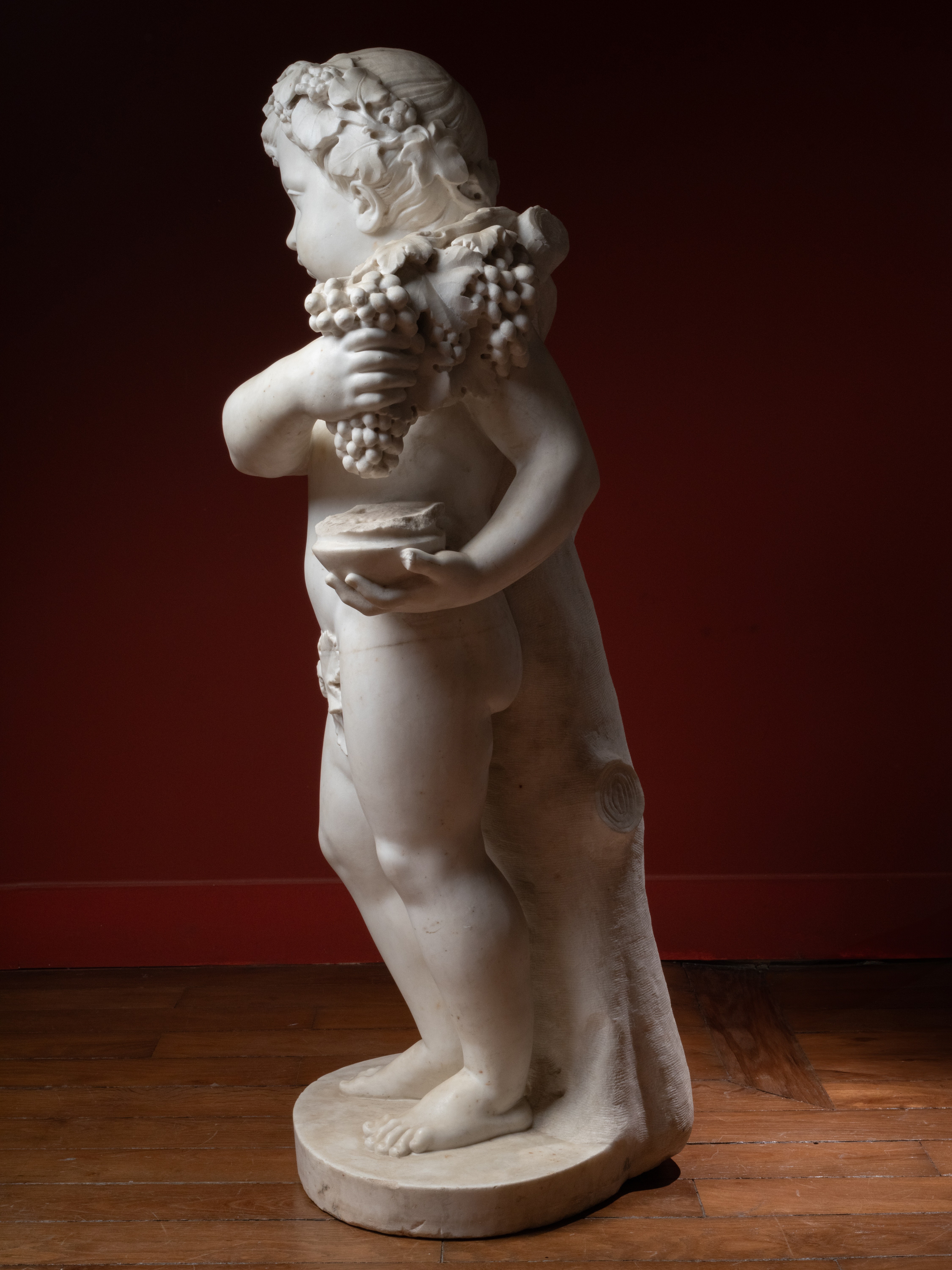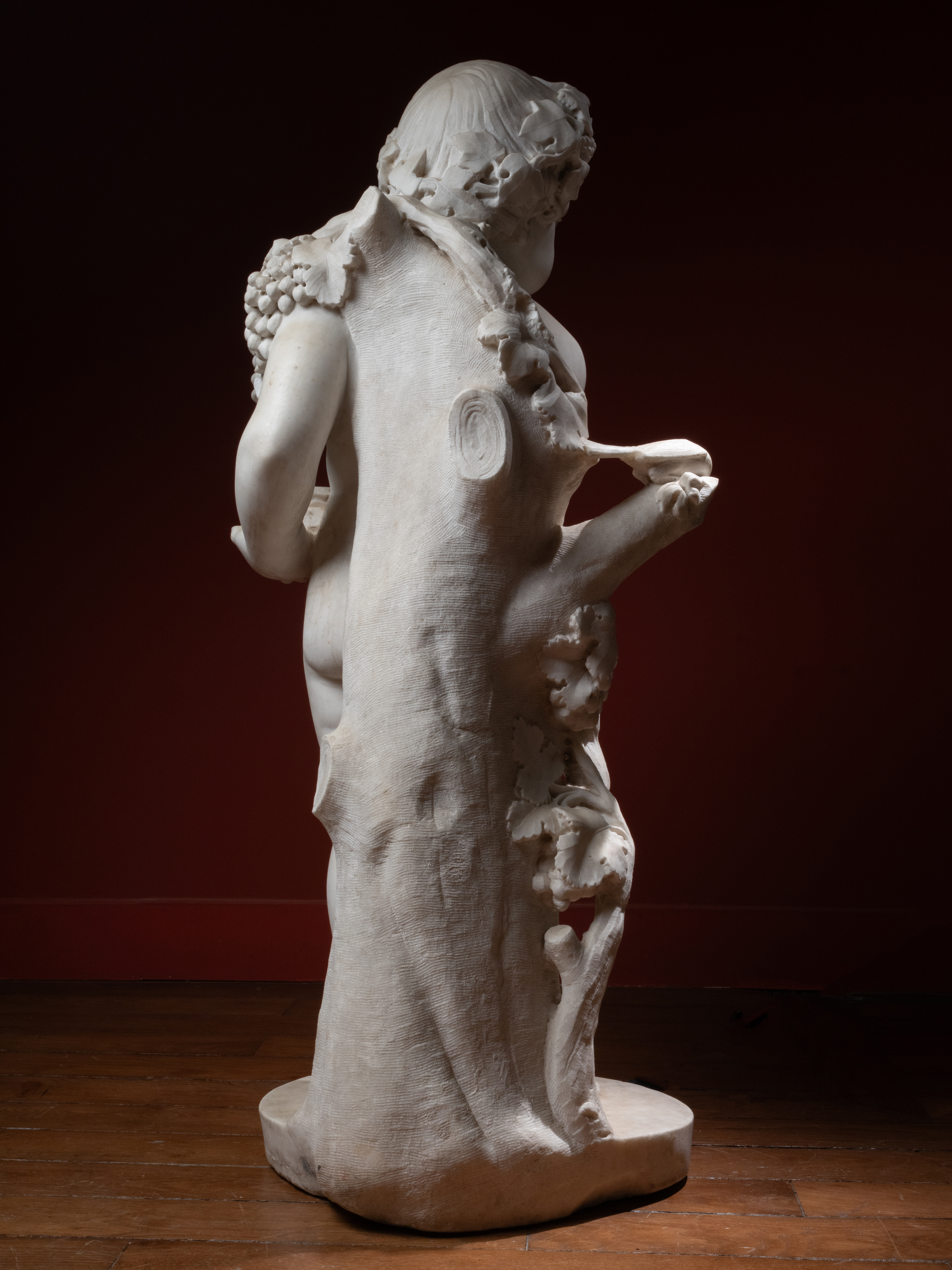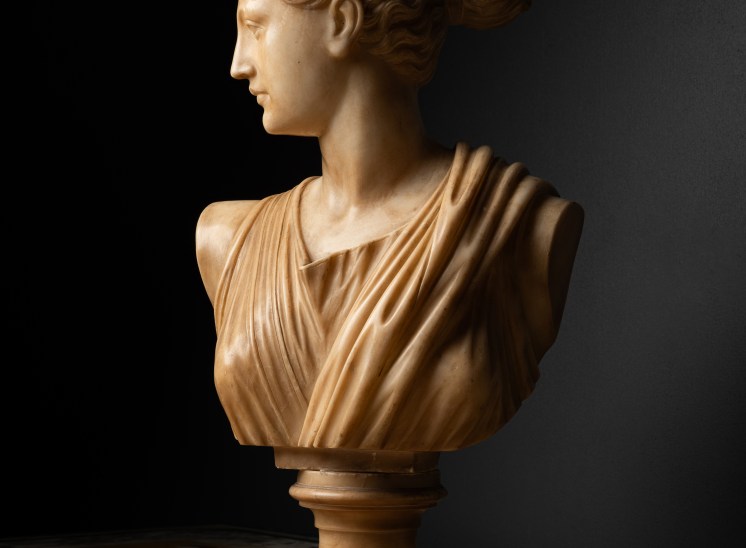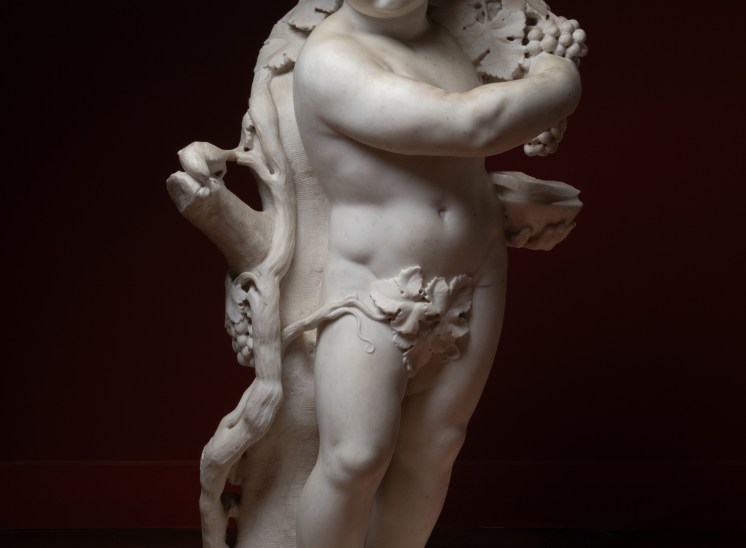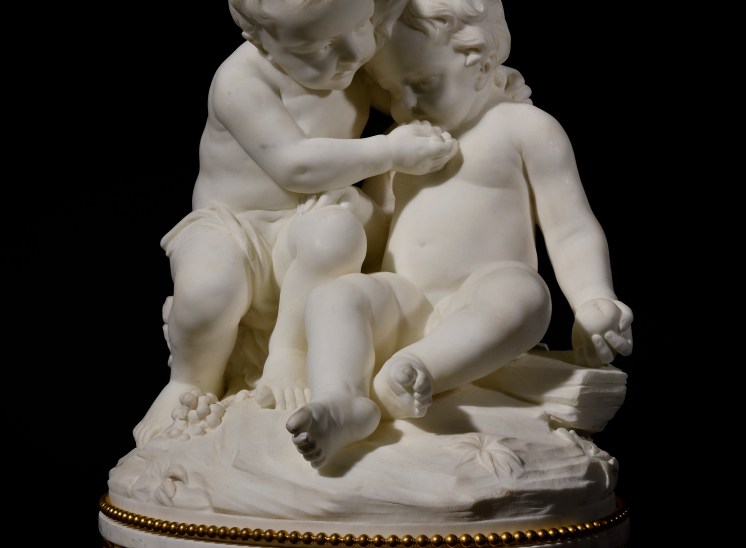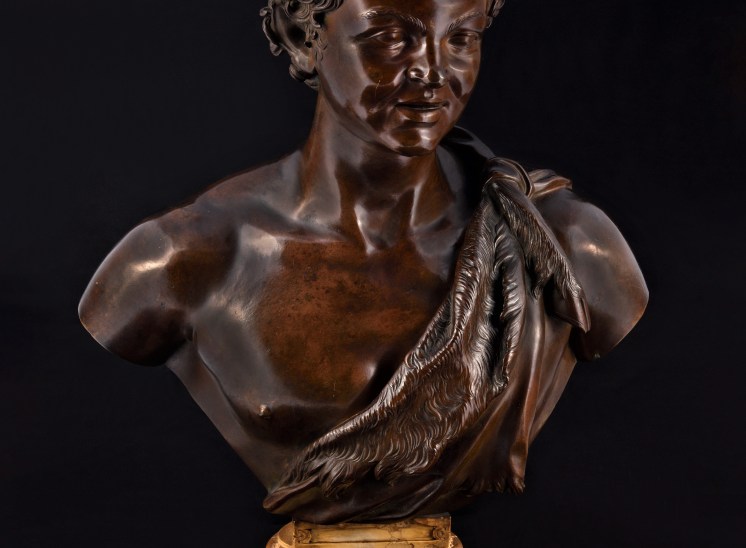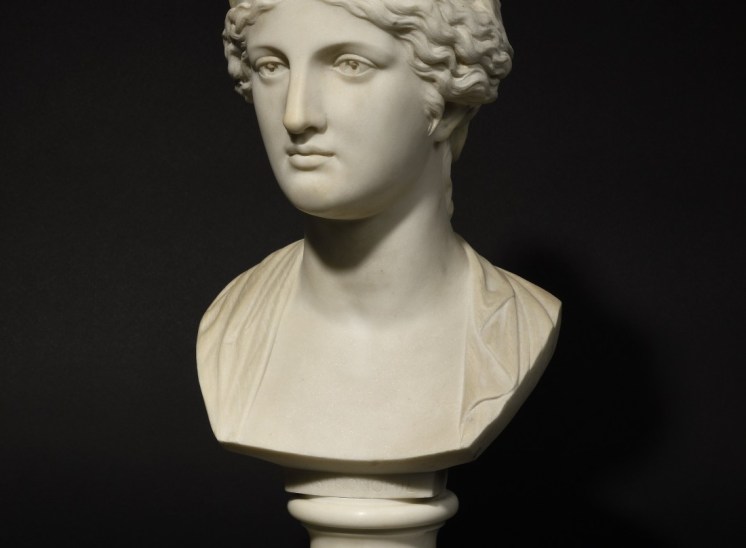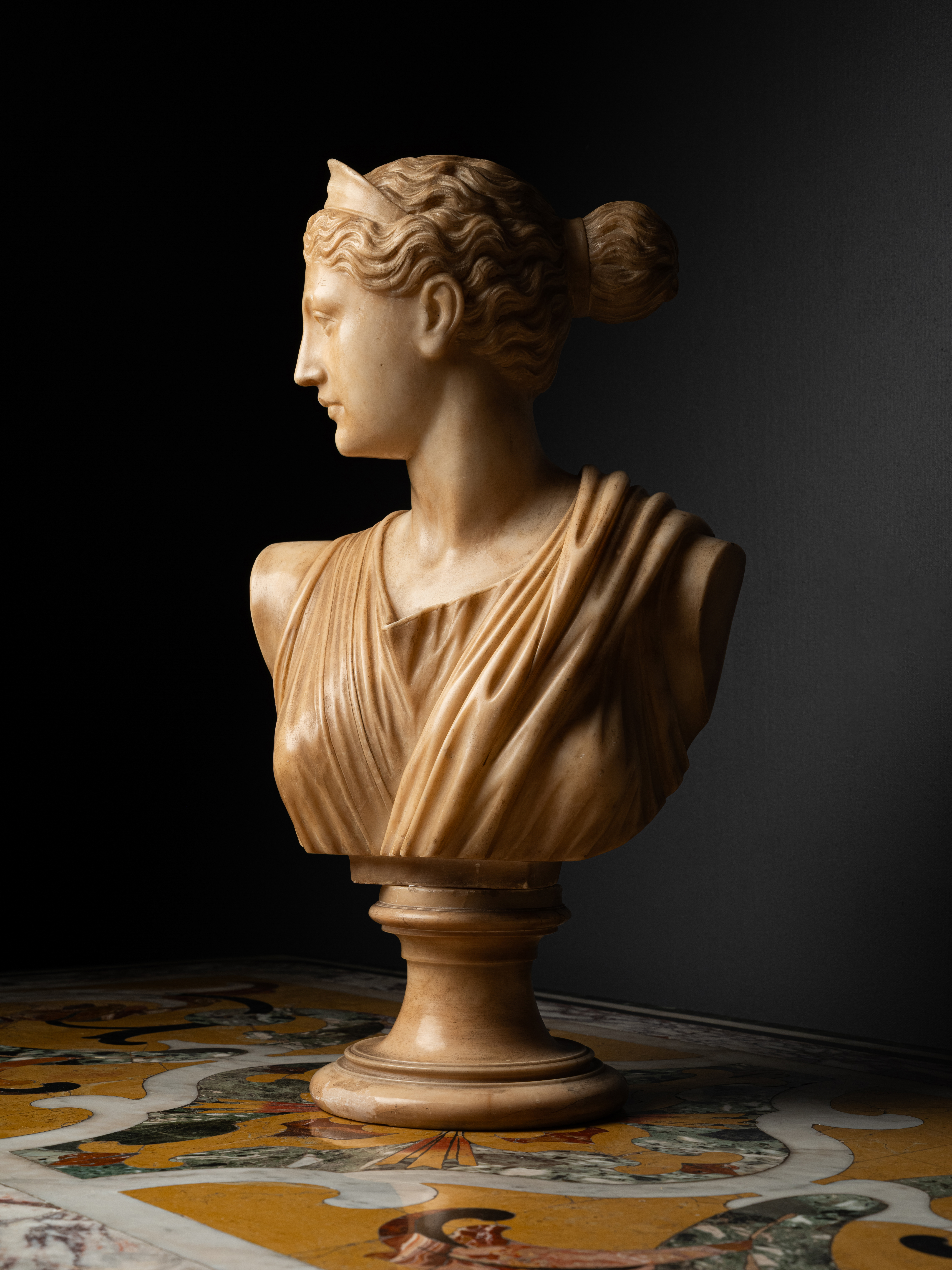

Allegory of Autumn by Jan Claudius de Cock.
Marble.
Antwerp.
ca. 1705-1710.
h. 37 in.
This exceptional grapes-and-vines-wearing marble allegory of Autumn is attributed to Jan Claudius de Cock, a Flemish sculptor and draughtsman born in 1667. Greatly influenced by François Duquesnoy, Jan Claudius, a member of the Antwerp Guild of Saint Luke ca. 1688-1689, specialised in small marble and terracotta figures of children, mostly representing allegories of virtues, lands, elements or seasons.
Rijksmuseum's Allegory of Africa (1704) is the earliest known marble of this kind, followed by a War Crowning Peace (1710) whose terracotta is now at the Stedelijk Museum in Breda. Notably, a pair of terracotta figures depicting Air and Fire, dated ca. 1705, one of which shows the same gesture as the present marble. Jan Claudius’ terracotta sculptures were typically prototypes, studies, concetti meant to be an early step of his creative process. Yet the marble figures for which these two terracotta are unrecorded and it is uncertain whether they were ever turned to marble.
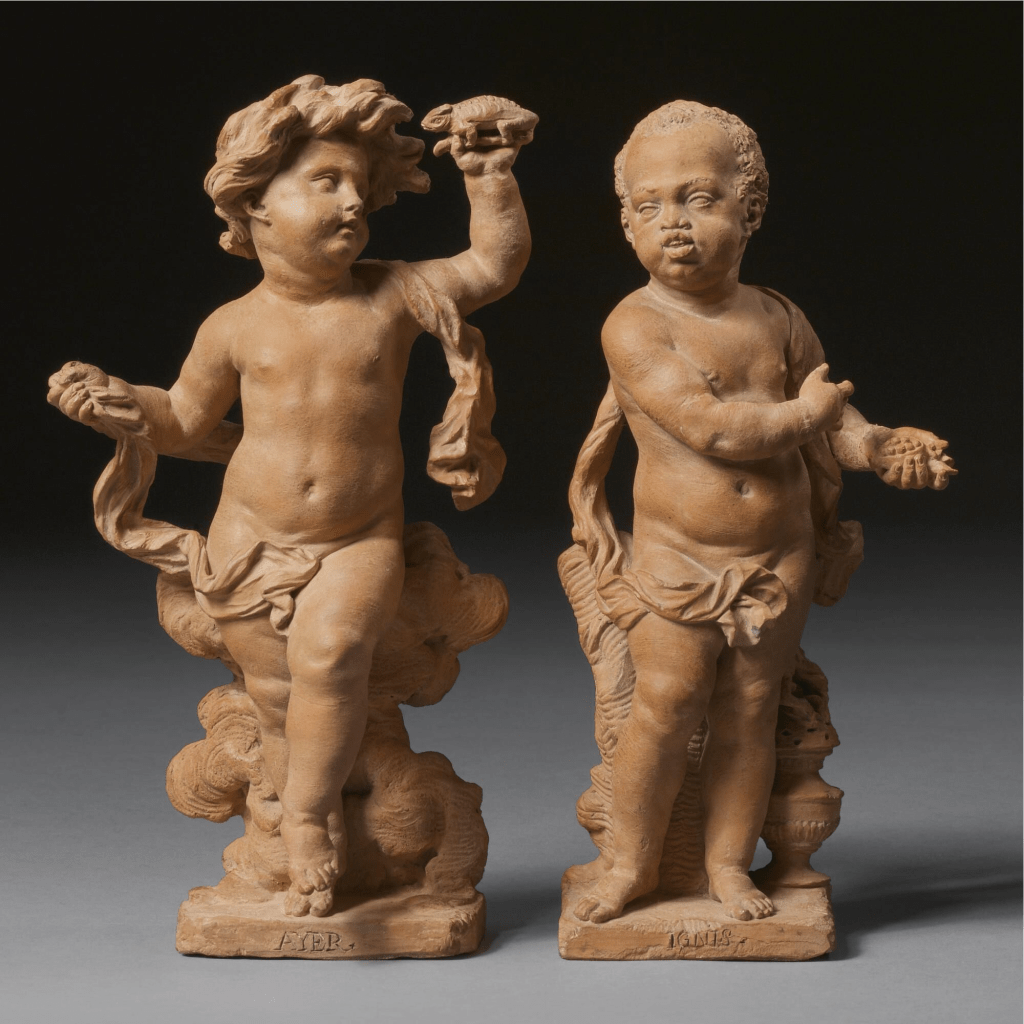
It is plausible that the terracotta models were repurposed, with Jan Claudius adapting the composition of Fire for another commission, or using some elements for another project. In doing so, he retained the tree trunk as a structural component of the contrapposto and turned the pomegranate into a bowl to contain the wine.
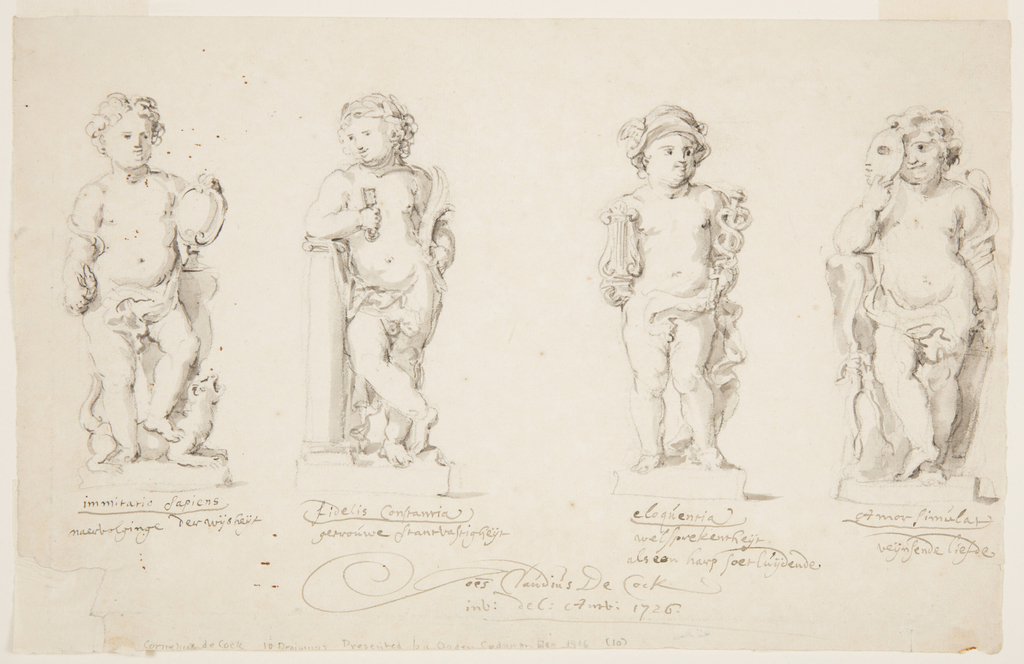
A distinctive feature of Jan Claudius’ work is the streak-like motifs as a naturalist way to render the texture of wood bark. While these are merely suggested in the terracotta model of Fire, they are rendered in exceptional detail in our marble sculpture. This stylistic trait also appears in his engravings and drawings, such as the Metropolitan Museum’s Allegory of Sculpture (1704).

Jan Claudius’ early sculptures were typically created for grand decorative schemes, often as components of monuments commissioned for princes and nobles. By the 1720s, however, he also turned to larger, life-sized and more traditional sculptures for altarpieces, such as Saints James and Peter for the Meurs monument (ca. 1723) and stone figures for a Calvary at Saint Paul’s Church in Antwerp (ca. 1734).
The technical, stylistic, and contextual elements provide compelling evidence for attributing this Allegory of Autumn to Jan Claudius de Cock, created during his 1705–1710 period.
Sources
P. Verhaegen, ‘Un groupe en marbre du sculpteur De Cock’, in Annales de la société royale d'archéologie de Bruxelles, Bruxelles, 1898 ; J. Leeuwenberg and W. Halsema-Kubes, Beeldhouwkunst in het Rijksmuseum, Amsterdam 1973 ; E. Dhanens, R. De Roo and al., La Sculpture au siècle de Rubens dans les Pays-Bas méridionaux et la principauté de Liège, Bruxelles, 1977 ; T. Clifford, Scultura II, London, 2009.