View of the Garden of the Borghese Villa, by Fleury Épinat
View of the Garden of the Borghese Villa, by Fleury Épinat
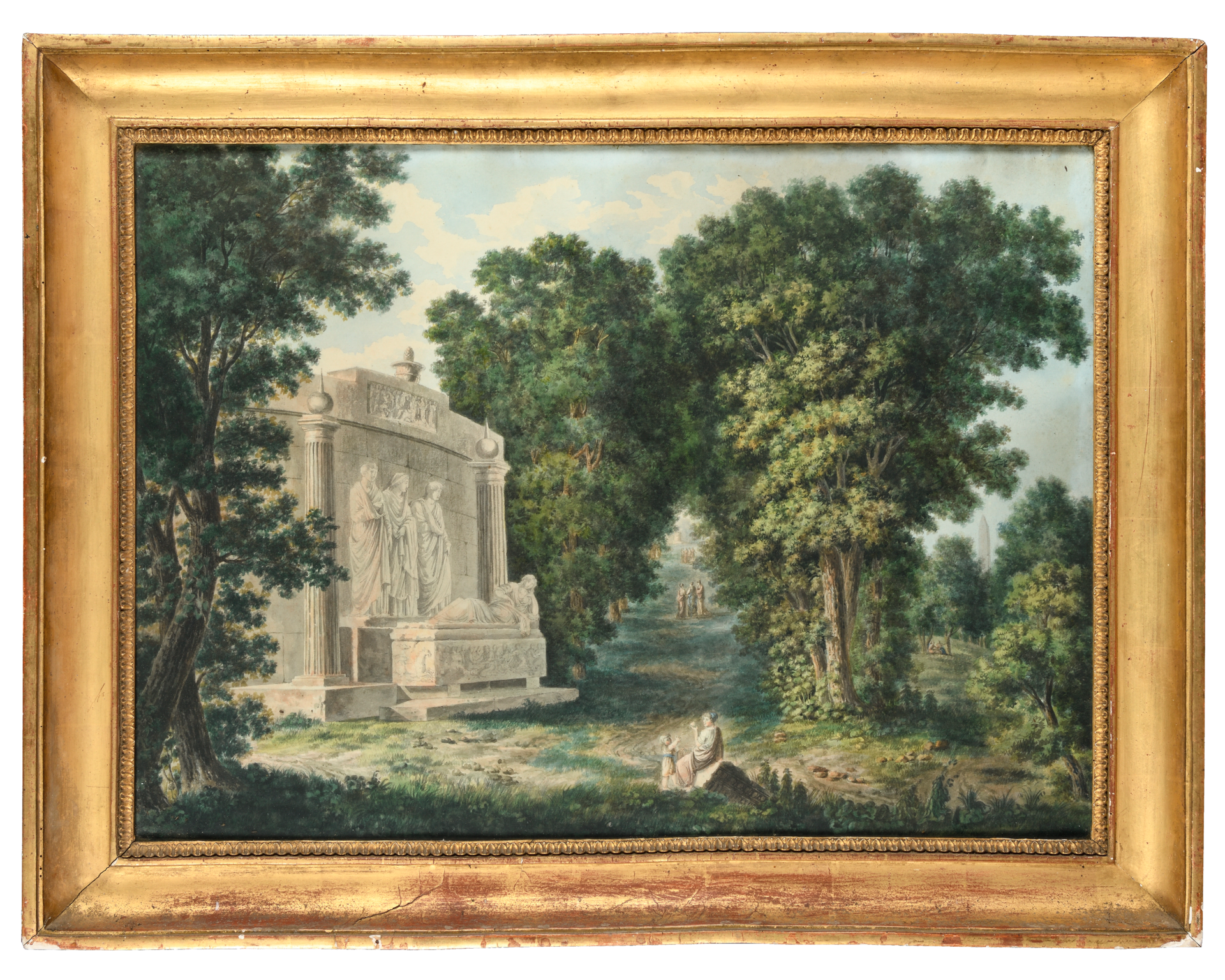
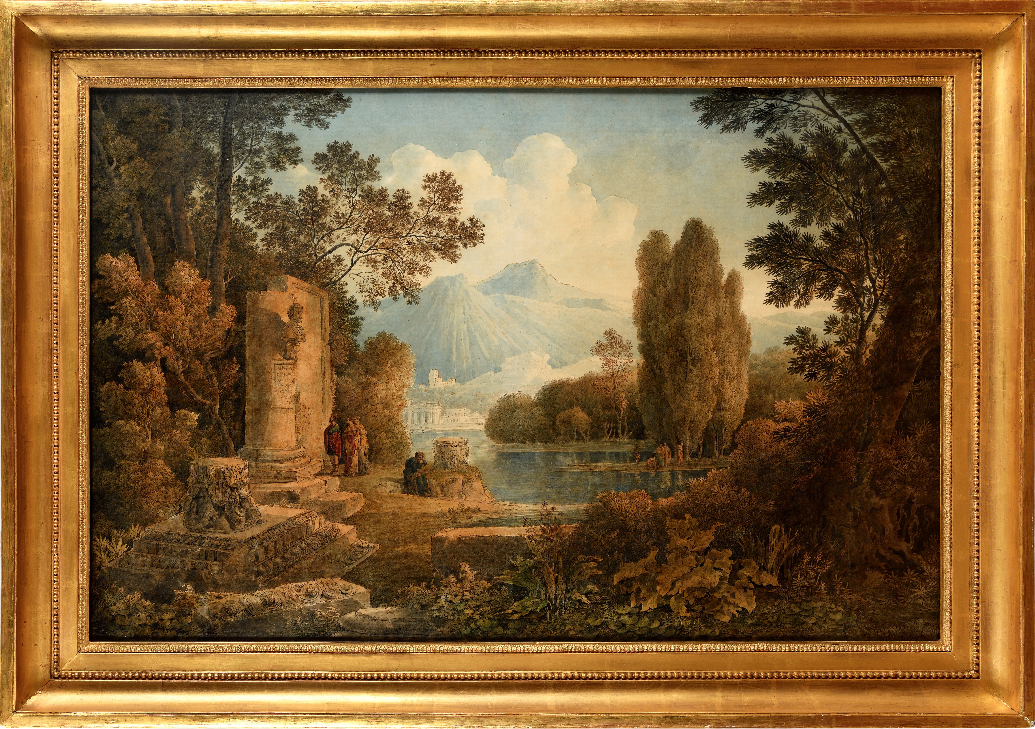
View of the Garden of the Borghese Villa, by Fleury Épinat Watercolour on paper Rome ca. 1787 62,5 x 81 ( x 31.9 in., with accessories)
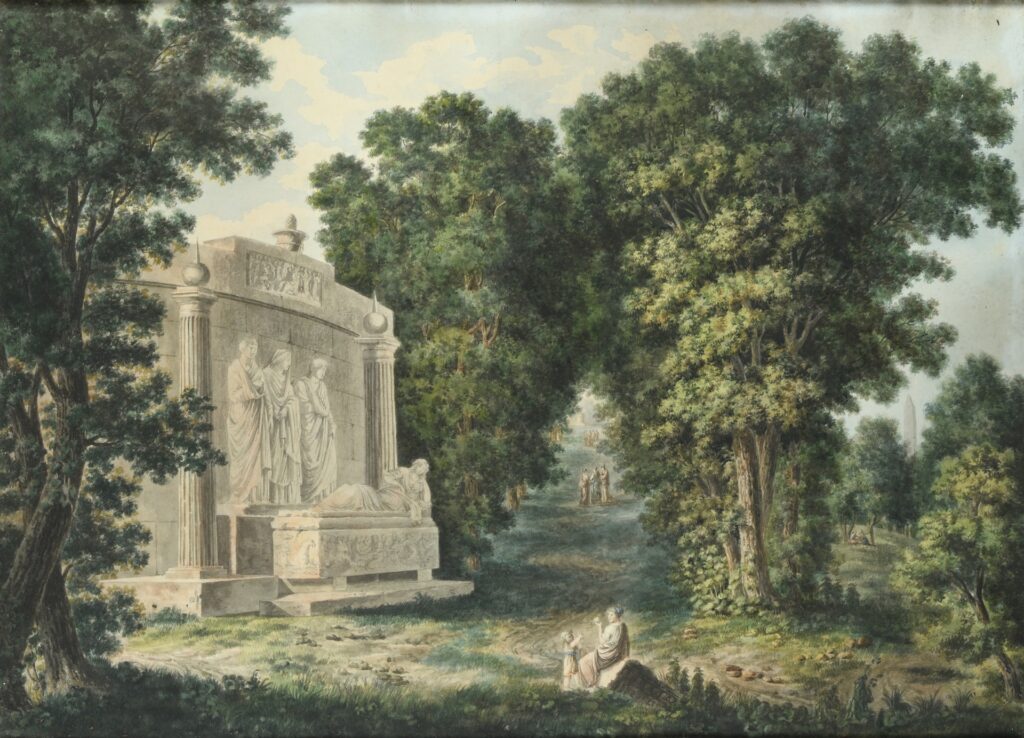
The exact setting of this veduta, showing the semicircular wall of the Grottone dei Leoni near the Giardino del Lago at the Borghese Villa, can be identified thanks to three antiquities recorded by the artist: a funerary group portrait (inv. CLXXXVIII), a sarcophagus with marine thiasos (inv. LXXXVII), and a klinè (inv. CLXXXVII) serving as its cover, all from the Borghese collections. That these three antiquities were together in the gardens is known from a drawing by Charles Percier, in which they are recorded for the first time and which is datable at the earliest to 1786 (Di Gaddo, 1997, p. 118). The antiques were not inventoried in Rooms II and VI of the Palazzo before 1832 (Nibby, 1832, pp. 74, 110 sq.), but is is known that the sarcophagus and the klinè had already left the gardens by 1805, for a drawing of the same location by Bolognese painter Antonio Basoli, who was in Rome that year, shows the group portrait still in place, flanked by the same, though slightly altered, fluted columns, but neither the sarcophagus nor the klinè (Riccomini, 2007, pp. 169–172).
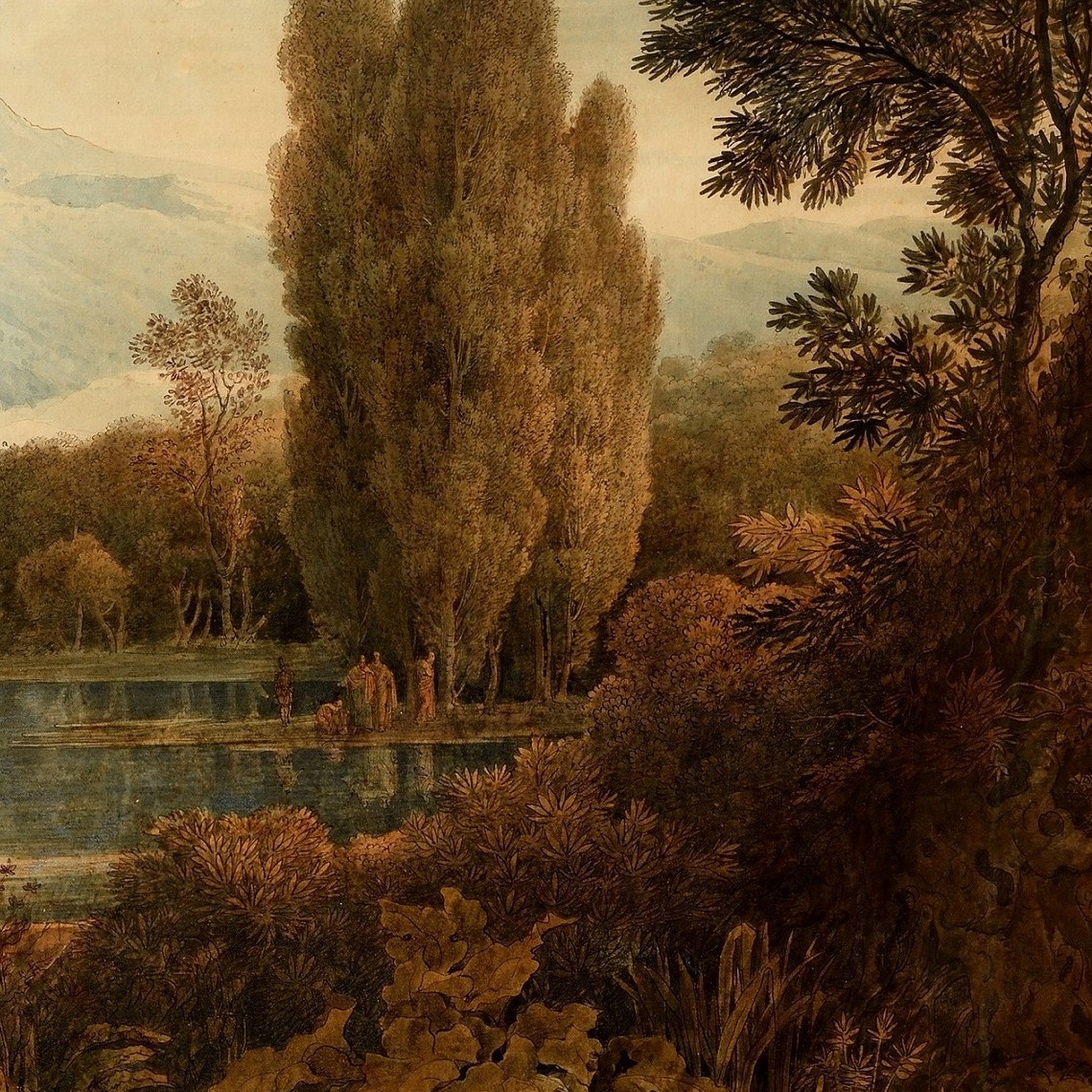
The provenance of the watercolour, that is the Château de Busset, situates it within a collection of sketches, drawings, and watercolours — Lyonnais for the most part, either by school or subject matter, several of which are the same hand as the present work, and share a certain handling of foliage and undergrowth, built up in accumulated triangular strokes, with a number of sheets signed by Fleury Épinat (1764–1830), a Davidian who followed his master to Rome in 1784 not to come back to France before 1800 (Vingtrinier, 1854, p. 4). Épinat was close to the fellow Lyonnais and Davidian Philippe-Auguste Hennequin who, having likewise followed David to Rome, refers in his mémoires to several visits with Épinat, circa 1787, to “the galleries, the ruins and the environs of Rome” where they “drew the landscape together” (Hennequin, 1933, p. 99), including one particular visit to the “Cardinal’s garden”, that is, the gardens of the Villa Borghese (ibid., p. 100).
The watercolour, under antique glass, is in its period frame, which has warped slightly.
Literature
See Antonio Nibby, Monumenti scelti della Villa Borghese, Rome 1832, Aimé Vingtrinier, Biographie des artistes lyonnais, vol. I, Lyon, 1854, Beata di Gaddo, L’architettura di Villa Borghese. Dal giardino privato al parco publicco, Rome, 1997 and “‘Un vero Paradiso Terestre’: il Parco di Villa Borghese nei disegni di Antonio Basoli (1805)”, in Prospettiva, n. 126-127, 2007.
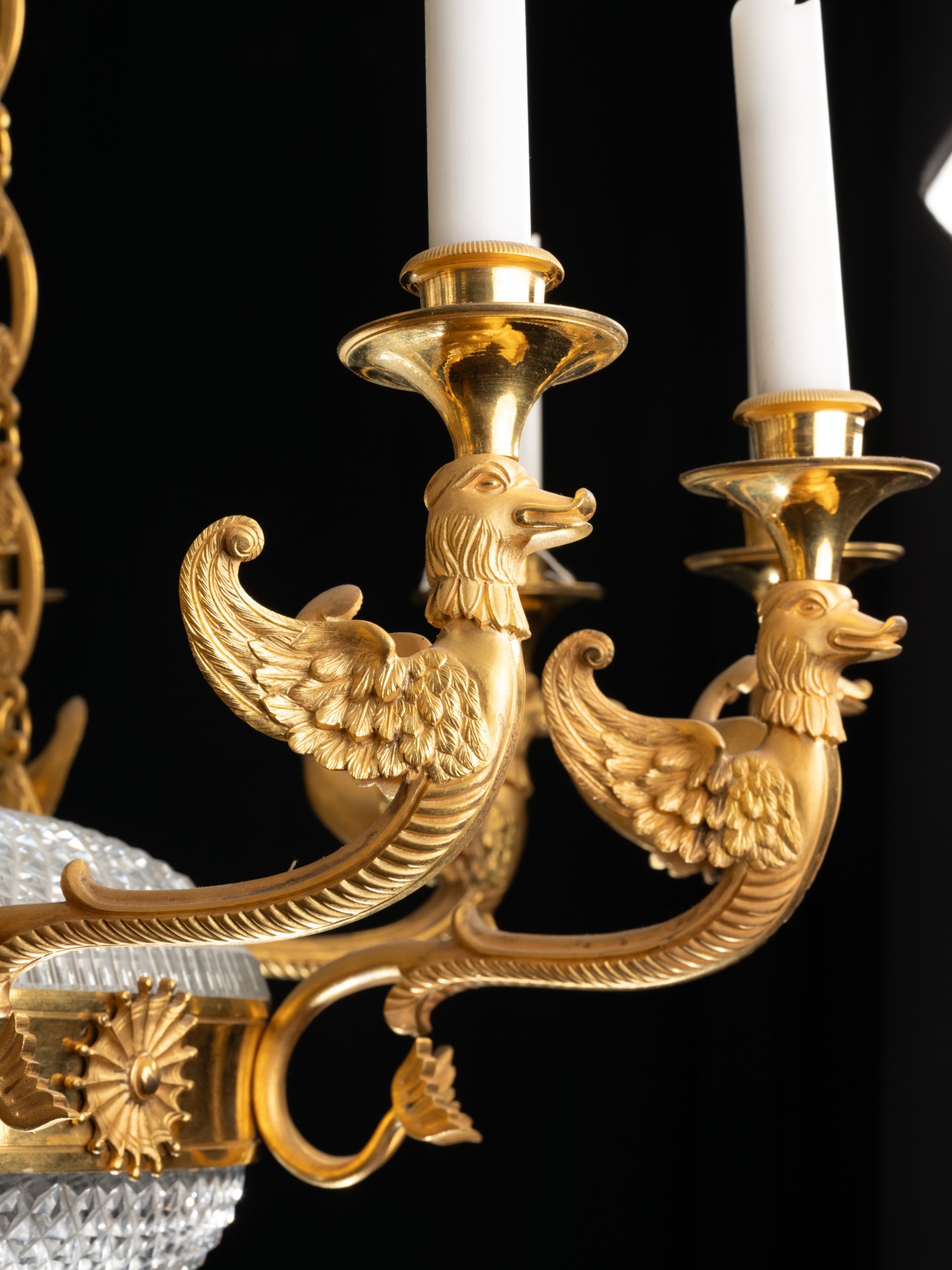
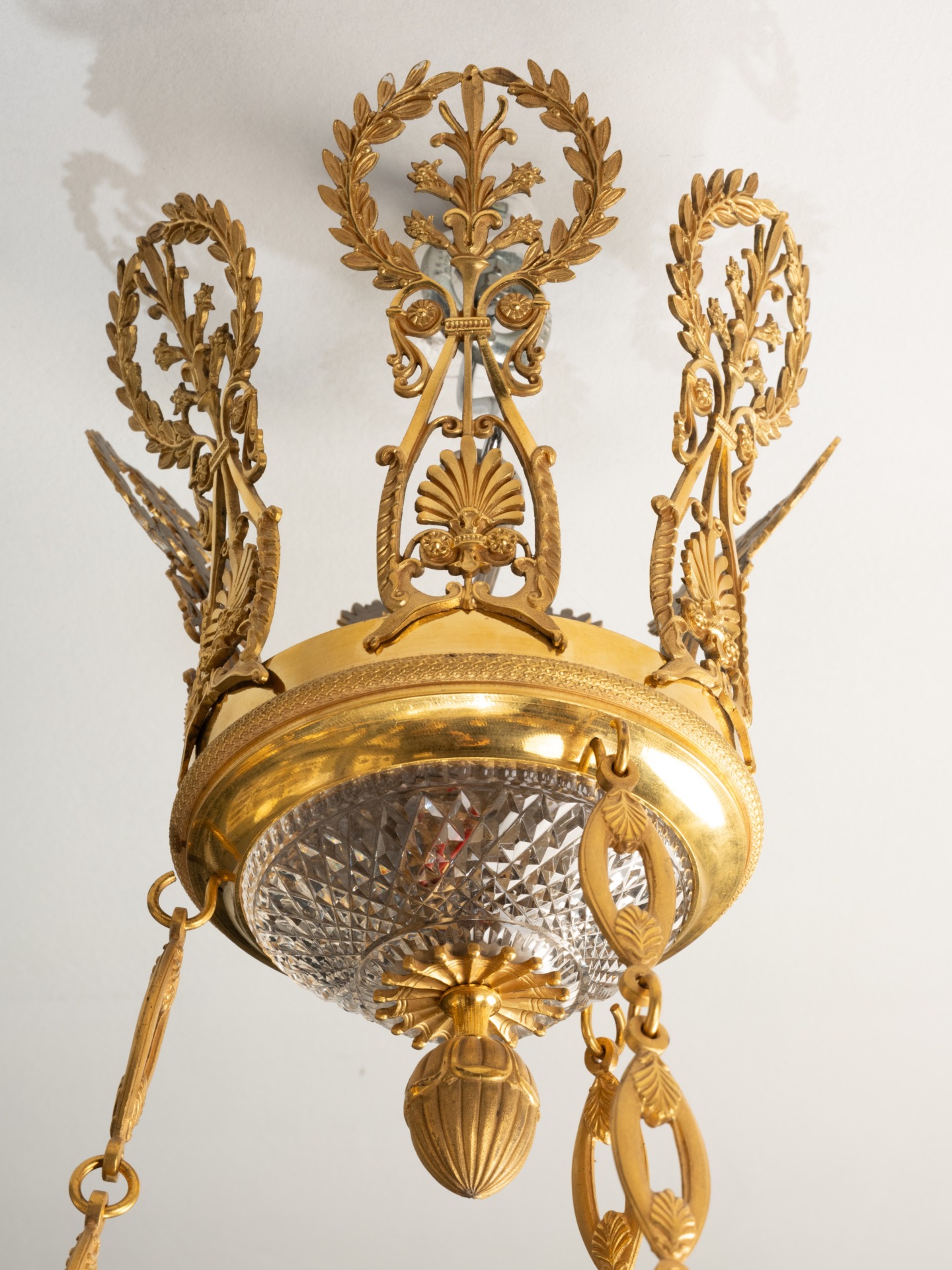
A Russian Empire Cut Crystal Twelve-Light Chandelier
A Russian Empire Cut Crystal Twelve-Light Chandelier
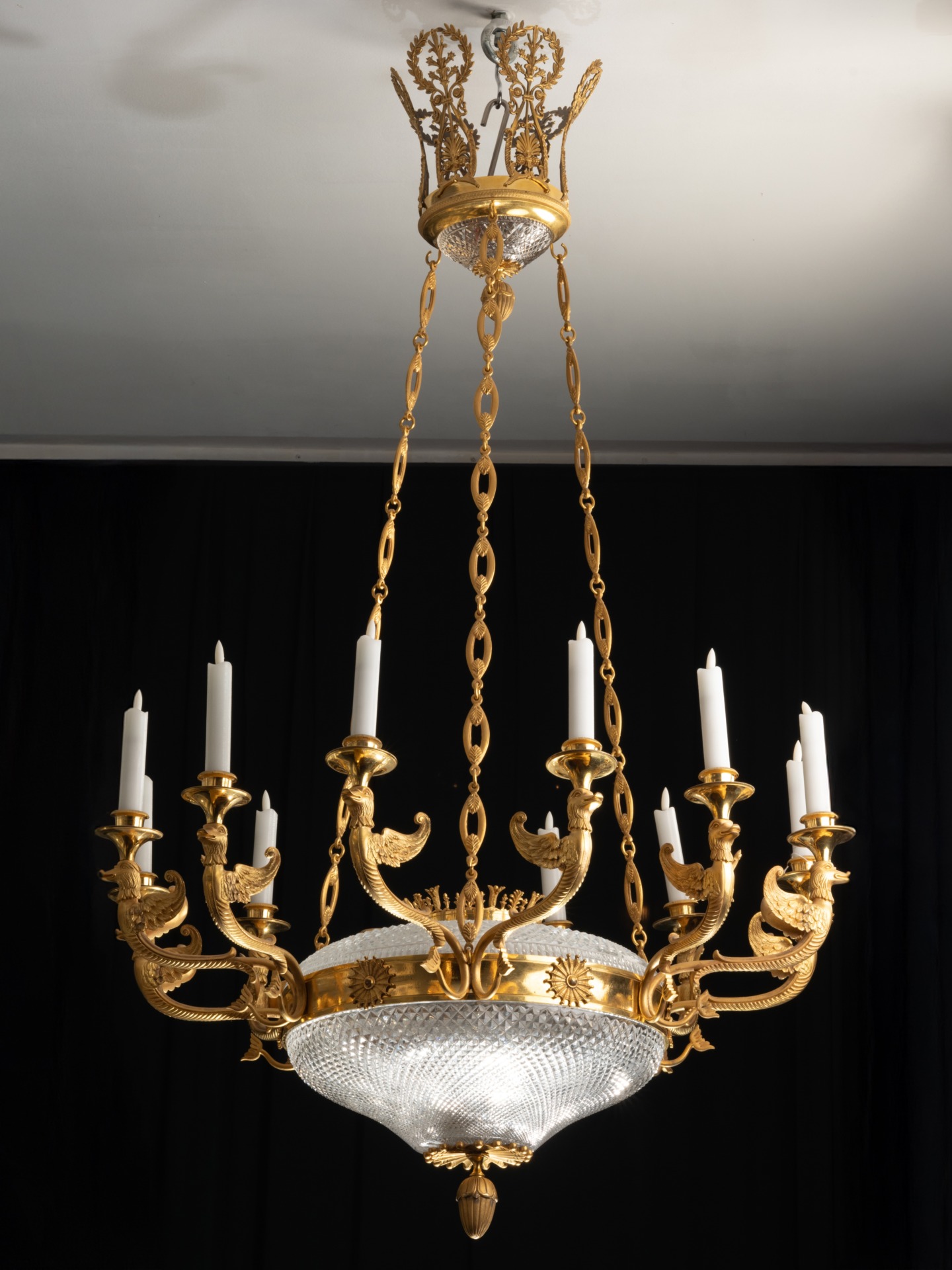
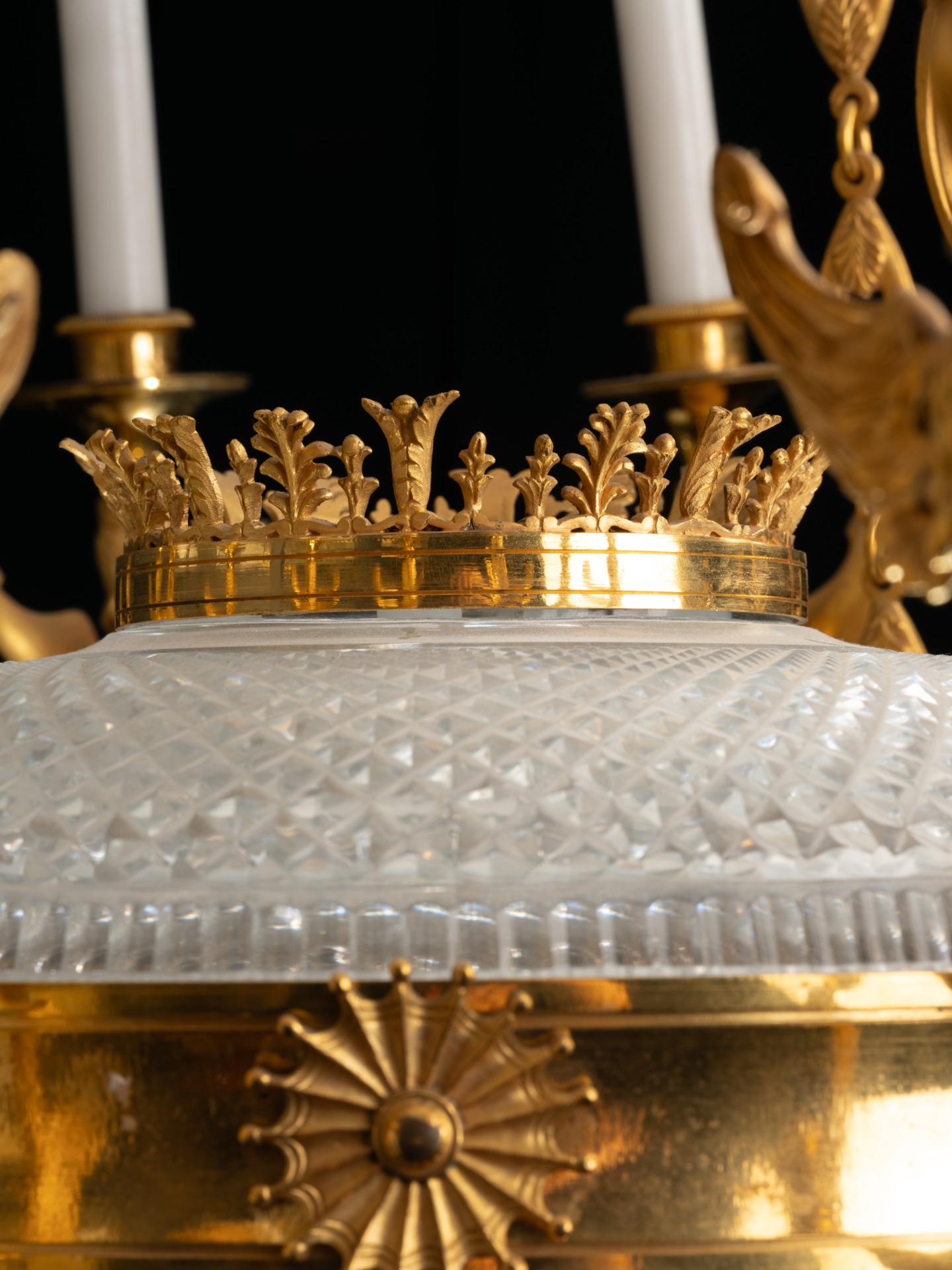
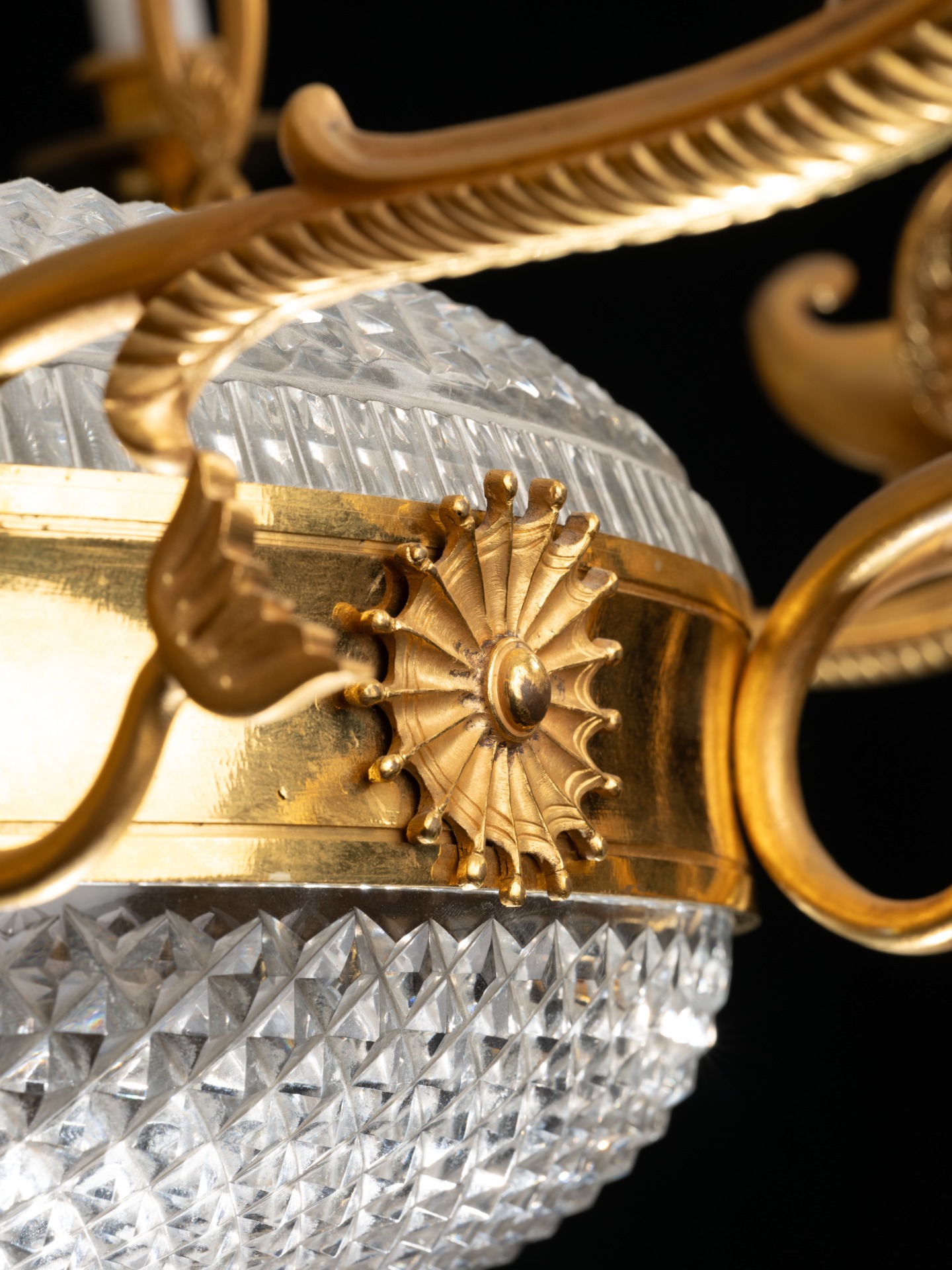
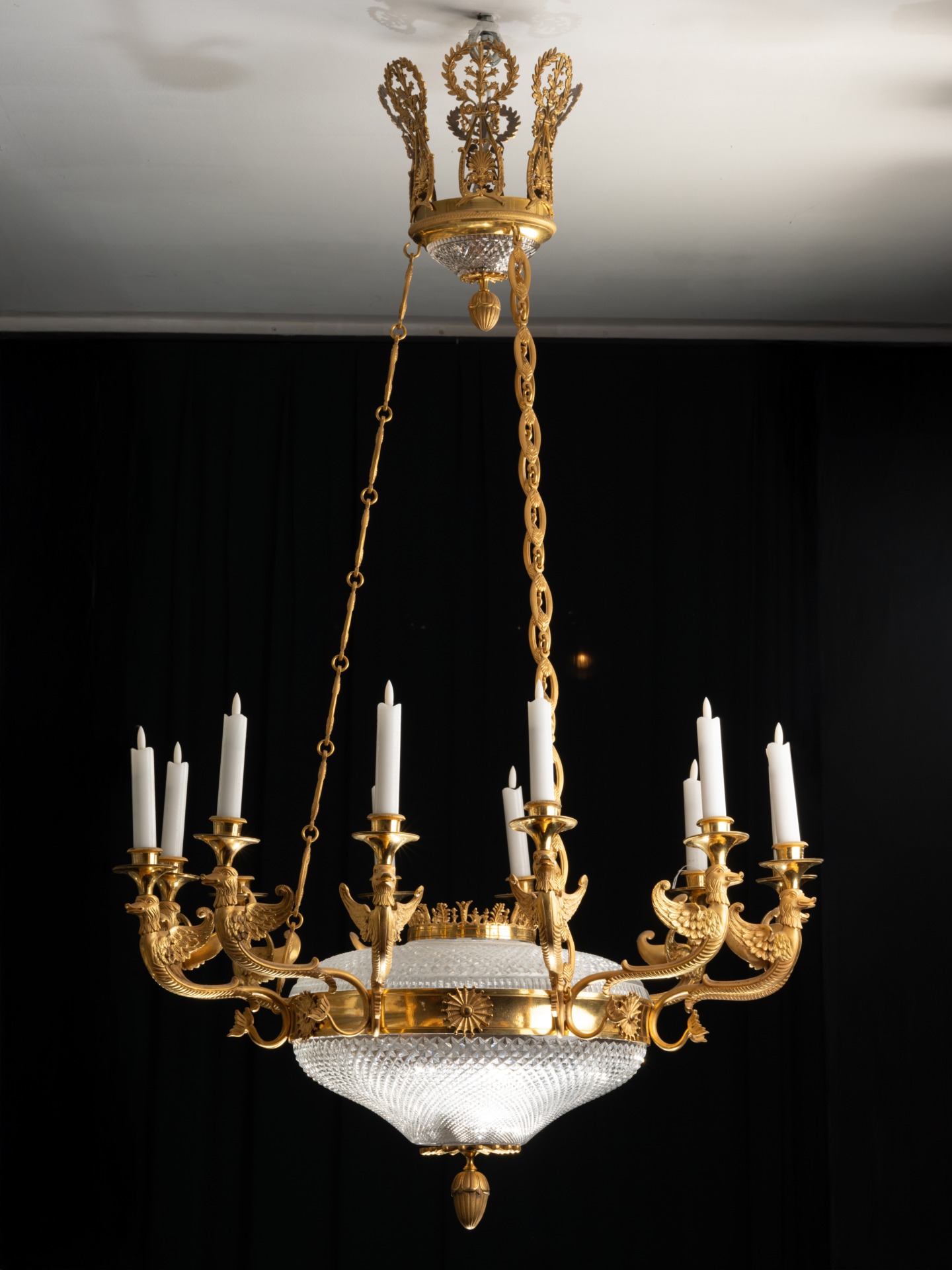
Twelve-light chandelier in gilt bronze and cut crystal Saint Petersburg First quarter of the 19th century 120 x 70 x 70 cm (47.2 x 27.6 x 27.6 in.)
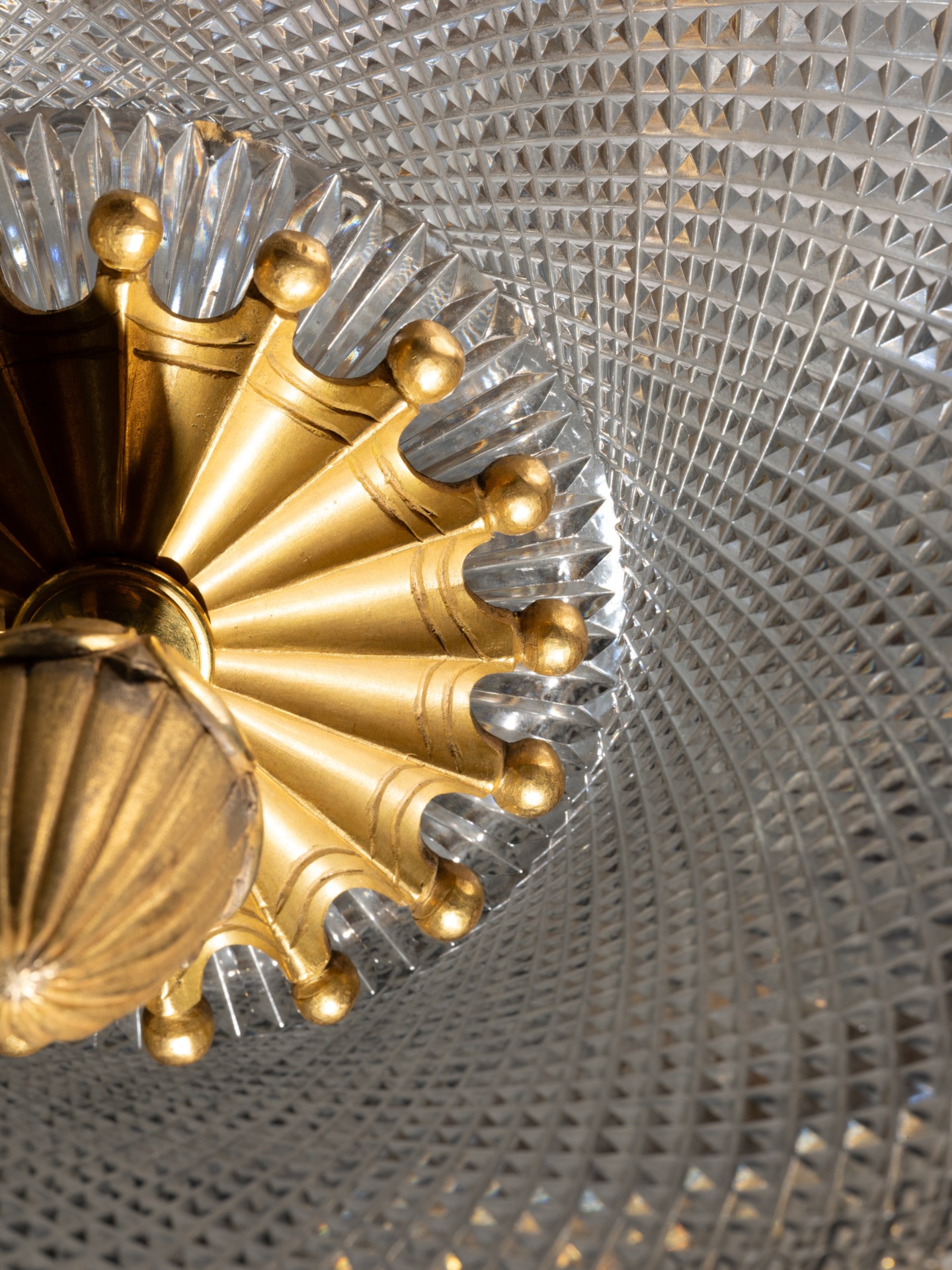
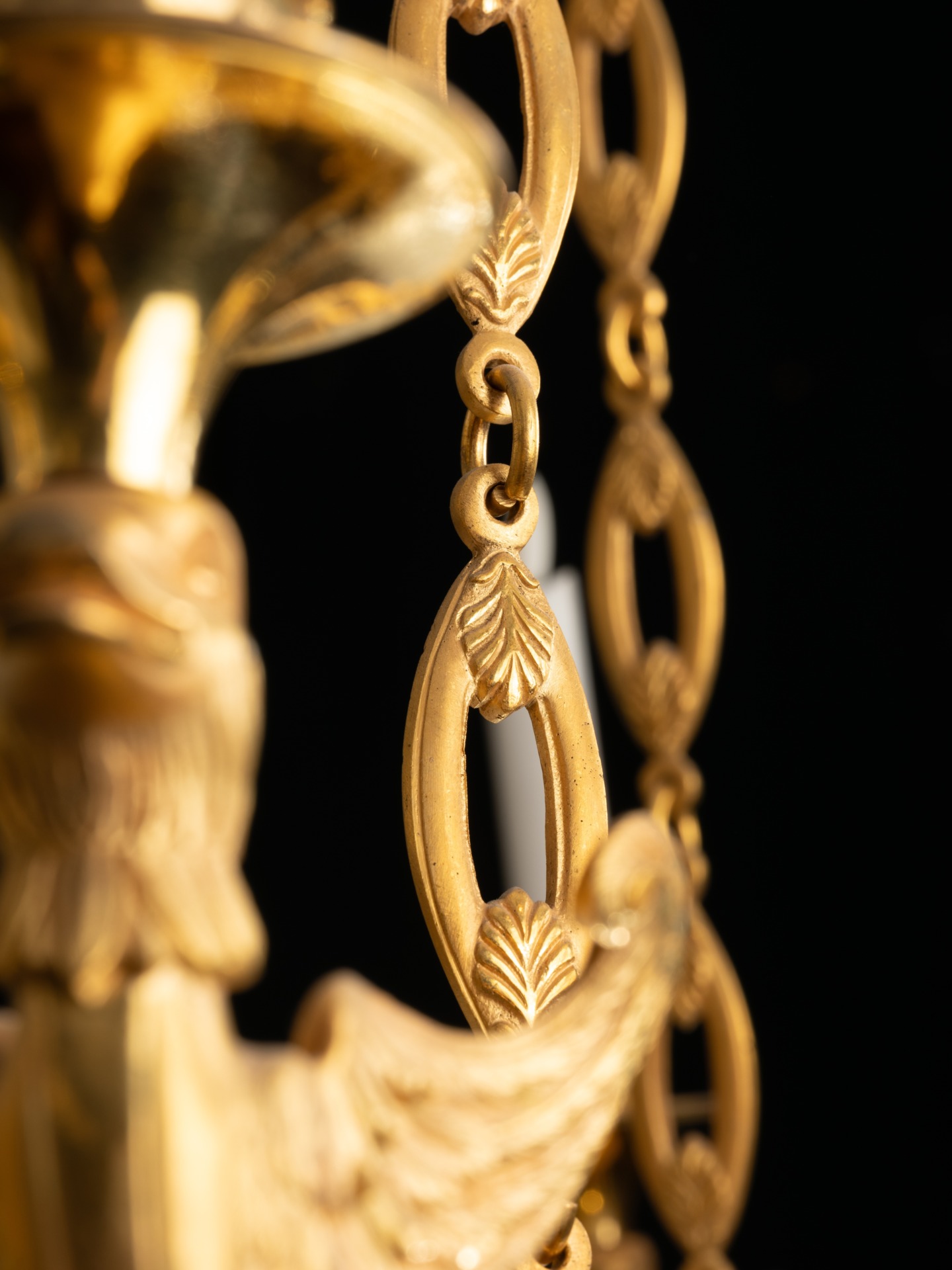
A Russian twelve-light chandelier, in mercury gilt-bronze and cut crystal, surmounted by a crown of scrolls, foliage, anthemia, and laurels finished with a cut-crystal pendant with diamond cut patterns and a pinecone finial, supporting, by three gilt-bronze chains chased with palms, a covered crystal core in the same diamond cut crystal and decorated with bronze rosettes, from which twelve arms spring in the form of swan protomai on whose heads are screwed the drip pans and candleholders. The lower part of the crystal core ends in a gracefully gable terminated with a bronze rosette and a chased pinecone finial. No missing elements. Neither drilled nor fitted for electrification. The crystal body is featured with a bronze cover, concealed beneath a small foliage crown, allowing for an addition as a central shaft.
Literature
Similar chandeliers are documented by Sychev, The Russian Chandeliers. 1760-1830, Saint Petersburg, 2003. For comparable examples of cut crystal by the Saint Petersburg Manufacture, see Asharina et al., Russian Glass of the 17th-20th Centuries, New York, 1990.
The Triumph of Bacchus, by Michelangelo Maestri
The Triumph of Bacchus, by Michelangelo Maestri
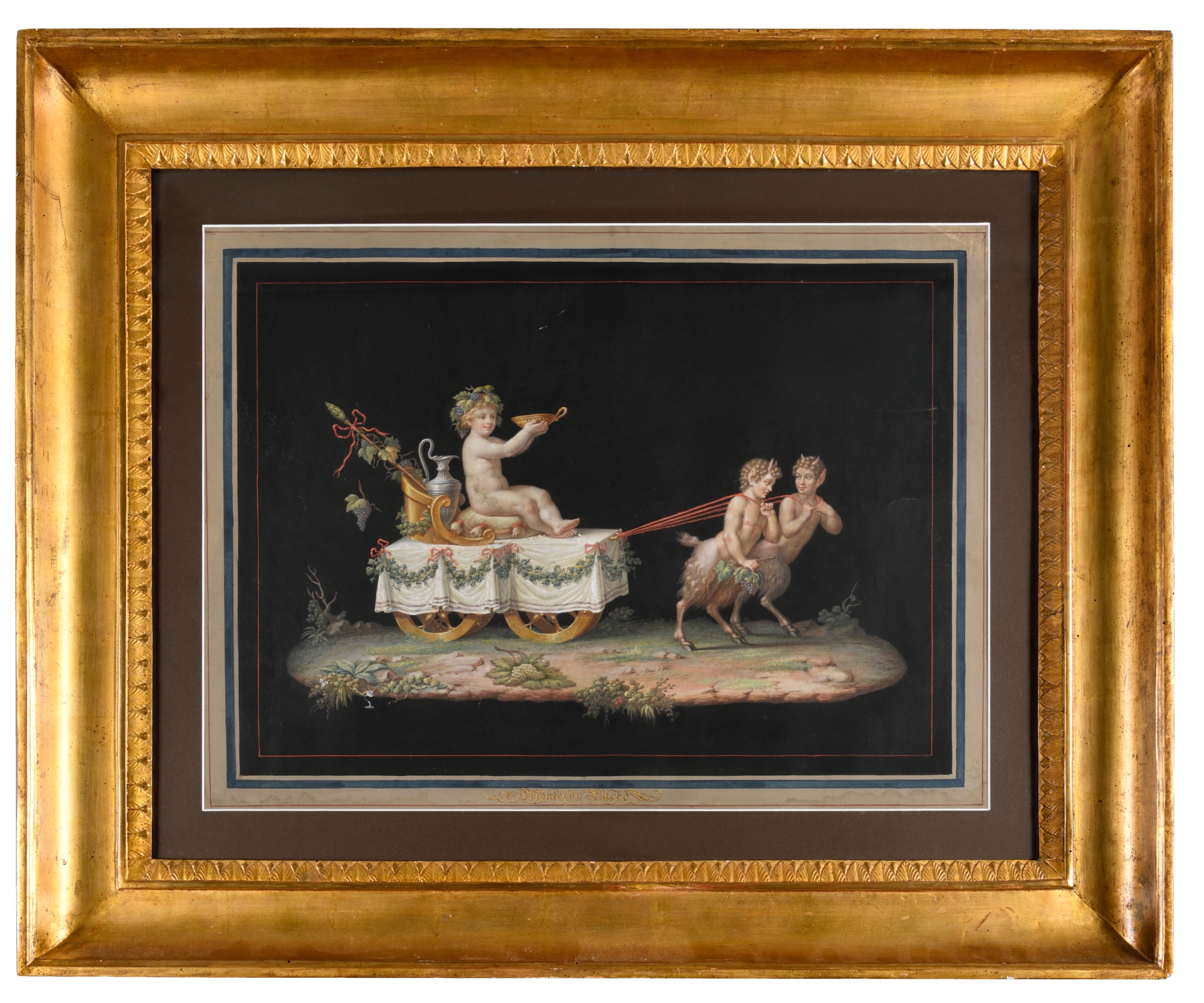
Gouache on paper Rome Before 1812 70,5 x 84,5 cm (27.75 x 33.3 in.)
The compositions of the Italian painter Michelangelo Maestri are taken from the frescoes discovered in Pompeii and Herculaneum during the 18th century and from the decorations imagined by Raphael and his pupil Giulio Romano for the great Roman palaces of the Renaissance.
Maestri’s gouaches were popular with aristocrats making their Grand Tour of Italy. Thanks to their high quality of execution on the one hand, and because they were based on the great mythological themes known since the Renaissance on the other.
In this case, this gouache represents the chariot of Bacchus pulled by two fauns. The original fresco was first painted for the Villa Lante in Rome around 1520 by Giulio Romano, before being moved to the Palazzo Zuccaro in Rome, where it is currently located.
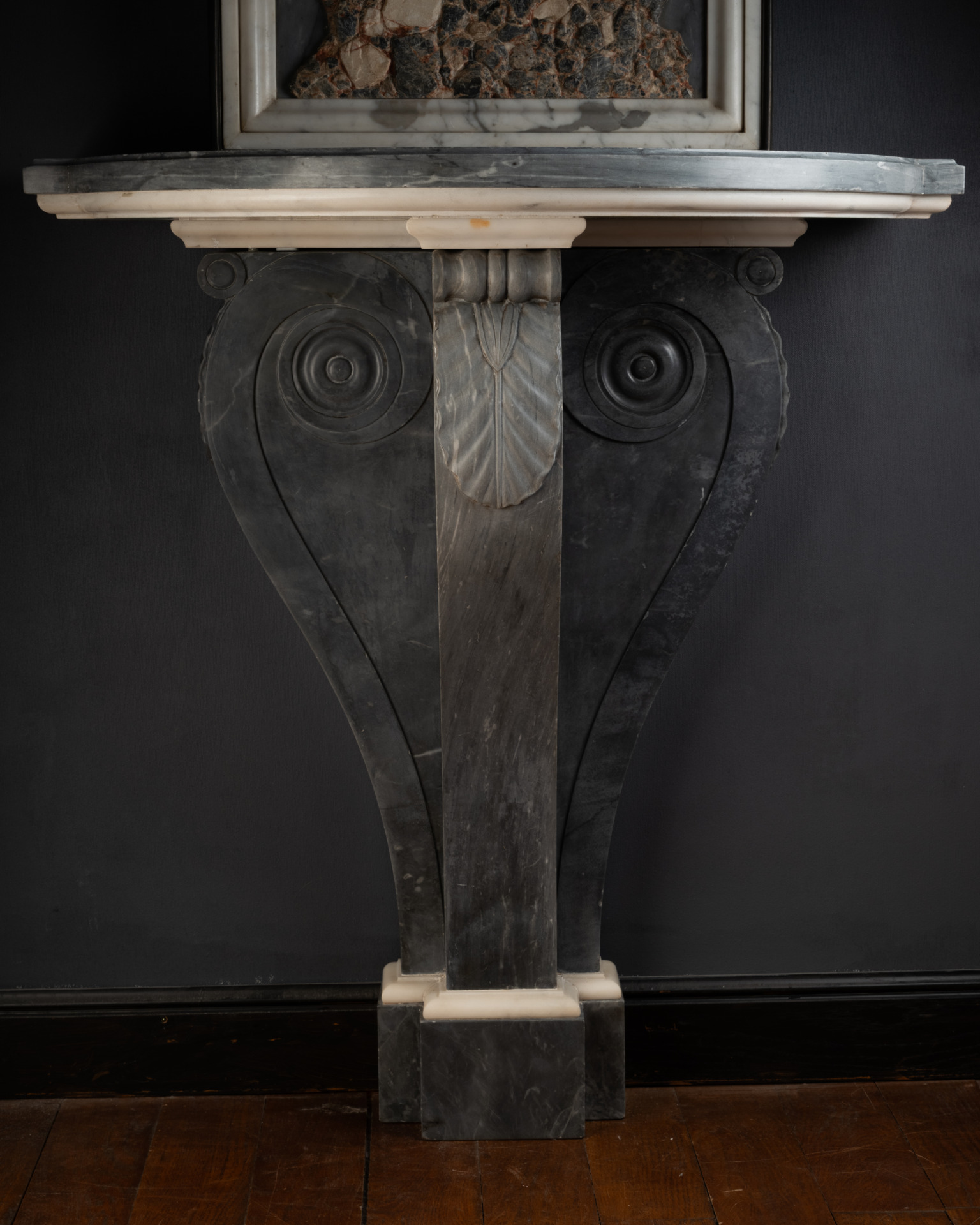
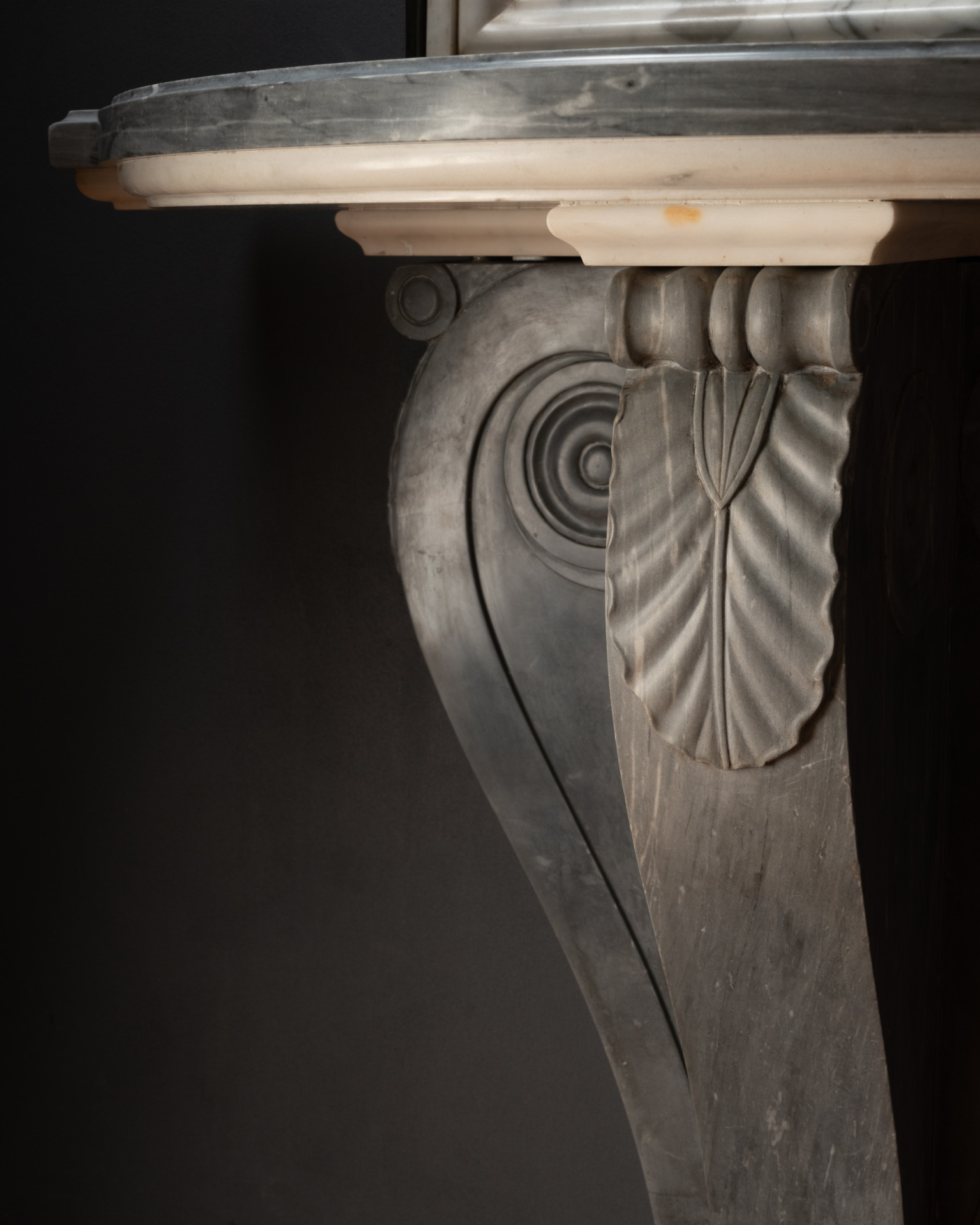
A Demi-lune Console In Bleu Turquin And White Carrara Marbles
A Demi-Lune Console in Bleu Turquin and White Carrara Marbles
Bleu turquin or bardiglio and white Carrara marble Italy Early 19th century 90,5 x 80 x 40 cm (35.4 × 31.5 × 15.75 in.) Provenance: collection of Victor Théophile Magnien, Paris, ca. 1900; his apartment, Paris, Faubourg Saint-Germain, thence by descent
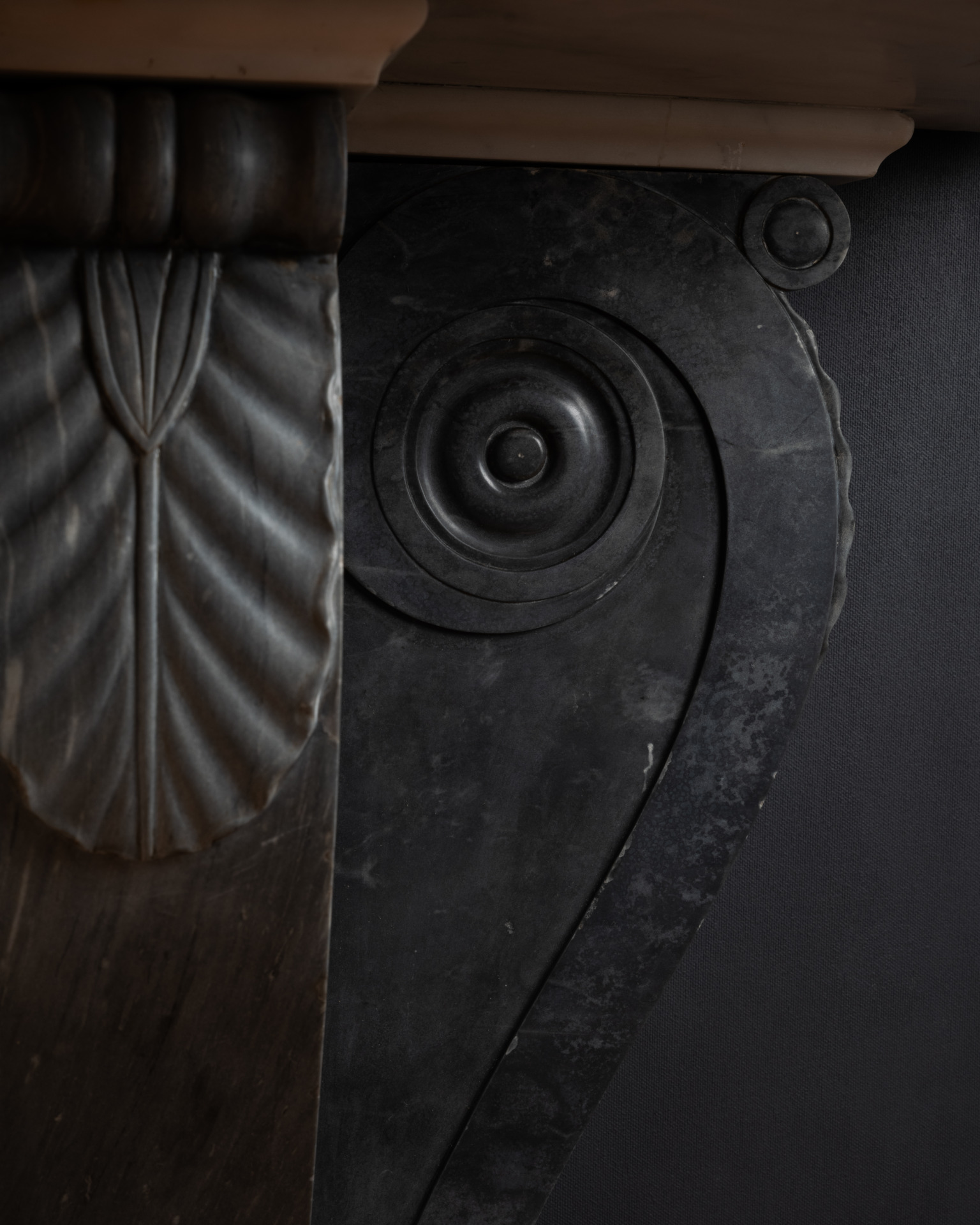
This scroll-leg console table in bleu turquin marble may be compared with a large console carved from the same marble that appeared at Sotheby’s London Stone III sale in 2022, and most likely originating from Ickworth House, a country house designed by Mario Asprucci and built in Suffolk during the first third of the nineteenth century for the 4th Earl of Bristol, whose collections and furnishings were in large part assembled and commissioned in Italy during the Earl’s Grand Tour.
Catalogued at that time as William IV — that is, the final period of the English Regency — the Stone III console shares with the offered piece the same motif of a rippled, veined water leaf adorning the scroll of each leg. The two consoles are distinguished, however, by the claw feet terminating the legs of the London example, and by the white Carrara marble ogee mouldings of the present console. Both pieces nonetheless fall squarely within the English Regency period, which extends from 1783 — the year of then-Prince-of-Wales George IV’s majority and of the remodelling of Carlton House by the architect Henry Holland — to the end of William IV’s reign in 1837, and which corresponds to the introduction and assimilation of neoclassicism into English furniture and interiors.
Archive photographs of the interior from which this demi-lune console originates — in which a large William III mirror and Blue John obelisks were also visible — reveal a discerning interest in English decorative arts of the eighteenth and nineteenth centuries.
Literature
See Steven Parissien, Regency Style, London, 1992.
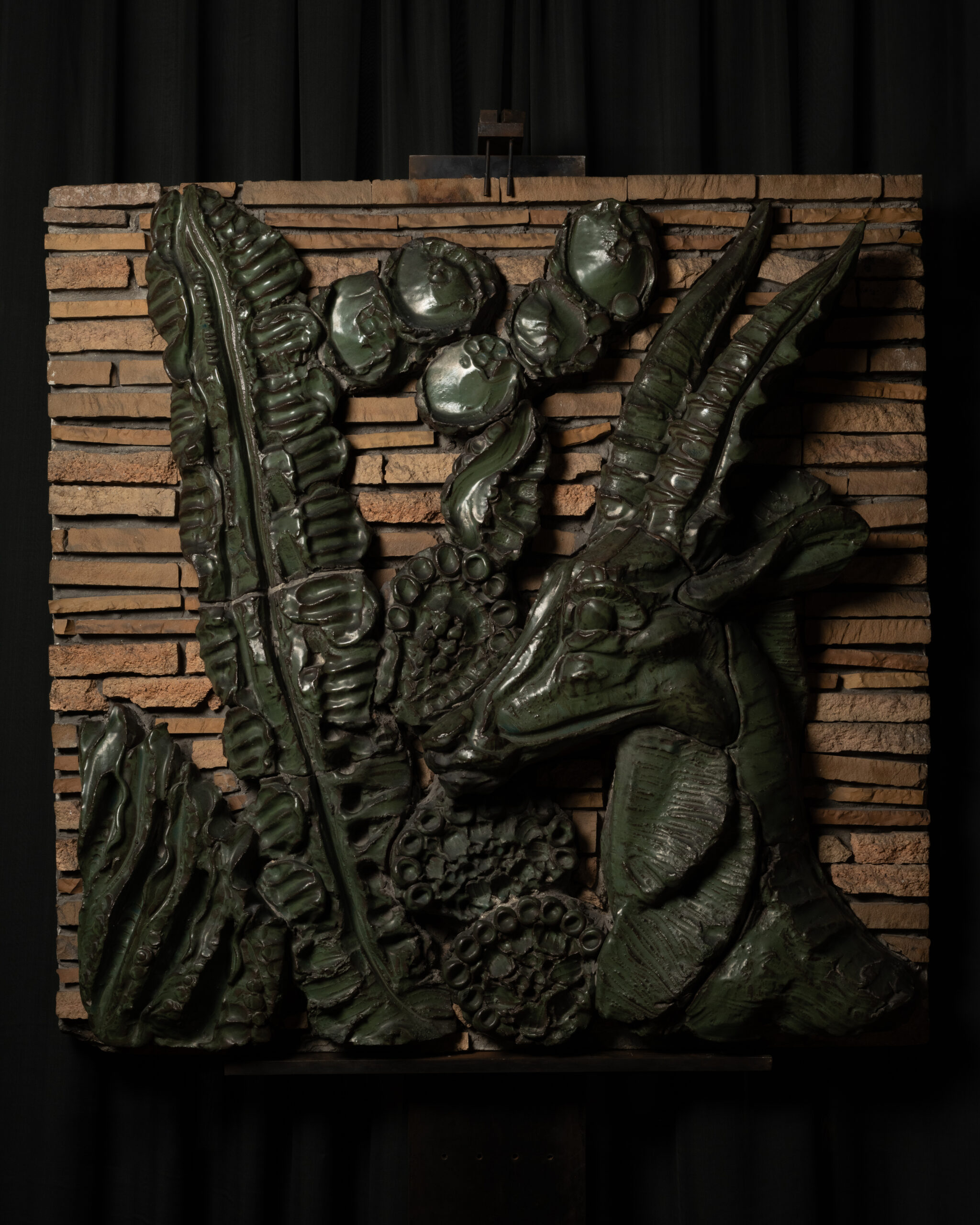
High-Relief Modello of the Antilocapra by Jean Mayodon
High-Relief Modello of the Antilocapra by Jean Mayodon
Glazed ceramic France ca. 1935 [Dimensions — to add]
Jean Mayodon’s personal collection (at least 1938 – his death, 1967) — Mayodon family — Private collection (held over 20 years).
Fig. 1, « Paquebot Pasteur » stamp, sold « 25 000 euros sans surcharge », in « Philatélie : Grande Armée, guerre de 1870-1871, 1 franc vermillon, « Paquebot Pasteur », pièces vedettes des prochaines ventes », Le Monde, May 19, 2019.
On June 9, 1980, sank the Filipina Saudia, off the coast of the Indian Ocean. This forty-year-old liner, which had left Jeddah to reach Manila, had had an eventful life and many owners. The Filipina Saudia I had been named so when it was acquired in 1976. Before, it was known as the Regina Magna ; but Regina Magna was not the real name of the ship. It had been named this way five years earlier, in 1971, upon its acquisition by the Greek shipowner Chandris. But what Chandris had bought that year was a ship called the Bremen, and ‘Bremen’ was a name that had been given in 1957 by the Norddeutscher Lloyd to a truly mythical ship : the Pasteur.
Fig. 2, The Pasteur at the arsenal of Saint-Nazaire, in La Science et la Vie, p. 163.
The SS Pasteur, a French liner 695 ft long, 87 ft wide, capable of carrying at least 26,500 tons, with 50,000 HP to cross the South Atlantic with 850 passengers on board, at a service speed of 22.5 knots. On her maiden voyage, the Pasteur was set to sail for Buenos Aires. Departure was planned on 14 September 1939. But the war prevented her from doing so : in August 1939, she returned to Saint-Nazaire to be transformed. Nearly a year later, after the German invasion of May 1940, she left for Brest. There she was loaded with a large quantity of gold, 213 tons from the vaults of the Banque de France, to be delivered to Halifax. After Halifax, she sailed to New York, to be loaded with weapons and ammunition, and sailed back to Halifax. This is when the British took control of her. They sent her to England. There, she was transformed a second time, to carry troops. Now a trooper, the former liner travelled between Southampton and Quebec. She also brought reinforcements to Suez after the German assault on El Alamein.
After returning under French control in October 1945, there was nothing left, of course, of the luxurious facilities that had made the fame ofthe Pasteur and those who designed her. Her once revered swimming pool, which before the war had featured in many advertisements and magazines, was then used to store soldiers’ rations. And even after the war the Pasteur kept sailing the Atlantic and Indian oceans. She made stops in Indochina and Africa until 1957. This is when she was sold, painfully and with some scandals, by the French government, looking for savings and for liquidity. The Pasteur was then acquired by Norddeutscher Lloyd, now Hapag-Lloyd, and became the Bremen.
In the months leading up to her inauguration, the Pasteur‘s first trip was advertised at great expense in the major magazines and newspapers. One article of Le Temps said that :
Passengers will find all the comfort they need : a library with thousands of books, an orchestra, movie screenings and ballrooms. Sports were particularly thought about on a ship set to sail under a heavenly climate and calm weather. An entire deck, 425 ft long, has been dedicated to sports, including a tennis court, all possible deck games, a bar and a lounge — perhaps the most successful innovation on board. Covered in raffia and bleached hemp rope, with 54 picture windows opening directly onto the sea, it is a real floating club. A dedicated staircase connects the lounge to the rooms of mechanotherapy and hydrotherapy, and to a superb swimming pool, adorned with a large 23 ft high decorative ceramic panel by Mayodon.
Fig. 3, The Pasteur’s Swimming Pool, in À Bord des paquebots. 50 ans d’arts décoratifs, Paris, 2011, p. 235.
Designed by the architects Maillard and Raguenet, the Pasteur was meant to be a sumptuous, lavish, almost paroxysmal enterprise : lightings by Perzel and Ingrand, ironwork by Subes, furniture by Majorelle and Leuleu, and — last but not least — a gigantic swimming pool (fig. 3) designed by Georges Hennequin and enhanced by a monumental bas-relief by Jean Mayodon, one of the greatest ceramists of his time.
About the swimming pool, Raymond Lestonnat, the ‘naval pundit’ of the leading weekly publication L’Illustration, wrote :
And what about the pool ? True magic. Lit up with diffused light, a submarine light, so to speak. The walls and floor are covered with glazed stone. Two terraces with a view on the sea, connected to the pool so the bathers can grab a drink at the bar without having to walk by the clothed tourists of the deck. Even the great and fashionable resorts are not so well equipped.
Jean Mayodon already a well-known ceramist when he was chosen to decorate the Pasteur’s swimming pool, famous especially for his ‘rich bestiary’ of swans, peacocks, horses, lions, gazelles. He had exhibited at most major shows, including the Salon d’Automne and the Palais Galliera. He was also a rising star at the prestigious Manufacture de Sèvres.
Jean Mayodon devant ses œuvres (1925), dans Gérard Landrot, Mayodon, Luxembourg, 2004, p. 67.
Born in 1893, Jean Mayodon began his career as a painter, and a painter he never ceased to be. An art critic, Ernest Tisserand, wrote in 1928 : ‘Apart from the fact that Mayodon, for ten years of his life, was almost exclusively concerned with painting on canvas, he reveals himself, in all his current works, as the only painter of frescoes that we have today’. Jean Mayodon himself confirmed this painter’s spirit in an interview quoted by Gérard Landrot : ‘I still have in my hand all the drawings and ornaments I used to do when I was a decorative painter. I love nudes and animals, and above all gaudy colours.’
It was around the age of 19, in 1912, that Mayodon began to work with ceramics. He was so evidently gifted that decorative artist Henri Hamm noticed him the very same year, and helped him exhibit his first works at the Salon d’Automne.
Mayodon’s fame in the 1920s was mainly due to his iconic vases, colourful and often gilt, with shapes inspired by Greek red-figure ceramics. At the time, Jean Mayodon was, so to speak, the leading ceramist to whom the greatest architects and decorators of the period turned, from Jules Leleu to Ruhlmann, not forgetting Porteneuve, Subes and Printz.
At the beginning of the 1930s, when he designed his first sketches for the huge bas-relief of the Pasteur — most likely in 1935 — Mayodon was somehow still rising : the Manufacture de Sèvres, undoubtedly the most famous porcelain factory in Europe since it was founded in 1756 — where he had trained under Ambroise Milet, and of which he would become artistic director in 1941 — had taken him onto its prestigious artistic board a year earlier, in 1934. But it was also, for Jean Mayodon, what could be said his ‘monumental period’ : once a decorative artist, who had crafted sumptuous but discreet pieces chosen to enhance interiors designed by great architects, Mayodon was now creating immense sculptures, works of fine art that, while still designed to fit into carefully designed interiors, could now have a life of their own and exist for their own sake. Between 1931 and 1938, Mayodon produced several monumental panels and reliefs : a large relief for the Dubly apartment, decorated by Ruhlmann ; the large relief for the Golden Age in 1936 ; and another large relief, with several panels, for the World’s Fair 1937. In other words, Jean Mayodon was clearly an artist at his technical acme when he agreed to supply the monumental relief for the Pasteur’s, and designed the Antilocapra modello.
The monumental haut-relief of Le Pasteur, baked in a large fire, is 30 ft high (a total of 23 ft according to the article in Le Temps, which probably does not include the underwater part of the relief, cf. pl. I), and had as its subject the flora and fauna of South America. The composition was bronze-green against a background of beige to pinkish red, a colour chosen by the architect Georges Hennequin, who had undertaken to line the walls of the pool with terracotta bricks. Now lost — no one knows if it was dismantled or destroyed during one of the Pasteur‘s many conversions, or if it sank with the ship in 1980 — nothing remains of Mayodon’s masterpiece, apart from the illustrations (fig. 3) and photographs (pl. II) of the pool ; and apart, of course, from the prototypes designed by the artist in the years leading up to the Pasteur’s inauguration.
This modello, representing an earlier version of the final high relief, is therefore one of the last remnants of what is perhaps the masterpiece of one of the greatest ceramists of the 20th century. Very similar in style and technique to the large Hunting Scene on held at the Musée Despiau-Wlérick in Mont-de-Marsan, this modello came from a private collection, where it was held for over 20 years. It previously belonged to the Mayodon family, having been in Jean Mayodon’s personal collection from at least 1938 until his death in 1967.
Literature
Ernest Tisserand, « Mayodon, Jean. Peintre et céramiste », in L’Art et les artistes. Revue mensuelle d’art ancien et moderne, Paris, 1928. Le Temps, « Le Paquebot « Pasteur » », August 29, 1939. Le Monde, « Sous le nom de « Bremen », la troisième unité de notre flotte concurrencera l’ « Île-de-France » sur l’Atlantique », July 19, 1957. Le Monde, « Le « Pasteur » est arrivé à Brême », Octobre 1st, 1957. Le Monde, « Première escale d’un transatlantique allemand en France depuis dix-neuf ans », July 26, 1958. Gérard Landrot, Mayodon, Luxembourg, 2004. Judith Miller, Art Deco, London, 2005. Frédéric Ollivier, Aymeric Perroy and Franck Sénant, À Bord des paquebots. 50 ans d’arts décoratifs, Paris, 2011. Olivier Le Bihan, Céramique d’artiste. Derain, Dufy, Matisse, Miró, Picasso…, Milano, 2012. Nicole Blondel, Céramique. Vocabulaire technique, Paris, 2014. Le Monde, « Philatélie : Grande Armée, guerre de 1870-1871, 1 franc vermillon, « Paquebot Pasteur », pièces vedettes des prochaines ventes », May 19, 2019.
Ancient Figures Deciphering, by Louis-François Cassas
Ancient Figures Deciphering, by Louis-François Cassas
Pen and wash, black and brown ink, watercolour France ca. 1782-1784 Unframed: h. 25.2 in.; w. 41 in. Framed: h. 32.7 in.; w. 46.4 in. Provenance: private collection, Milan
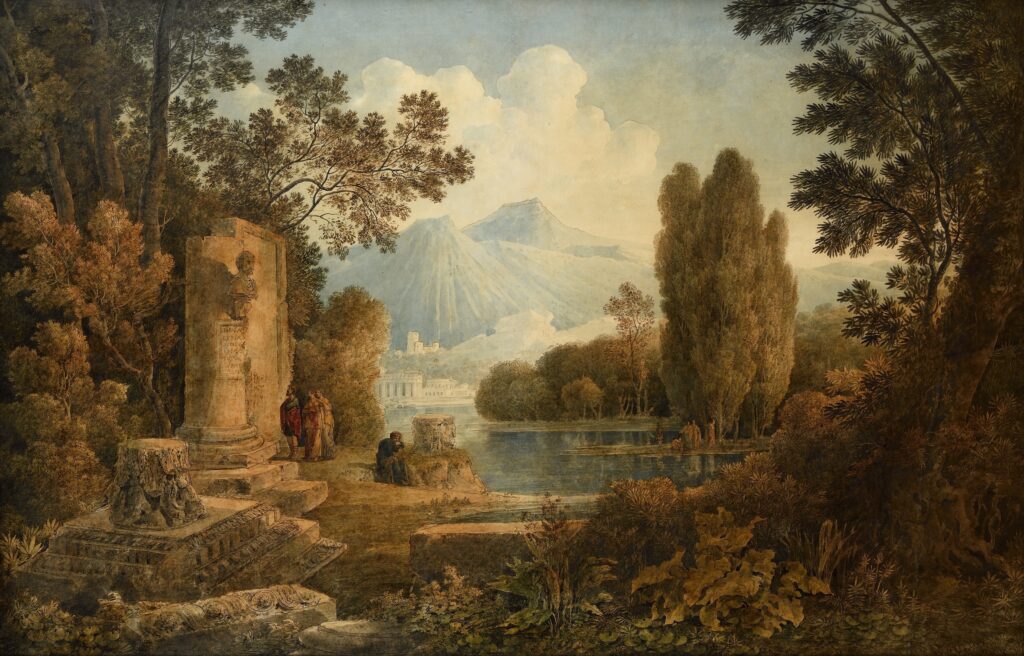
On our watercolor, the diverse vegetation that frames a dazzling blue sky animated by a few clouds is typical of Cassas’s compositions. The artist relies on the asymmetry to introduce an abundant foreground. It is completed by ruins that serve as a repoussoir to provide deepness to the whole composition. The mountain inhabited by ruins that stand in the background is a point of falling light that opens up the perspective rather than blocking the view.1
The glistening river leads the eye: from the back to the foreground, the eye bounces back and forth to the figures reading the ancient inscription and those on the background with their reflection on the water answering to the shape of the cypress trees. This construction is inspired by Nicolas Poussin’s compositions.
This work can be compared with the watercolor which had been presented at the Salon du Dessin, Paris, in 2000, “Landscape with characters near an antique sculpture in front of a lake, a mountain in the background”. Another comparison can be made with the latest large sheet sold at Christie’s on March 22, 2017: “Archaeologists examining a bas-relief on the outskirts of the city of Athens”.
Louis-François Cassas was a French draftsman, painter, engraver and orientalist born on June 3, 1756, in Azay-le-Ferron (Indre) and died in Versailles (Yvelines) on November 1, 1827.
Son of a royal road surveyor, Louis-François Cassas was trained as an engineer of bridges and roads. He began his career as a stereotomy draughtsman on the construction site of bridges. That is how he learned the rigor and quasi-architectural meticulousness typical of his work throughout all of his painter career.
As a protégé of Louis-Antoine de Chabot, who became the Duke of Rohan-Chabot in 1791, he trained at the latter’s academy from 1775 to 1778. He was a pupil of Lagrenée who taught him the use of the wash and introduced him to the taste of the picturesque and the exotic. This taste was confirmed during his first trip to Italy from 1779 to 1783. With the Duke of Rohan-Chabot, he went to Naples, Istria and Dalmatia, places that were little visited by the travelers of his time. During this first journey, he collaborated with the Saint Non Abbey for a book called “Voyage pittoresque ou description des Royaumes de Naples et de Sicile” (1781-1786, 4 volumes).
The Count of Choiseul-Gouffier, ambassador of the Sultan of Turkey, crossed his path back in Paris.2 As a passionate archaeologist, this new protector viewed Cassas as the artist all designated to help him in his enterprise of survey of the classical sites and monuments of the Middle East and Asia Minor. Cassas ended these four years of travel in Rome where he exhibited more than 250 drawings which were much appreciated by the public.
He eventually settled permanently in Paris to work on the publication of his works in a “voyages pittoresques” which was never completed. He taught at the school of the Royal Manufacture of Gobelins where he was appointed inspector of works and professor of drawing in 1816. As a teacher, he played the role of initiator of neoclassicism in the early 19th century. From 1817, he drew large watercolors whose format was close and sometimes exceeded on meter in length to sell them.
From his precise surveys of archaeological sites, his numerous drawings, sketches and studies of ancient monuments, Cassas developed landscapes that intertwined both the rigor of archeological surveys and the powerful fantasy of the antiquity. Those watercolors were very successful during his lifetime, and the large sheets are now extremely rare on the market.
On most of the paintings, the archaeological site represented is pure fantasy. He designed virtuous assemblies of real elements that give a grandiose aspect to his watercolors. Those imaginary views are nonetheless bathed in the Mediterranean atmosphere that makes them look like they are based on the reality.
This watercolor is in keeping with the neoclassical taste of Cassas’ contemporaries. Indeed, the young aristocrats who were travelling for their Grand Tour during the 18th and 19th centuries were dazzled by the picturesqueness of the ancient ruins they went to admire around the Mediterranean sea. This watercolor matches this idealized vision of antiquity by placing a few characters dressed in antique garments in the middle of a serene and grandiose landscape. This idealized antiquity is the main subject of the painting, making Cassas the ultimate Grand Tour artist.
Louis-François Cassas was a French draftsman, painter, engraver and orientalist born on June 3, 1756, in Azay-le-Ferron (Indre) and died in Versailles (Yvelines) on November 1, 1827. ↩︎
Louis-François Cassas was a French draftsman, painter, engraver and orientalist born on June 3, 1756, in Azay-le-Ferron (Indre) and died in Versailles (Yvelines) on November 1, 1827. ↩︎
A Pair of Candlesticks with Serpents and Lyres
A Pair of Candlesticks with Serpents and Lyres
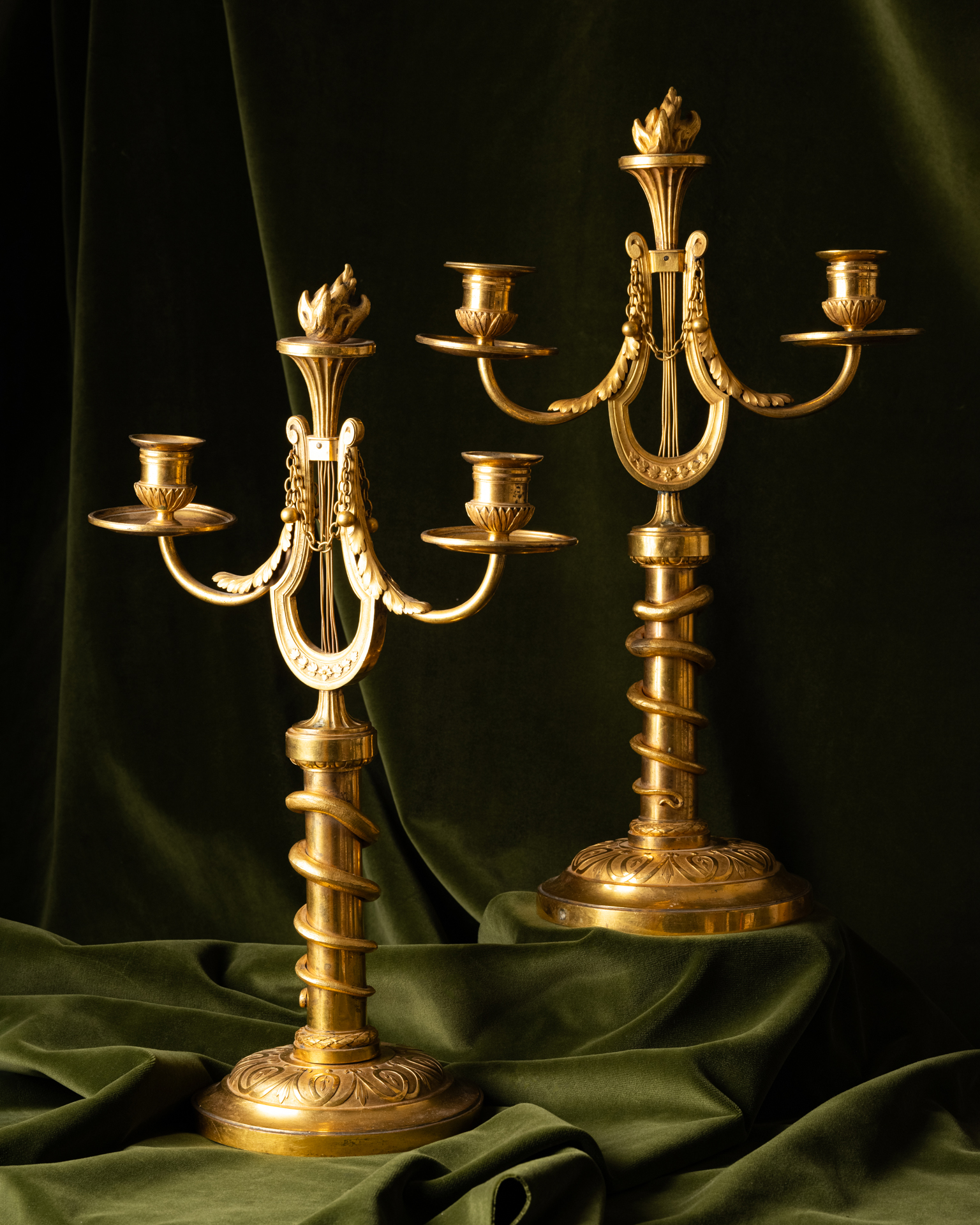
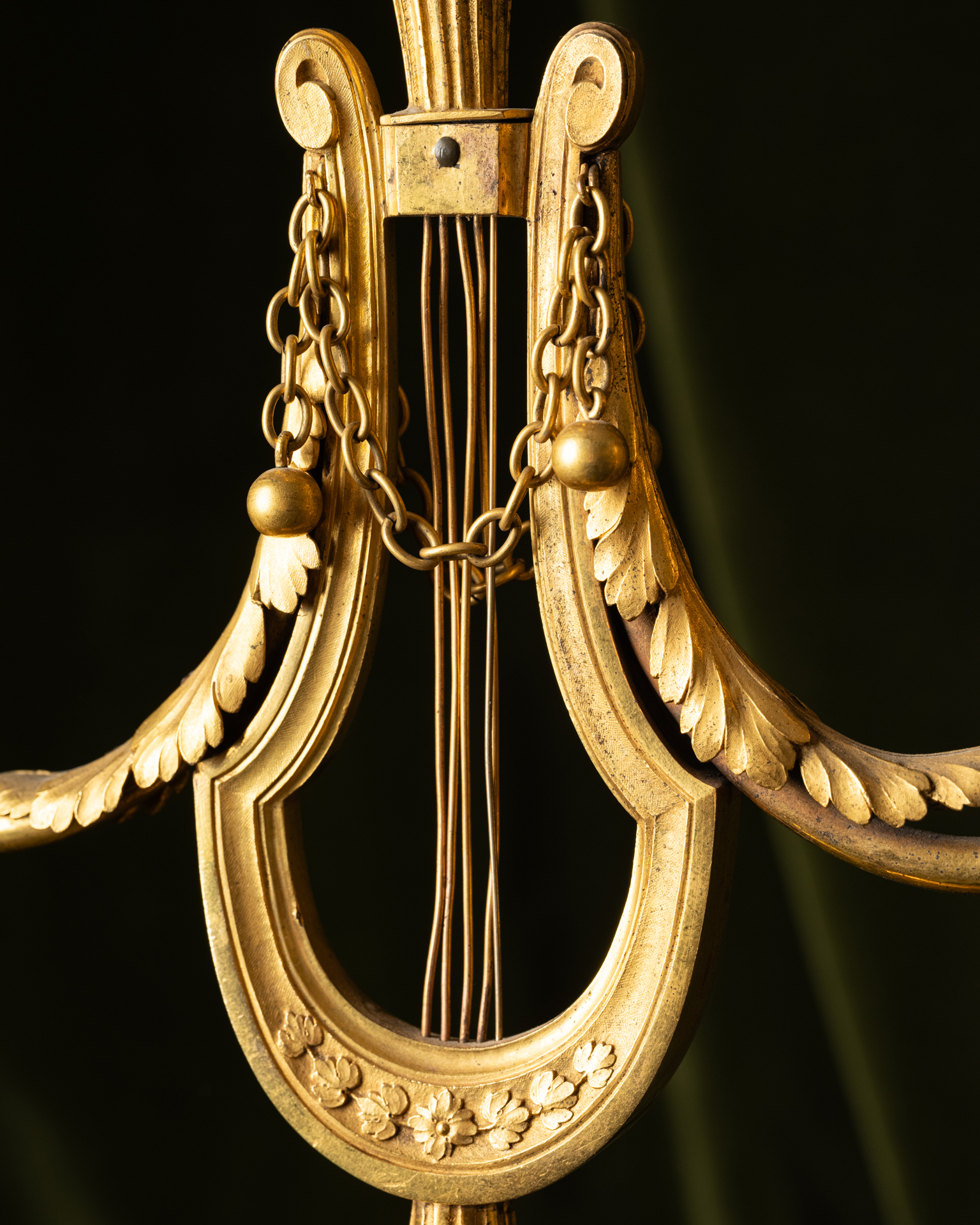
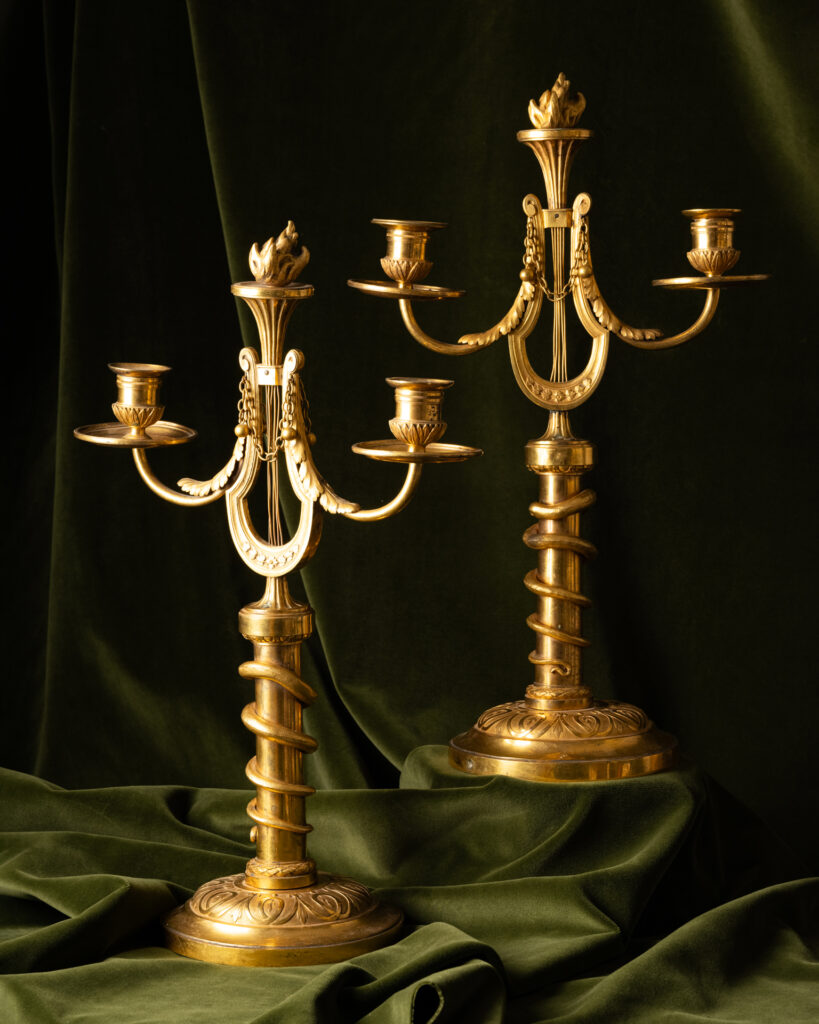
Gilt bronze and copper Vienna Late 18th century h. 51 cm (20 in.)
Several features suggest the attribution of this pair of candlesticks to a Viennese workshop: the decorative repertoire, derived from French neoclassical bronzes and combining “acanthus and palmette”, “ornamental use of musical instruments” and “animal motifs”;1 the use of gilt metal chains, found on several chandeliers in the collection of the Möbelmuseum in Vienna; and above all the use of gilt copper for the base, the drip pans and probably the strings of the lyre — a material and technique that betray the persistence, in the Viennese decorative arts, of a metalworking tradition that had remained, prior to the importation of French bronzes, “at the primitive stage of simple Gürtlerei”.2
Be that as it may, these candlesticks, of a hitherto unrecorded model, display chasing of a high order: the modelling of the undulating acanthus, laurel and oak leaves, the matted grounds of the copper base and the flutes of the flaming torch, the modelling of the flame itself, the texture of the serpent’s skin, the rosettes and volutes of the lyre — which in places rival the contemporary work of the French bronzists.
Literature
See Eduard Leisching, “Die Bronzen im Hof-Mobiliendepôt in Wien”, in Monatsschrift herausgegeben vom Österreichischen Museum für Kunst und Industrie, VI, 1903, Vienna.
That is, the traditional Germanic craft of shaping and gilding non-ferrous metals, ibid., p. 429. ↩︎
Rock Crystal And Fire-gilt Metal Chandelier Attributed To E. Baguès And G. B. Metellino
Rock Crystal And Fire-gilt Metal Chandelier
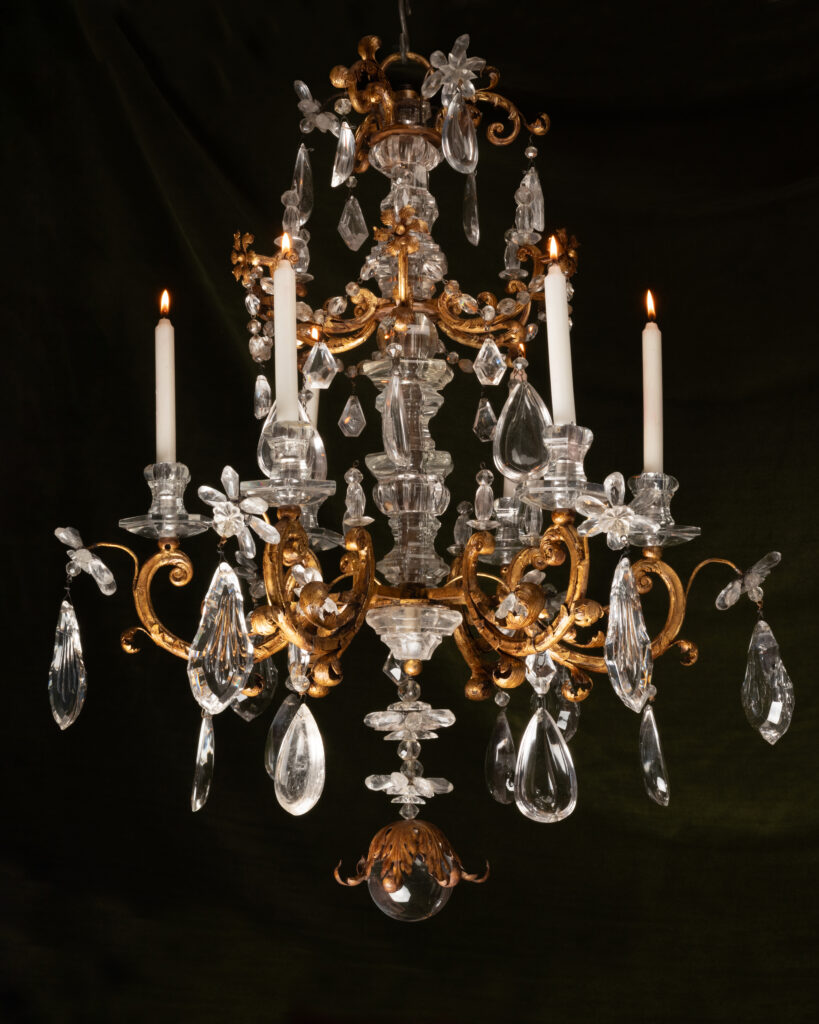
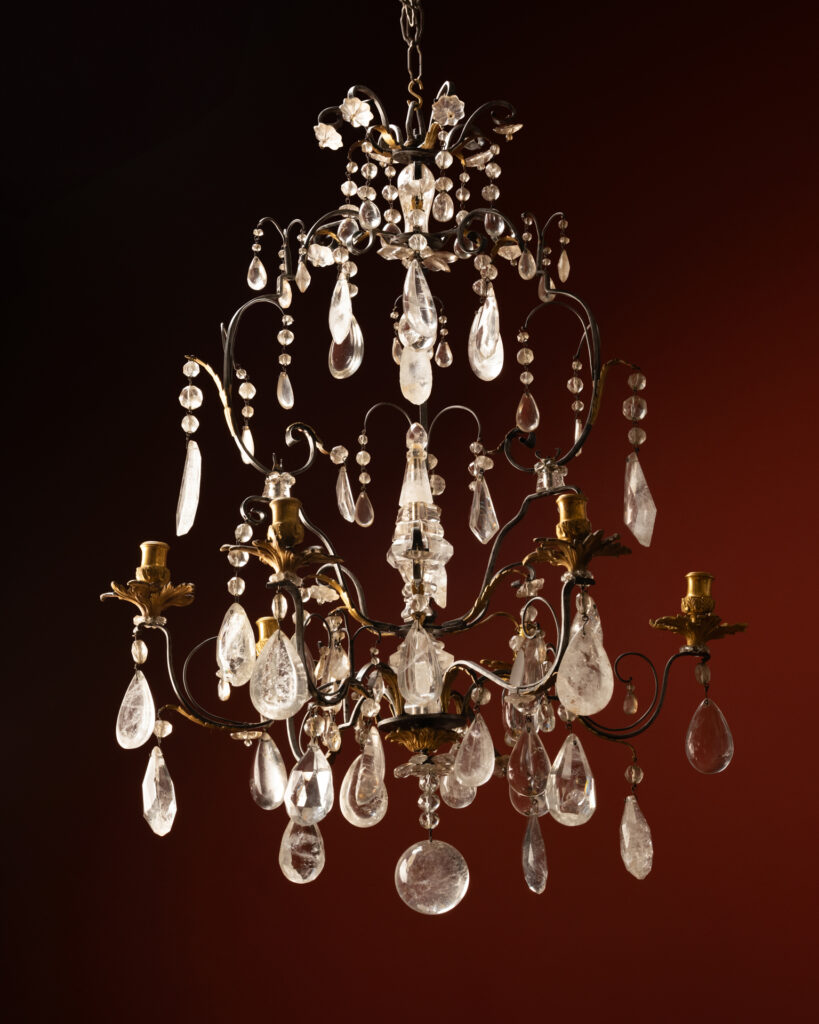
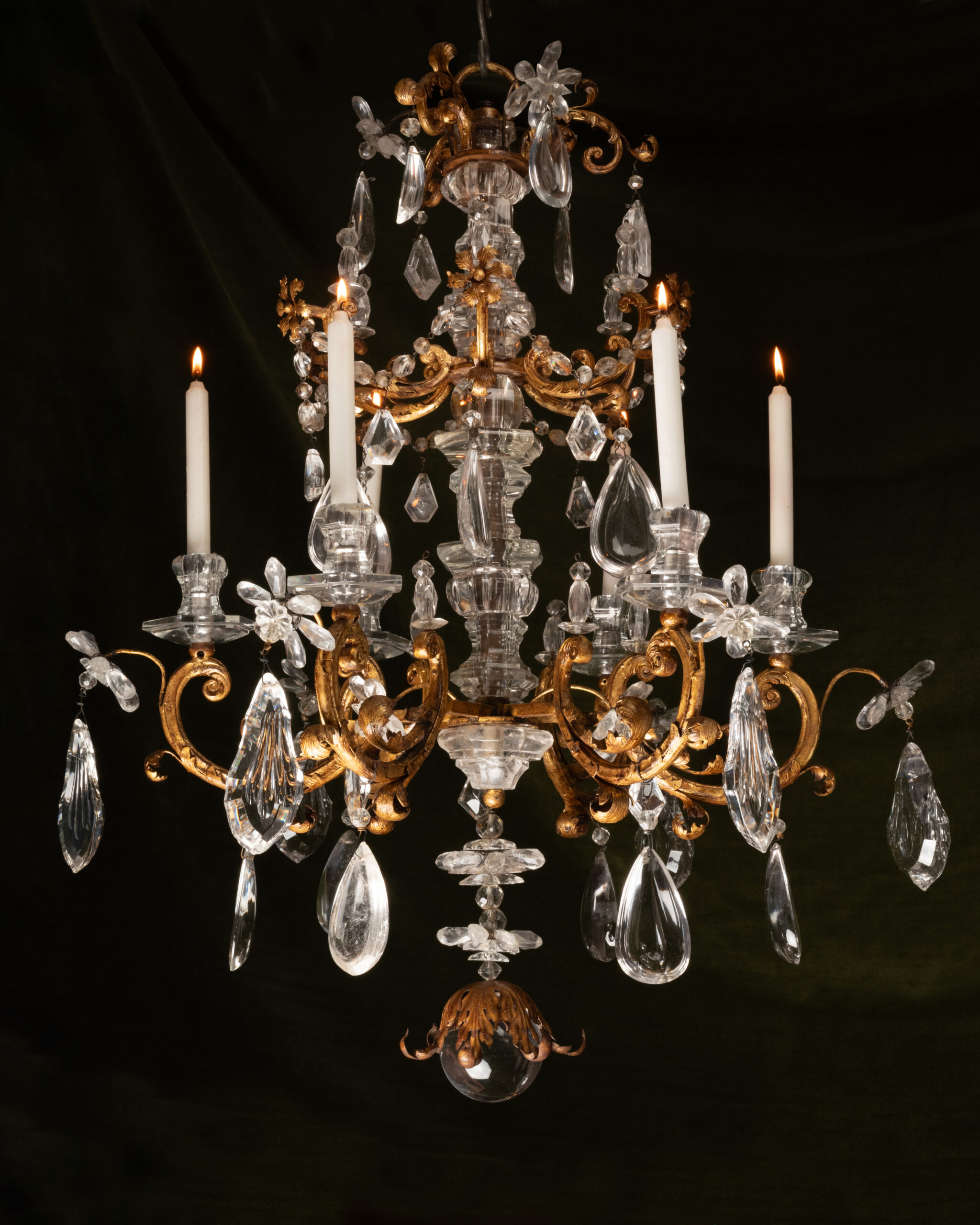
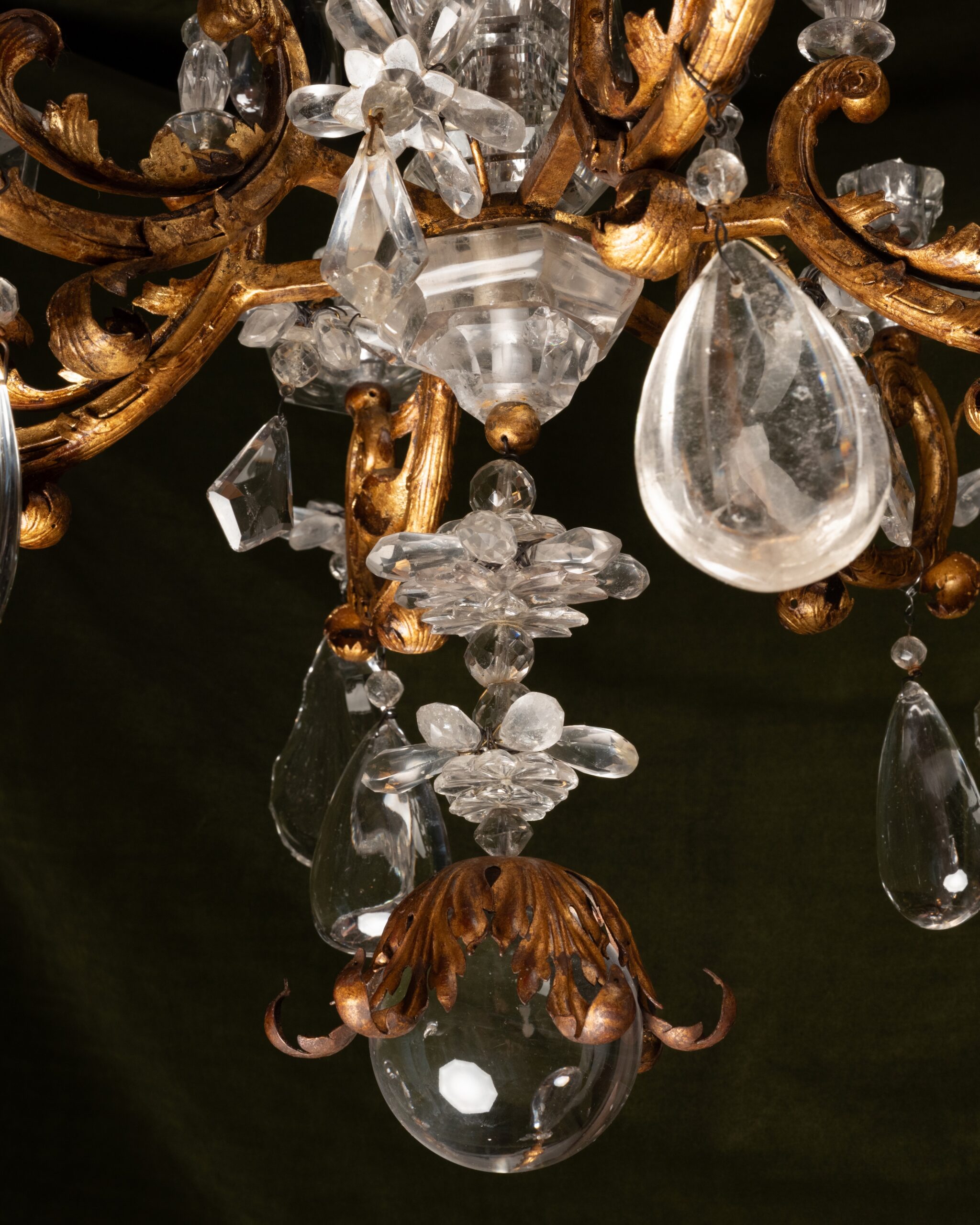
Six-light chandelier attributed to Eugène Baguès or to L’Escalier de cristal, some parts attributed to Giovanni Battista Metellino Gilt metal, rock crystal Milan, France Late 19th century, incorporating elements from the early 18th century 85 x 65 cm (31.5 × 25.6 in)
The structure of this six-light chandelier bears the imprint of two distinct periods of manufacture. The six semi-circular arms, adorned with foliate volutes, appear to be the oldest components. The refinement of their ornamentation and certain technical features associate them with a group of Milanese works dating from the early years of the 18th century.
At least two known chandeliers present a comparable structure. The first, a twelve-arm chandelier housed in the Metropolitan Museum, was executed using a technique similar to that of the present piece: the arms, decorated with gilt metal foliage, emerge from a baluster-shaped shaft in rock crystal, projecting first perpendicularly before curving sharply into voluted semicircles. The second chandelier, located in the Konferenzzimmer of the Hofburg in Vienna, is even closer: in addition to a similar structure, it features identical six-pointed star motifs in gilt metal, executed in the same manner as the foliage.
Both chandeliers are attributed to Giovanni Battista Metellino, a Milanese stone-cutter active from the late 17th to the early 18th century, whose hand is recognisable — in both style and execution — in the crystal work of the Metropolitan Museum and Hofburg chandeliers. It has thus been inferred that a Milanese workshop, specialising in lighting production and regularly collaborating with Metellino for crystal elements, was responsible for this very rare group of chandeliers distinguished by a shared ornamental language in gilt metal and rock crystal.
The Hofburg chandelier underwent significant modifications in the late 19th century, most likely carried out by the Viennese firm J. & L. Lobmeyr, which at the time was overseeing the electrification of the Konferenzzimmer. The present chandelier appears to have undergone a similar intervention, probably during the same period, possibly by the firm of Eugène Baguès. Founded in 1840, the Baguès company had, by the late 19th century, developed a speciality in electrifying antique light fixtures, while also trading in both antique and modern objets d’art — particularly chandeliers. In the firm’s early advertisements, antique pieces are sometimes shown alongside Baguès’ original creations, a juxtaposition likely intended to highlight the historical and technical precision that the firm prided itself on, aspiring to produce decorative objects of a quality comparable to those of the 18th century. This interplay between old and new sometimes occurred within a single object, through the reuse of antique components — occasionally irreplaceable — within newly created works.
The present chandelier appears to have emerged from precisely this kind of practice: its structure was altered, its arms enlarged, new decorative elements added, and the entire piece adapted for electrification — a domain in which the firm of Eugène Baguès played a leading role in the late 19th century.
L’Escalier de cristal, another firm renowned for producing high-quality objets d’art and furniture in 18th-century styles — always in extremely limited numbers and for an elite clientele — was also known for incorporating antique elements, sometimes of an inimitable nature. A drawing of a chandelier strikingly similar to the present example appears in one of L’Escalier de cristal’s design books, making it plausible to attribute the reconfiguration of this piece to that firm.
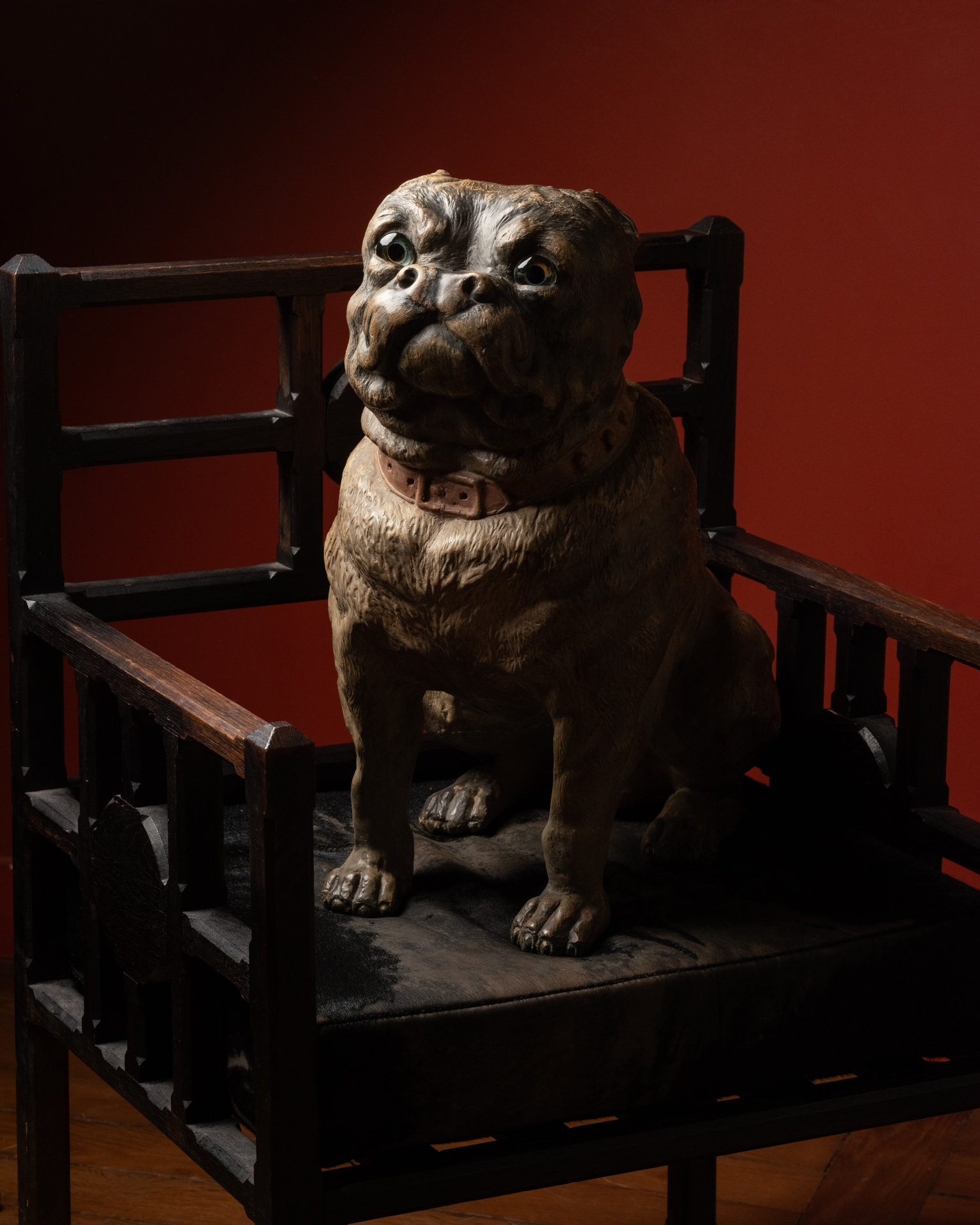
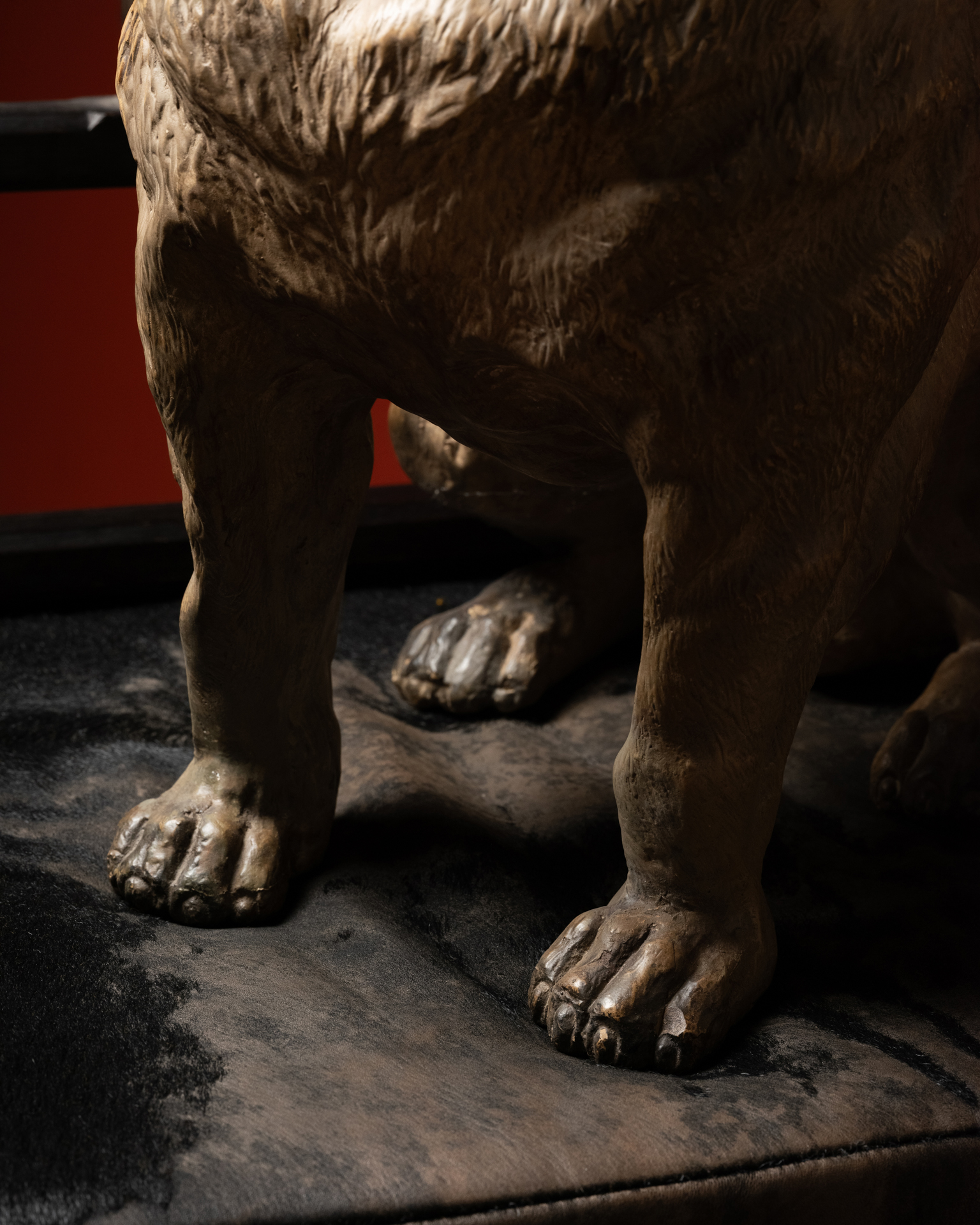
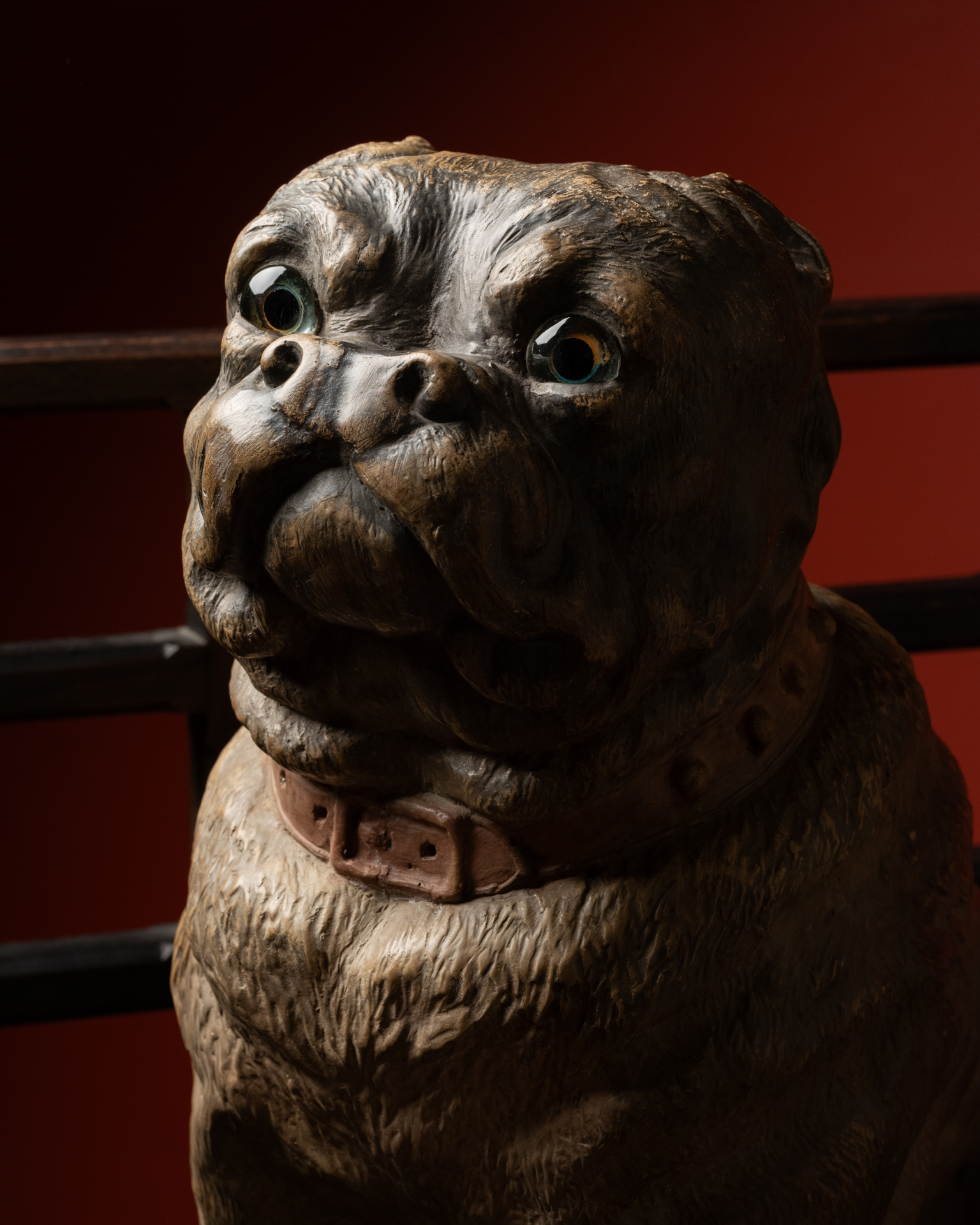
Terracotta and sulphide Czech Republic Late 19th century 52 x 45 x 25 cm (20.5 x 17.7 x 9.85 in.)
Painted terracottas of this type, most often depicting life-size pug with eyes in cristallo-ceramic known as ‘sulphide’, are frequently held to be of Austrian origin on the grounds of their resemblance to the small animal figurines of Friedrich Goldscheider. The hypothesis of a Victorian English production has also been put forward, most likely due to the breed itself and a strong tradition of animal sculpture in porcelain and terracotta in Staffordshire.
It seems more probable, however, that dog sculptures of this kind are of Czech manufacture: similar cold-painted terracotta dogs do indeed bear the mark of Johann Maresch (1821–1914), a Bohemian ceramicist whose manufactory was active in Ústí nad Labem, near the present German-Czech border. The use of sulphide — the encrustation of ceramic forms within molten crystal or glass — further supports this Bohemian hypothesis; and the fact that the Kingdom of Bohemia belonged to the Austro-Hungarian monarchy from the sixteenth century until 1914 might account for the Viennese reputation of these objects.
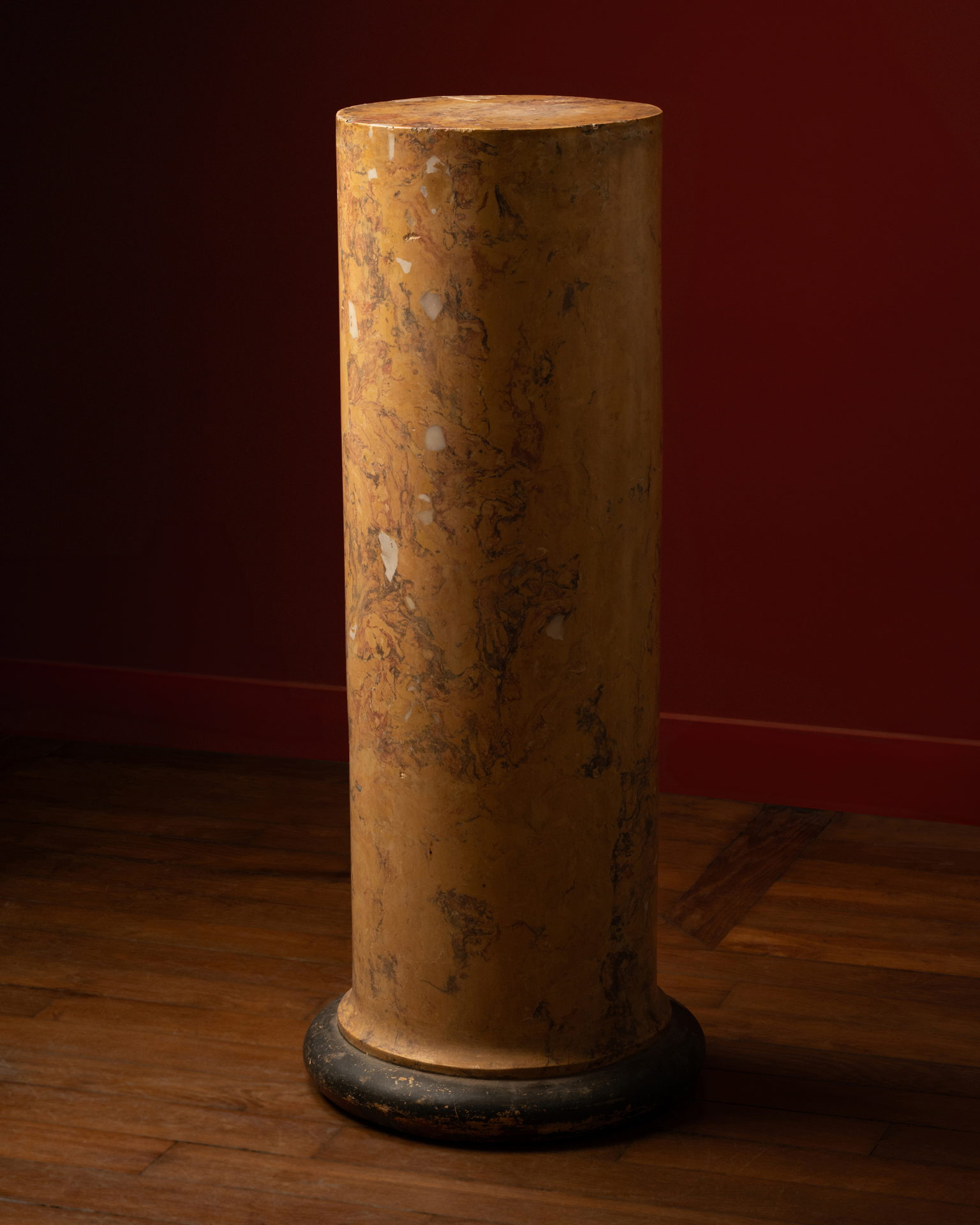
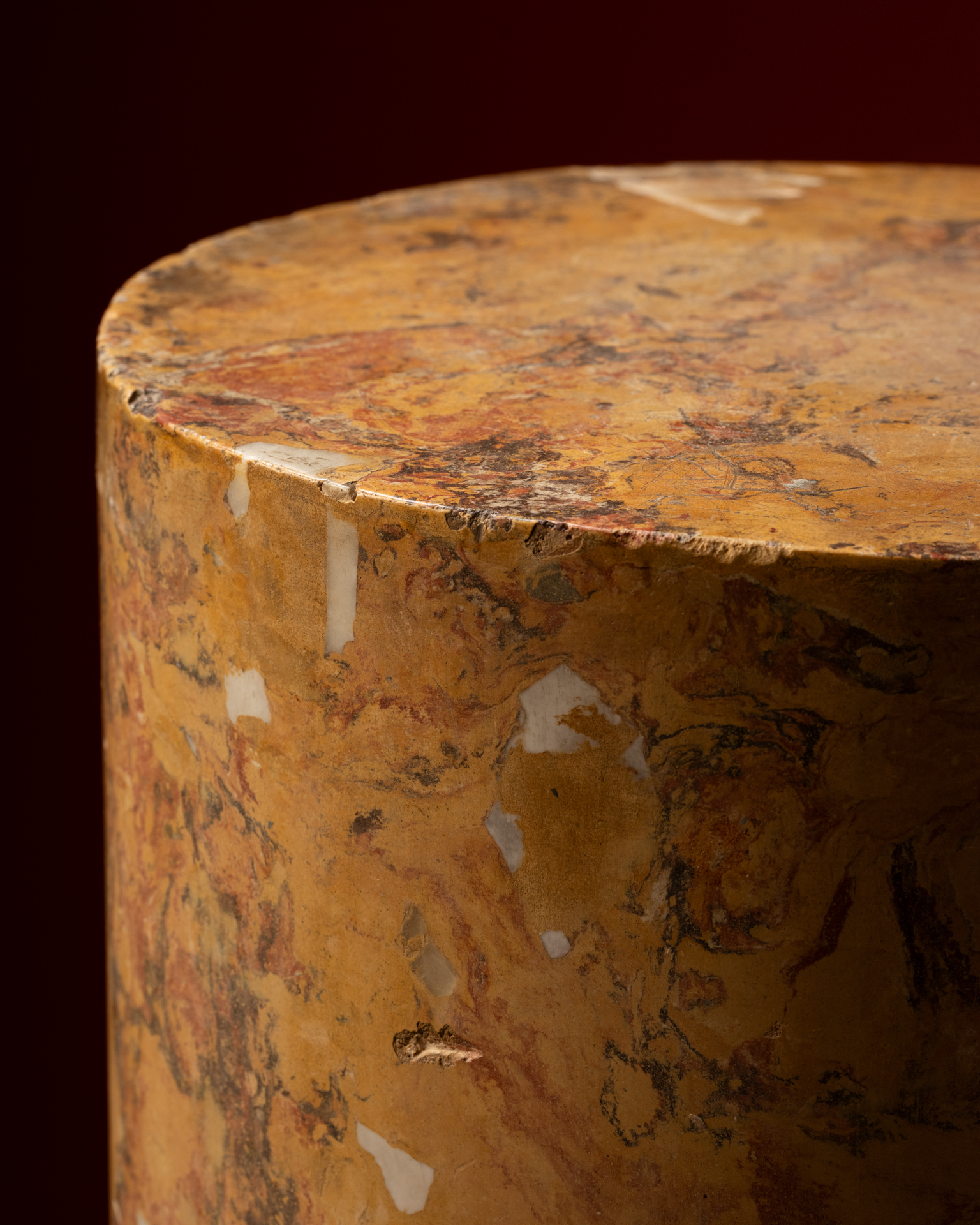
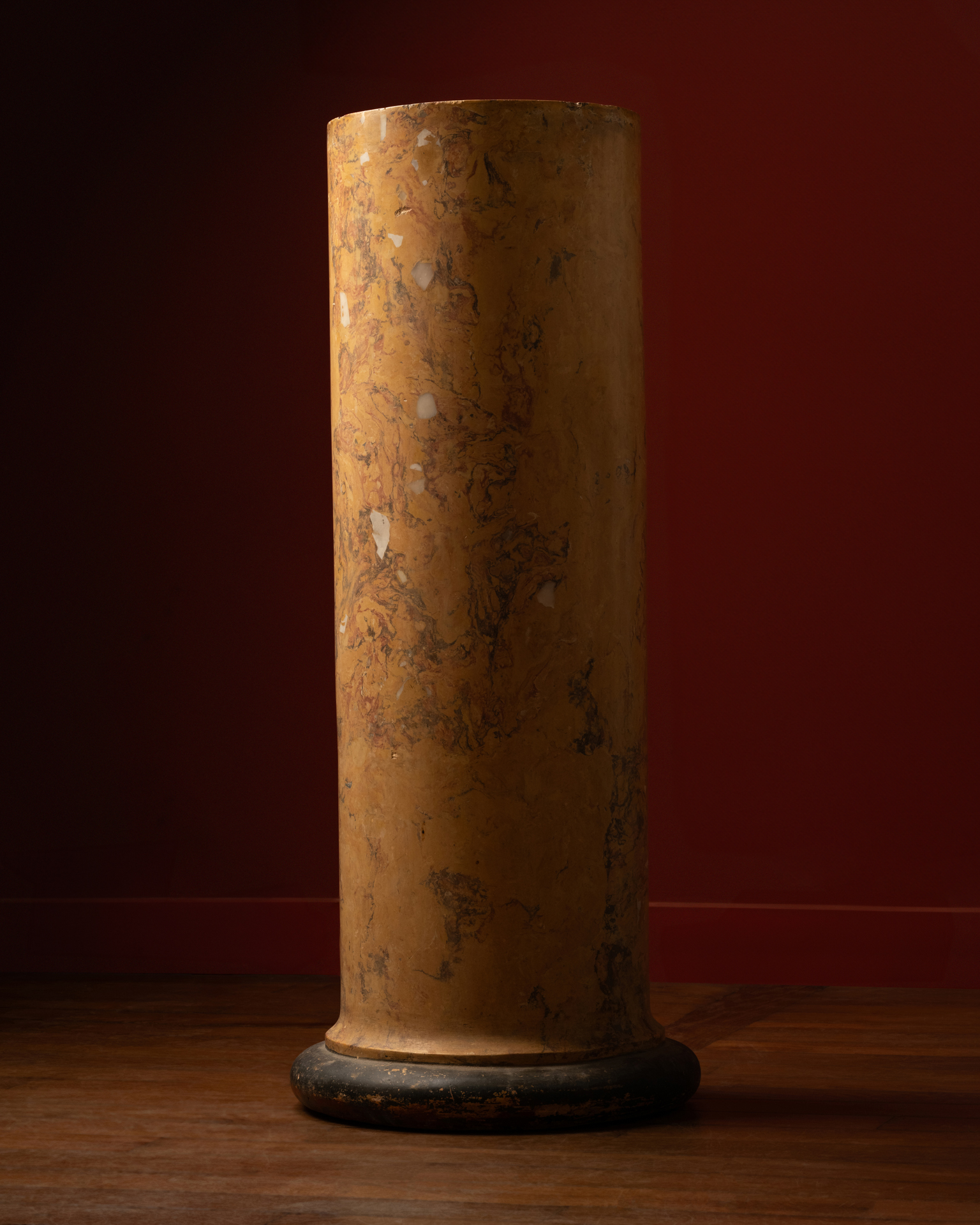
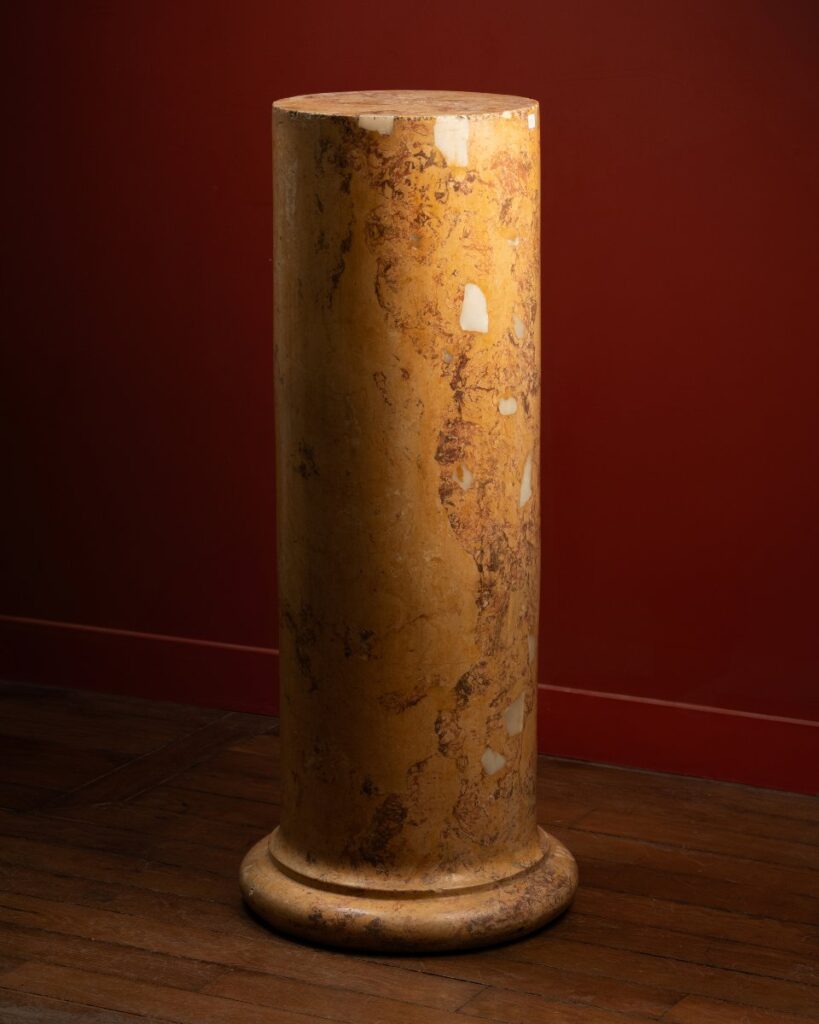
A Scagliola Column Imitating Breccia Gialla
A scagliola column imitating breccia gialla
Scagliola Italy 19th century h. 102 cm ; d. 32,5 cm (h. 40.16 ; d. 12.8 in.)
In his 1845 treatise on the pietre antiche, Corsi mentions a “very rare” breccia gialla with a “of orange with small white, red, and dark blue markings” — of a type that may have served as the model for the present column, which is indeed speckled with warmer motifs than traditional breccia.
Literature
See Faustino Corsi, Delle pietre antiche, Rome, 1845 and Gabriele Borghini, Marmi antichi, Rome, 2004.