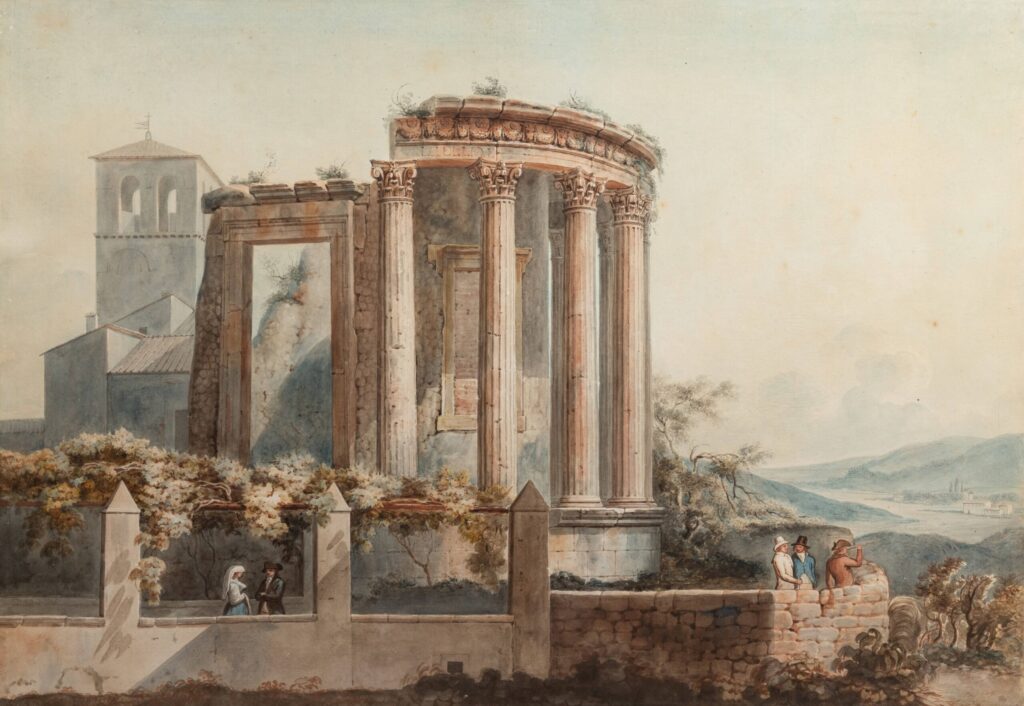
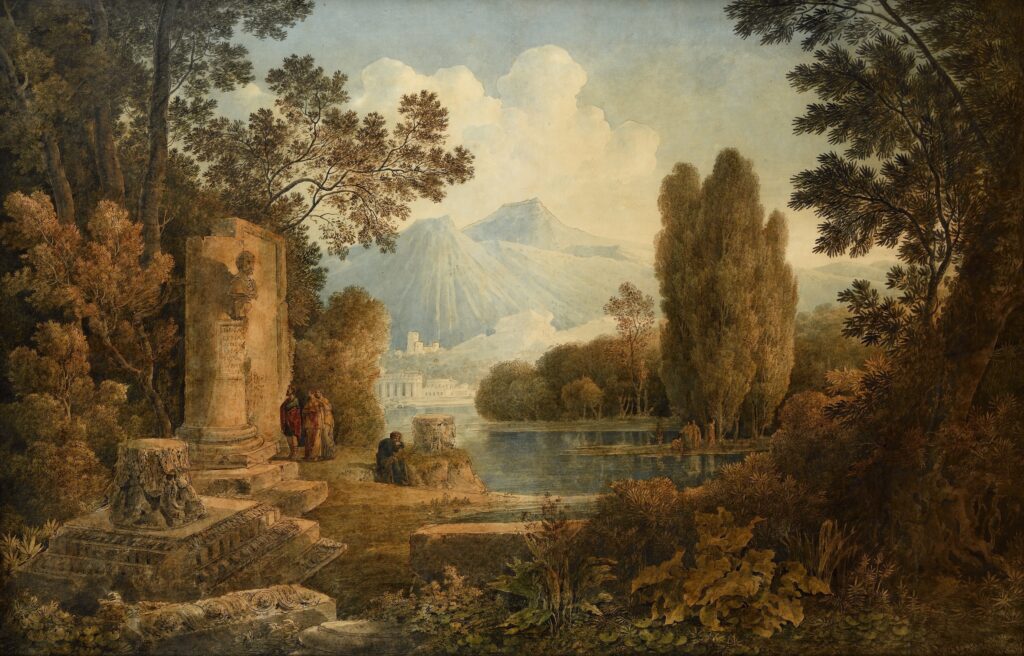
View of the Garden of the Borghese Villa, by Fleury Épinat
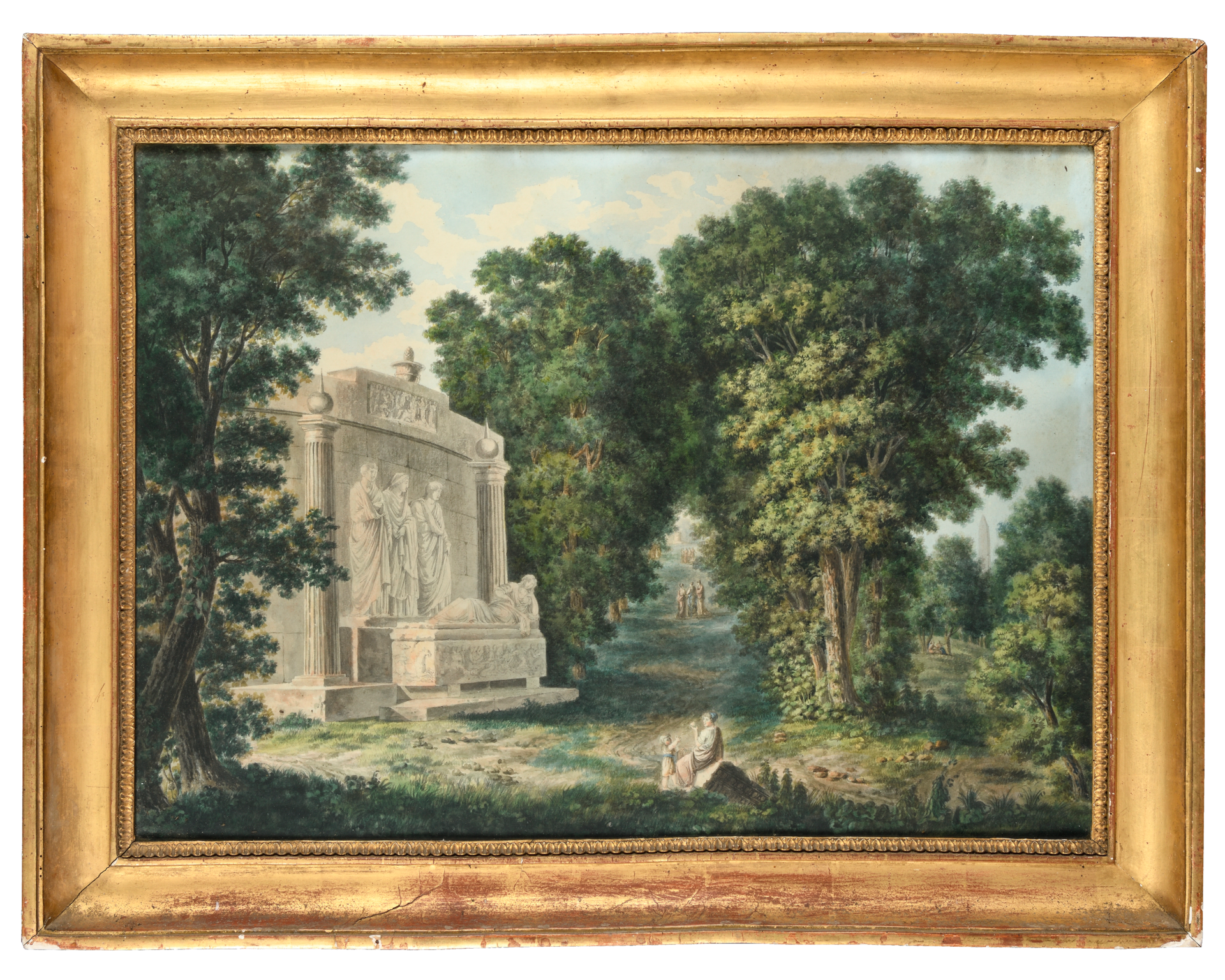
The exact setting of this veduta, showing the semicircular wall of the Grottone dei Leoni near the Giardino del Lago at the Borghese Villa, can be identified thanks to three antiquities recorded by the artist: a funerary group portrait (inv. CLXXXVIII), a sarcophagus with marine thiasos (inv. LXXXVII), and a klinè (inv. CLXXXVII) serving as its cover, all from the Borghese collections. That these three antiquities were together in the gardens is known from a drawing by Charles Percier, in which they are recorded for the first time and which is datable at the earliest to 1786.1 The antiques were not inventoried in Rooms II and VI of the Palazzo before 1832,2 but is is known that the sarcophagus and the klinè had already left the gardens by 1805, for a drawing of the same location by Bolognese painter Antonio Basoli, who was in Rome that year, shows the group portrait still in place, flanked by the same, though slightly altered, fluted columns, but neither the sarcophagus nor the klinè.3
The provenance of the watercolour, that is the Château de Busset, situates it within a collection of sketches, drawings, and watercolours — Lyonnais for the most part, either by school or subject matter, several of which are the same hand as the present work, and share a certain handling of foliage and undergrowth, built up in accumulated triangular strokes, with a number of sheets signed by Fleury Épinat (1764–1830), a Davidian who followed his master to Rome in 1784 not to come back to France before 1800.4 Épinat was close to the fellow Lyonnais and Davidian Philippe-Auguste Hennequin who, having likewise followed David to Rome, refers in his mémoires to several visits with Épinat, circa 1787, to “the galleries, the ruins and the environs of Rome” where they “drew the landscape together”,5 including one particular visit to the “Cardinal’s garden”, that is, the gardens of the Villa Borghese.6
The watercolour, under antique glass, is in its period frame, which has warped slightly.
Literature
See Antonio Nibby, Monumenti scelti della Villa Borghese, Rome 1832, Aimé Vingtrinier, Biographie des artistes lyonnais, vol. I, Lyon, 1854, Beata di Gaddo, L’architettura di Villa Borghese. Dal giardino privato al parco publicco, Rome, 1997 and “‘Un vero Paradiso Terestre’: il Parco di Villa Borghese nei disegni di Antonio Basoli (1805)”, in Prospettiva, n. 126-127, 2007.