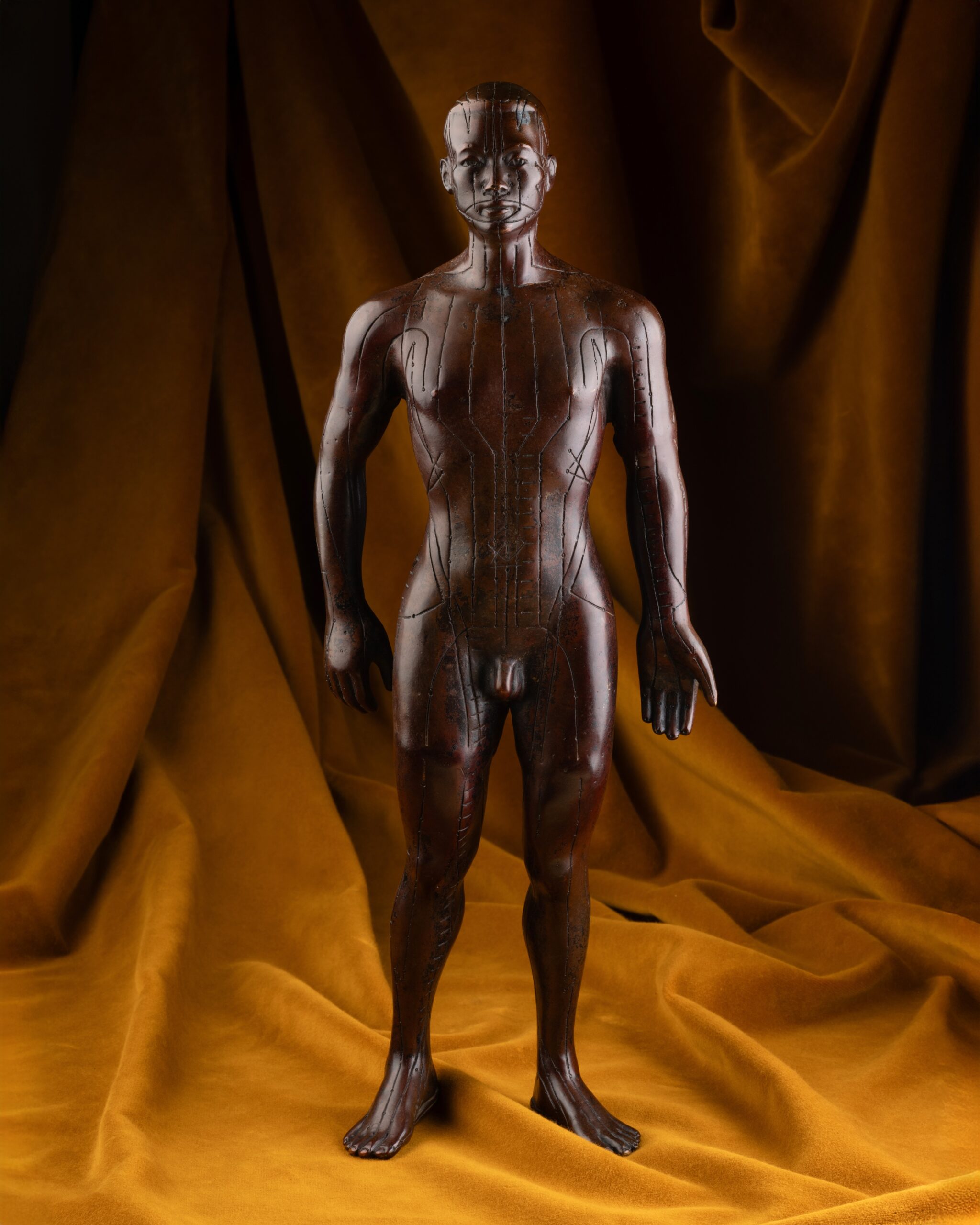
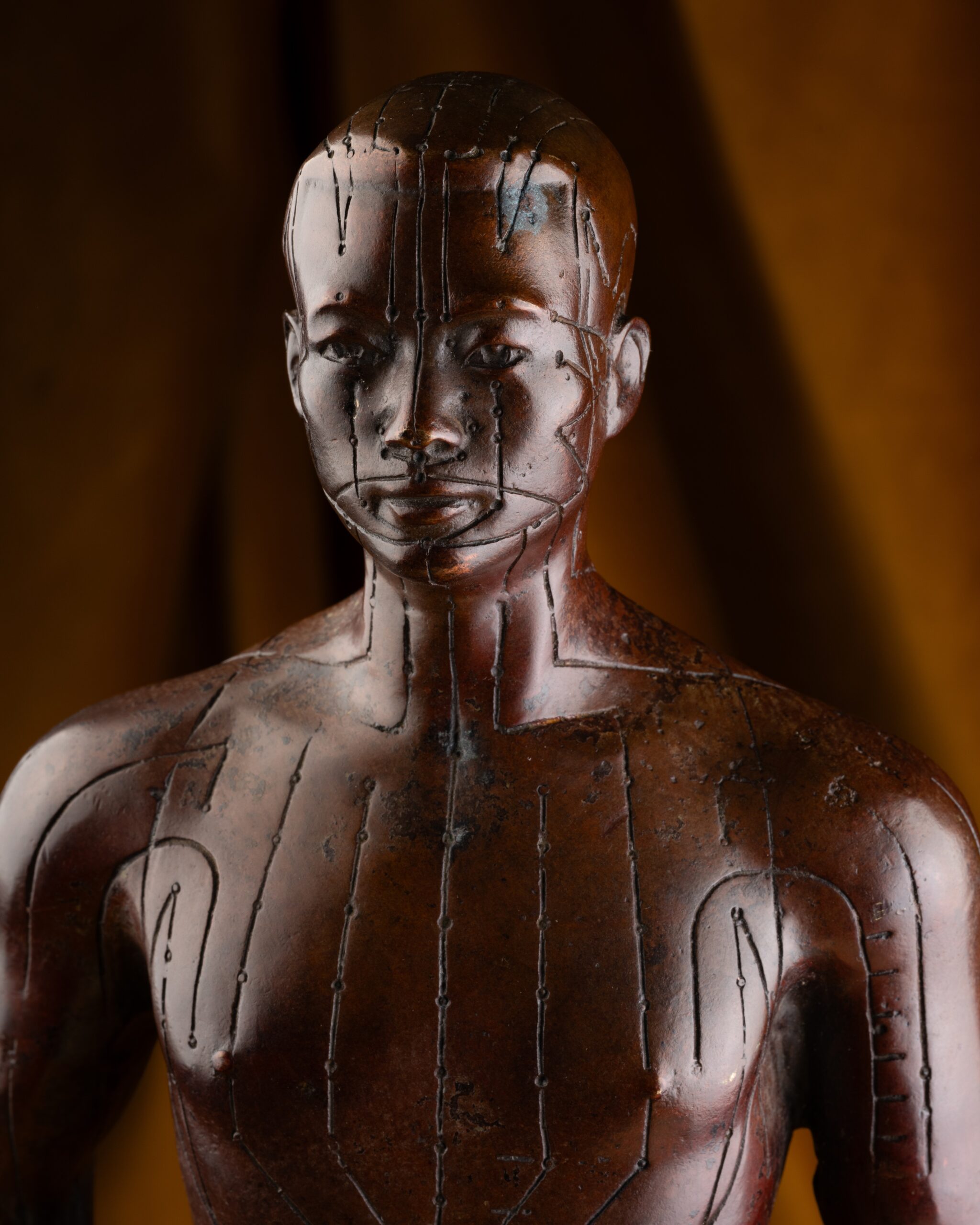
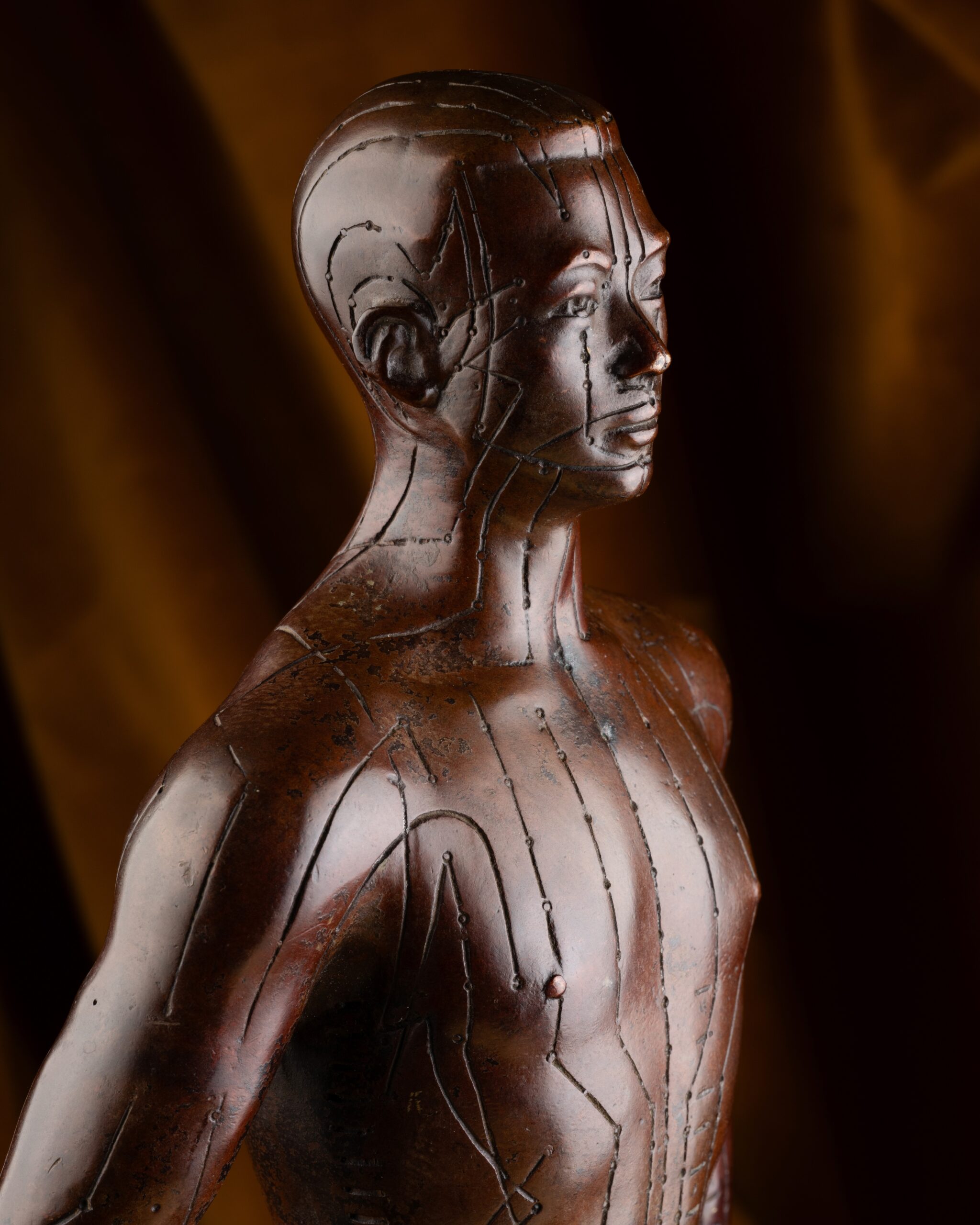
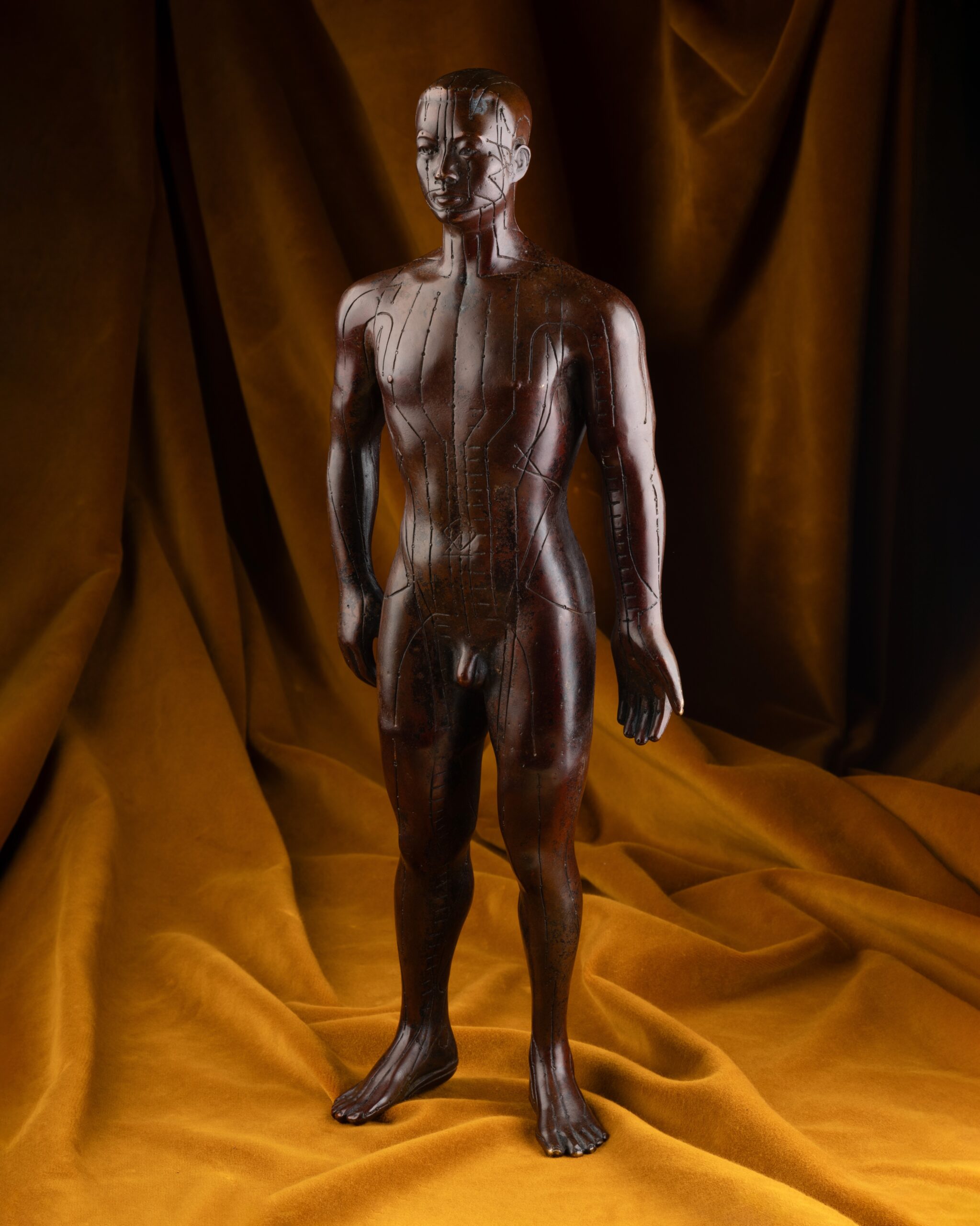
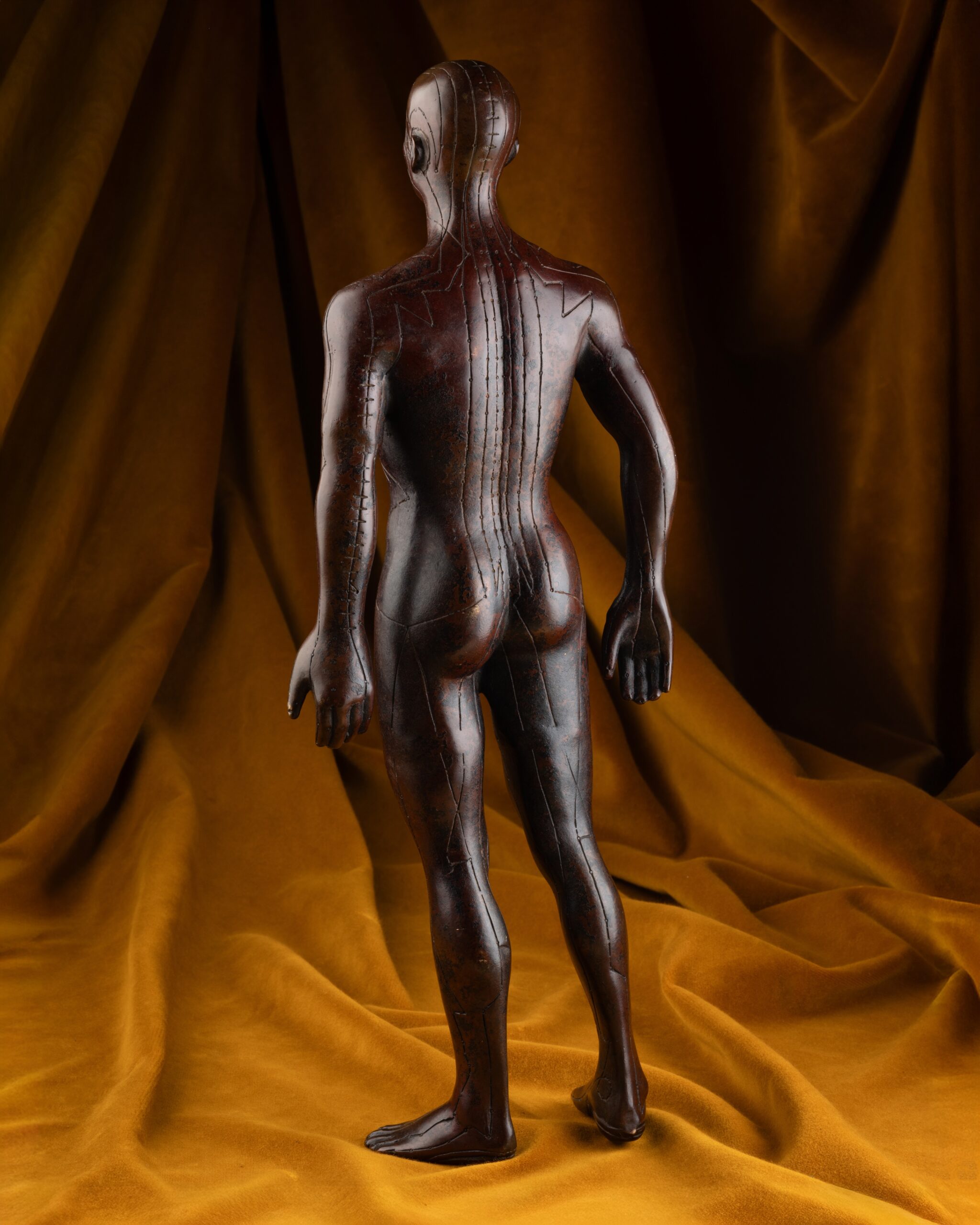
This acupuncture bronze model, or tong ren, represents an interesting synthesis of art and medical science, rooted in a tradition of acupuncture education dating back to the Song Dynasty in 11th-century China. Far more than a decorative sculpture, it serves as a standardized three-dimensional textbook, meticulously mapping the meridians and acupoints through which Qi is believed to flow.
This specific figure is a Modern iteration of the classical medical model, produced via sand casting with a sand core. Cast in a heavy bronze alloy, the sculpture features a dark, oxidized patina that accentuates the intricate network of 361 primary acupuncture points and 14 major meridians (Jingluo) integrated directly into the metal. The anatomy is presented in a rigid, formalized “anatomical position” to ensure an unobstructed view of the pathways and the Chinese characters identifying each site. It functions as a precise cartographic instrument, codifying the body as a “microcosm” of universal forces and providing a tangible, durable reference for the complex topography of Traditional Chinese Medicine.
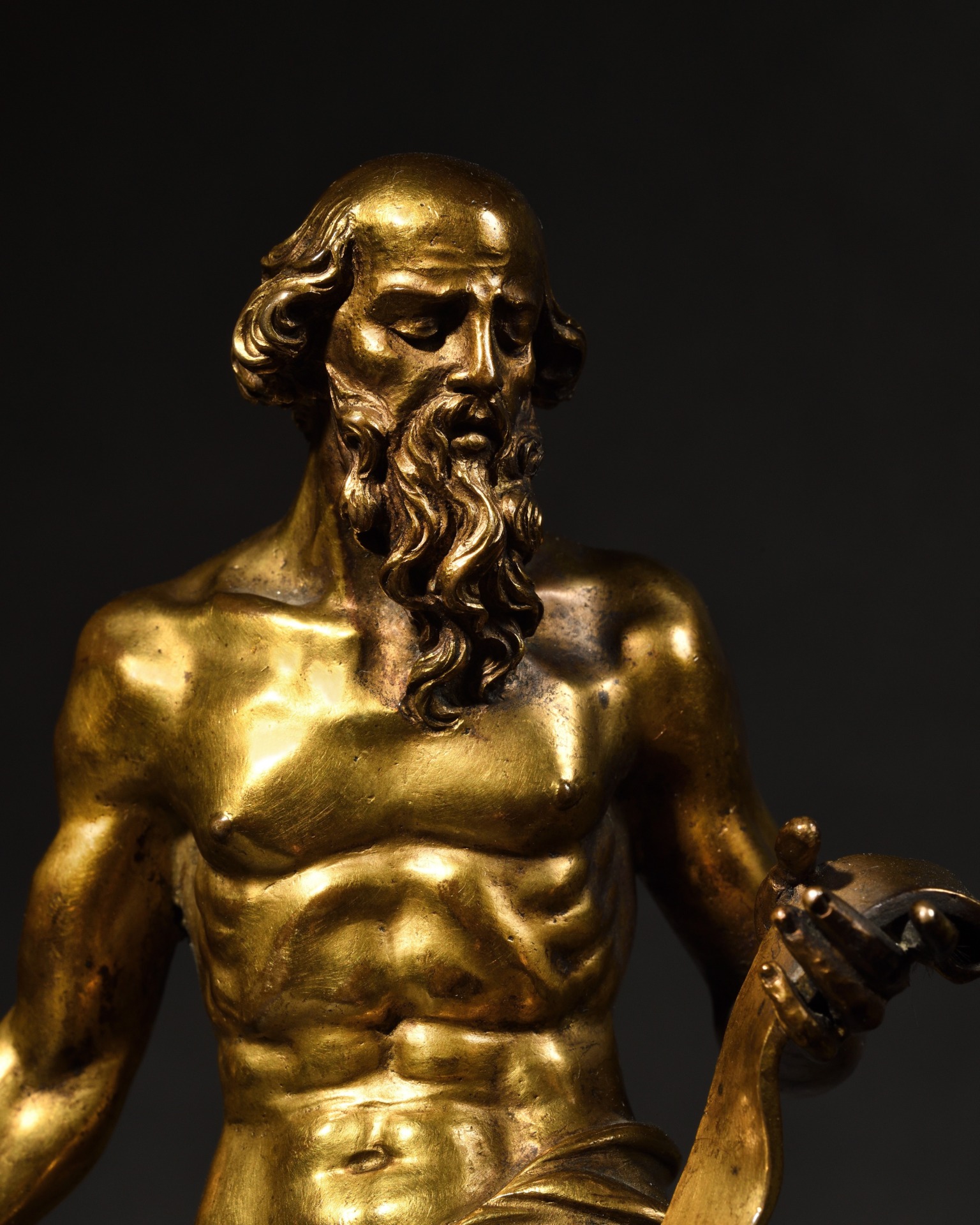
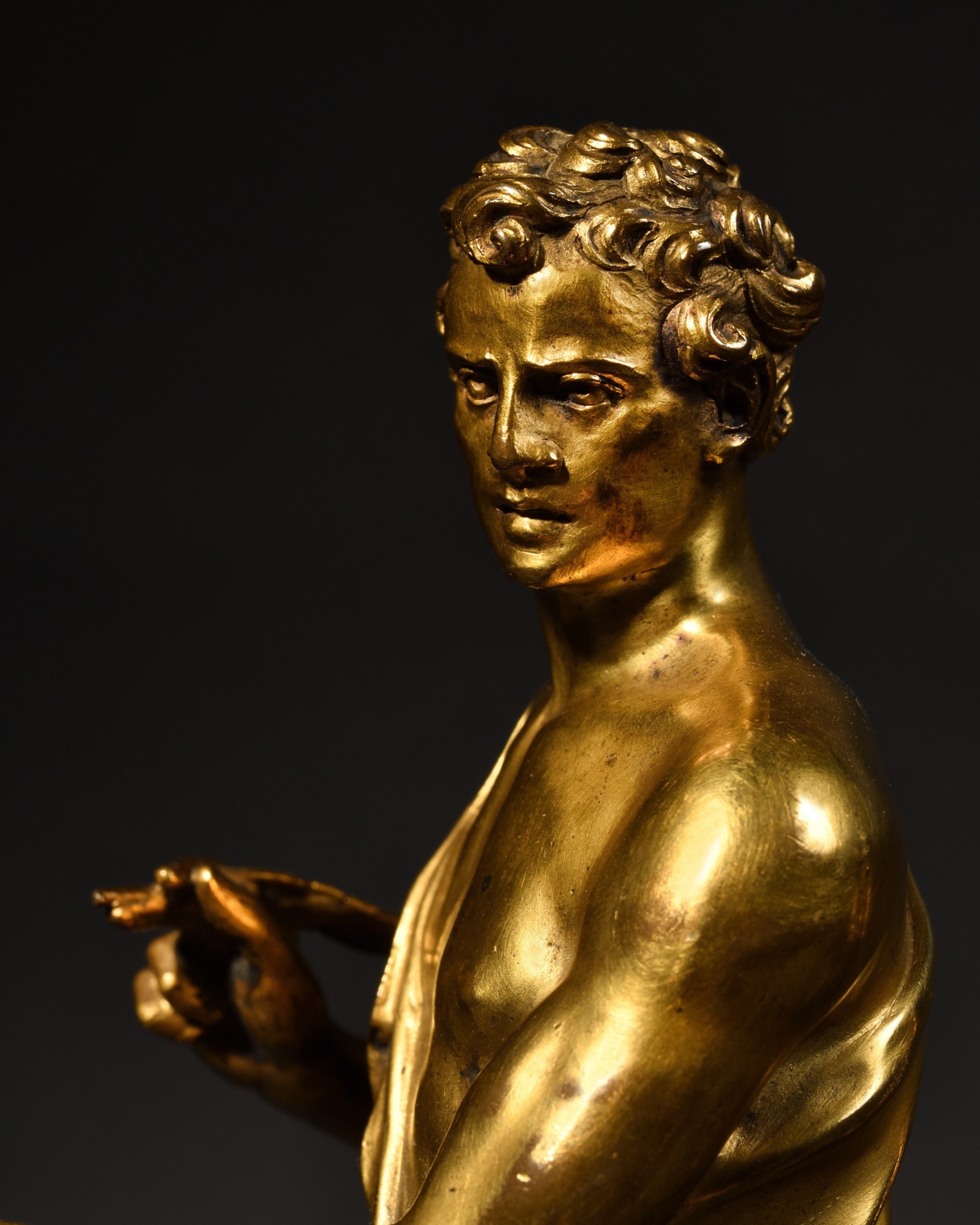
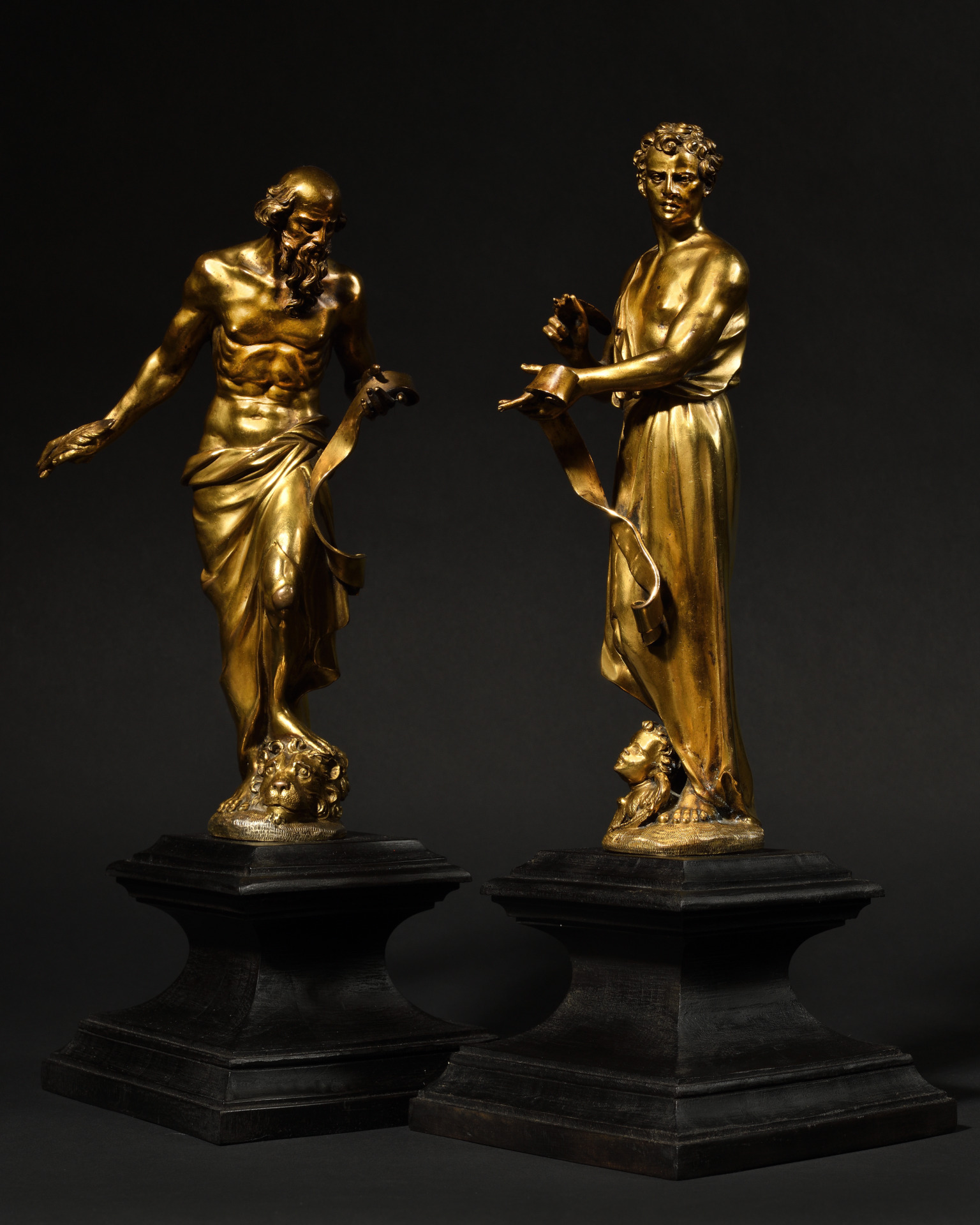
Saint Mark and Saint Matthew, by the Master of Ciechanowiecki
Saint Mark and Saint Matthew, by the Master of Ciechanowiecki
Mercury-gilt bronze, base sealed with silver-soldered copper Northern Italy or Germany 17th century h. 22 cm (8.6 in., without accessories)
Saint Mark: possibly the Camillo Castiglioni collection, then David David-Weill; Saint Mark and Saint Matthew: collection of Jacques Favre de Thierrens.
These two gilded bronze sculptures depict two of the Evangelists. They are identifiable by their attributes: the lion for Saint Mark, the winged man for Saint Matthew, and each holds a scroll in one hand and a quill in the other. The extraordinary refinement of the sculpture and the care given to every detail attest to the talent of an artist whose name remains unknown to this day.
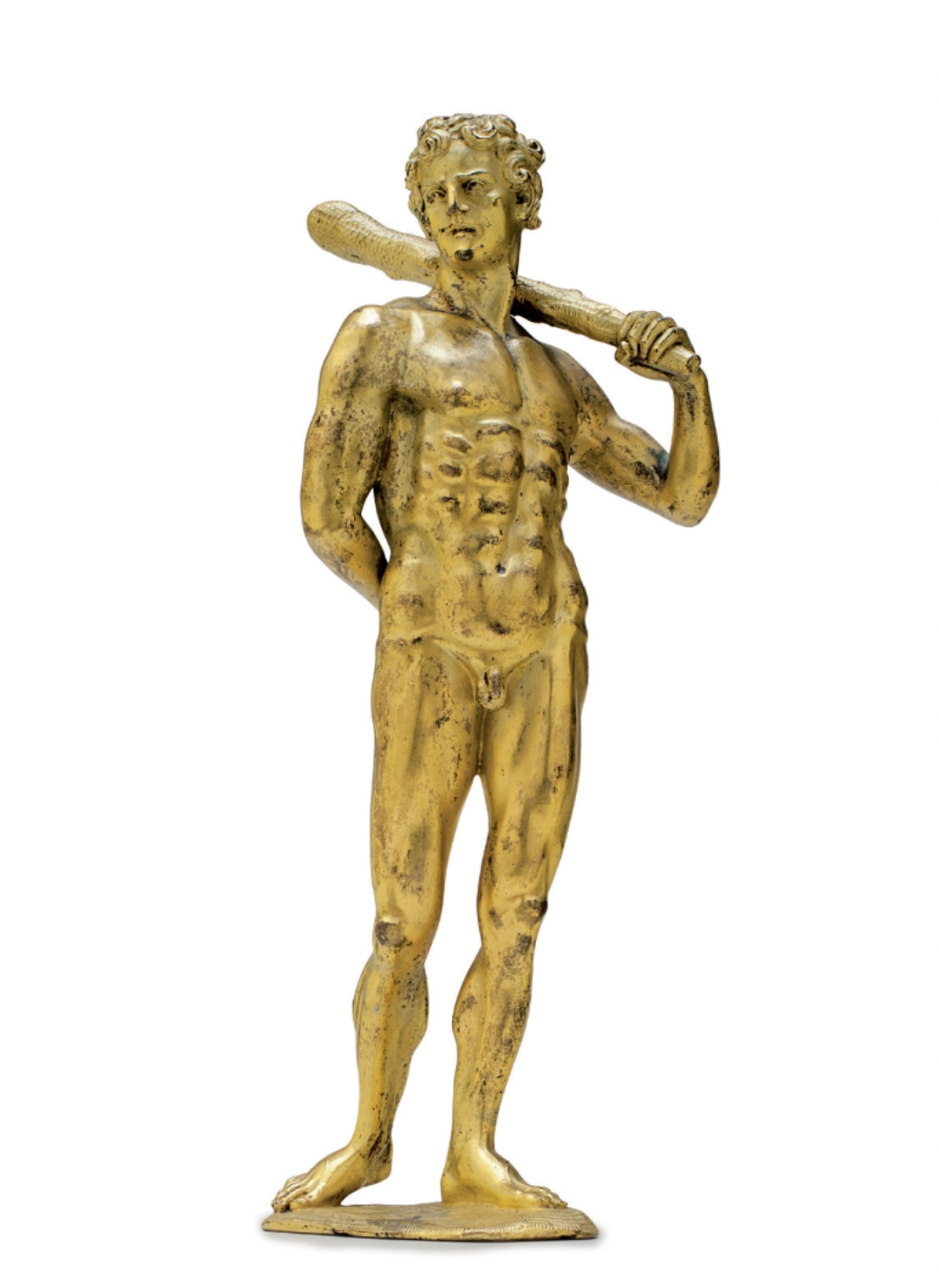
Fig. 1 — Young Hercules, Master of Ciechanowiecki. Christie’s, 4 July 1989, lot 128 — sold for £85,000.
Nevertheless, these two figures can be integrated into the body of works brought to light by Andrew Ciechanowiecki from the 1960s onwards. This patron, gallerist and bronze specialist had identified a group of around forty sculptures that all appeared to have been made by the same hand. The artist behind these works is today known as the “Master of Ciechanowiecki” or the Master of the Fitzwilliam Museum, as part of Ciechanowiecki’s collection had been placed on deposit at that museum for a number of years.
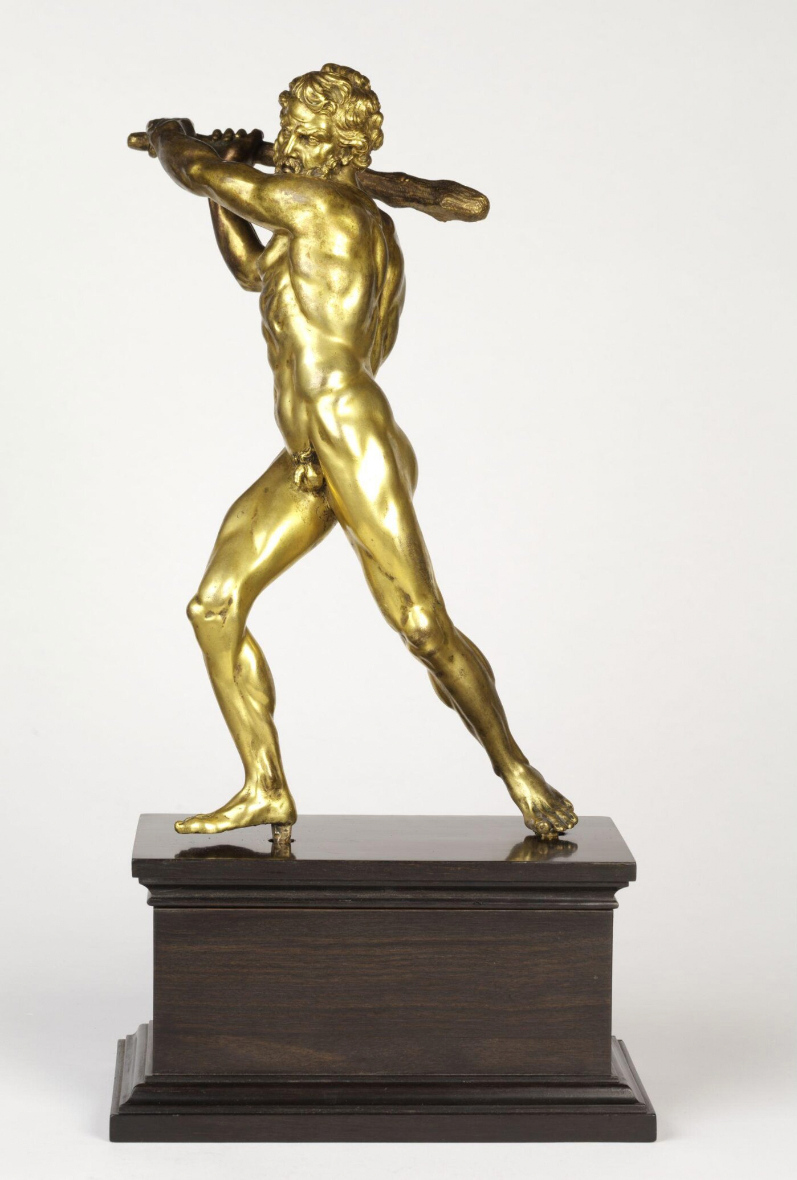
Fig. 2 — Hercules, attributed to the Master of Ciechanowiecki. Victoria and Albert Museum, h. 33.3 cm.
The characteristics shared by these works have been described by several specialists, beginning with Ciechanowiecki himself in his correspondence (Doc. 1). This letter reveals his difficulty in pinpointing a geographical region for these bronzes, so thoroughly do the works appear to synthesise the styles and techniques employed in Italy, Germany, Flanders and France during the 17th century.
Doc. 1 — Lettre de A.S. Ciechanowiecki à K. Lankheit. Extrait de Białonowska, M. (2012). Andrzej Stanisław Ciechanowiecki. Collectionneur, marchand et mécène, Lublin. Pages 79-81.
“In January 1969 A. S. Ciechanowiecki asked Klaus Lankheit: The bronze of which I enclose a photograph has been a headache to me for some time. I had originally seen it in the circle of Hubert Gerhard, then moved towards the idea of an unidentified Flemish master, by whom a group of works could be assembled, including the very pretty bronze in the Huntington collection in San Marino and a gilt group in my own collection […]. This is still my opinion but one or two colleagues have suggested that it may be around 1700 and have again pointed towards Florence. I am not at all convinced by this suggestion […]. In response, Klaus Lankheit confirmed the dating: “Die Figur gehört in die Epoche um 1700. Die Faltengebung könnte in der Tat für Soldani sprechen, inc drängt sich mir das Französische in der Figur sehr Stark auf.” The correspondence shows that at the end of the 1960s, A. S. Ciechanowiecki had a certain number of statuettes in his collection, which allowed him to draw conclusions about their attribution after observing their common features. It is also known that from the very beginning the collector and researchers saw in the works of an unknown master both features of Italian sculpture, mainly Florentine, and South German, French and even Flemish.”
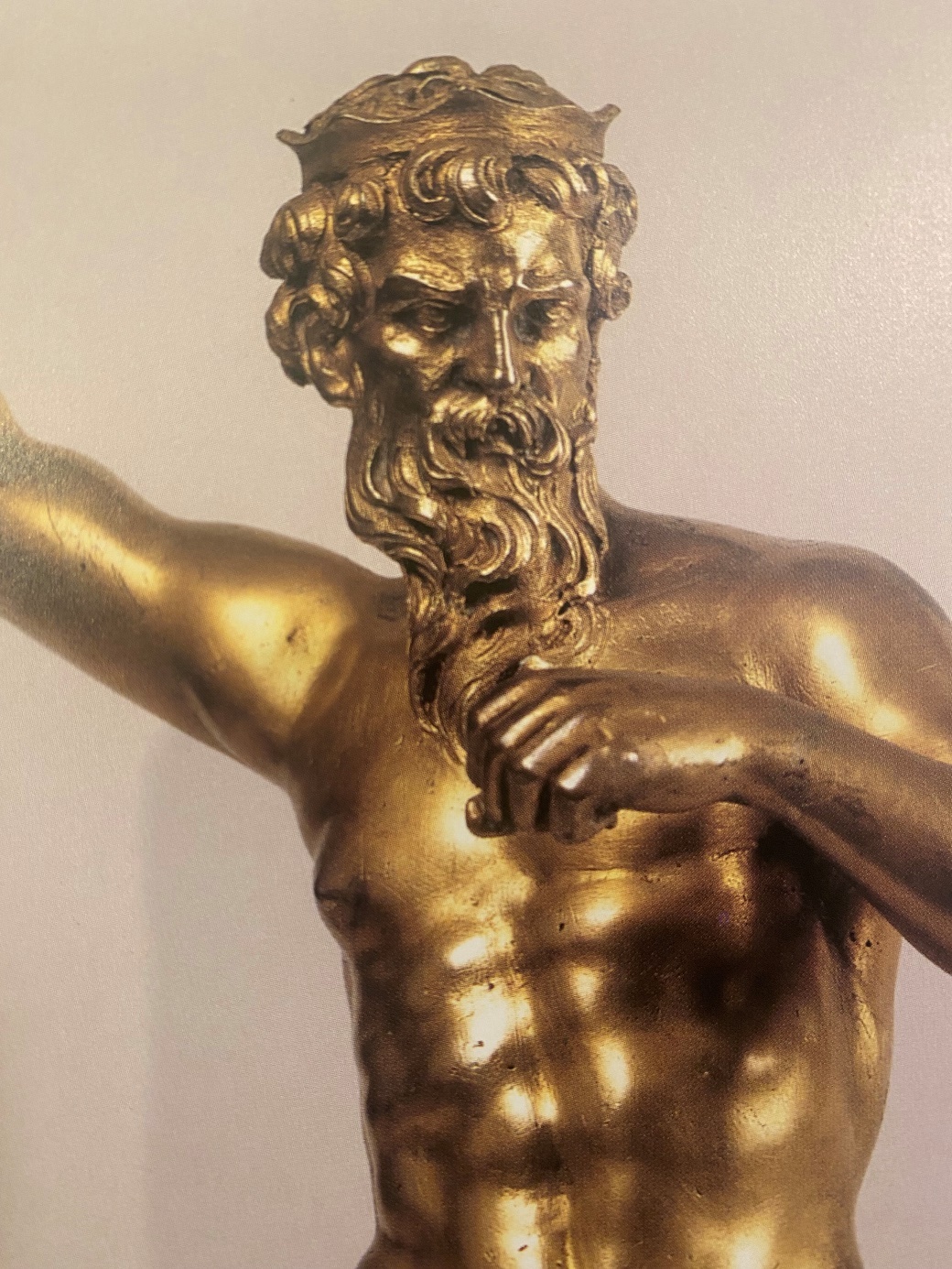
Fig. 3 — Neptune, Master of Ciechanowiecki. Museo Civico Amedeo Lia, La Spezia, h. 22 cm.
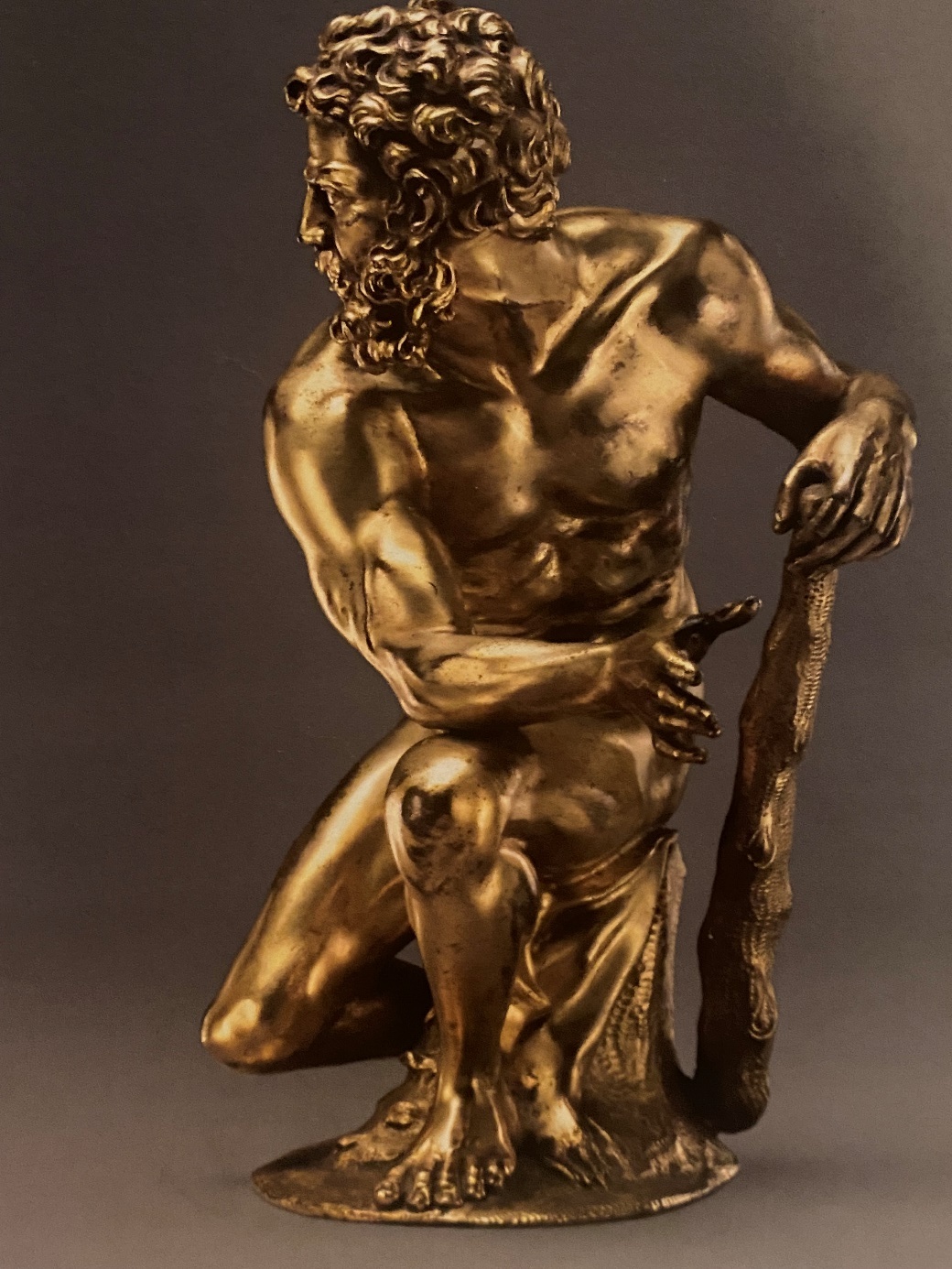
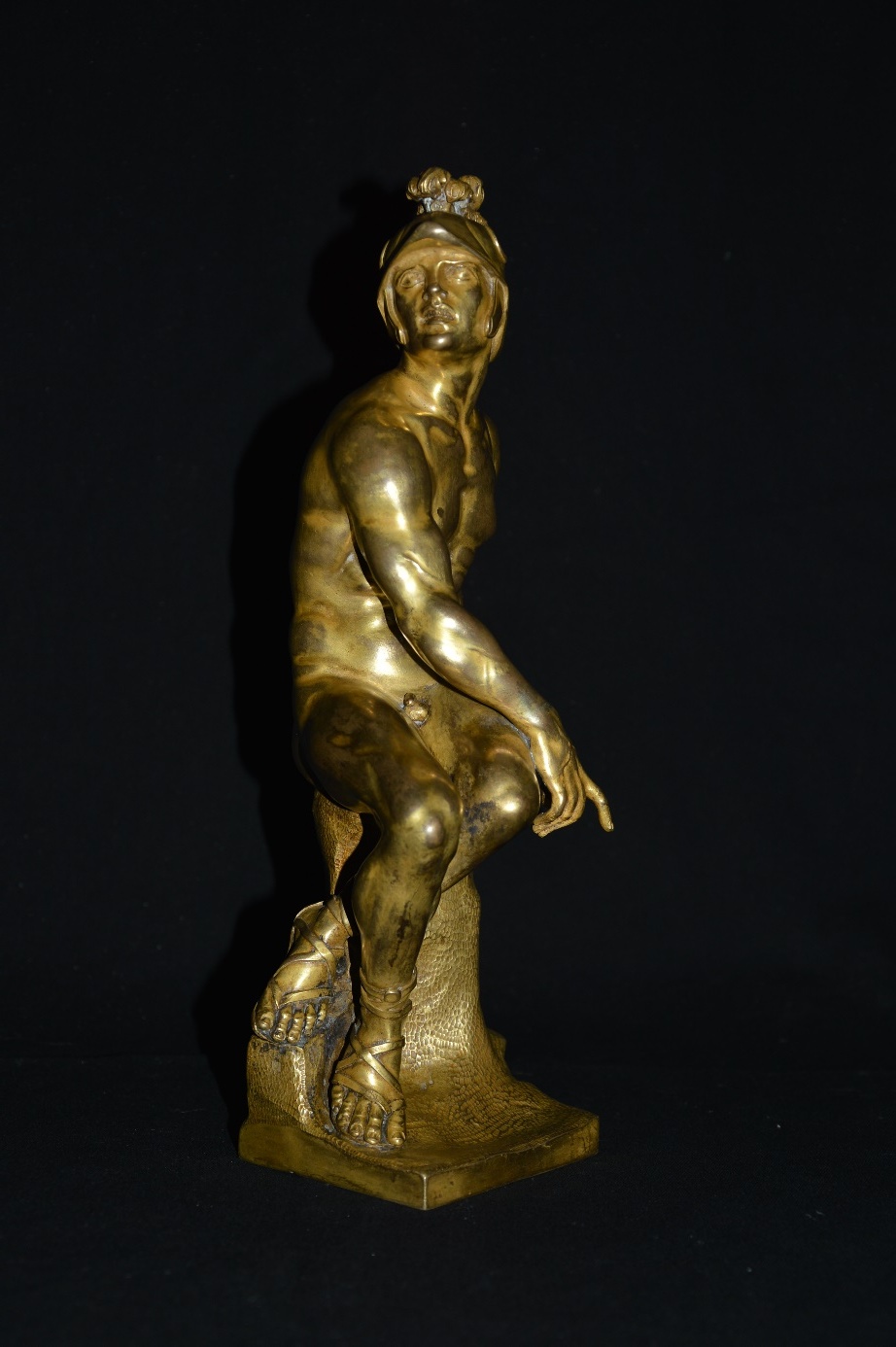
It has thus been possible to isolate a number of shared characteristics that allow one to identify the hand of this master. These include their small size (averaging around twenty centimetres), the frequent use of gilt bronze, an exceptionally fine level of chasing throughout, and a delicacy in the treatment of surfaces that calls to mind the work of a goldsmith. Then there is the hair of the figures, composed of thick, curling locks that fall heavily over the forehead (as in the model of a young Hercules commonly attributed to the Master of Ciechanowiecki, Fig. 1). The barely incised irises, the furrowed, pronounced brows (Fig. 2 and 3), and the high, prominent cheekbones (Figs. 1, 4 and 5). The lean, powerful musculature, which betrays an excellent knowledge of anatomy, is heightened by predominantly frontal and dramatic poses that reflect a distinctly Baroque sensibility. Attention to detail — such as veins and fingernails (Figs. 4 and 5) — combined with the wide variety of chasing techniques employed (notably on the bases of most sculptures) creates contrast between the textures depicted.
Fig. 4 — Seated Hercules, Master of Ciechanowiecki, Italy, Rome, 2nd half of the 16th century, h. 15.2 cm.
The fact that certain elements appear so strikingly similar (the faces of the Hercules, Fig. 1, and our Saint Matthew) and that some sculptures present variations in pose suggests that the artist created separate components that were then assembled onto the main figure: arms, head, hands and accessories were likely cast from individual moulds, allowing the artist to vary the composition without having to create an entirely new model. All of these elements have led the specialists who have grappled with this genuine puzzle to associate the master with an artist active in the first half of the 17th century, who probably worked in Rome or Florence and was influenced by the styles of Giambologna, Bernini and Adriaen de Vries. The techniques employed suggest that the master may have been a German goldsmith trained in Augsburg, a major centre of gilt bronze sculpture at the time. In terms of style, the work shows a strong influence of Italian Mannerism, and more specifically that of an artist who would have worked in Rome during the 17th century.
Fig. 5 — Mars, attributed to the Master of Ciechanowiecki. Private collection.
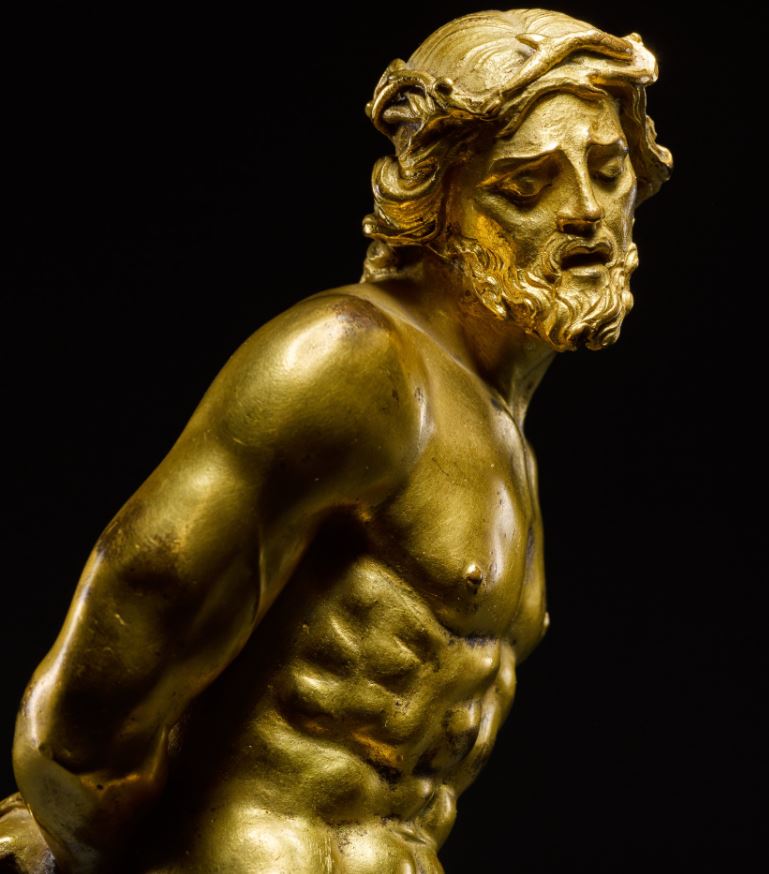
A Christ at the Column (Figs. 6) sold at Sotheby’s London in December 2021 can also be associated with this corpus: it shares similar dimensions with the pieces previously discussed, and its expression, the treatment of the drapery, the handling of the base, and the rendering of the musculature are all comparable. It has been linked to the Italian sculptor Alessandro Algardi, as this model of Christ was traditionally attributed alternately to Algardi and Duquesnoy, with experts never having reached agreement. This example illustrates how significant artistic exchanges between artists of different nationalities were during this period: a model attributed to a Frenchman and an Italian was taken up by the Master of Ciechanowiecki, an artist who was probably German.
Fig. 6 — Christ at the Column, follower of Alessandro Algardi, Italy, Rome or Southern Germany, 17th century, h. 21 cm. Sotheby’s London, 7 December 2021.
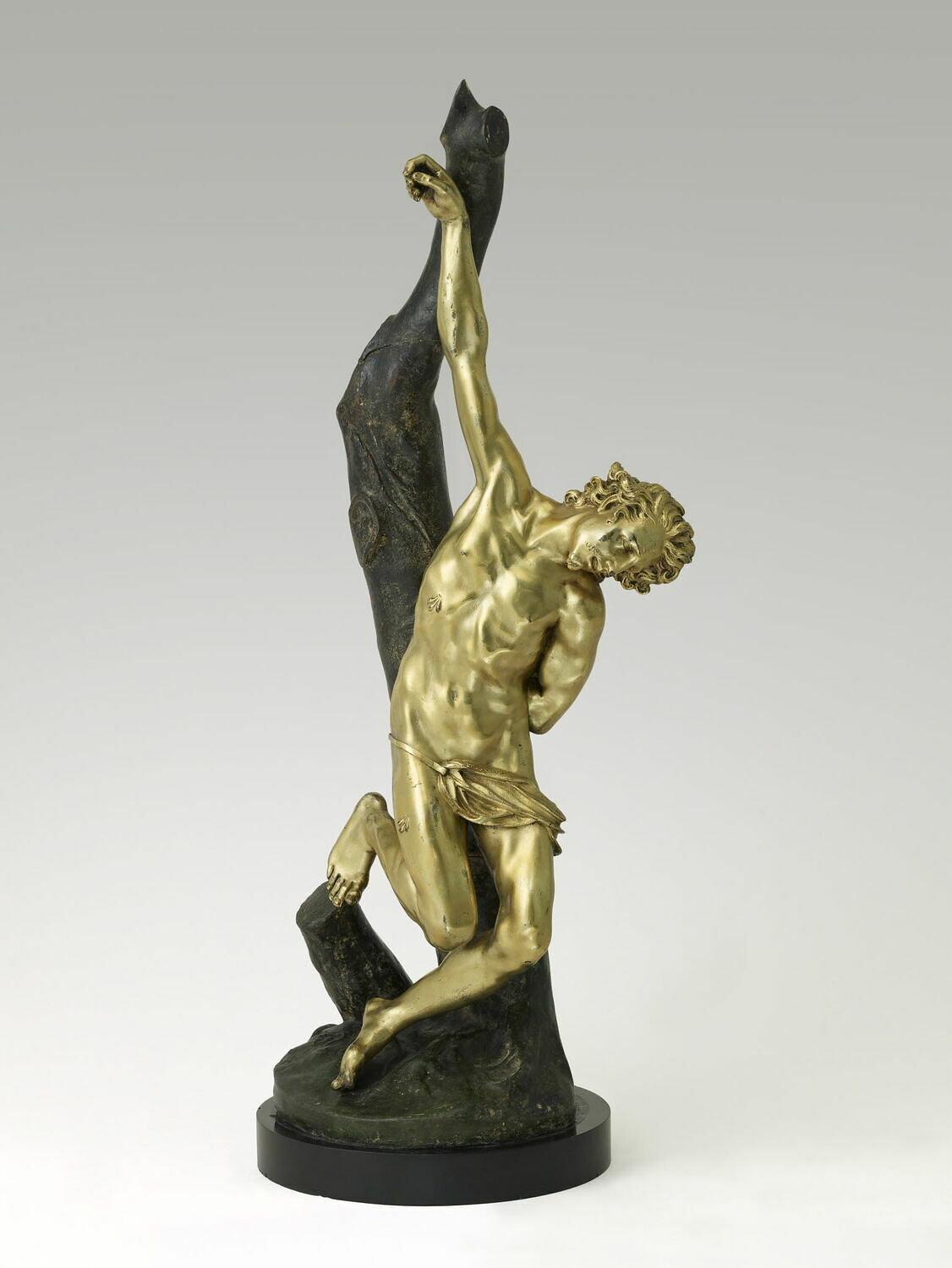
There is a Saint John the Baptist (Fig. 7) in the Louvre that has been attributed to a German artist by the name of Georg Petel, nicknamed the “German Michelangelo.” This work could be associated with the corpus attributed to the Master of Ciechanowiecki. Petel, German by origin, visited Italy and almost certainly France, and built his career in Augsburg in the context of the Counter-Reformation. Furthermore, as a friend of Rubens and Van Dyck, he was acquainted with the sculptures of Giambologna and Bernini. It is possible that the Master of Ciechanowiecki belonged to this artist’s circle.
Fig. 7 — Saint Sebastian, formerly attributed to Georg Petel. Musée du Louvre.
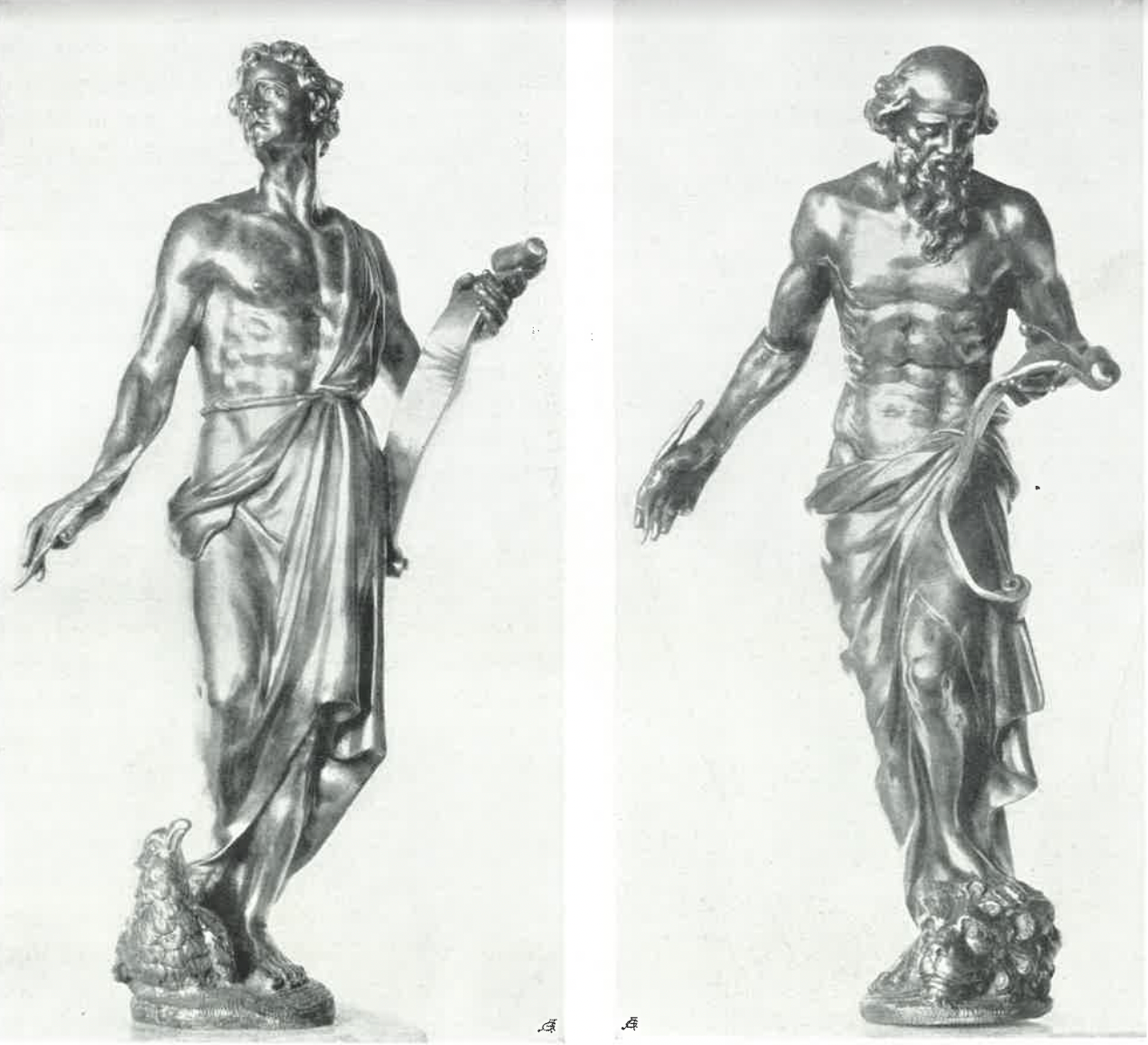
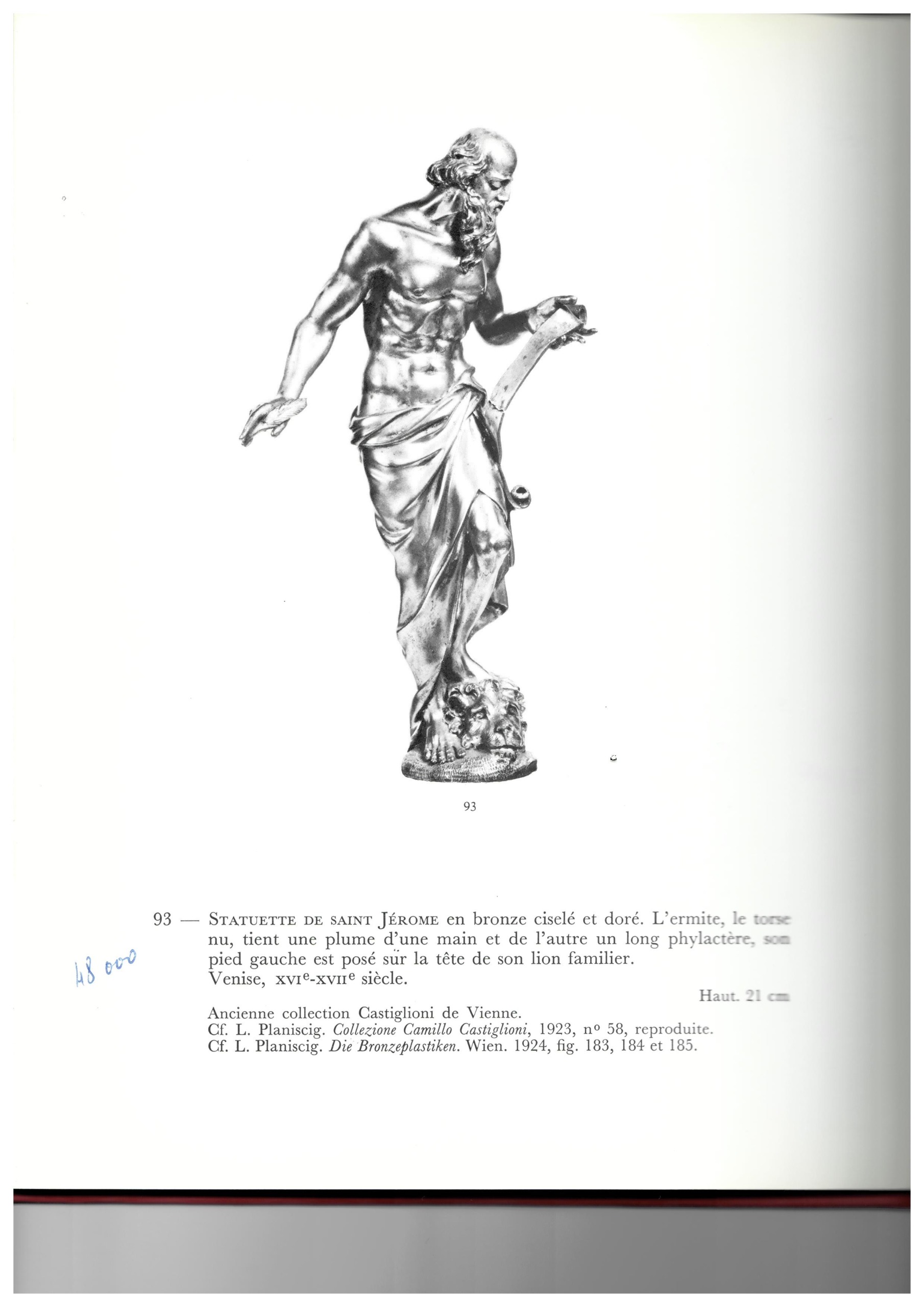
What is in any case certain is that our master’s models were produced in variants, known across different periods and reproduced with varying degrees of success. In the case of our Evangelists, a Saint John and a Saint Mark were sold in 1925 (Fig. 8); they formed part of the prestigious Camillo Castiglioni collection and had been attributed to Tiziano Aspetti by Leo Planiscig. The Saint Mark from the Castiglioni collection subsequently appeared as a Saint Jerome in the David David-Weill collection, sold in Paris on 16 June 1971 (Fig. 8). Another Saint John is known in the collection of the Minneapolis Institute of Art, though that piece is of mediocre quality and considerably later in date, as is a Saint Matthew held by the Royal Palace Museum in Warsaw.
Fig. 8 — Saint John and Saint Mark, attributed to Tiziano Aspetti. Camillo Castiglioni collection, sold in 1925.
In light of all these elements, we can confidently state that this pair of sculptures represents an extremely significant landmark in art history: combining characteristics of both Italian and German sculpture, of Mannerism and the Baroque, these are works of geographical and stylistic transition — witnesses to the extraordinary vitality of the artistic world at the turn of the 17th century, despite the prevailing climate of political turmoil.
Fig. 9 — Lot 93, “Collection D. David-Weill” sale, Ader, Paris, 16 June 1971.
Literature
See Białonowska, M. (2012). Andrzej Stanisław Ciechanowiecki. Collectionneur, marchand et mécène, Lublin, pp. 79-81; Warren, J., Bewer, F. G., Cosentino, L., & Dorment, R. (2010). Beauty & Power: Renaissance and Baroque Bronzes from the Peter Marino Collection, Wallace Collection, p. 54; Avery, C. (1998). Sculture, bronzetti, placchette, medaglie, Museo Civico Amedeo Lia, La Spezia, n. 97; Planiscig, L. (1921). Venezianische Bildhauer der Renaissance, Schroll, p. 591; sale catalogue, Collection D. David-Weill, Ader, Paris, 16 June 1971, lot 93.
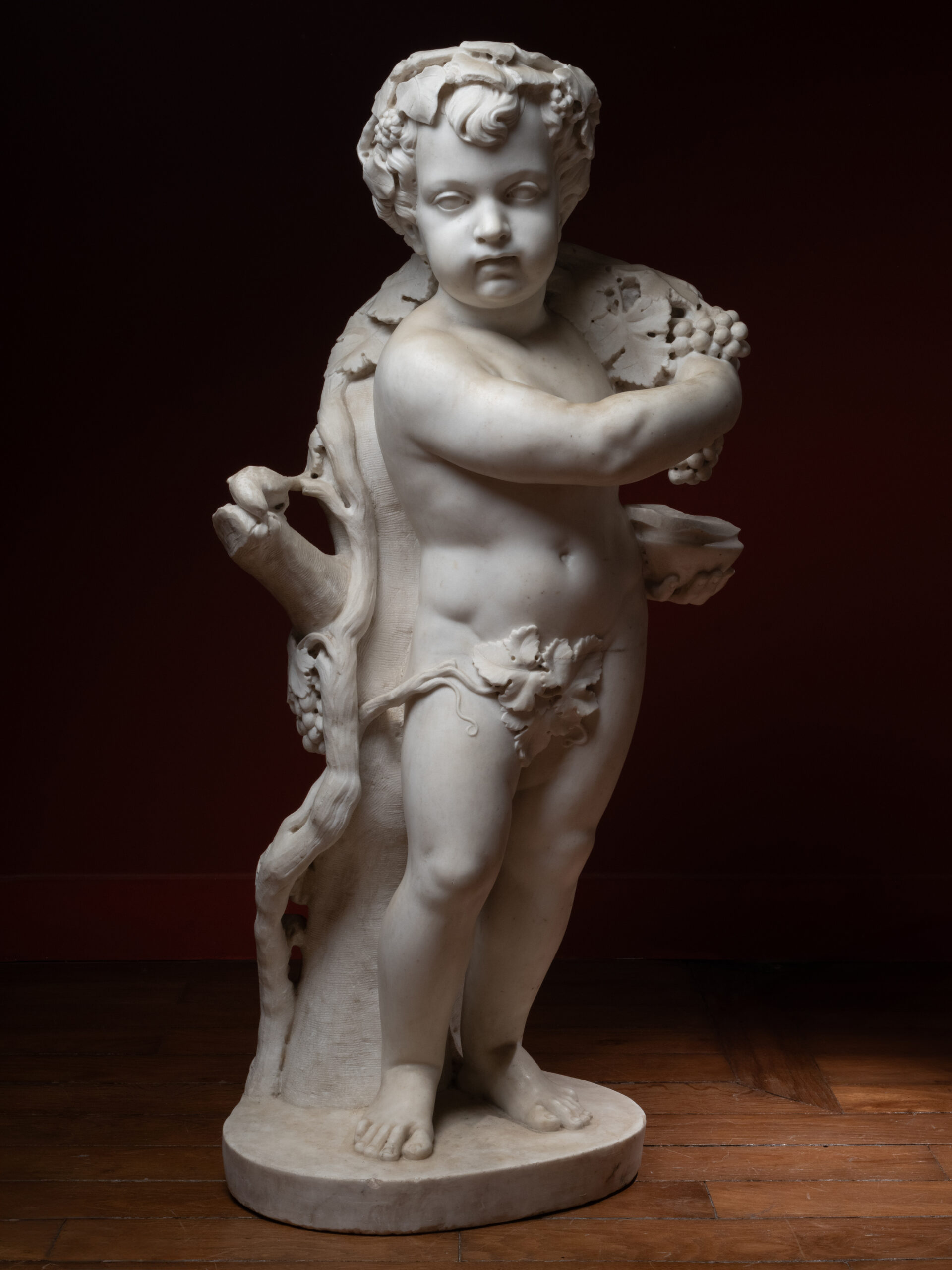
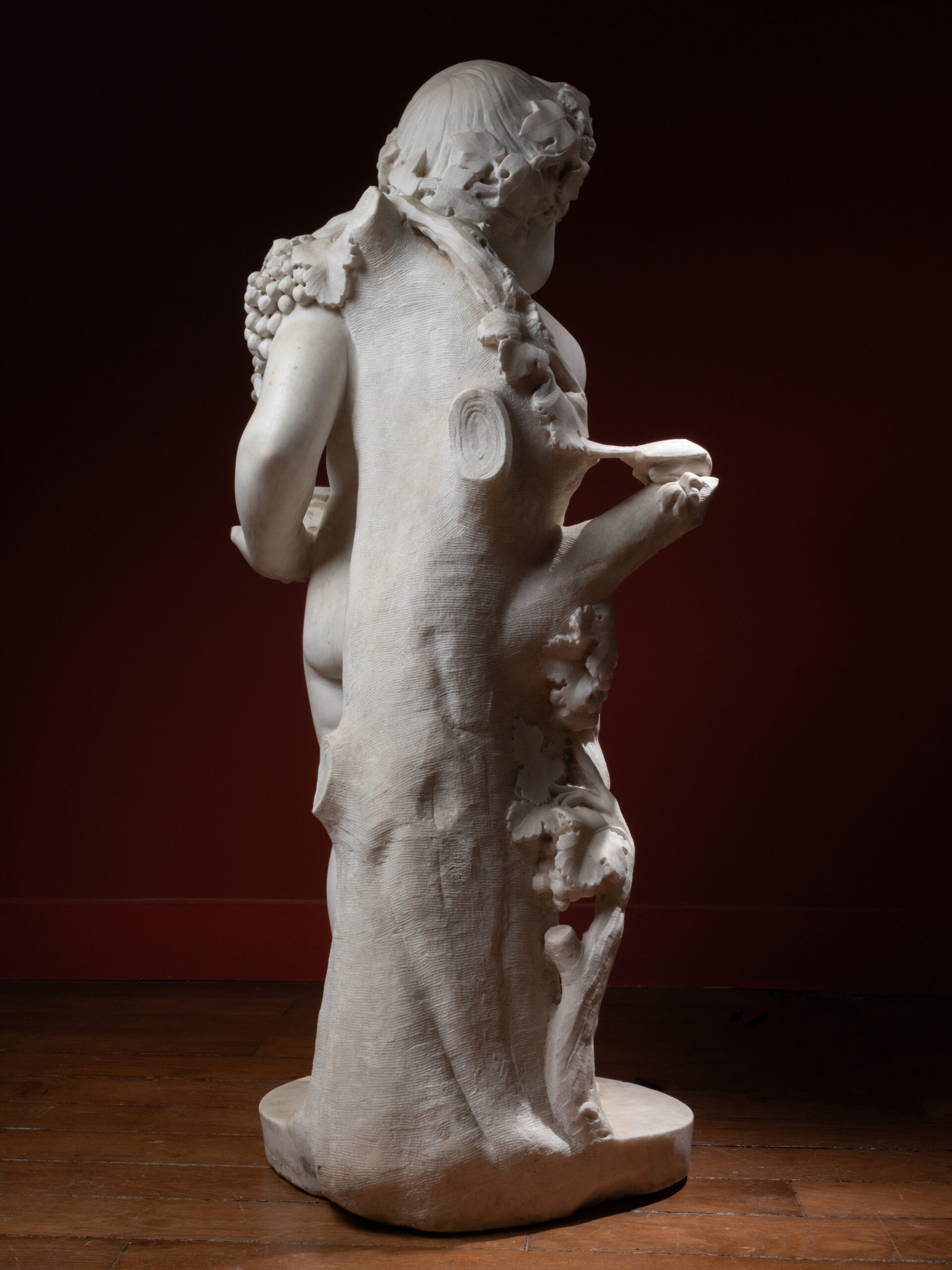
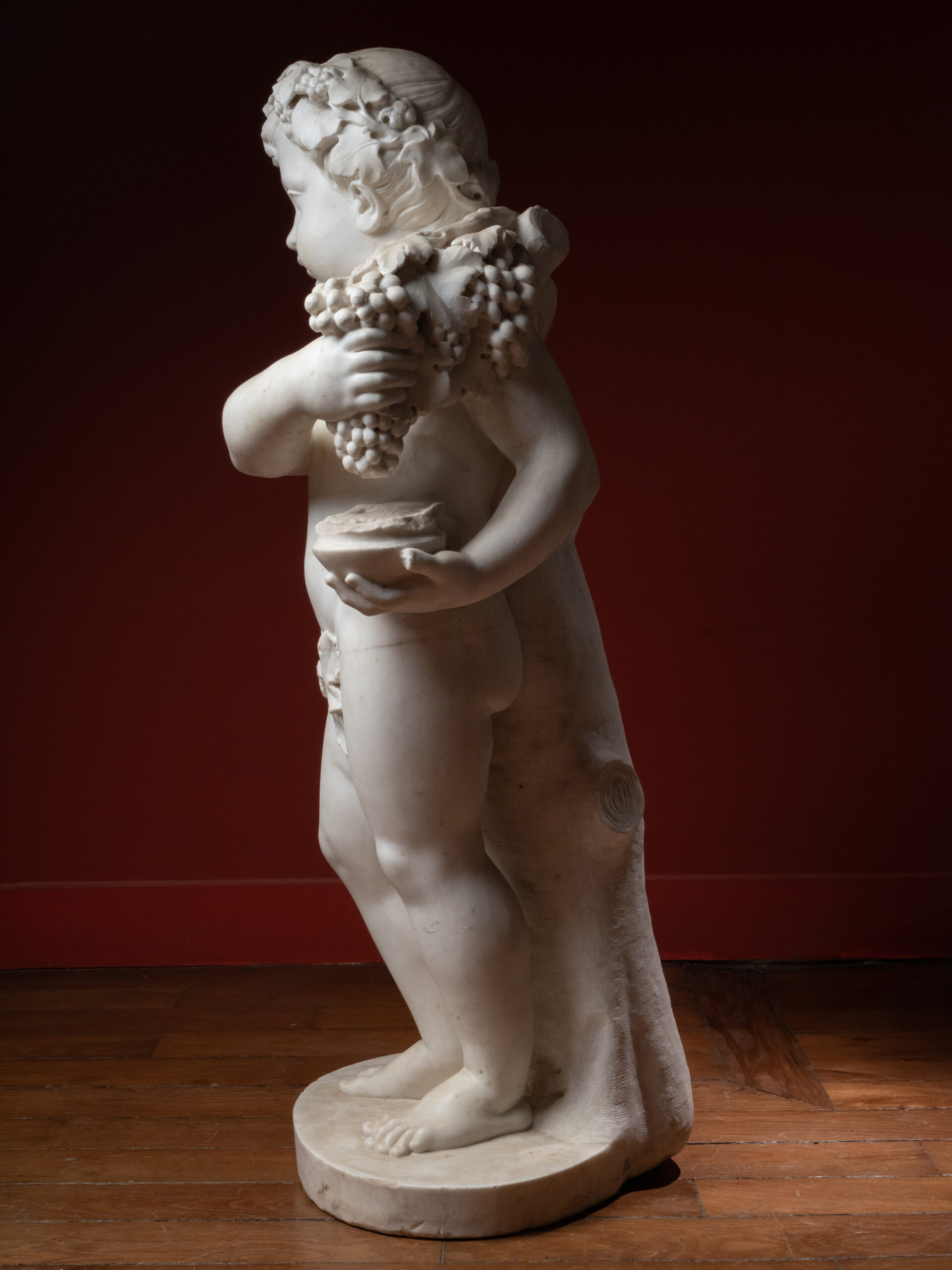
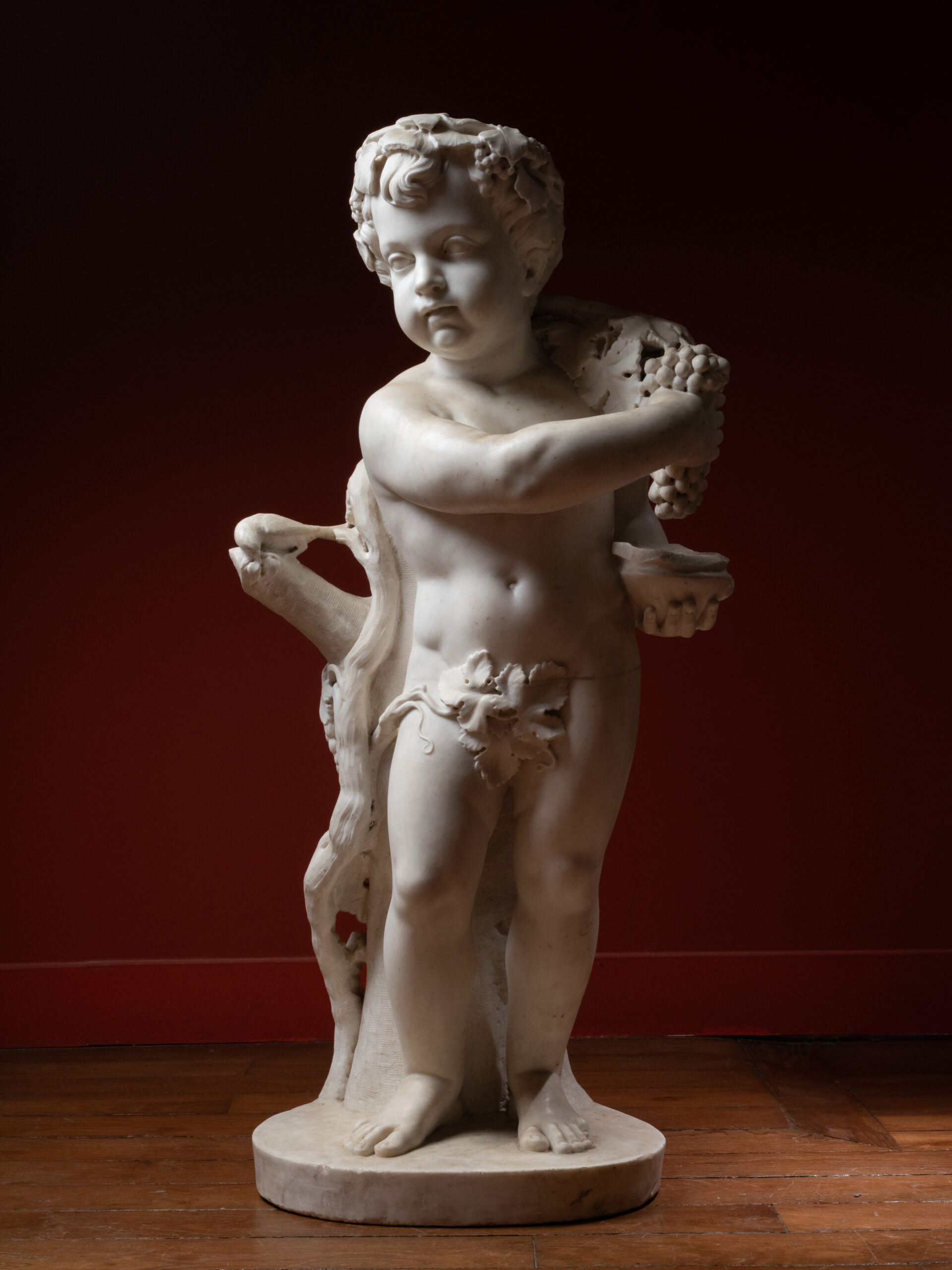
Allegory of Autumn by Jan Claudius de Cock
Allegory of Autumn, by Jan Claudius de Cock
Marble Antwerp ca. 1705-1710 h. 94 cm (37 in.)
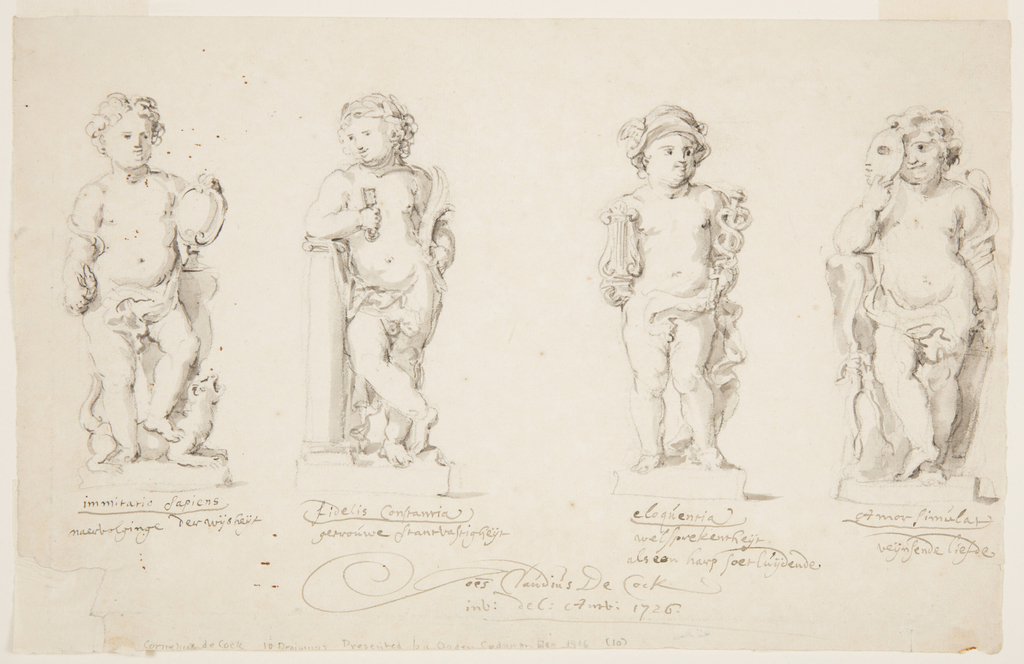
This exceptional grapes-and-vines-wearing marble allegory of Autumn is attributed to Jan Claudius de Cock, a Flemish sculptor and draughtsman born in 1667. Greatly influenced by François Duquesnoy, Jan Claudius, a member of the Antwerp Guild of Saint Luke ca. 1688-1689, specialised in small marble and terracotta figures of children, mostly representing allegories of virtues, lands, elements or seasons.
Jan Claudius de Cock, Drawing, projects for statues : Wisdom, Constancy, Eloquence, Cupid disguised (1726), Cooper Hewitt Museum, New York City ; crayon, pen, ink, brush, watercolor on paper, 20,9 x 32,9 cm.
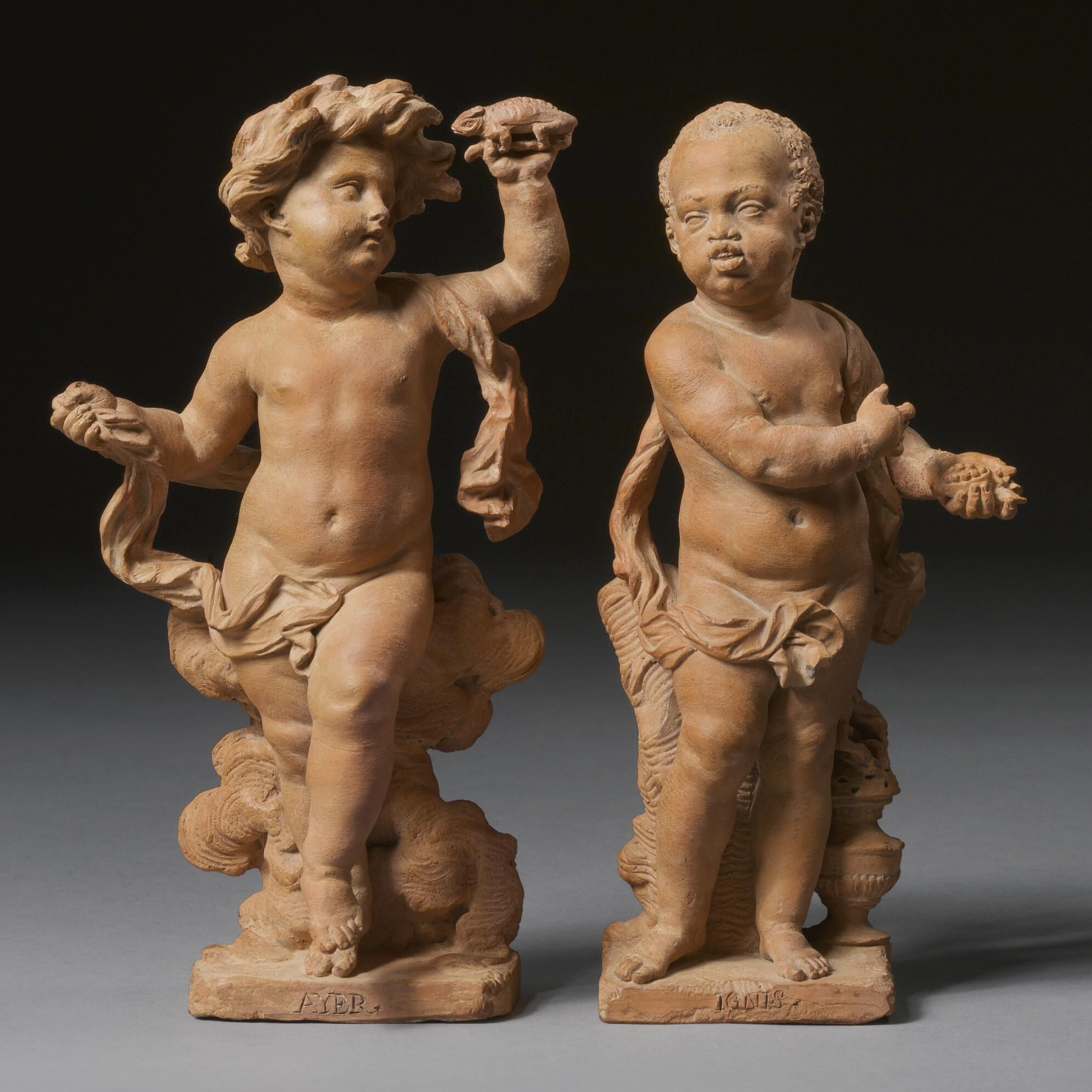
Rijksmuseum’s Allegory of Africa (1704) is the earliest known marble of this kind, followed by a War Crowning Peace (1710) whose terracotta is now at the Stedelijk Museum in Breda. Notably, a pair of terracotta figures depicting Air and Fire, dated ca. 1705, one of which shows the same gesture as the present marble. Jan Claudius’ terracotta sculptures were typically prototypes, studies, concetti meant to be an early step of his creative process. Yet the marble figures for which these two terracotta are unrecorded and it is uncertain whether they were ever turned to marble.
Jan Claudius de Cock, A Pair of Figures representing Air and Fire (ca. 1705), Gallery Tomasso, London ; terracotta, 27 cm high.
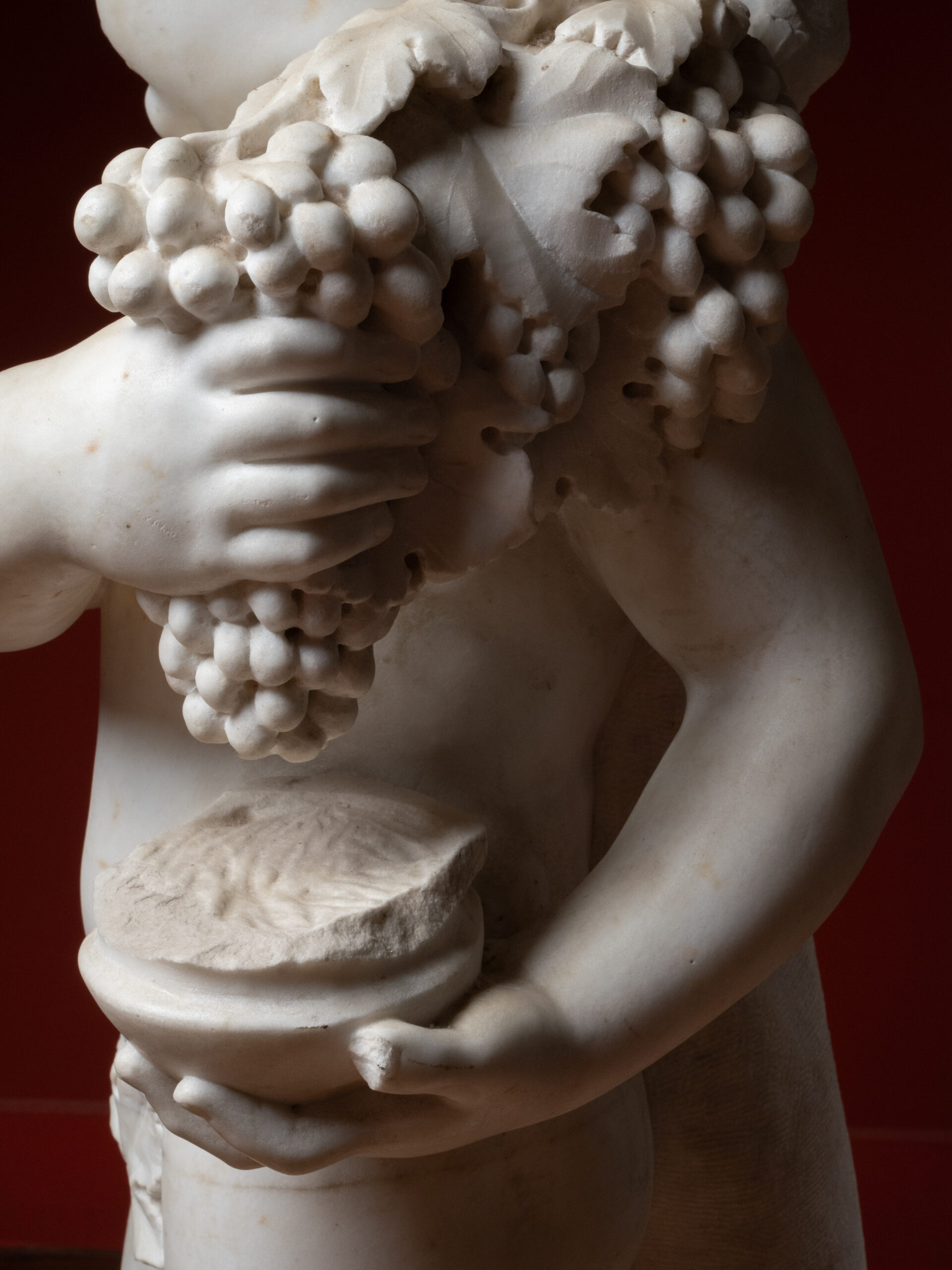
It is plausible that the terracotta models were repurposed, with Jan Claudius adapting the composition of Fire for another commission, or using some elements for another project. In doing so, he retained the tree trunk as a structural component of the contrapposto and turned the pomegranate into a bowl to contain the wine.
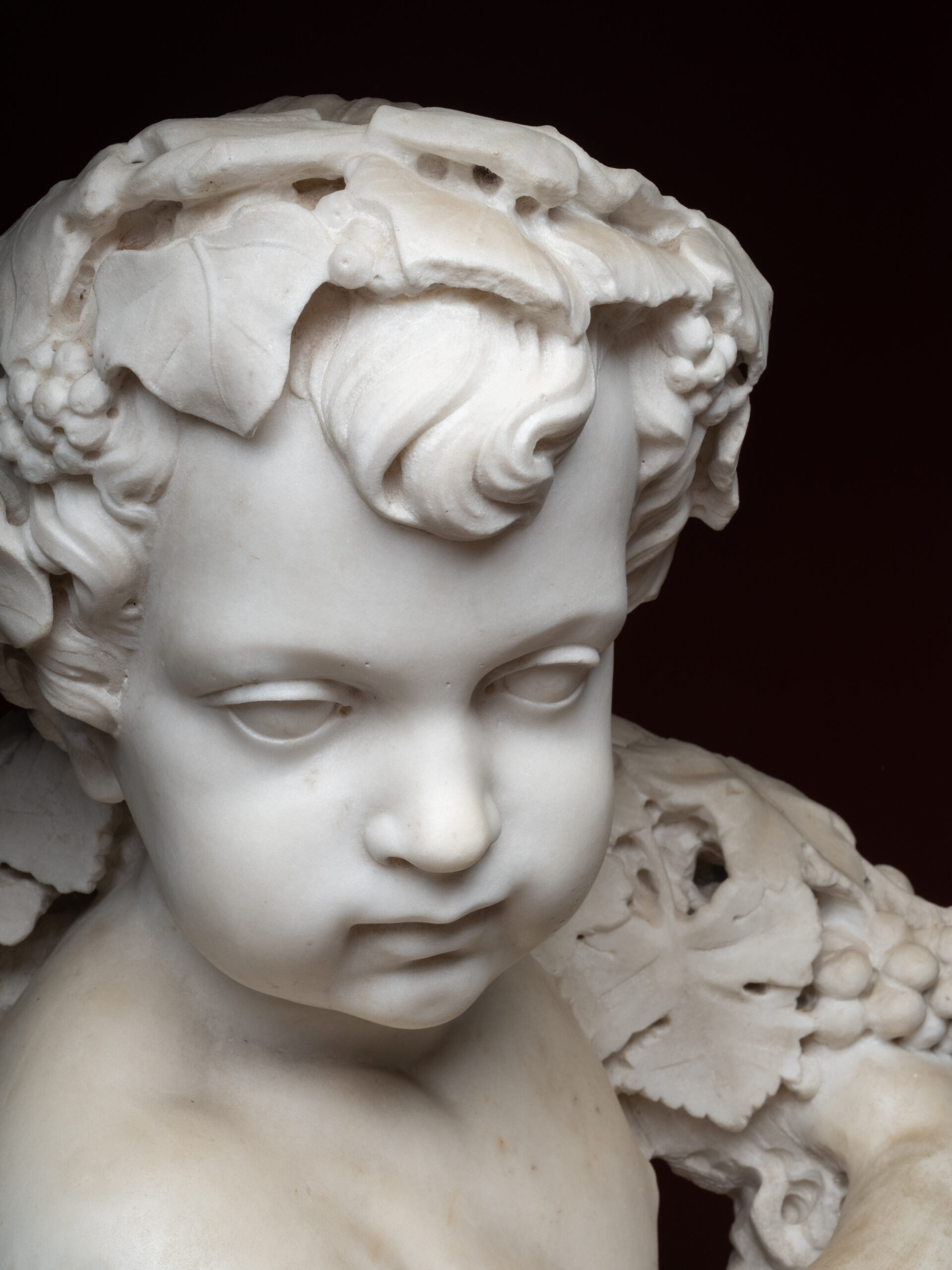
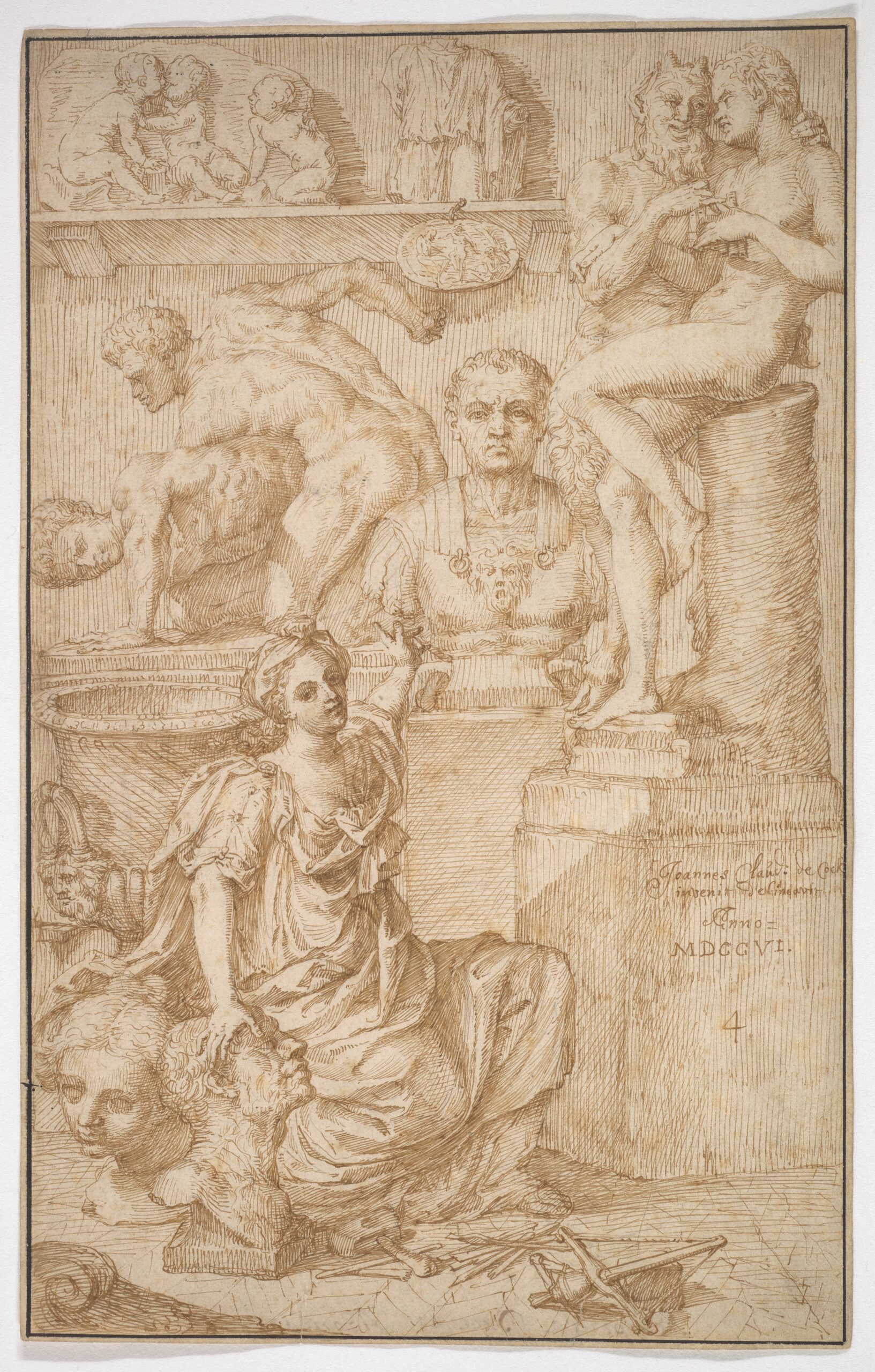
A distinctive feature of Jan Claudius’ work is the streak-like motifs as a naturalist way to render the texture of wood bark. While these are merely suggested in the terracotta model of Fire, they are rendered in exceptional detail in our marble sculpture. This stylistic trait also appears in his engravings and drawings, such as the Metropolitan Museum’s Allegory of Sculpture (1704).
Jan Claudius de Cock, Allegory of Sculpture (1704), Metropolitan Museum, New York City ; pen and brown ink on paper, 31,7 x 19,5 cm.
Jan Claudius’ early sculptures were typically created for grand decorative schemes, often as components of monuments commissioned for princes and nobles. By the 1720s, however, he also turned to larger, life-sized and more traditional sculptures for altarpieces, such as Saints James and Peter for the Meurs monument (ca. 1723) and stone figures for a Calvary at Saint Paul’s Church in Antwerp (ca. 1734).
The technical, stylistic, and contextual elements provide compelling evidence for attributing this Allegory of Autumn to Jan Claudius de Cock, created during his 1705–1710 period.
Literature
P. Verhaegen, ‘Un groupe en marbre du sculpteur De Cock’, in Annales de la société royale d’archéologie de Bruxelles, Bruxelles, 1898 ; J. Leeuwenberg and W. Halsema-Kubes, Beeldhouwkunst in het Rijksmuseum, Amsterdam 1973 ; E. Dhanens, R. De Roo and al., La Sculpture au siècle de Rubens dans les Pays-Bas méridionaux et la principauté de Liège, Bruxelles, 1977 ; T. Clifford, Scultura II, London, 2009.
A Two-Panel Meiji-period Screen in Honor of the Wedding of Toshitsune and Tamahime
A Two-Panel Meiji-period Screen in Honor of the Wedding of Toshitsune and Tamahime
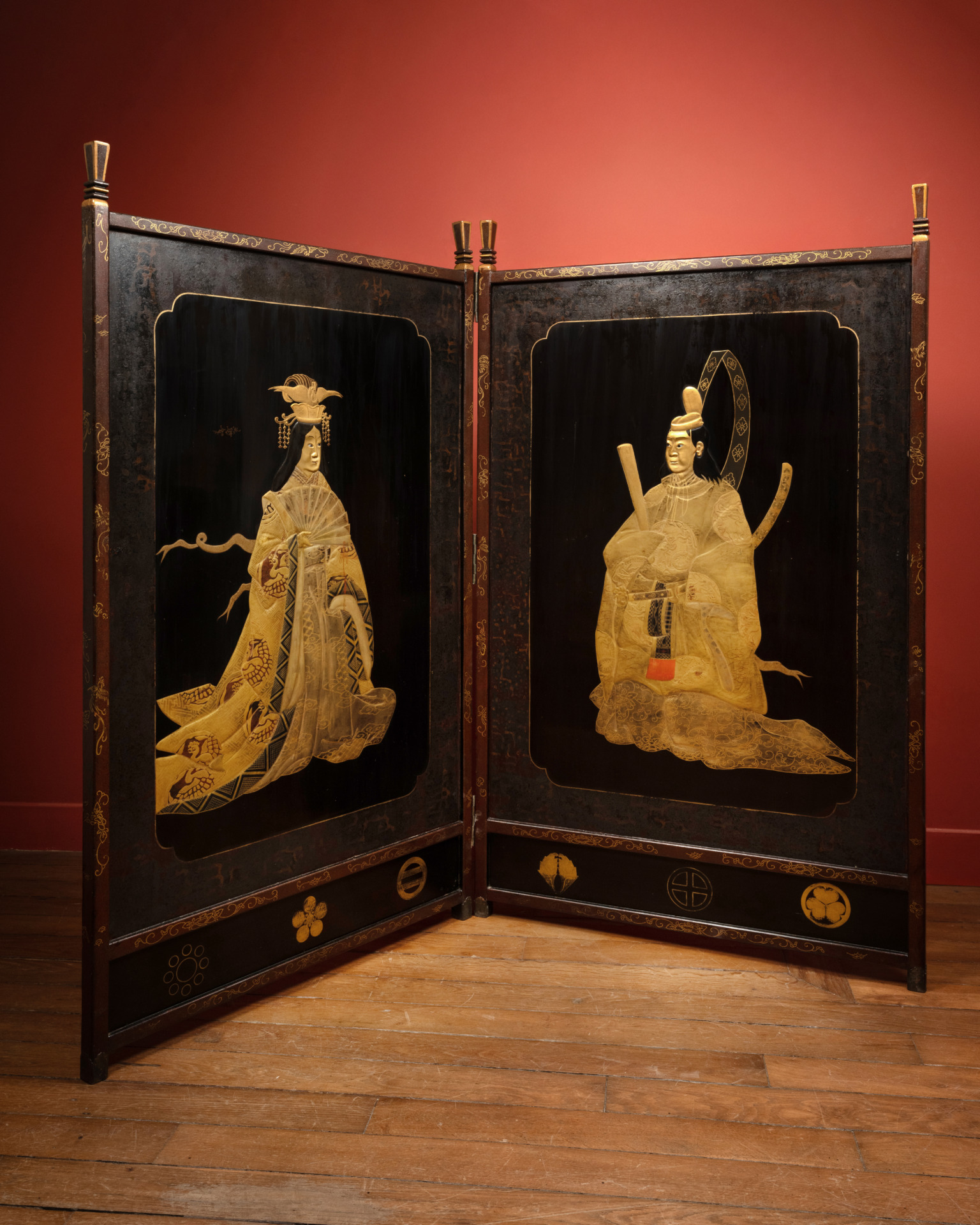
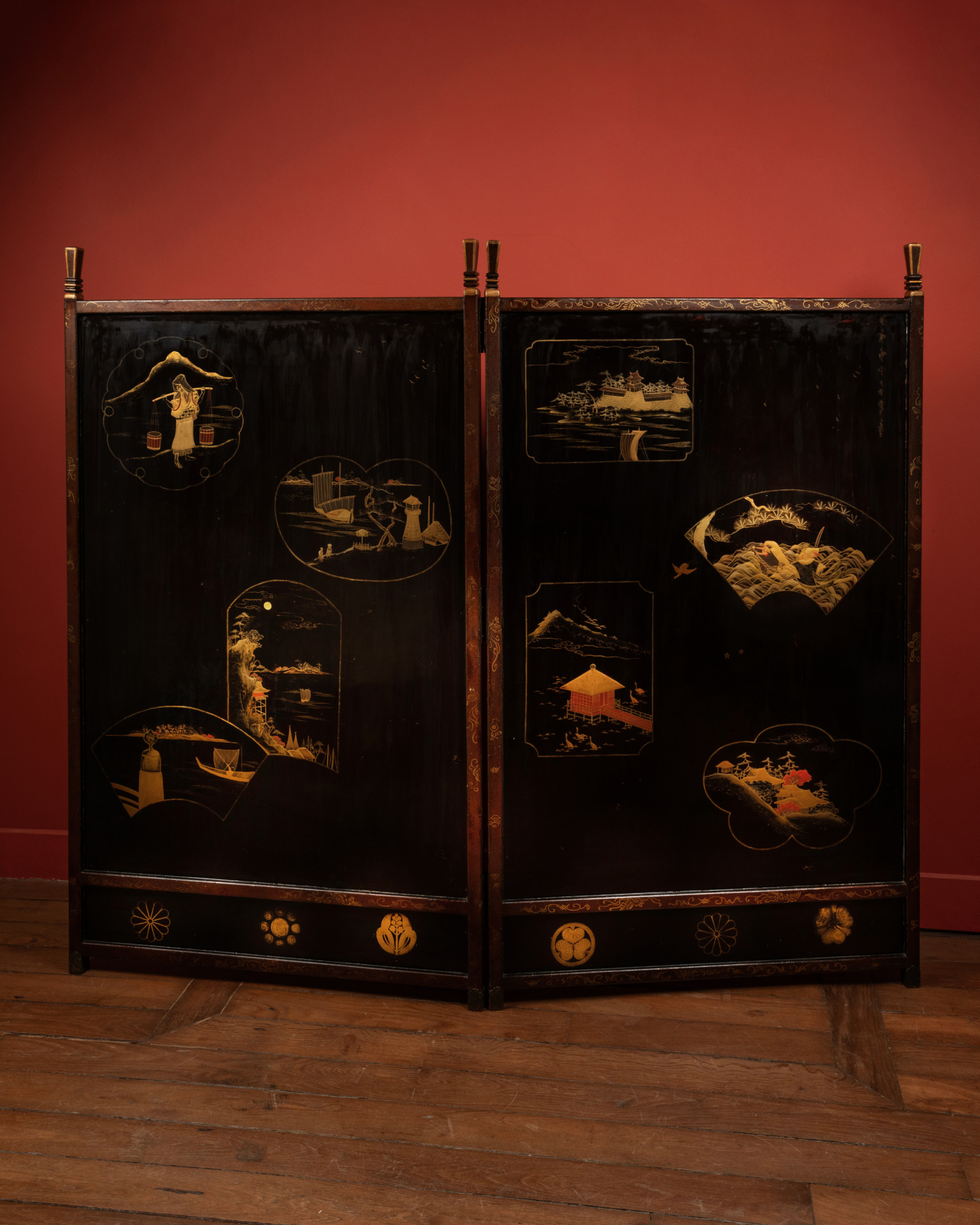
Wood, black lacquer, gold Meiji period 130 x 76 cm (51 x 30 in., per panel)
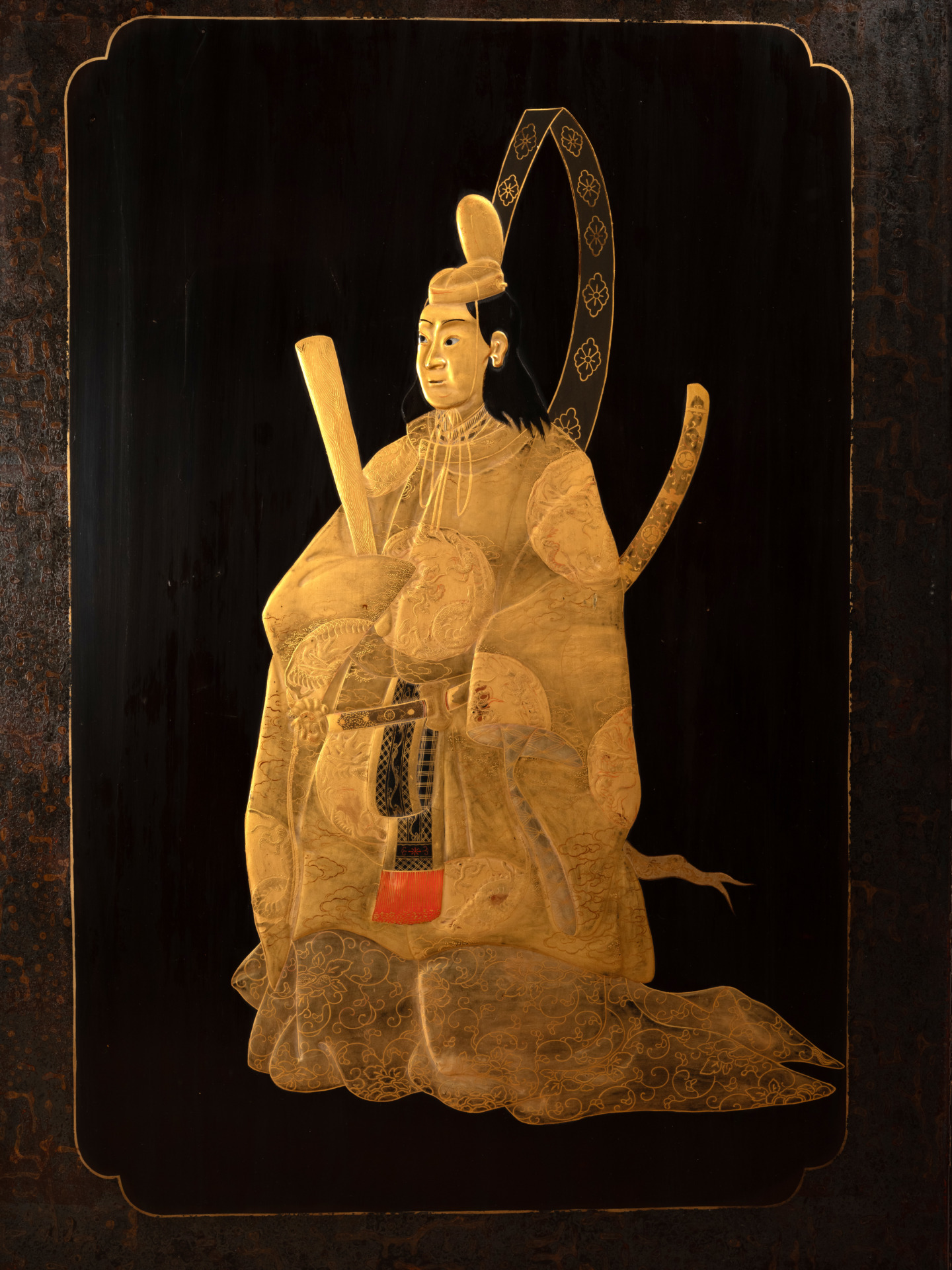
This two-panel screen, or byôbu (屏風), is decorated, on one side, with scenes and landscapes inspired by the hiramaki-e (平蒔絵) lacquered lids of suzuribako (硯箱) or tabikushibako (旅櫛箱), the writing or makeup boxes of the Edo period, particularly those of Kanyōsai.
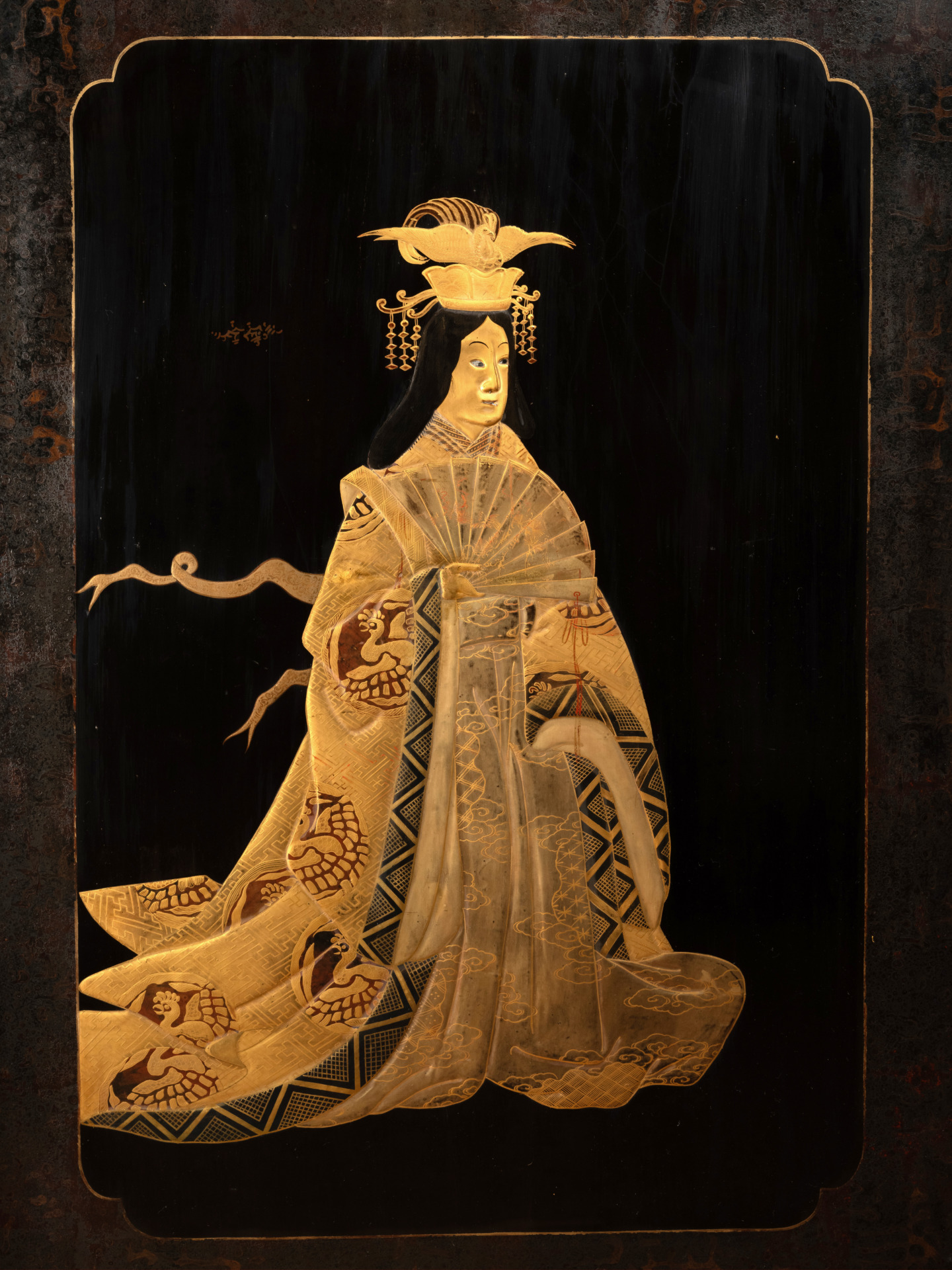
The interior of the screen, on the other hand, features two large figures in takamaki-e (高蒔絵), a lacquer technique with a higher relief than hiramaki-e. The costume and gestures of these characters, particularly the folded command fan held by the male figure, indicate a high rank in Japanese nobility. The combination of heraldic symbols (mon 紋), confirming this rank, signifies an alliance between the Kuyo, Maeda, Ashikaga, Shimazu, and Tokugawa clans. These heraldic signs collectively seem to reference the 1603 marriage of Maeda Toshitsune and Tamahime, daughter of Hidetada Tokugawa.
A Pair of Fluted, giallo antico-like Scagliola Columns
A Pair of Fluted, giallo antico-like Scagliola Columns
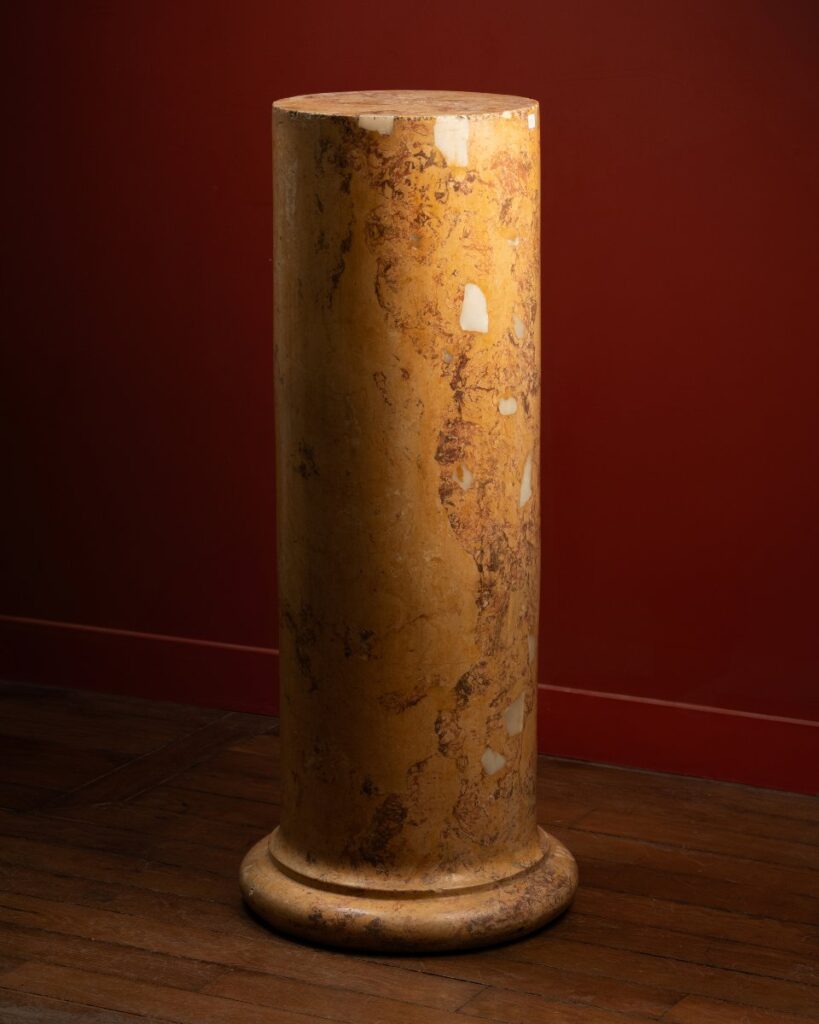
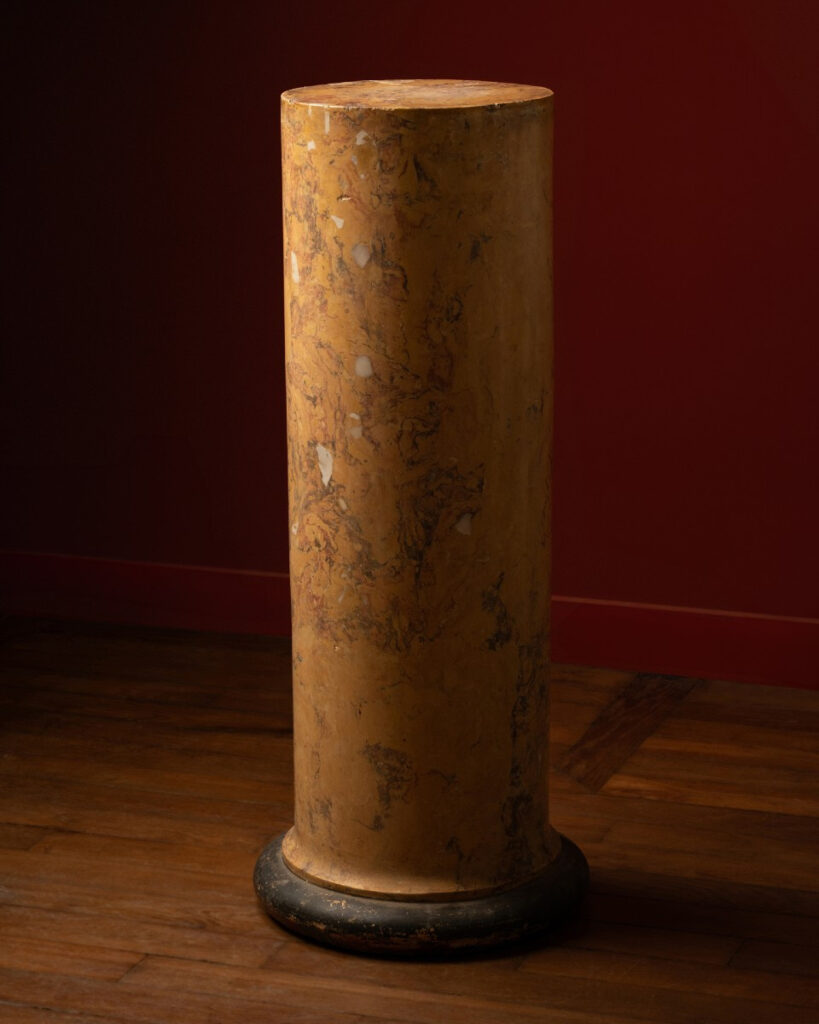
Scagliola Italy 19th century h. 110 cm (43.3 in.)
These two columns, due to their age and wear, look like remnents of ancient ruins, and might even more come across as magnified versions of the miniature Roman ruins of Domenico Padiglione held at Sir John Soane’s Museum in London, or of the Greek temples marble models of Carlo Albacini held at the Capodimonte.
An Indian bronze ‘body mask’ worn during the bhûta ceremonies
An Indian bronze ‘body mask’ worn during the bhûta ceremonies
Bronze Karnataka (West India) 18th or 19th century 42 x 31 cm (16.5 x 21.6 in.)
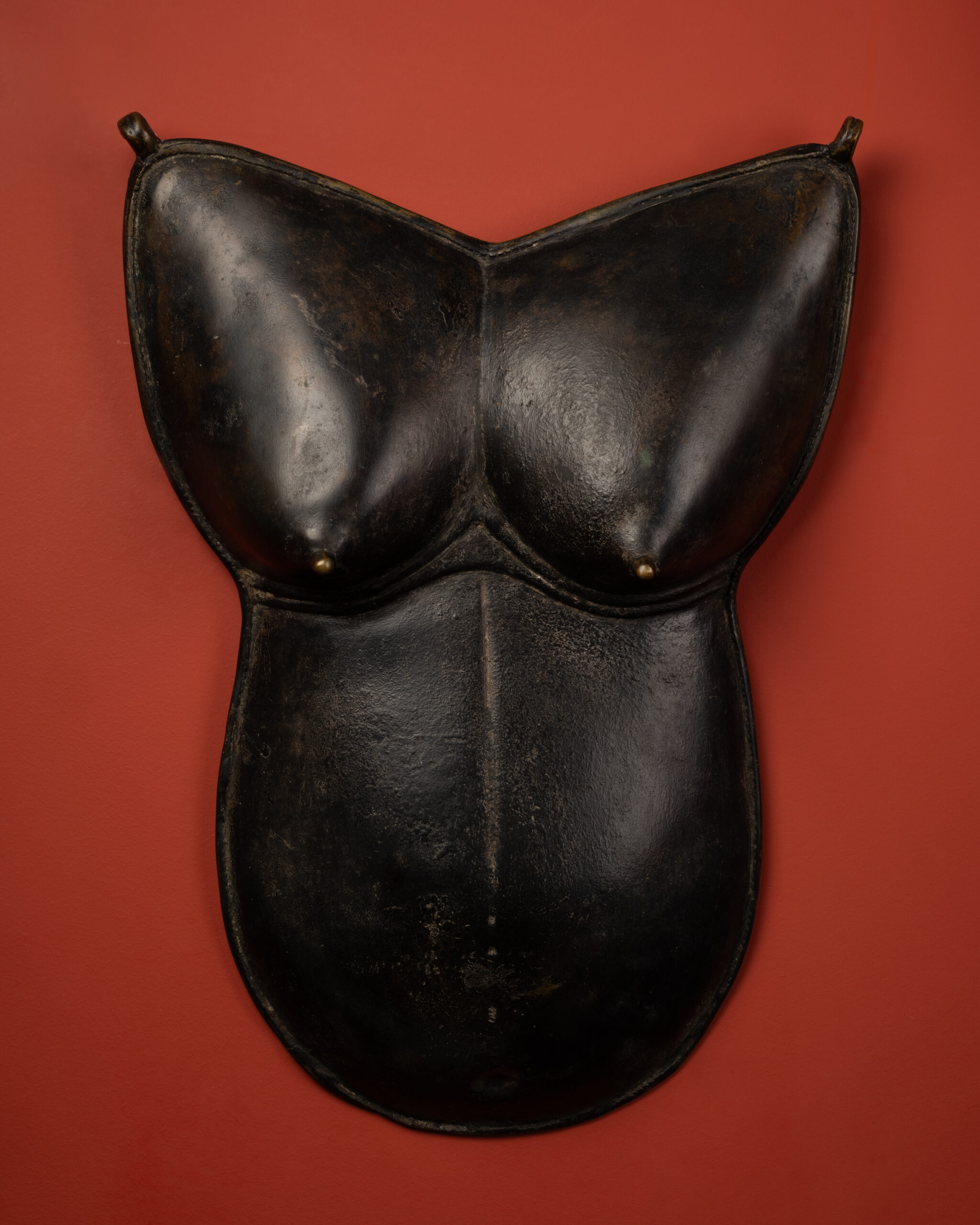
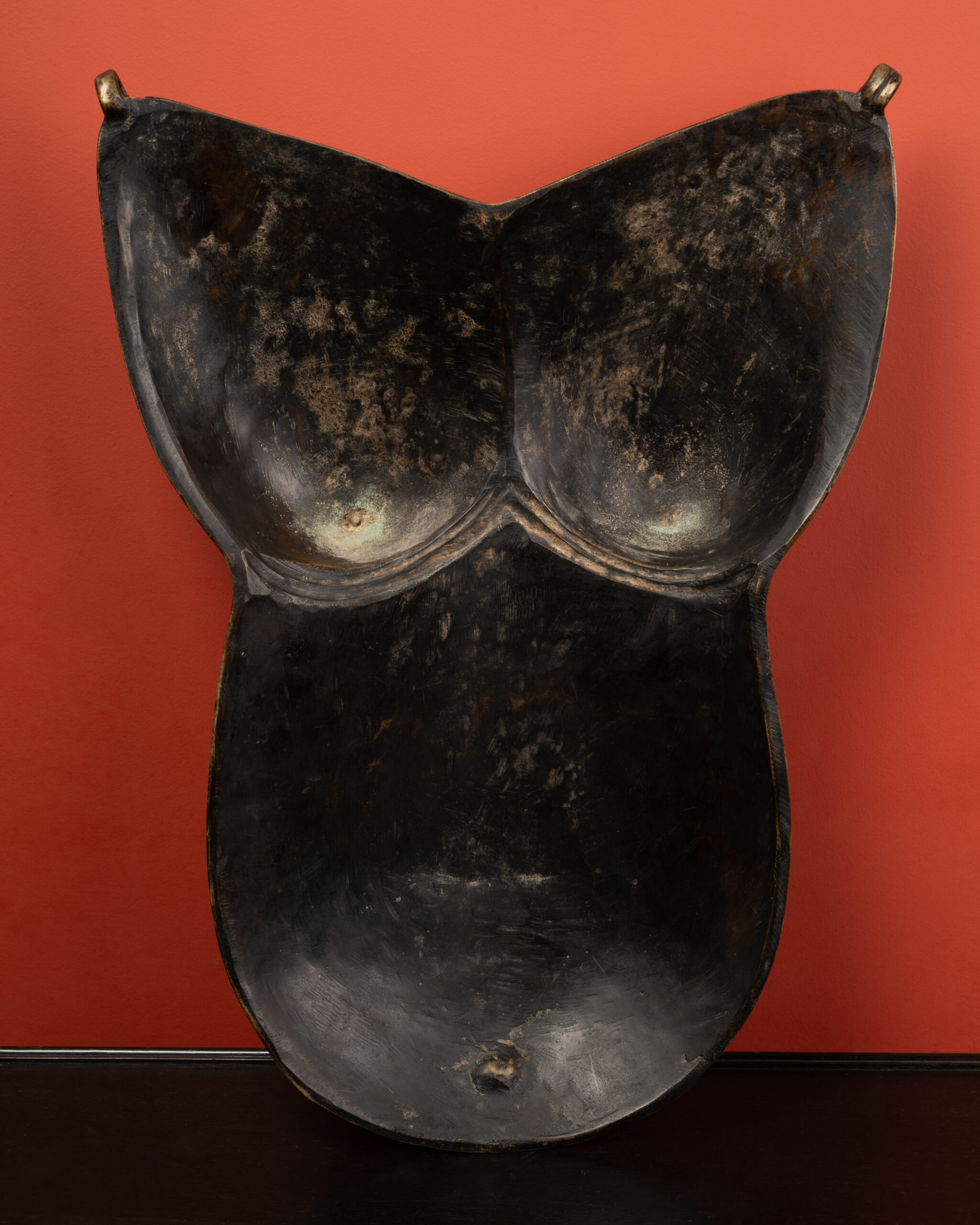
A 18th century bronze ceremonial bronze bhûta chestplate or ‘body mask’, used during the ceremony of Dharmanema in the coastal region of Karnataka in West India.
These ‘body masks’ were worn — mostly with proper masks or helmets — by mediums embodying the female bhûta spirits they wished to invoke, allowing these spirits to express themselves through the medium during his trance. In an all-night festival, sponsored by the families seeking guidance, a male medium would don the mask, inviting the bhuta to possess him. He then sings, dances, tells stories, offers advice for daily life, helps resolve conflicts, and shares myths associated with these spirits through narration or song.
A Neo-Gothic Picture Frame
A Neo-Gothic Picture Frame
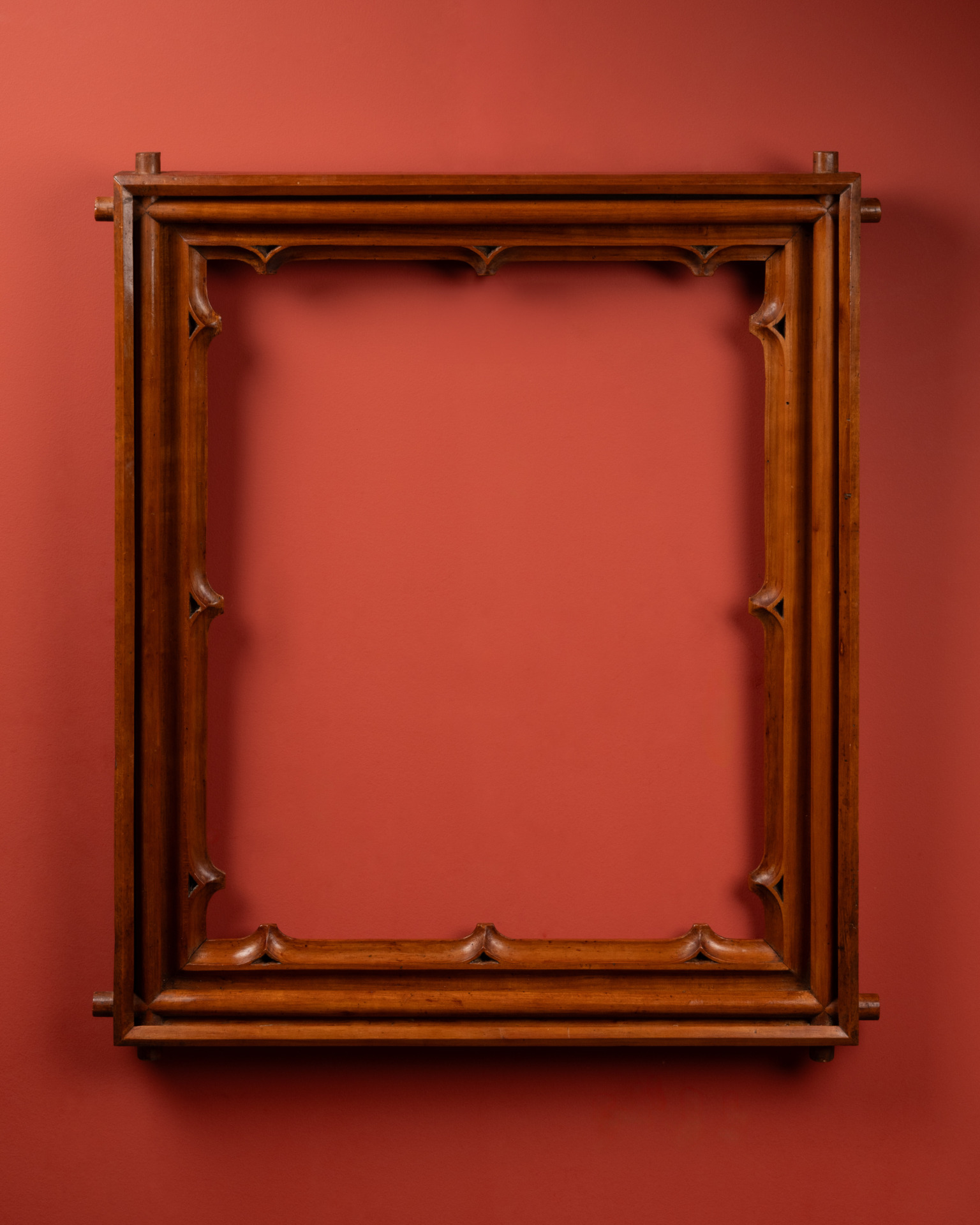
A Neo-Gothic picture frame Pine wood Middle of the 19th century 60 x 52 cm (23.6 x 20.4 in.)
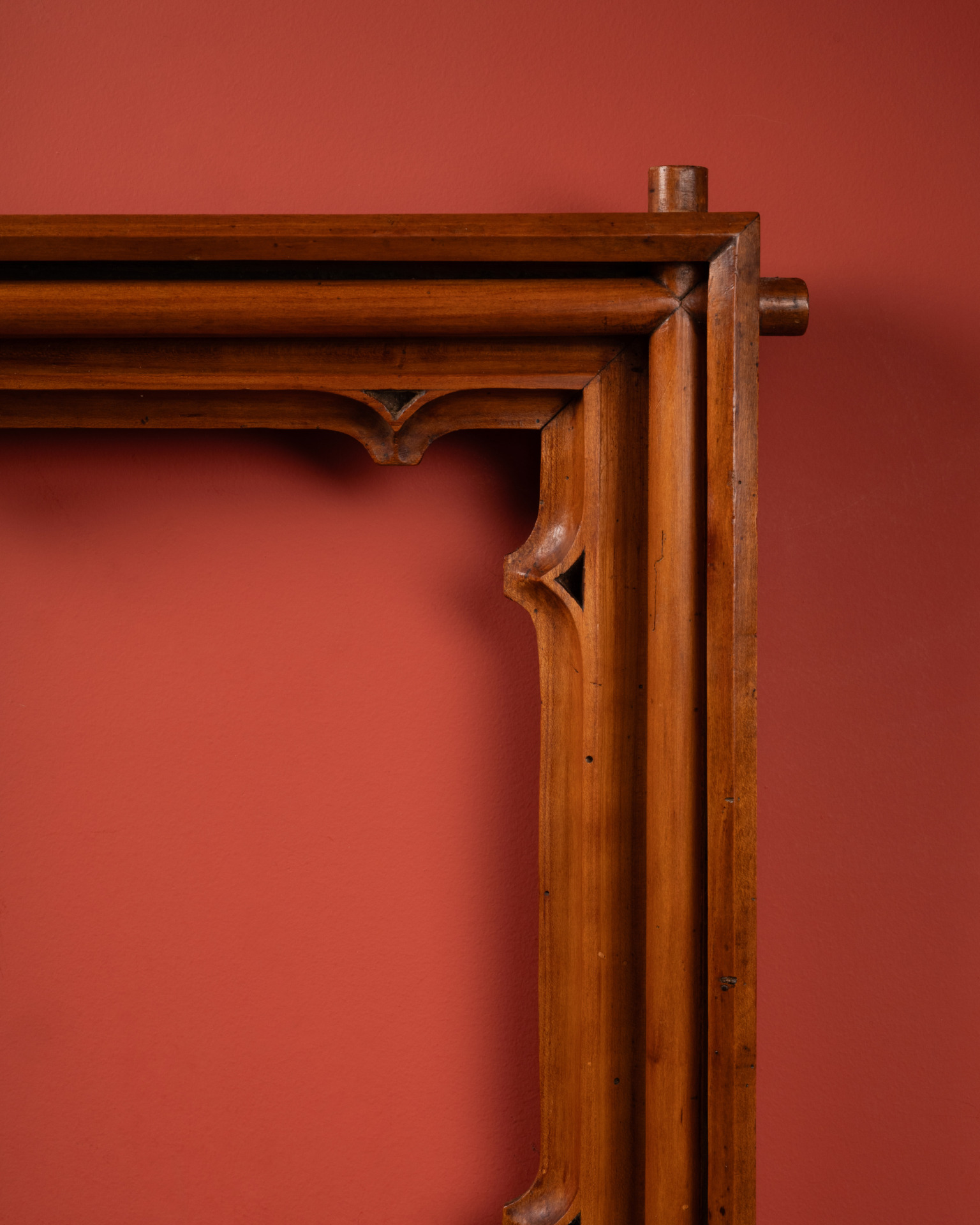
A Neo-Gothic, pine wood picture frame ornated with architectural ‘redents’ imitating Gothic window mullions.
Similar picture frames, inspired by Gothic architecture, were designed for many Romantic and Nazarene paintings towards the middle of the nineteenth century. Paul Mitchell and Merrell Holberton (authors of A History of European Picture Frames) mention a frame with similar characteristics custom made for a Visitation by Ernst Deger. The frame of this painting, exhibited in Düsseldorf, features similar compartments inspired by Gothic architecture. They also mention a frame designed for Austrian Nazarene painter Joseph Führich’s The Road to Emmaus, with ‘inner and outer ribs intersect at the corners’.
Literature
See Eugène-Emmanuel Viollet-le-Duc, Dictionnaire raisonné de l’architecture française du XIe au XVIe siècle, Paris, 1858, Henry Heydenryk, The Art and History of Frames, New York, 1993 and Paul Mitchell and Merrell Holberton, A History of European Picture Frames, London, 1996.
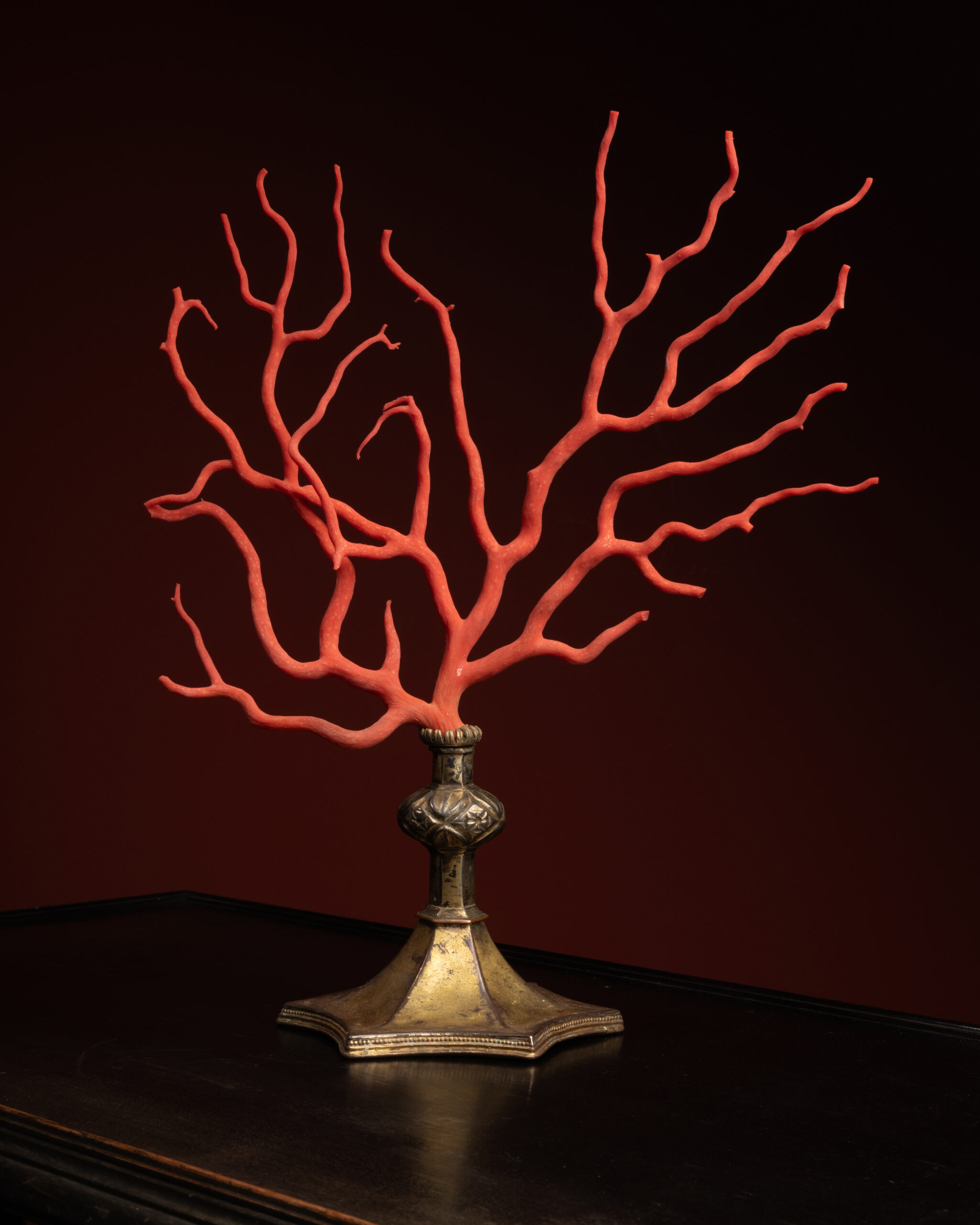
Red coral branch set on a Gothic brass base
Red coral branch set on a Gothic embossed brass base
Coral, brass 15th century (chalice) 38 cm x 30 cm (15 x 11.8 in.)
A branch of red coral mounted on a Gothic embossed and chased brass chalice base. The design of the chalice base combines a knot with floral ornaments and a hexagonal foot. This type of chalice was quite fashionable from the middle of the 13th century to the late of the 14th century, especially in Paris and for the most important commissions. It remained used, however, in the rest of France and Europe throughout the 15th century, especially in England by the 1360s.
Literature
See Un trésor gothique : La châsse de Nivelles, Köln, 1996, Anna-Elisabeth Theuerkauff-Liederwald, Mittelalterliche Bronze- und Messinggefäße. Eimer, Kanne, Lavabokessel, Berlin, 1998 and Virginia Glenn, Romanesque & Gothic Decorative Metalwork and Ivory Carvings in the Museum of Scotland, Edinburgh, 2003.
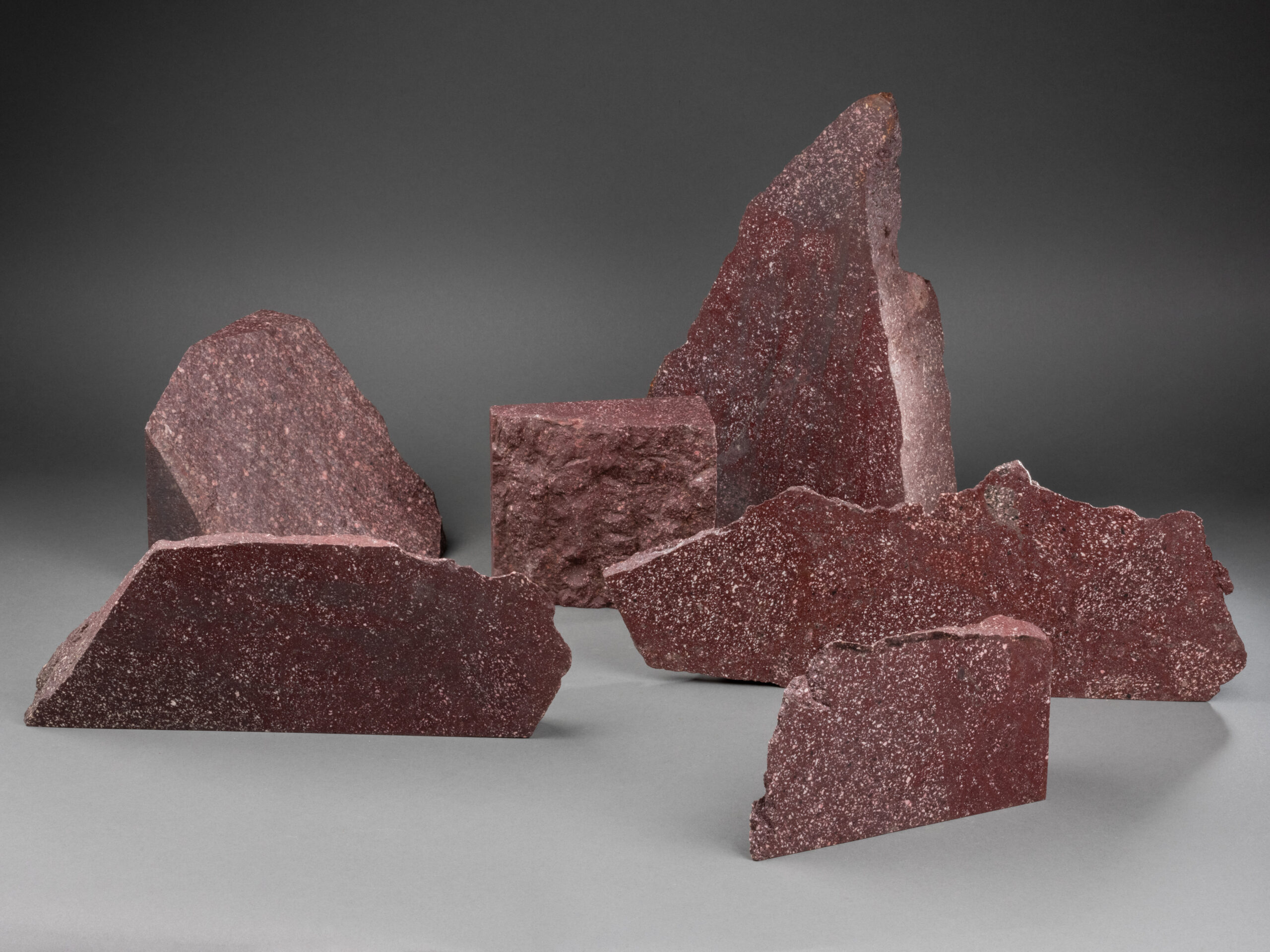
Important set of porphyry blocks
Important set of porphyry blocks
Six blocks of Egyptian porphyry
Ranging in size from 14 to 38 cm long, these red Egyptian porphyry blocks have been partially polished.
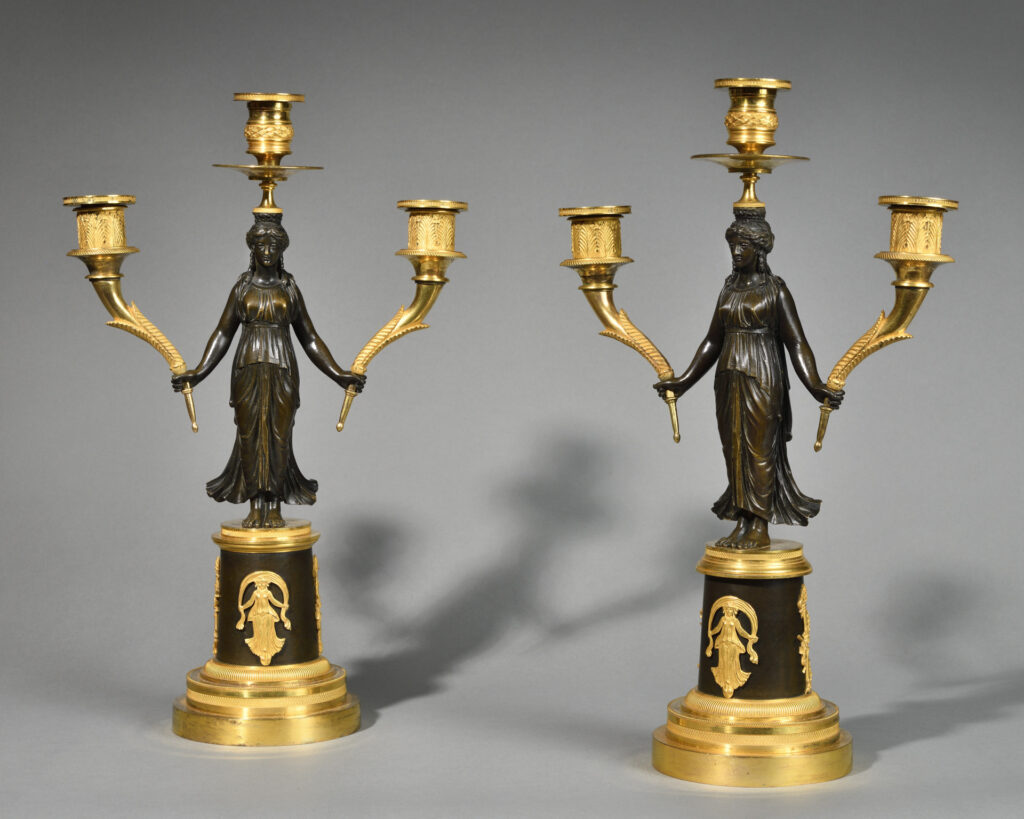
A Pair of Empire Ormolu ‘Vestals’ Candelabra attributed to Pierre-Philippe Thomire
A Pair of Empire Ormolu ‘Vestals’ Candelabra attributed to Pierre-Philippe Thomire
A Pair of Empire Ormolu ‘Vestals’ Candelabra attributed to Pierre-Philippe Thomire Ormolu, chased and patinated bronze ca. 1810 h. 60,5 cm (23.8 in.)
On a patinated bronze base decorated with ormolu appliques representing alternating torches and vestals, other vestals support a sphere. It carries three candle arms composed of a wolf’s head spitting out a foliage motif on which rests the binet. A shaft finished by a binet surmounts the sphere.
This pair of candelabras is based on the vestal with crossed arms model created for a series of pairs of torches delivered by Thomire-Duterme to the palace of Fontainebleau in 1809 and destined for the small apartment of the Empress. The wolf heads spitting out the candle arms represent an uncommon motif that has also been attributed to Thomire.