Rock Crystal and Fire-Gilt Metal Chandelier Attributed to Eugène Baguès and Giovanni Battista Metellino
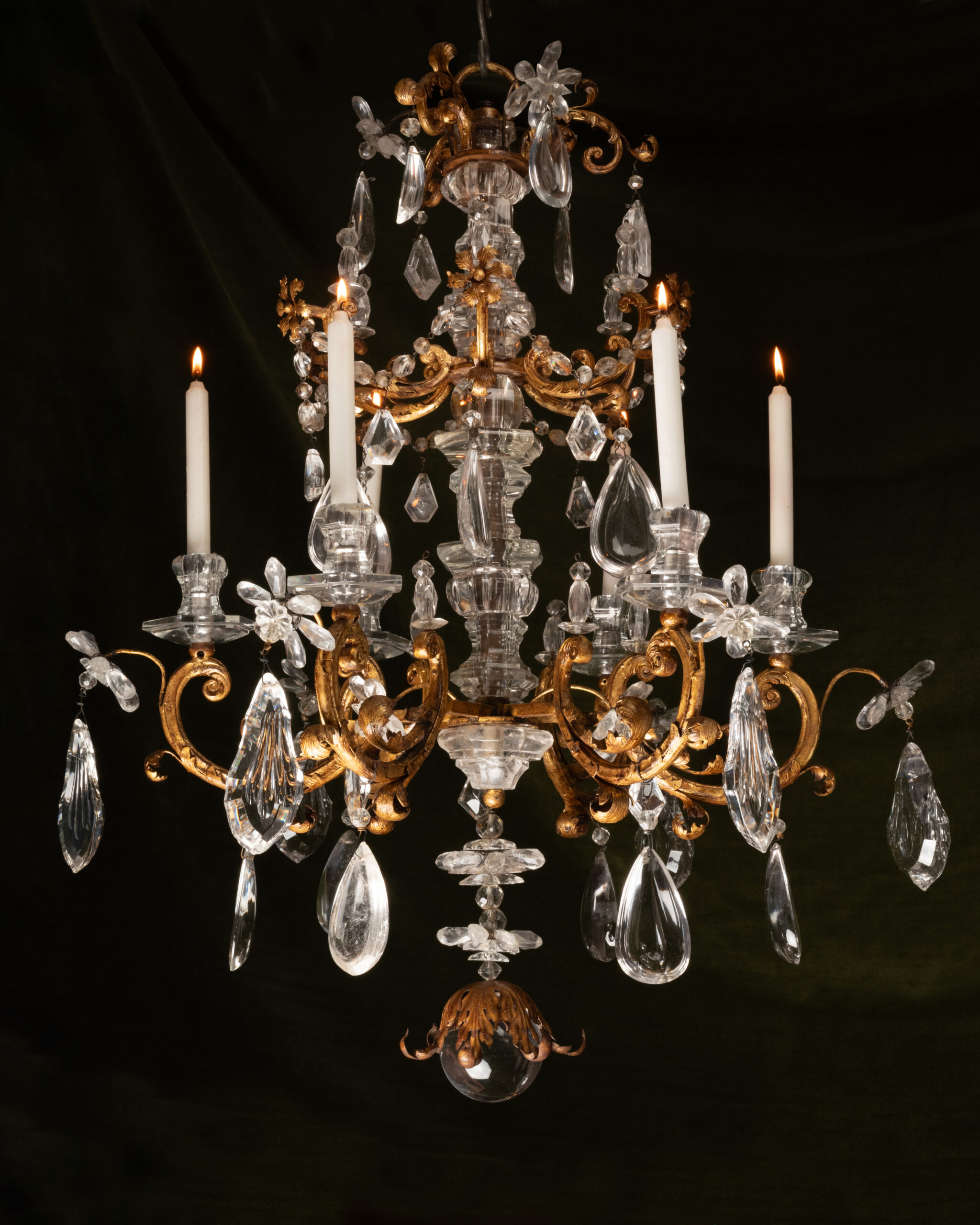
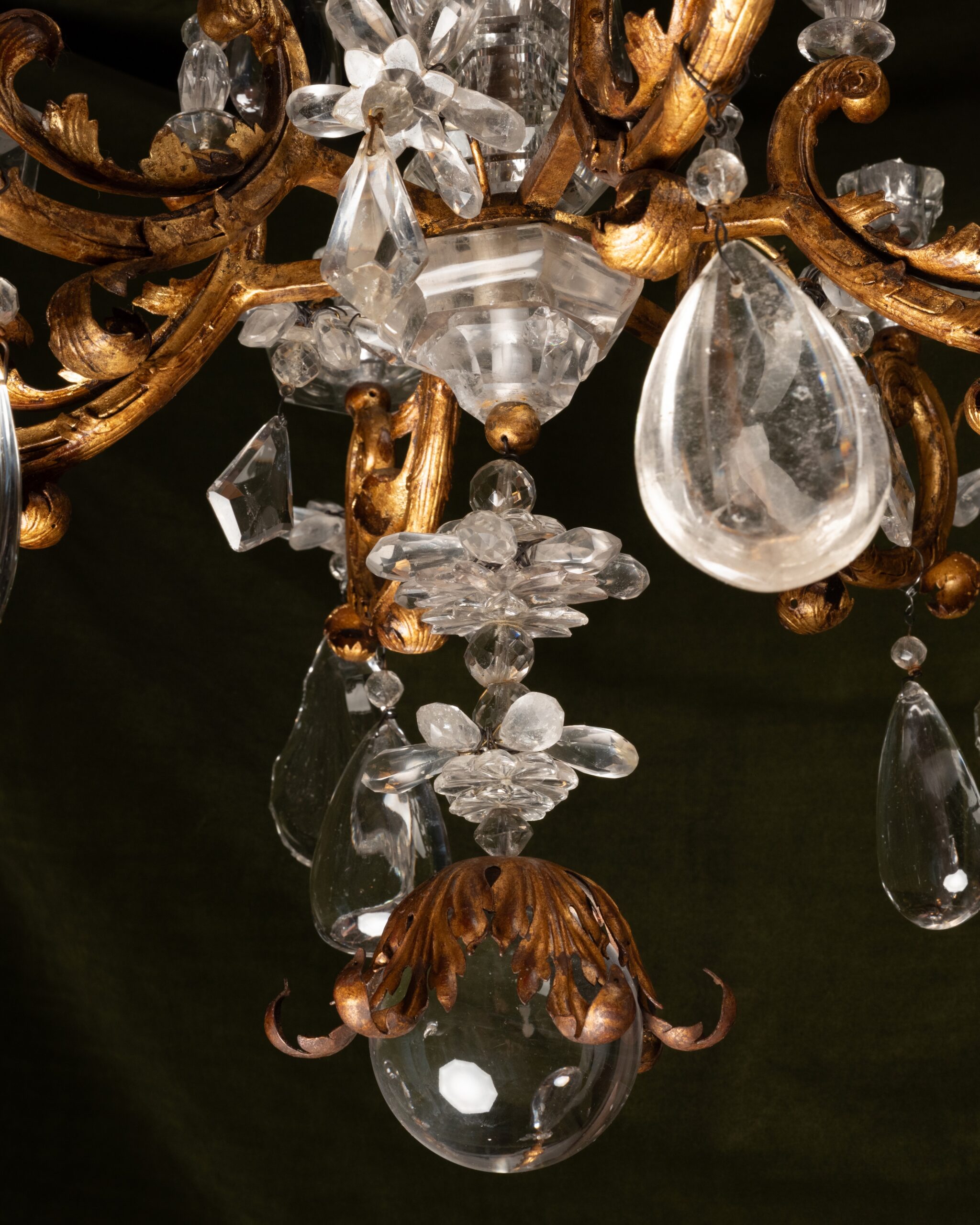
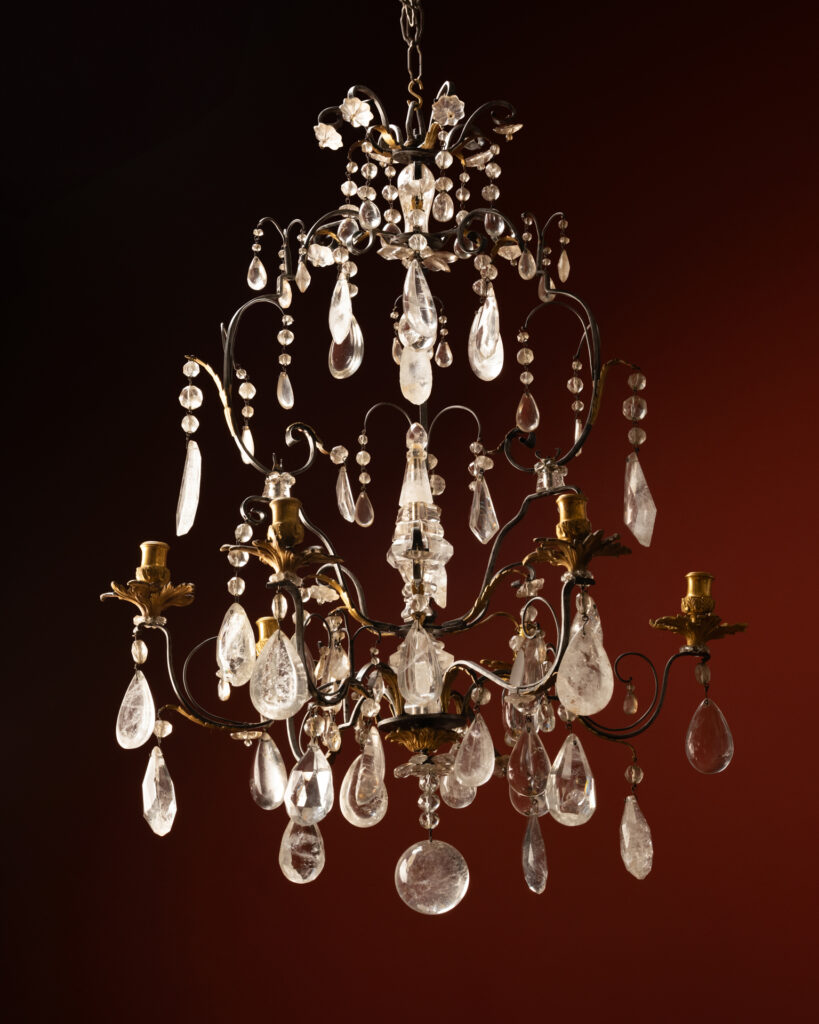
The structure of this six-light chandelier bears the imprint of two distinct periods of manufacture. The six semi-circular arms, adorned with foliate volutes, appear to be the oldest components. The refinement of their ornamentation and certain technical features associate them with a group of Milanese works dating from the early years of the 18th century.
At least two known chandeliers present a comparable structure. The first, a twelve-arm chandelier housed in the Metropolitan Museum, was executed using a technique similar to that of the present piece: the arms, decorated with gilt metal foliage, emerge from a baluster-shaped shaft in rock crystal, projecting first perpendicularly before curving sharply into voluted semicircles. The second chandelier, located in the Konferenzzimmer of the Hofburg in Vienna, is even closer: in addition to a similar structure, it features identical six-pointed star motifs in gilt metal, executed in the same manner as the foliage.
Both chandeliers are attributed to Giovanni Battista Metellino, a Milanese stone-cutter active from the late 17th to the early 18th century, whose hand is recognisable — in both style and execution — in the crystal work of the Metropolitan Museum and Hofburg chandeliers. It has thus been inferred that a Milanese workshop, specialising in lighting production and regularly collaborating with Metellino for crystal elements, was responsible for this very rare group of chandeliers distinguished by a shared ornamental language in gilt metal and rock crystal.
The Hofburg chandelier underwent significant modifications in the late 19th century, most likely carried out by the Viennese firm J. & L. Lobmeyr, which at the time was overseeing the electrification of the Konferenzzimmer. The present chandelier appears to have undergone a similar intervention, probably during the same period, possibly by the firm of Eugène Baguès. Founded in 1840, the Baguès company had, by the late 19th century, developed a speciality in electrifying antique light fixtures, while also trading in both antique and modern objets d’art — particularly chandeliers. In the firm’s early advertisements, antique pieces are sometimes shown alongside Baguès’ original creations, a juxtaposition likely intended to highlight the historical and technical precision that the firm prided itself on, aspiring to produce decorative objects of a quality comparable to those of the 18th century. This interplay between old and new sometimes occurred within a single object, through the reuse of antique components — occasionally irreplaceable — within newly created works.
The present chandelier appears to have emerged from precisely this kind of practice: its structure was altered, its arms enlarged, new decorative elements added, and the entire piece adapted for electrification — a domain in which the firm of Eugène Baguès played a leading role in the late 19th century.
L’Escalier de cristal, another firm renowned for producing high-quality objets d’art and furniture in 18th-century styles — always in extremely limited numbers and for an elite clientele — was also known for incorporating antique elements, sometimes of an inimitable nature. A drawing of a chandelier strikingly similar to the present example appears in one of L’Escalier de cristal’s design books, making it plausible to attribute the reconfiguration of this piece to that firm.