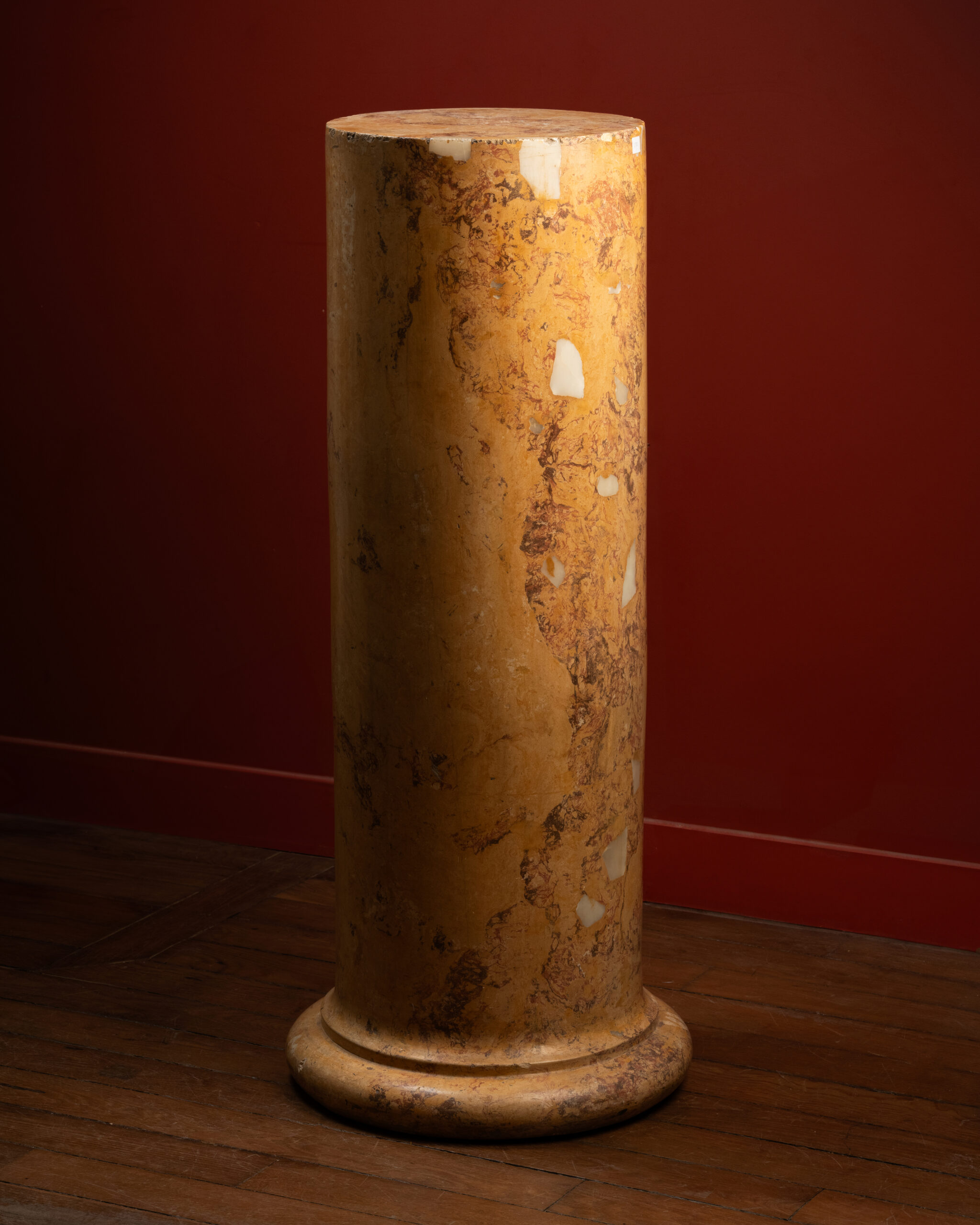
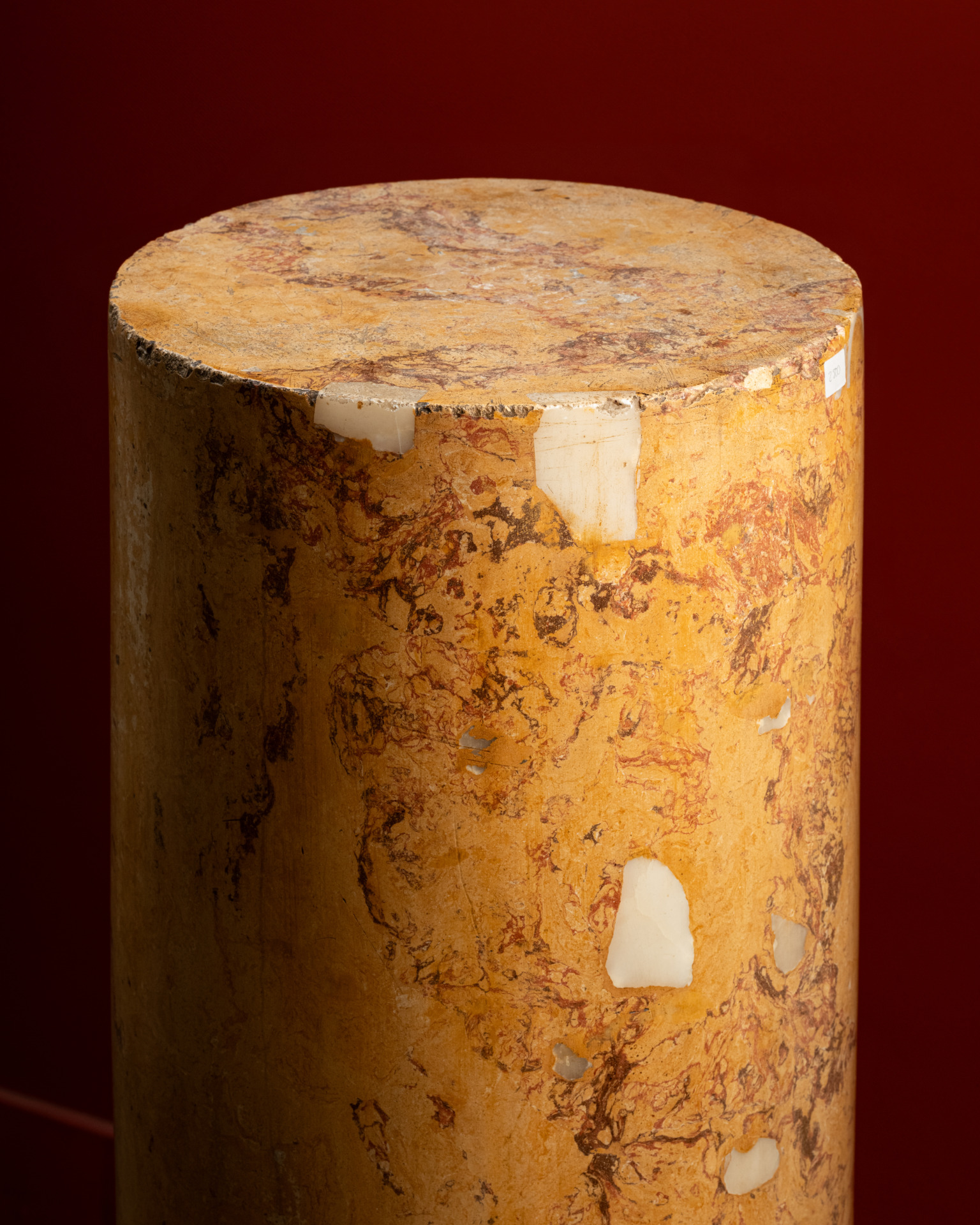
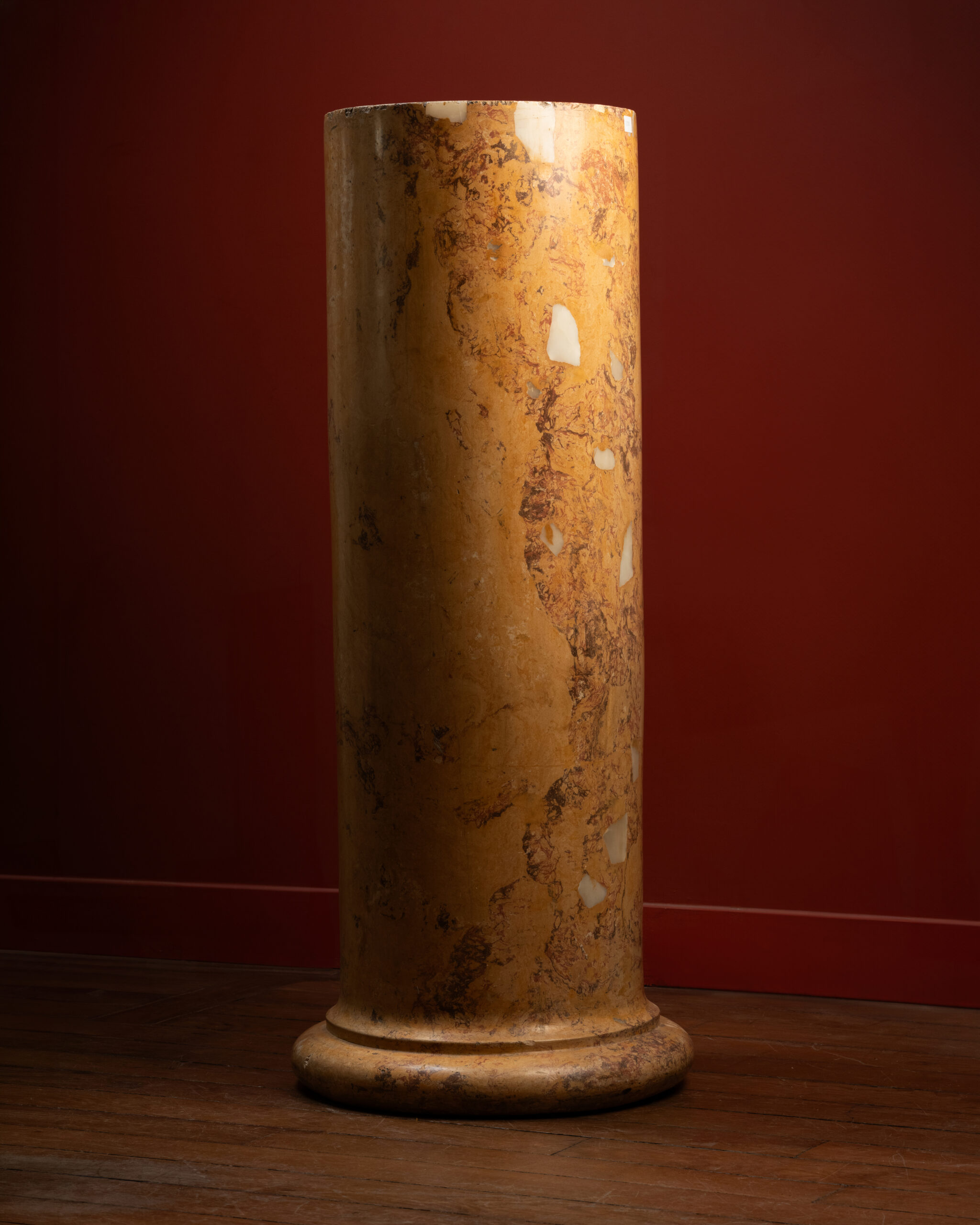
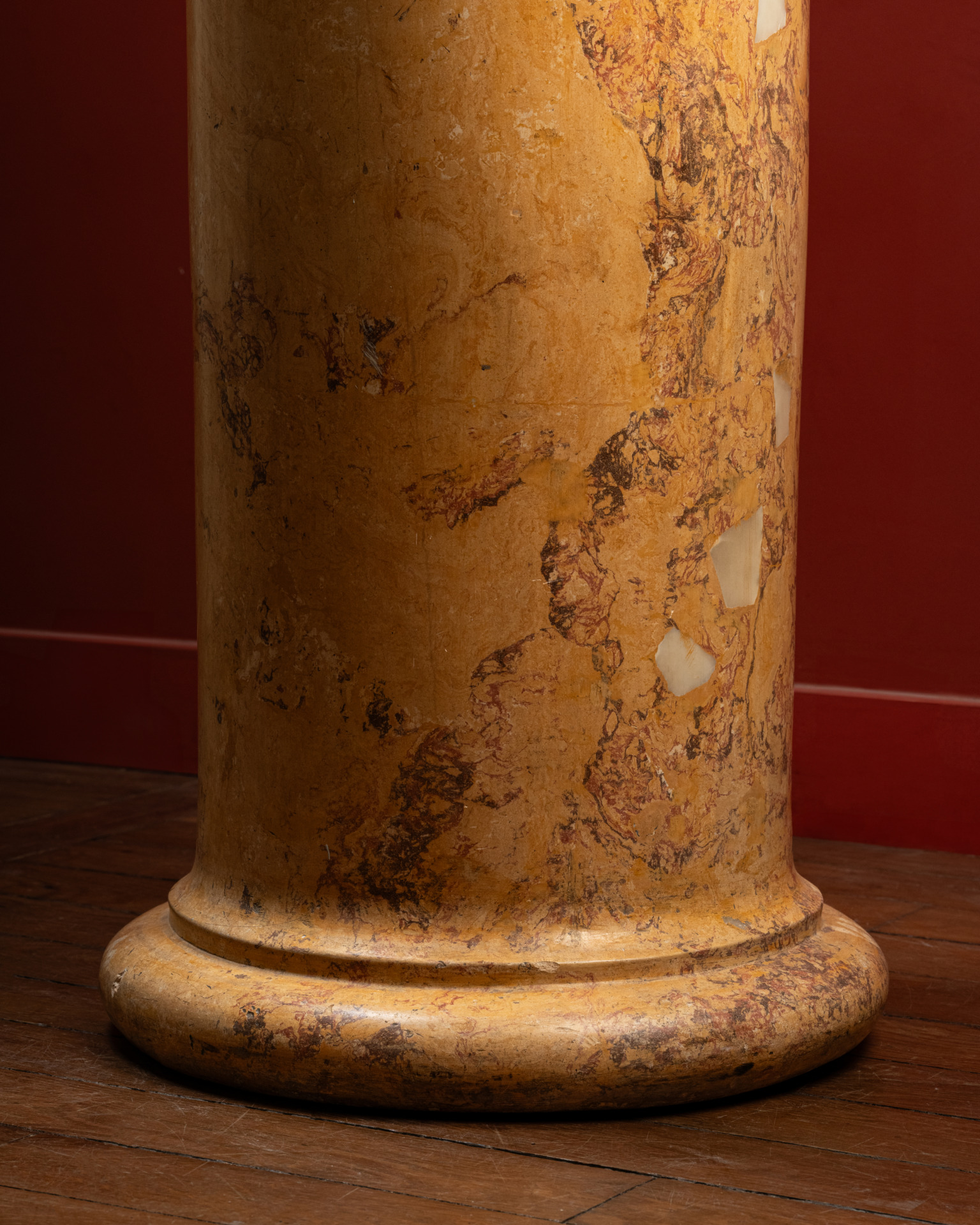
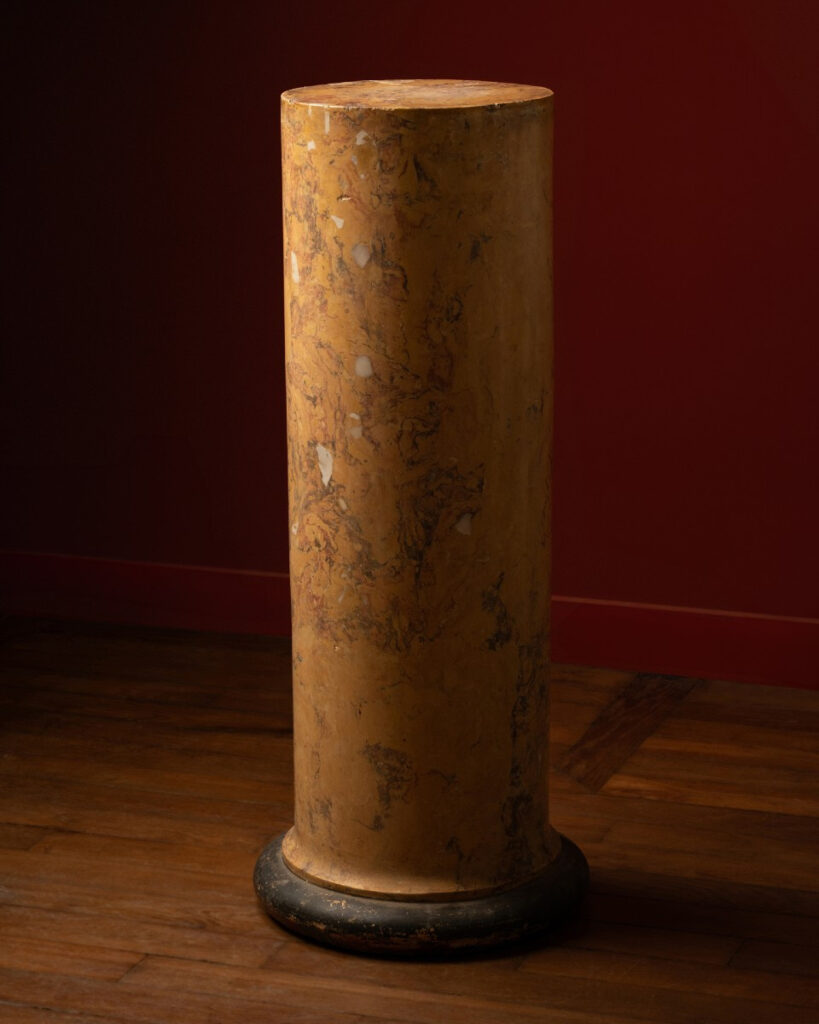
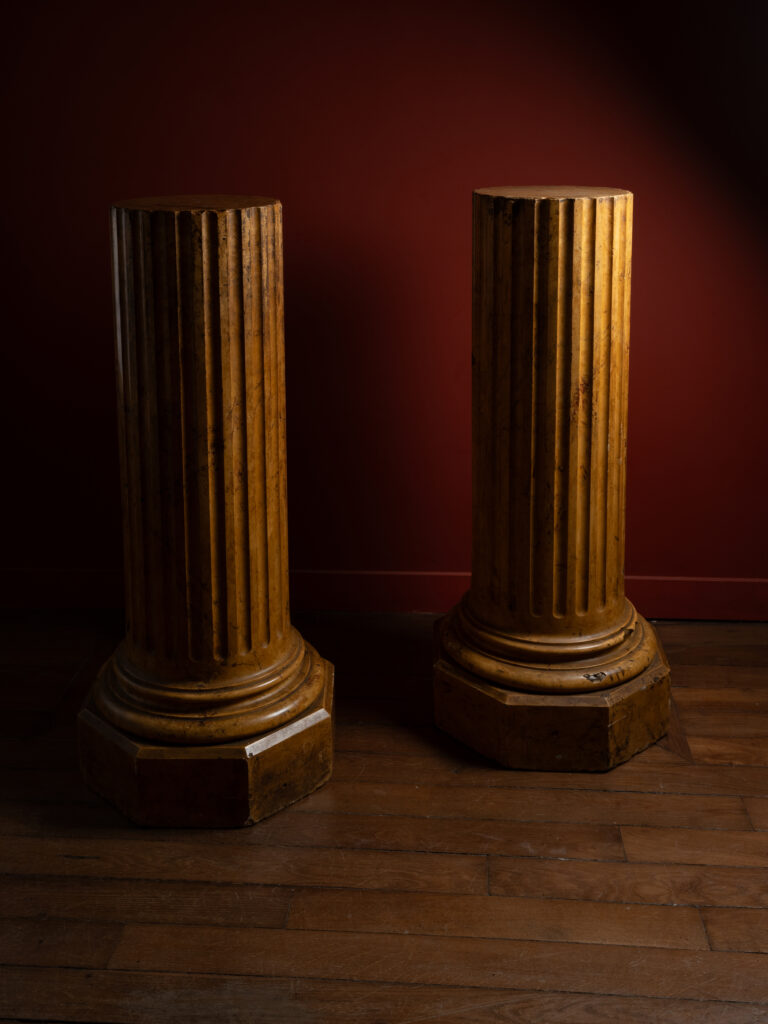
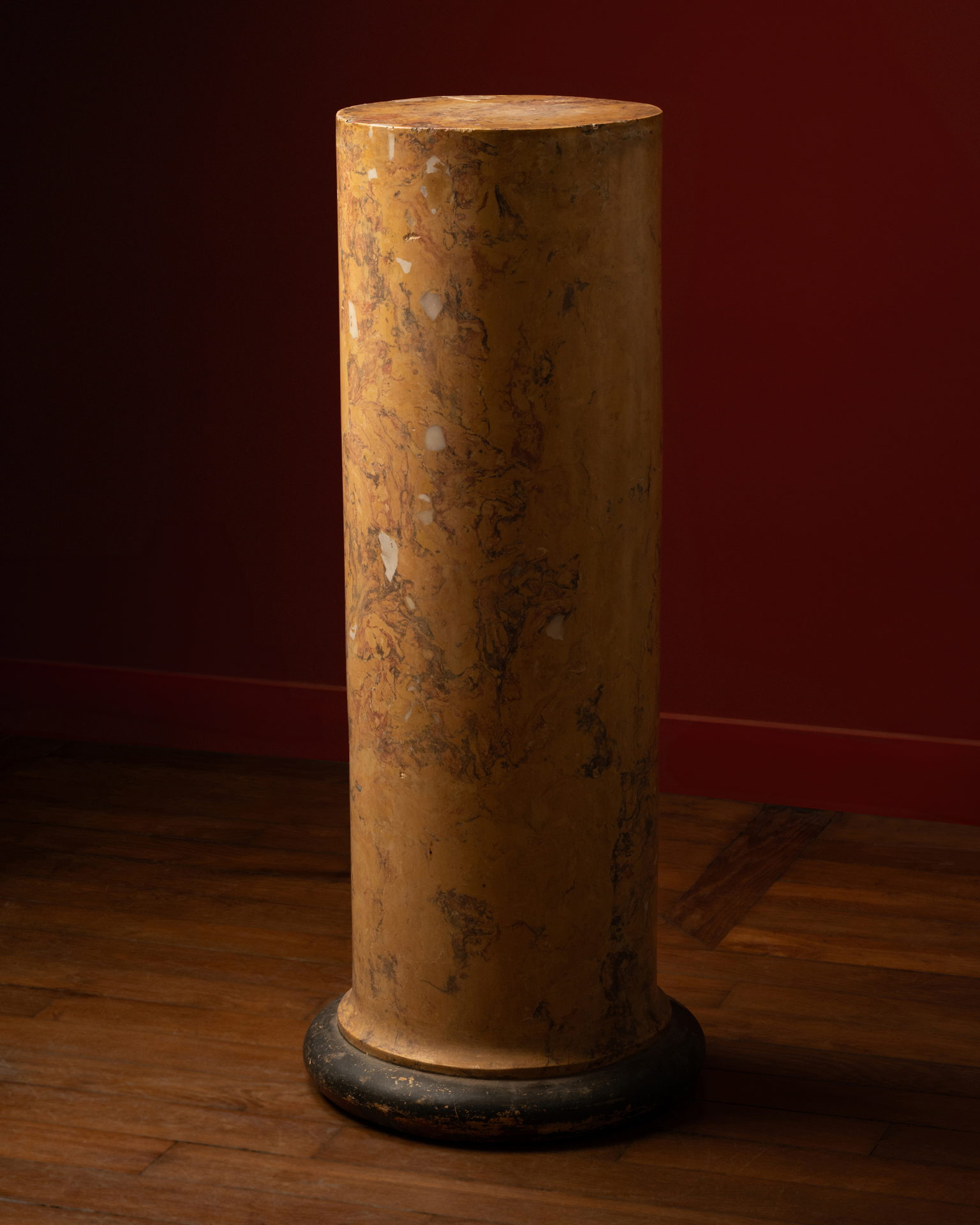
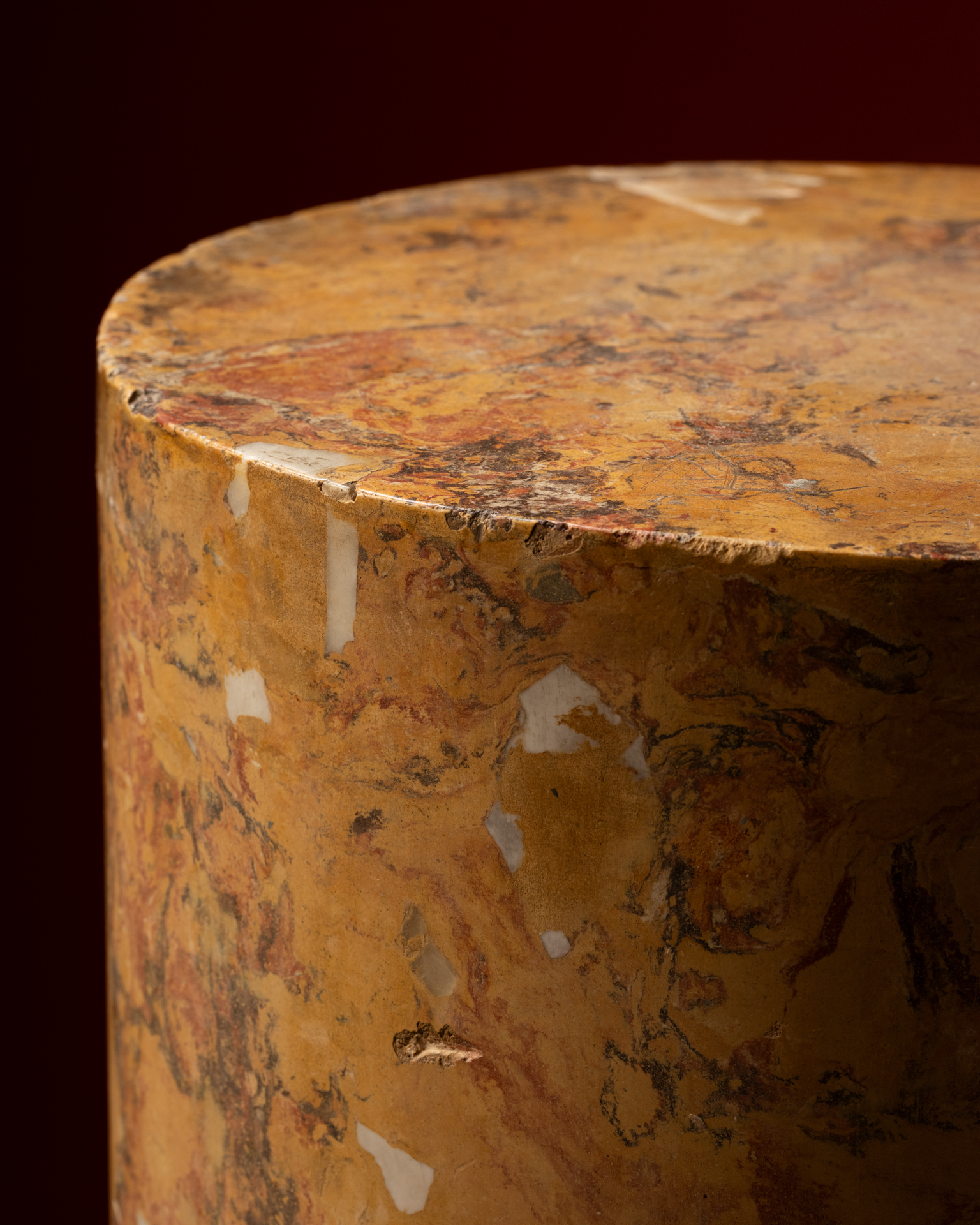
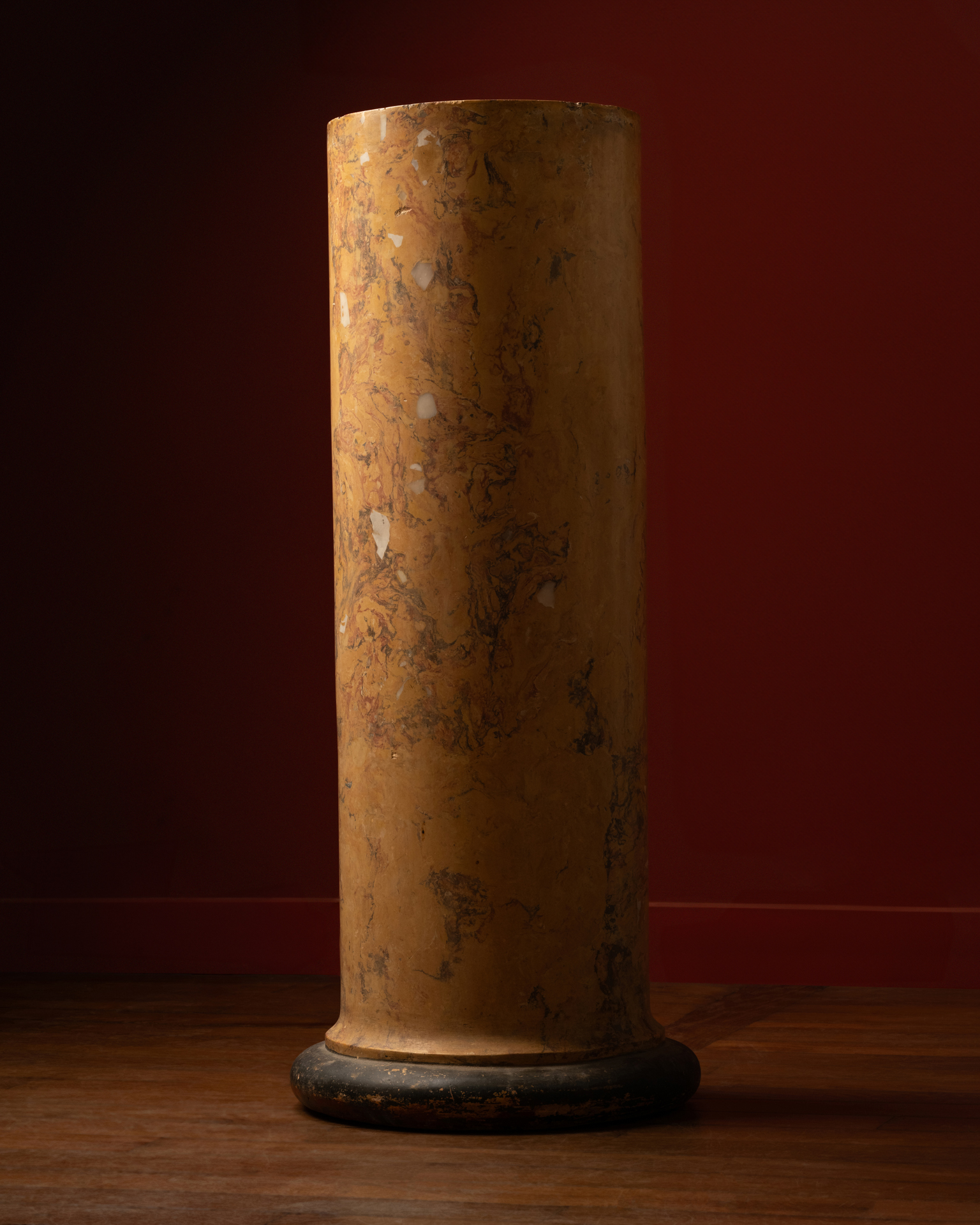
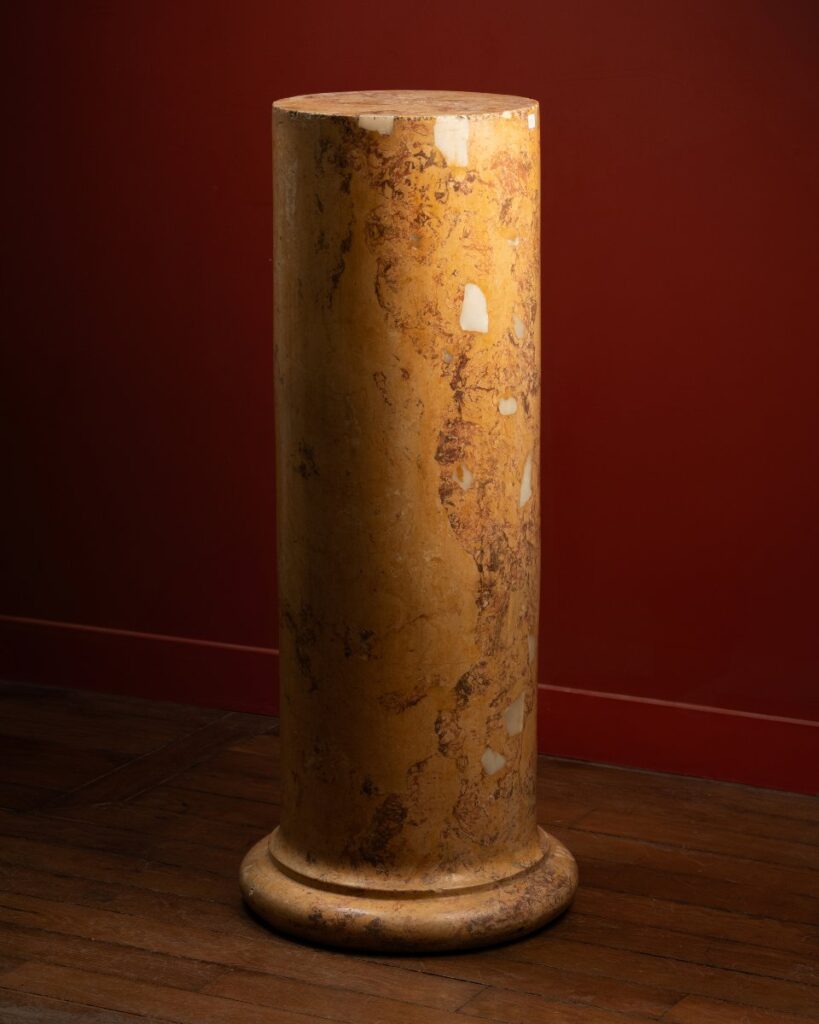
Scagliola Italy 19th century h. 102 cm ; d. 32,5 cm (h. 40.16 ; d. 12.8 in.)
Corsi mentions, in his 1845 treatise on the pietre antiche, a “very rare” breccia gialla with a “of orange with small white, red, and dark blue markings” — of a kind that may well have served as the model for the present column, which is indeed speckled with rather warm motifs compared to that of traditional breccia.
Literature
See Faustino Corsi, Delle pietre antiche, Rome, 1845 and Gabriele Borghini, Marmi antichi, Rome, 2004.
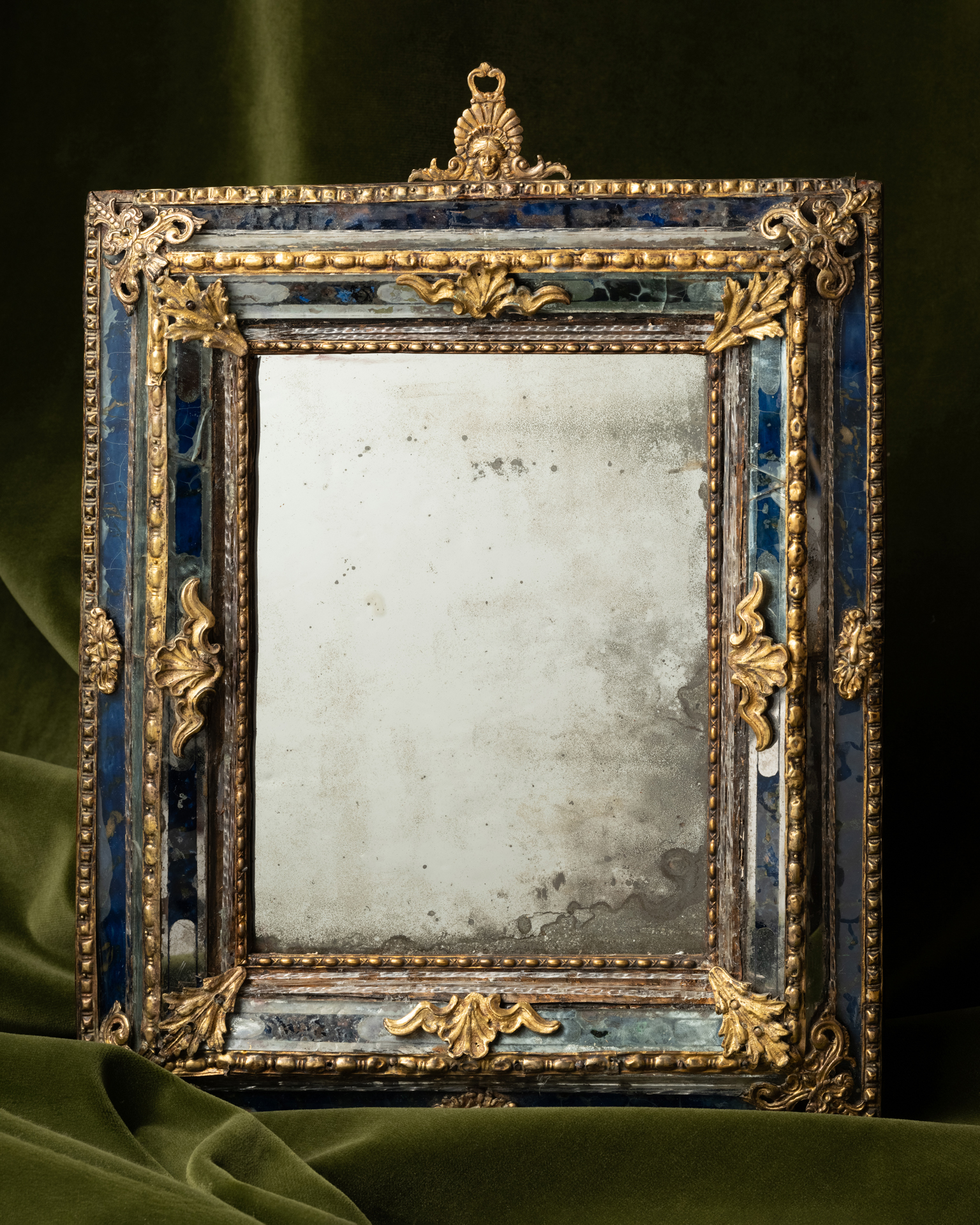
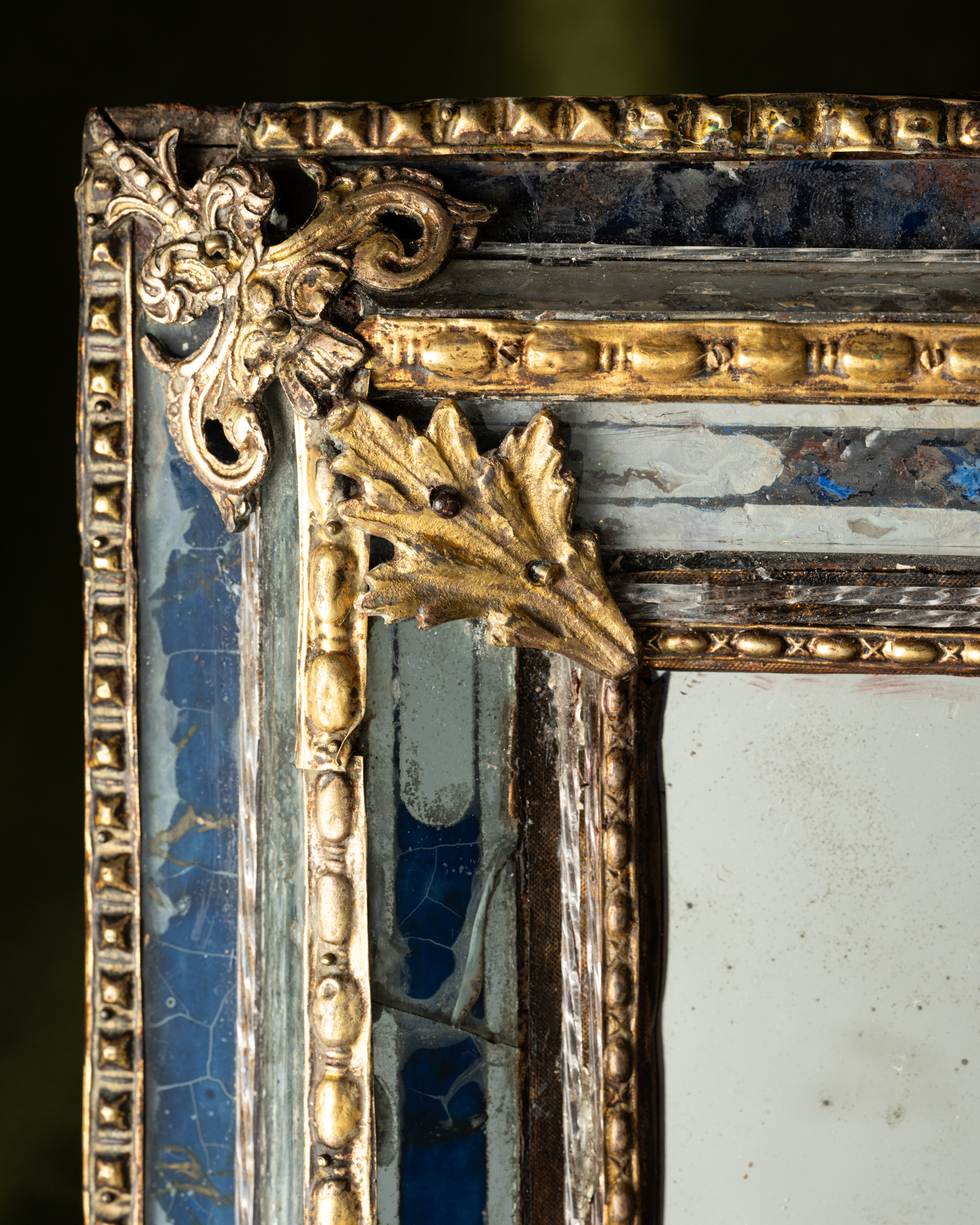
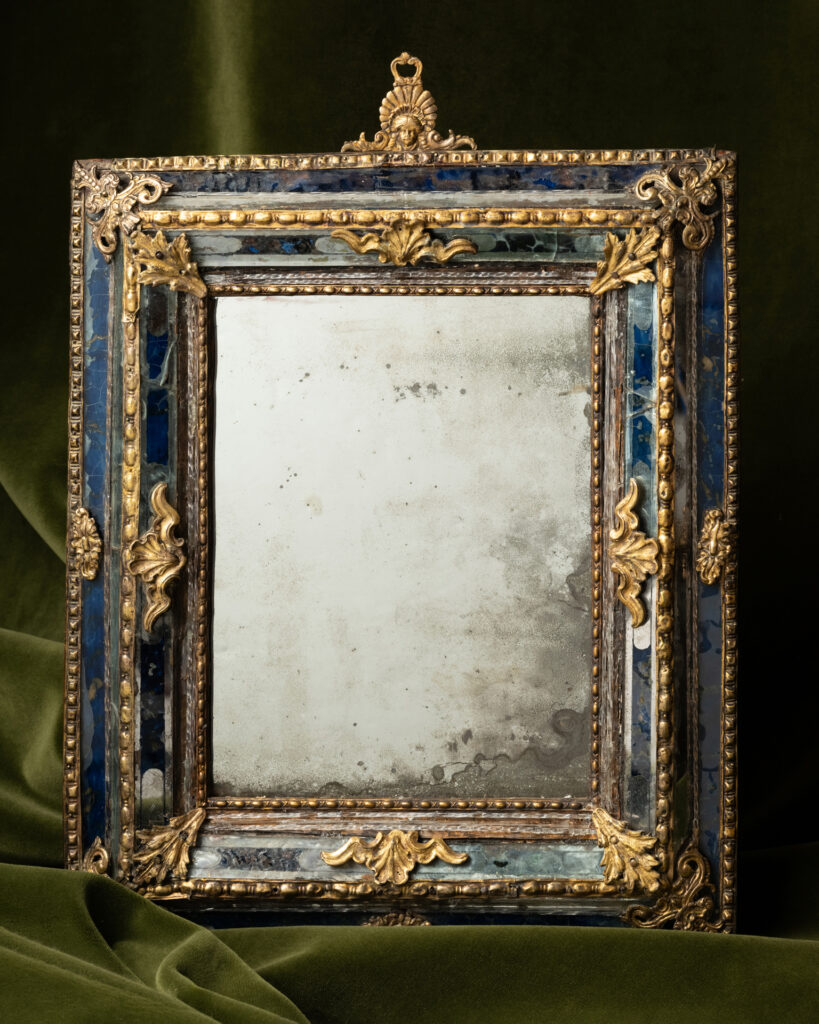
Mercury-plate mirror, glass asticciole torciglione, riporti colorati ‘zaffiro’, gilt bronze and copper Murano Early 18th Century 31 x 37 cm (12.2 x 14.6 in.)
The frame of the mirror, with canes — or asticciole — of twisted glass, along with gilt-metal shells and fusaroles, is made out of colored glass parcloses which ‘recall sapphire, topaz, ruby, and emerald, represented by appliqués of colored and fused glass’.1
This type of frame, which first appeared at the end of the 16th century and was produced until the mid-18th century by Murano glassmakers,2 was intended for the ‘wealthiest and most lavish clientele.3 A mirror of the same type from the collections of the Museo Vetrario in Murano, published by Morazzoni, is likely the ‘Specchio in cornice dorata e riporti di vetro colorato’ listed as No. 939 in the museum’s catalogue, under the section dedicated to Vetri muranesi del secolo XVIII, or 18th-century Murano glass.4 Consequently, the present mirror should be dated to the early years of the 18th century; while its torsated glass asticciole, gilt-bronze and copper fusaroles and quasi rocaille shells, and ‘sapphire’ or cobalt glass riporti are unquestionably Muranese.
Literature
Giuseppe Marino Urbani de Gheltof, Catalogo del Museo civico vetrario di Murano, Venice, 1888 ; Giuseppe Morazzoni, Le cornici veneziane, Milano, 1954.
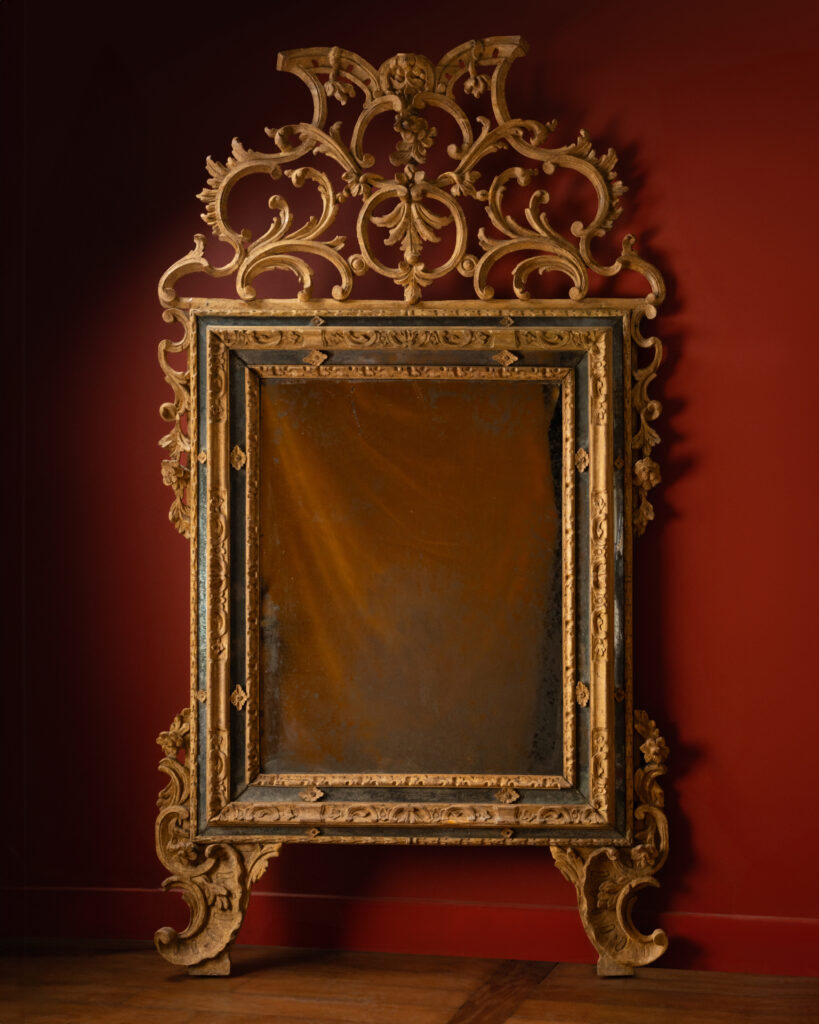
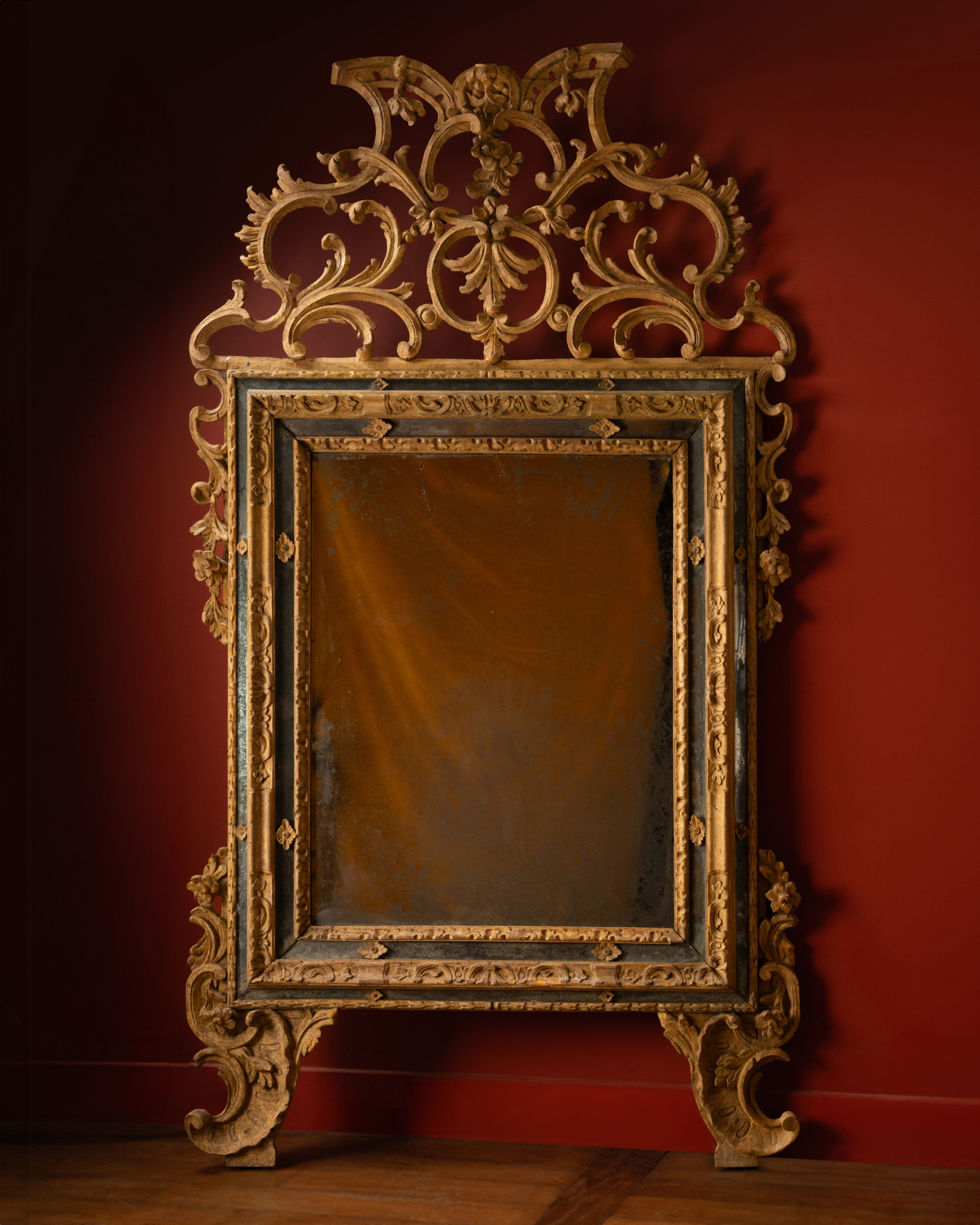
Tin-mercury mirror, intagliato poplar wood, in so-called giallo polenta lacquer Piedmont ca. 1750–1767 165 x 90 cm (65 x 35.4 in.)
At least two similar mirrors are located respectively in the apartments of the Duke of Chiablese and in the antibiblioteca of the famous Stupinigi hunting lodge built for Victor Amadeus II of Savoy in Stupinigi.
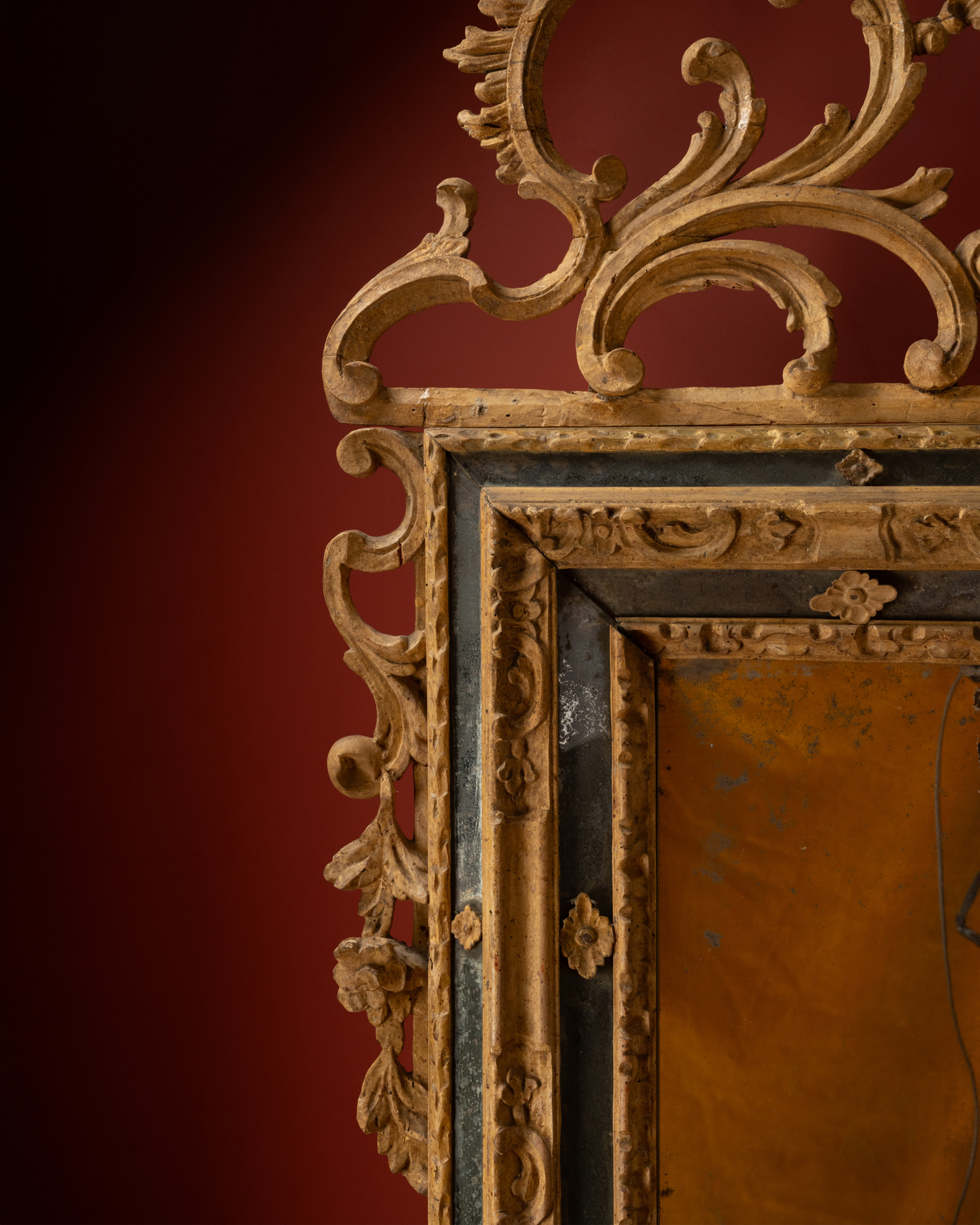
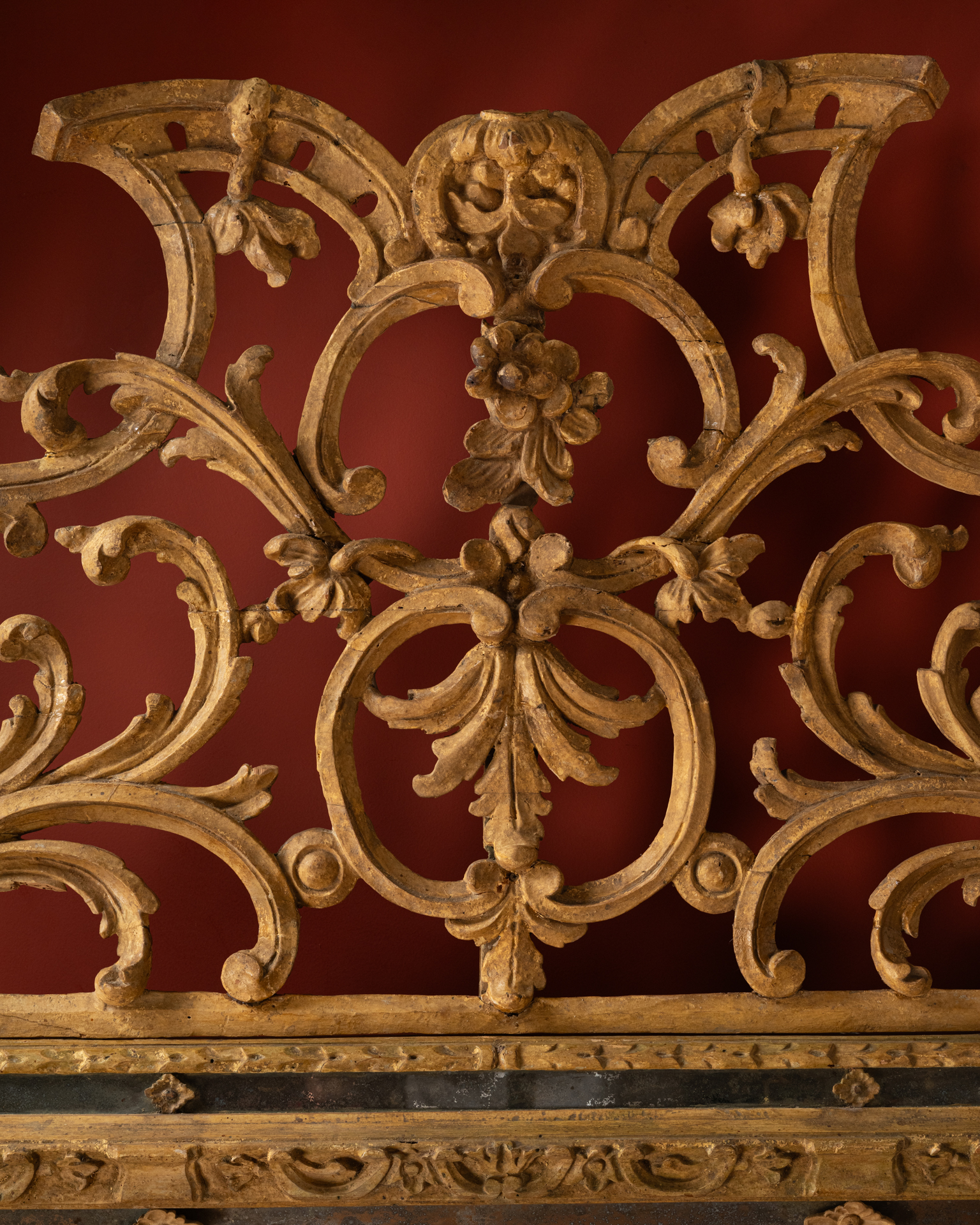
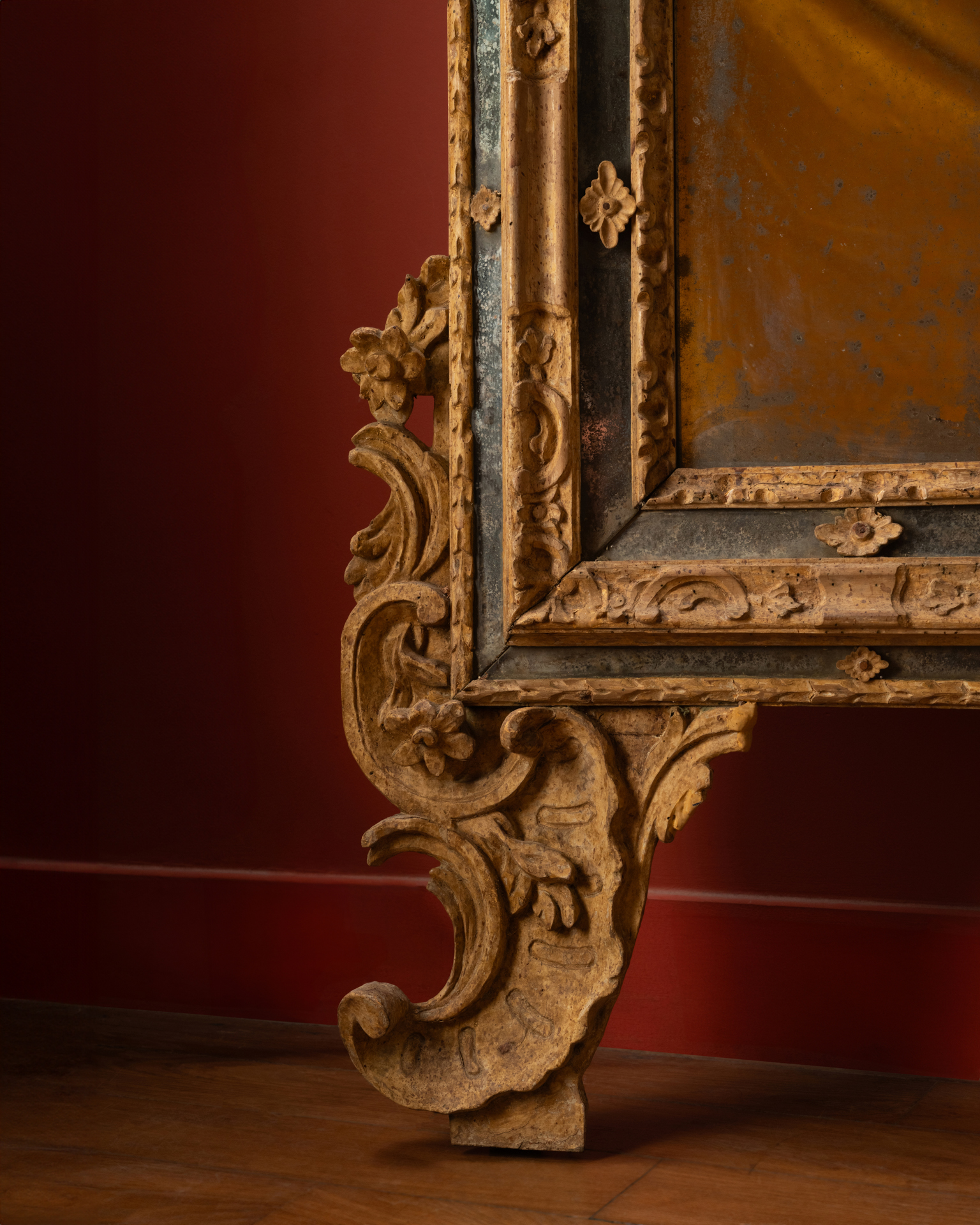
These mirrors, characteristic of the Northern Italian school of woodcarving or intagliato, consist of a mercury looking-glass framed by carved wood friezes and double row of parcloses mirror plates adorned with rosettes. Furthermore, they are framed by a cresting ajouré in carved wood, flower garlands whose carving style is characteristic of Piedmontese workshops, and rocaille feet, which serve as a reminder that these mirrors were designed to be placed atop console tables.
Their decoration thus incorporates the foliage scroll and cartouche ornaments designed by the Piedmontese architect Benedetto Alfieri for the House of Savoy and their court. Specifically, they echo the stuccos, frames, and paneling created after Alfieri’s designs by Turinese craftsmen between 1753 and 1767 inside the Palazzo Chiablese in Turin.
Literature
See Graham Child, World Mirrors. 1650-1900, London, 1990 and Enrico Colle, Museo di arti applicate. Mobili e intagli lignei nel Castello Sforzesco, Milan, 1996.
Scagliola Italy 19th century h. 102 cm ; d. 32,5 cm (h. 40.16 ; d. 12.8 in.)
In his 1845 treatise on the pietre antiche, Corsi mentions a “very rare” breccia gialla with a “of orange with small white, red, and dark blue markings” — of a type that may have served as the model for the present column, which is indeed speckled with warmer motifs than traditional breccia.
Literature
See Faustino Corsi, Delle pietre antiche, Rome, 1845 and Gabriele Borghini, Marmi antichi, Rome, 2004.
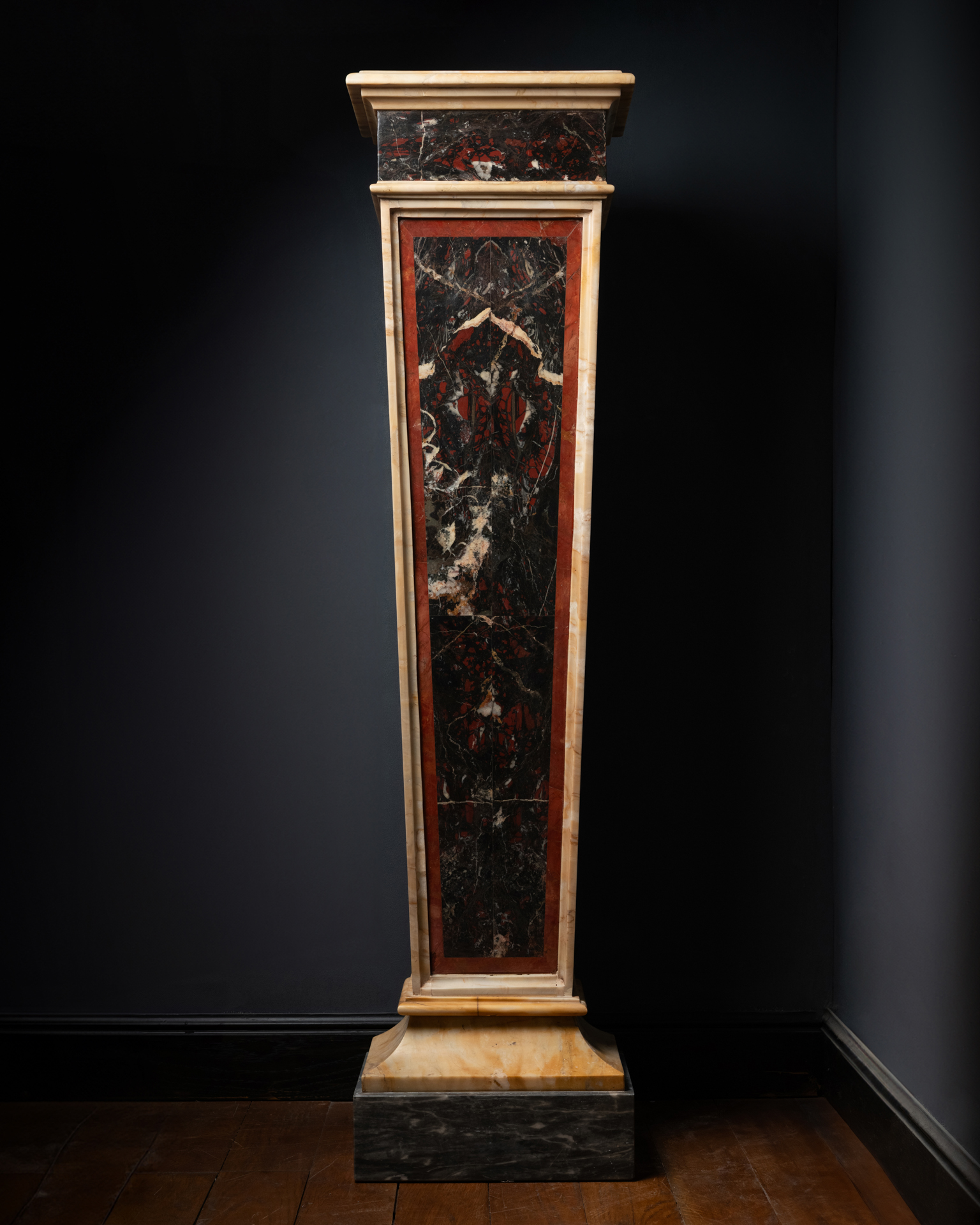
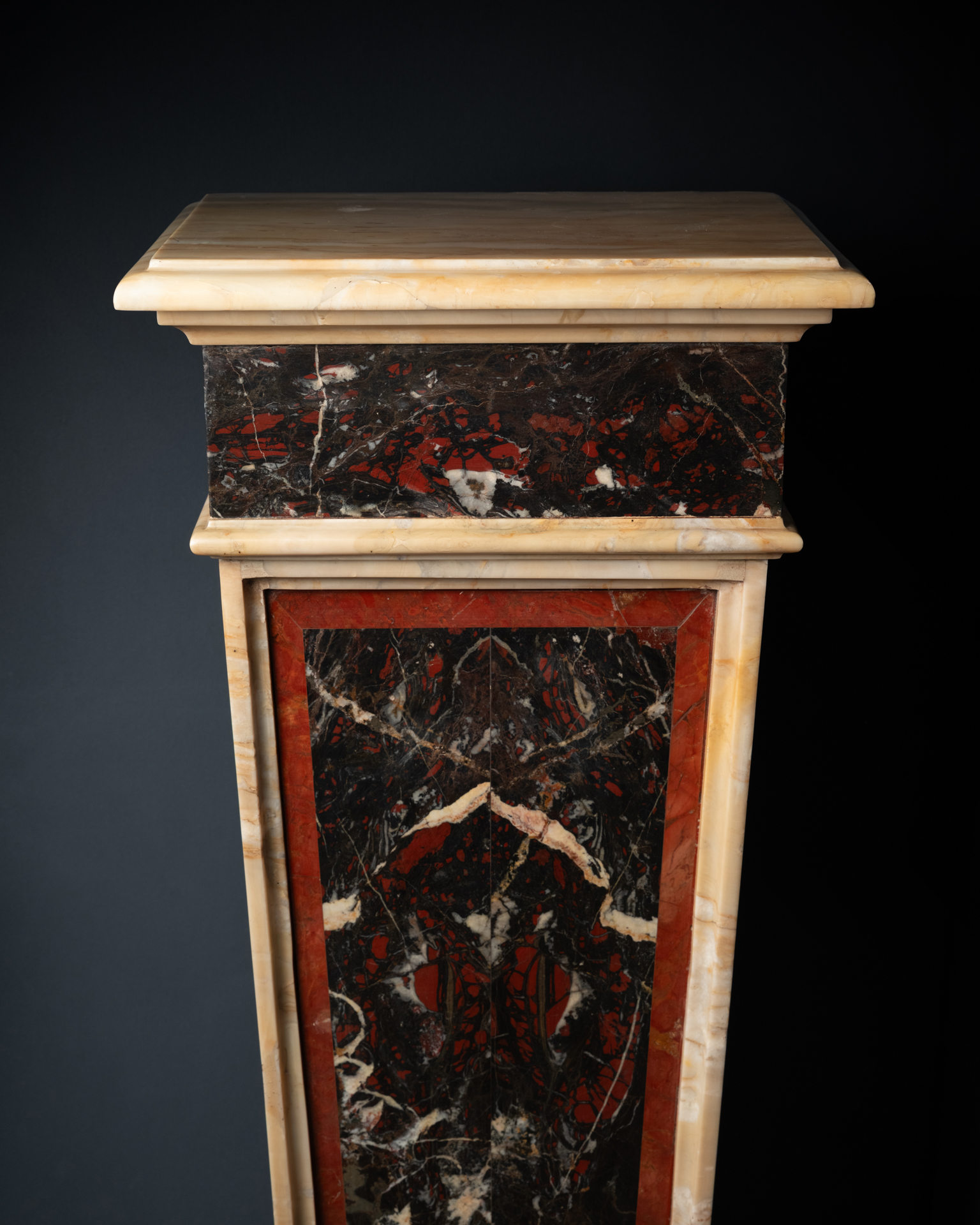
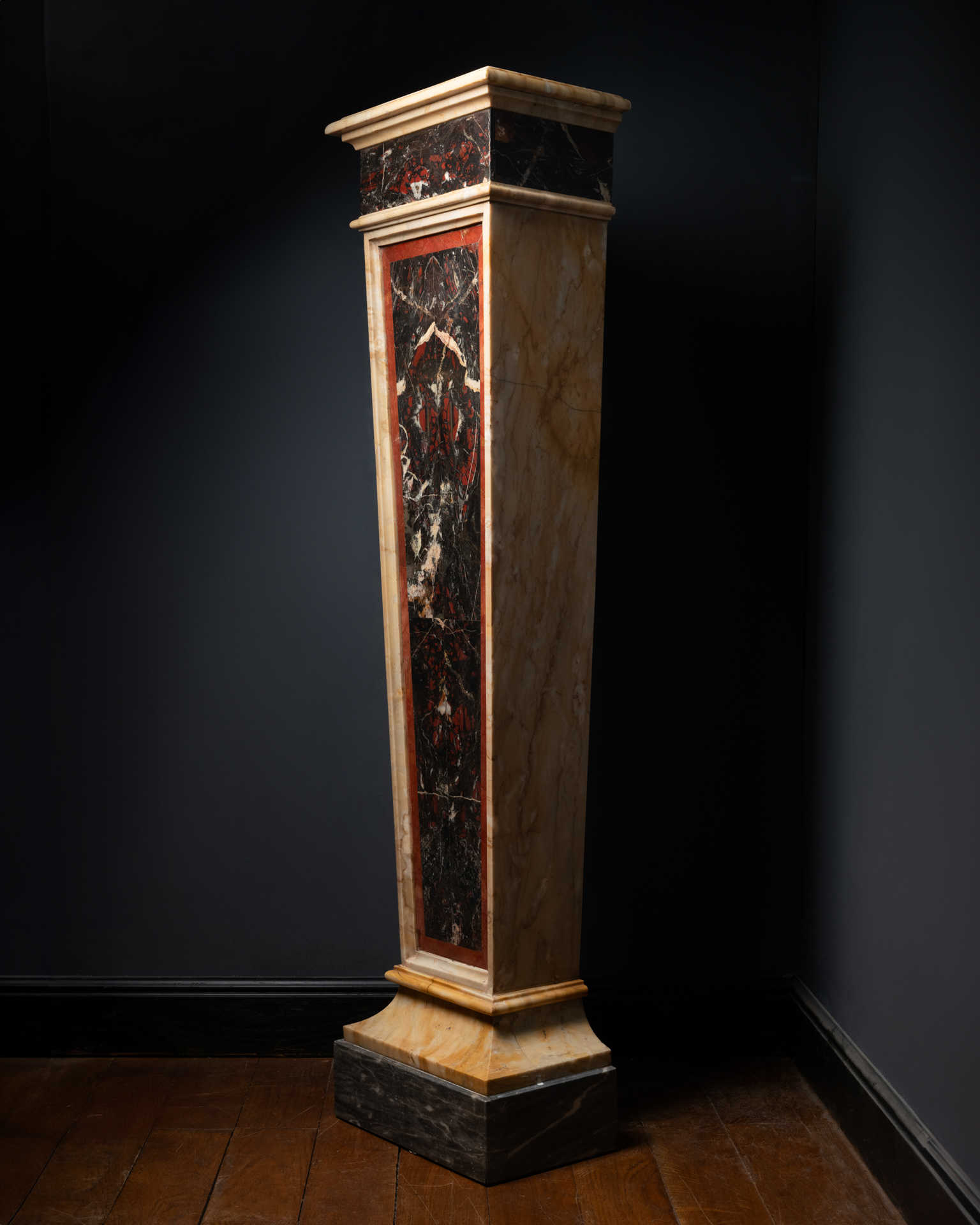
Nero africano, rosso, giallo, and bardiglio marbles Italy 123 x 22 x 32 cm
A pedestal in nero africano marble veneer framed by a red marble listel, likely so-called rosso ammonitico, and moldings in giallo antico. The piece rests on a quadrangular base of bardiglio.
Literature
See Borghini, Marmi antichi, Rome, 2004.
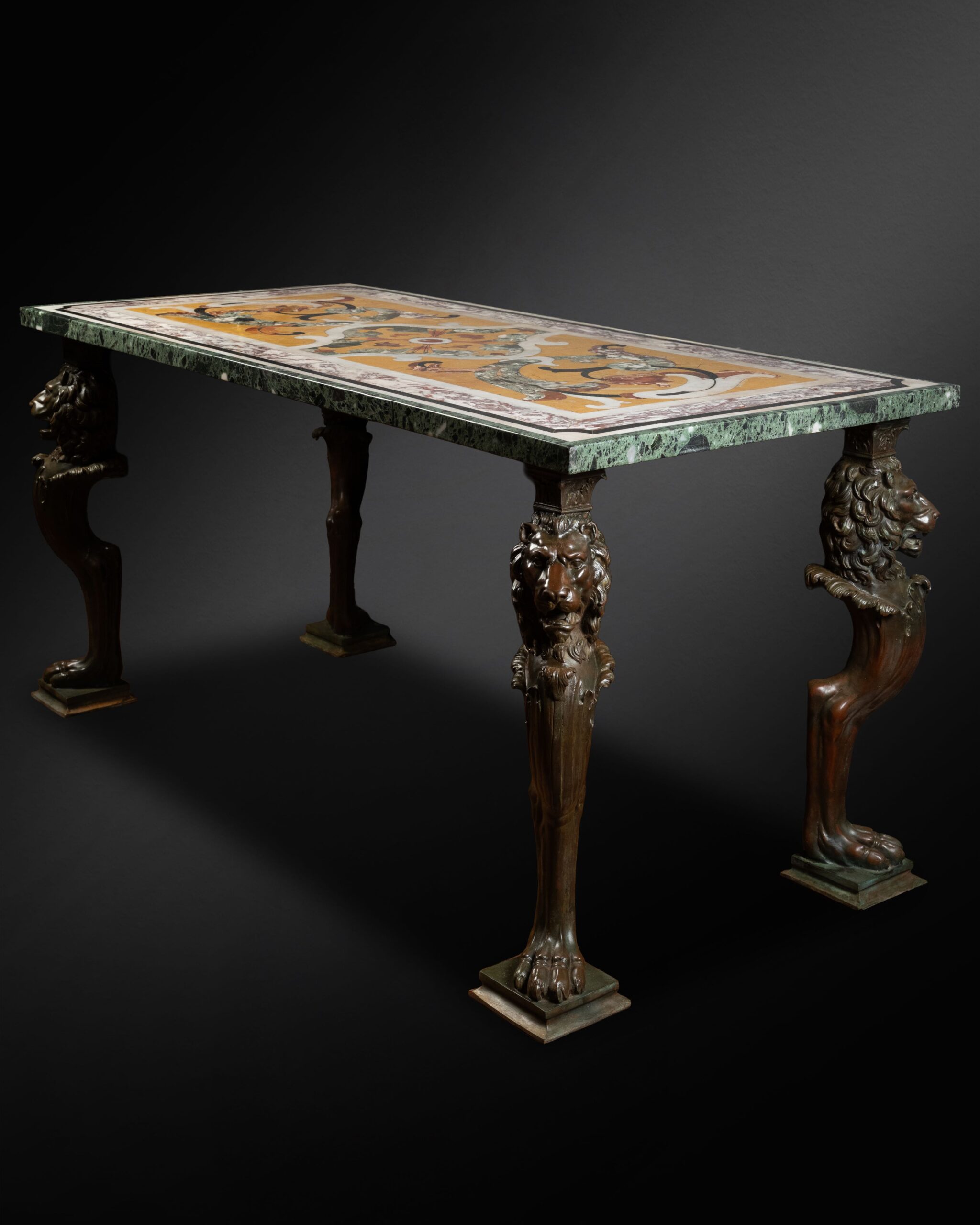
A Polychrome Marble Intarsia Table With Bronze Trapezophoroi
A Polychrome Marble Intarsia Table With Bronze Trapezophoroi
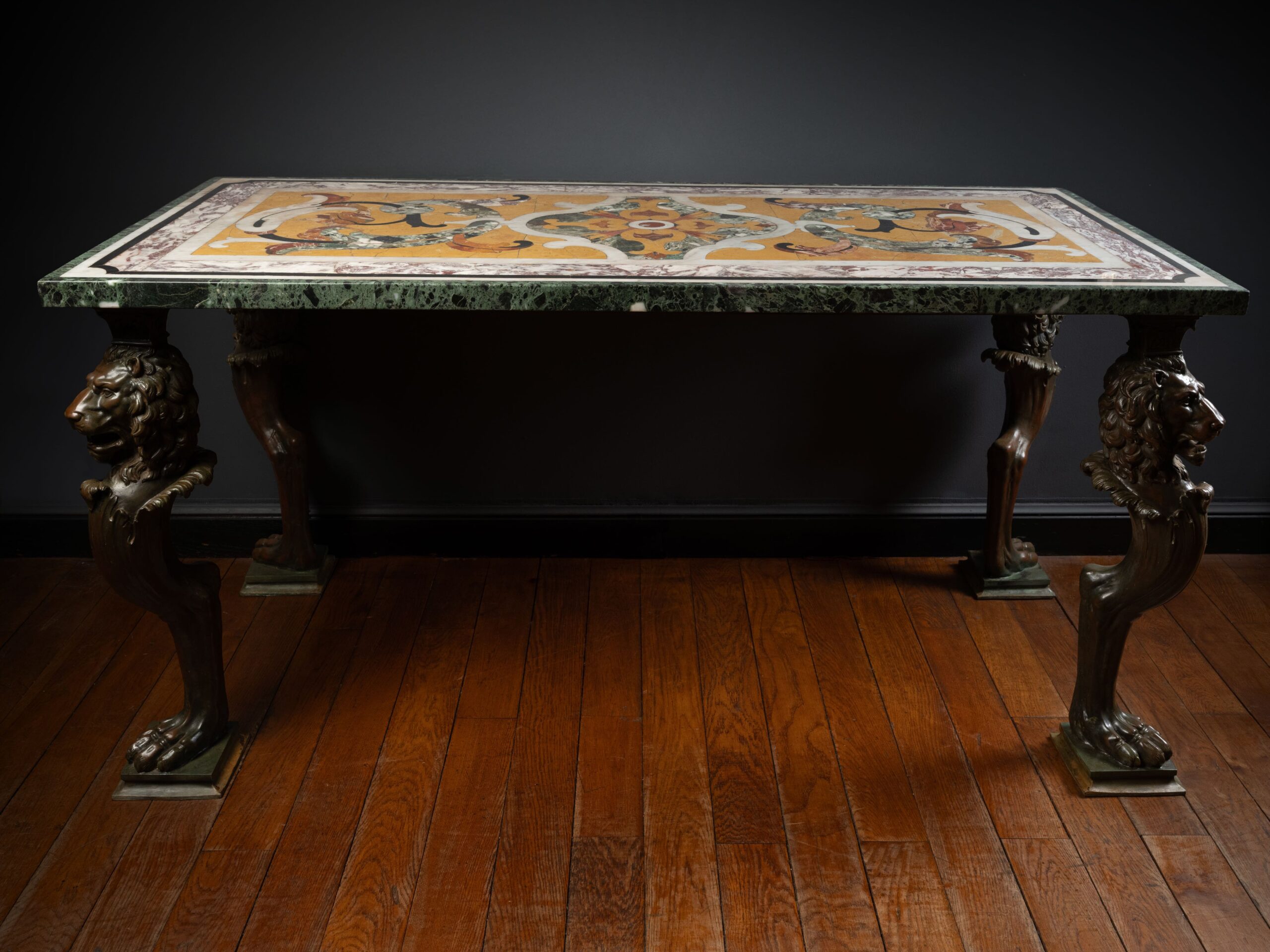
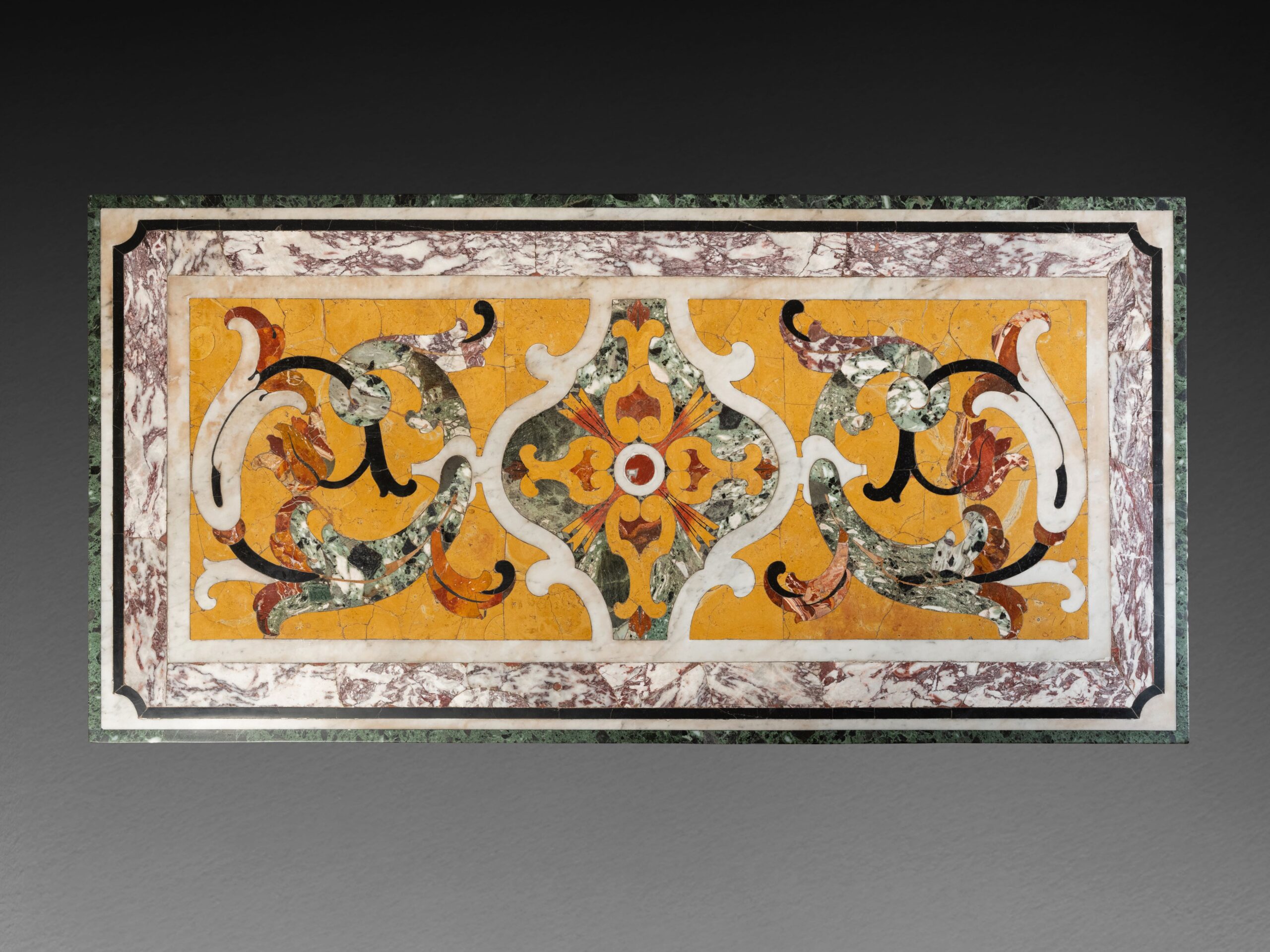
Intarsia of Sicilian jasper, nero di Belgio, giallo di Siena, Carrara white, pavonazzetto, and verde antico; bronze base Naples (tabletop) and Rome (base) Early 18th century (tabletop) and late 19th century (base) 78 × 155 × 75 cm (30¾ × 61 × 29½ in.)
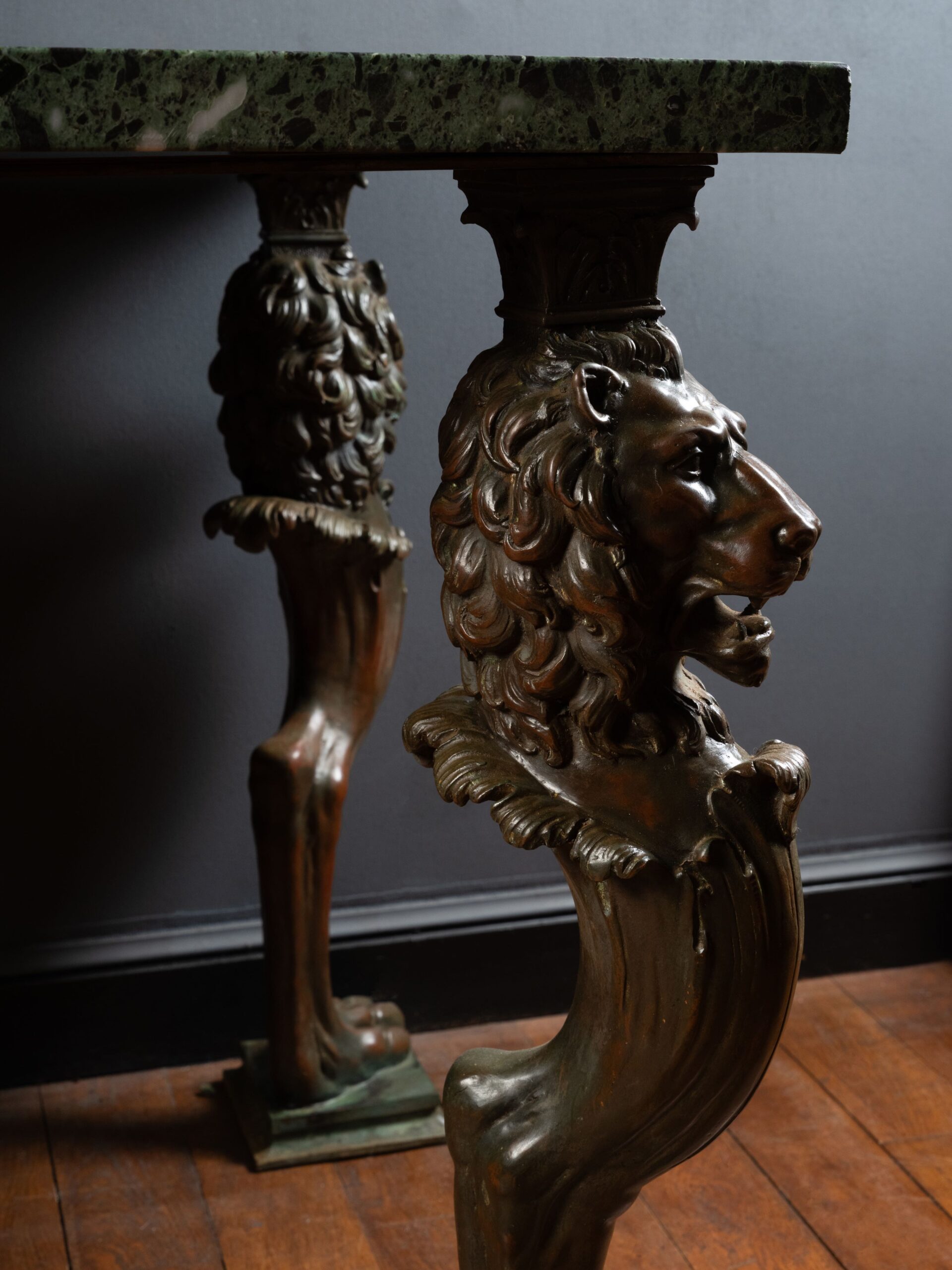
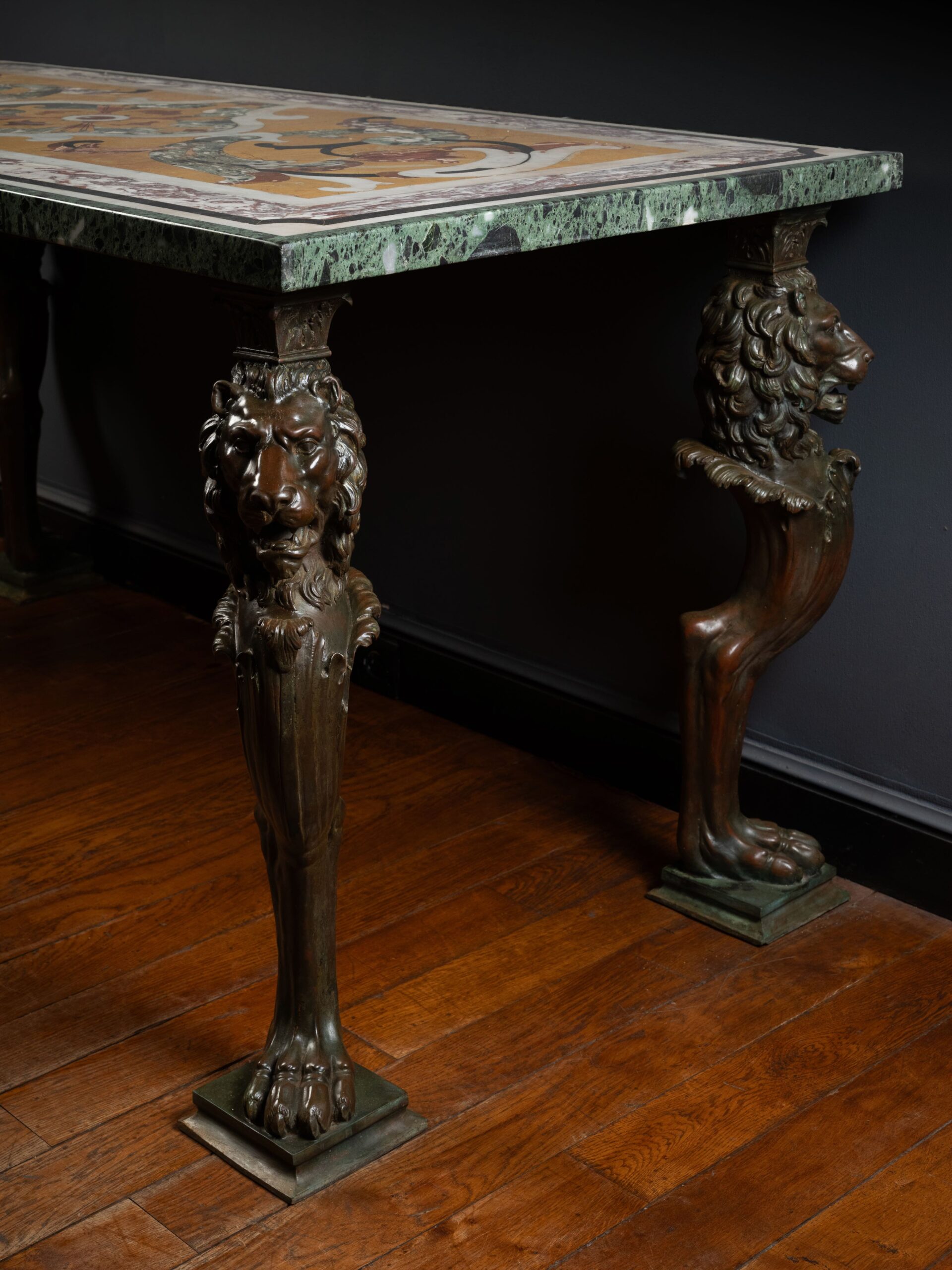
The word trapezophoron, literally “table-bearer,” from the Greek τράπεζα (table) and φέρειν (to carry), is said of a table leg, most often in marble or bronze, carved in the form of a lion, panther, or griffin head. Among the Romans, these tables with theriomorphic — that is, whose support takes the form of an animal, from the Greek θηρίον (wild beast) and μορφή (form) — trapezophoroi were frequently used to display vases and were accordingly known as mensae vasariae (vase tables).
The intarsia tabletop.
The mensa vasaria with winged lion protomes, found behind the impluvium of the domus Cornelia, the house of Cornelius Rufus at Pompeii, is among the finest examples of the type. The bronze base of the present table, however, replicates the trapezophoroi of yet another antique model, a tripod held in the Naples Archaeological Museum, whose expressive, shaggy lion heads spring from a powerful paw, the skin of which curls away in a pattern reminiscent of the acanthus leaf. This tripod — itself a mensa vasaria, and one of the finest of its kind, according to Overbeck — was likewise discovered at Pompeii, this time in the triclinium of the Haus des kleinen Mosaikbrunnens, the Casa degli Scienziati, excavated between 1839 and 1845. The casting of this base is almost certainly Italian work of the late nineteenth or early twentieth century; it reproduces the antique faithfully, though with a slight elongation in height.
These bronze trapezophoroi support a marble top of considerably earlier date, predating both their casting and the discovery of the Pompeian mensae. It is a reuse of an antependium with intarsia of flowers and foliated scrolls combining Sicilian jasper, nero di Belgio, giallo di Siena and Carrara marble as well as pavonazzetto, the whole framed in verde antico. The intarsia is in all likelihood an early eighteenth-century work and has undergone some discreet restoration.
Literature
See Overbeck, Pompeji in seinen Gebäuden, Leipzig, 1884. On the use, in the eighteenth century, of verde antico frames for piani di tavolo, see Roettgen and Gonzàlez-Palacios, The Art of Mosaics: Selections from the Gilbert Collection, Los Angeles, 1984. On nero di Belgio and the other marbles, see Borghini, Marmi antichi, Rome, 2004.
Bronze Coffee Table With Catalpa Leaves
Bronze coffee table with catalpa leaves
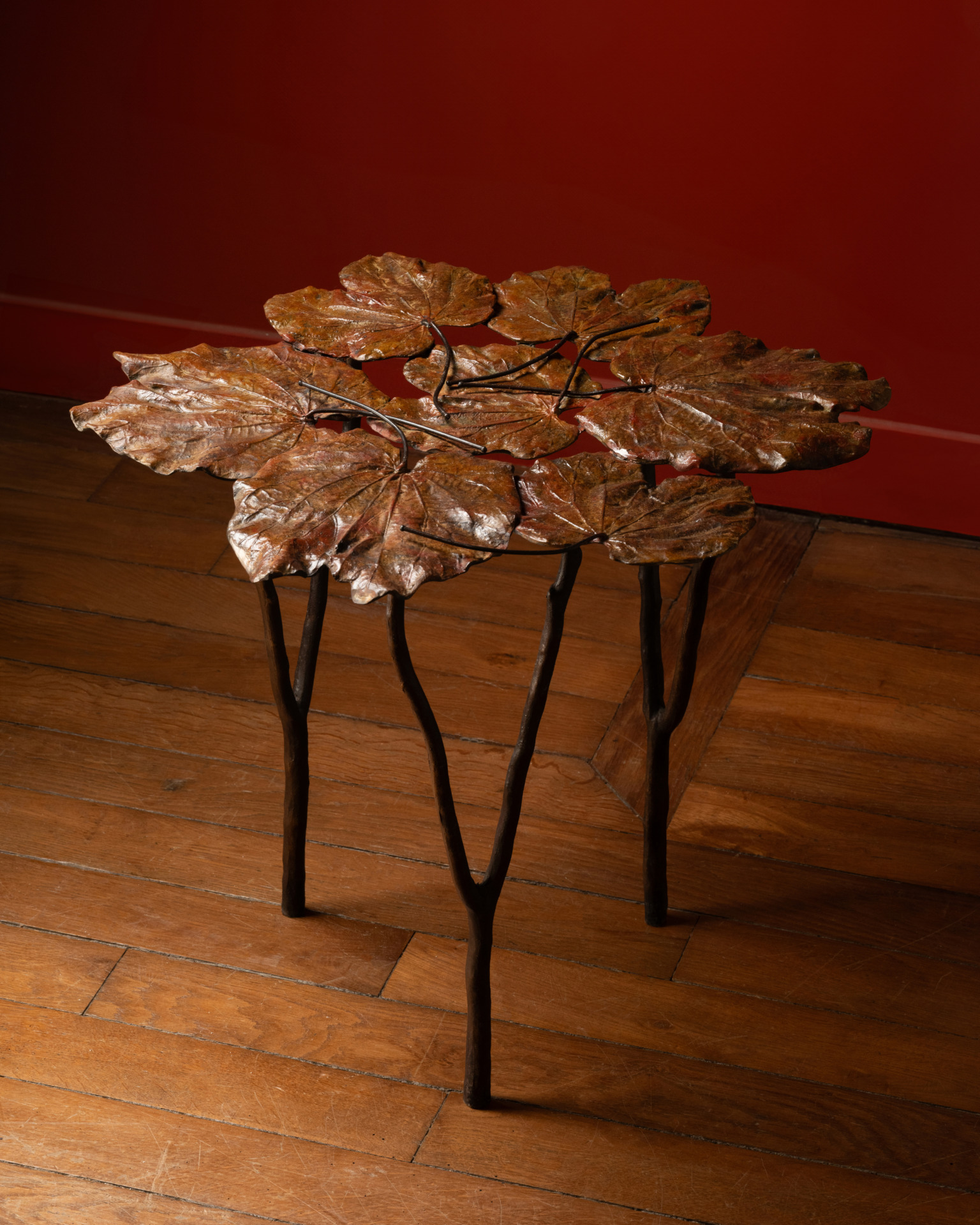
Bronze France 20th century 51 x 57 cm (20.1 x 22.4 in)
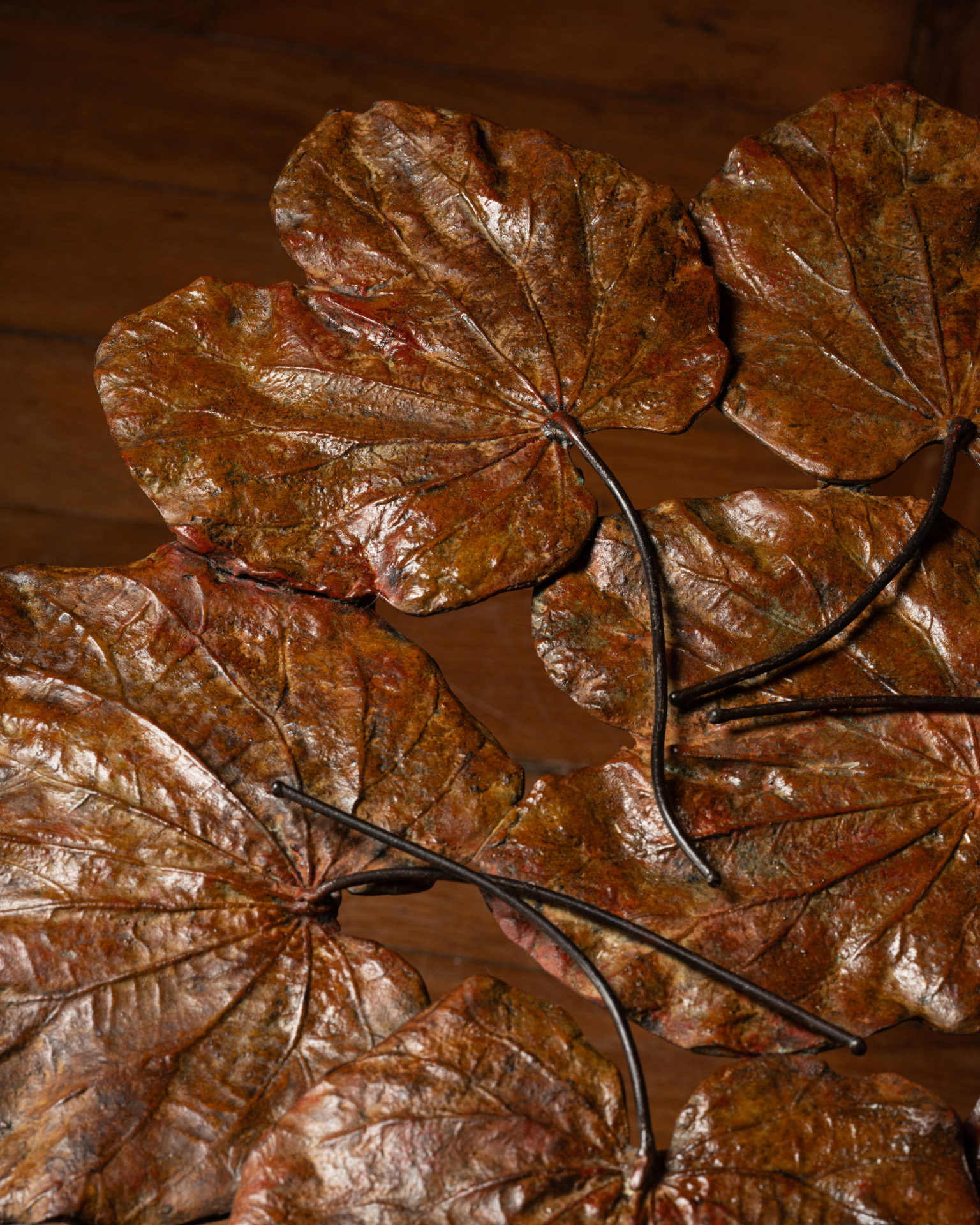
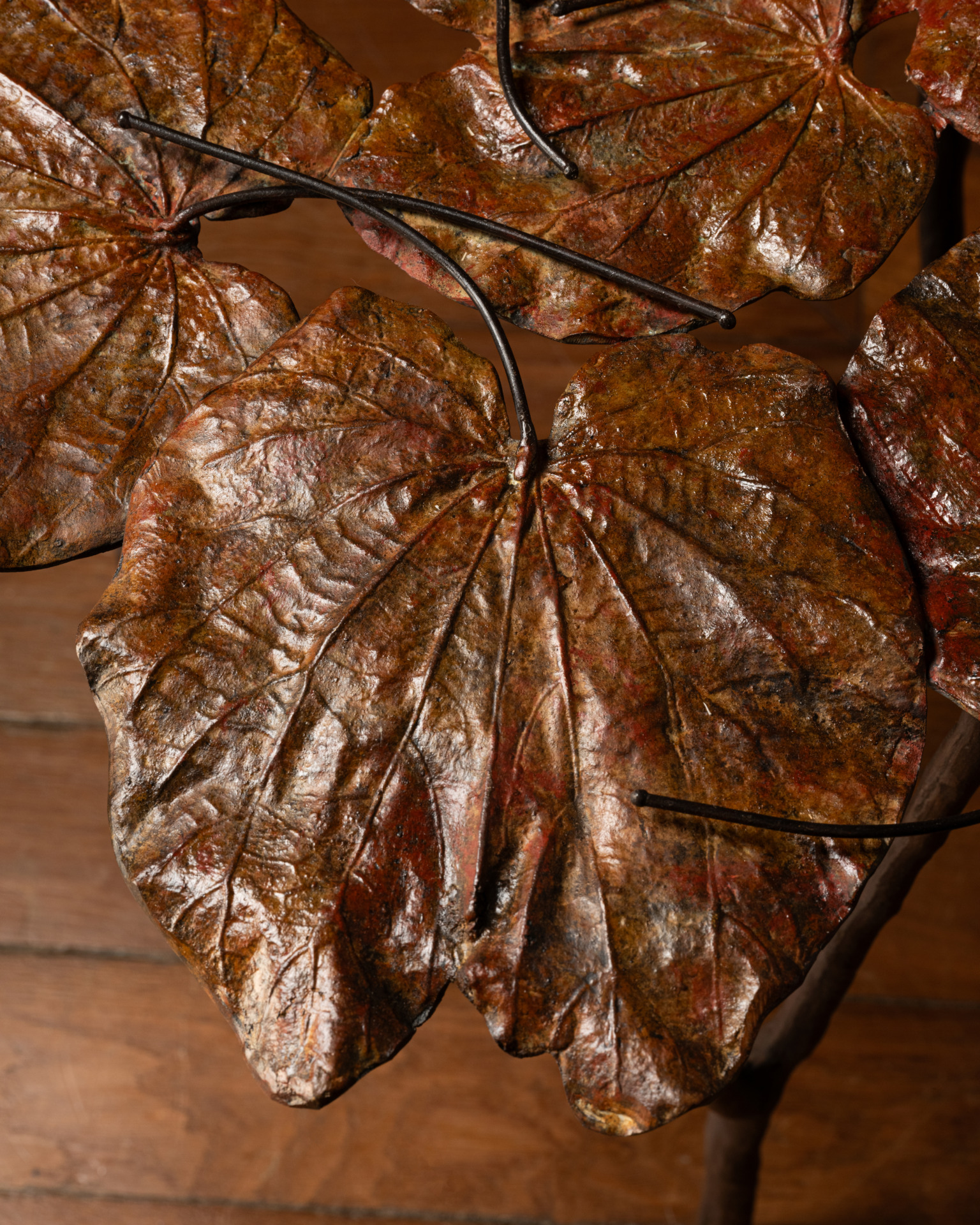
This small bronze table features a top representing a ground strewn with withered catalpa leaves. These leaves rest on three bronze legs depicting the branches of a tree. Unsigned, it is likely a French work from the second half of the 20th century.
A specimen marble, porphyry and semi-precious stones guéridon
A specimen marble, porphyry and semi-precious stones guéridon
Marble, porphyry and semi-precious stones table-top on parcel-gilt bronze base Italy Early 19th century for the top, the base of later date 71 x 87 x 87 cm (28 x 34.25 x 34.25 in.)
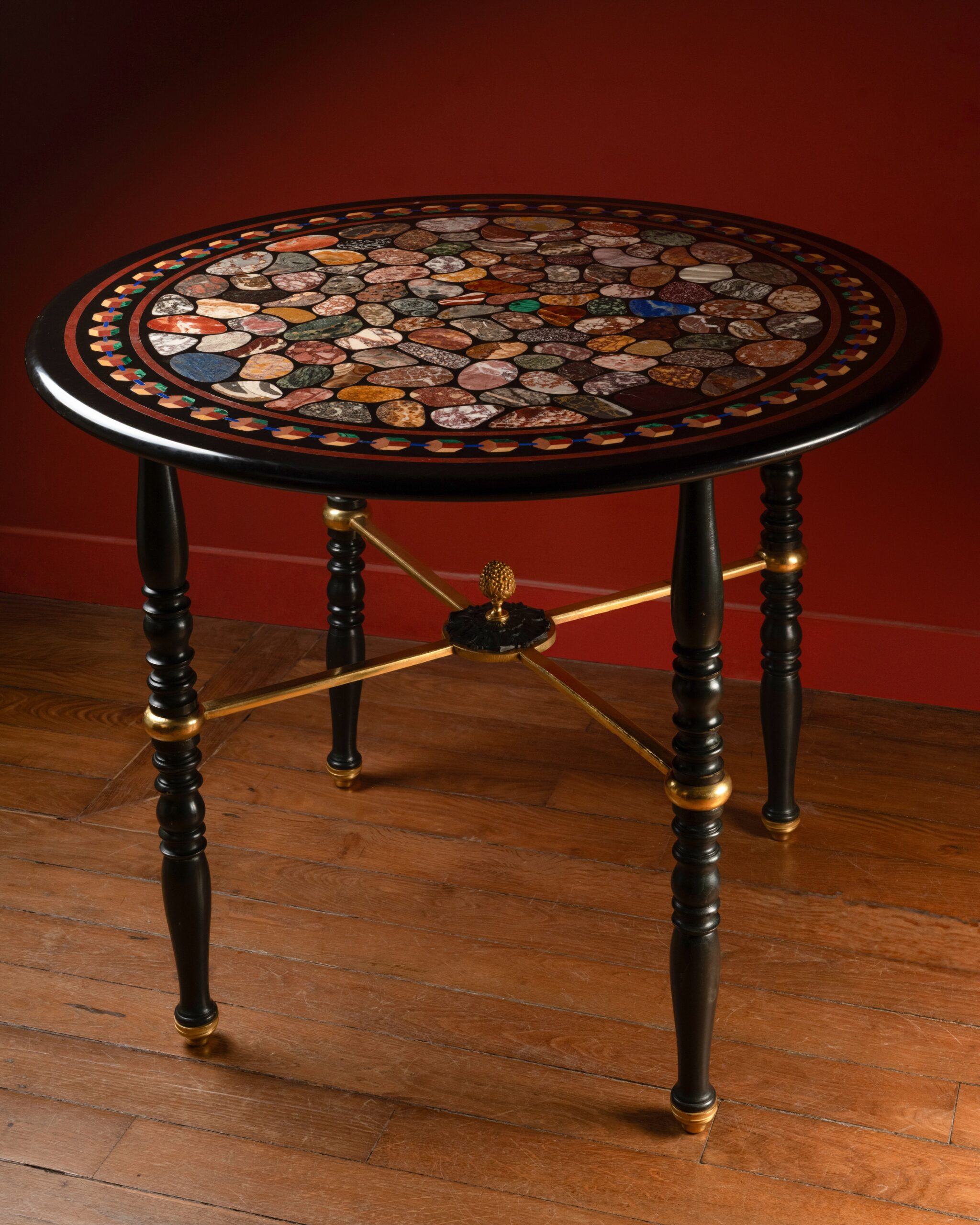
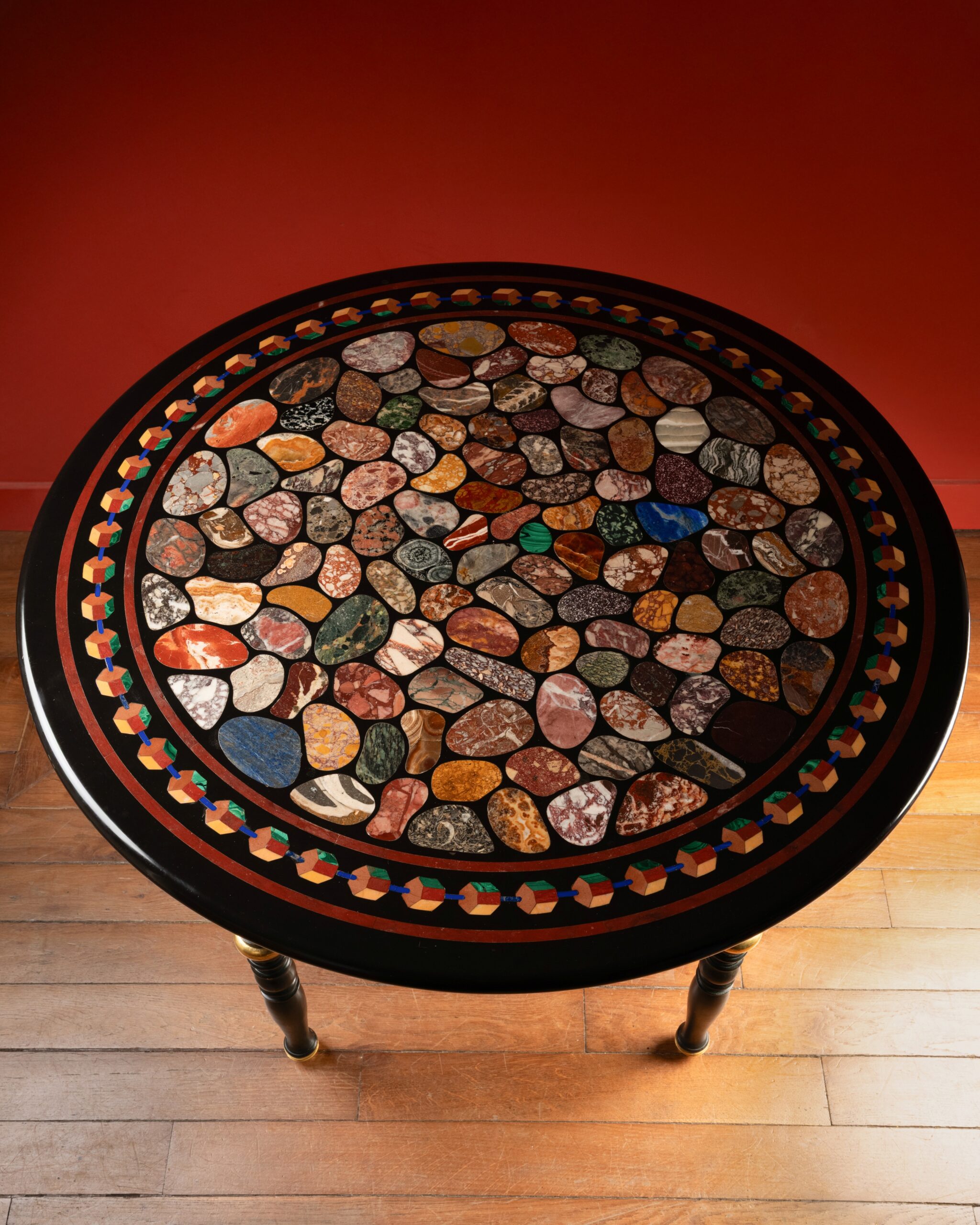
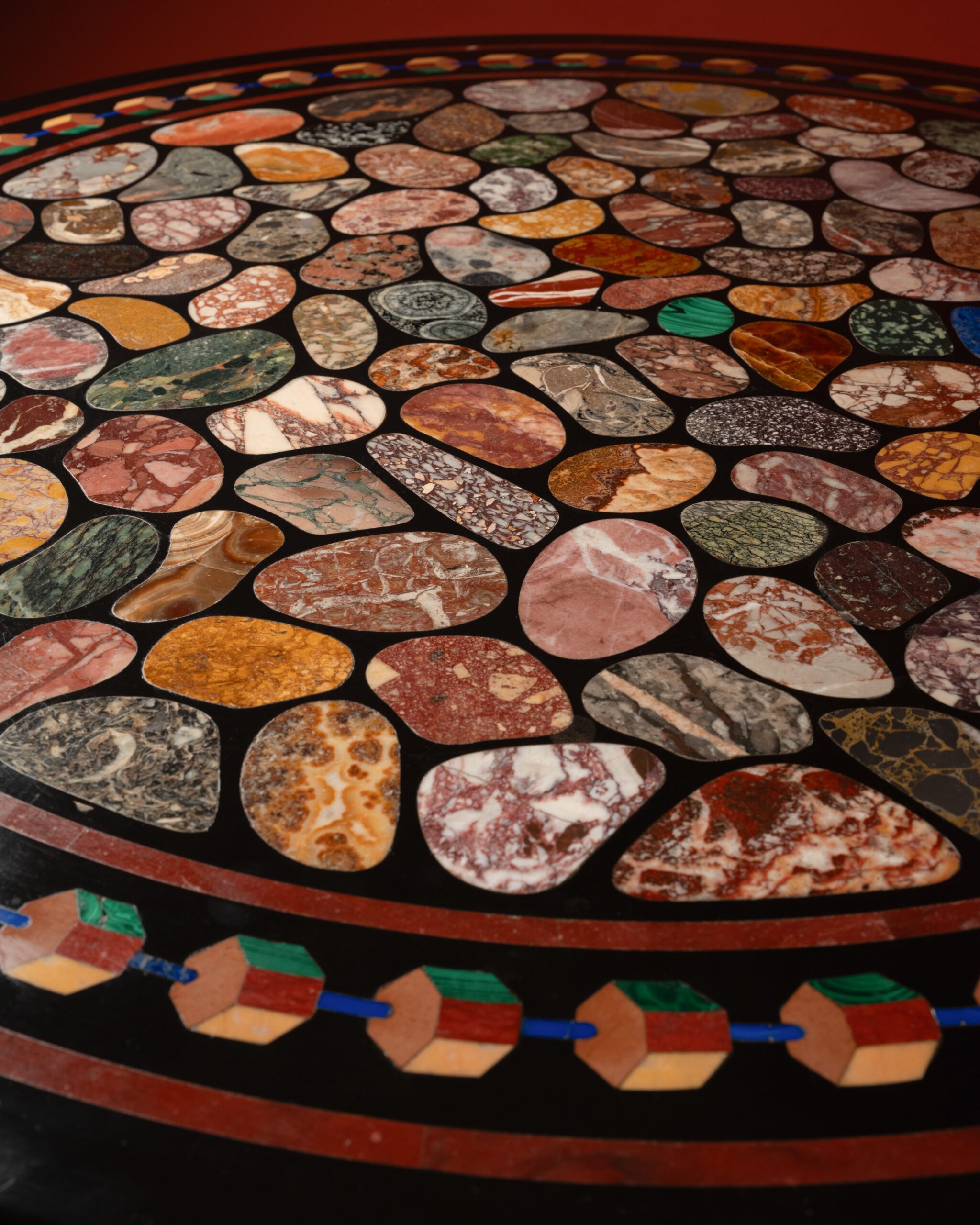
This guéridon is composed of a significant top of samples of marbles from Italy, France, Anatolia, and Africa, some bearing the mark of a fossil, breccias from numerous massifs, granites and diorites, including a rare orbicular diorite, porphyries from Greece, Trento and Egypt, alabasters, lumachelles, jaspers, malachites, lapis and chalcedonies, bordered by a gallery of hexagonal prisms in malachite, rosso, and giallo as well as a beige marble, linked together by a cord of lapis lazuli, all resting on an important base entirely in patinated and gilt bronze, with bun feet, the stretcher adorned with a rosette in patinated bronze and a pine cone in gilt bronze.
The top evokes Roman productions of the first third of the 19th century. The base is of later date.
Pair Of Louis XVI Period Armchairs Stamped By Jean-baptiste Boulard
Pair of “à la Reine” armchairs stamped by Jean-Baptiste Boulard
Moulded, carved and lacquered beech France 1790 92 x 44 x 59 cm (36.2 × 17.3 × 23.2 in.)
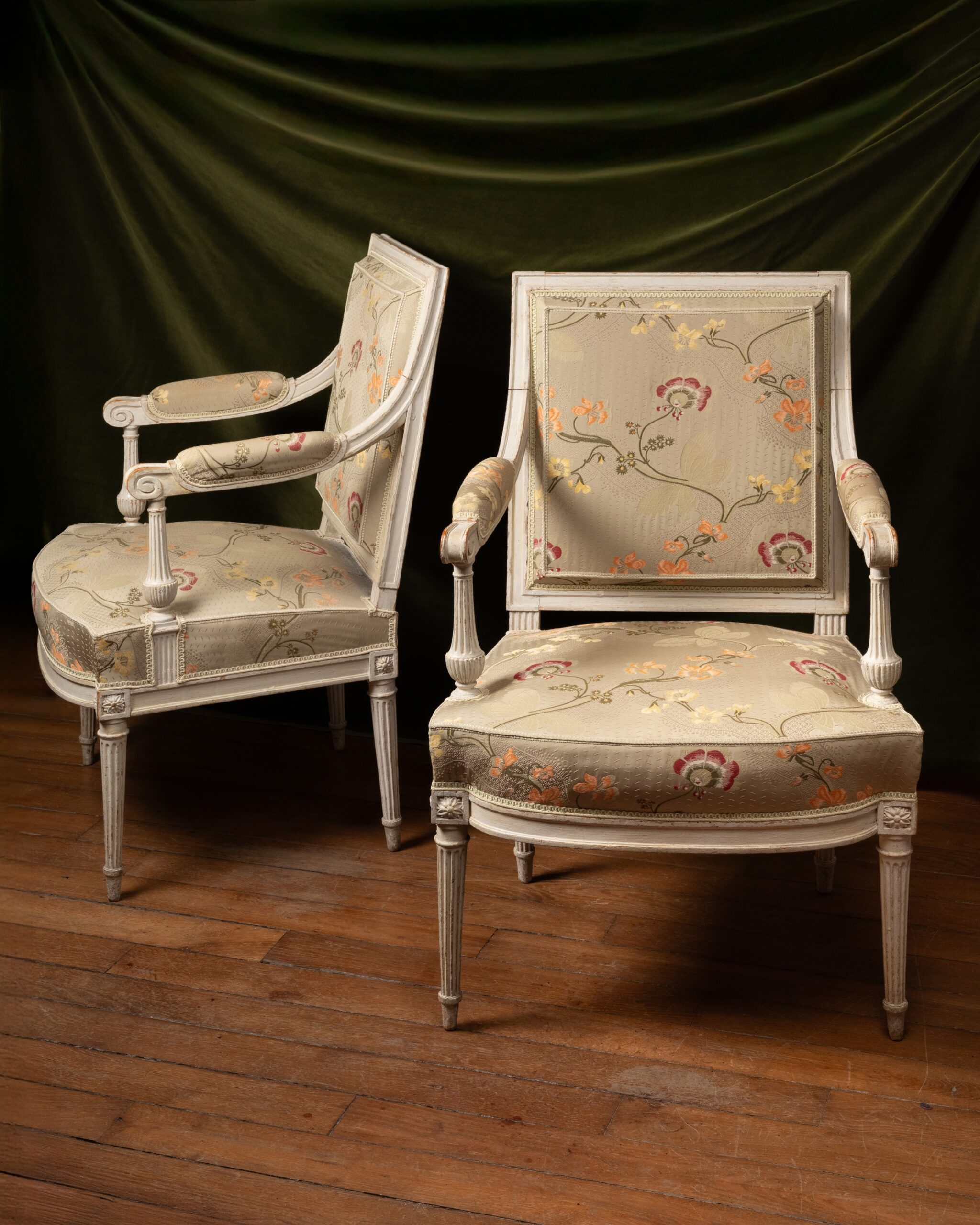
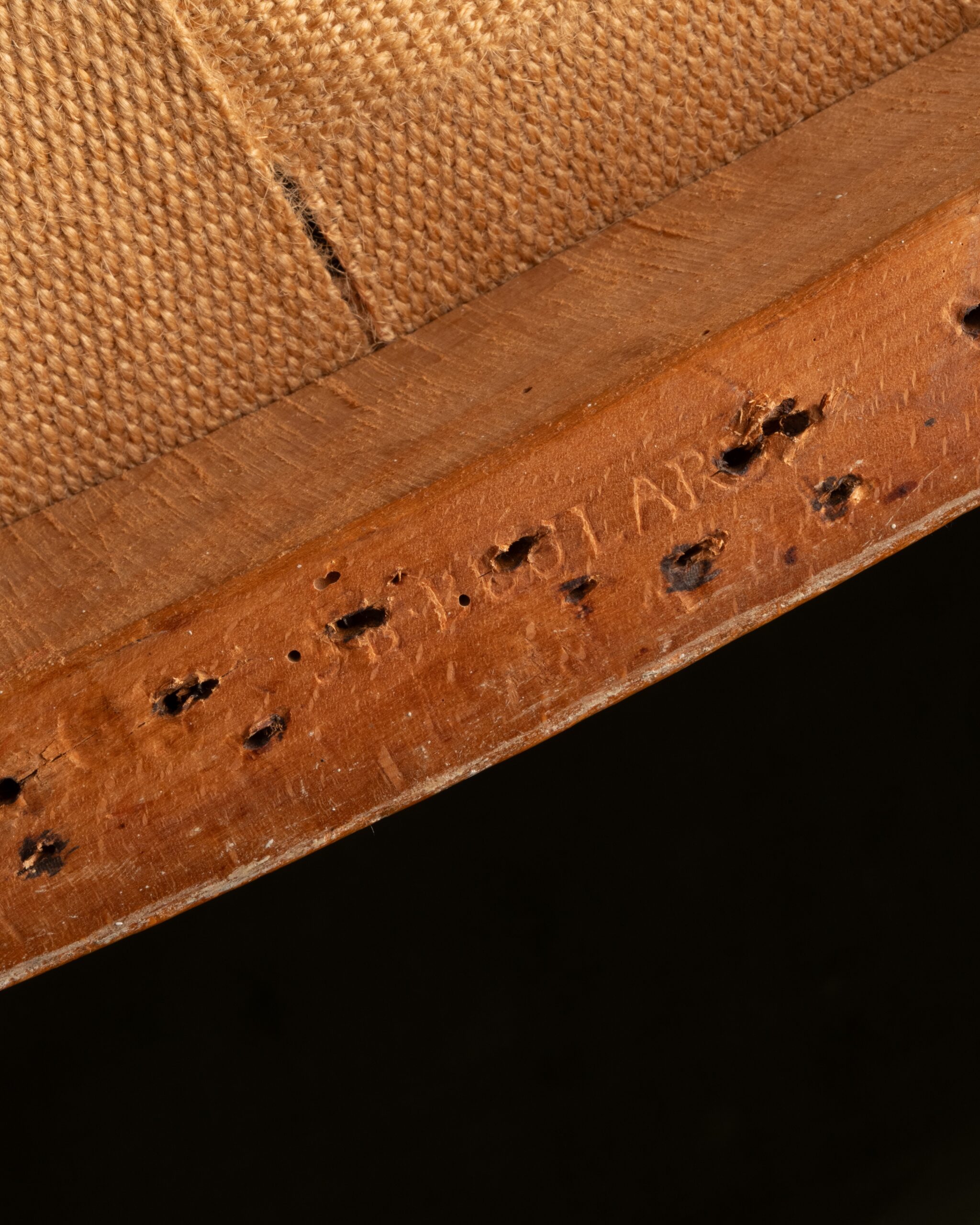
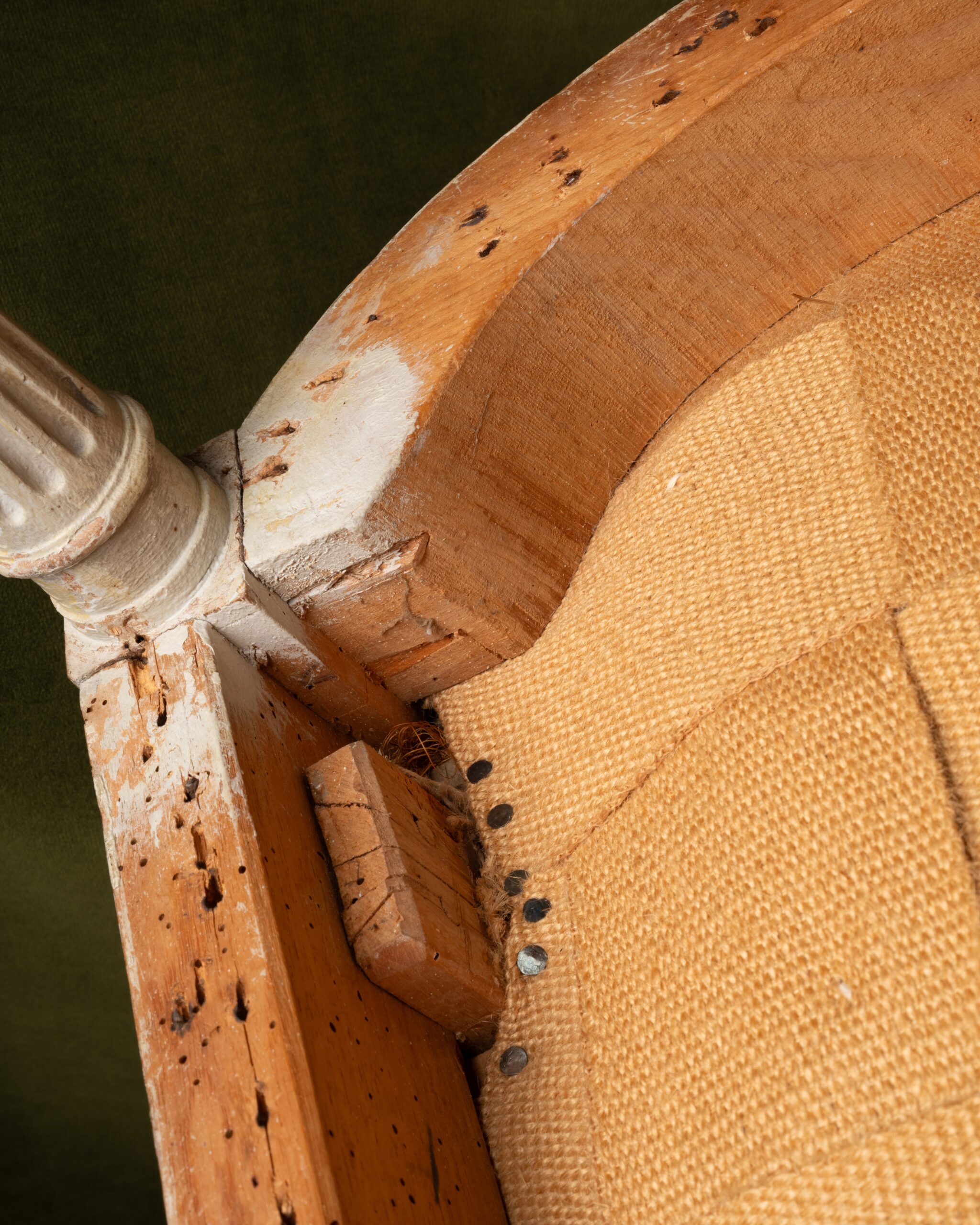
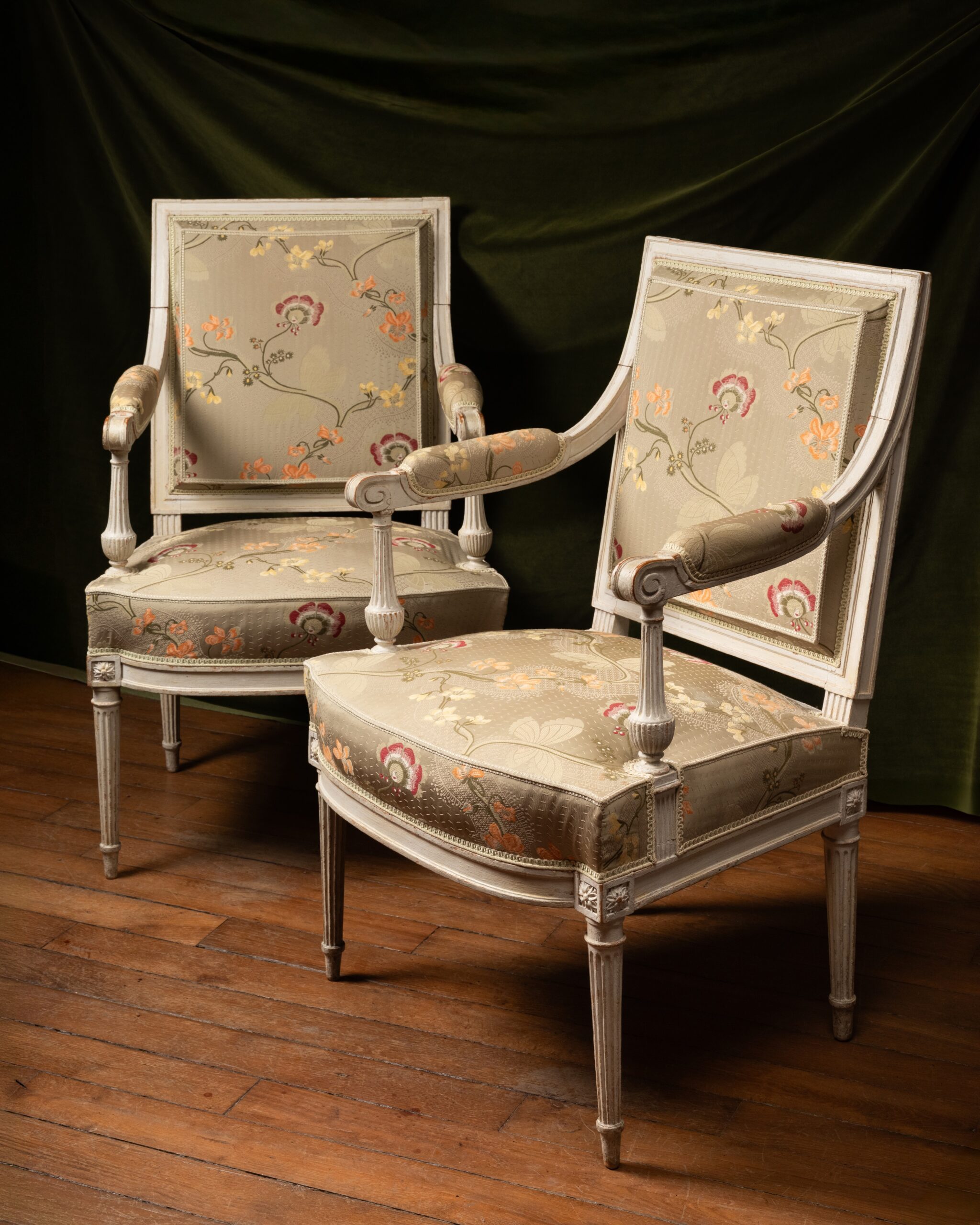
This pair of Louis XVI period “à la Reine” armchairs in moulded and carved beechwood, cream-lacquered, bears the stamp of Jean-Baptiste Boulard.
The rectangular backrests, padded armrests supported by fluted baluster-shaped supports with gadrooned motifs, the corner blocks adorned with rosettes, and the tapered, fluted legs ending in toupie feet: the entire ornamental vocabulary of these two armchairs reflects the purest Louis XVI period fashion.
Jean-Baptiste Boulard, a Parisian cabinetmaker born around 1725 and likely trained in the workshop of Michel Avisse, was certified as a master in 1754 and established himself on Rue de Cléry. In 1777, he was appointed to the Garde-Meuble, from which point he produced a considerable number of commissions for the royal households. Among them: the grand bed of Louis XVI for Fontainebleau, created in 1785 with Hauré; furniture for the King’s cabinet at Saint-Cloud; a salon suite for the Queen at Versailles; seating for the apartments of Mesdames Louise and Élisabeth, as well as for the Count and Countess of Provence—that is, the future Louis XVIII and his wife Marie-Joséphine of Savoy. He also supplied much of the furniture for the Count of Artois at the Château de Bagatelle and several pieces for the Duchess of Polignac at Fontainebleau.
The green upholstery enwrought with floral motifs is modern, inspired by Louis XVI period tapestries.
An extremely similar armchair, part of a pair, is on display in the antechamber of the Dauphin’s apartment at the Château de Compiègne. The second armchair of that pair, commissioned in 1790 for Madame Élisabeth’s cabinet at Compiègne, was sold at Christie’s, Paris, on December 10, 2000, for 293,750 francs, or approximately €67,000.
Literature
François de Salverte, Les Ébénistes du XVIIIe siècle, Paris, 1923 ; Pierre Devinoy and Madeleine Jarry, Le Siège français, Fribourg, 1973 ; Bill Pallot, L’Art du Siège au XVIIIe siècle en France, Paris, 1987.
Pair Of Red Marble Pedestals
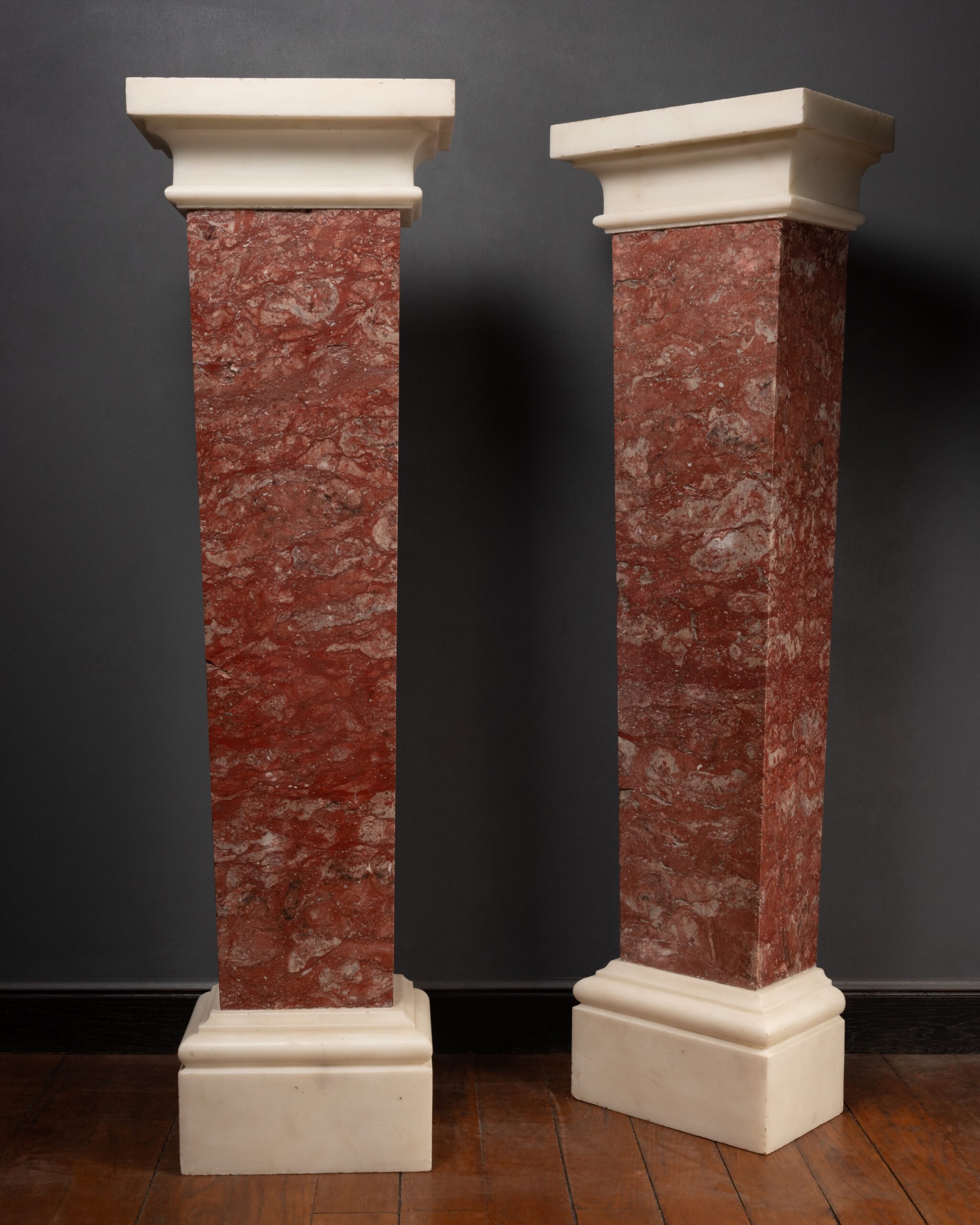
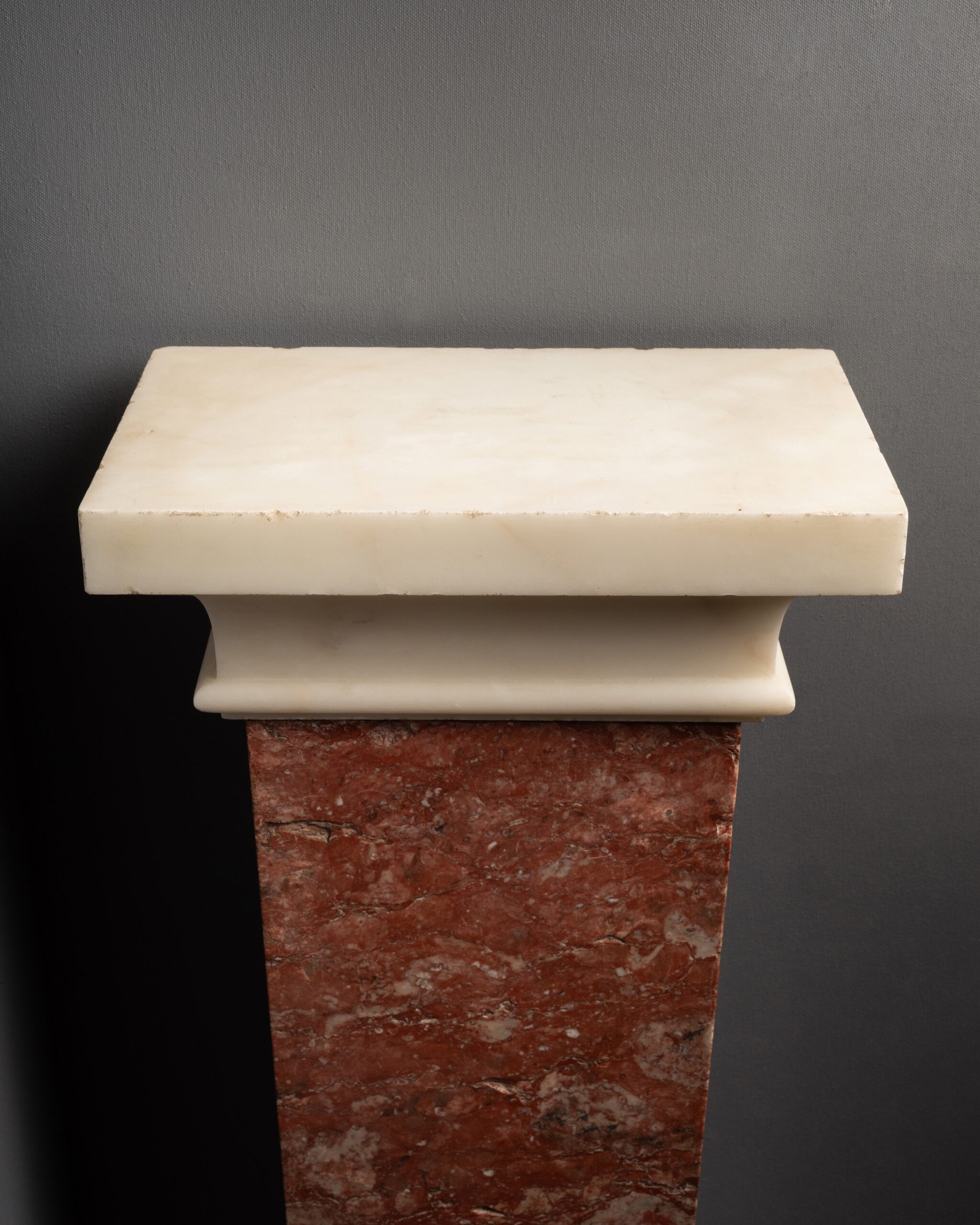
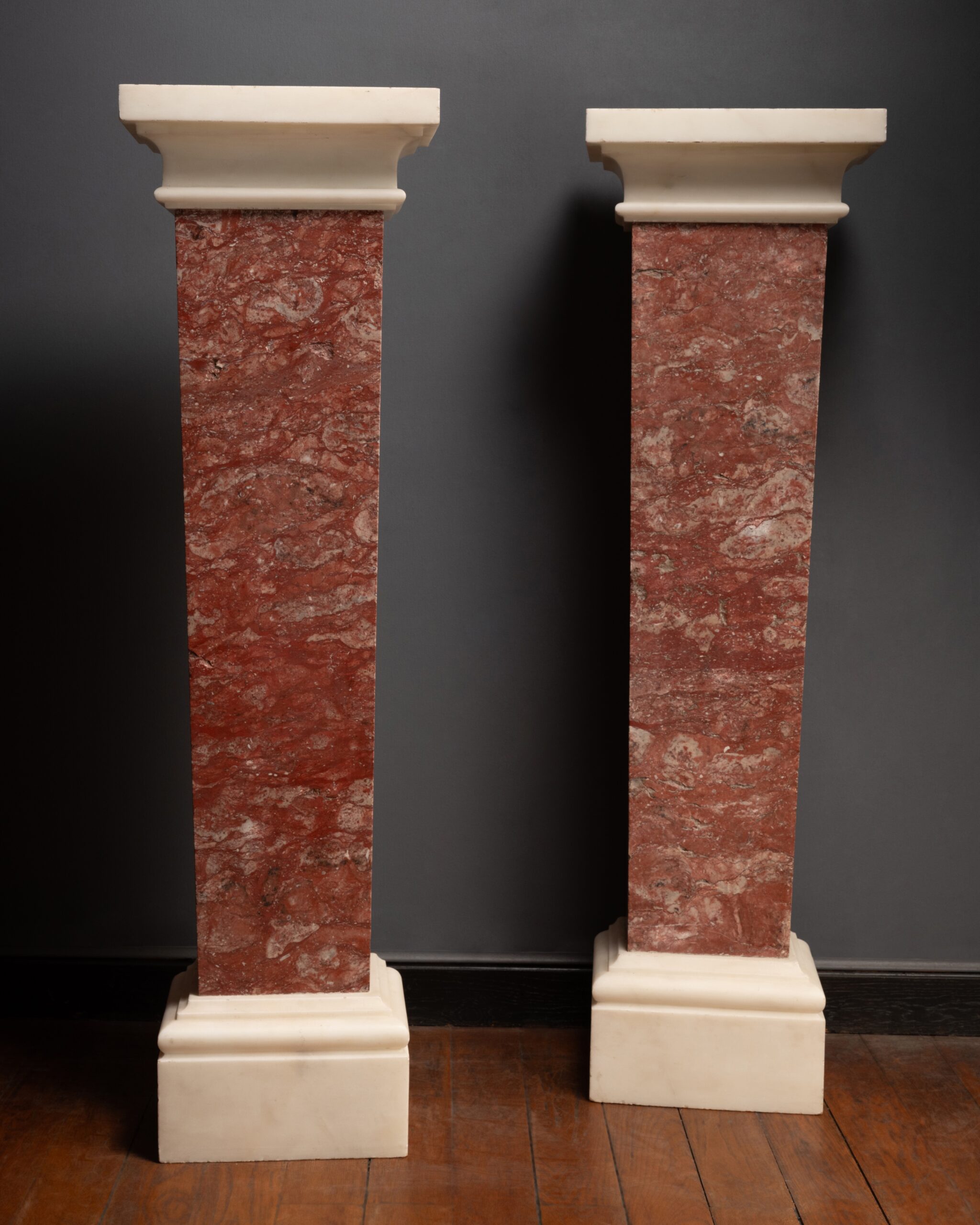
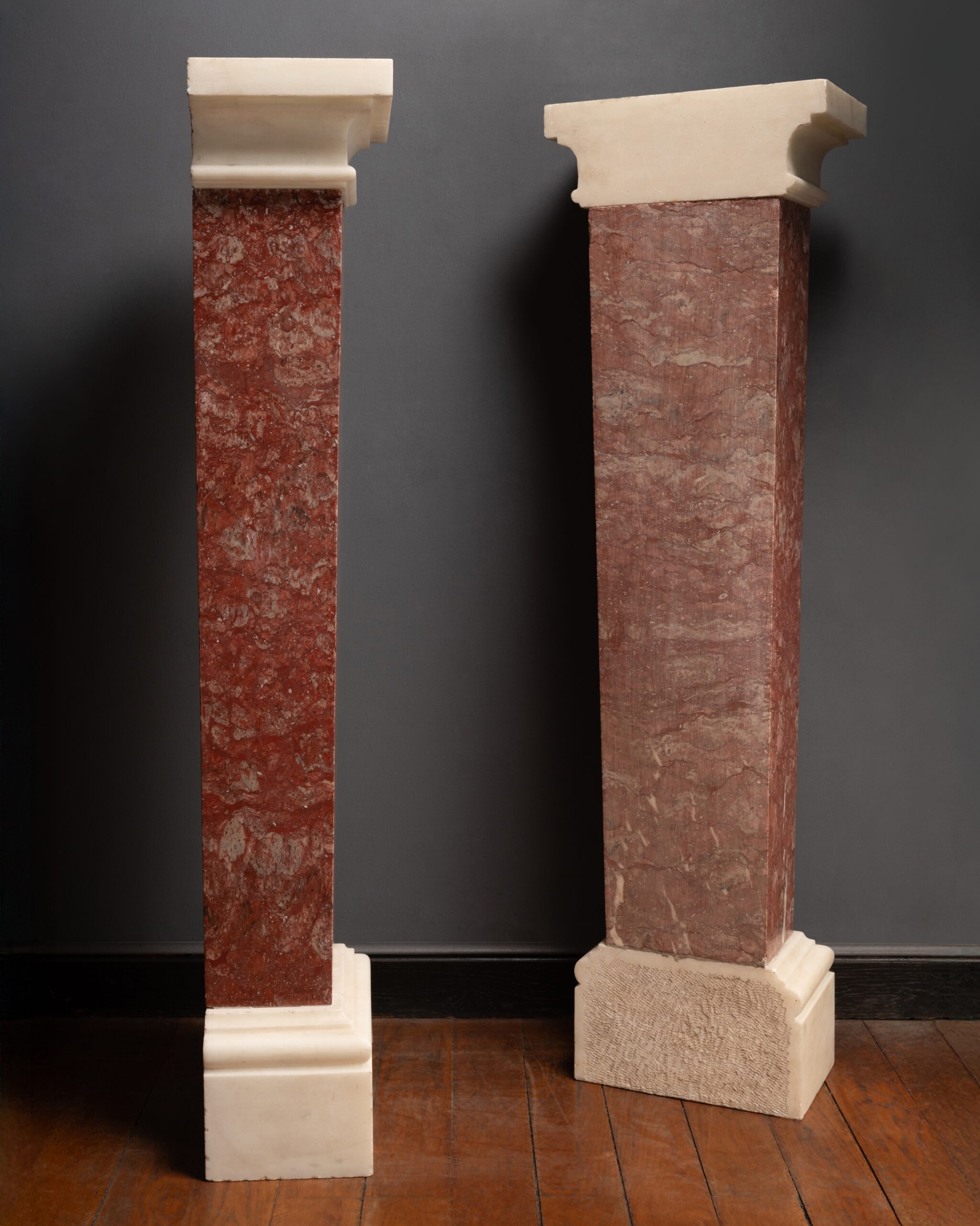
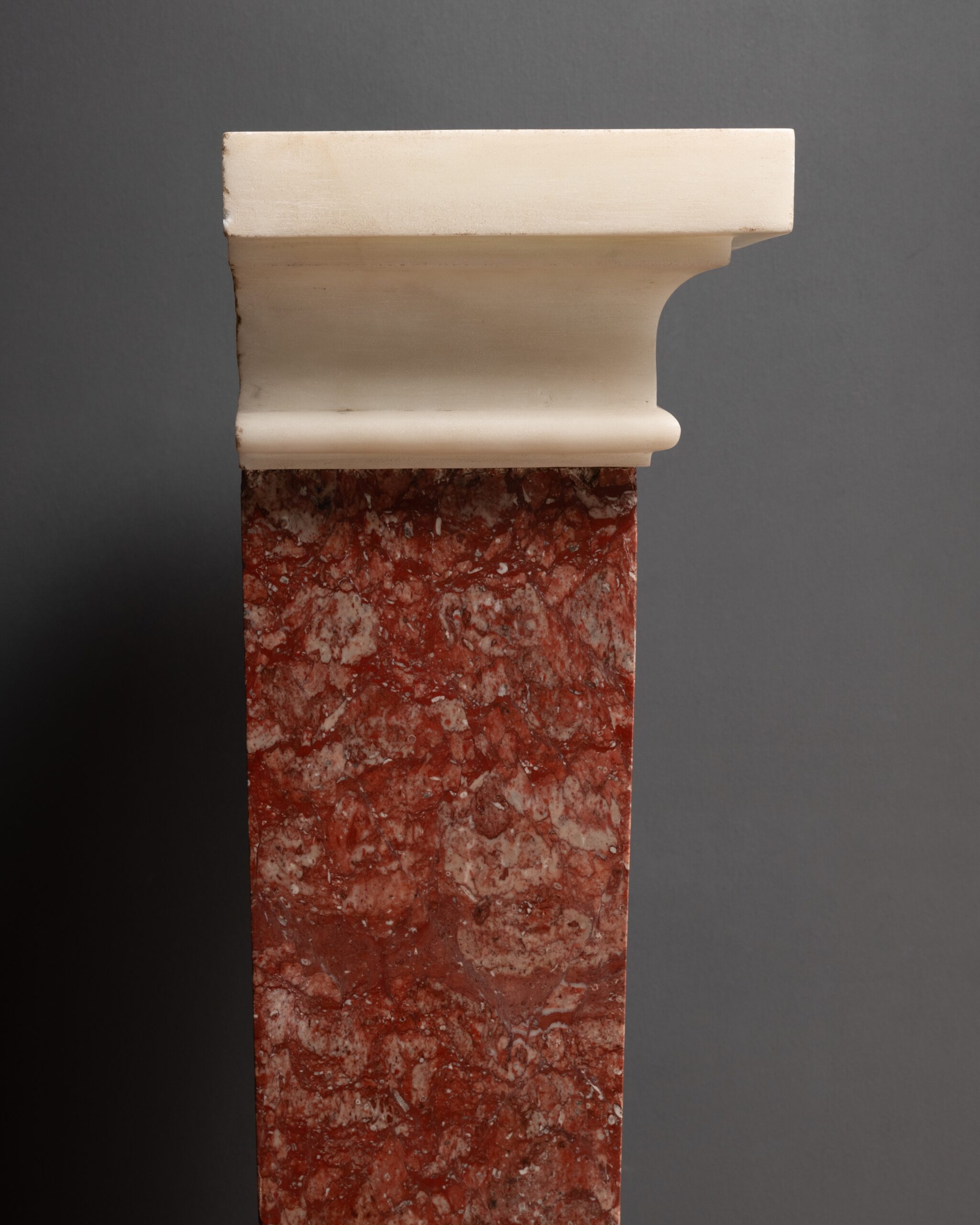
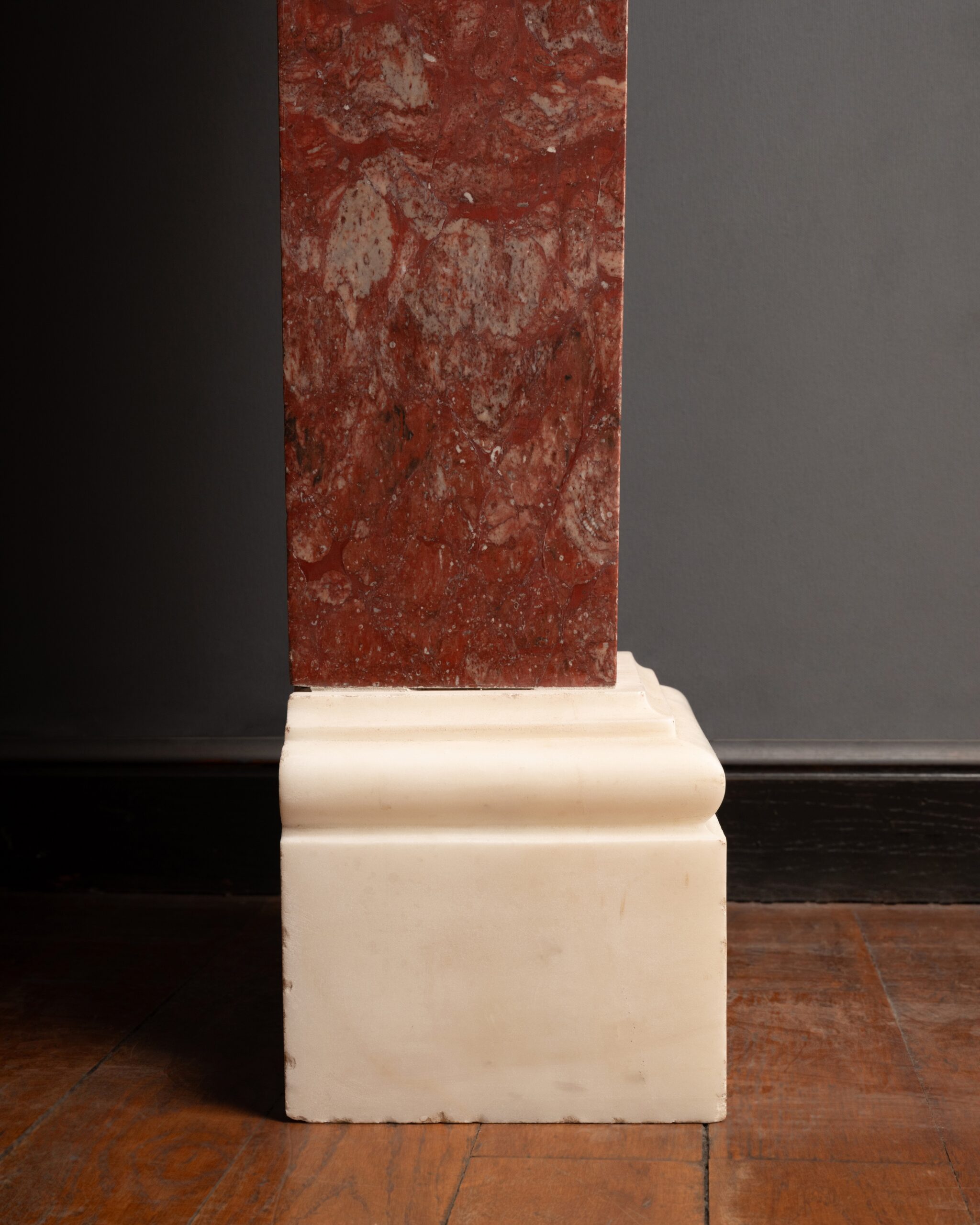
Pair of pedestals in red Pyrenean marble and white Saint-Béat marble
Marbre rose des Pyrénées, white “Saint-Béat” marble France 131 x 38 x 23 cm (51.6 x 15 x 9 in.)
The shafts of these tall pedestals were carved from a single block of marbre rose des Pyrénées. They are therefore not veneered. The capital and the plinth, meanwhile, were carved from a block of white “Saint-Béat” marble.
The Saint-Béat quarry in the Pyrenees, the source of this marble, was already “known to the Romans […] and enjoyed all the favor and attention it was given, in the hope that it might replace Carrara statuary marble. (Mouquin, 2018)” According to Félibien, it was meant to be used per angusta ad augusta: “[it] is difficult to use for sculpture, but the figures made from it would be of greater beauty than those made from the marble that comes from Genoa.”
The difficulty of using this marble in statuary explains why it fell into disuse in the 18th century, despite numerous mercantile attempts to use it as a replacement for Carrara white, and a brief revival of interest in the 19th century.
Literature
Sophie Mouquin, Versailles et ses marbres, Paris, 2018.