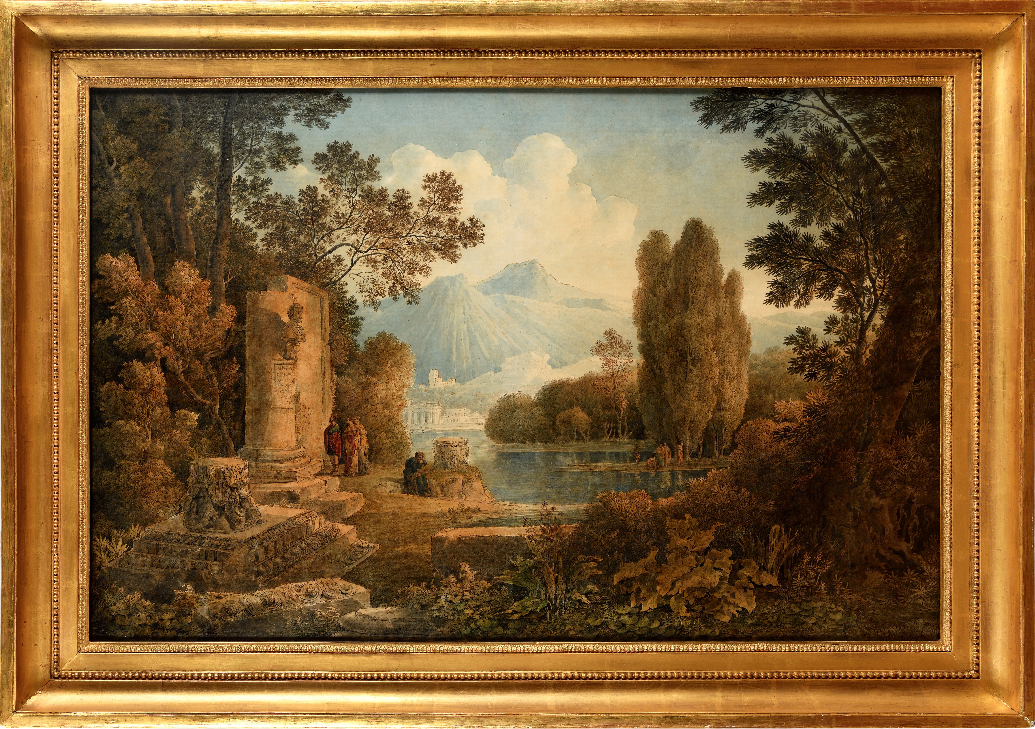
View of the Garden of the Borghese Villa, by Fleury Épinat
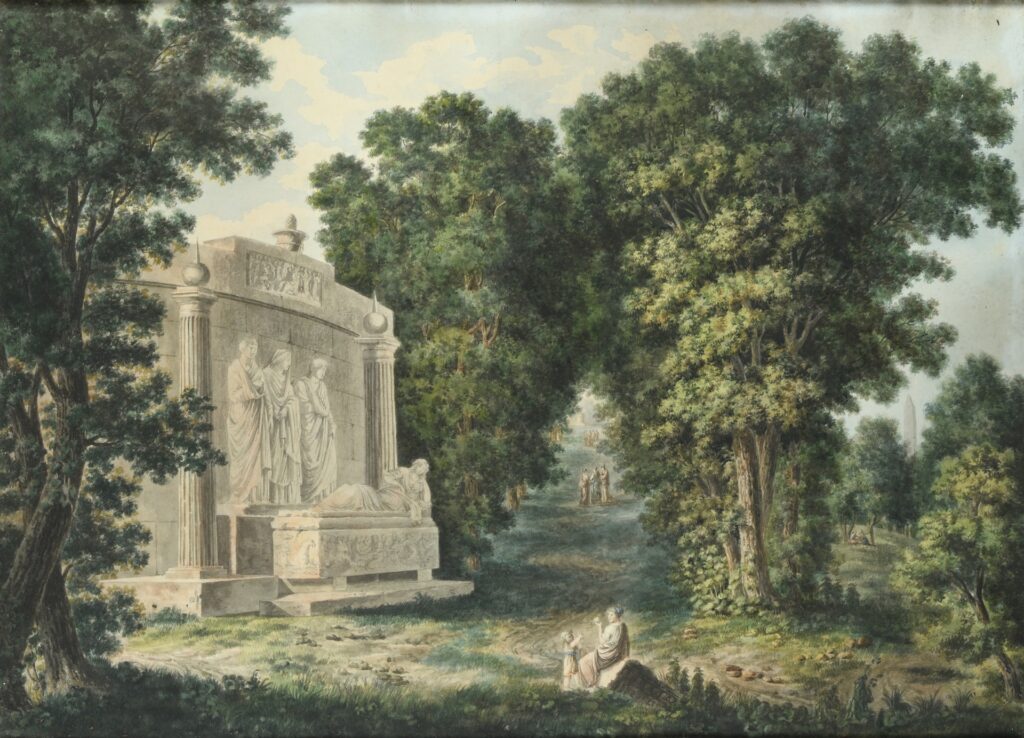
View of the Garden of the Borghese Villa, by Fleury Épinat
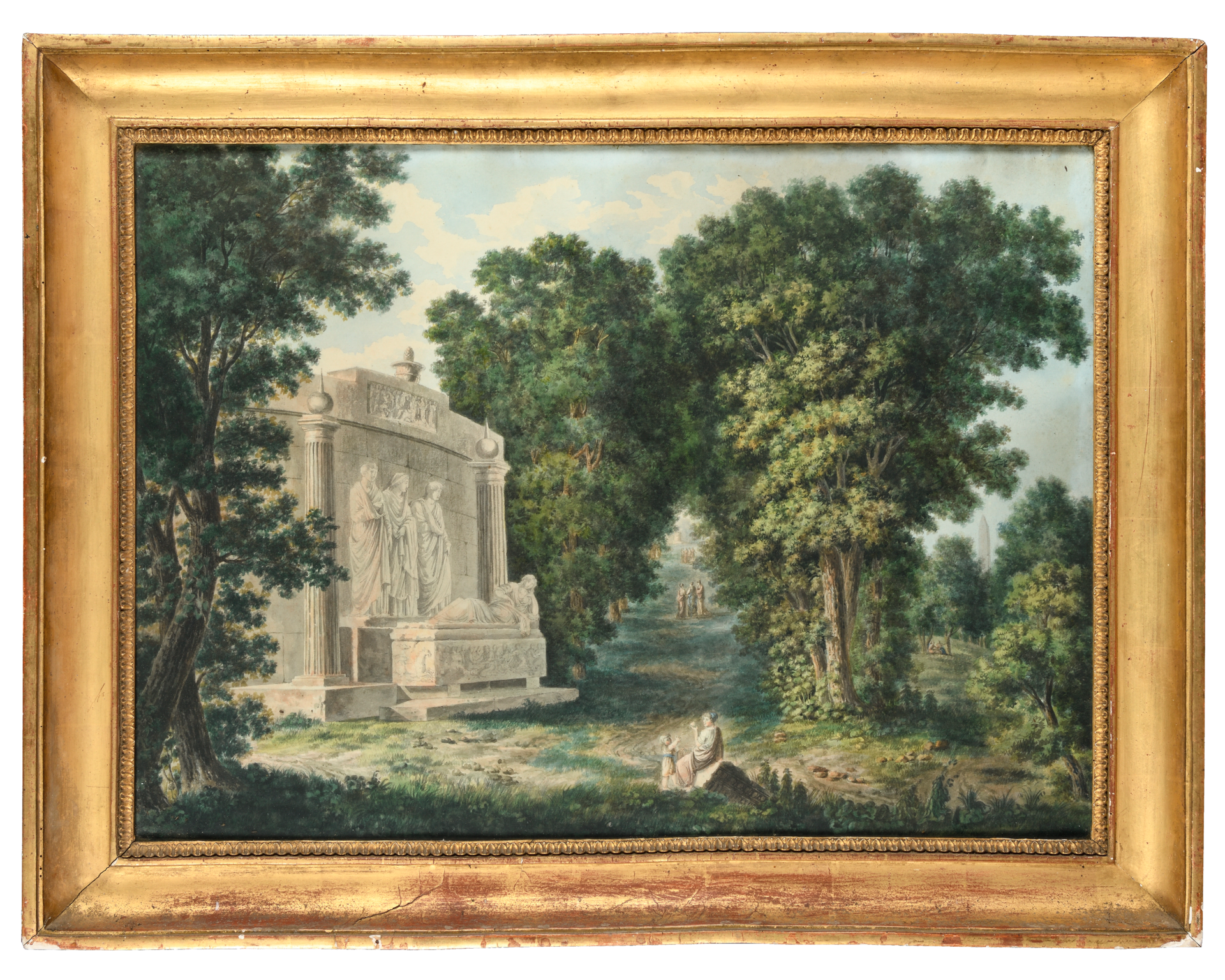
View of the Garden of the Borghese Villa, by Fleury Épinat Watercolour on paper Rome ca. 1787 62,5 x 81 ( x 31.9 in., with accessories)
The exact setting of this veduta, showing the semicircular wall of the Grottone dei Leoni near the Giardino del Lago at the Borghese Villa, can be identified thanks to three antiquities recorded by the artist: a funerary group portrait (inv. CLXXXVIII), a sarcophagus with marine thiasos (inv. LXXXVII), and a klinè (inv. CLXXXVII) serving as its cover, all from the Borghese collections. That these three antiquities were together in the gardens is known from a drawing by Charles Percier, in which they are recorded for the first time and which is datable at the earliest to 1786 (Di Gaddo, 1997, p. 118). The antiques were not inventoried in Rooms II and VI of the Palazzo before 1832 (Nibby, 1832, pp. 74, 110 sq.), but is is known that the sarcophagus and the klinè had already left the gardens by 1805, for a drawing of the same location by Bolognese painter Antonio Basoli, who was in Rome that year, shows the group portrait still in place, flanked by the same, though slightly altered, fluted columns, but neither the sarcophagus nor the klinè (Riccomini, 2007, pp. 169–172).
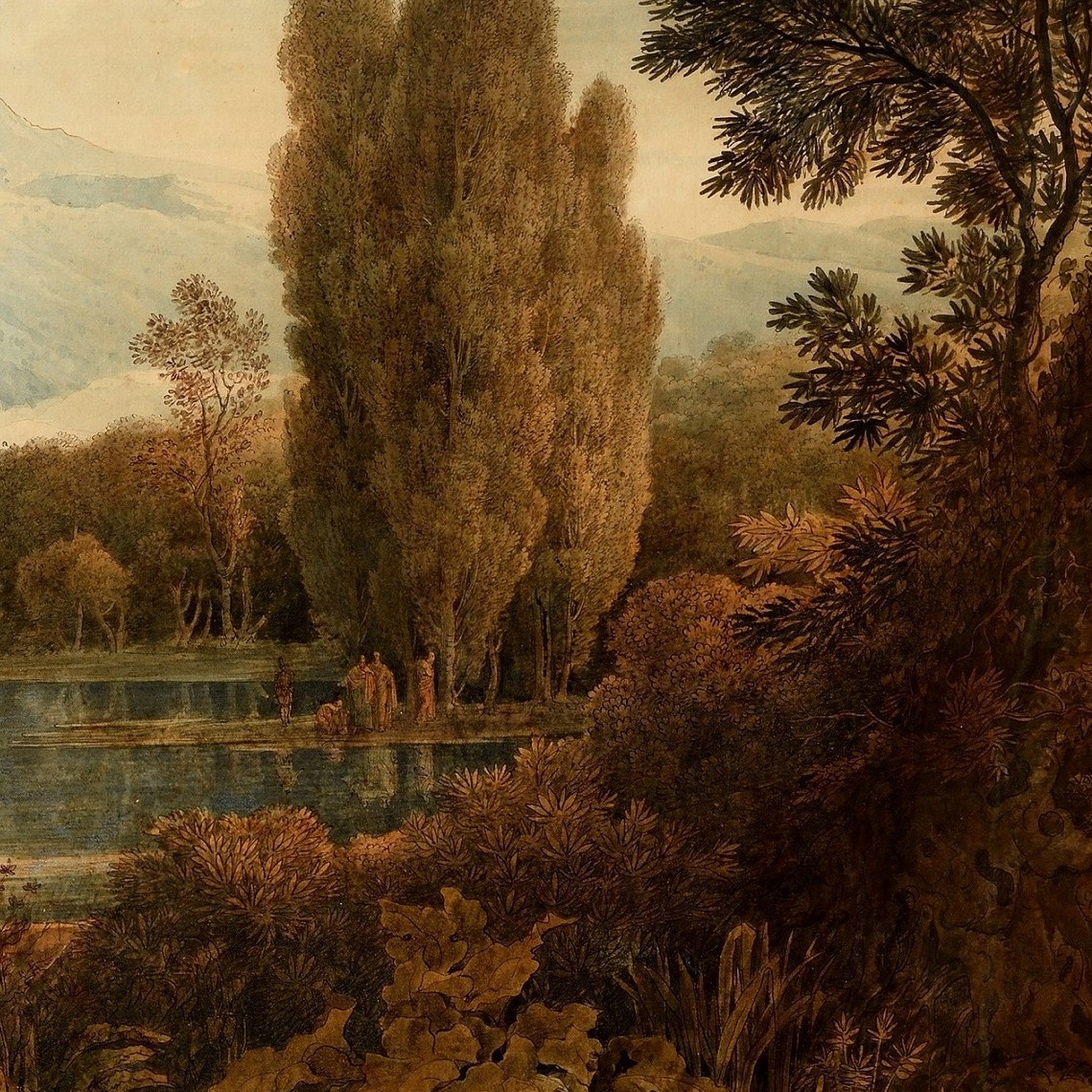
The provenance of the watercolour, that is the Château de Busset, situates it within a collection of sketches, drawings, and watercolours — Lyonnais for the most part, either by school or subject matter, several of which are the same hand as the present work, and share a certain handling of foliage and undergrowth, built up in accumulated triangular strokes, with a number of sheets signed by Fleury Épinat (1764–1830), a Davidian who followed his master to Rome in 1784 not to come back to France before 1800 (Vingtrinier, 1854, p. 4). Épinat was close to the fellow Lyonnais and Davidian Philippe-Auguste Hennequin who, having likewise followed David to Rome, refers in his mémoires to several visits with Épinat, circa 1787, to “the galleries, the ruins and the environs of Rome” where they “drew the landscape together” (Hennequin, 1933, p. 99), including one particular visit to the “Cardinal’s garden”, that is, the gardens of the Villa Borghese (ibid., p. 100).
The watercolour, under antique glass, is in its period frame, which has warped slightly.
Literature
See Antonio Nibby, Monumenti scelti della Villa Borghese, Rome 1832, Aimé Vingtrinier, Biographie des artistes lyonnais, vol. I, Lyon, 1854, Beata di Gaddo, L’architettura di Villa Borghese. Dal giardino privato al parco publicco, Rome, 1997 and “‘Un vero Paradiso Terestre’: il Parco di Villa Borghese nei disegni di Antonio Basoli (1805)”, in Prospettiva, n. 126-127, 2007.
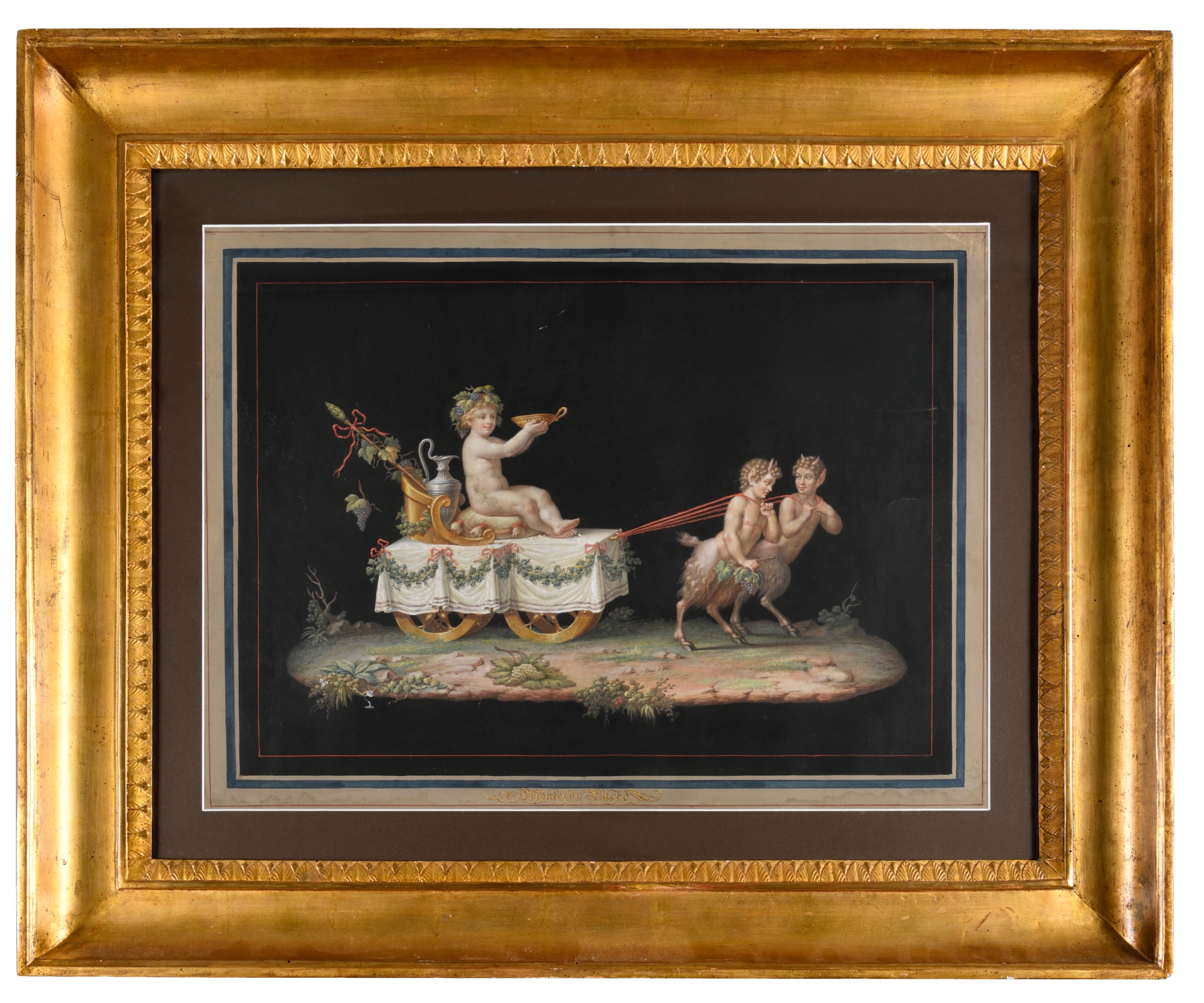
Gouache on paper Rome Before 1812 70,5 x 84,5 cm (27.75 x 33.3 in.)
The compositions of the Italian painter Michelangelo Maestri are taken from the frescoes discovered in Pompeii and Herculaneum during the 18th century and from the decorations imagined by Raphael and his pupil Giulio Romano for the great Roman palaces of the Renaissance.
Maestri’s gouaches were popular with aristocrats making their Grand Tour of Italy. Thanks to their high quality of execution on the one hand, and because they were based on the great mythological themes known since the Renaissance on the other.
In this case, this gouache represents the chariot of Bacchus pulled by two fauns. The original fresco was first painted for the Villa Lante in Rome around 1520 by Giulio Romano, before being moved to the Palazzo Zuccaro in Rome, where it is currently located.
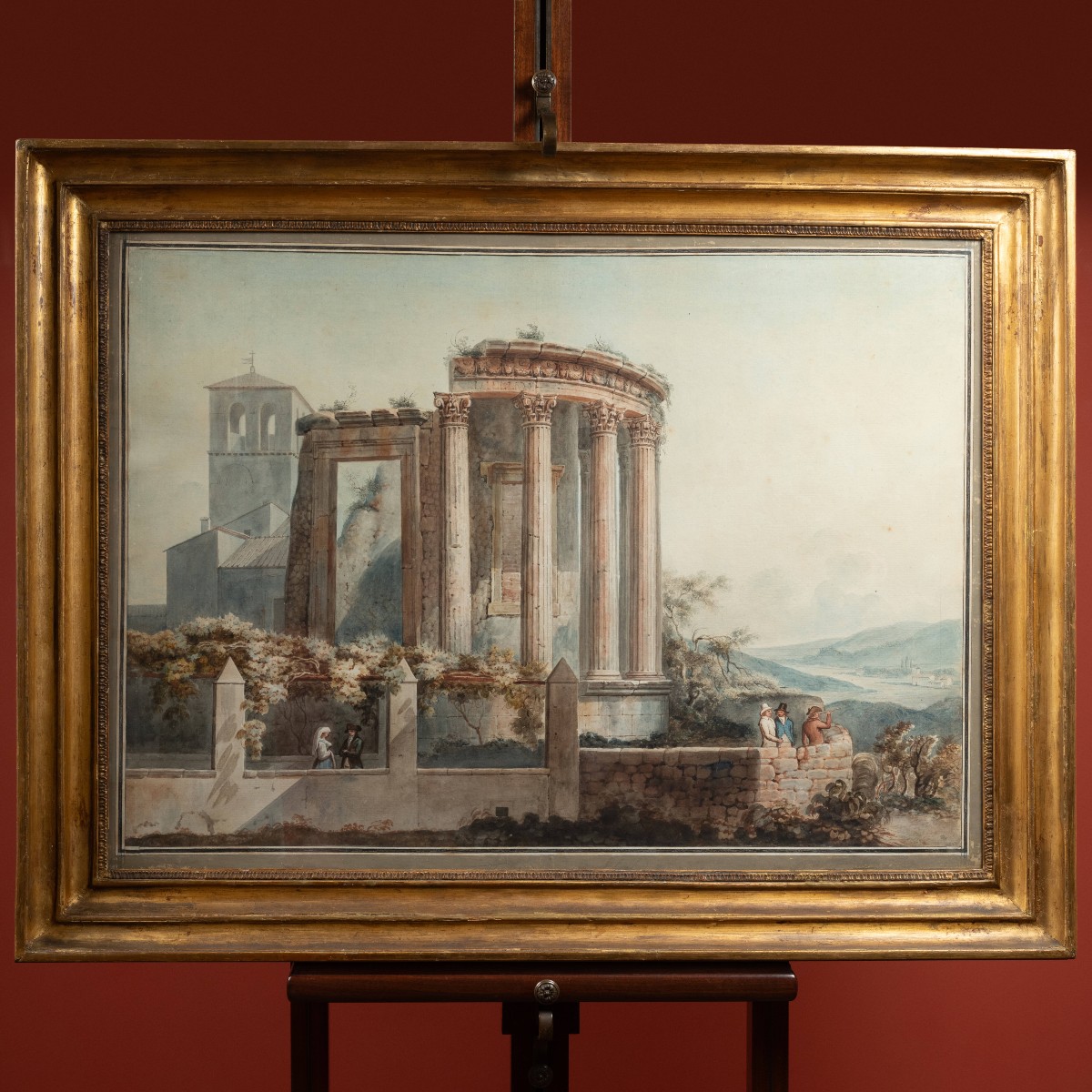
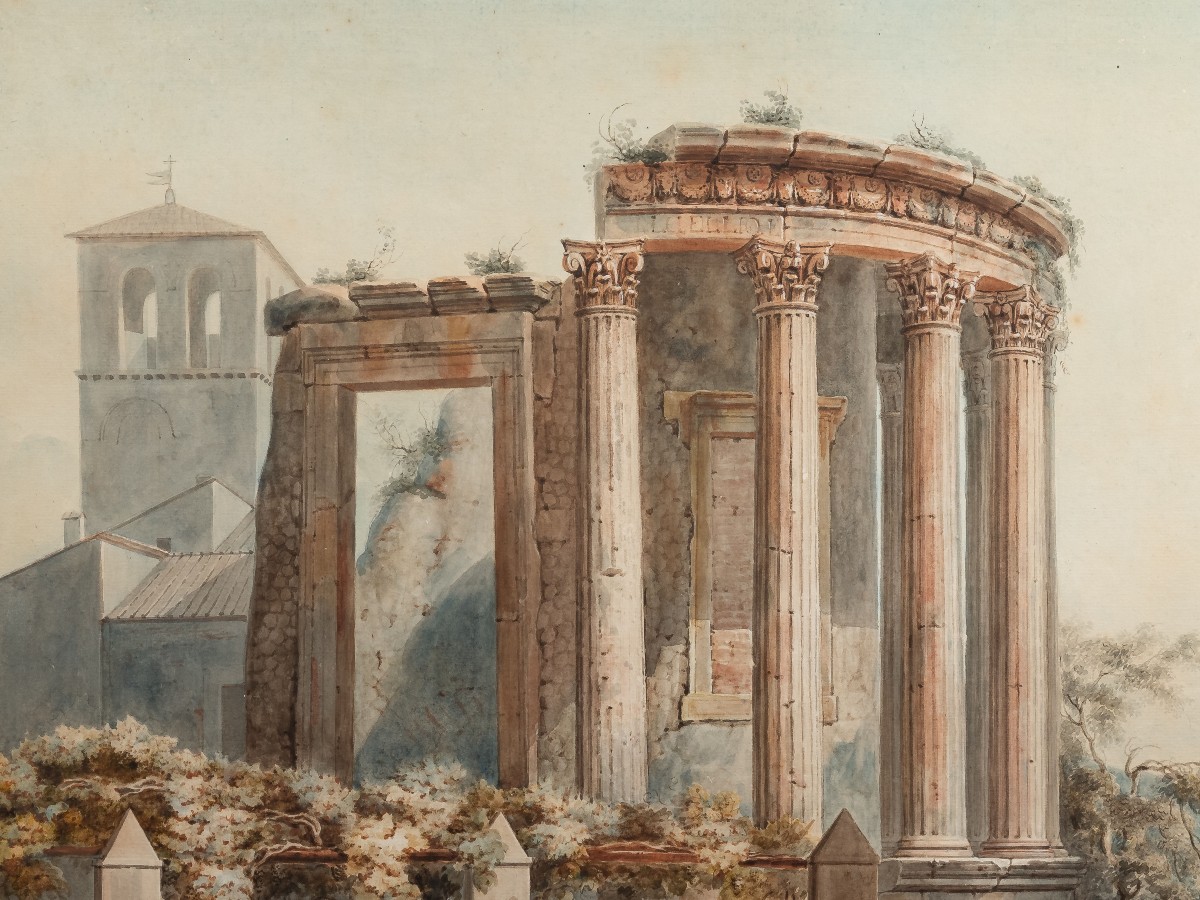
View of the Temple of Vesta in Tivoli, attributed to Franz Kaisermann and Bartolomeo Pinelli
View of the Temple of Vesta in Tivoli, attributed to Franz Kaisermann and Bartolomeo Pinelli
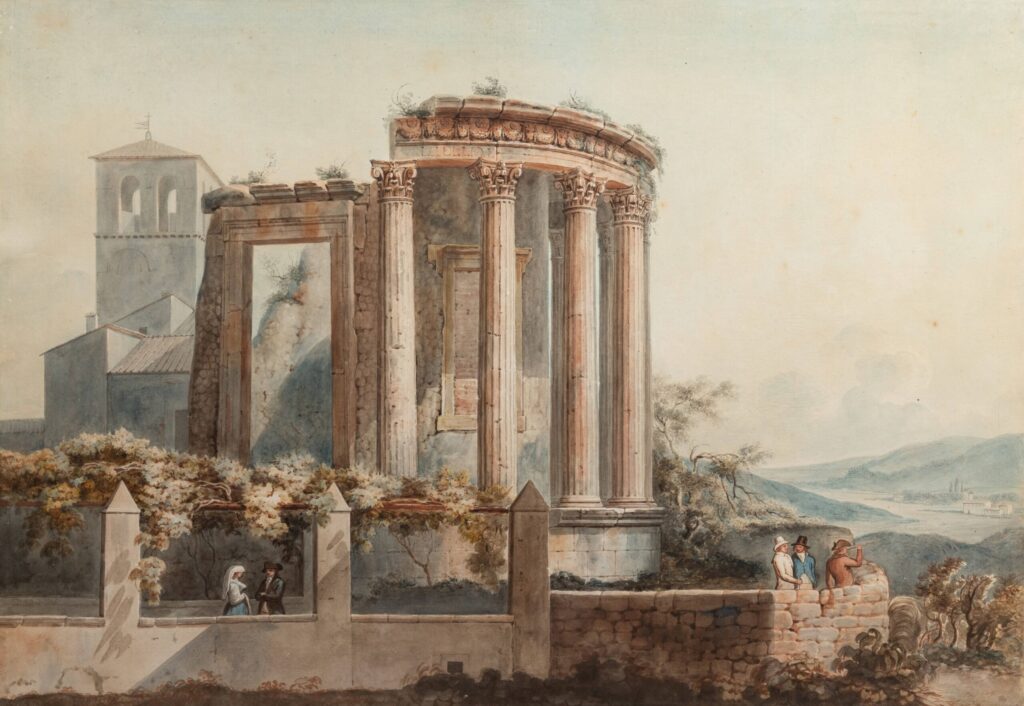
Watercolor Rome ca. 1795 h. 56 cm ; l. 77 cm (22 x 30.3 in.)
This watercolor depicting the Temple of Vesta in Tivoli, surrounded by figures in late 18th-century costumes, is part of a series of at least fifteen dispersed watercolors, though known through gouache copies preserved at the National Library of Spain and cataloged by Thomas Ashby. Another view from the same set, showing a different part of the Temple of Vesta, surfaced at a sale in 2011, bearing the number 5 on the reverse, which corresponds to gouache number 13 by Thomas Ashby.
These gouaches, presented at the exhibition Palabras de viajeros. El viaje literario y su aportación a la cultura europea (‘Words of Travelers. The Literary Journey and Its Contribution to European Culture’), held at the National Library of Spain in 2023, were dated ca. 1790, likely based on topographical criteria, but were attributed only to an anonymous Italian. Behind this anonymous Italian, in truth, likely lies a duo of artists : Franz Kaisermann and Bartolomeo Pinelli.
Born in Switzerland in 1765, Franz Kaisermann was arguably the most famous assistant of Louis Ducros1, whom he joined in Rome in 1783 before entering the clientele of Camillo and Pauline Borghese, who commissioned significant watercolors from him. Under their patronage, he gained great renown among the grand tourists passing through Rome. He collaborated with the Roman painter and draftsman Bartolomeo Pinelli, a master at depicting contemporary figures engaged in vignettes and bambochades. It was with Bartolomeo Pinelli that Franz Kaisermann published, in 1827, I sette colli di Roma e vedute di Roma, a collection of topographical views of the city of Rome. Pinelli’s vedute, along with the watercolors and washes created with Kaisermann, tend to humanize Roman ruins, portrayed amidst grand tourists or Italian locals, often of modest origins.
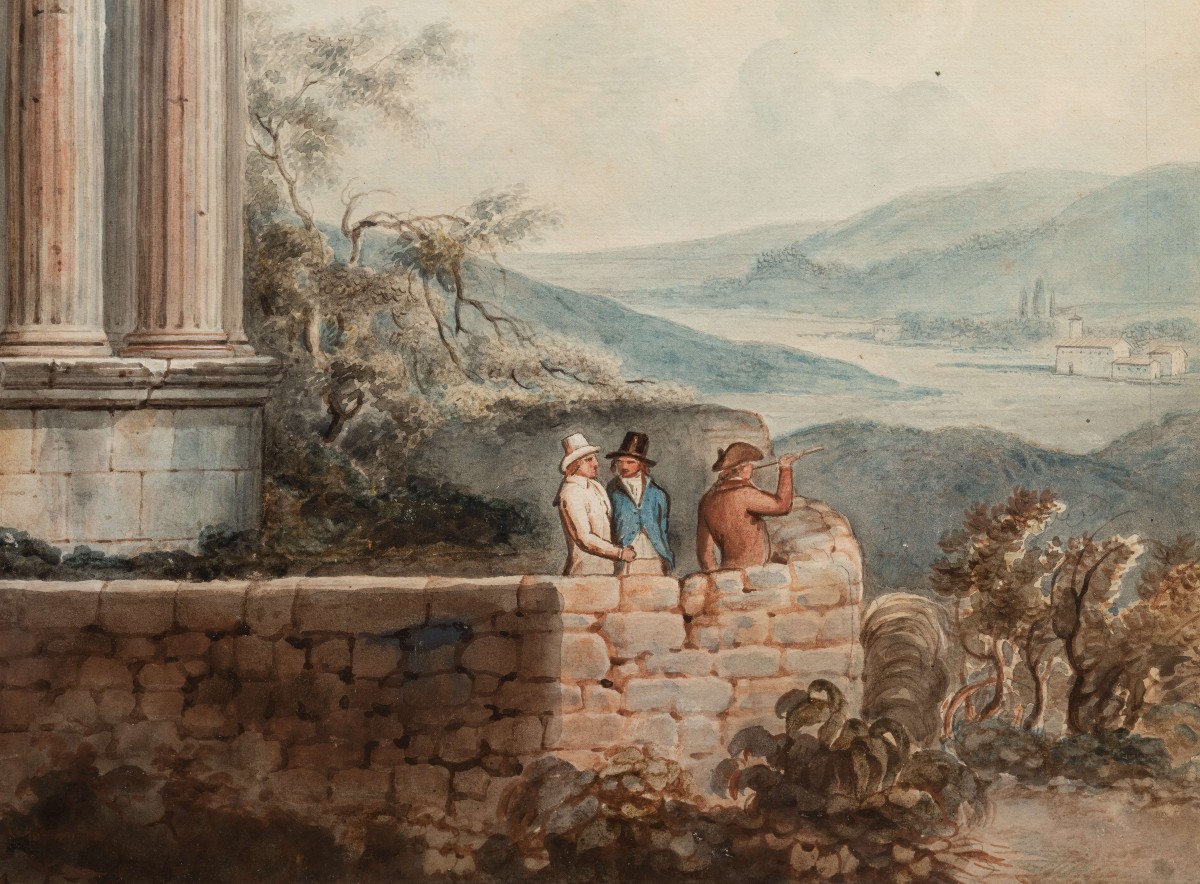
The attribution to Franz Kaisermann and Bartolomeo Pinelli rests on all these elements : the coloring, shadows, foliage, as well as the precision of architectural descriptions characteristic of Franz Kaisermann’s style, while the figures appear drawn from Bartolomeo Pinelli’s repertoire. Pinelli frequently sketched or painted the human figures in Kaisermann’s views, the latter being more skilled in landscapes and architecture. The characters of Kaisermann and Pinelli, recognizable by their simple features and, above all, their costumes, move like figurines from veduta to veduta. The small group to the right of the Temple of Vesta, consisting of several men wearing hats and one in a tricorn holding a telescope in his right hand, reappears in a black ink study signed by Franz Kaisermann, sold at Thierry de Maigret in 2013.
Literature
See John Gage, Colour in Turner. Poetry and Truth, London, 1969, Emmanuel Bénézit, Dictionnaire des peintres, sculpteurs, dessinateurs et graveurs, vol. 6, Paris, 1976 and Jane Turner, The Grove Dictionary of Art, vol. 24, London, 1996.
The attribution to Franz Kaisermann and Bartolomeo Pinelli rests on all these elements : the coloring, shadows, foliage, as well as the precision of architectural descriptions characteristic of Franz Kaisermann’s style, while the figures appear drawn from Bartolomeo Pinelli’s repertoire. Pinelli frequently sketched or painted the human figures in Kaisermann’s views, the latter being more skilled in landscapes and architecture. The characters of Kaisermann and Pinelli, recognizable by their simple features and, above all, their costumes, move like figurines from veduta to veduta. The small group to the right of the Temple of Vesta, consisting of several men wearing hats and one in a tricorn holding a telescope in his right hand, reappears in a black ink study signed by Franz Kaisermann, sold at Thierry de Maigret in 2013. ↩︎
Ancient Figures Deciphering, by Louis-François Cassas
Ancient Figures Deciphering, by Louis-François Cassas
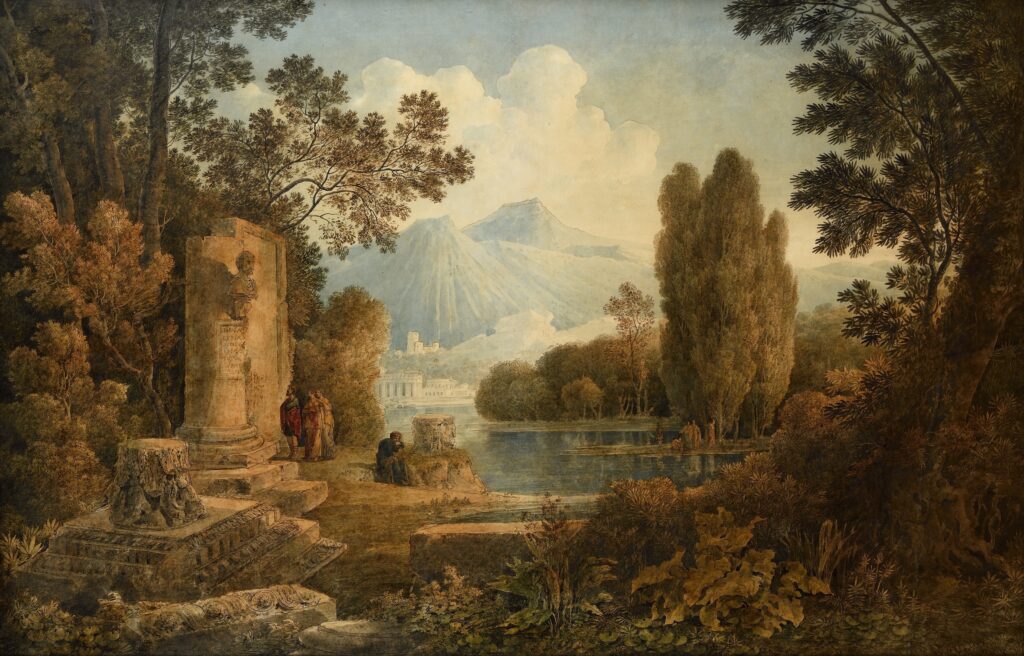
Pen and wash, black and brown ink, watercolour France ca. 1782-1784 Unframed: h. 25.2 in.; w. 41 in. Framed: h. 32.7 in.; w. 46.4 in. Provenance: private collection, Milan
On our watercolor, the diverse vegetation that frames a dazzling blue sky animated by a few clouds is typical of Cassas’s compositions. The artist relies on the asymmetry to introduce an abundant foreground. It is completed by ruins that serve as a repoussoir to provide deepness to the whole composition. The mountain inhabited by ruins that stand in the background is a point of falling light that opens up the perspective rather than blocking the view.1
The glistening river leads the eye: from the back to the foreground, the eye bounces back and forth to the figures reading the ancient inscription and those on the background with their reflection on the water answering to the shape of the cypress trees. This construction is inspired by Nicolas Poussin’s compositions.
This work can be compared with the watercolor which had been presented at the Salon du Dessin, Paris, in 2000, “Landscape with characters near an antique sculpture in front of a lake, a mountain in the background”. Another comparison can be made with the latest large sheet sold at Christie’s on March 22, 2017: “Archaeologists examining a bas-relief on the outskirts of the city of Athens”.
Louis-François Cassas was a French draftsman, painter, engraver and orientalist born on June 3, 1756, in Azay-le-Ferron (Indre) and died in Versailles (Yvelines) on November 1, 1827.
Son of a royal road surveyor, Louis-François Cassas was trained as an engineer of bridges and roads. He began his career as a stereotomy draughtsman on the construction site of bridges. That is how he learned the rigor and quasi-architectural meticulousness typical of his work throughout all of his painter career.
As a protégé of Louis-Antoine de Chabot, who became the Duke of Rohan-Chabot in 1791, he trained at the latter’s academy from 1775 to 1778. He was a pupil of Lagrenée who taught him the use of the wash and introduced him to the taste of the picturesque and the exotic. This taste was confirmed during his first trip to Italy from 1779 to 1783. With the Duke of Rohan-Chabot, he went to Naples, Istria and Dalmatia, places that were little visited by the travelers of his time. During this first journey, he collaborated with the Saint Non Abbey for a book called “Voyage pittoresque ou description des Royaumes de Naples et de Sicile” (1781-1786, 4 volumes).
The Count of Choiseul-Gouffier, ambassador of the Sultan of Turkey, crossed his path back in Paris.2 As a passionate archaeologist, this new protector viewed Cassas as the artist all designated to help him in his enterprise of survey of the classical sites and monuments of the Middle East and Asia Minor. Cassas ended these four years of travel in Rome where he exhibited more than 250 drawings which were much appreciated by the public.
He eventually settled permanently in Paris to work on the publication of his works in a “voyages pittoresques” which was never completed. He taught at the school of the Royal Manufacture of Gobelins where he was appointed inspector of works and professor of drawing in 1816. As a teacher, he played the role of initiator of neoclassicism in the early 19th century. From 1817, he drew large watercolors whose format was close and sometimes exceeded on meter in length to sell them.
From his precise surveys of archaeological sites, his numerous drawings, sketches and studies of ancient monuments, Cassas developed landscapes that intertwined both the rigor of archeological surveys and the powerful fantasy of the antiquity. Those watercolors were very successful during his lifetime, and the large sheets are now extremely rare on the market.
On most of the paintings, the archaeological site represented is pure fantasy. He designed virtuous assemblies of real elements that give a grandiose aspect to his watercolors. Those imaginary views are nonetheless bathed in the Mediterranean atmosphere that makes them look like they are based on the reality.
This watercolor is in keeping with the neoclassical taste of Cassas’ contemporaries. Indeed, the young aristocrats who were travelling for their Grand Tour during the 18th and 19th centuries were dazzled by the picturesqueness of the ancient ruins they went to admire around the Mediterranean sea. This watercolor matches this idealized vision of antiquity by placing a few characters dressed in antique garments in the middle of a serene and grandiose landscape. This idealized antiquity is the main subject of the painting, making Cassas the ultimate Grand Tour artist.
Louis-François Cassas was a French draftsman, painter, engraver and orientalist born on June 3, 1756, in Azay-le-Ferron (Indre) and died in Versailles (Yvelines) on November 1, 1827. ↩︎
Louis-François Cassas was a French draftsman, painter, engraver and orientalist born on June 3, 1756, in Azay-le-Ferron (Indre) and died in Versailles (Yvelines) on November 1, 1827. ↩︎
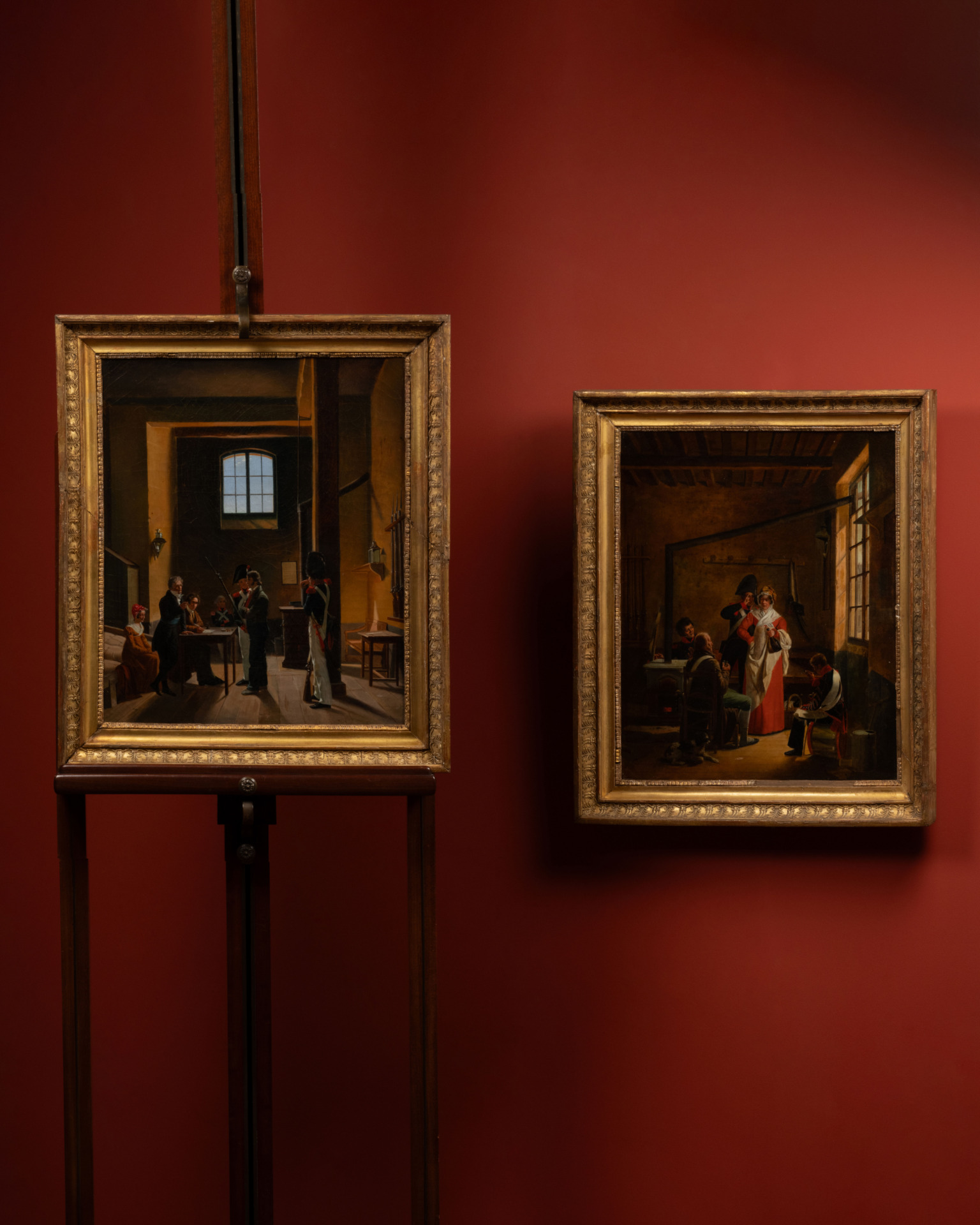
The Brandy Merchentess And Interrogation At The Guardhouse By Pierre Duval Le Camus
The Brandy Merchentess at the guardhouse and Interrogation at the guardhouse, by Pierre Duval Le Camus
Oil on canvas 1822 55 x 47 cm (21,6 x 18,5 in)
The 1822 Salon catalog mentions, at n°440 and 441 : La marchande d’eau-de-vie au corps de garde [The Brandy Merchentess at the guardhouse] and L’interrogatoire au corps de garde [Interrogation at the guardhouse], two scenes exhibited alongside nine other paintings by Pierre Duval Le Camus, a Norman painter born in 1790, a pupil of Claude Gautherot and then of Jacques-Louis David.
We know these two scenes were conceived as pendants for the 1822 Salon — the second Salon in which the artist attended — thanks to two lithographs advertised that same year in the Tablettes universelles : “This etching [La Marchande d’eau-de-vie au corps de garde], makes a pair with l’interrogatoire au corps de garde. We owe it to M. Lecamus, to whom we owe the beautiful picture of la réprimande.” The link between the two scenes is emphasised by many subtle details the painter inserted in the paintings. The most picturesque of them all is the playing card — a five of hearts — that the guards might have dropped carelessly, after having played during their watch. That the same five of hearts lies on the floor in both interiors suggests these scenes unfold within a unified time and setting.
The Tablettes universelles mention La Réprimande because this “beautiful picture, also exhibited at the 1822 Salon alongside La Marchande and L’Interrogatoire, brought considerable fame to Duval Le Camus. La Réprimande was purchased in 1822 by the Duchess of Berry, a major patron, daughter of Francis I of the Two Sicilies and widow of Charles-Ferdinand d’Artois, second son of Charles X. The year 1822 thus marks the beginning of royal favor for Duval Le Camus under the Restoration and inaugurates a prestigious career: in 1827, another genre scene exhibited at the Salon and awarded a first-class medal was acquired by Charles X; yet another scene was purchased by Louis-Philippe in 1831, who named the painter Chevalier of the Légion d’honneur in 1837, likely for founding the Musée de peinture et de sculpture in Lisieux. Duval Le Camus continued to exhibit his canvases regularly at the Salons. In 1845, he exhibited alongside his son Jules-Alexandre, also a painter, his famous Pifferari donnant une leçon à son fils, now in the Louvre. Baudelaire, in his Salon de 1845, immortalized him with these two lines:
Duval Le Camus Père sait d’une voix légère Passer du grave au doux, du plaisant au sévère.
La Marchande d’eau-de-vie au corps de garde and L’Interrogatoire au corps de garde thus bear witness to the taste for genre painting under the Restoration, a broad domain often overshadowed by grand Romantic compositions and history painting. These are also among the earliest preserved works by Duval Le Camus, marked by an almost northern austerity strikingly close to the compositions of Martin Drolling — an austerity that softens, warms, and fades as taste evolves and the painter gains mastery in the decades that follow.
A signed version of La Marchande d’eau-de-vie appeared at Sotheby’s in 2006, alongside a scene showing La Partie de piquet de deux invalides. This version of La Marchande was therefore thought to be the one exhibited at the 1822 Salon. The pendant to La Marchande, that is L’Interrogatoire, was not known at the time, replaced by La Partie de piquet, and it was incorrectly suggested that it formed a pair with La Marchande due to their similar dimensions, matching frames, and identical nameplates. However, it is impossible that these two paintings were ever a true pair, since La Partie de piquet predates La Marchande by three years and the two were never shown together at the Salon. Furthermore, the version of La Marchande in question is smaller than the one we have here, with certain details clearly cropped.
The current pair, L’Interrogatoire and La Marchande, bears on the back of the canvas the stamp of the Belot firm, at no. 3 “Rue de l’Arbre sec.” The Belot firm, founded by Michel Belot in 1768, and a supplier of canvases to painters in the early 19th century, changed ownership in 1824, becoming “Vallé et Bourniche,” still at 3, rue de l’Arbre Sec.
All these elements — the Belot stamp dating from before 1824, the cropped details in the version sold at Sotheby’s, and the fact that these two canvases have been preserved together just as they were exhibited at the 1822 Salon — seem to confirm that these are indeed the paintings shown at the 1822 Salon, and that the La Marchande sold at Sotheby’s is a slightly later replica.
The two paintings are housed in period frames which, over the centuries, have suffered significant losses. The canvases themselves are in perfect condition.
Sources
Explication des ouvrages de peinture et dessins, sculpture, architecture et gravure des artistes vivans, exposés au Musée royal des Arts, le 24 avril 1822, Paris, 1822 ; Jean-Baptiste Gouriet, Tablettes universelles, Paris, 1822 ; Michaël Vottero, “Pierre Duval le Camus, peintre de genre“, in Les Duval Le Camus, peintres de père en fils, Saint-Cloud, 2010.
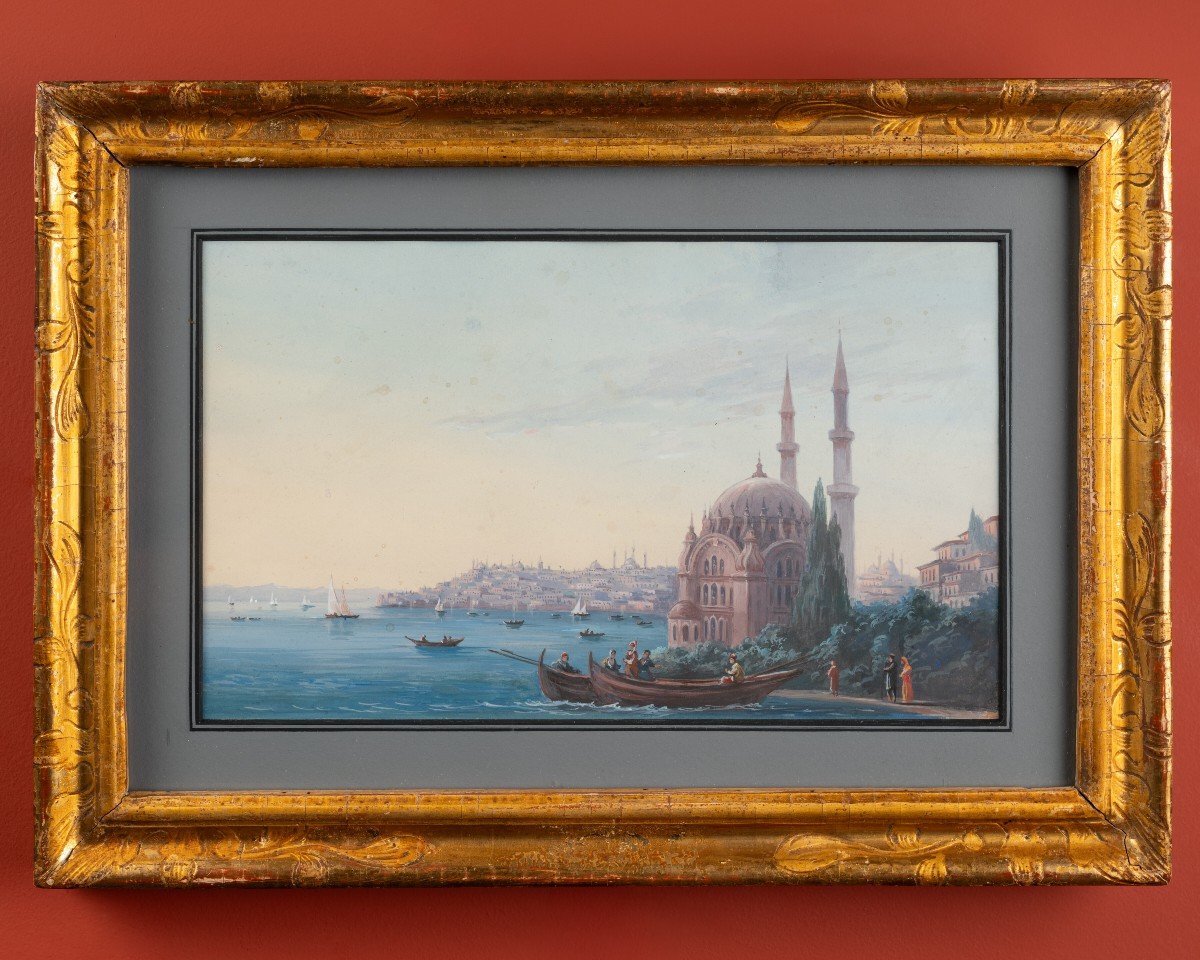
Marine landscape of the Bosphorus in the style of Ivan Aivazovsky
Marine landscape of the Bosphorus in the style of Ivan Aivazovsky.
Gouache. Late 19th century. h. 9,8 in. ; w. 13,8 in. View of Constantinople, painted in gouache in the style of Ivan Aivazovsky, celebrated for his seascapes illustrating the Bosphorus Strait. This painting features the Ortaköy mosque in particular, built in 1855 at the deep end of the European shore of the Bosphorus. The mosque of Ortaköy was built at the request of Sultan Abdulmecid I, who commissioned its construction to Nikoğos Balyan, an Armenian architect trained in Paris, and part of a dynasty of architects who adorned the shores of the Bosphorus with many magnificent monuments : the Dolmabahçe Palace, the Çırağan Palace, the mosques of Dolmabahçe and Ortaköy. This gouache is sold with an elegant frame decorated with floral motifs.
Marine landscape of the Bay of Naples
Marine landscape of the Bay of Naples.
Gouache. Late 19th century. h. 14,4 cm ; w. 19,5 cm.
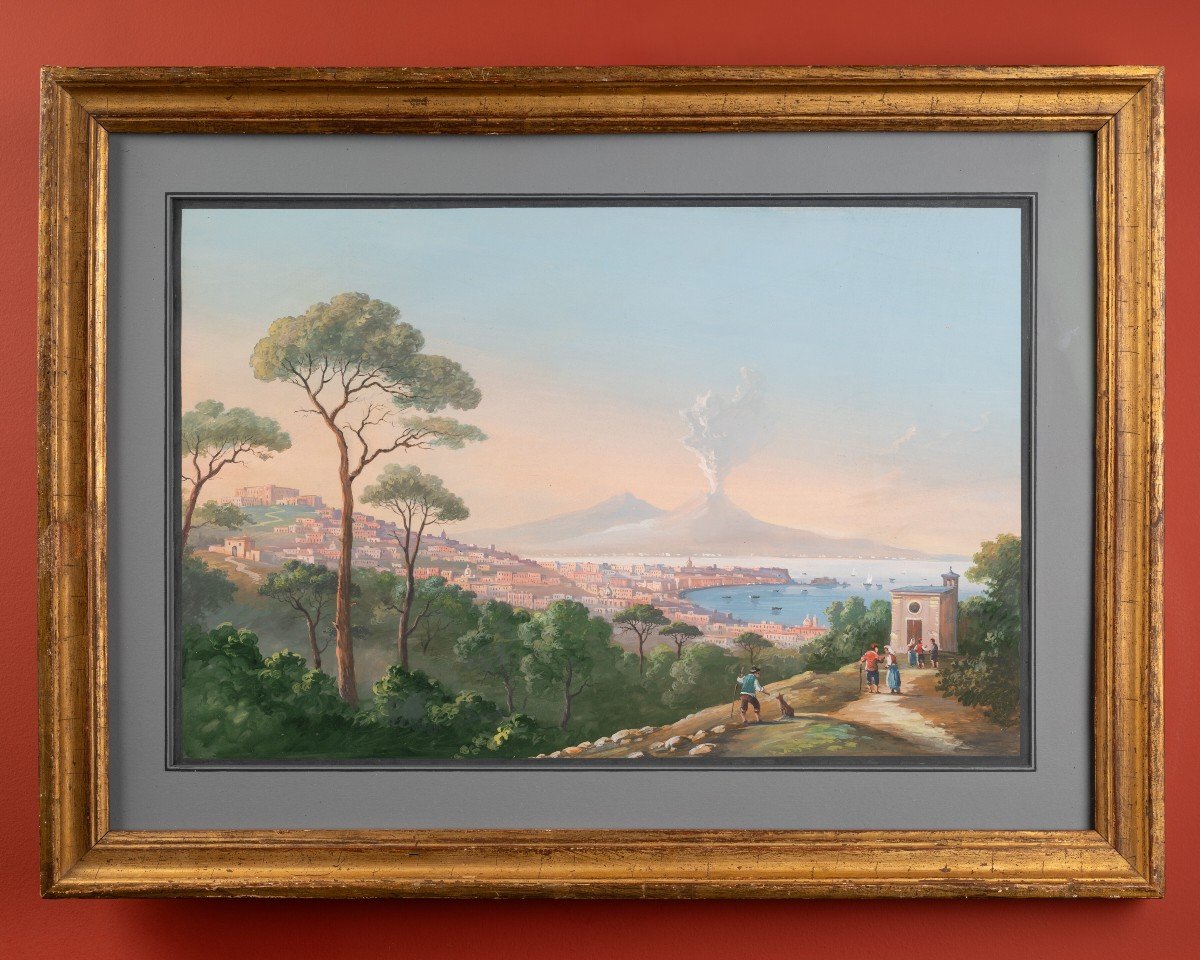
View of the Bay of Naples, painted in gouache in the manner of Italian vedutisti from the late 18th century. In this view of the bay taken from Pausilippe, the great charterhouse is visible on the left, and in the background of the landscape, Vesuvius, from which a large plume of smoke is rising.
Allegories of the Moon and of Mars by Michelangelo Maestri after Udine and del Vaga
Allegories of the Moon and of Mars, by Michelangelo Maestri after Udine and del Vaga
Gouache on paper Italy Before 1812 47 x 56 cm (18.5 x 22 in.)
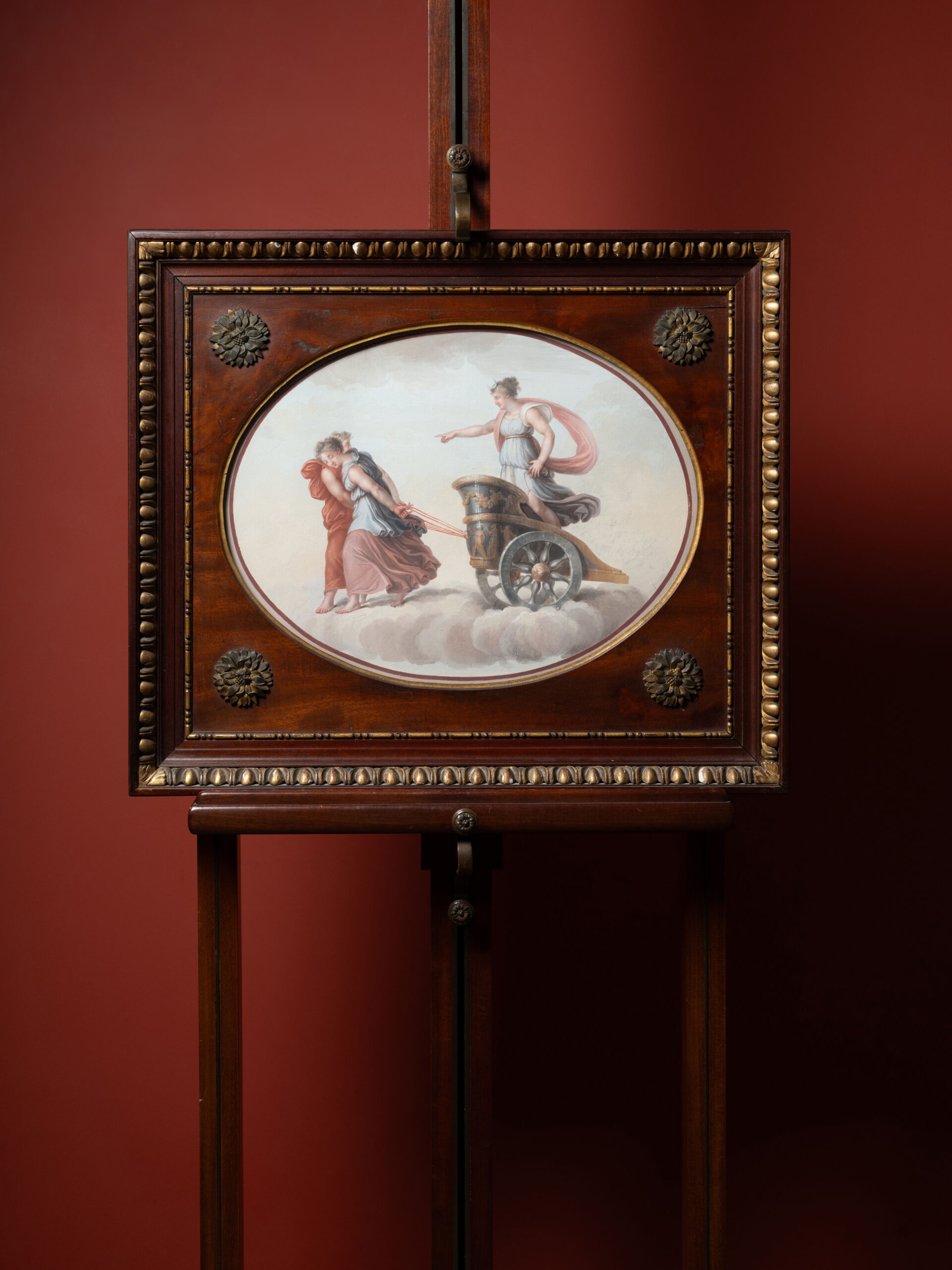
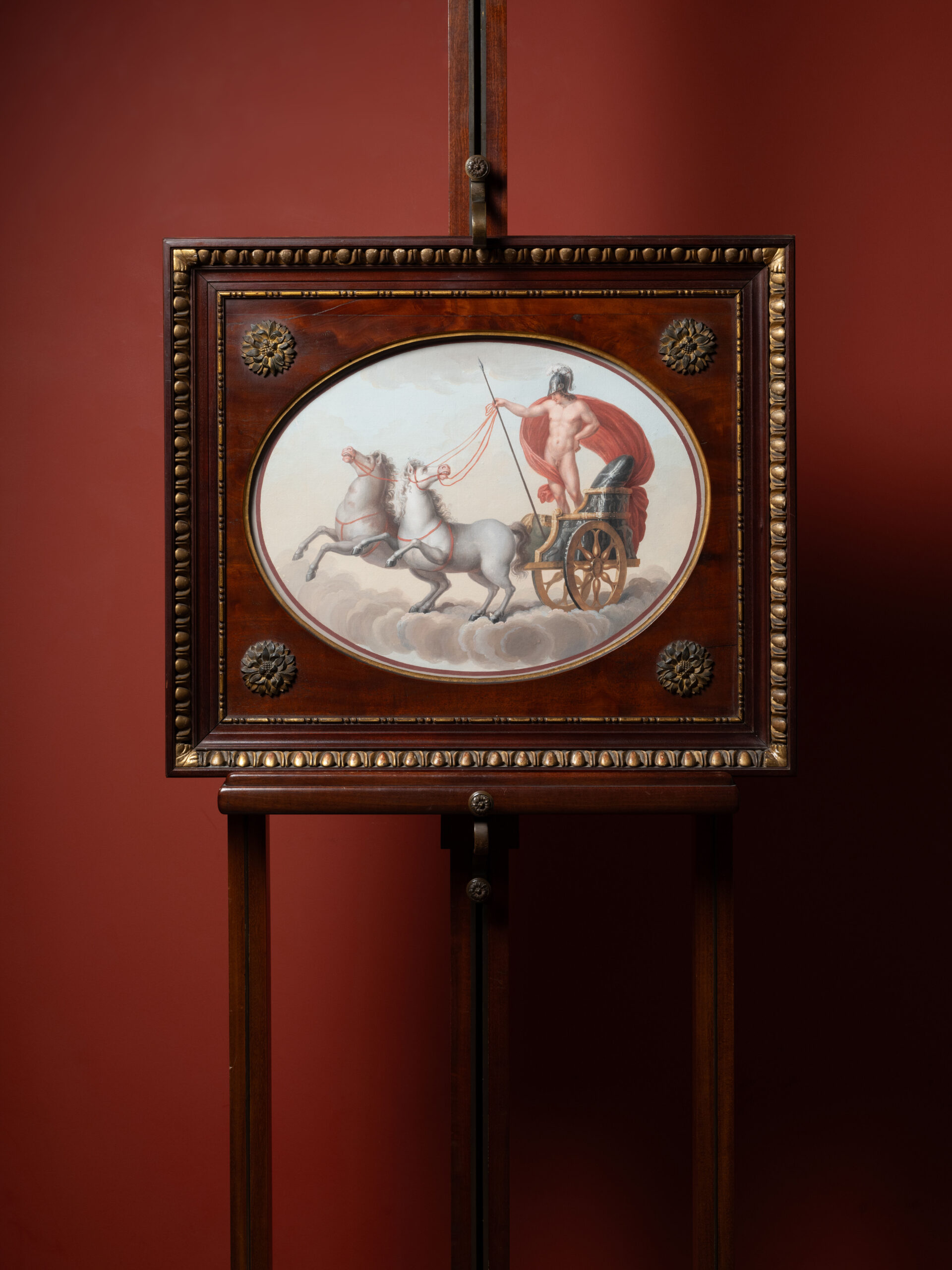
These two gouaches refer to a large group of subjects long attributed to Raphael, widely diffused at the end of the eighteenth century for a clientele of Grand Tourists — the European elites who travelled to Italy for its Greek and Roman antiquities and its most famous works of art, foremost among them those of Michelangelo and Raphael.
A series of twelve Greco-Roman deities, among them the present Mars and Diana, is known through a set of engravings by Carlo Lasinio, an engraver active in Florence at the close of the eighteenth century. A rarer and earlier set exists after the same model, the work of Roman rather than Florentine hands, engraved by Pietro Bettelini and Pietro Fontana. Established within the Roman artistic community, the two were close to Thorvaldsen and Canova, and counted in their circle the painter Michelangelo Maestri, whose signature appear on twelve prints published by Bettelini and Fontana now held in the British Museum. It is likely that the present paintings are likewise by Maestri, who died in Rome in 1812 and was known for his gouaches after Raphaelesque and Pompeian subjects.
The cycle of twelve gods is in truth a cycle of twelve “planets,” as Montagnani observes in his description of the engravings that record the composition of the frescoes in the Sala Borgia: the Volta della Sala Borgia nel Palazzo Vaticano ove sono espressi i Pianeti, le Ore del giorno, ed i segni del Zodiaco dell’immortal Rafaello Sanzio da Urbino. The figures here depicted are the Moon and Mars, the two celestial bodies nearest the Earth. As for the original frescoes, now lost, they were not conceived by Raphael, as was once believed, but by his pupils Giovanni da Udine and Perino del Vaga, in all likelihood following the master’s design.
Each gouache is set in an Empire mahogany frame carved with egg-and-dart friezes and applied at the corners with carved and gilded rosettes. Some cracks are visible on the frame.
Literature
Joseph Archer Crowe et Giovanni Battista Cavalcaselle, Raphael. His Life and Works, t. II, London, 1882 ; John Pope-Hennessy, Raphael, New York, 1970.