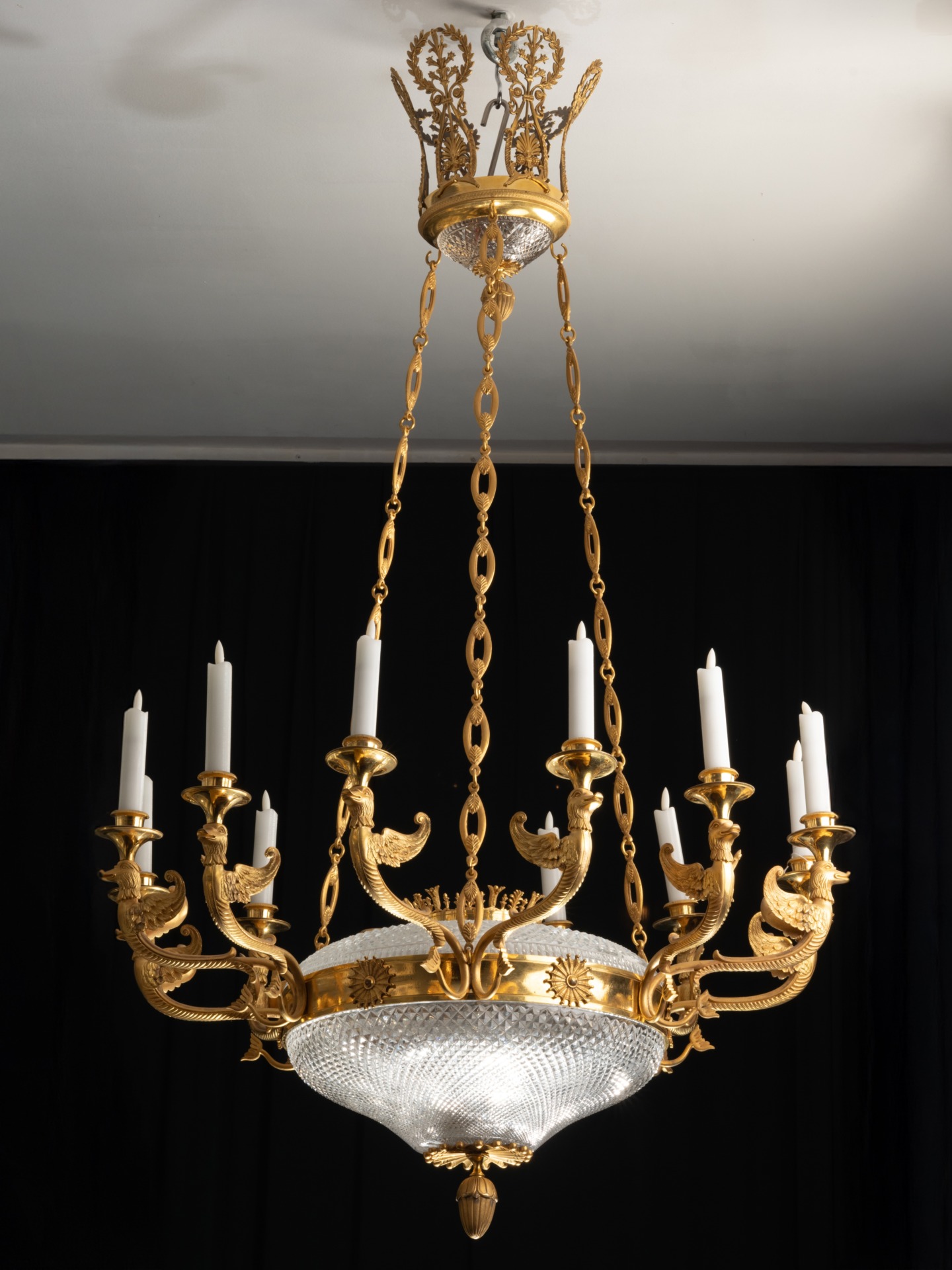
A Russian Empire Cut Crystal Twelve-Light Chandelier
A Russian Empire Cut Crystal Twelve-Light Chandelier
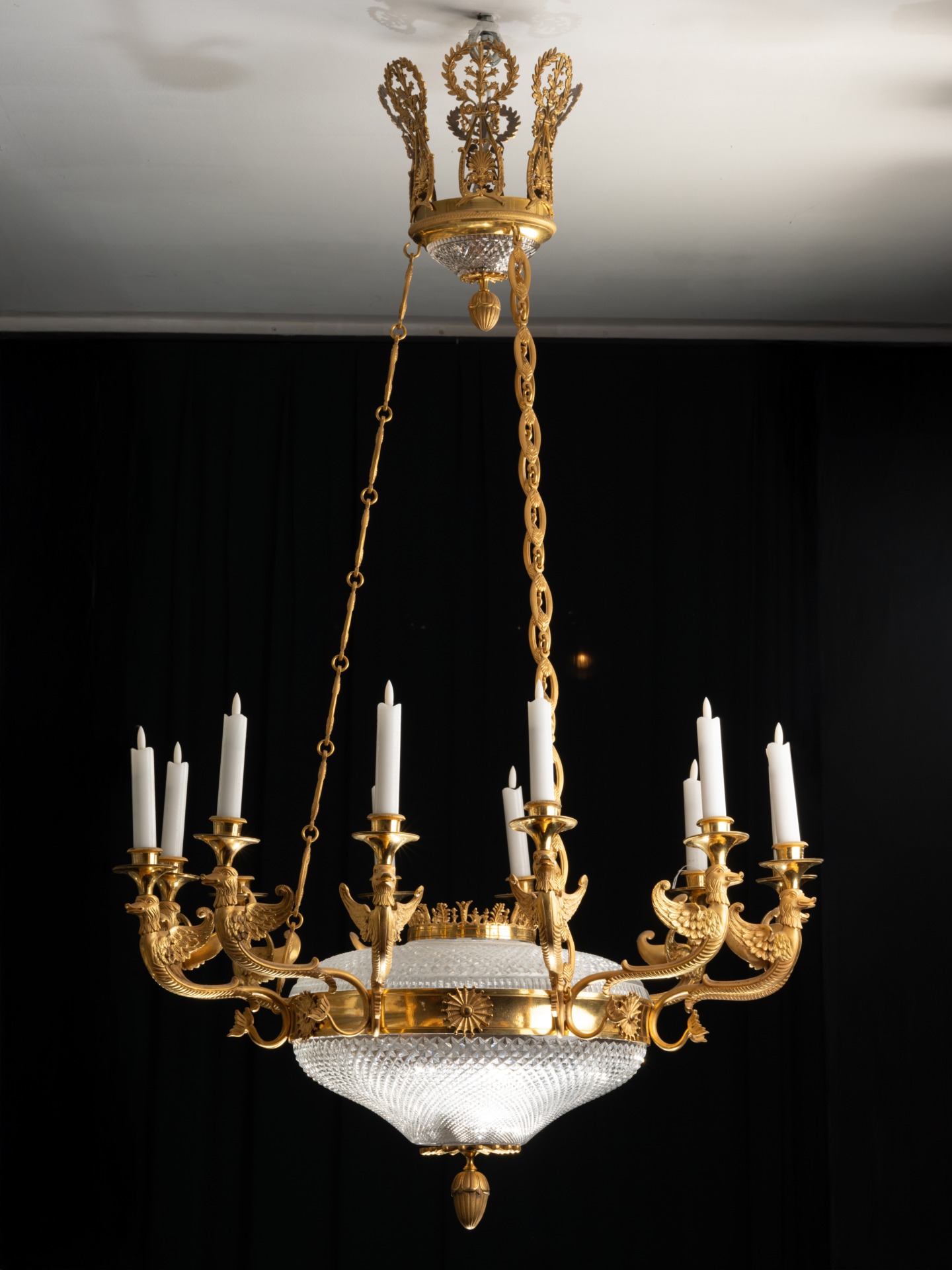
Twelve-light chandelier in gilt bronze and cut crystal Saint Petersburg First quarter of the 19th century 120 x 70 x 70 cm (47.2 x 27.6 x 27.6 in.)
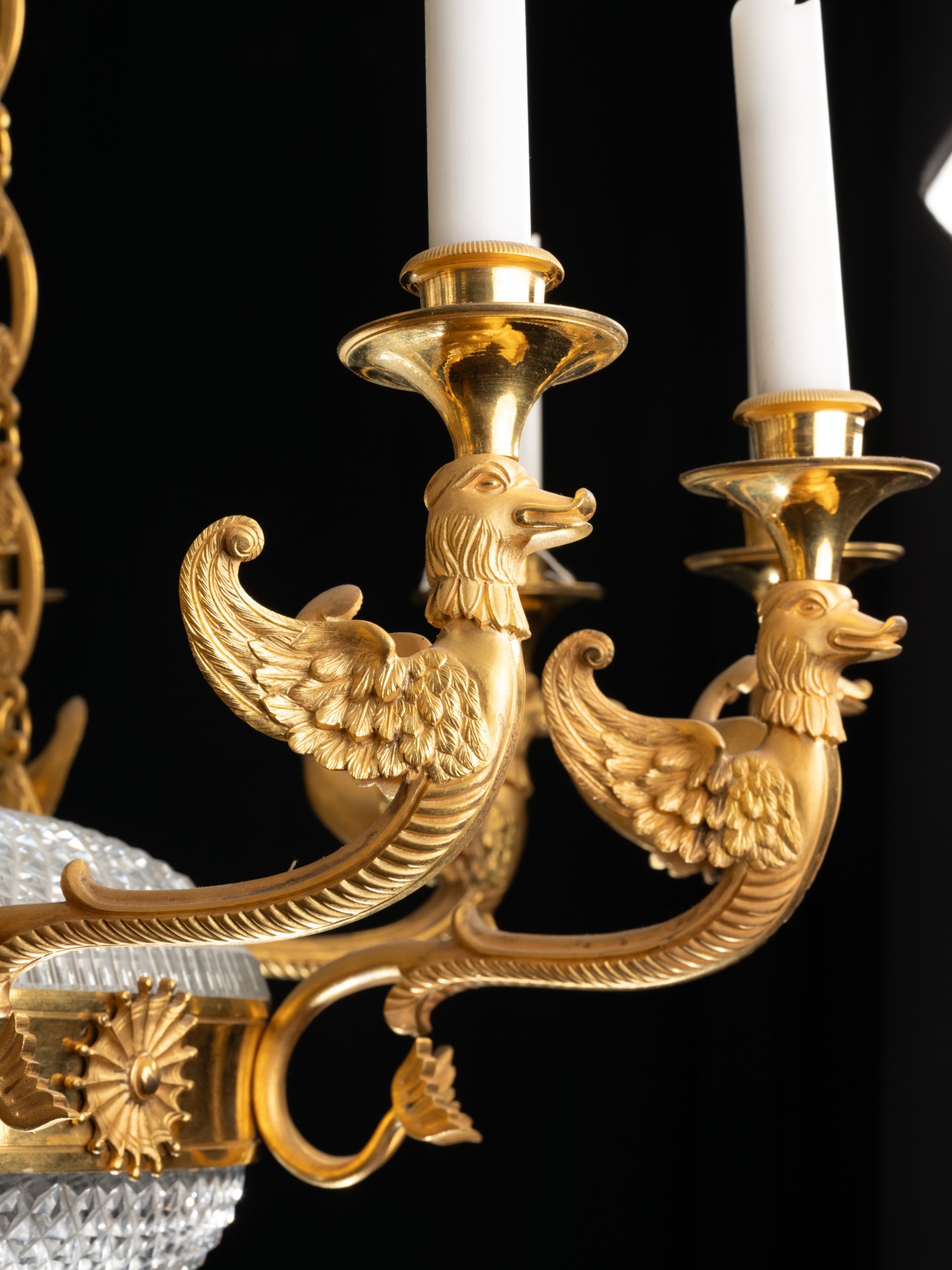
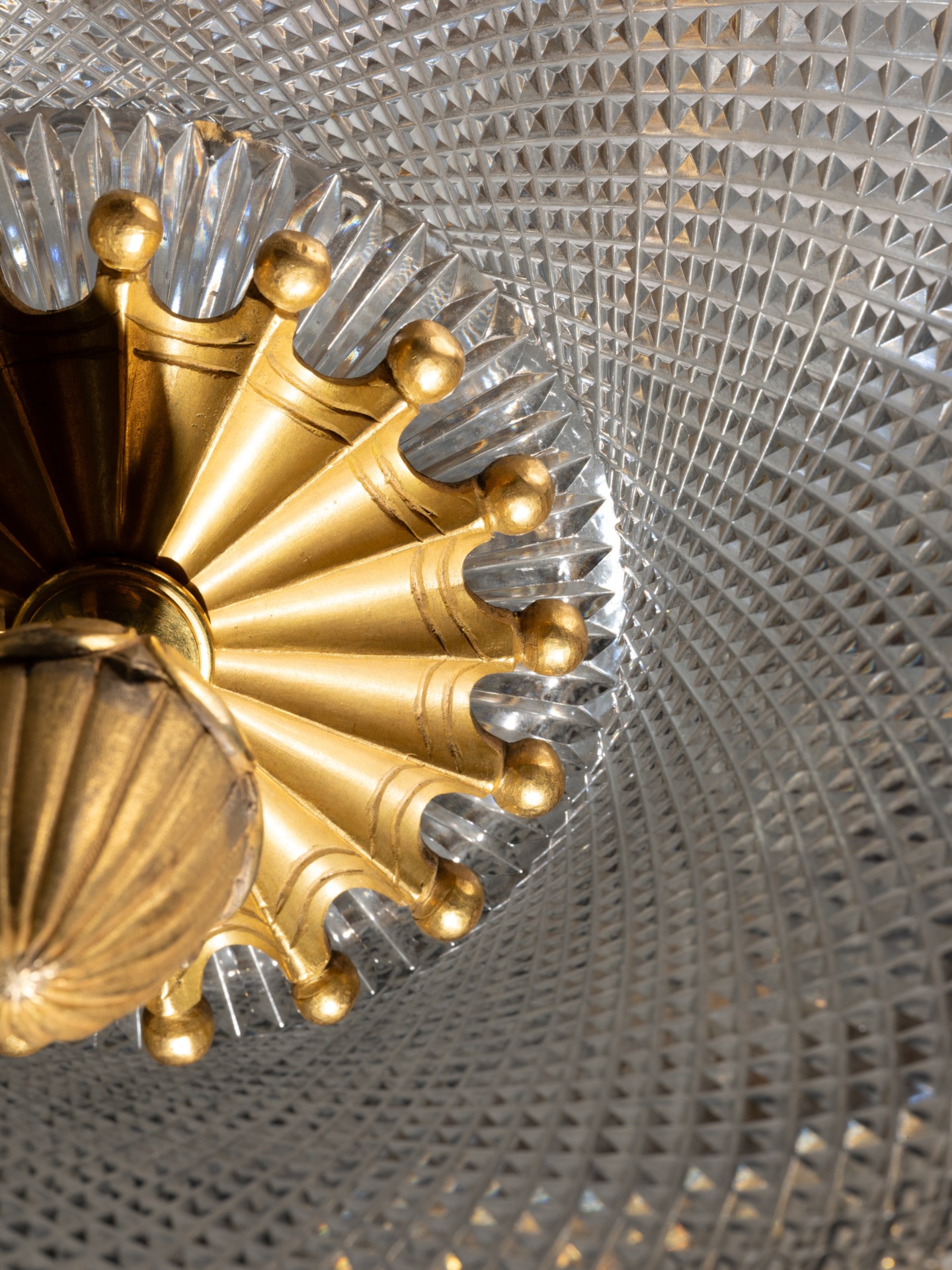
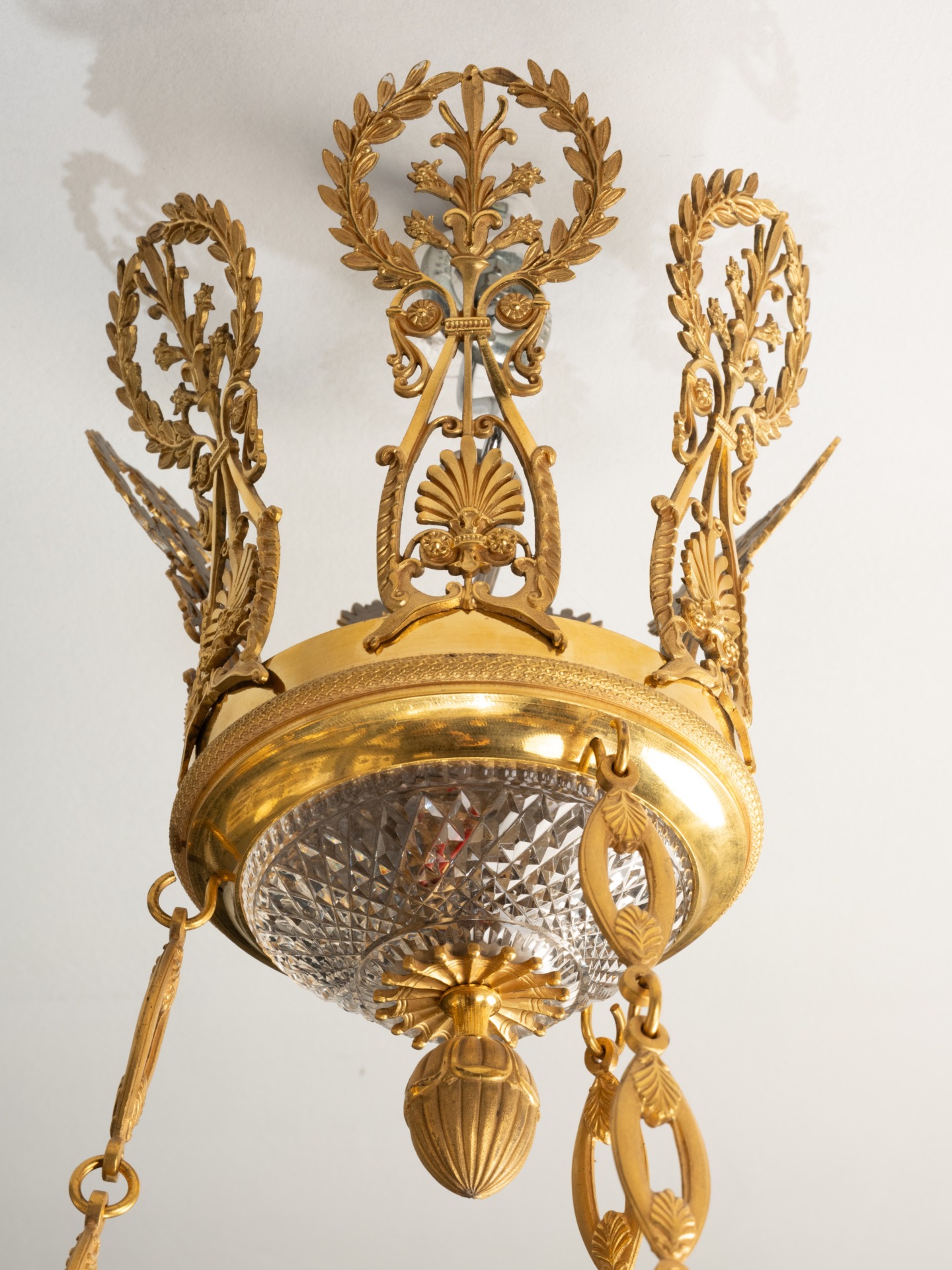
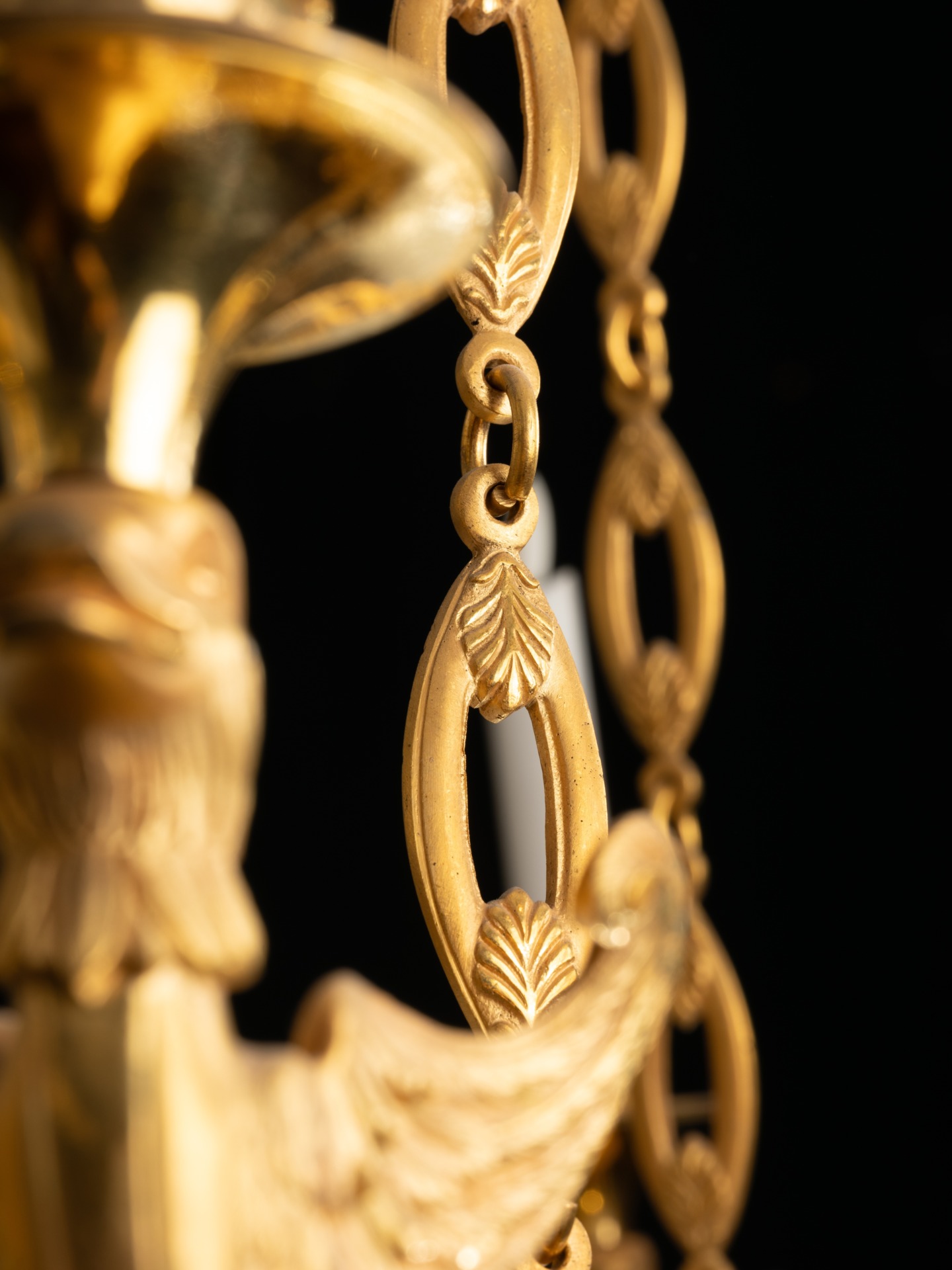
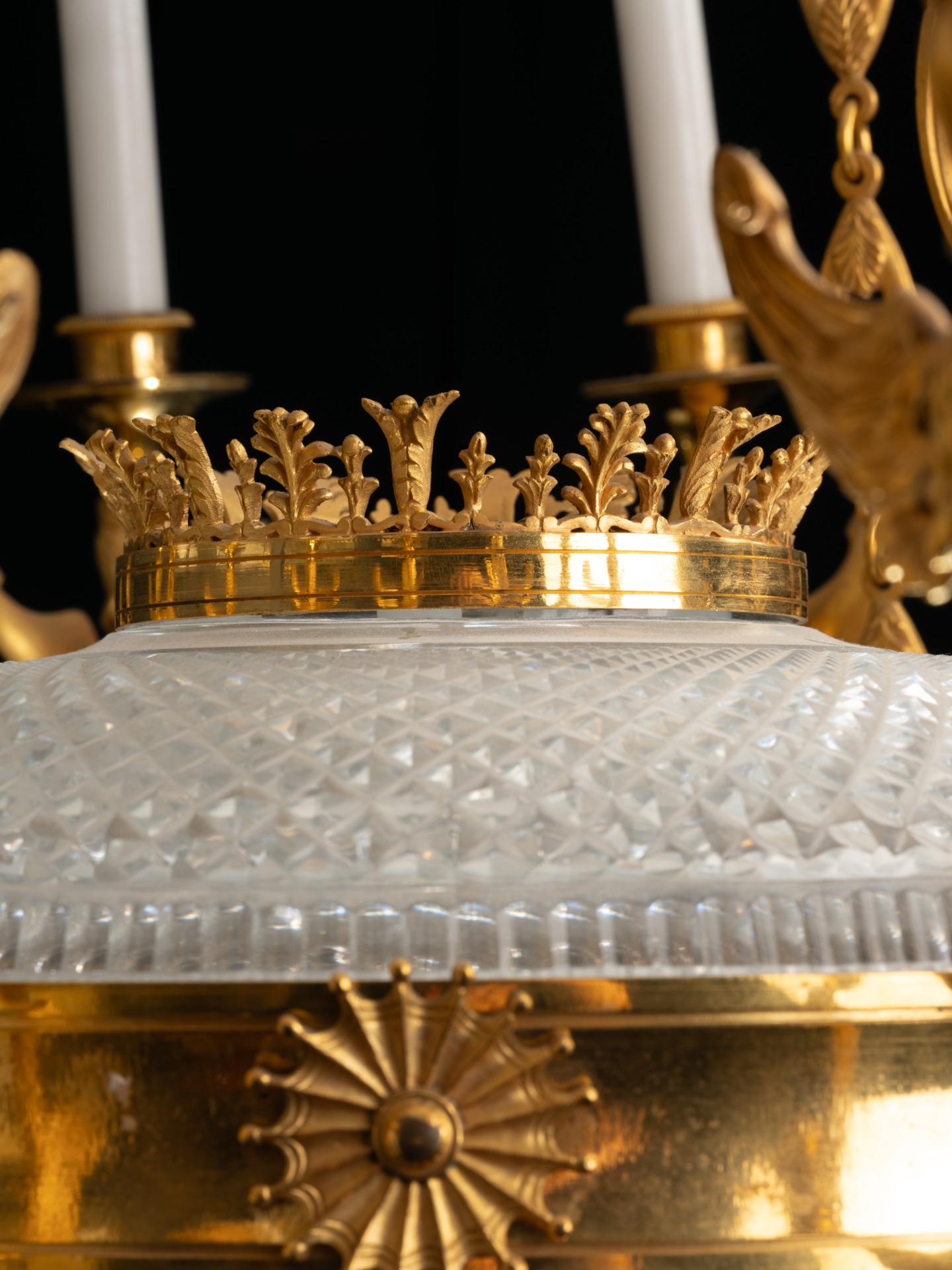
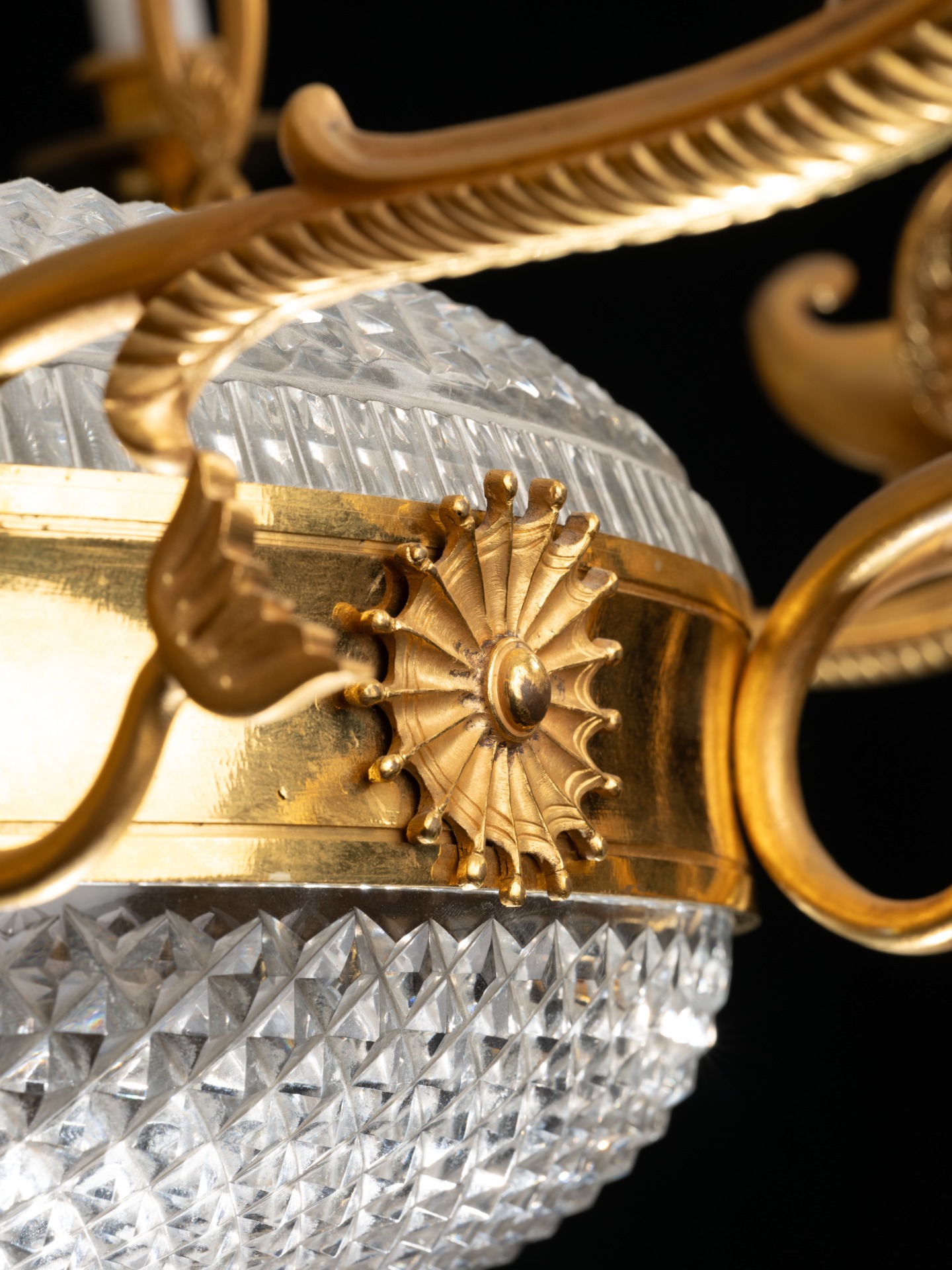
A Russian twelve-light chandelier, in mercury gilt-bronze and cut crystal, surmounted by a crown of scrolls, foliage, anthemia, and laurels finished with a cut-crystal pendant with diamond cut patterns and a pinecone finial, supporting, by three gilt-bronze chains chased with palms, a covered crystal core in the same diamond cut crystal and decorated with bronze rosettes, from which twelve arms spring in the form of swan protomai on whose heads are screwed the drip pans and candleholders. The lower part of the crystal core ends in a gracefully gable terminated with a bronze rosette and a chased pinecone finial. No missing elements. Neither drilled nor fitted for electrification. The crystal body is featured with a bronze cover, concealed beneath a small foliage crown, allowing for an addition as a central shaft.
Literature
Similar chandeliers are documented by Sychev, The Russian Chandeliers. 1760-1830, Saint Petersburg, 2003. For comparable examples of cut crystal by the Saint Petersburg Manufacture, see Asharina et al., Russian Glass of the 17th-20th Centuries, New York, 1990.
Tall “cobra” Table Lamp, After A Model By Edgar Brandt
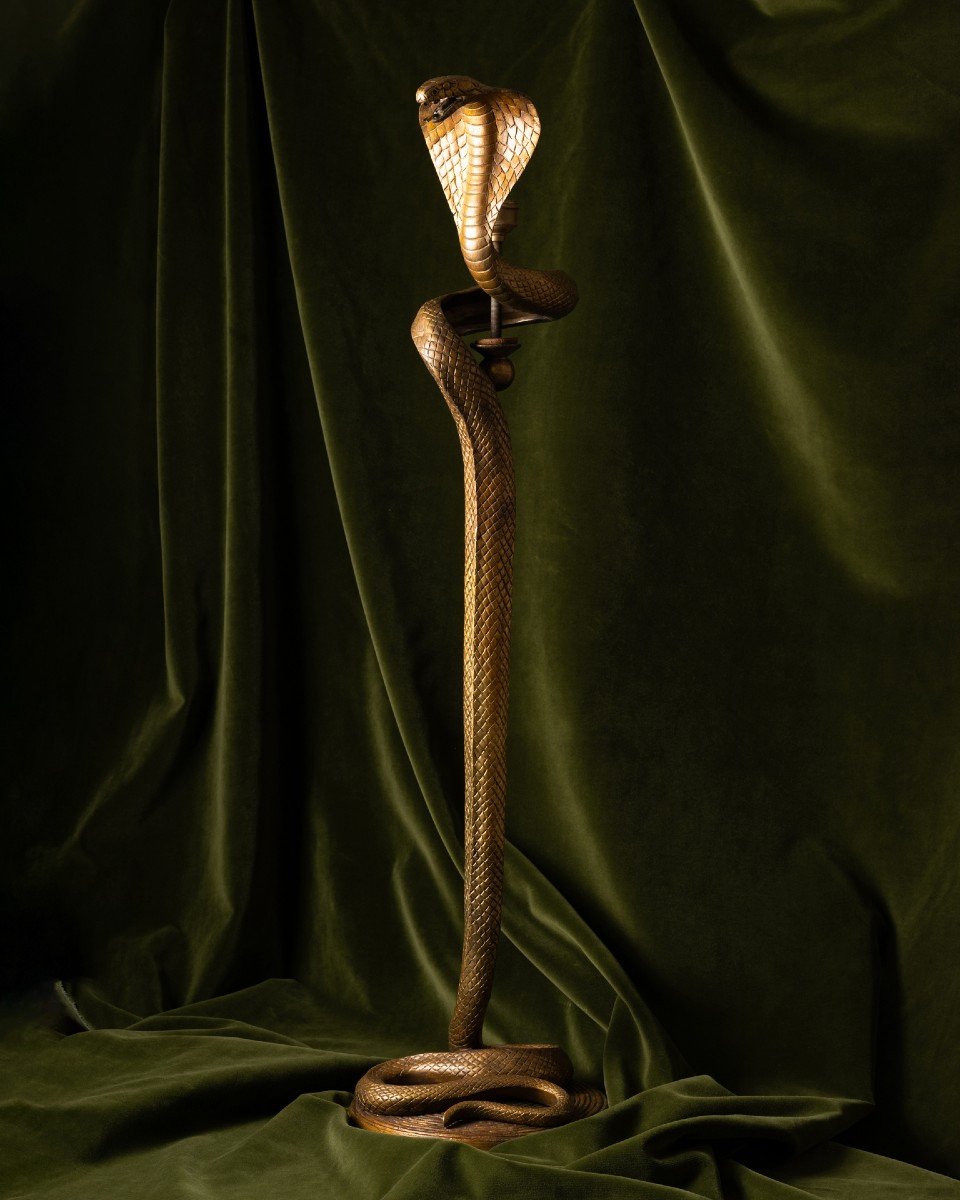
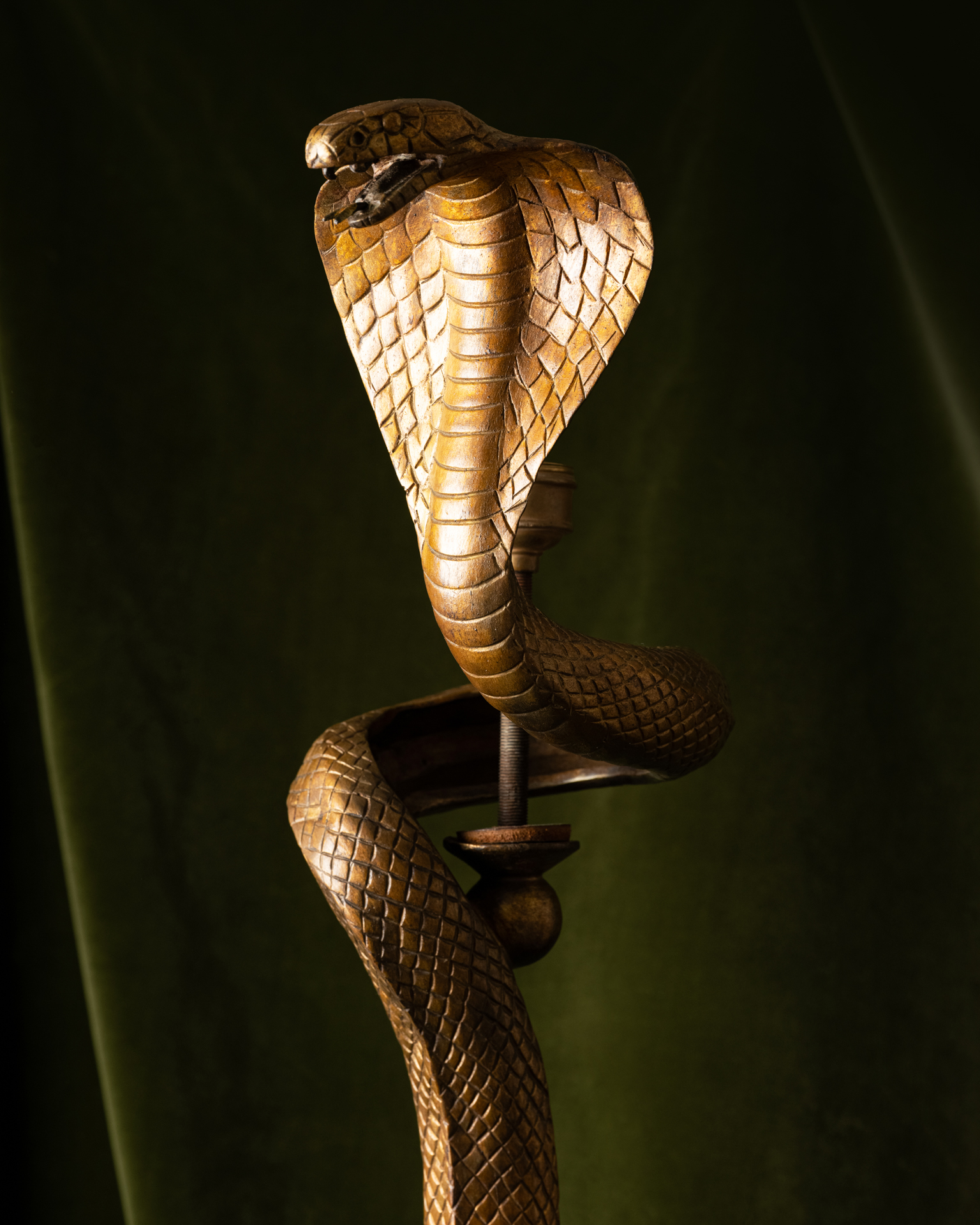
Tall “Cobra” table lamp, after a model by Edgar Brandt
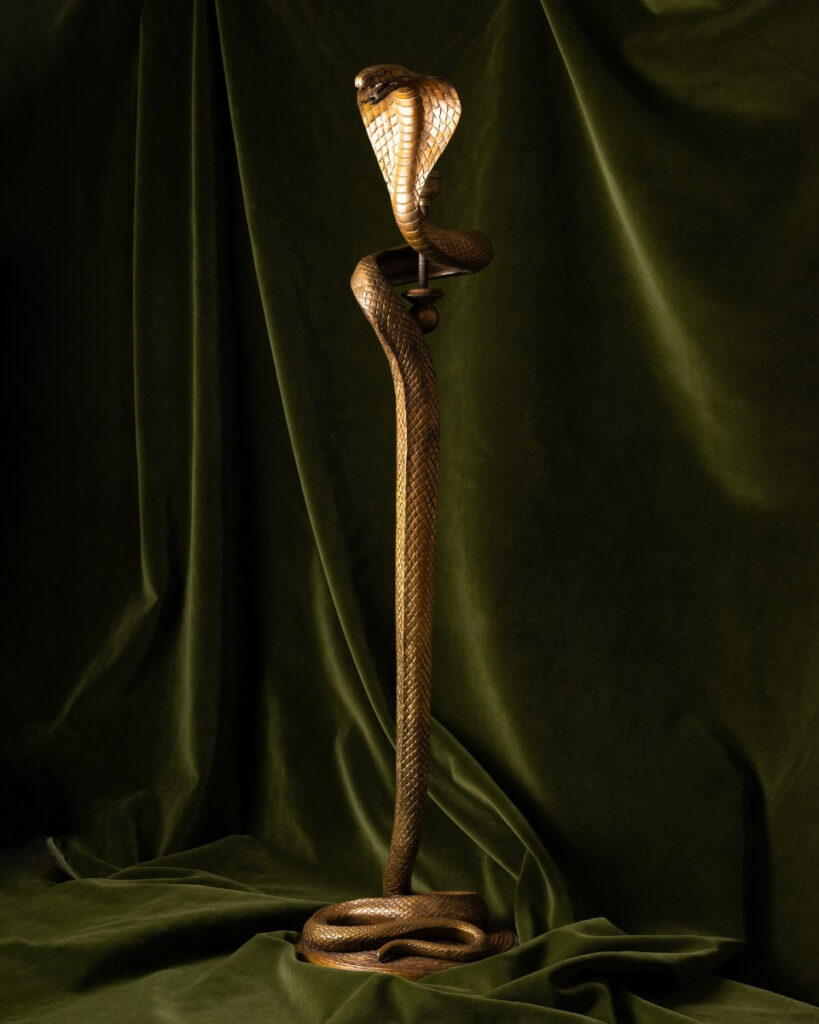
Patinated bronze France 20th century 89 x 24 cm (35 x 9.4 in.)
Decorative bronze works, and in particular the two snake-shaped lamp models — La Tentation (Temptation) and Cobra — are almost an exception in Edgar Brandt‘s œuvre, as they were produced in large edition as well as executed and finished by founders and bronzesmiths, unlike the ironwork pieces that bear his name. It is estimated that around 400 Tentation and Cobra lamps were produced during Brandt’s lifetime, with variations in size, shape, casting and finish.
This lamp bears a signature on the base; the cup-shaped shade is missing.
Literature
See Joan Kahr, Edgar Brandt. Art Deco Ironwork, New York, 2010.
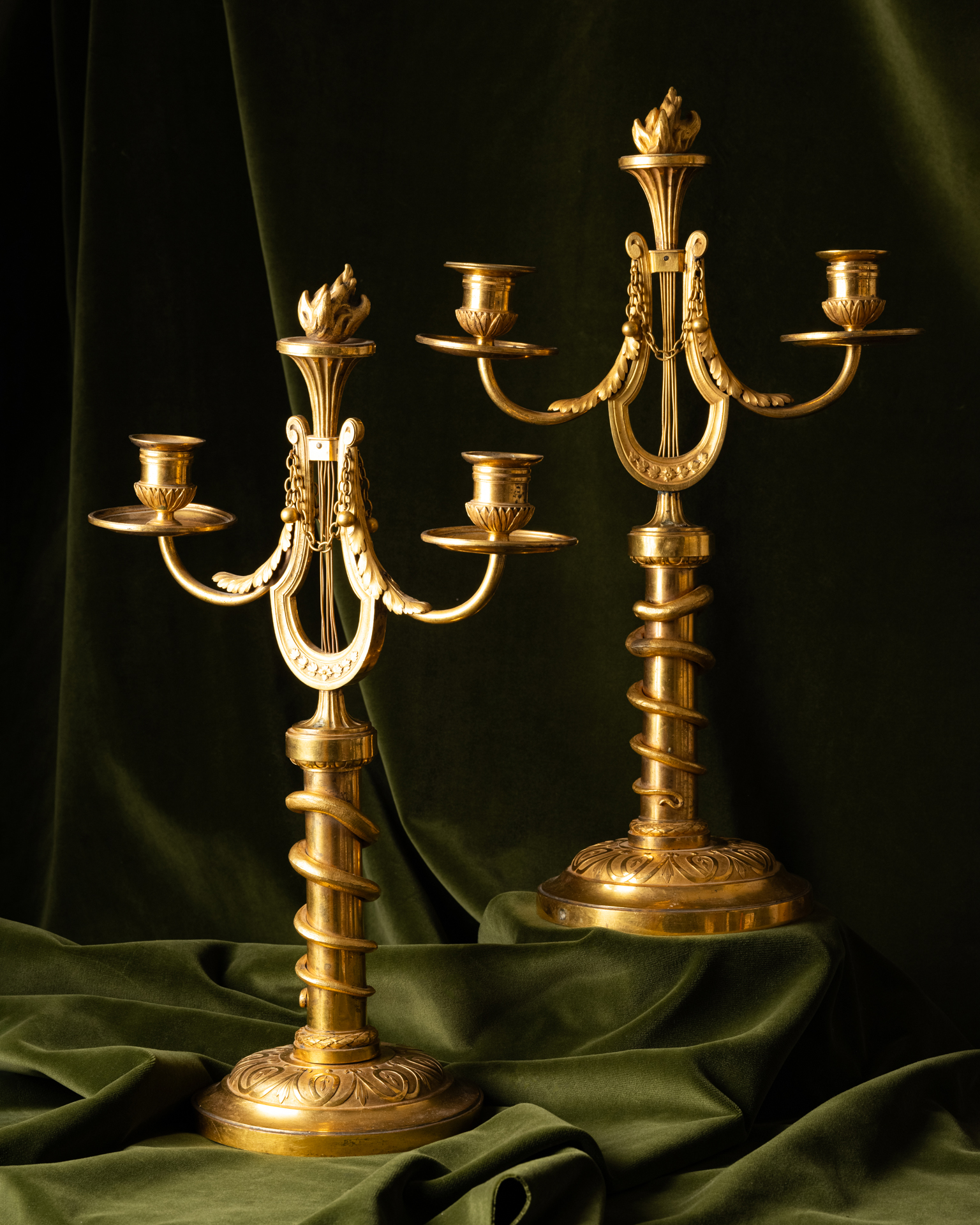
Gilt bronze and copper Vienna Late 18th century h. 51 cm (20 in.)
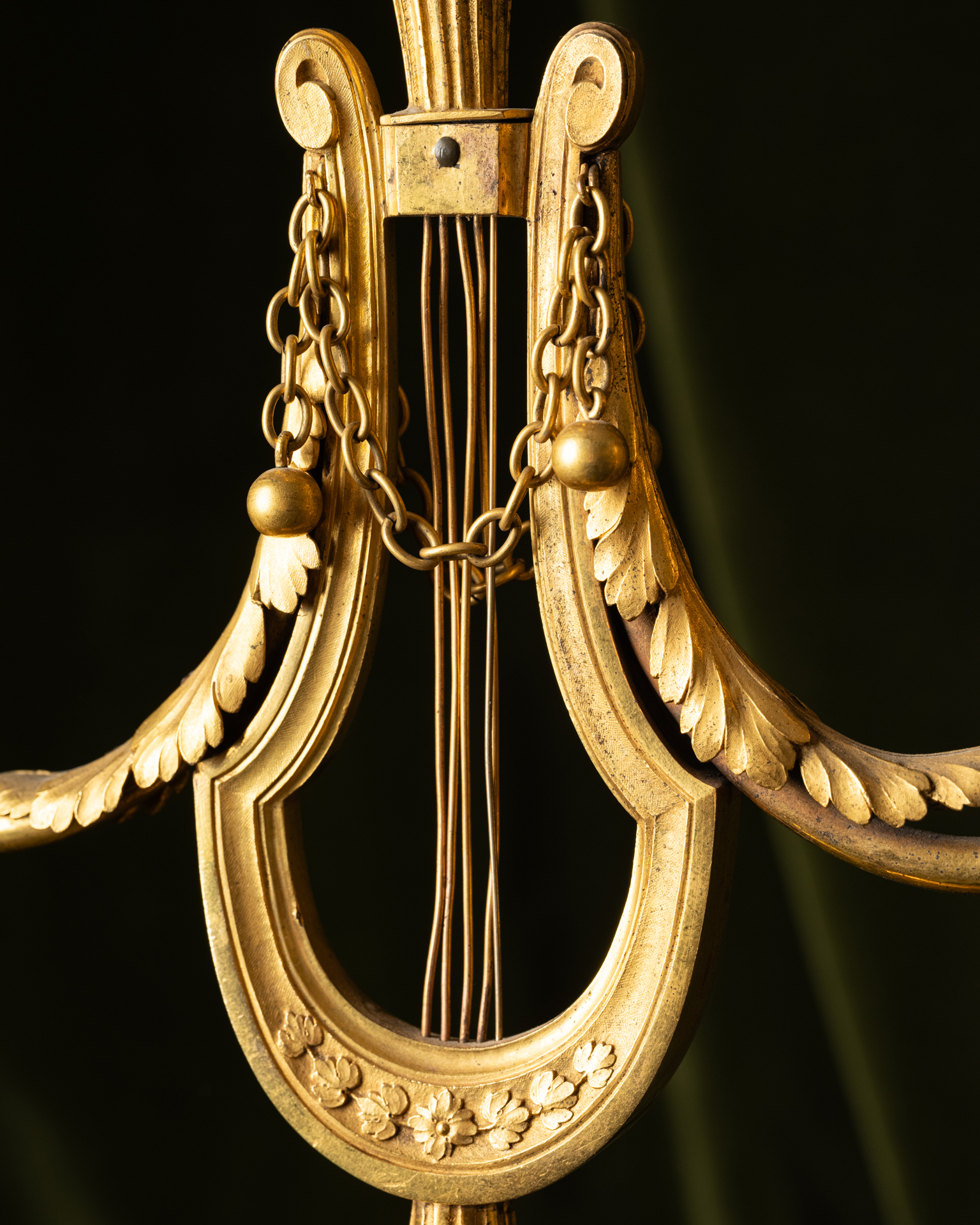
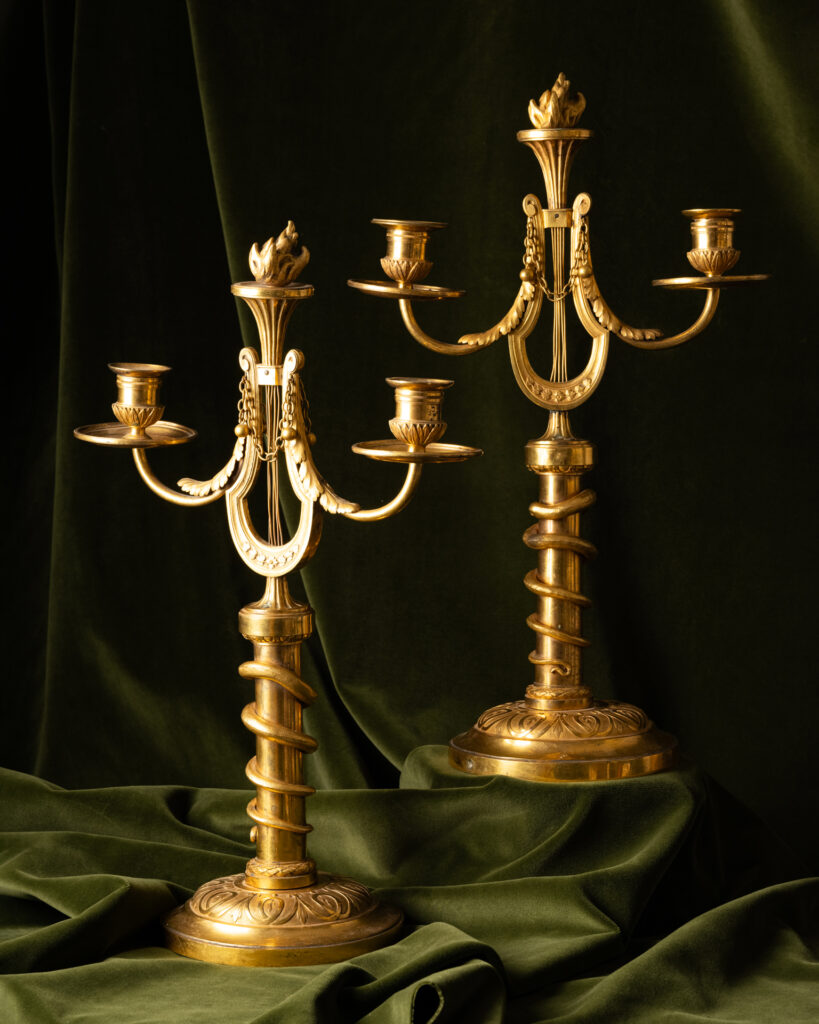
Several features suggest the attribution of this pair of candlesticks to a Viennese workshop: the decorative repertoire, derived from French neoclassical bronzes and combining “acanthus and palmette”, “ornamental use of musical instruments” and “animal motifs”;1 the use of gilt metal chains, found on several chandeliers in the collection of the Möbelmuseum in Vienna; and above all the use of gilt copper for the base, the drip pans and probably the strings of the lyre — a material and technique that betray the persistence, in the Viennese decorative arts, of a metalworking tradition that had remained, prior to the importation of French bronzes, “at the primitive stage of simple Gürtlerei”.2
Be that as it may, these candlesticks, of a hitherto unrecorded model, display chasing of a high order: the modelling of the undulating acanthus, laurel and oak leaves, the matted grounds of the copper base and the flutes of the flaming torch, the modelling of the flame itself, the texture of the serpent’s skin, the rosettes and volutes of the lyre — which in places rival the contemporary work of the French bronzists.
Literature
See Eduard Leisching, “Die Bronzen im Hof-Mobiliendepôt in Wien”, in Monatsschrift herausgegeben vom Österreichischen Museum für Kunst und Industrie, VI, 1903, Vienna.
That is, the traditional Germanic craft of shaping and gilding non-ferrous metals, ibid., p. 429. ↩︎
Rock Crystal And Fire-gilt Metal Chandelier Attributed To E. Baguès And G. B. Metellino
Rock Crystal And Fire-gilt Metal Chandelier
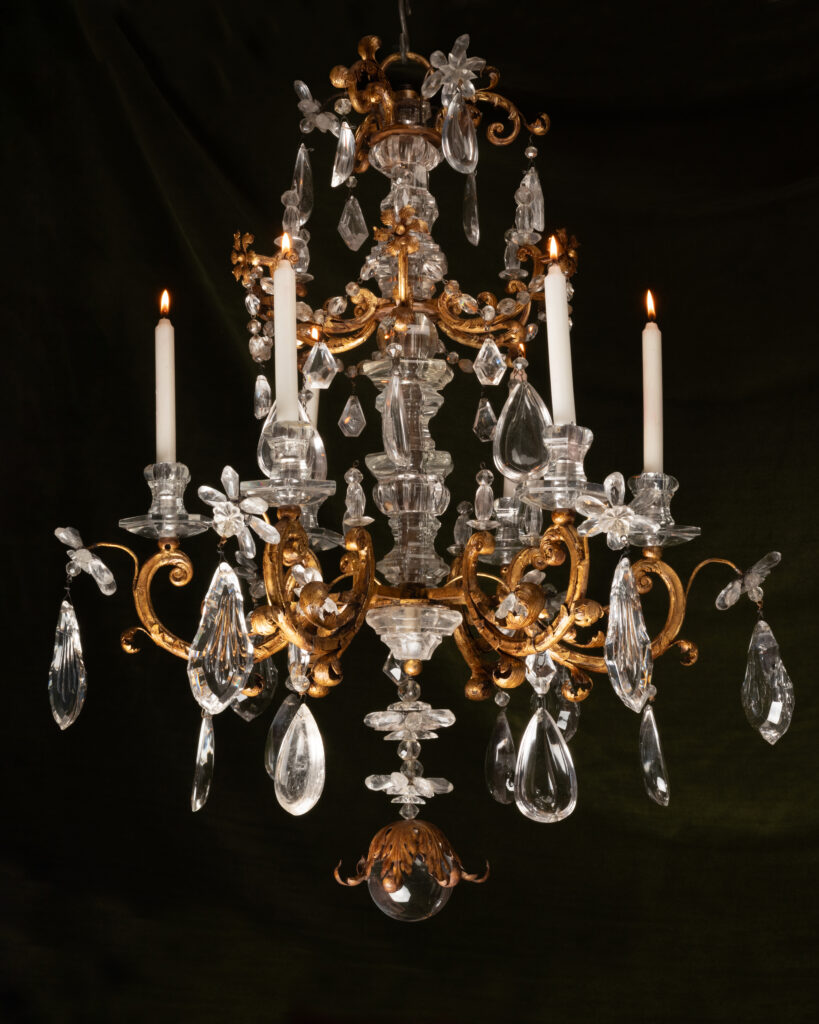
Six-light chandelier attributed to Eugène Baguès or to L’Escalier de cristal, some parts attributed to Giovanni Battista Metellino Gilt metal, rock crystal Milan, France Late 19th century, incorporating elements from the early 18th century 85 x 65 cm (31.5 × 25.6 in)
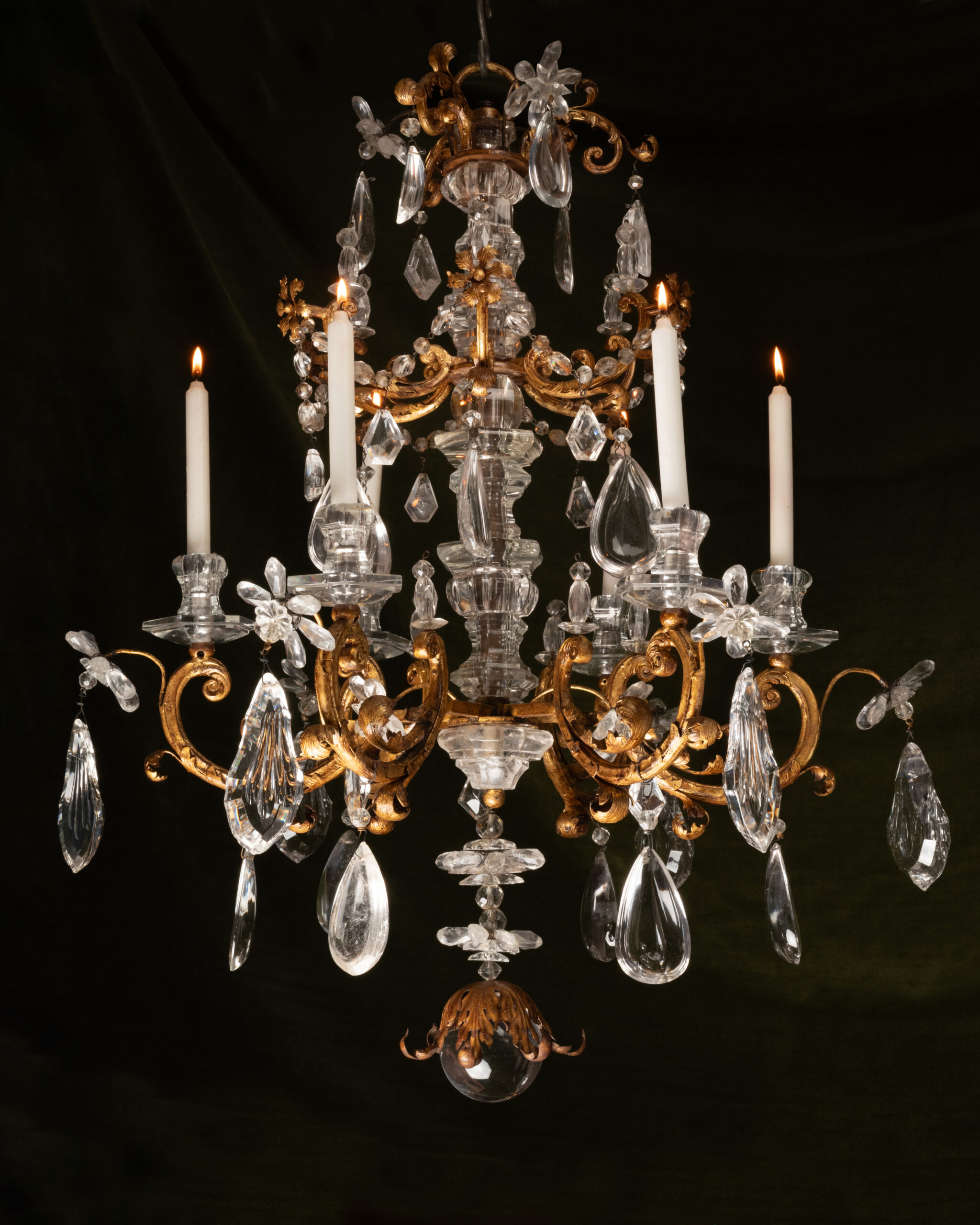
The structure of this six-light chandelier bears the imprint of two distinct periods of manufacture. The six semi-circular arms, adorned with foliate volutes, appear to be the oldest components. The refinement of their ornamentation and certain technical features associate them with a group of Milanese works dating from the early years of the 18th century.
At least two known chandeliers present a comparable structure. The first, a twelve-arm chandelier housed in the Metropolitan Museum, was executed using a technique similar to that of the present piece: the arms, decorated with gilt metal foliage, emerge from a baluster-shaped shaft in rock crystal, projecting first perpendicularly before curving sharply into voluted semicircles. The second chandelier, located in the Konferenzzimmer of the Hofburg in Vienna, is even closer: in addition to a similar structure, it features identical six-pointed star motifs in gilt metal, executed in the same manner as the foliage.
Both chandeliers are attributed to Giovanni Battista Metellino, a Milanese stone-cutter active from the late 17th to the early 18th century, whose hand is recognisable — in both style and execution — in the crystal work of the Metropolitan Museum and Hofburg chandeliers. It has thus been inferred that a Milanese workshop, specialising in lighting production and regularly collaborating with Metellino for crystal elements, was responsible for this very rare group of chandeliers distinguished by a shared ornamental language in gilt metal and rock crystal.
The Hofburg chandelier underwent significant modifications in the late 19th century, most likely carried out by the Viennese firm J. & L. Lobmeyr, which at the time was overseeing the electrification of the Konferenzzimmer. The present chandelier appears to have undergone a similar intervention, probably during the same period, possibly by the firm of Eugène Baguès. Founded in 1840, the Baguès company had, by the late 19th century, developed a speciality in electrifying antique light fixtures, while also trading in both antique and modern objets d’art — particularly chandeliers. In the firm’s early advertisements, antique pieces are sometimes shown alongside Baguès’ original creations, a juxtaposition likely intended to highlight the historical and technical precision that the firm prided itself on, aspiring to produce decorative objects of a quality comparable to those of the 18th century. This interplay between old and new sometimes occurred within a single object, through the reuse of antique components — occasionally irreplaceable — within newly created works.
The present chandelier appears to have emerged from precisely this kind of practice: its structure was altered, its arms enlarged, new decorative elements added, and the entire piece adapted for electrification — a domain in which the firm of Eugène Baguès played a leading role in the late 19th century.
L’Escalier de cristal, another firm renowned for producing high-quality objets d’art and furniture in 18th-century styles — always in extremely limited numbers and for an elite clientele — was also known for incorporating antique elements, sometimes of an inimitable nature. A drawing of a chandelier strikingly similar to the present example appears in one of L’Escalier de cristal’s design books, making it plausible to attribute the reconfiguration of this piece to that firm.
A Six-light Chandelier In Hammered Iron And Gilt Bronze
A Six-light chandelier in hammered iron and gilt bronze
Hammered and forged iron, gilt bronze, rock crystal, iron and copper rivets Italy or France First half of the 18th century 75 × 60 cm
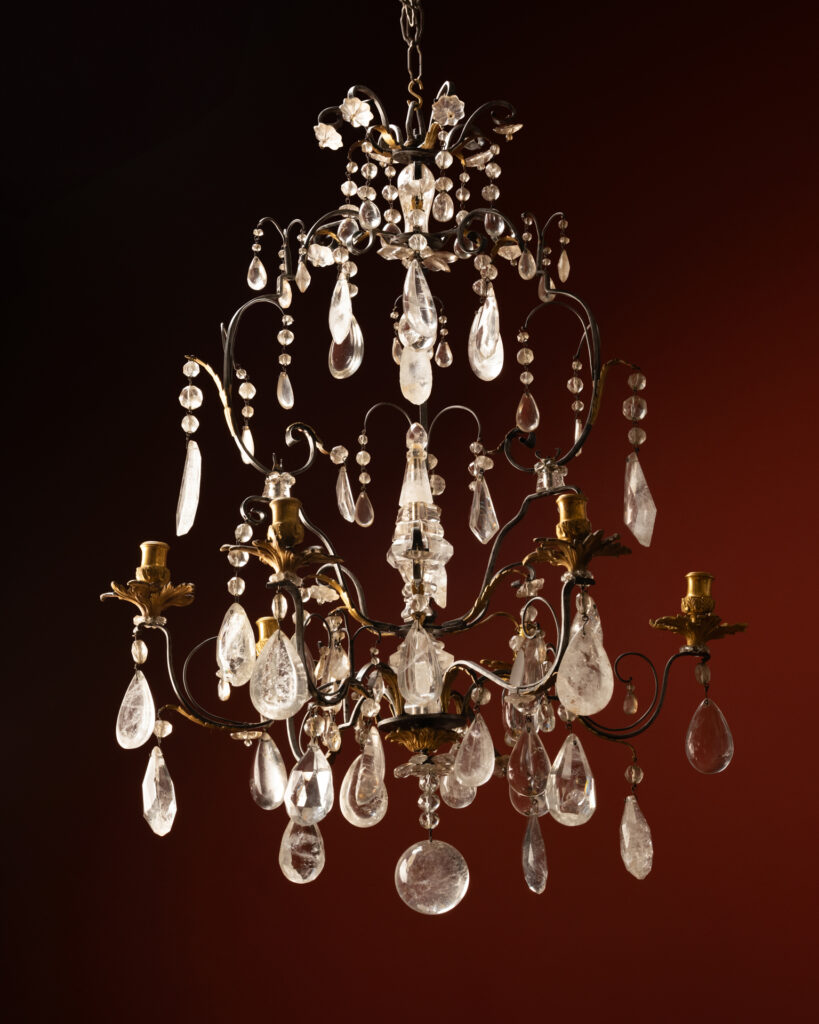
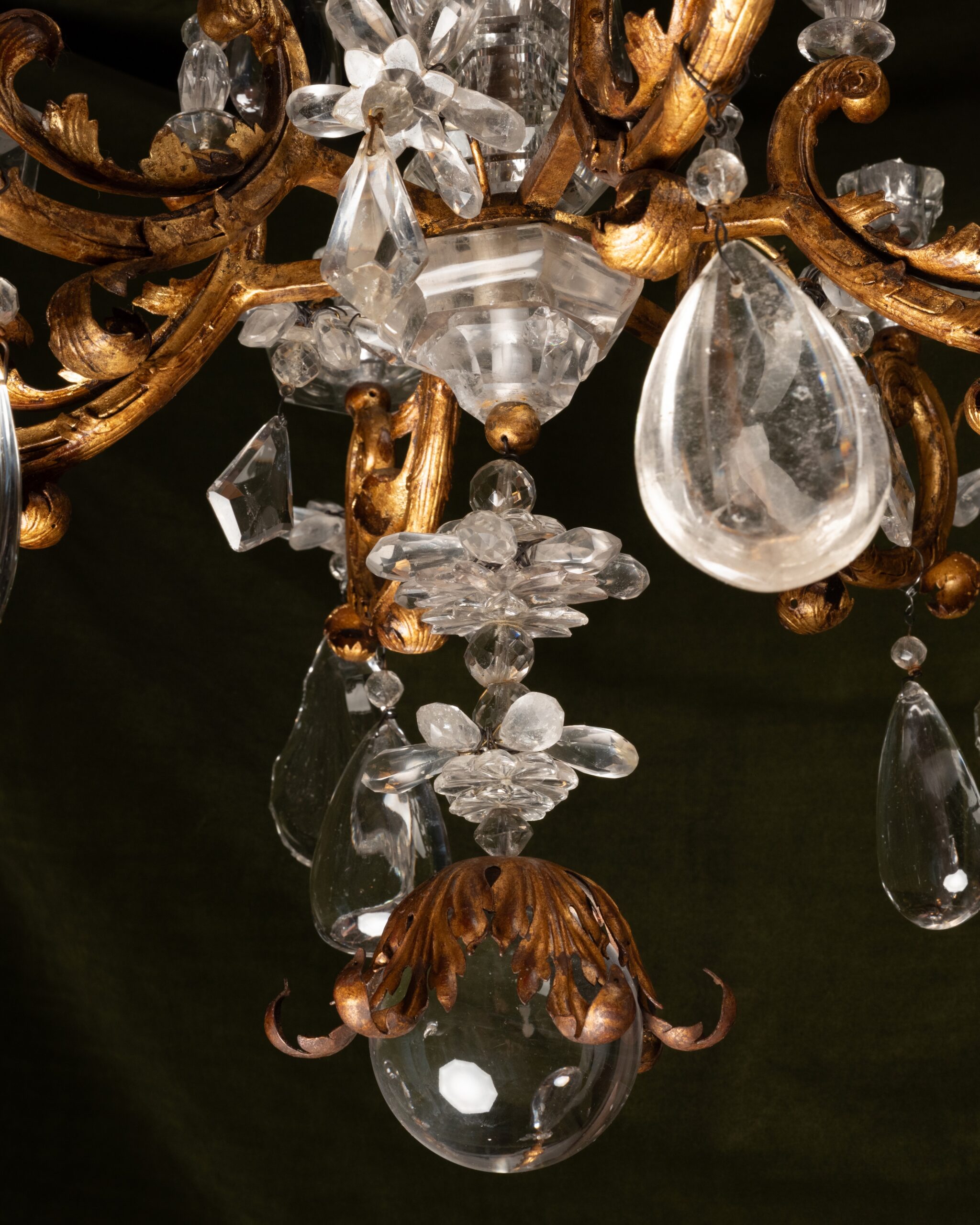
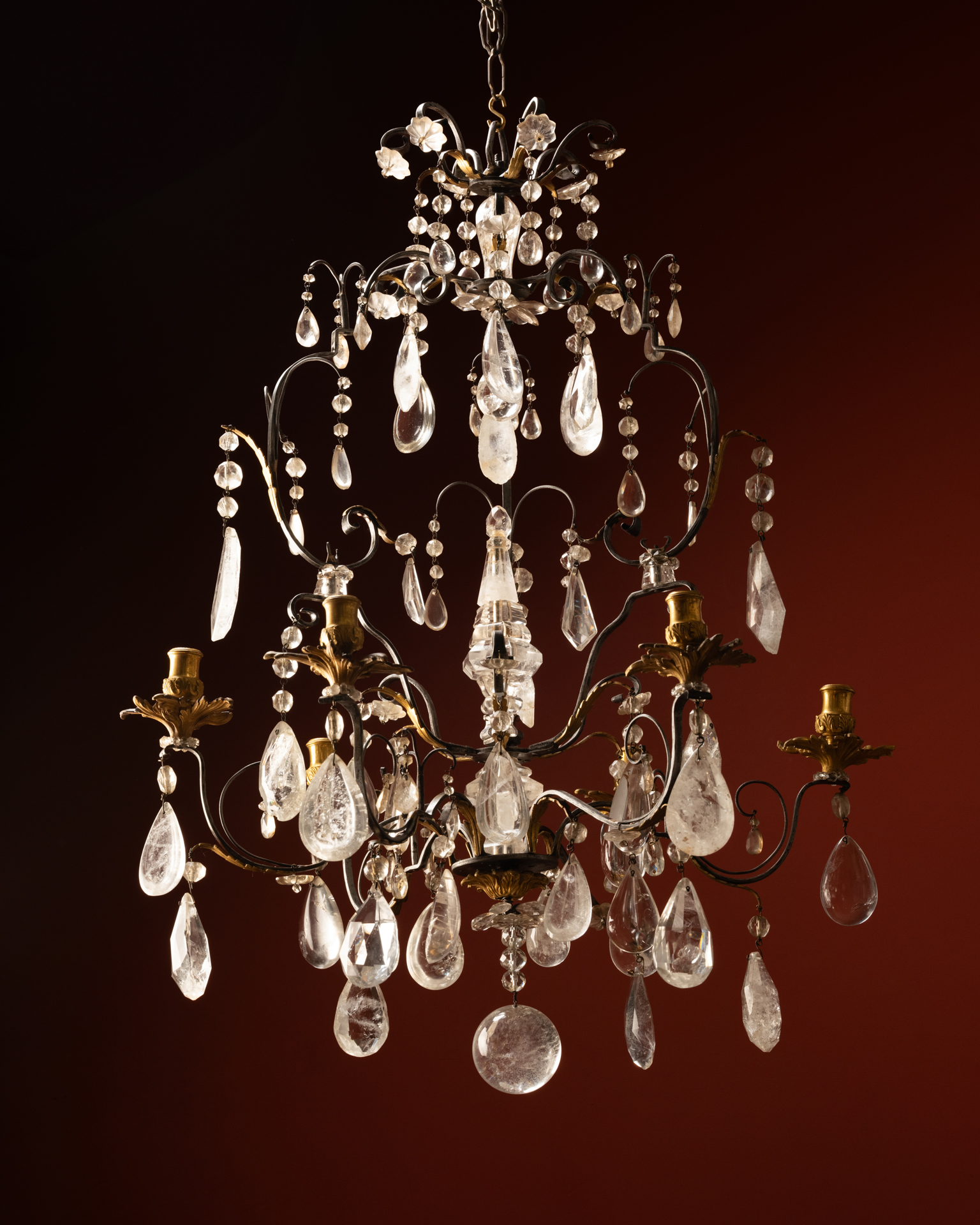
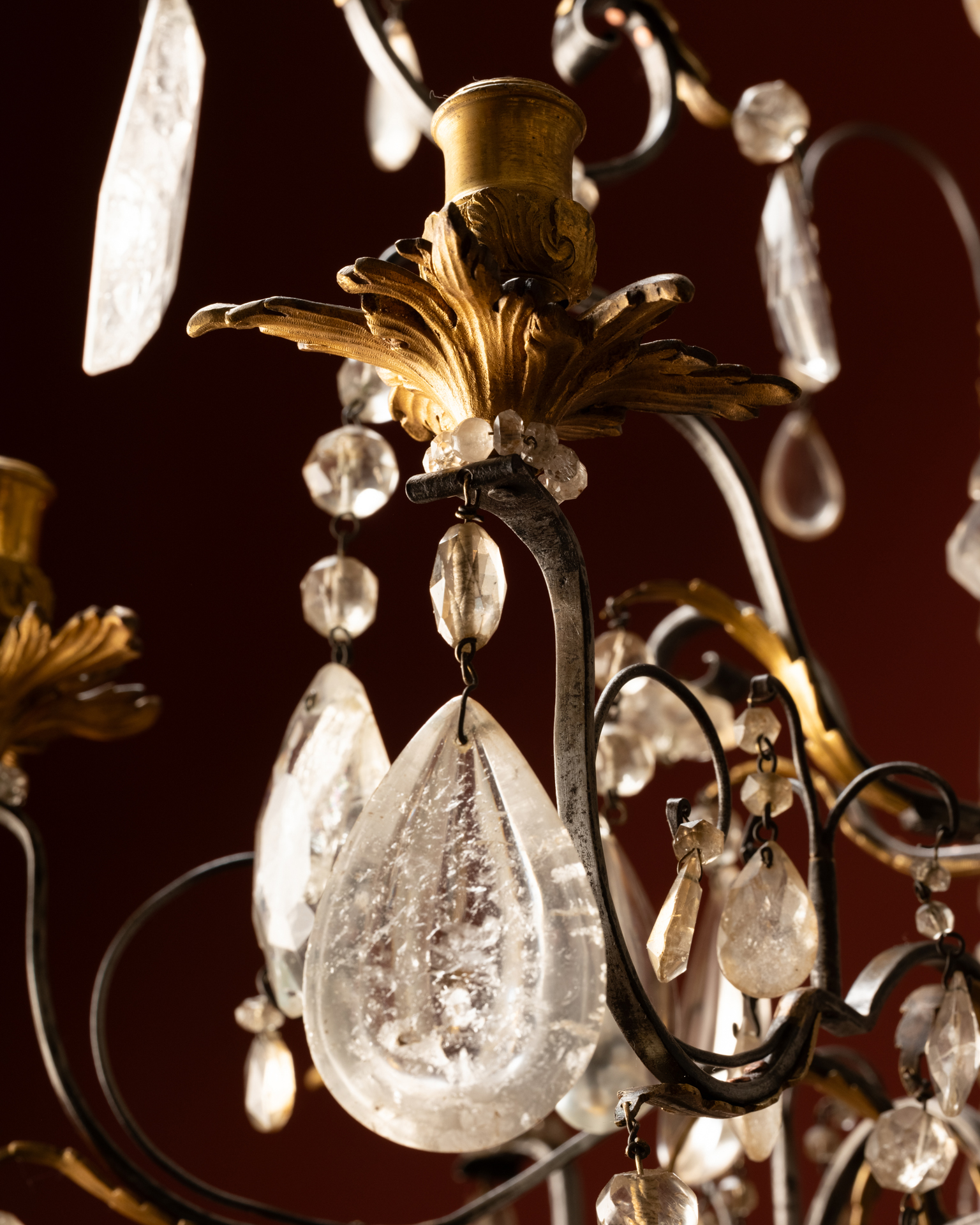
Six-light chandelier in hammered and forged iron and gilt bronze, adorned with rock crystal pendants, stars, rosettes, beads, and drops. The rocaille decoration of the gilt bronze nozzles and drip pans can be found on a chandelier at the Palazzo de Cava de’ Tirreni in Campania and dated between 1740 and 1760, which supports the hypothesis of an Italian manufacture — probably Piedmontese, moreover suggested by the use of ferro battuto. The remarkably rocaille style of the nozzles and drip pans, as well as the few gilt bronze motifs in the shape of chicory leaves, also makes a French manufacture plausible — such pieces in iron or steel and gilt bronze having also been produced in France under the Regency and under Louis XV, in Paris as well as in Provence.
A Pair Of Mechanical ‘carcel’ Lamps By François-nicolas Poupinel
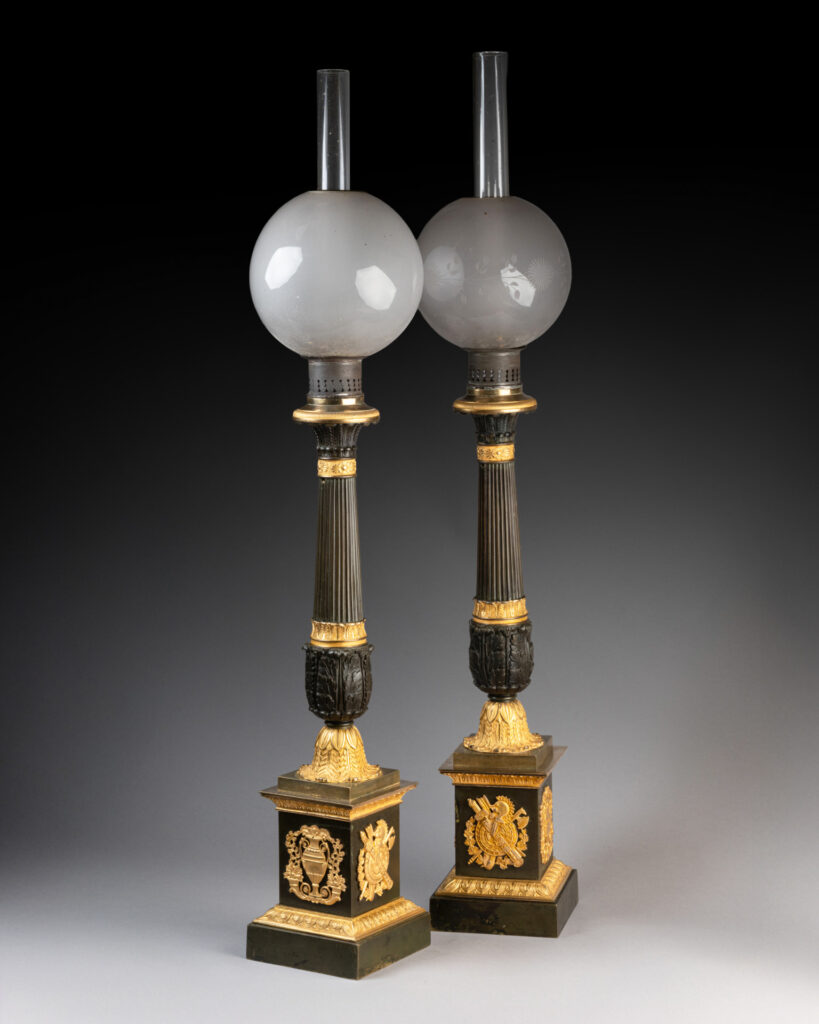
A Pair of Carcel Lamps by François-Nicolas Poupinel
Parcel-gilt bronze, glass France ca. 1828 h. 58 (cm) (22¾ in., without accessories); h. 82 cm (32¼ in., with accessories)
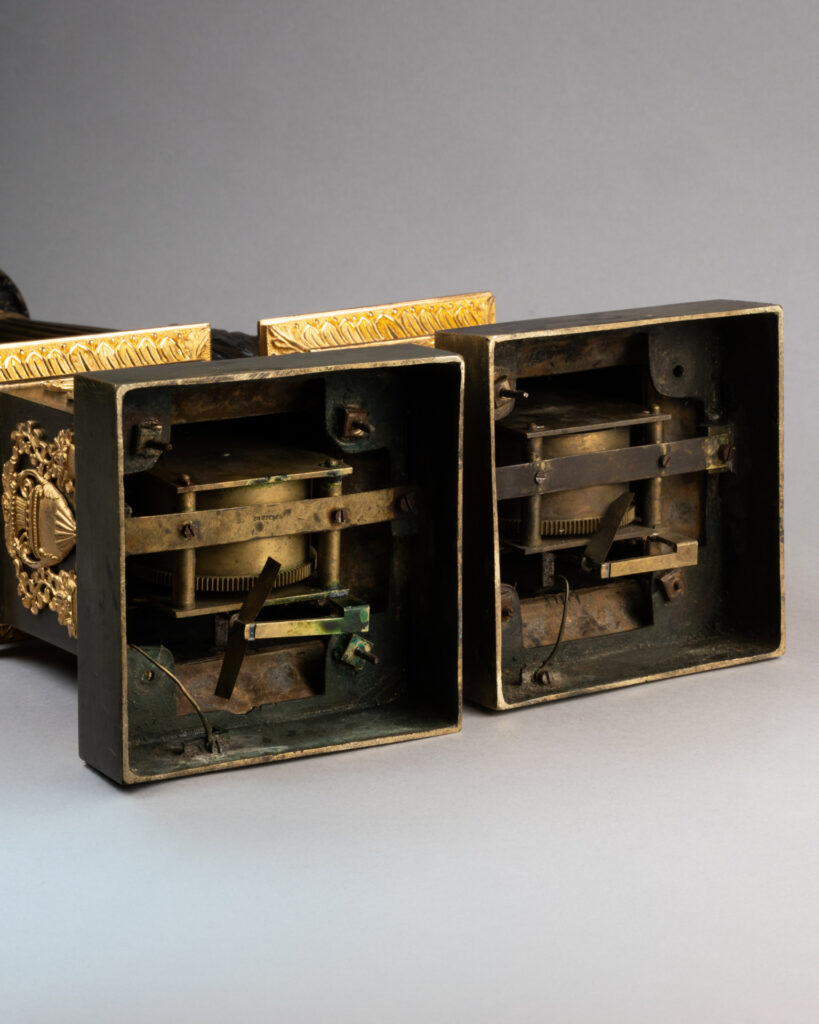
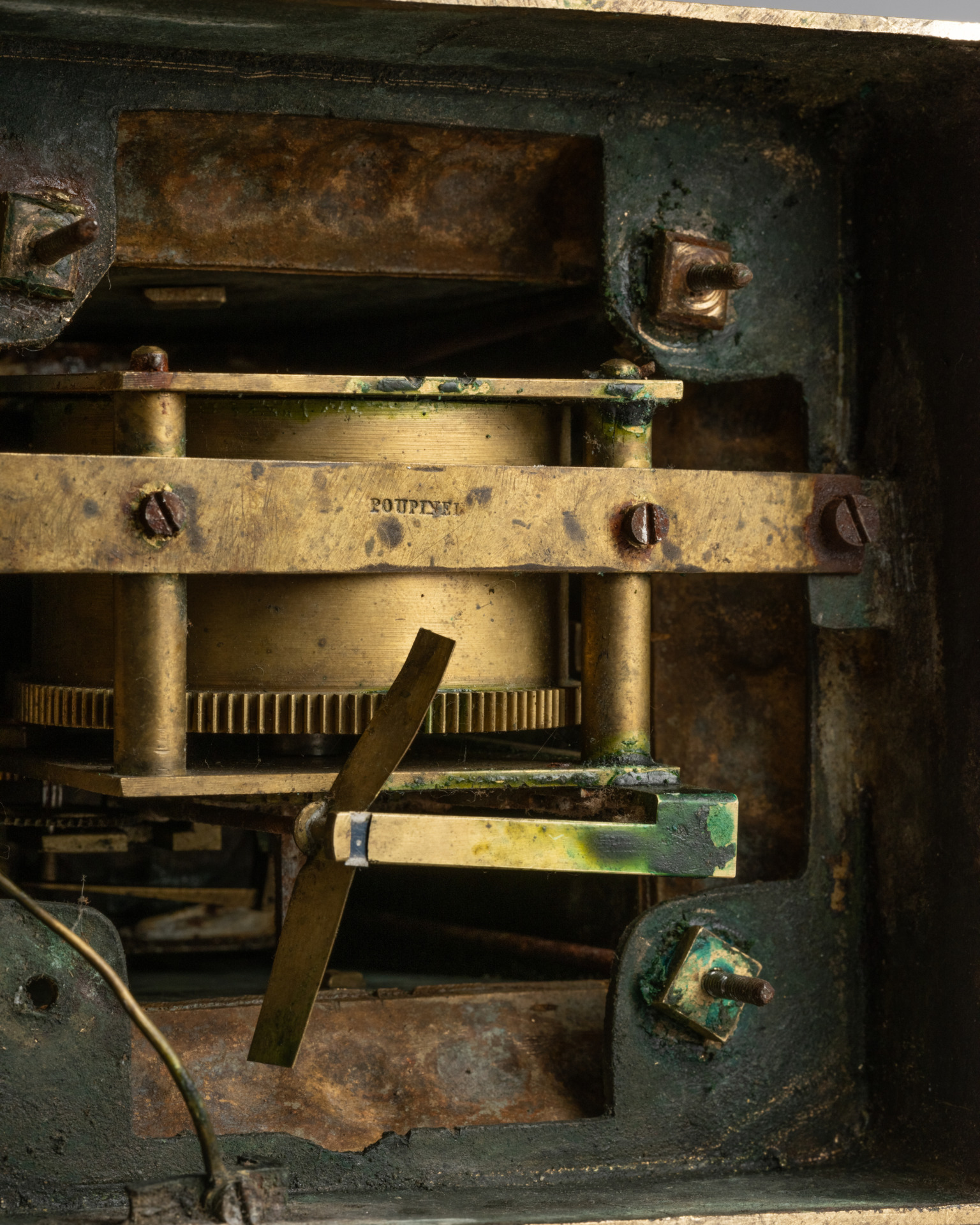
One of the two lamps bears, beneath its mechanism, the signature of François-Nicolas Poupinel, listed as a “maker of mechanical lamps, known as Carcel lamps, of elegant form” in the Almanach des commerçans, banquiers, négocians, manufacturiers, fabricans et artistes de la capitale of 1828. In 1842, Poupinel was granted a five-year patent for a type of piston lamp about which little is known — a system related to, though apparently distinct from, the Carcel lamps he had been manufacturing fifteen years earlier.
View of the mechanism and of the signature of François-Nicolas Poupinel.
The clockmaker Guillaume Carcel (1750–1812) had devised a lamp with a clockwork mechanism, patented in 1800 under the name “lampe Lycnomena.” The mechanism allowed oil to be continuously raised to the burner by means of a force pump driven by clockwork gearing. These lamps were costly, and met with little commercial success during their inventor’s lifetime. Carcel’s patent, however, having expired, the invention entered the public domain in 1816 and was thereafter freely adopted and refined, soon becoming a fixture of the grandest bourgeois interiors.
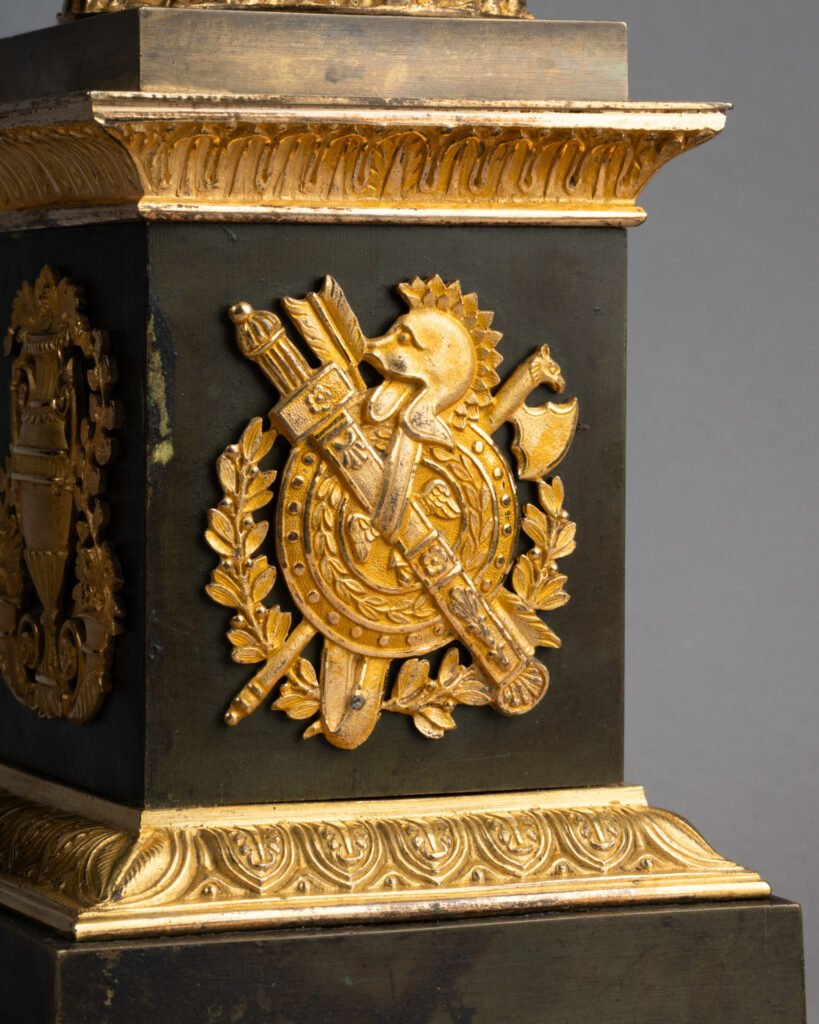
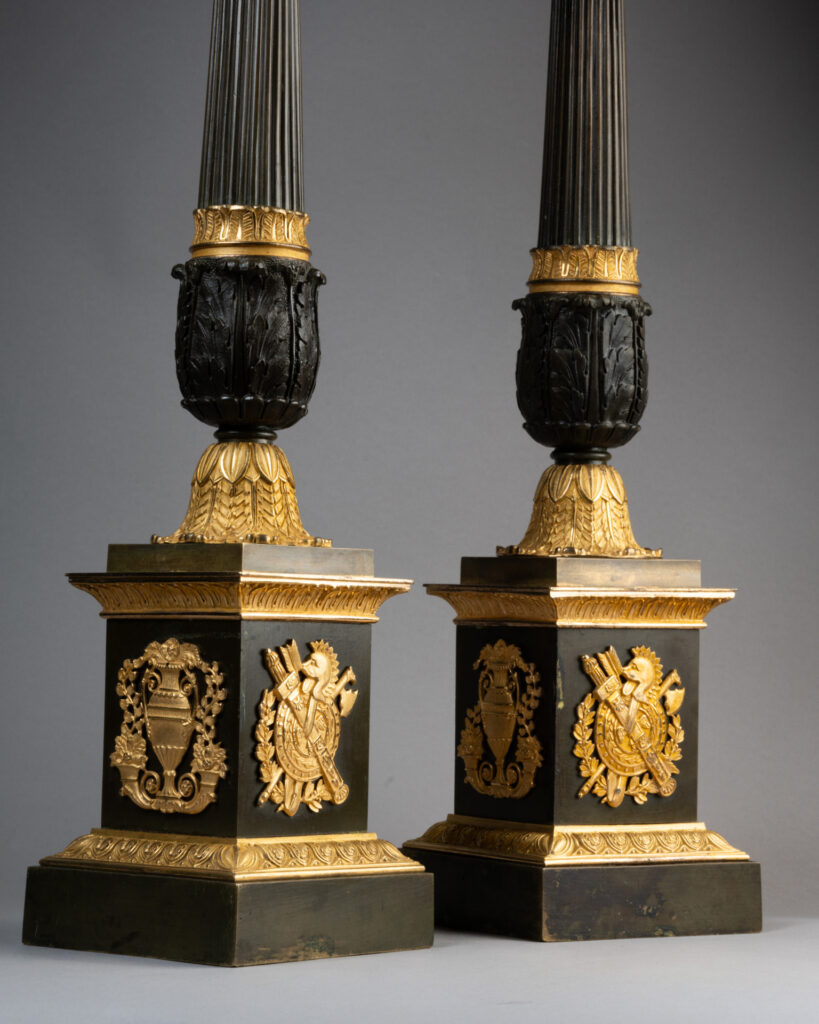
The year 1828, at which Poupinel appears in the Almanach, is consistent with these lamps’ ornements and casting. They display all the hallmarks of the Restoration style: their tall, lightly fluted columns, rising from a double base and crowned by foliate capitals, are partially gilt and patinated, and their bases adorned with elegant applied motifs of vases and trophies in gilt bronze. That the bronzes were chased in the manner shown here, that is worked with a mat à la pointe, speaks to the quality of finish expected of mechanical lamps in the first third of the 19th century.
The lamps do not appear to have undergone restoration but show some wear to the patina. Wear to the gilding is limited, though there are minor losses, notably to one of the applied vase motifs. The globes are old but may not original as they form a near-pair. The mechanism is in good condition but has not been activated.
Literature
See Deflandre, Répertoire du commerce de Paris, ou Almanach des commerçans, banquiers, négocians, manufacturiers, fabricans et artistes de la capitale, Paris, 1828; Catalogue des brevets d’invention, d’importation et de perfectionnement délivrés du 1er janvier 1828 au 31 décembre 1842, Paris, 1843; Figuier, Les Merveilles de la science ou Description populaire des inventions modernes, vol. IV, Paris, 1870.
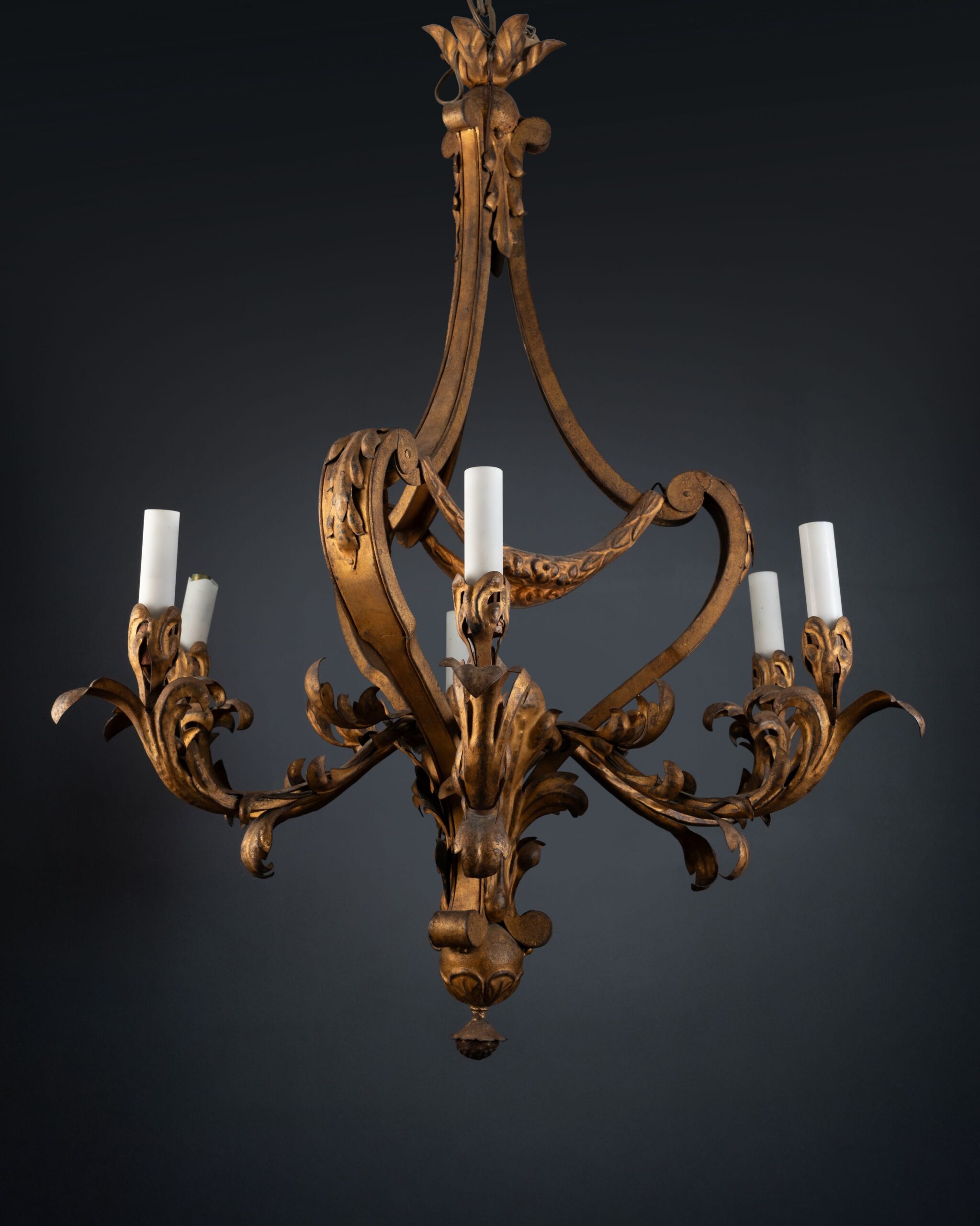
Regency Style Chandelier
Regency Style Chandelier
Gilded wrought iron (ferro battuto dorato) France or Italy Early 20th century 80 x 60 x 60 cm (31.5x 23.6 x 23.6 in.)
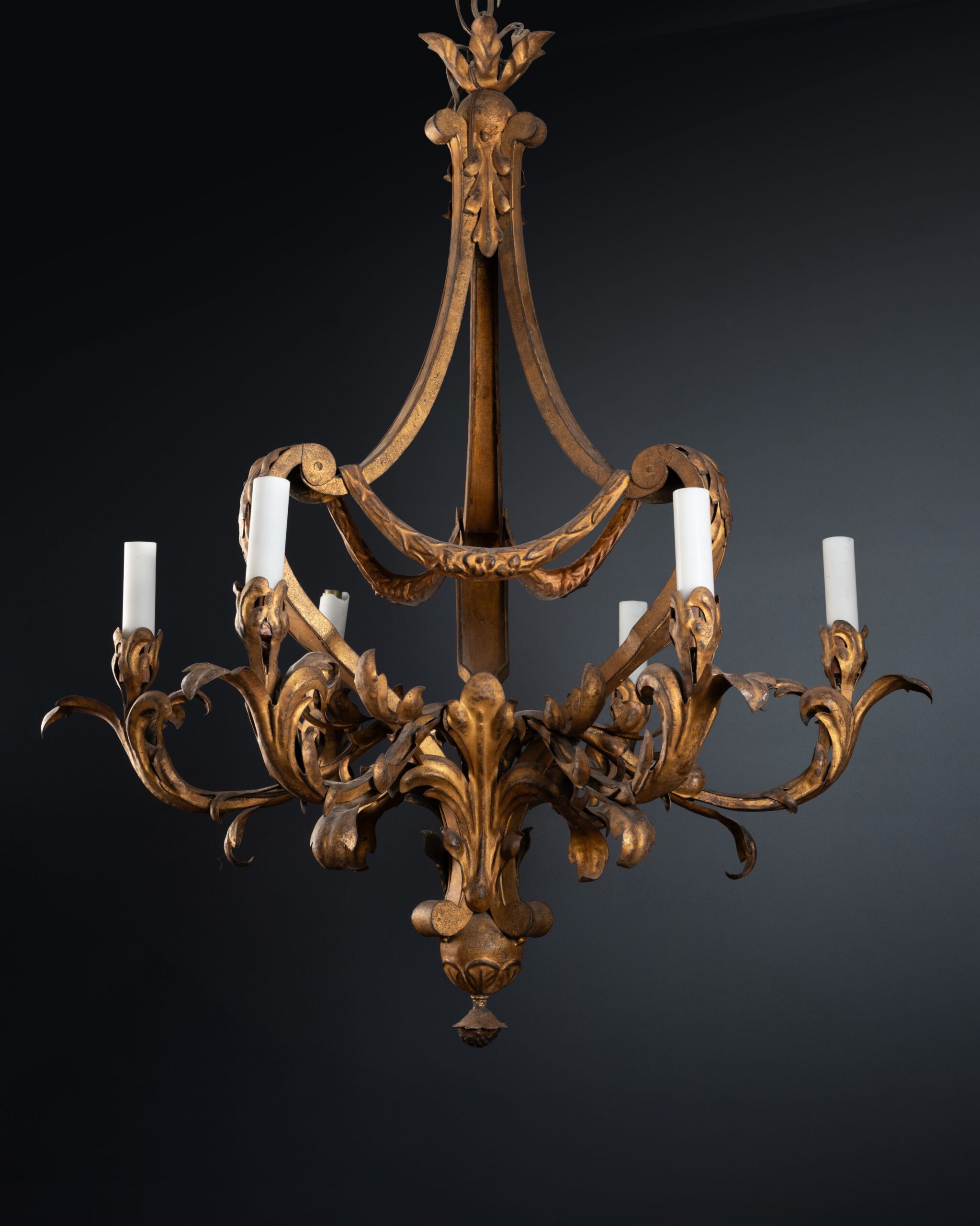
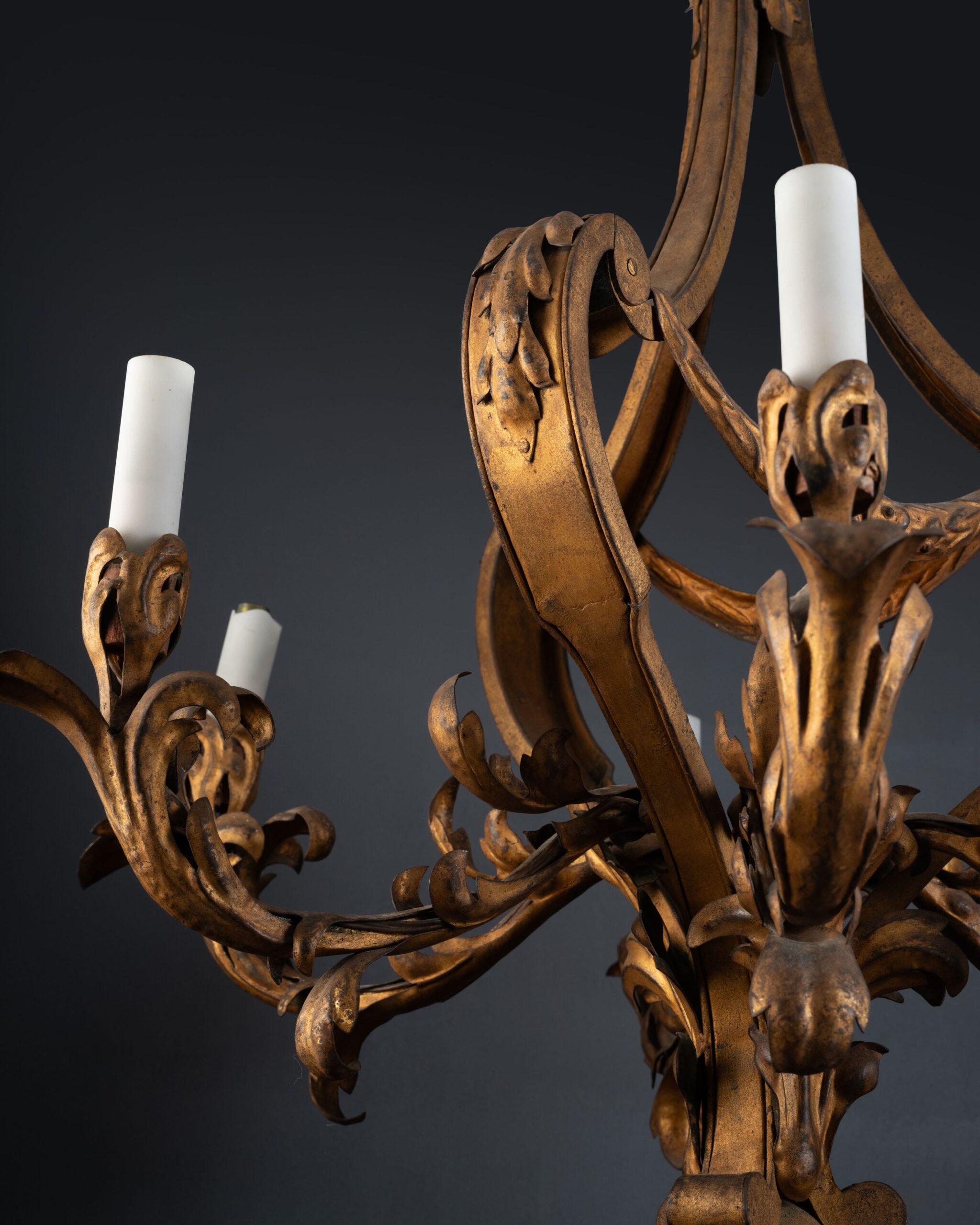
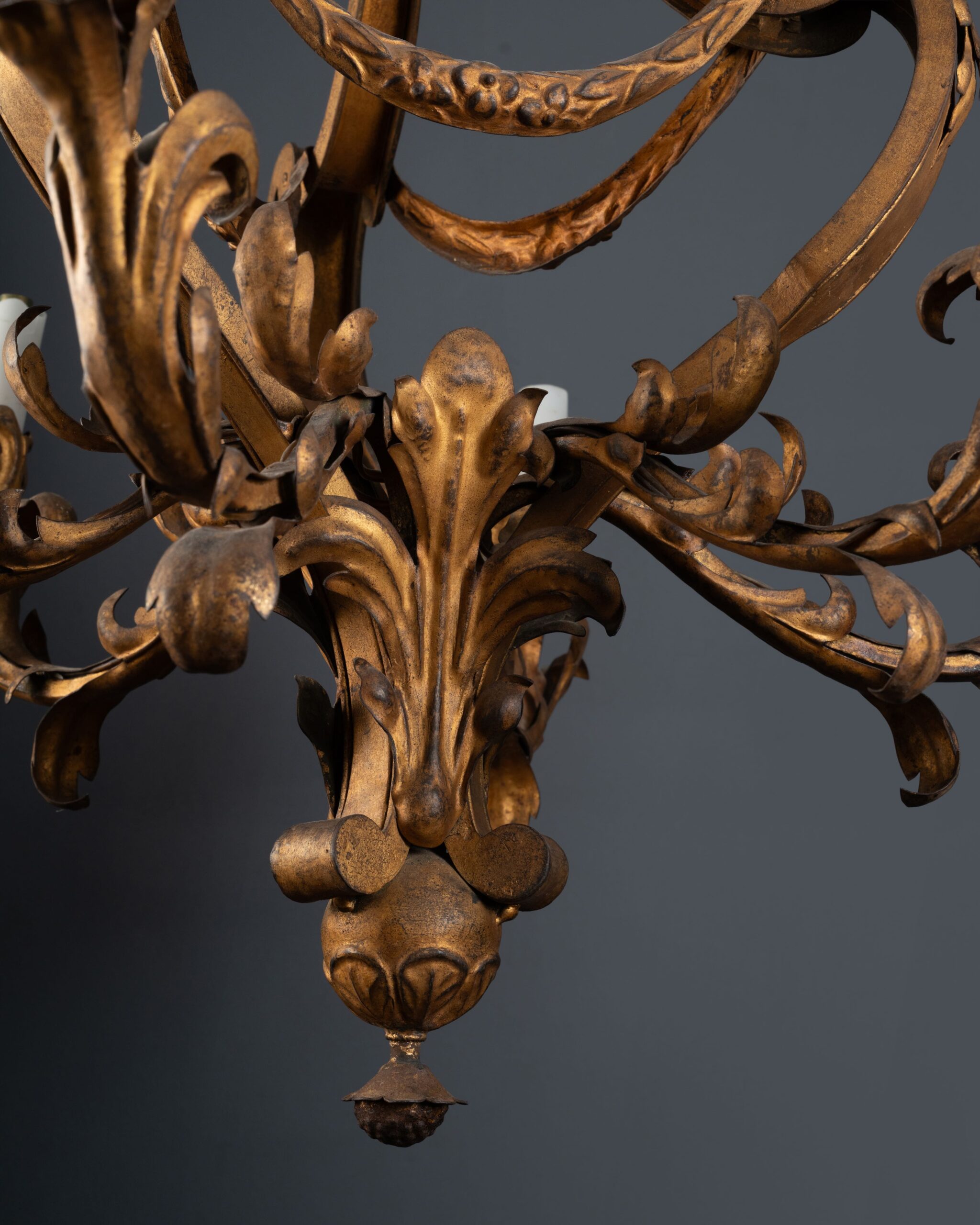
Six light chandelier in ferro battuto dorato, whose form and imposing scrolls draw on the inventions of Jean Bérain and the chandeliers of Charles-André Boulle, while blending them with naturalistic motifs — foliage and garlands, grape clusters and stylized fleurs-de-lys — typical of the following period and heralding the rocaille chandeliers of Philippe and Jacques Caffiéri.
This chandelier, a work of the early 20th century, was conceived for electricity, the bobèches and light arms concealing the wiring. It retains its characteristic “aged gold” appearance, typical of the gilt wrought-iron technique.
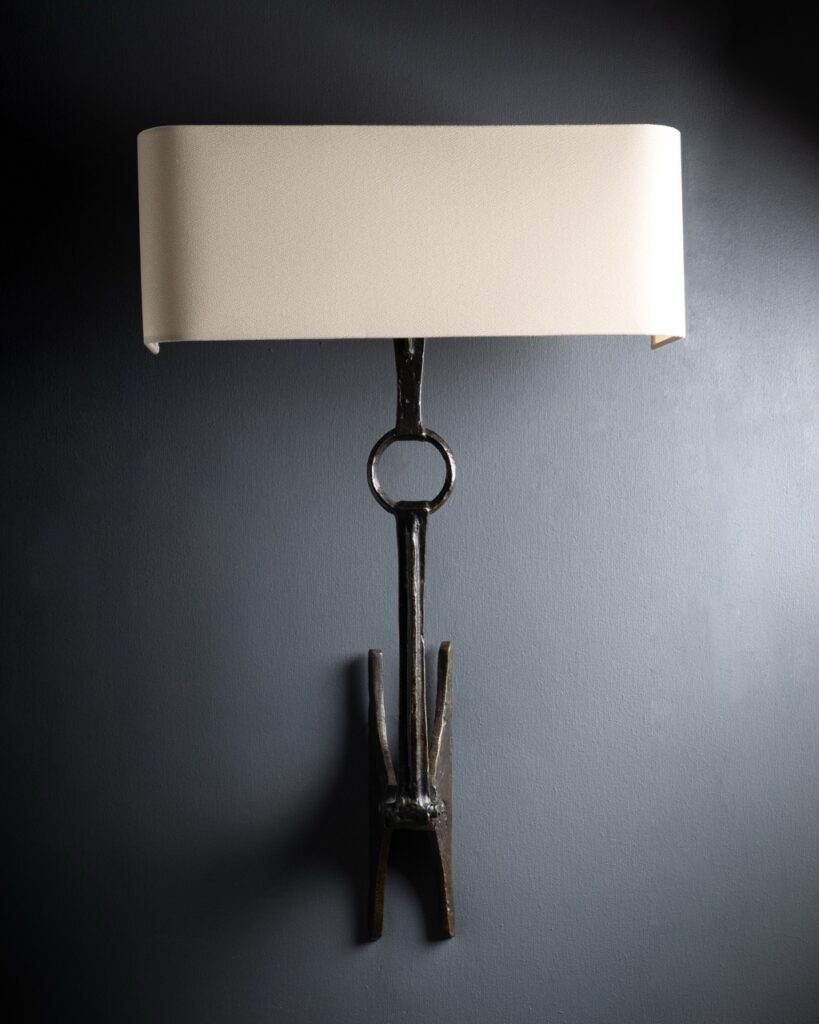
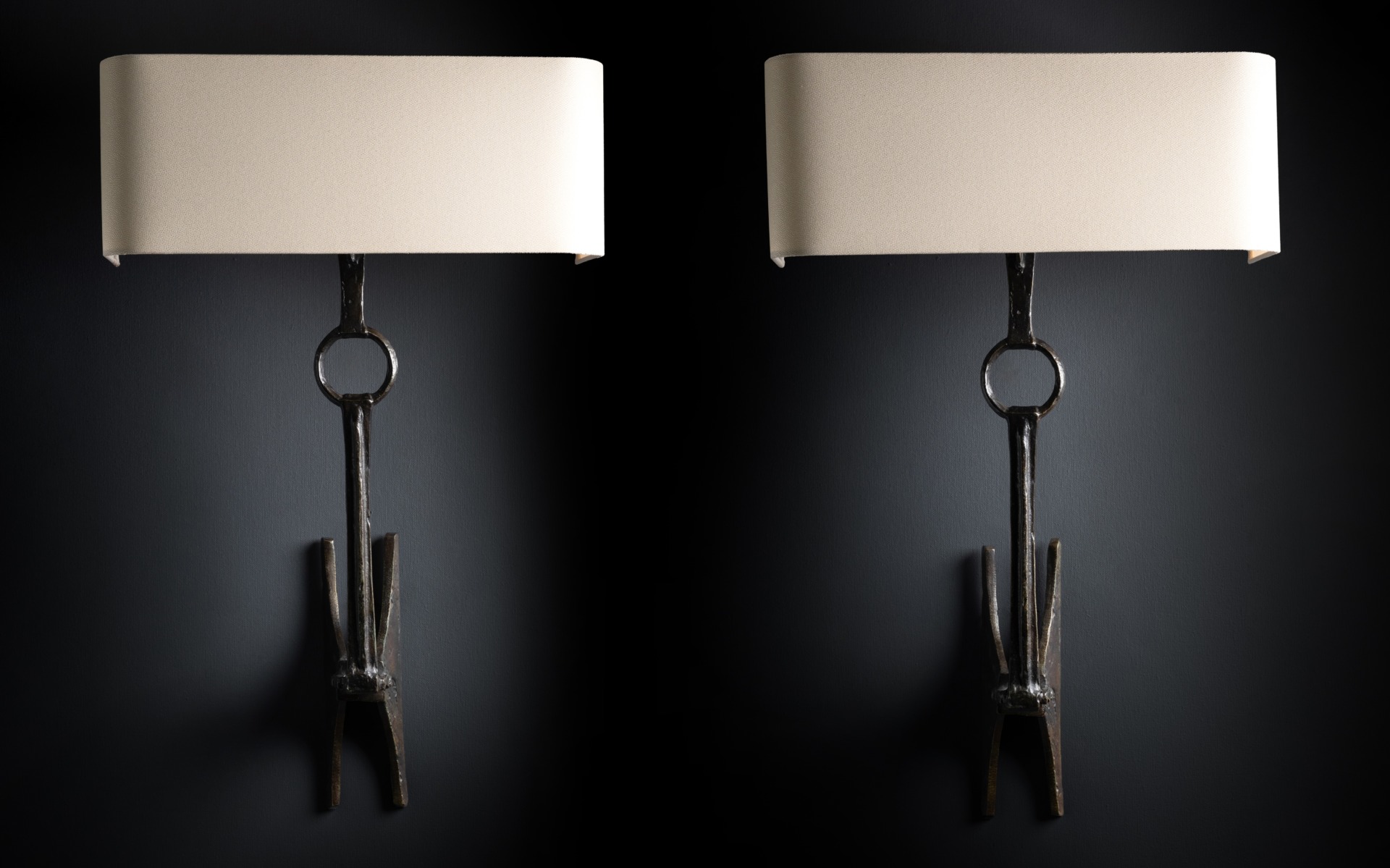
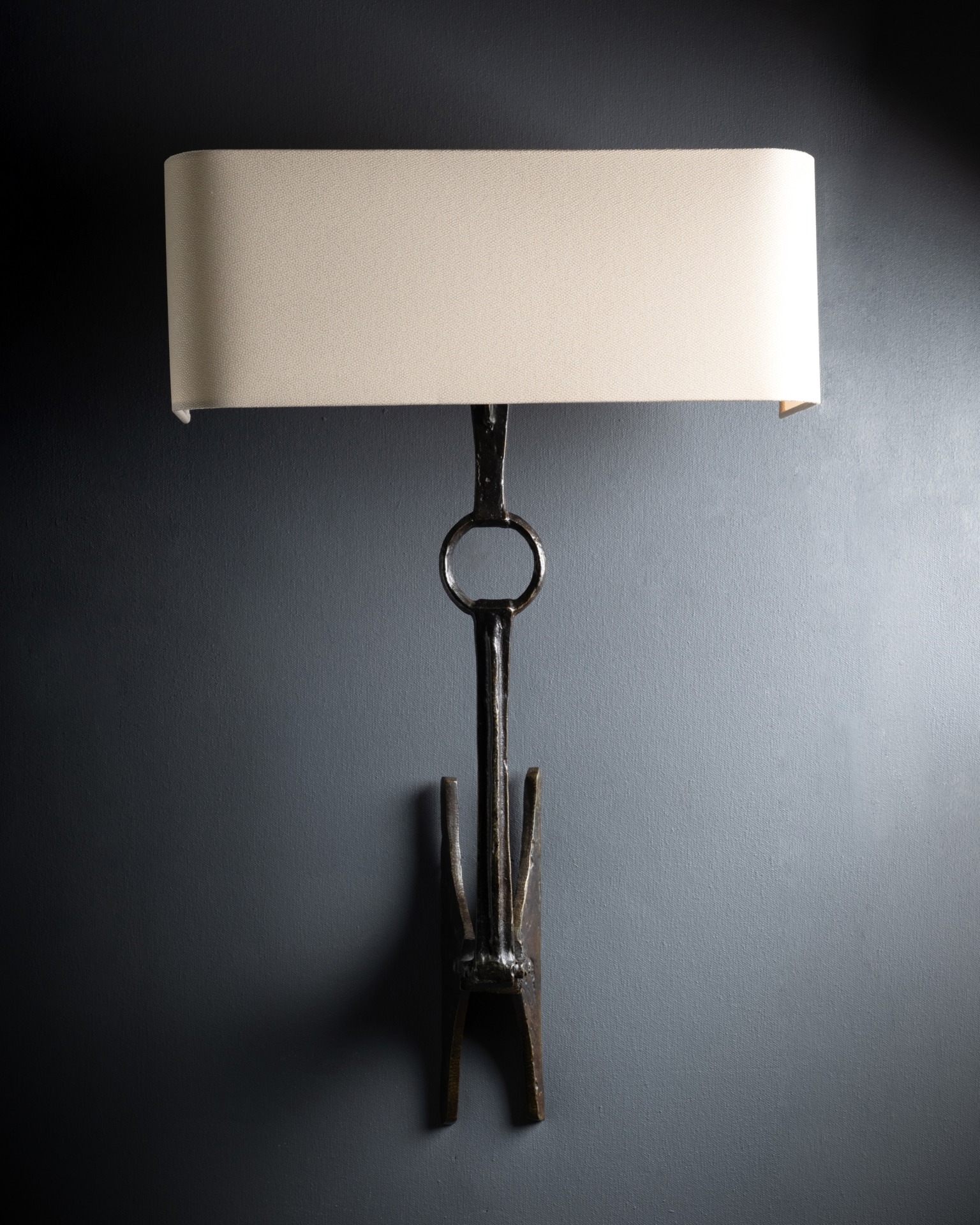
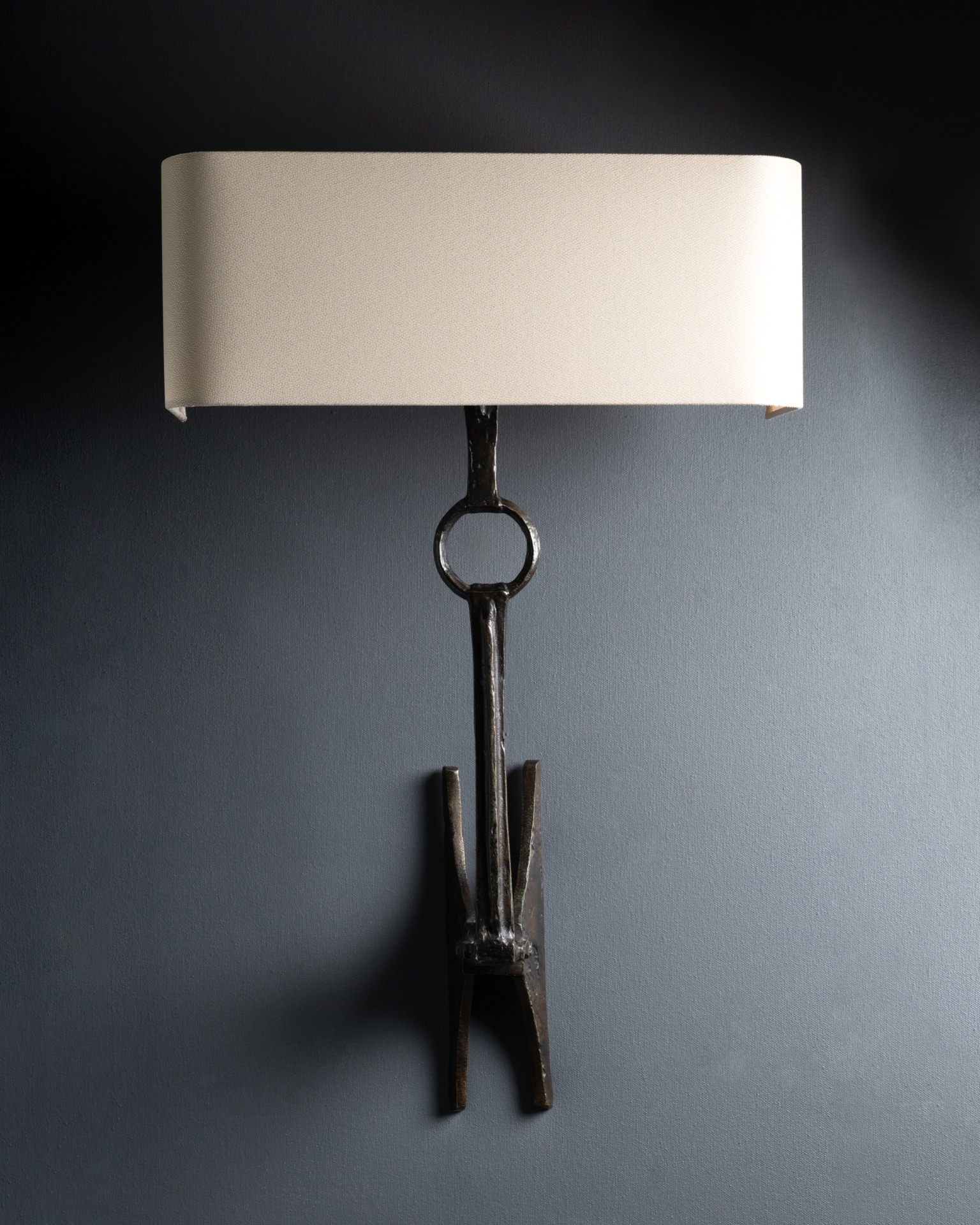
Pair of ‘Stirrups’ bronze wall-lights, by Félix Agostini
Pair of ‘Stirrups’ bronze wall-lights, by Félix Agostini
Bronze, fabric with ‘shagreen’ pattern France 1960s 68 x 40,5 cm (26.8 x 15.9 in.)
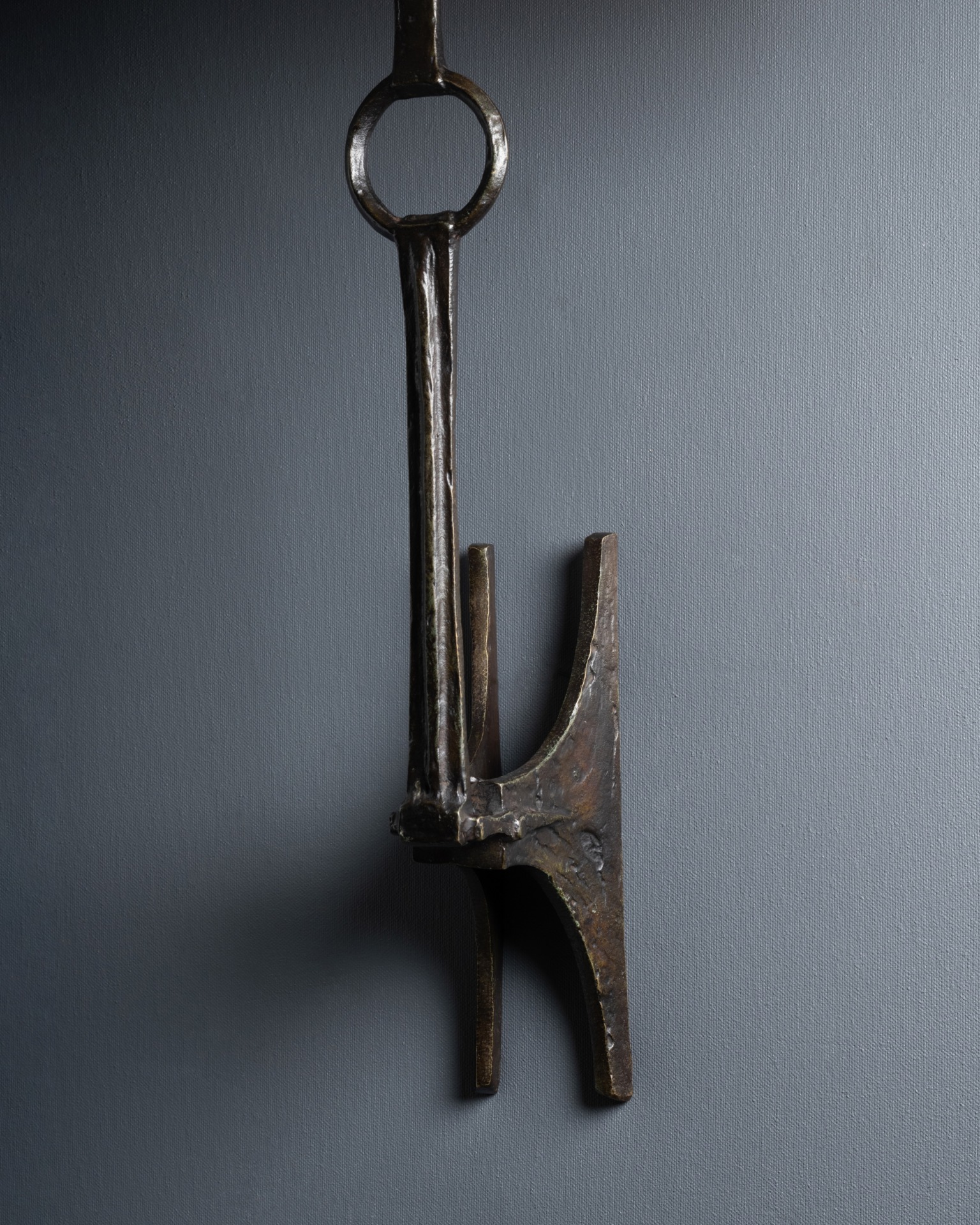
This pair of stirrup-shaped, ‘Étriers’ wall lights — with the base of the stirrup mounted to the wall and the leather strap forming the shaft — sometimes also referred to as caryatid lights, is fitted with custom-made fabric lampshades crafted by the Abats-jour Agostini workshop, following the original models.
Félix Agostini, born in 1910 in Paris into a family of Corsican artisans, was a French designer and sculptor known for lighting pieces blending classical elegance with an avant-gardiste creativity. From a young age, he displayed a keen interest in craftsmanship and aesthetics — a talent that propelled him to become one of the leading figures of Postwar French design.
Trained at the École des Beaux-Arts in Paris, Agostini began his career as a sculptor before dedicating himself to lighting design. His early creations, influenced by Art Deco and the modernist style, reveal a preference for organic forms and noble materials such as bronze and brass. During the 1950s and 1960s, he entered a prolific creative period, producing visually striking wall-lights and table lamps. These pieces, with their pure lines and vivid motifs, are not unlike those of Agostini’s illustrious rival Diego Giacometti.
Set of four three-light wall sconces in gilt bronze
Set of four three-light wall sconces in gilt bronze.
Gilt bronze France 40 x 45 x 30 cm (15.7 x 17.7 x 11.8 in.)
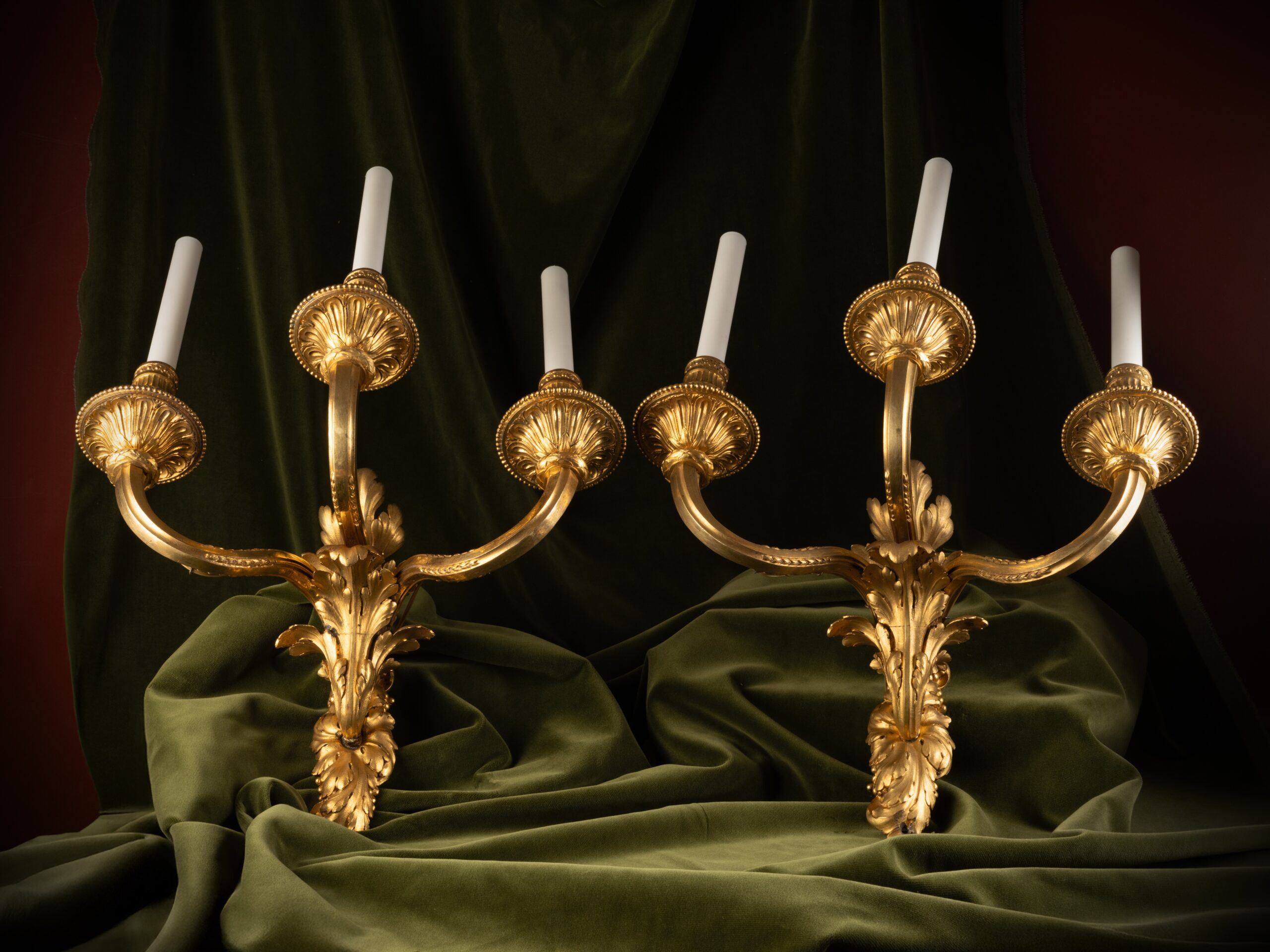
The design of this set appears to be inspired by forms widely disseminated by the ornemaniste Charles Delafosse toward the end of Louis XV’s reign. Though undoubtedly later in date, these sconces exhibit the ornamental and at times contradictory elements that are hallmarks of the goût grec (Greek taste), a style Delafosse himself helped to popularize.
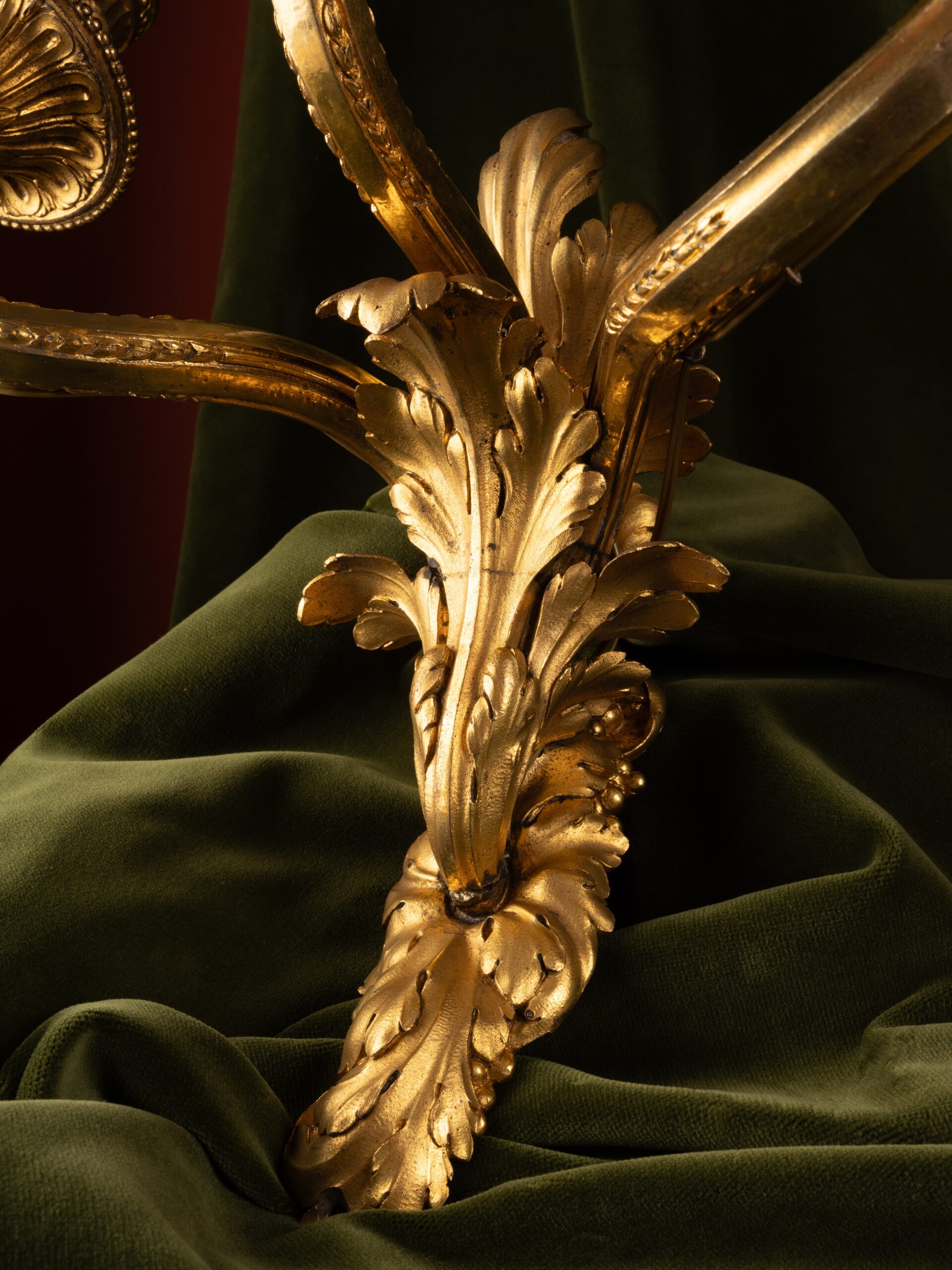
This stylistic synthesis is evident throughout the composition. The central stem of each sconce is garnished with luxuriant acanthus leaves — the so-called ‘acanthe qui panache’ (pluming acanthus) noted in the inventories of the Garde-Meuble de la Couronne — which are a frequent motif in the furniture mounts of the Louis XV period. In contrast, the three light arms emerging from this foliage are sober in design, terminating in wide drip-pans embellished with garlands and gadrooning, motifs that would become typical of the Louis XVI style.
The composition is itself a testament to the so-called Transition style, which formed a bridge between the Rococo extravagance of the Louis XV era and the more architectonic forms of the Neoclassical Louis XVI style. Indeed, to borrow a term from the historiography devoted to late 18th century furniture, the design can be understood as a form of rocaille symétrisé (symmetrized Rococo) : the backplate’s finial, still clearly indebted to the Louis XV style, is asymmetrical (with the sconces conceived as opposing pairs), while the remainder of the composition is strictly ordered, creating a strong symmetry around the central stem. This stands in stark contrast to the fluid, almost invariably asymmetrical light arms of the high Rococo period, such as those designed by Meissonnier, Pineau, or Caffiéri.
The fire-gilding and finishing are of the highest order, and the chasing of the guilloché-patterned nozzles rivals that seen on the most exceptional examples from the 18th century.
The wall lights were adapted and drilled for electricity at the end of the 19th century, but their assembly shows that they were not originally designed for this purpose.
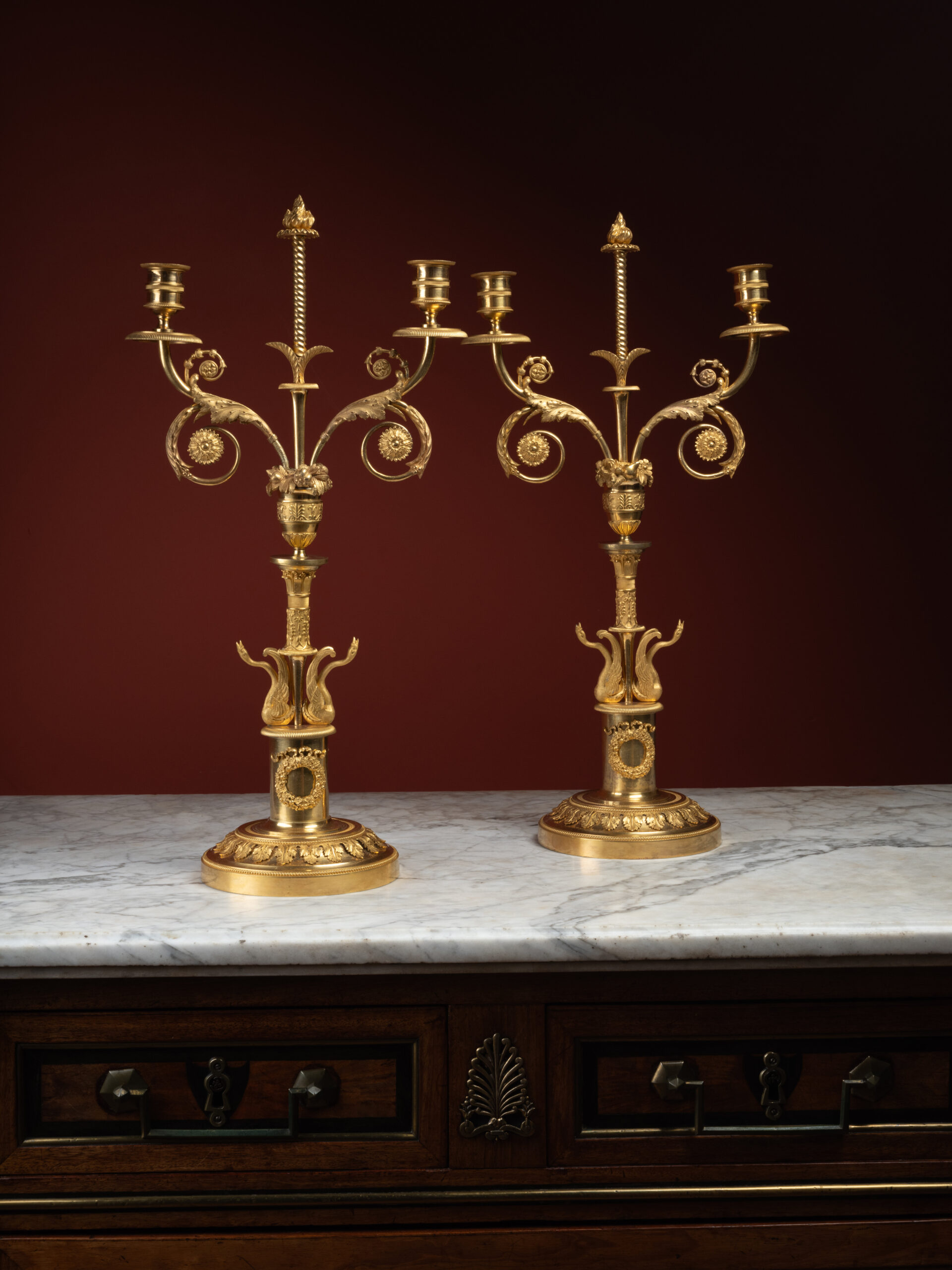
19th Century Russian Candelabra with Swan-like Figures
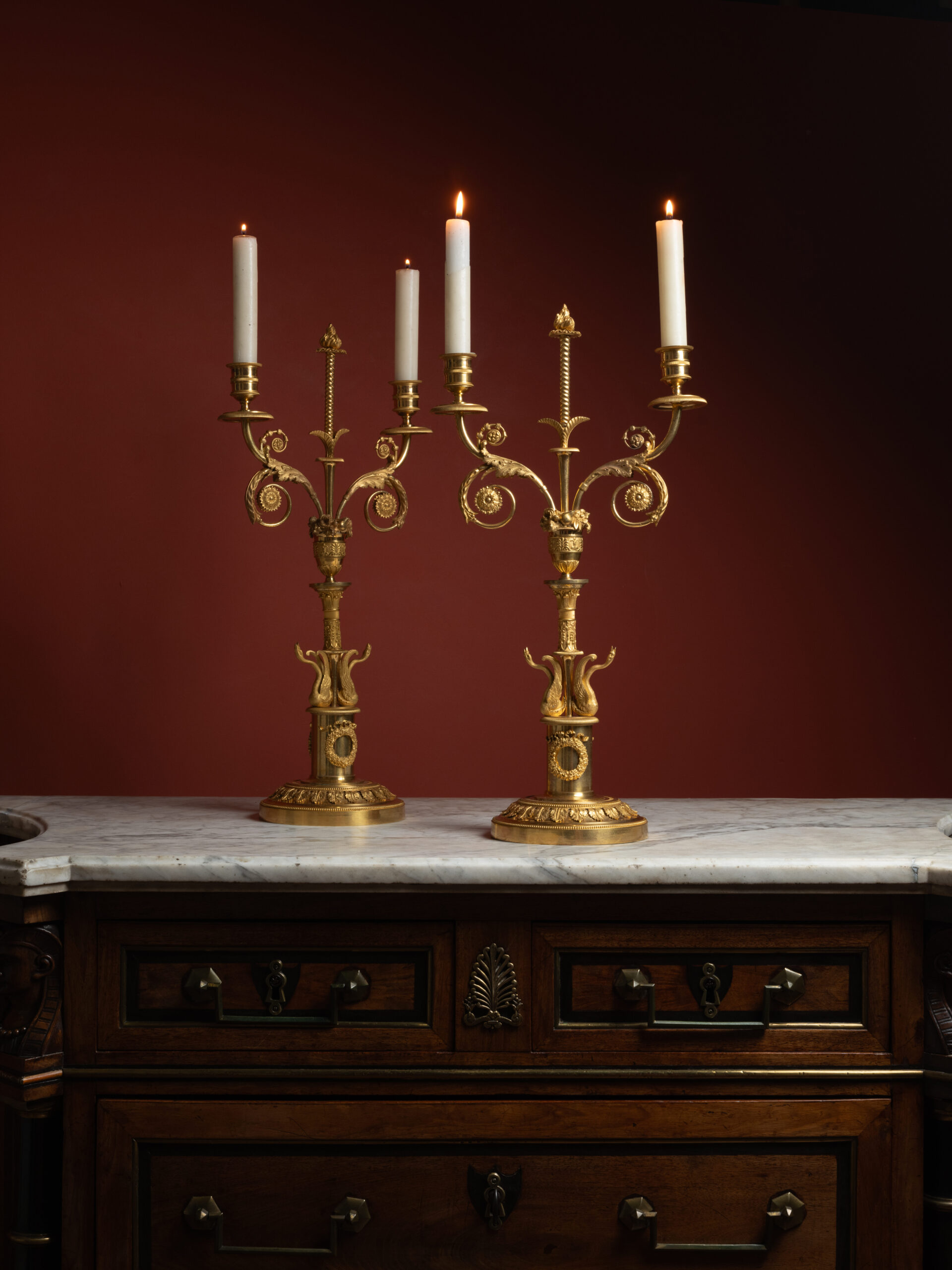
Candelabra-candlesticks with coupled swan figures.
Gilt bronze Russia Early 19th century h. 48 cm (h. 18.9 in.)
This impressively chased pair of two-lights candelabra is most likely Russian work, related to some pieces designed by Giacomo Quarenghi for the Imperial Manufactory of Saint Petersburg, at the end of the 18th century.
The production of gilt-bronze decorative arts, in early 19th-century Russia, relied largely on French and German artisans, who had been invited to Russia in the latter half of the previous century. This historical fact explains two notable tendencies in many Russian productions of the time : an exceptionally rich ornamental composition, that date back to 18th-century Italy, and a high level of skills in the gilding and chasing of the bronze, brought to Russia by French bronzemiths and German goldsmiths, some of which have been recorded, such as Schreiber, Baumann, and Bergenfeld.
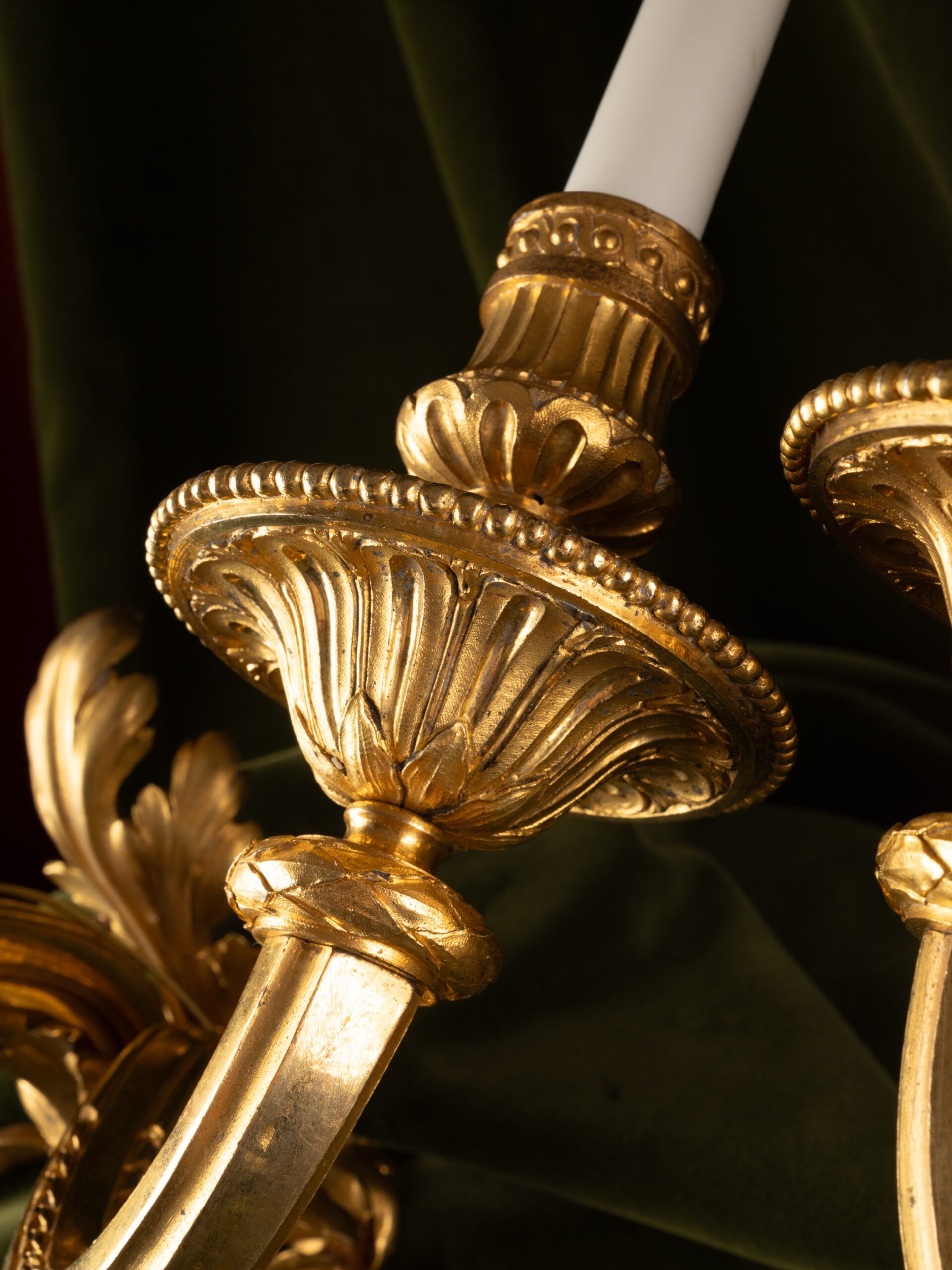
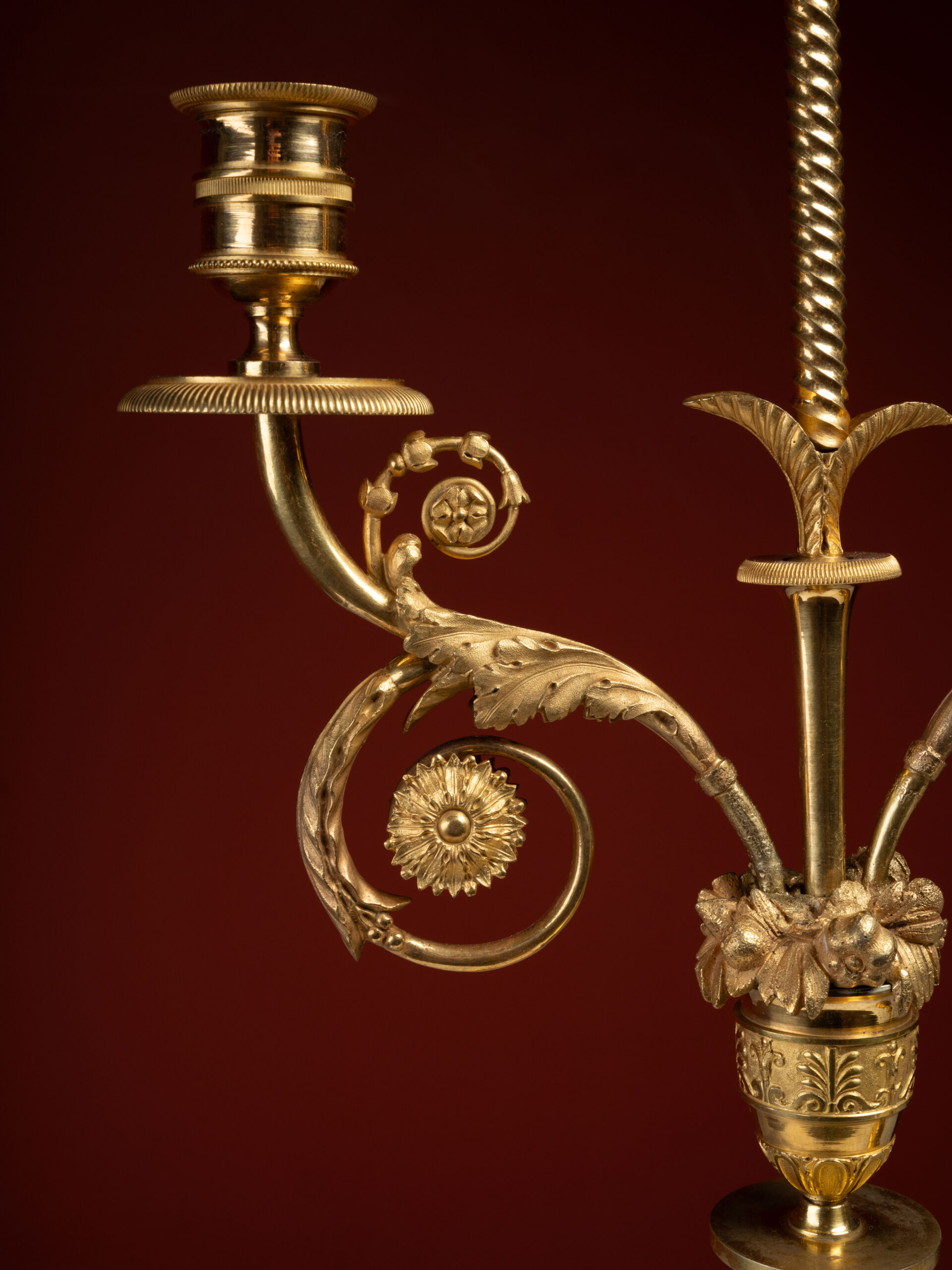
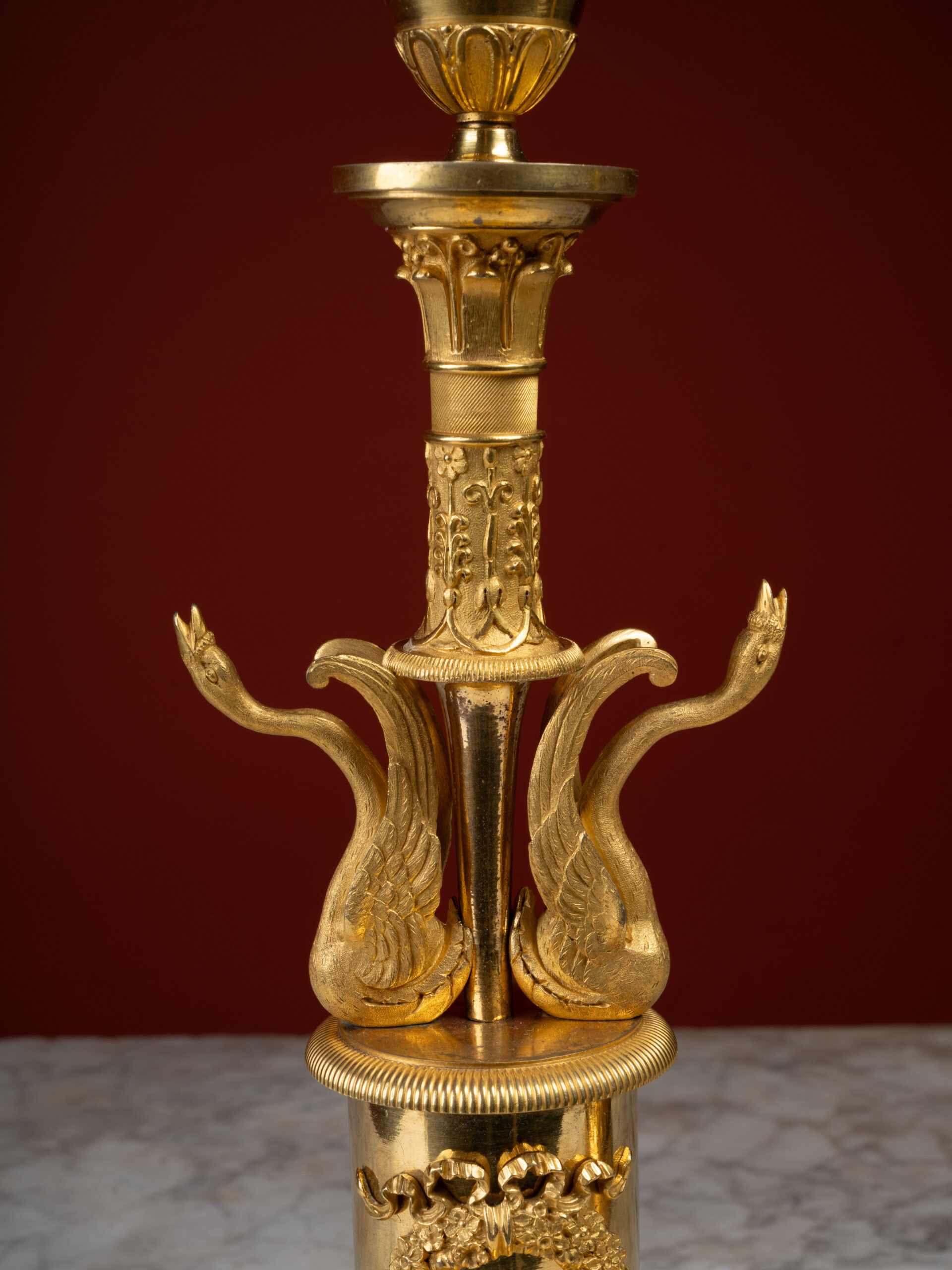
This quality, at the verge of goldsmithing, is evident in the chiseling of these candelabra, particularly in the wings of the swans, whose iconography dominates both French decorative arts under the Empire and those of Imperial Russia. Notable too, the finely modeled and matte-finished acanthus leaves, mounted to, and not cast with, the candelabra’s base. Other elements, such as the ribboned flower wreaths, mounted too, along with the scrolling light arms decorated with acanthus leaves, and the flower and fruit vases, further align these candelabra with the productions of the Saint Petersburg manufactory, the most prestigious works of which had been designed by Italian artists invited to Russia, such as architects Carlo Rossi and Giacomo Quarenghi.
Despite iconographic similarities, the stylistic and ornamental differences between early 19th-century French and Russian gilt bronzes stem from the embargo imposed under Tsar Alexander I on French bronzes. With few French art items in the new style available in Russia at the time, Russian collectors eager to decorate their interiors with pieces in the latest style had to rely on designers based in Russia, often of Italian origin. As a result, the French Empire style, which was spreading across Europe, was reinterpreted due to the relative isolation of Russian artisans. These craftsmen created what became known as the “Russian Empire” style, blending the French Empire’s classical and Egyptomania-inspired iconography with a lavish ornamental richness of Italian origin.
This pair of candelabra also doubles as torches : the vase of flowers and fruit that tops the shaft and from which the light arms emerge is in fact a nozzle.
Literature
Igor Sychev, The Russian Chandeliers 1760-1830, Moscow, 2003 ; Igor Sychev, Russian bronze, Moscow, 2003.