Tall Candlesticks with ram-heads, Russian Empire period
A Pair of Tall, Ram-Headed Ormolu Candlesticks
Ormolu. Russia. ca. 1810-1820. 33 cm (h. 13 in.)
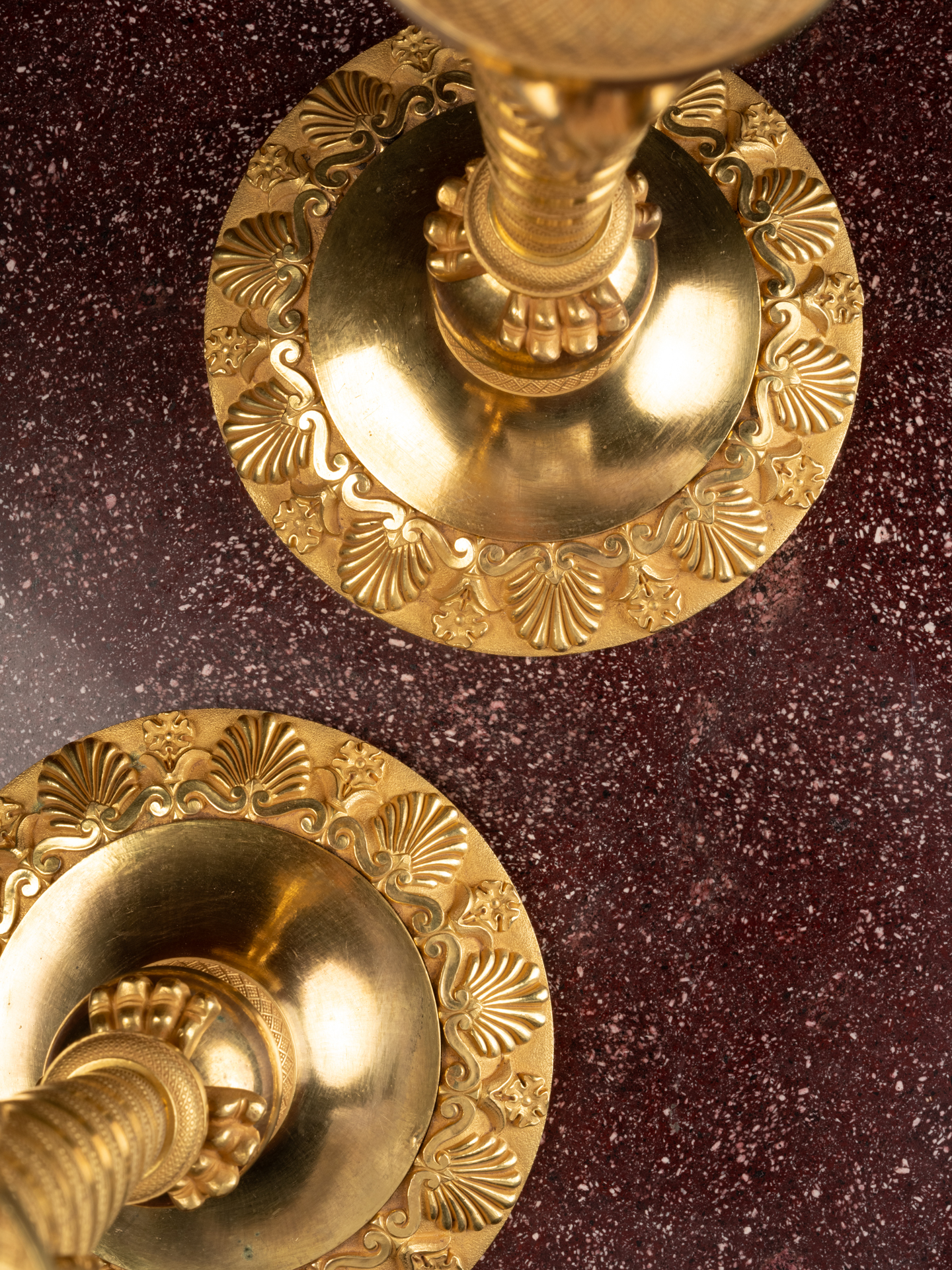
These candlesticks are part of a group of decorative bronzes associated with Moscow productions from the early 19th century. An identical pair is located at Arkhangelskoye, near Moscow, in the Prince’s Study, decorated between 1810 and 1820 with a suite of Karelian birch furniture adorned with ormolu mounts.
A nearly identical pair of candlesticks was part of Sir Richard Wallace’s collection at Hertford House. Through Jacques Seligmann, it was acquired by Mrs. Henry Walters and subsequently sold at Parke-Bernet Galleries in New York from April 30 to May 3, 1941, where the design was attributed to Gouthière. More recently, a set of four nearly identical candlesticks was sold from the Nelson Grimaldi Seabra collection at Christie’s in New York on October 22, 2003, for $74,090. Even more recently, an identical pair — except for the engraved motifs around the drip pans, which are less refined — was sold for $8,820 at Christie’s (New York, April 17, 2024).
Literature
Valery Rapoport, Arkhangelskoye, Saint-Petersburg, 1984 ; Igor Sychev, The Russian Chandeliers 1760-1830, Moscou, 2003.
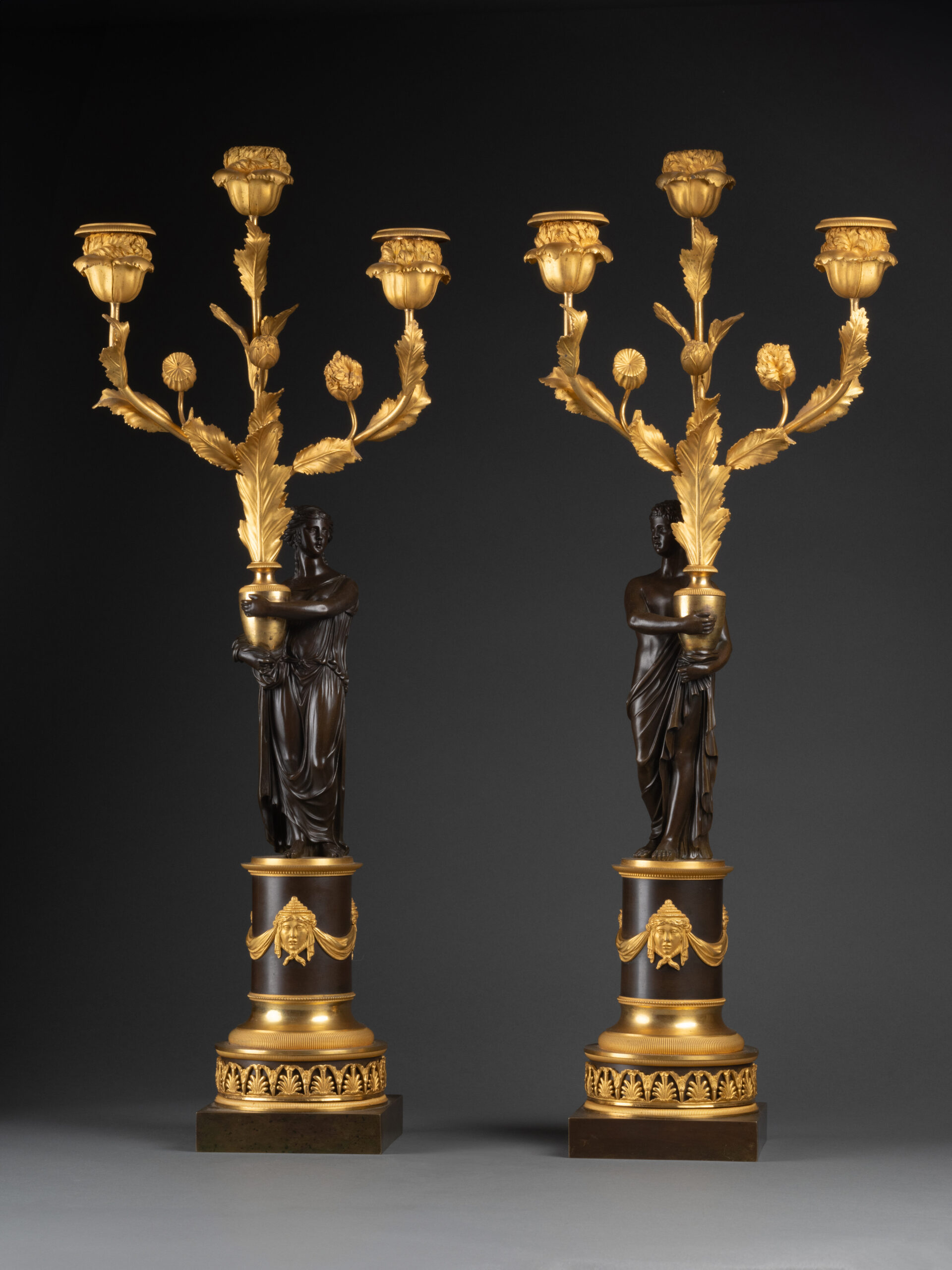
A Pair of Directoire Candelabra with Poppy Flowers
A Pair of Directoire Candelabra with Poppy Flowers
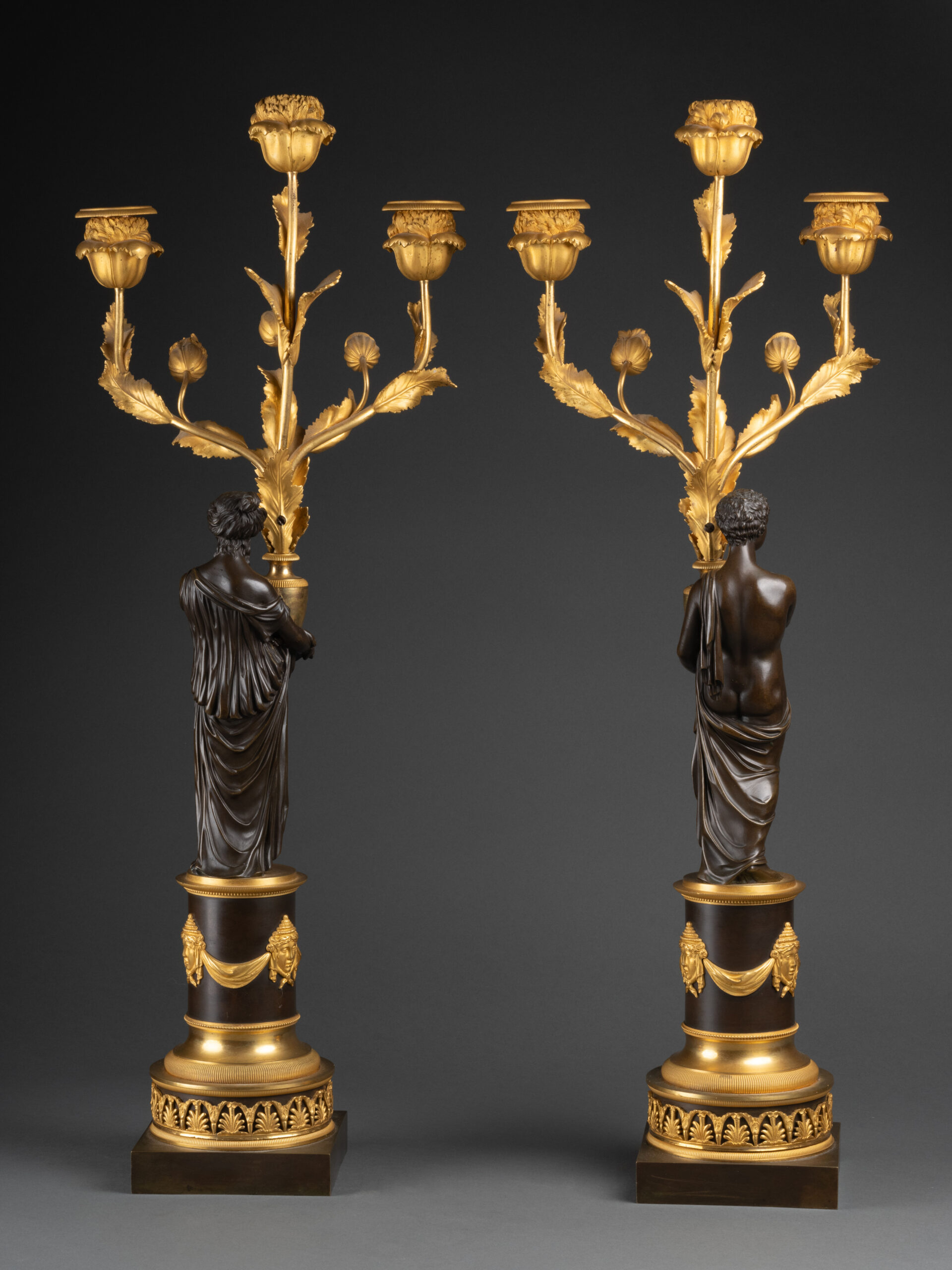
Gilt and patinated chased bronze France ca. 1795 h. 65 cm (25.6 in.)
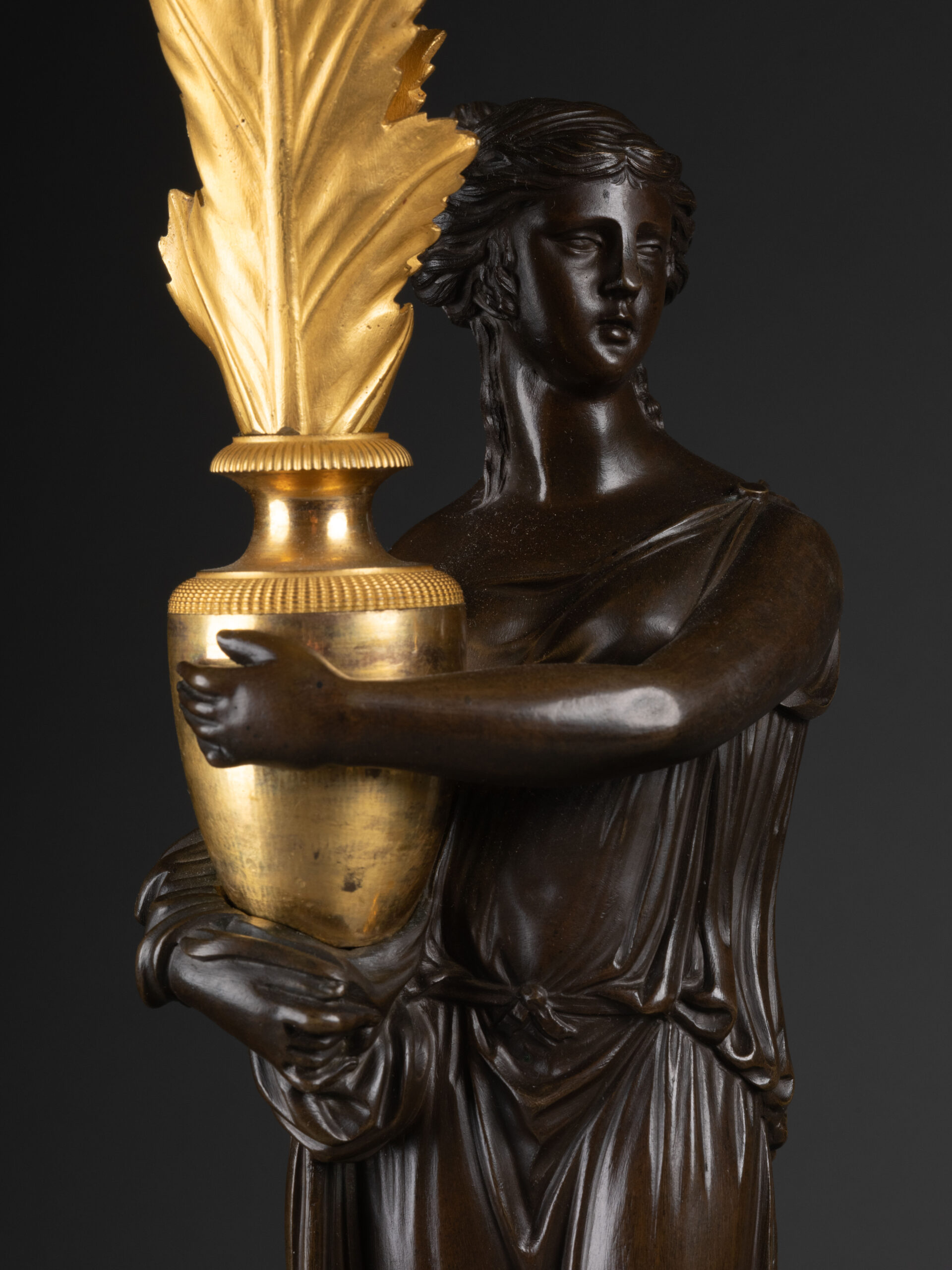
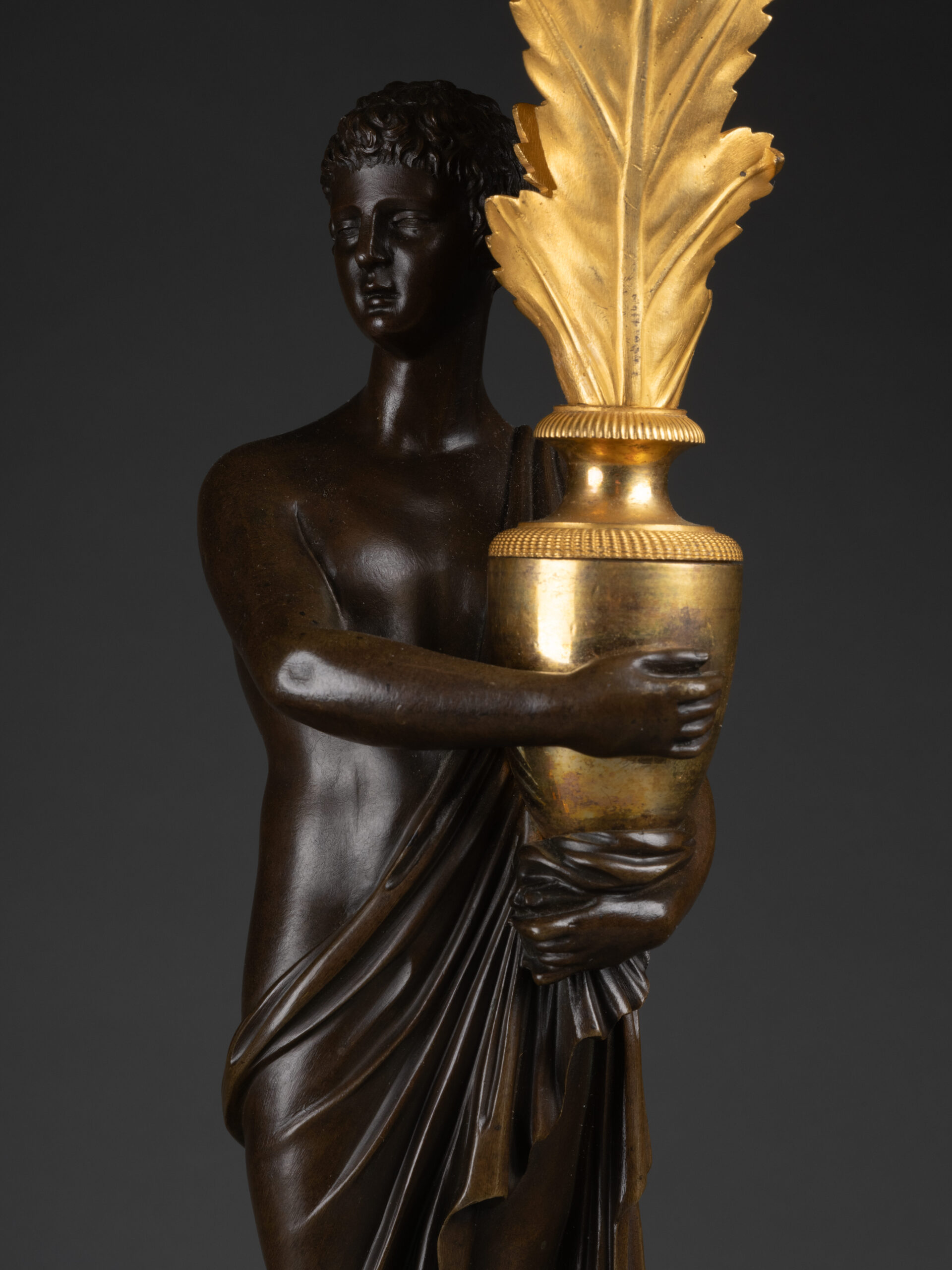
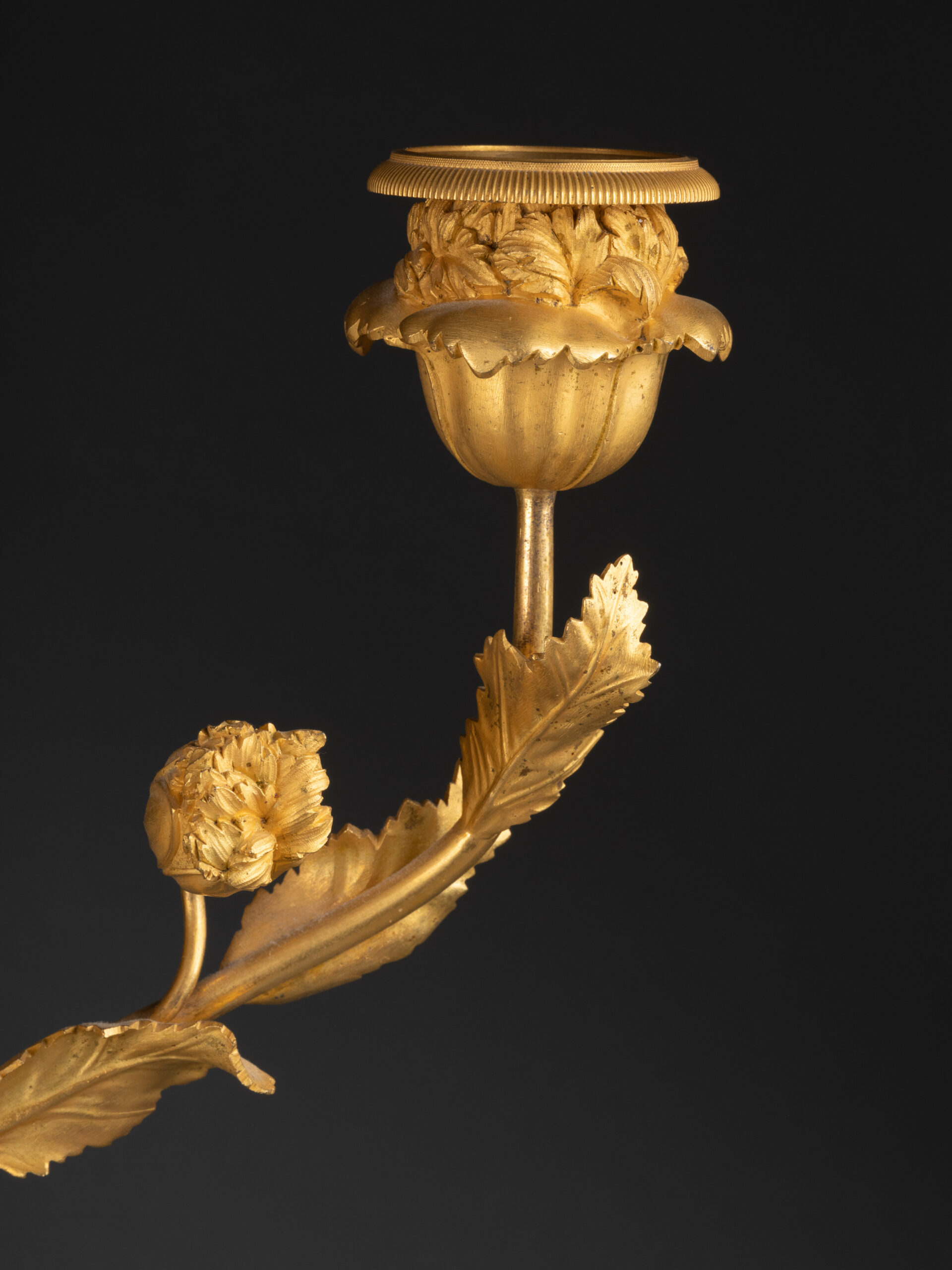
Executed in chased bronze, gilt and patinated, each candelabrum sets upon a cylindrical base worked with palmettes, masks and drapery — a figure in Antique dress, the two forming a couple, who lifts a vase from which the three light-arms spring, wound with acanthus and poppies.
Two comparable pairs of this model were recorded in the French Mobilier National in 1911—one at the Palais de l’Élysée, the other at the Hôtel de la Marine, then the Ministry of the Navy—though neither matches the present pair in scale, which rises to 65 cm against the 50,5 cm of the Élysée version.
Pairs of this scale have twice reached the market in the present century: one at Sotheby’s on 28 November 2006, for £24,000; the other at Koller on 21 September 2006, for 16,000 Swiss francs.
Literature
Ernest Dumonthier, Les Bronzes du mobilier national, t. II, Paris, 1911.
A Pair of Bronze Candelabra with Dancing Bacchantes
A Pair of Bronze Candelabra with Dancing Bacchantes
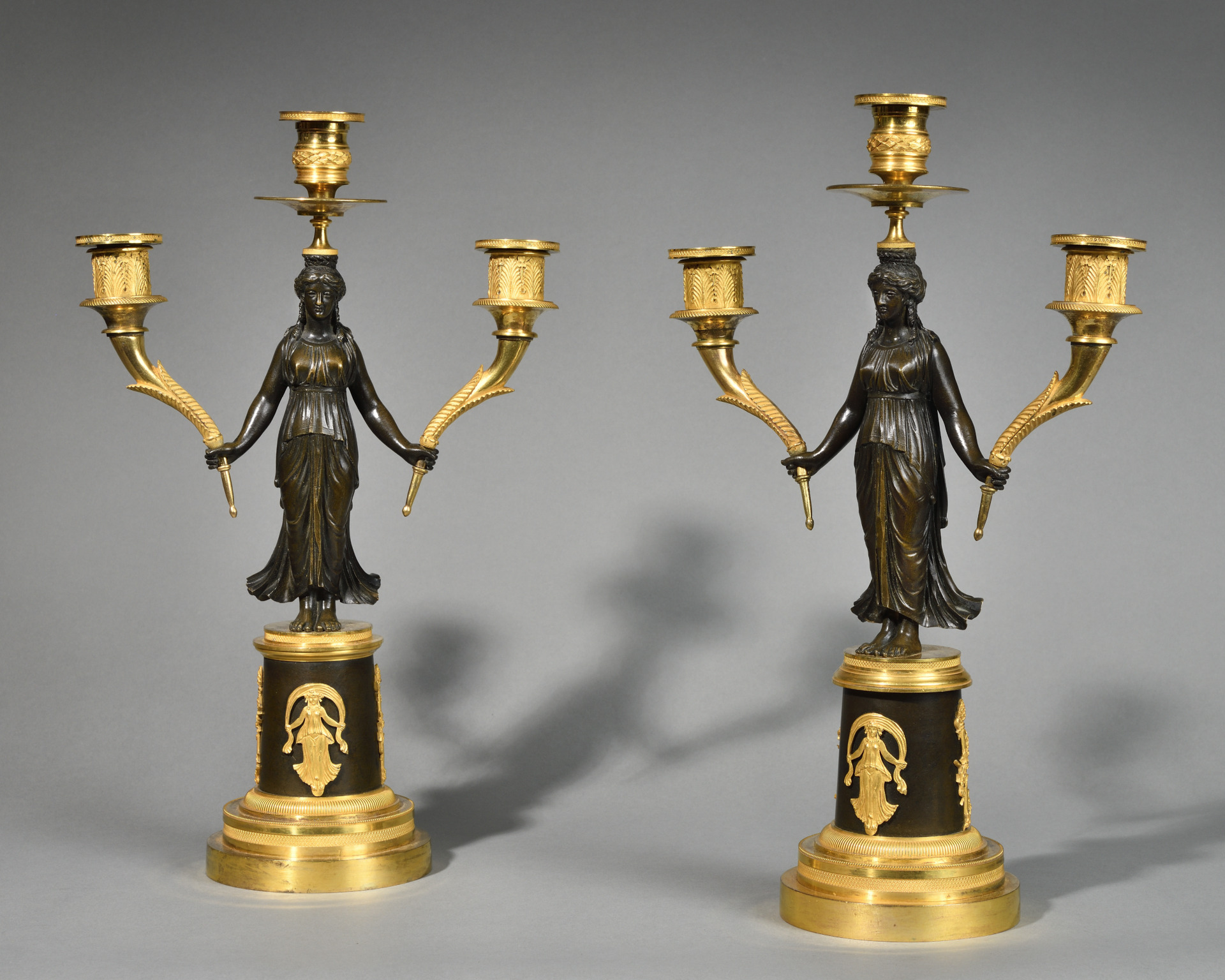
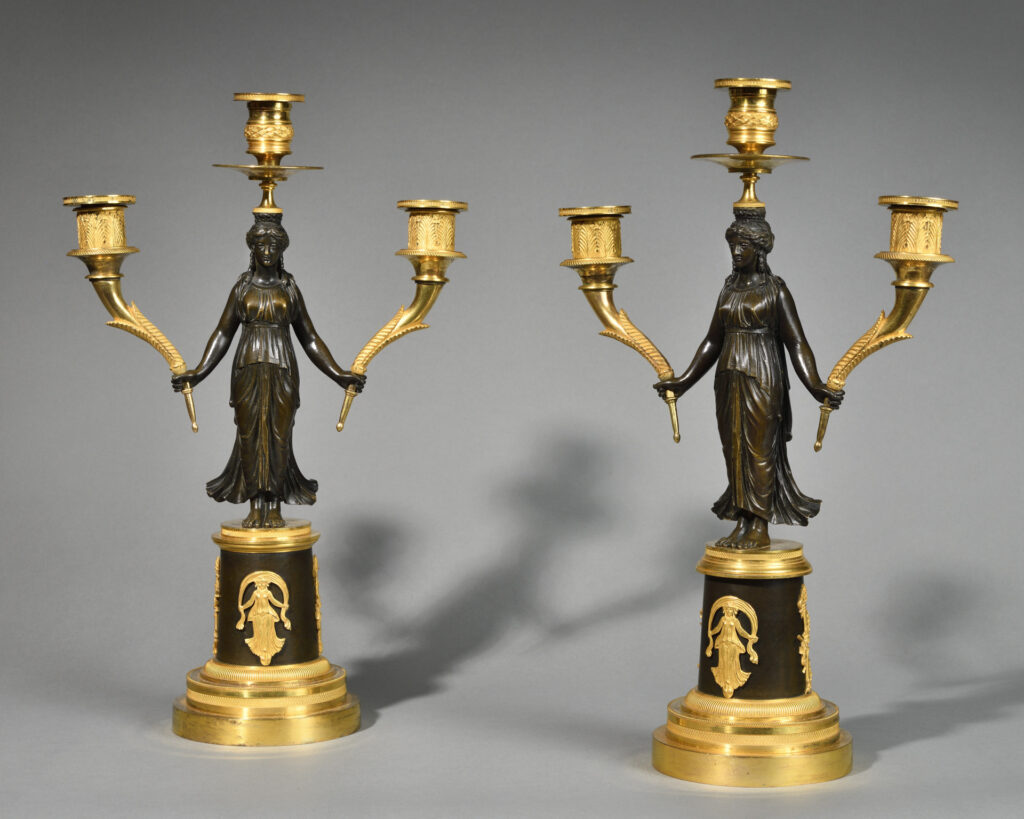
Gilt bronze and patinated bronze Early 19th century 40 x 23,5 cm (15.75 x 9.25 in.)
Each candelabrum takes the form of a woman holding two light-arms shaped as cornucopias and banded with foliate friezes. Her long gown, swept about her bare feet, shows her dancing and lends the figure its movement, while her hair, drawn up into braids at the crown, supports a further socket wreathed with a frieze of laurel. The pedestal carries gilt-bronze mounts — a second dancer, and the thyrsus, a staff crowned with a pine cone and twined with ivy. In the cornucopia, the dance and the thyrsus, the model gathers the attributes of Bacchus and his train.
A Pair of Empire Ormolu ‘Vestals’ Candelabra attributed to Pierre-Philippe Thomire
A Pair of Empire Ormolu ‘Vestals’ Candelabra attributed to Pierre-Philippe Thomire
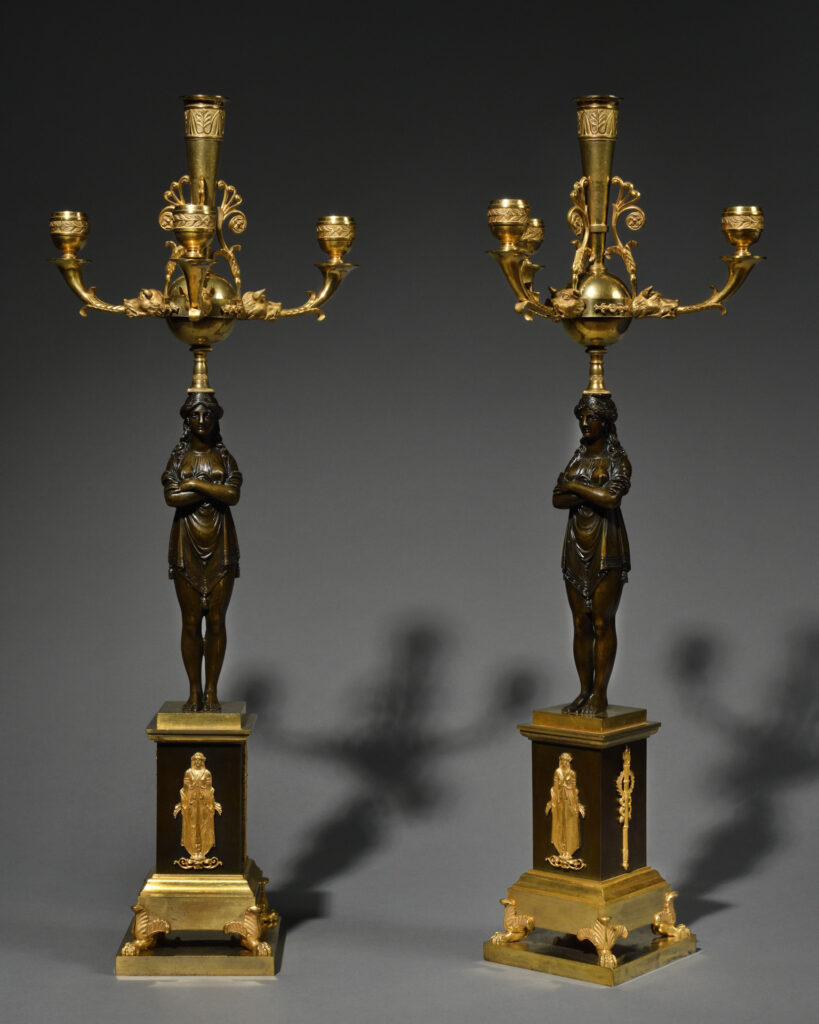
A Pair of Empire Ormolu ‘Vestals’ Candelabra attributed to Pierre-Philippe Thomire Ormolu, chased and patinated bronze ca. 1810 h. 60,5 cm (23.8 in.)
On a patinated bronze base decorated with ormolu appliques representing alternating torches and vestals, other vestals support a sphere. It carries three candle arms composed of a wolf’s head spitting out a foliage motif on which rests the binet. A shaft finished by a binet surmounts the sphere.
This pair of candelabras is based on the vestal with crossed arms model created for a series of pairs of torches delivered by Thomire-Duterme to the palace of Fontainebleau in 1809 and destined for the small apartment of the Empress. The wolf heads spitting out the candle arms represent an uncommon motif that has also been attributed to Thomire.