Gilt Bronze ‘bust Of A Child Prince’ After Germain Pilon
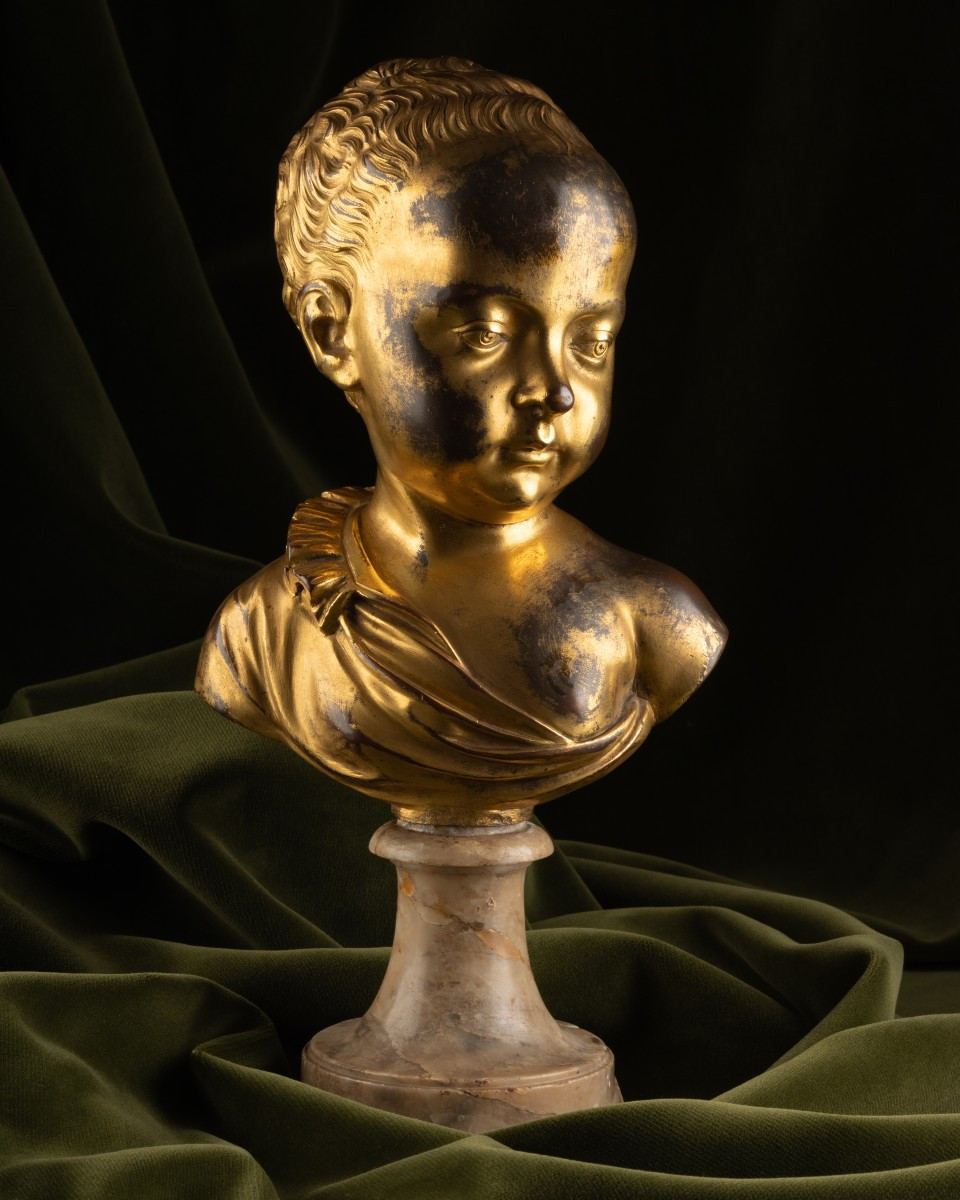
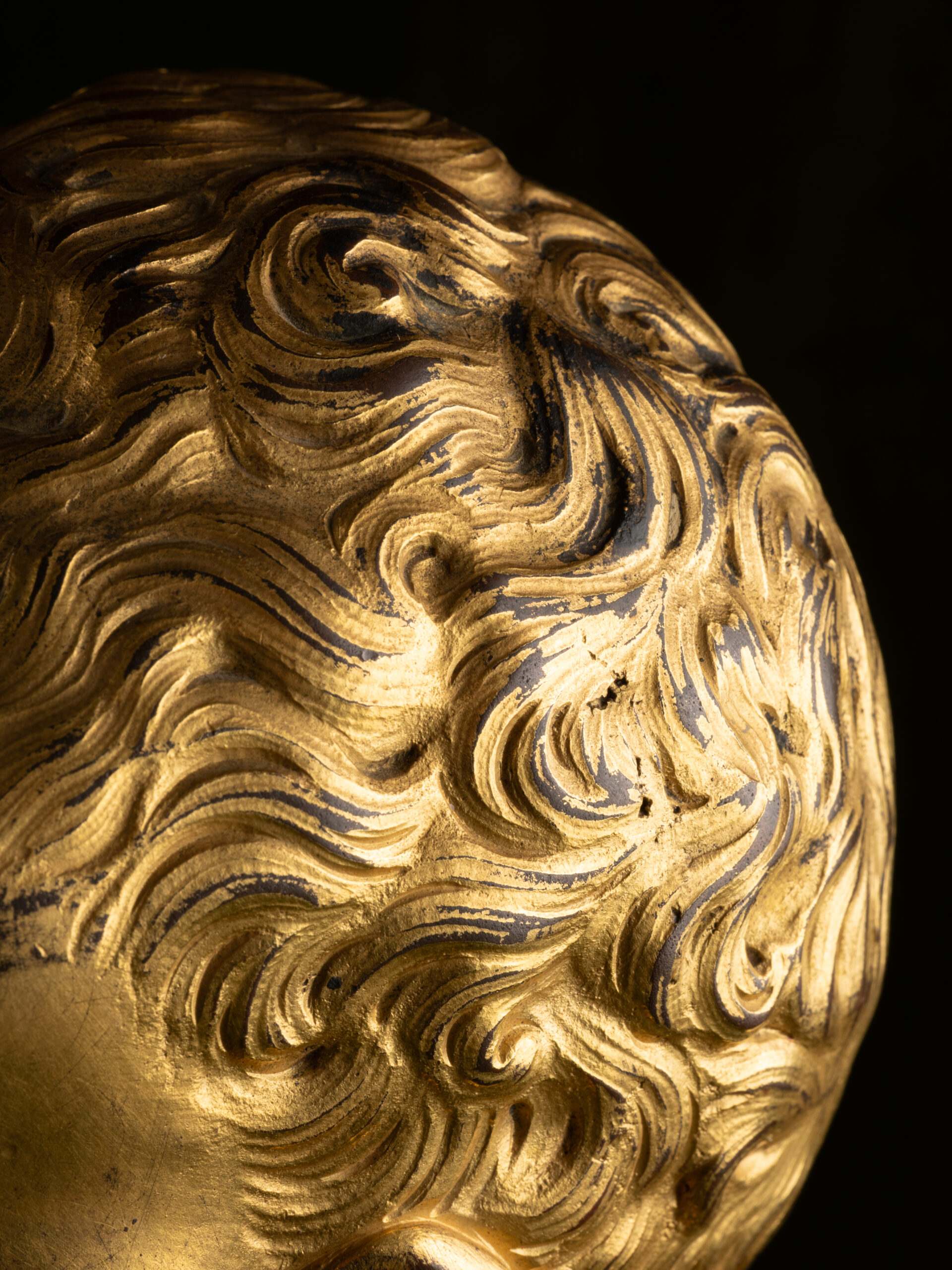
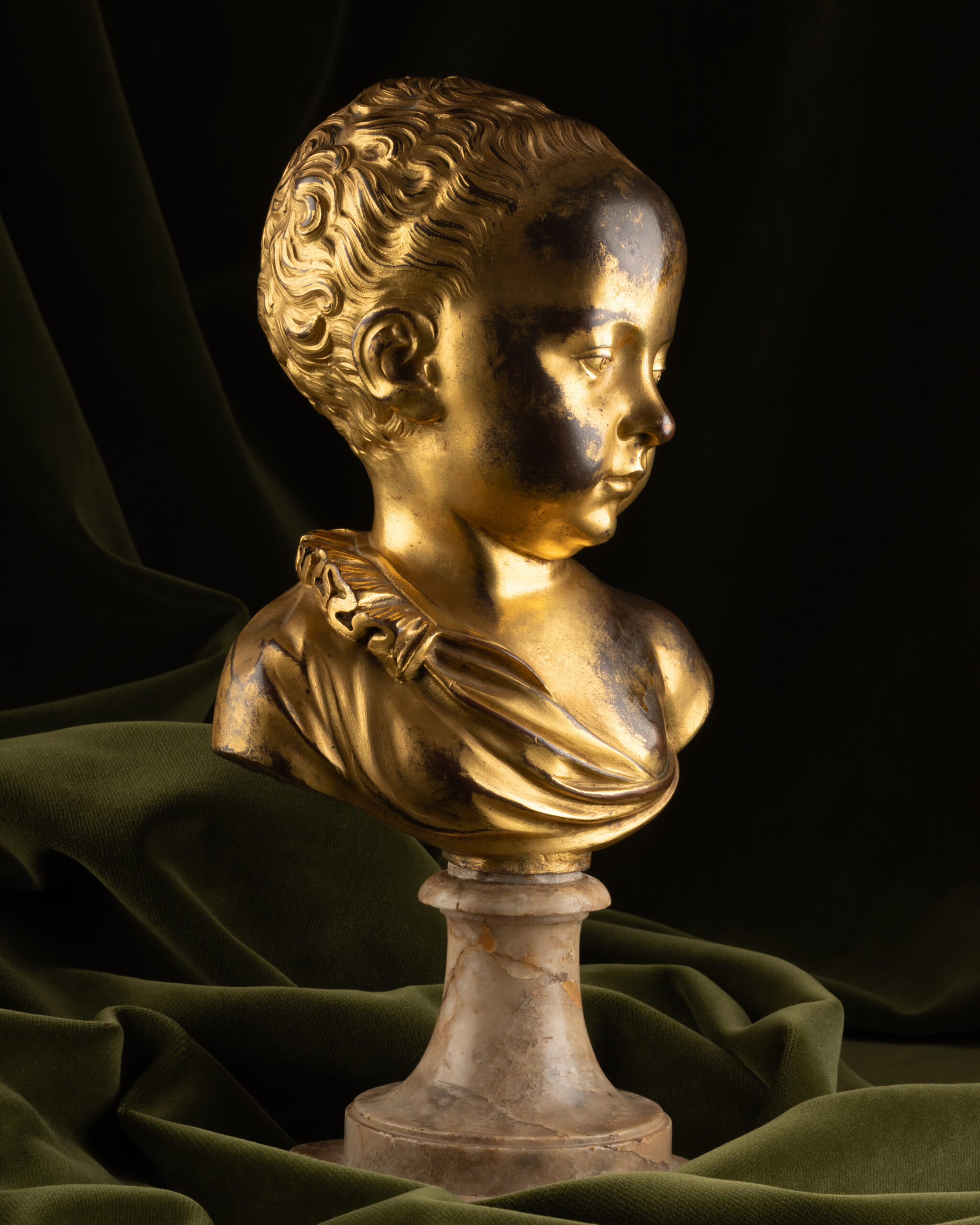
Bust of a Child after Germain Pilon.
Gilt bronze, alabaster France Late 17th century h. 33.5 cm (13,2 in.)
A similar gilt bronze bust was exhibited in 1967 at the Château de Laarne during the exhibition “Bronzes de la Renaissance de Donatello à François Duquesnoy” (Renaissance Bronzes from Donatello to François Duquesnoy). This latter piece traditionally came from the Russian Imperial collections, and had, in all likelihood, been acquired by the art historian and collector Henry-René d’Allemagne during the numerous dispersals of private Russian collections after the October Revolution. Because it was a cast of a Bust of a Child in marble preserved at the Louvre and attributed since the end of the 19th century to Germain Pilon or his workshop, this gilt bronze version had at the time been dated to the late 16th century, Germain Pilon having died in 1590.
Although the present bronze is certainly by the same hand as that of Henri-René d’Allemagne, it seems unlikely that this hand is that of Germain Pilon or a student from his workshop, as no gilt bronze bust from that time is known and attributed to either Germain Pilon or his workshop. It is true that the Wallace Collection in London possesses a bronze cast of the bust of Charles IX preserved at the Louvre. This bust, in marble and alabaster, dated 1568, appears in the post-mortem inventory of Catherine de’ Medici, and no one other than Germain Pilon seems to have been capable of sculpting such a portrait. The Wallace Collection bronze, traditionally from the collections of the Duchess of Berry, seems to attest to the early existence of bronzes cast after the sculpted portraits by Germain Pilon — royal portraits, or thought to be so, whose originals had been gathered by Cardinal de Richelieu only four decades after Germain Pilon’s death, in the context of his “Galerie des illustres” at the Palais Cardinal, which became the Palais Royal in 1643.
The very program of the Galerie des Illustres allows for addressing the delicate question of the subject’s identity in this bust. Titled Bust of Henri IV as a child during the 1967 exhibition, it had initially been designated as a portrait of Henri III by Barbet de Jouy in 1873, for the reason that the subject presents some similarities with a toddler sketched in a late 16th-century red chalk drawing, preserved at the Bibliothèque Nationale and bearing a notation, probably later, designating this child as Henri III. The problem of the dating, attribution, and identification of the subject of this bust was summarized by the historian Louis Gonse in an aside of an eulogy for Germain Pilon and this bust:
“He knew how to question the troubled soul of his models, just as he knew, on occasion, how to render with infinite skill the fleeting graces of childhood. If it is, as has been believed, a portrait of Henri III as a child, the little Louvre bust would be from the master’s youth. It seems to me to be of too accomplished an art not to belong, like the other busts, to his last period. Moreover, it is very difficult to identify the features of a model of that age. Doubts have even been raised about the attribution of this bust to Pilon. Some people wanted to attribute it to François Duquesnoy, but it is certainly from the 16th century and in the manner of Pilon, who here rivals the Florentines, those consecrated interpreters of putti.”
It is noteworthy that it did not occur to either Barbet de Jouy or the commissioners of the 1967 exhibition that the dates of Germain Pilon’s activity, on the one hand, and the evident age of the child portrayed, on the other, are incompatible with the birth dates of these kings: no work by Germain Pilon is known before his participation in the work on the tomb of François I in 1558; as for Henri III and Henri IV, they were born in 1551 and 1553 respectively. The Bust of a Child at the Louvre, if this child is indeed the future Henri III, would then be one of the first known works by Germain Pilon, completed before he gained favor with Catherine de’ Medici and became, so to speak, the sculptor of her Court. Furthermore, there already exists a bust of Henri III firmly attributed to Germain Pilon, by the same hand as that of Charles IX, also mentioned in the queen mother’s post-mortem inventory, and further cited in Richelieu’s collections at the Palais Cardinal. Henri III appears in it at maturity, and everything suggests that it dates from the same time as the aforementioned bust of Charles IX, namely the year 1568.
If the child in Germain Pilon’s bust is indeed one of Catherine de’ Medici’s sons, the least improbable hypothesis is that it is Hercule de France, Duke of Alençon, the last son of Henri II and Catherine de’ Medici. This duke, who took the name François de France after the death of his brother King François II at age 16 in 1560, did not leave a significant mark on the history of France. Thus, it is probable that the importance of this bust was caused, in the 17th century as in the 19th and 20th, by a confusion or a presumption, through which this young prince was mistaken for Henri III or Henri IV, Kings of France. The Russian provenance of the bust exhibited in 1967, if proven, could also be explained by such a presumption: Henri III, King of France upon the death of his brother Charles IX in 1574, was also King of Poland in 1573 and Grand Duke of Lithuania.
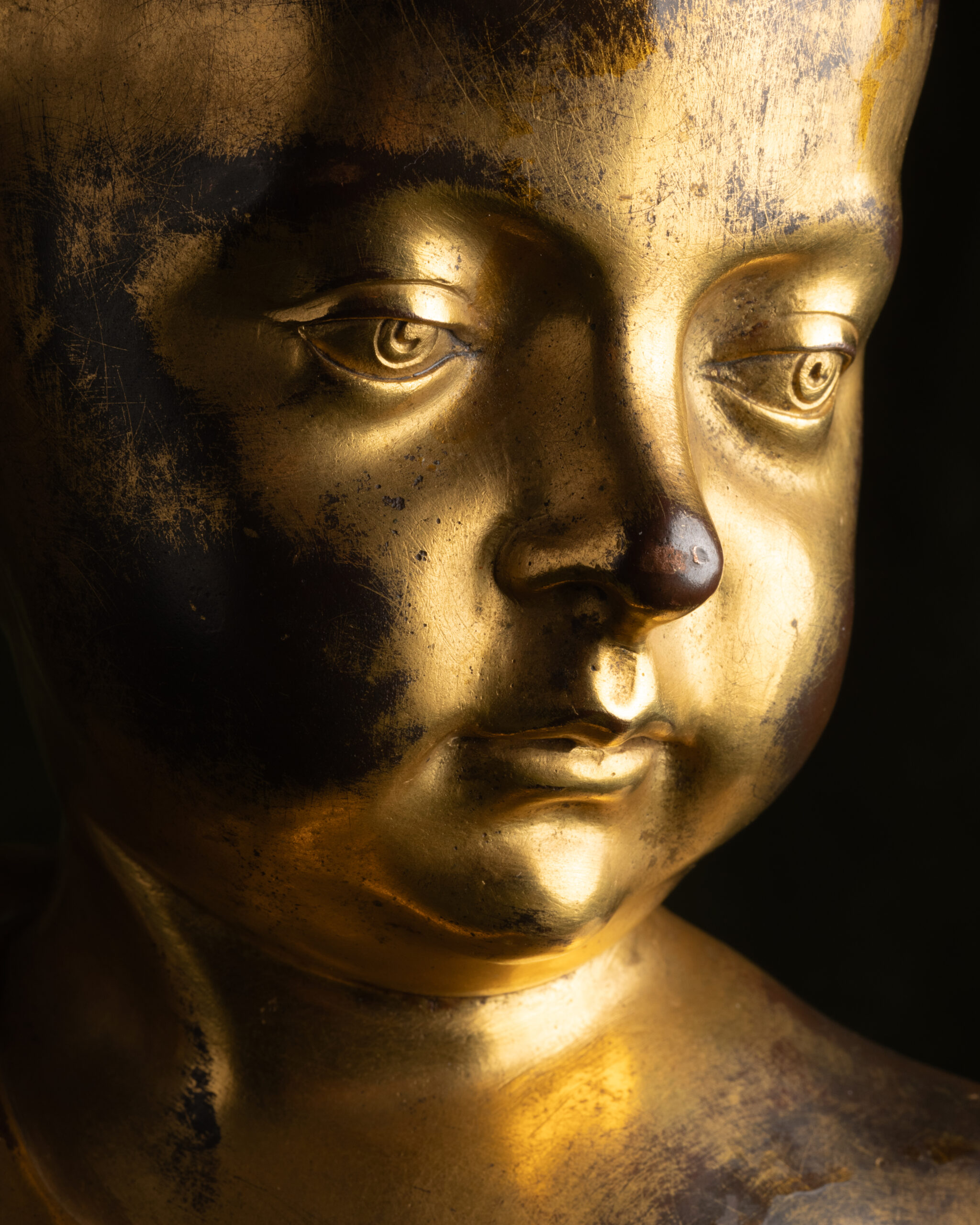
As for the dating of the present bronze and the one from the Russian Imperial collections, it is noteworthy that they share the same treatment of the iris, in the form of an incised spiral, which is typical of bronze portraits from the second half of the 17th century. A bust, also in gilt bronze, of Louis XIV by or after Coysevox, also preserved in the Wallace Collection in London, and undoubtedly related to a bronze bust of the same king presented by Coysevox at the Salon of 1699, is the closest work, in terms of technique and style, to these two bronzes. Since gilt bronze busts of this type are, on the one hand, remarkably rare in public collections, and the use of an incised spiral as an iris is, on the other hand, characteristic of sculpted portraits from the second half of the 17th century onwards, this parallel supports a later dating than that proposed at the 1967 exhibition, namely the late 17th century and not the late 16th.
Literature
Louis Gonse, La Sculpture française depuis le XIVe siècle, Paris, 1895; Émile Molinier, “Un buste d’enfant du XVIe siècle,” in Monuments et mémoires de la Fondation Eugène Piot, vol. 6, no. 1, 1899; Jean Babelon, Germain Pilon, Paris, 1927; Charles Terrasse, Germain Pilon, Paris, 1930; Henry-René d’Allemagne, La maison d’un vieux collectionneur, vol. II, Paris, 1948; Bronzes de la Renaissance de Donatello à François Duquesnoy, Brussels, 1967; Pierre Chevallier, Henri III, roi shakespearien, Paris, 1985; Jean-René Gaborit, Geneviève Bresc-Bautier et al., Sculpture française II. Renaissance et Temps Modernes, Paris, 1998; Robert Wenley, French Bronzes in the Wallace Collection, London, 2002; Geneviève Bresc-Bautier, Guilhem Scherf et al., Les Bronzes français de la Renaissance au Siècle des lumières, Paris, 2008.
Tall “cobra” Table Lamp, After A Model By Edgar Brandt
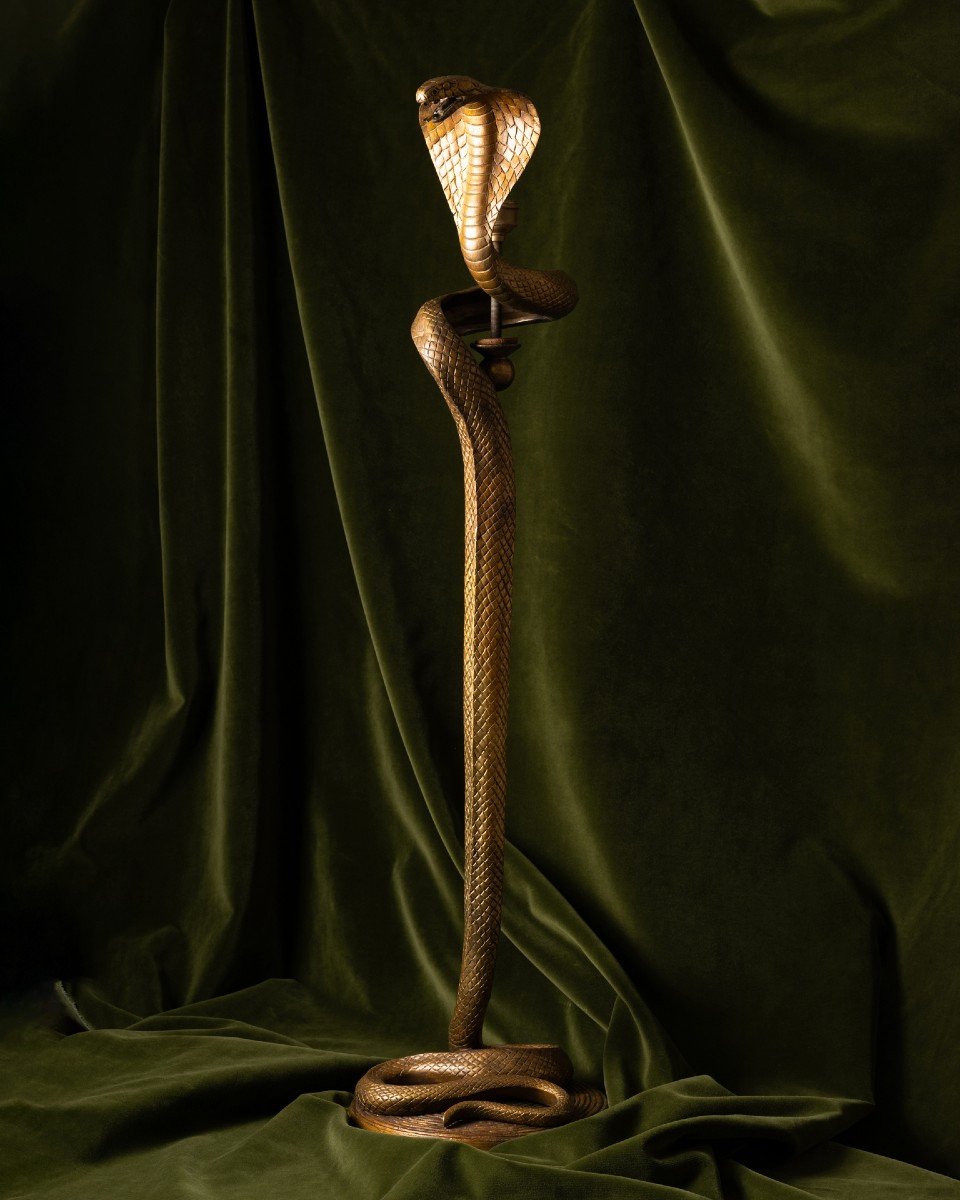
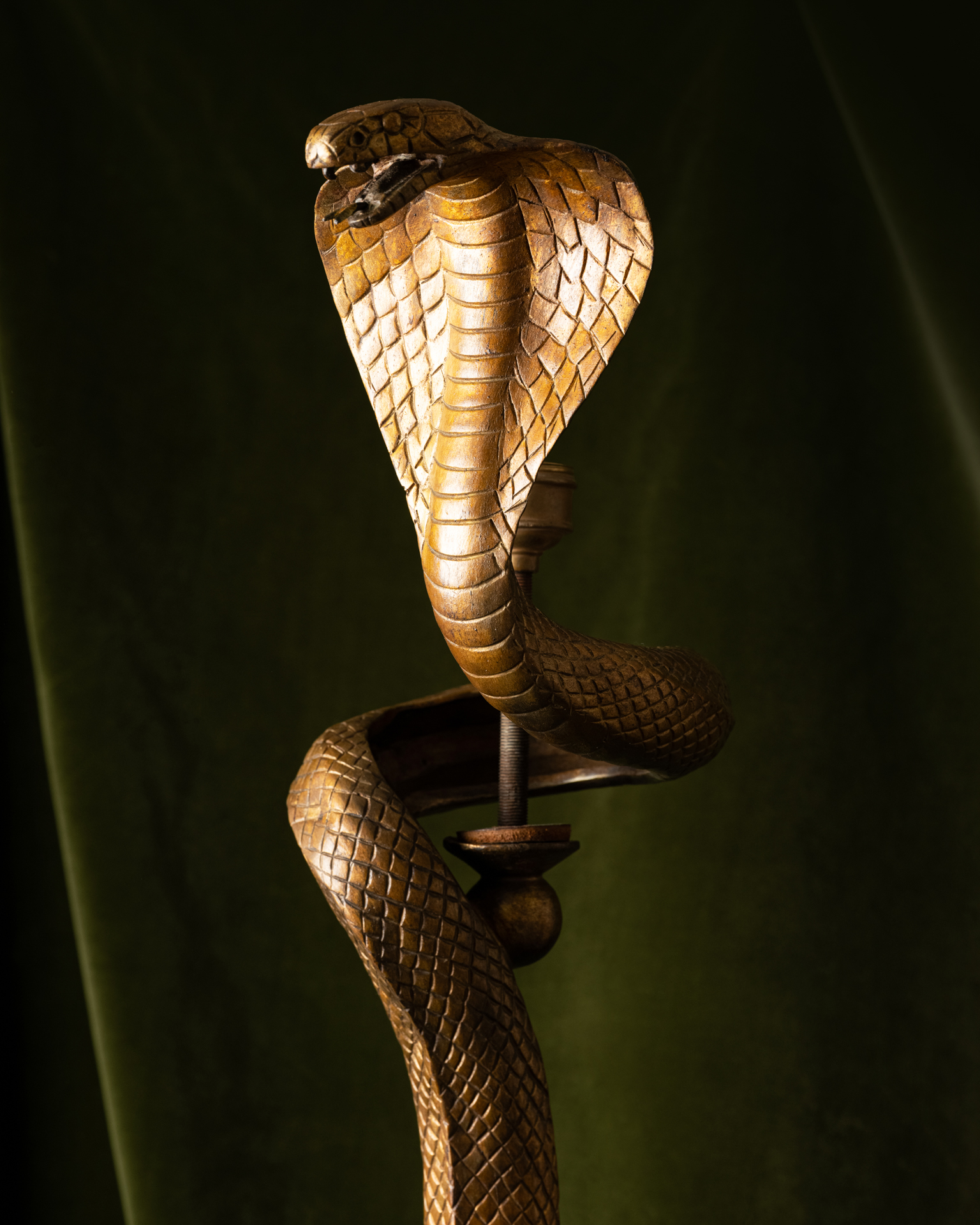
Tall “Cobra” table lamp, after a model by Edgar Brandt
Patinated bronze France 20th century 89 x 24 cm (35 x 9.4 in.)
Decorative bronze works, and in particular the two snake-shaped lamp models — La Tentation (Temptation) and Cobra — are almost an exception in Edgar Brandt‘s œuvre, as they were produced in large edition as well as executed and finished by founders and bronzesmiths, unlike the ironwork pieces that bear his name. It is estimated that around 400 Tentation and Cobra lamps were produced during Brandt’s lifetime, with variations in size, shape, casting and finish.
This lamp bears a signature on the base; the cup-shaped shade is missing.
Literature
See Joan Kahr, Edgar Brandt. Art Deco Ironwork, New York, 2010.
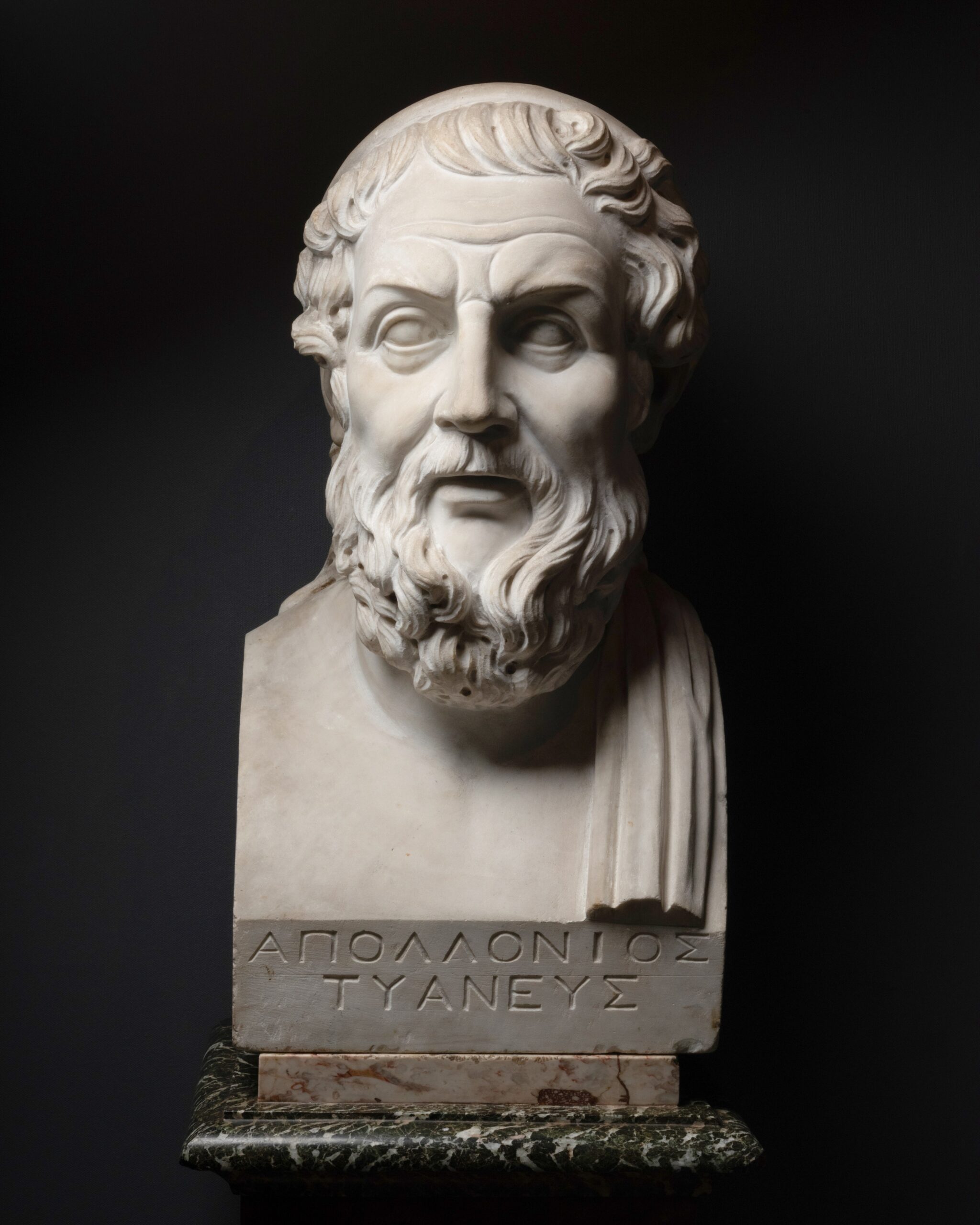
Bust Formerly Identified As Apollonius Of Tyana, Attributed To Carlo Albacini
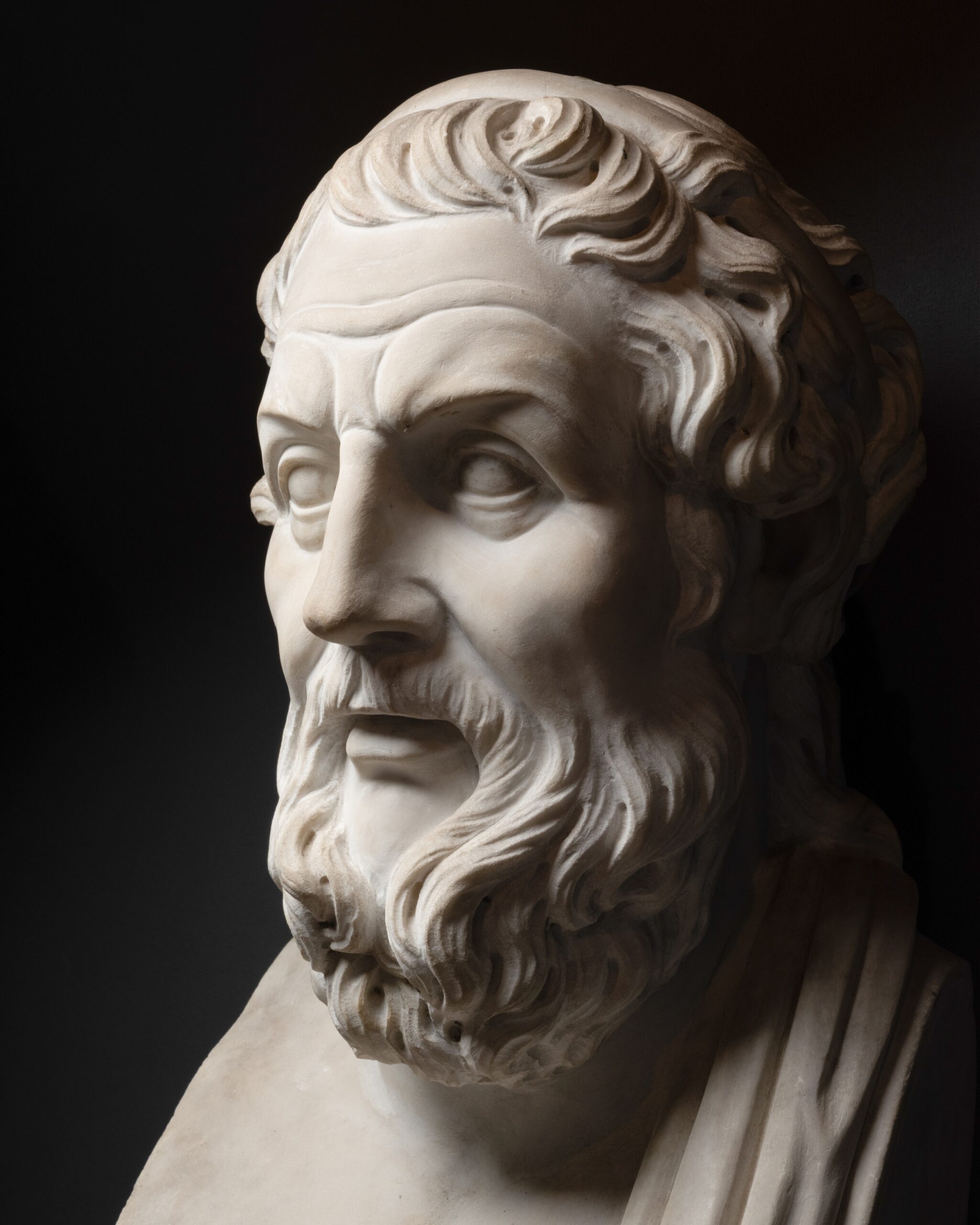
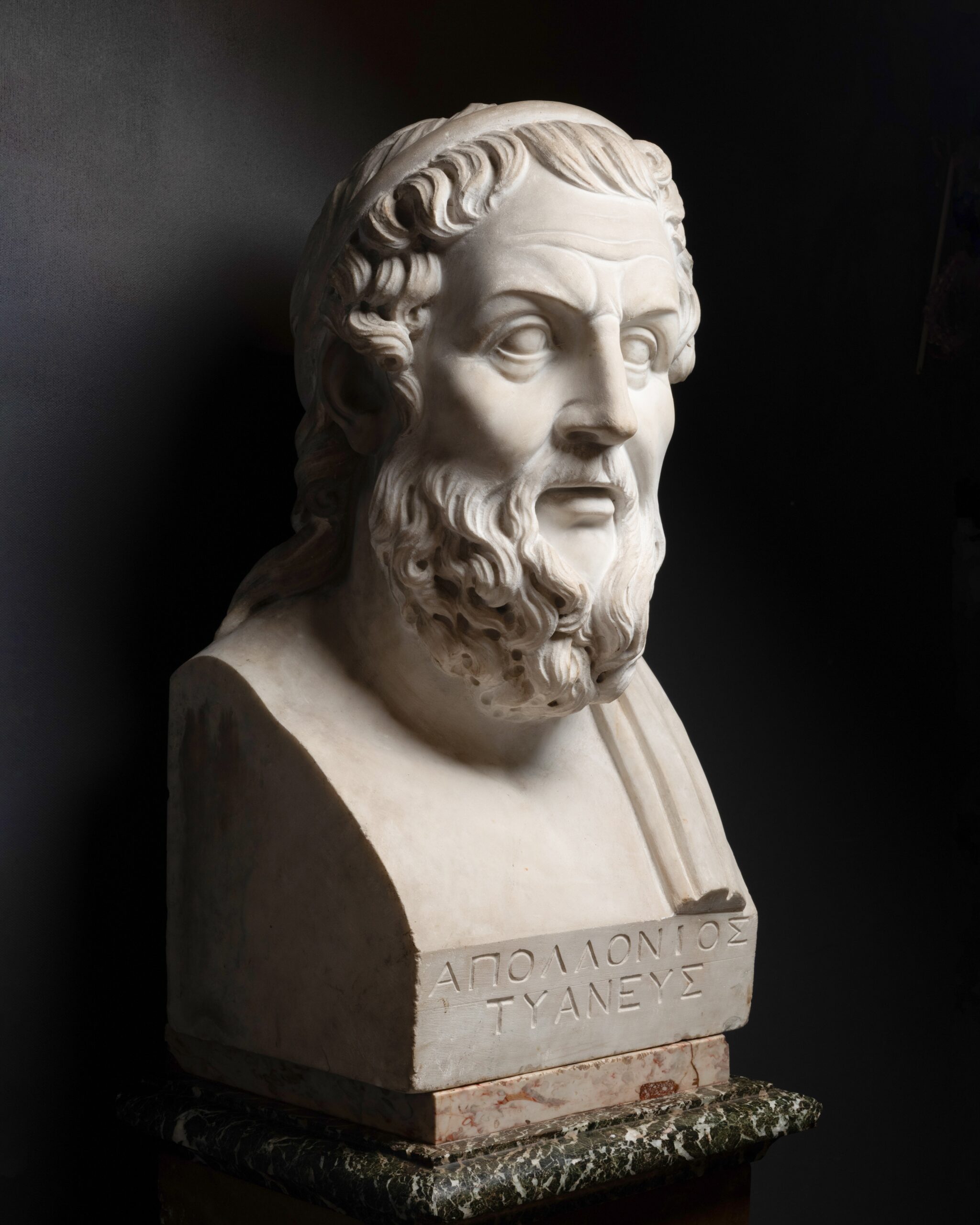
Bust formerly identified as Apollonius of Tyana, attributed to Carlo Albacini.
Marble Italy 1780-1790 29 x 59 x 24 cm (11.4 x 23.2 x 9.4 in)
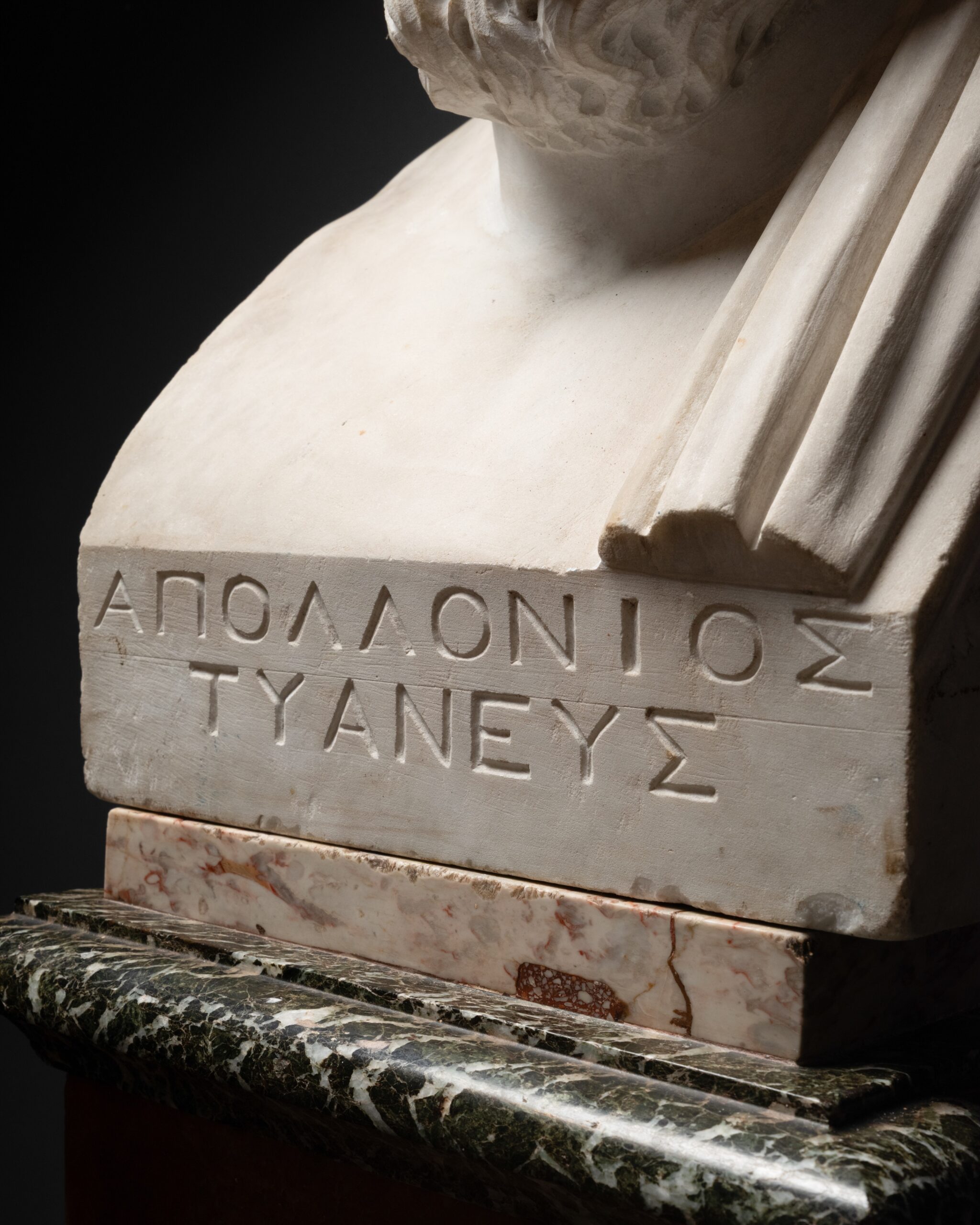
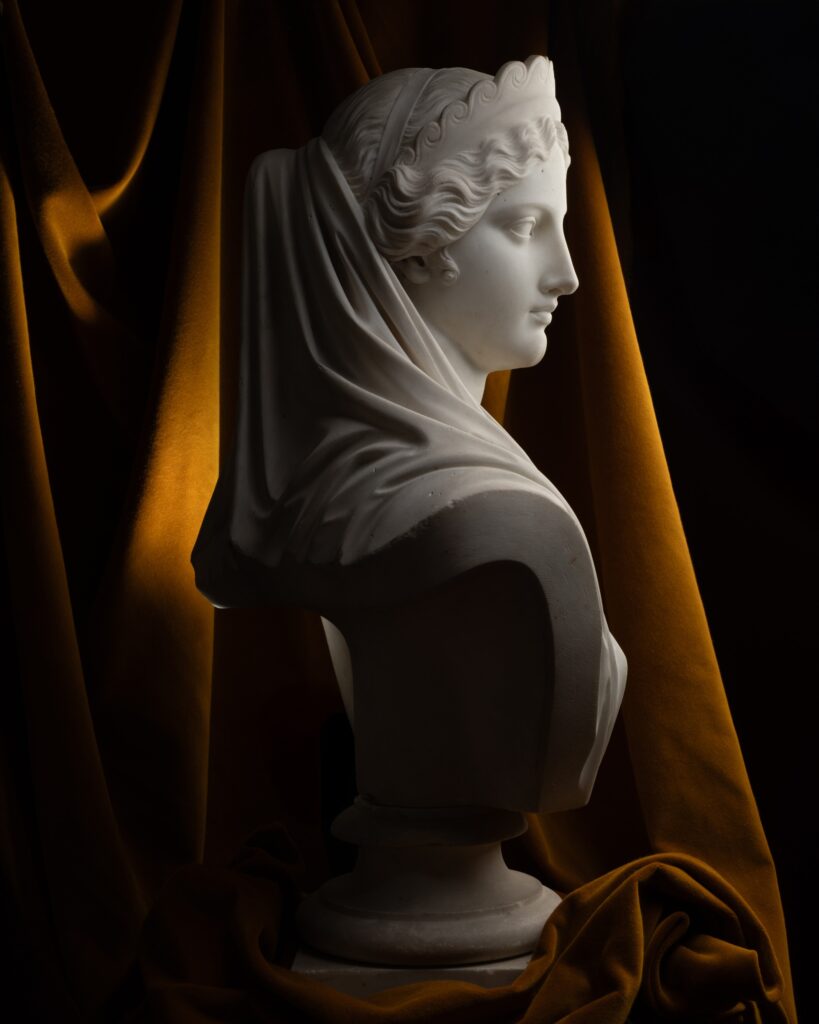
This bust, carved from white Carrara marble, depicts the bearded face of an elderly man, his head turned slightly to the right. He wears a thick rolled headband, or taenia, crowning an abundant head of hair that falls onto the nape of the neck. The eyes are large and deeply set but not incised, conveying the vacant gaze associated with blindness. The bust terminates in the form of a herm and features a Greek inscription on the chest. The technical virtuosity of the execution lies in its rigorous fidelity to the Severe style of the antique prototype. The precision of the proportions suggests the use of a pointing machine, or compasso, allowing for a near-perfect imitation of the ancient model held in the Stanza dei Filosofi of the Capitoline Museums.
For much of the 17th and 18th centuries, this type of portrait was identified as Apollonius of Tyana, a Neo-Pythagorean ascetic born in Cappadocia at the beginning of the Christian era. In a brief, eloquent, yet stern account of his life, the archaeologist Ennio Quirino Visconti wrote that Apollonius : “affected in truth a great severity of morals and led a hard and ascetic life […], traveled through the various provinces of the Roman Empire, and even other countries so that everyone might admire his virtues; and he was particularly committed to restoring the rites of pagan worship. He went twice to Rome, where it is said he endured some persecutions; and after making his most common residence in several cities of Asia, particularly Smyrna and Ephesus, he concealed his final moments, being over ninety years old, from the knowledge of his disciples, likely so that his death would have the appearance of an apotheosis. […] A certain Hierocles dared, two centuries later, to oppose this hero of paganism to the divine legislator of the Christians. This act of impudence prompted Eusebius, Bishop of Caesarea, to write a refutation of Hierocles, which proves—by the considerations he feels obliged to maintain for the person of Apollonius—to what extent the memory of the Pythagorean was venerated in the world.”
The identification of this type of portrait as Apollonius dates back to the mid-17th century and Leonardo Agostini, superintendent of antiquities in Rome under Alexander VII. Agostini had drawn a parallel between the features of a bust of this type and a profile appearing both on a contorniate medallion and on one of the gems in the Fulvio Orsini collection. Ennio Quirino Visconti definitively corrected this attribution in the early 19th century based on numismatic evidence from Amastris, reclassifying portraits of this type as one of the four primary Hellenistic portraits of Homer.
As for the present bust, an imitation after the Capitoline bust, it must be attributed to Carlo Albacini and his workshop. Albacini lived from 1756 to 1759 alongside Bartolomeo Cavaceppi in the artists’ quarter of Rome. He appears to have remained in his master’s immediate circle during the peak of Cavaceppi’s career, from the 1760s to the early 1770s. At this time, Albacini began undertaking restorations for English clients and dealers who were also patrons of Cavaceppi, notably Charles Townley and William Blundell, as well as the Earl of Lansdowne, Thomas Mansel-Talbot and James Smith Barry.Albacini’s reputation as a sculptor and restorer was then second only to that of Cavaceppi, restorer to Popes Benedict XIV and Clement XIII and supervisor of some of the most significant restorations of the marbles in the Museo Pio-Clementino. It is unsure whether Albacini himself performed restoration work on the Capitoline Homer-Apollonius herm that served as the model for this bust. However, an inventory of plaster casts sold by Albacini’s son, Filippo, in 1838, mentions three copies of “Apollonius of Tyana.” One of these is a replica of a herm of the same type, formerly in the collection of José Nicolás de Azara, the Spanish ambassador to Rome, and now held in the Prado.
Mispelling of the name Απολλωνιος τυανευς (Apolloniôs tyaneys), here spelled Απολλονιος τυανευς (Apollonios tyaneys).
The most compelling evidence regarding the context of the bust’s execution lies in the Greek inscription visible on the portrait. The name Apollonius derives from Apollo, which in Ancient Greek requires an unaccented omicron in the first syllable and an accented omega in the second. The sculptor of this bust made the error of writing the second “o” of Apollonius with an omicron instead of an omega. Remarkably, a similar error is found on another bust reputed to represent Apollonius of Tyana — a once famous, now-lost bust that belonged to Giuseppe Valletta before passing to the Earls of Pembroke at Wilton House. Regarding Albacini, it is known that he and his assistants were accustomed to adding the names of the presumed subjects to the busts, both on restored works and on replicas : “The base was also generally provided with an inscription in Greek letters, giving the supposed identity of the subject. It is only in very few cases that modern scholarship would agree with these identifications (e.g. ‘Carneades’ and ‘Periander’ are probably correct identifications, but ‘Herodotus’ is in fact Aristogeiton, and ‘Pittacus’ may represent Miltiades), and several are portraits of anonymous Greeks, confidently (but without justification) identified by the modern inscription as, for example, Theocritus, Heraclitus, Theophrastus, and Heracles.”
The presence of this spelling error suggests a common iconographic or philological source shared by the restorer of the Wilton House bust and the sculptor of the present work. It links these two pieces not by form—since one indeed represents Apollonius while the other actually depicts Homer—but by the shared intellectual climate of their creation. Both testify to the pre-scientific enthusiasm for ancient marbles that characterized the history of early modern European collecting, a period when the eagerness to possess antiquities, or failing that, their imitations, often outweighed archaeological rigor.Given the rarity of the Apollonius type, it is highly improbable that such an error in identification and inscription would have been committed after Visconti overturned Agostini’s thesis. This places the bust in the earliest phase of modern “anticomanie,” specifically in the 1780s—the period when the marbles of the Azara collections were being restored by Albacini.
Literature
See Ennio Quirino Visconti, Iconographie grecque, Paris, 1808 ; Henry Stuart Jones, A Catalogue of the Ancient Sculptures preserved in the Municipal Collections of Rome. The Sculptures of the Museo Capitolino, Oxford, 1912 ; Anton Hekler, Greek and Roman Portraits, London, 1912 ; Gisela Richter, The Portraits of the Greeks, London, 1965 ; Glenys Davies, “The Albacini Cast Collection. Character and significance”, in Journal of the History of Collections, III, no. 2, 1991 ; Edgar Peters Bowron and Joseph Rishel, Art in Rome in the Eighteenth Century, Philadelphia, 2000.