A Pair of Bronze Tazze with Bucrania Friezes
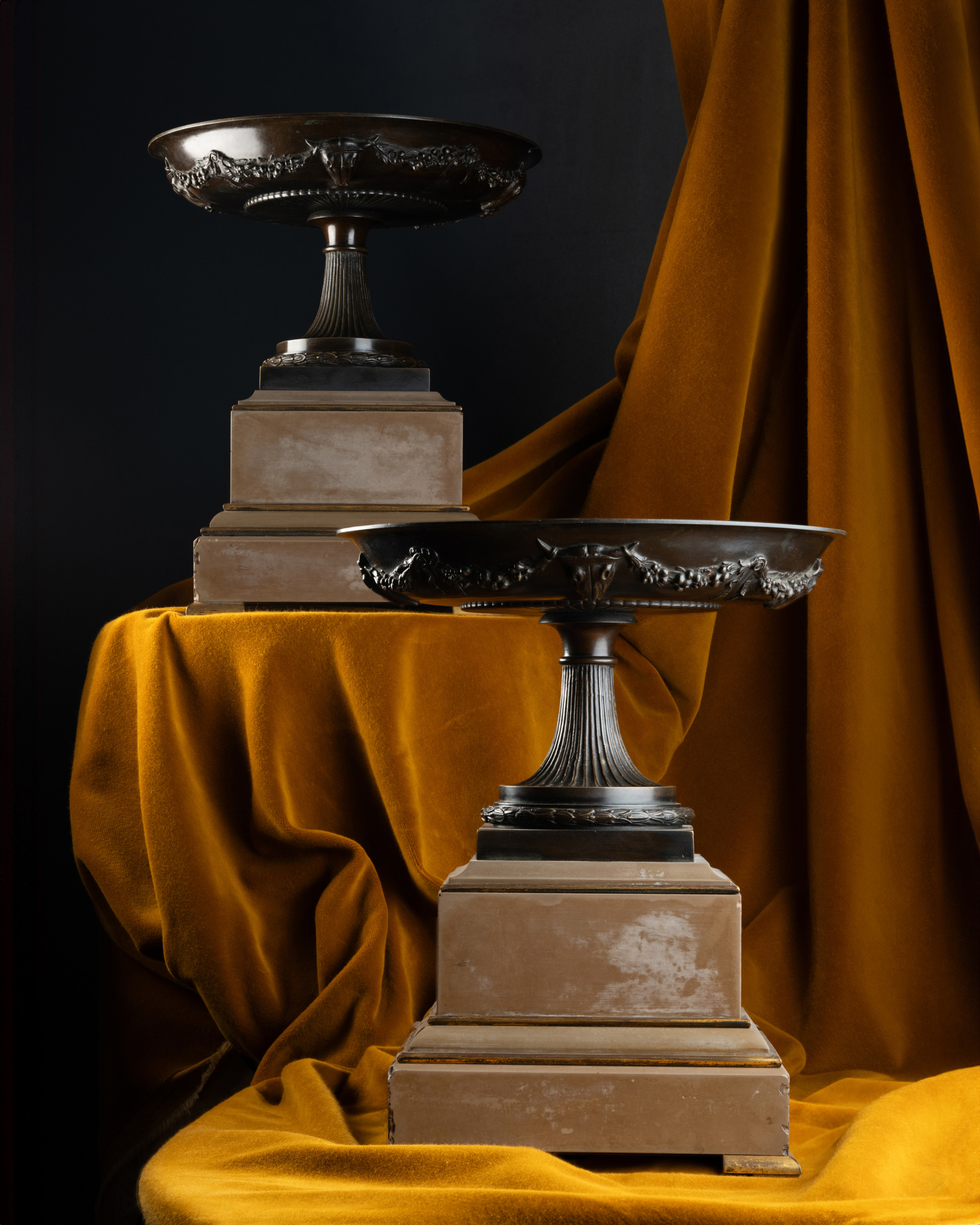
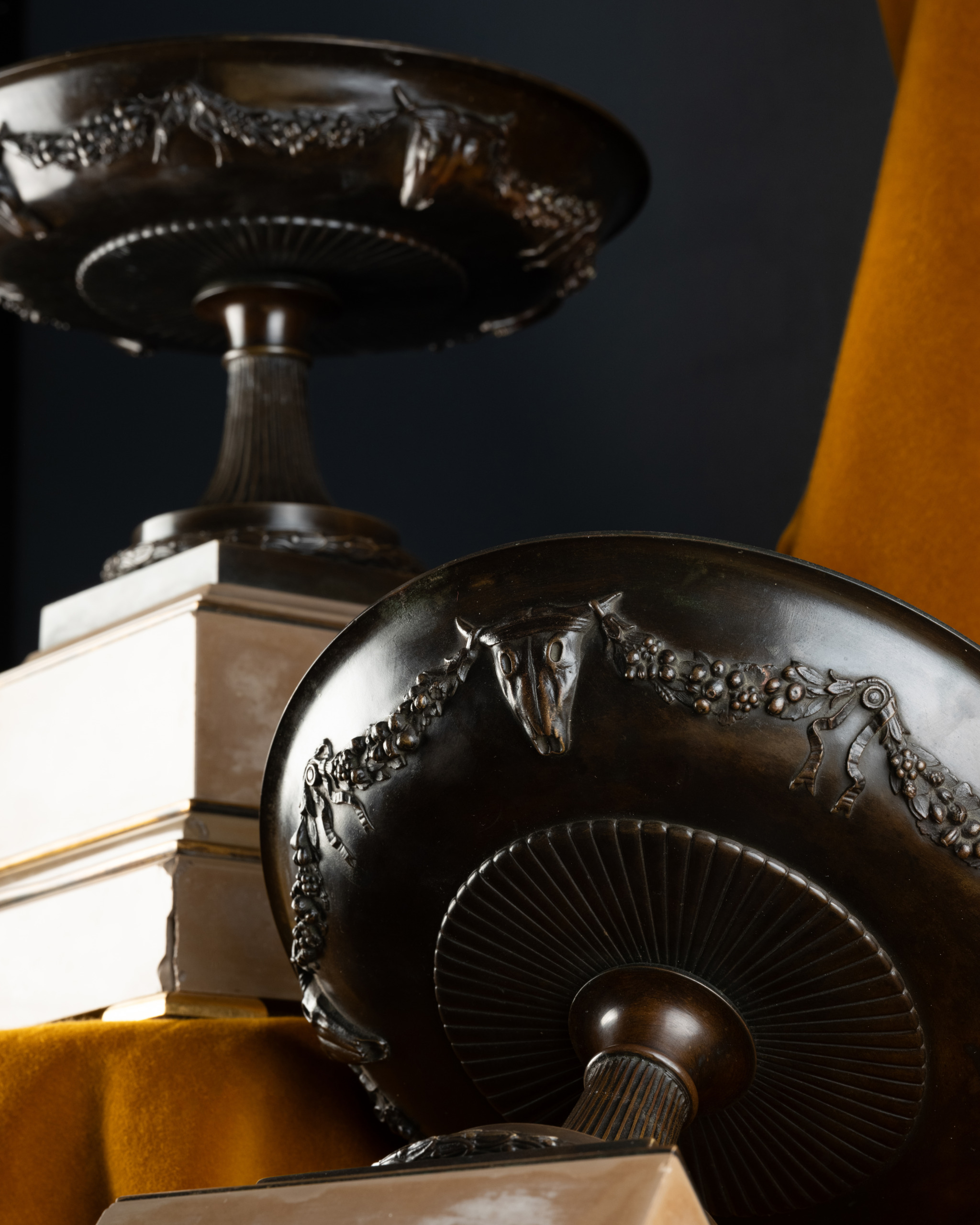
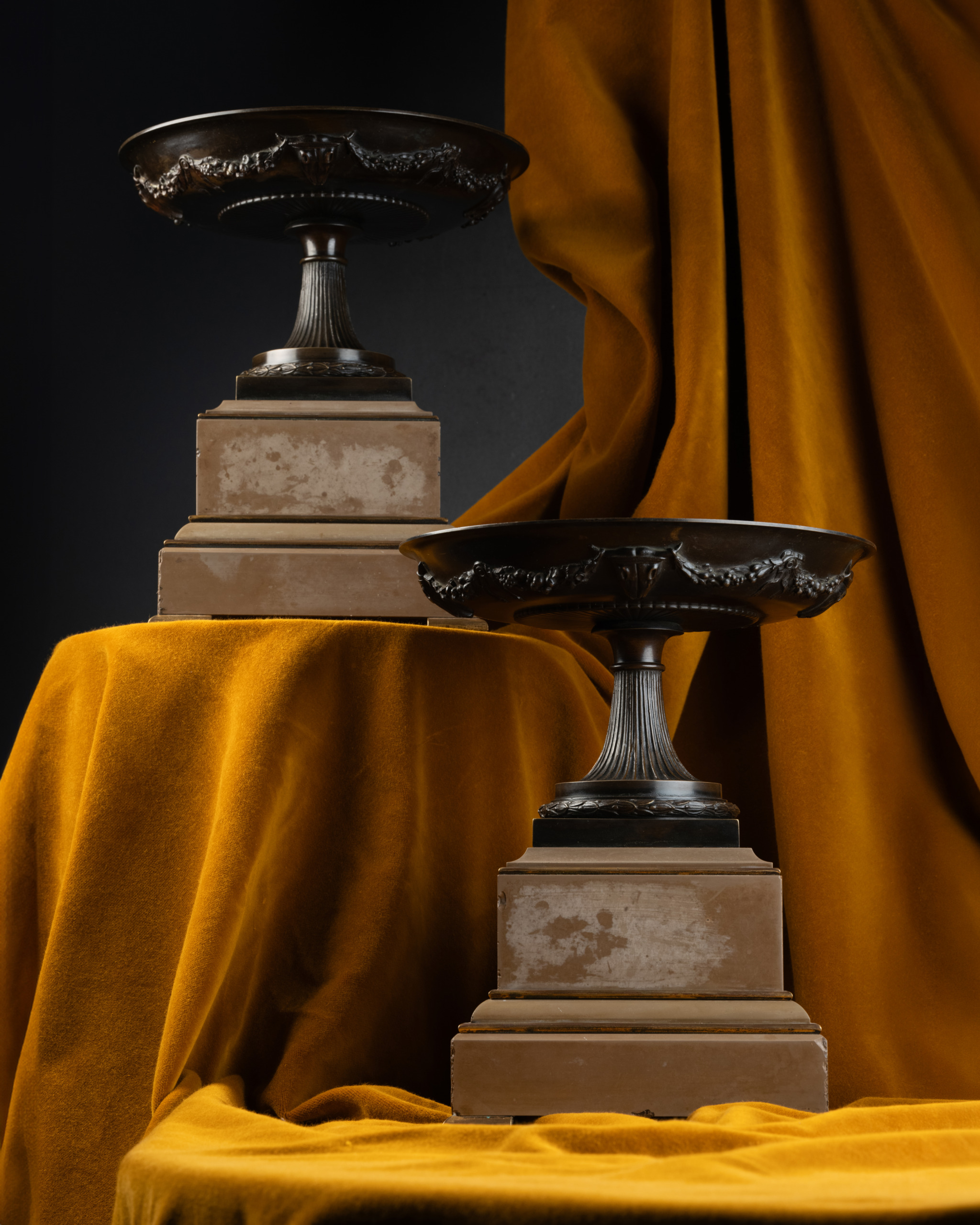
This pair of cups, or tazze, almost certainly belongs to the orbit of either the Manfredini in Milan or the Valadier in Rome — both workshops fluent in casting bronze friezes of bucrania and encarpa whose modeling and chasing rival the one running around the flared rim of each cup. That frieze is expertly worked here, its encarpa — the swags of flowers and fruit — treated individually, and so asymmetrically.
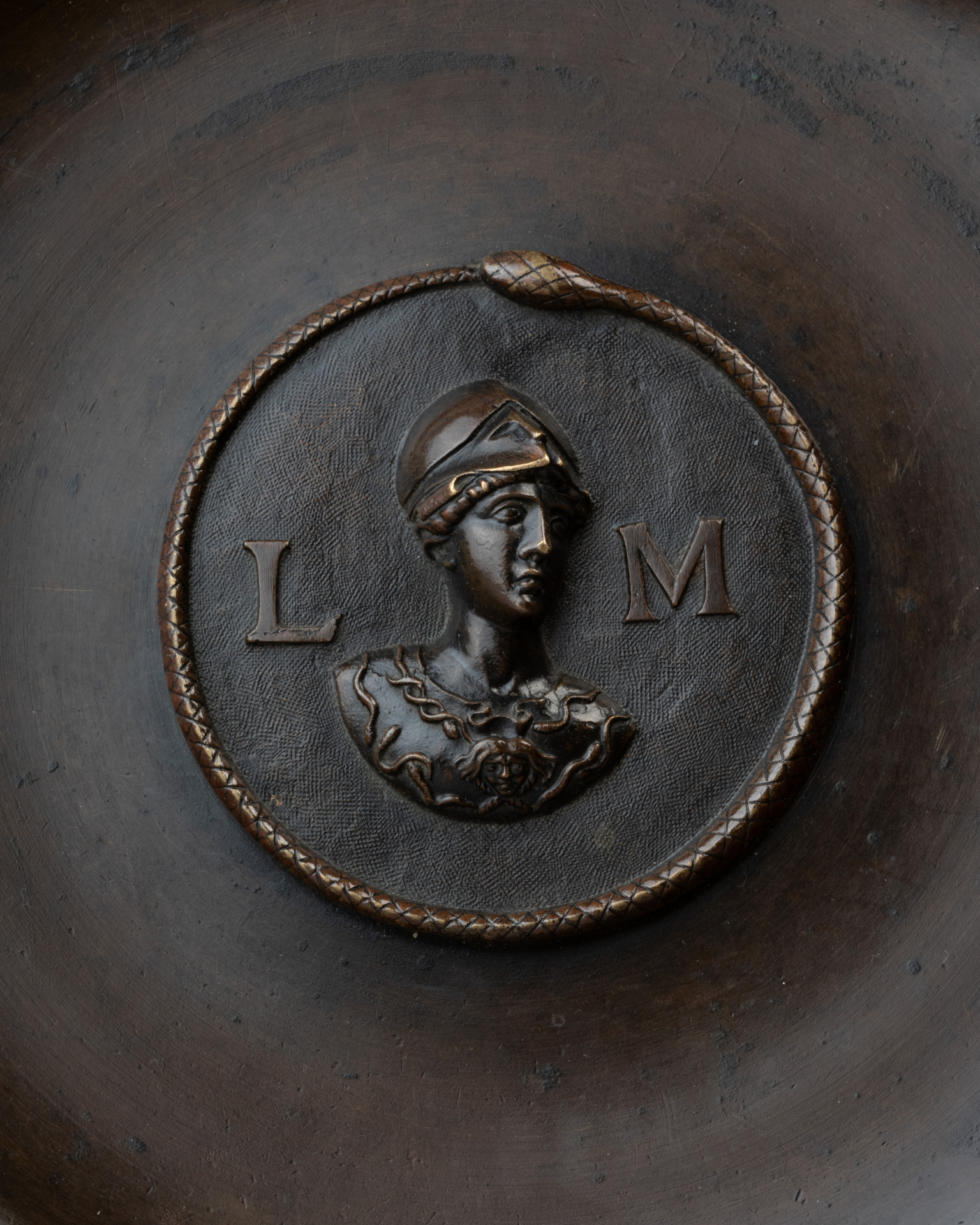
Luigi Manfredini became a master of the bucrania-and-encarpa motif in bronze. Eugène de Beauharnais, then Viceroy of Italy, had invited him and his brothers to Milan to found a workshop capable of rivaling the luxury bronzesmith work of Rome and Paris. His masterpiece was a bronze tripod after the much-copied example from the Temple of Isis at Pompeii, presented to Napoleon and Marie-Louise in 1811 and subsequently repeated in several versions — at least six of them at the Bavarian court by the close of the nineteenth century,1 one at the Hofburg, one at Pavlovsk.2 The medallion set into the bottom of each cup reinforces the connection: a three-quarter Pallas Athena in mezzo rilievo, helmeted in the Corinthian manner, bearing the aegis bordered with interlaced serpents and the gorgoneion. This is the type of the Pallas of Velletri — unearthed in Rome in 1797 and received in Paris with great ceremony in 1803,3 the very years in which the Manfredini are documented in the city.4 The goddess is flanked by the initials “L. M.” in relief against a broad matte ground and encircled by an ouroboros. Those initials answer to the mark of Luigi Manfredini, who signed in this way on occasion — as on two candelabra delivered to the Palazzo Reale in Milan.
The Valadier, however, used the same motif no less freely: first in the Salone d’Oro of the Palazzo Chigi in Rome, and again on a pair of candelabra now in the Metropolitan Museum, New York. The strongest parallel is at the Palazzo Borghese. There, for a series of plinths now in the Sala Egizia, Luigi Valadier cut a frieze very close to the one on these cups — the ribbons, or vittae, that bind the fruit swags passing first across the brow of each bucranium, vanishing behind it, then rising again to loop around each horn.5 The stone of the substantial molded plinths supporting the two cups may strengthen this Roman reading, the Valadier having possibly used a comparable stone for a reduction of the Artemis of Ephesus.
Literature
See Francis Haskell and Nicholas Penny, Taste and the Antique. The Lure of Classical Sculpture. 1500-1900, New Haven, 1981, Enrico Colle, Bronzi Decorativi in Italia. Bronzisti e fonditori italiani dal Seicento all’Ottocento, Milan, 2001 ; Andreina D’Agliano et al., Ricordi dell’Antico. Sculture, porcellane e arredi all’epoca del Grand Tour, Milan, 2008 and Anne Coliva et al., Valadier. Splendore nella Roma del Settecento, Milan, 2019.