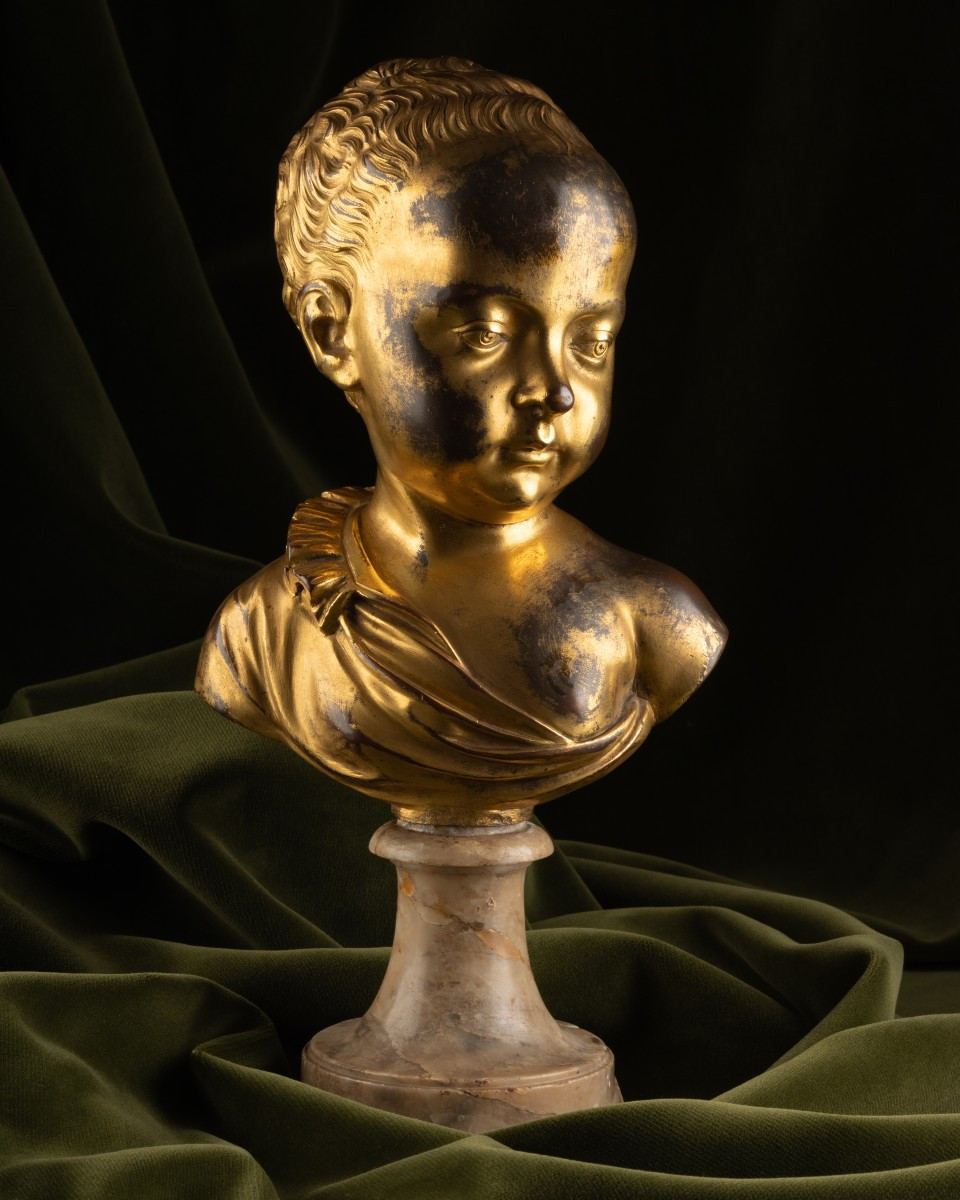
Gilt Bronze ‘bust Of A Child Prince’ After Germain Pilon
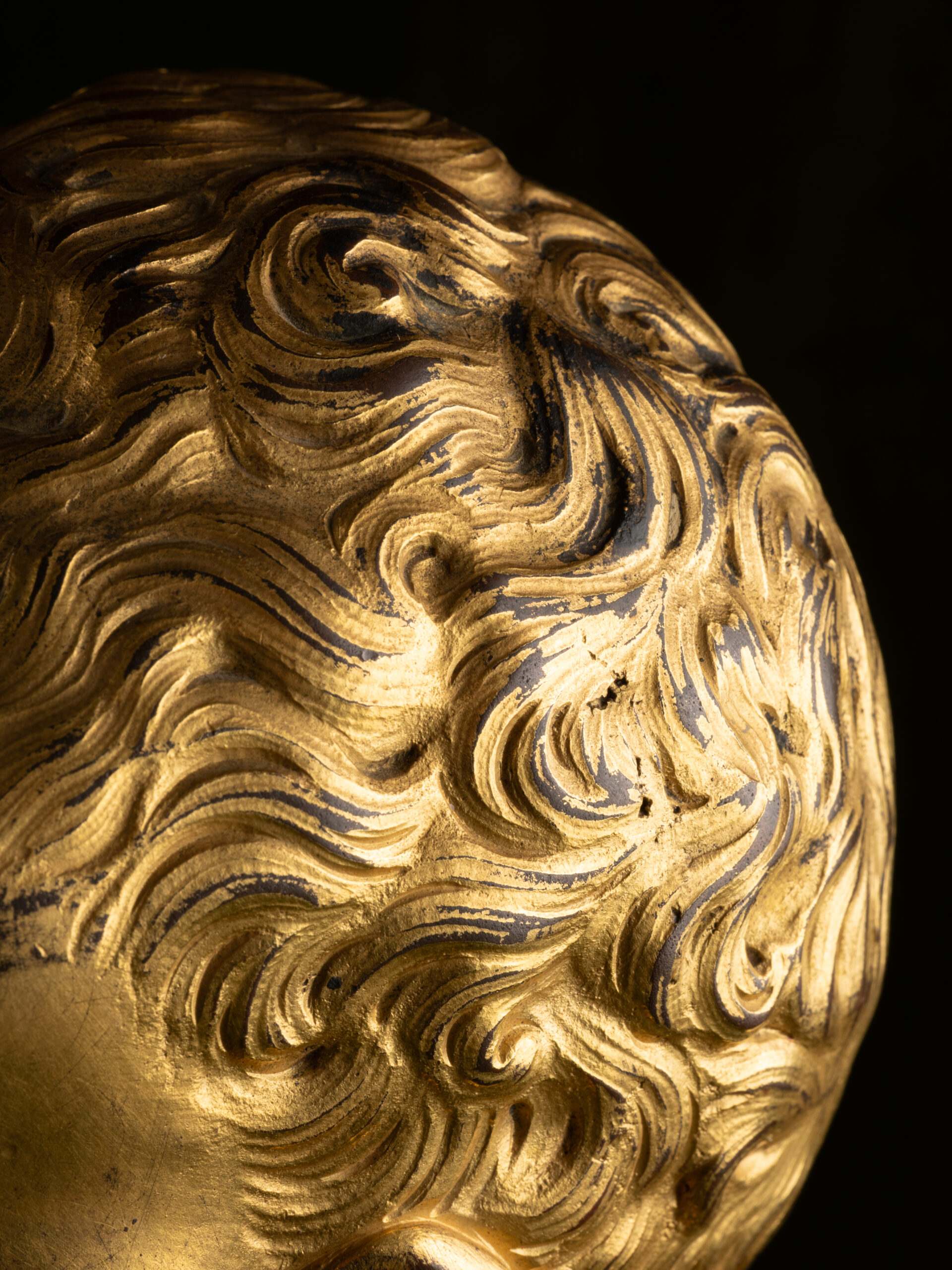
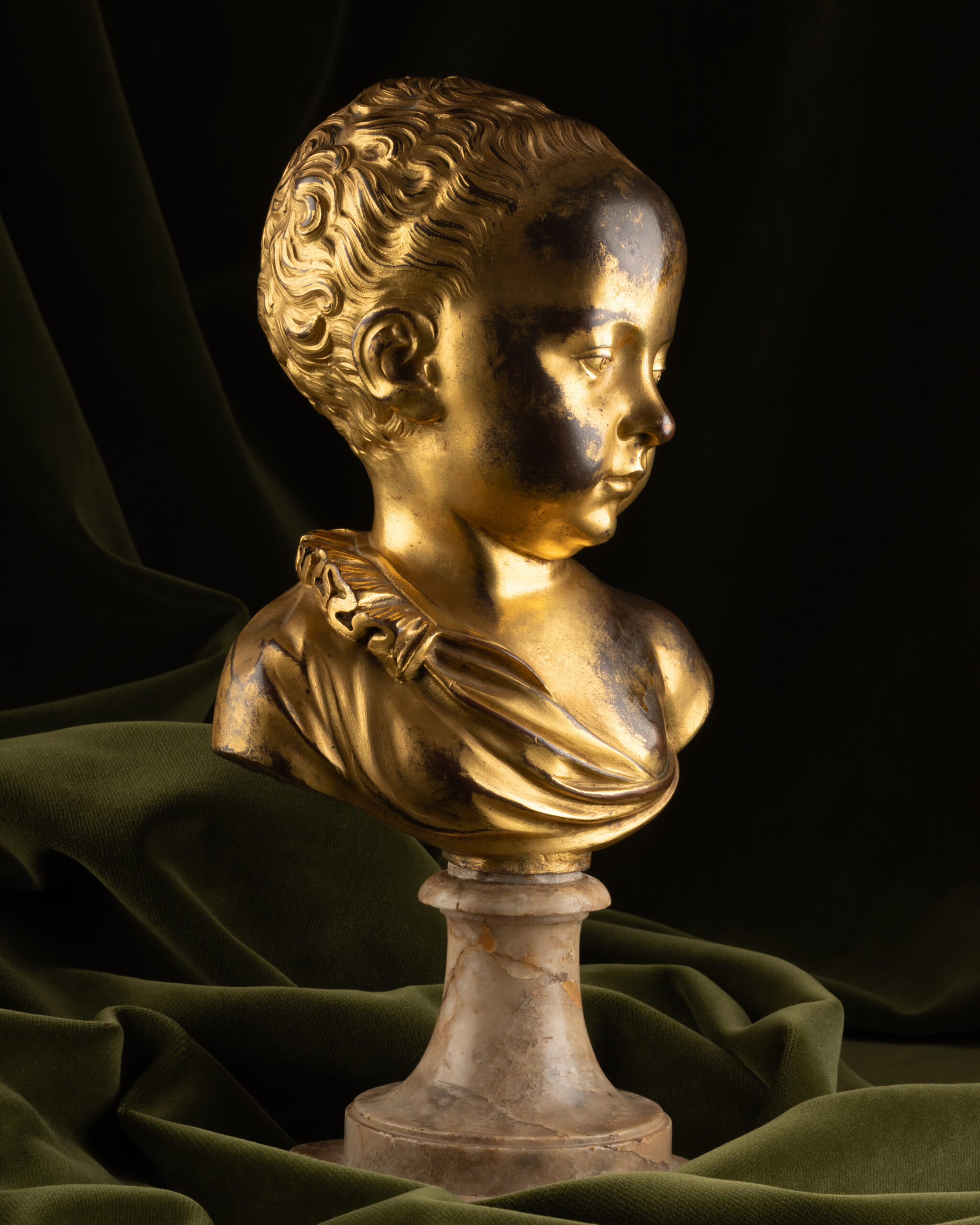
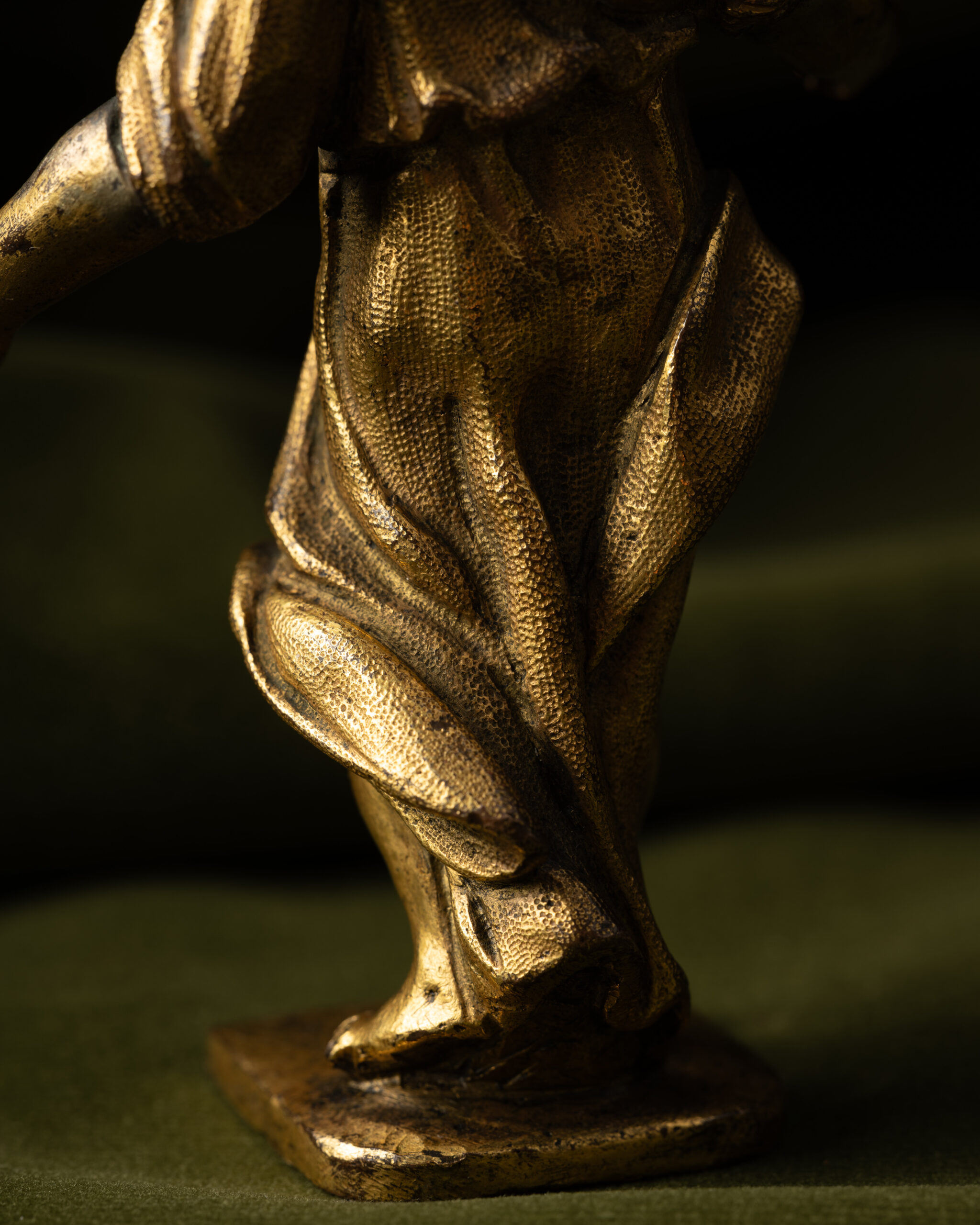
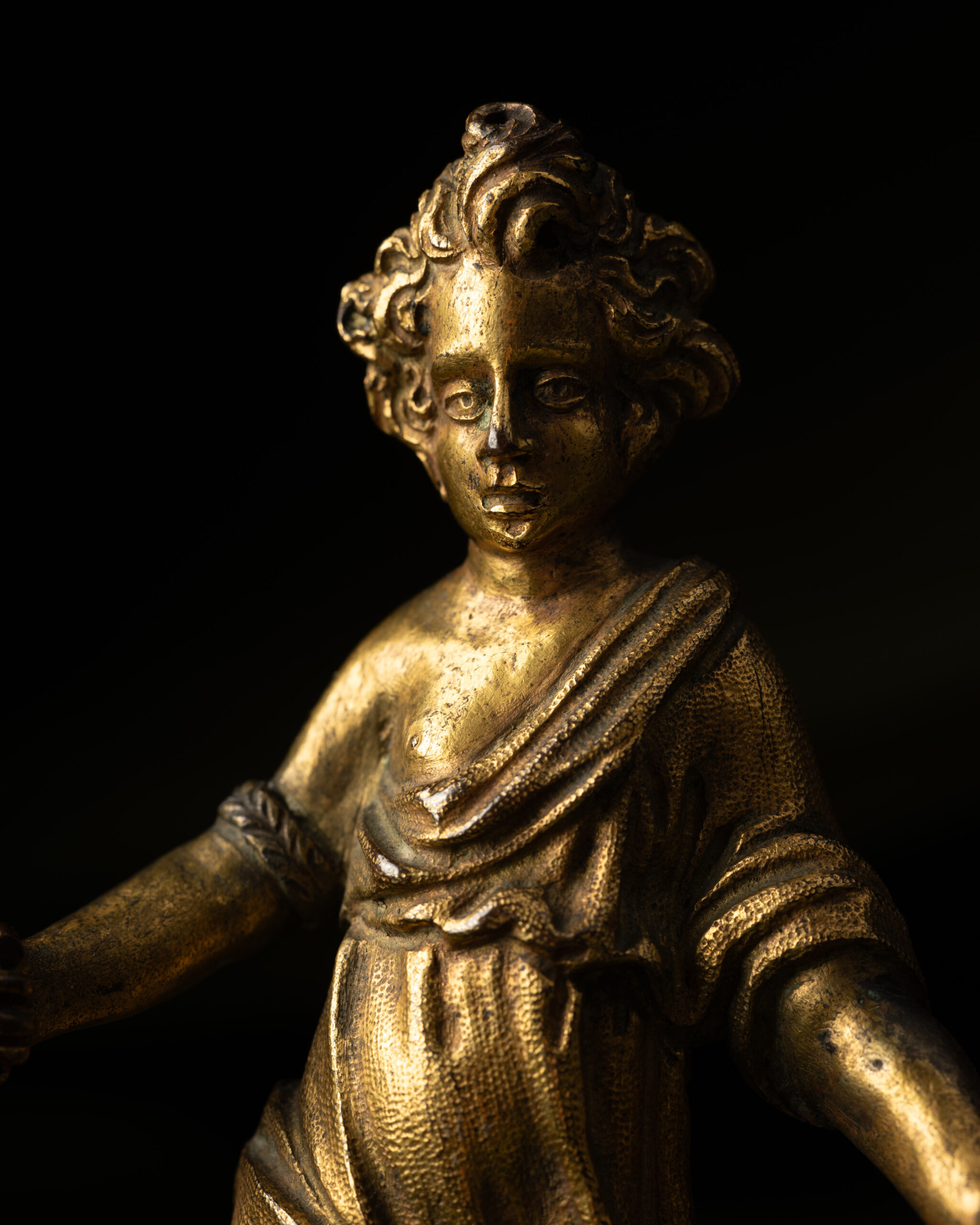
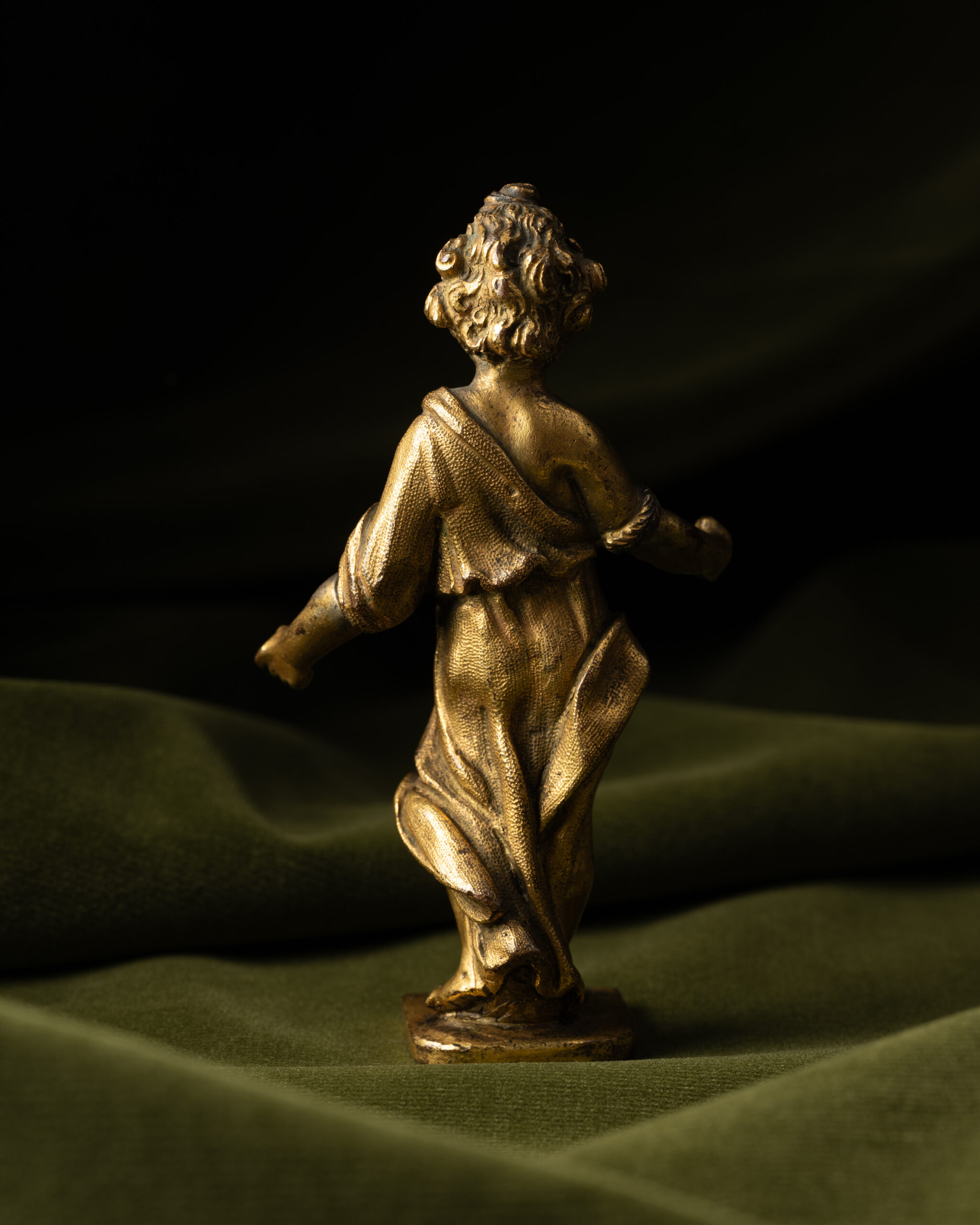
Bust of a Child after Germain Pilon.
Gilt bronze, alabaster France Late 17th century h. 33.5 cm (13,2 in.)
A similar gilt bronze bust was exhibited in 1967 at the Château de Laarne during the exhibition “Bronzes de la Renaissance de Donatello à François Duquesnoy” (Renaissance Bronzes from Donatello to François Duquesnoy). This latter piece traditionally came from the Russian Imperial collections, and had, in all likelihood, been acquired by the art historian and collector Henry-René d’Allemagne during the numerous dispersals of private Russian collections after the October Revolution. Because it was a cast of a Bust of a Child in marble preserved at the Louvre and attributed since the end of the 19th century to Germain Pilon or his workshop, this gilt bronze version had at the time been dated to the late 16th century, Germain Pilon having died in 1590.
Although the present bronze is certainly by the same hand as that of Henri-René d’Allemagne, it seems unlikely that this hand is that of Germain Pilon or a student from his workshop, as no gilt bronze bust from that time is known and attributed to either Germain Pilon or his workshop. It is true that the Wallace Collection in London possesses a bronze cast of the bust of Charles IX preserved at the Louvre. This bust, in marble and alabaster, dated 1568, appears in the post-mortem inventory of Catherine de’ Medici, and no one other than Germain Pilon seems to have been capable of sculpting such a portrait. The Wallace Collection bronze, traditionally from the collections of the Duchess of Berry, seems to attest to the early existence of bronzes cast after the sculpted portraits by Germain Pilon — royal portraits, or thought to be so, whose originals had been gathered by Cardinal de Richelieu only four decades after Germain Pilon’s death, in the context of his “Galerie des illustres” at the Palais Cardinal, which became the Palais Royal in 1643.
The very program of the Galerie des Illustres allows for addressing the delicate question of the subject’s identity in this bust. Titled Bust of Henri IV as a child during the 1967 exhibition, it had initially been designated as a portrait of Henri III by Barbet de Jouy in 1873, for the reason that the subject presents some similarities with a toddler sketched in a late 16th-century red chalk drawing, preserved at the Bibliothèque Nationale and bearing a notation, probably later, designating this child as Henri III. The problem of the dating, attribution, and identification of the subject of this bust was summarized by the historian Louis Gonse in an aside of an eulogy for Germain Pilon and this bust:
“He knew how to question the troubled soul of his models, just as he knew, on occasion, how to render with infinite skill the fleeting graces of childhood. If it is, as has been believed, a portrait of Henri III as a child, the little Louvre bust would be from the master’s youth. It seems to me to be of too accomplished an art not to belong, like the other busts, to his last period. Moreover, it is very difficult to identify the features of a model of that age. Doubts have even been raised about the attribution of this bust to Pilon. Some people wanted to attribute it to François Duquesnoy, but it is certainly from the 16th century and in the manner of Pilon, who here rivals the Florentines, those consecrated interpreters of putti.”
It is noteworthy that it did not occur to either Barbet de Jouy or the commissioners of the 1967 exhibition that the dates of Germain Pilon’s activity, on the one hand, and the evident age of the child portrayed, on the other, are incompatible with the birth dates of these kings: no work by Germain Pilon is known before his participation in the work on the tomb of François I in 1558; as for Henri III and Henri IV, they were born in 1551 and 1553 respectively. The Bust of a Child at the Louvre, if this child is indeed the future Henri III, would then be one of the first known works by Germain Pilon, completed before he gained favor with Catherine de’ Medici and became, so to speak, the sculptor of her Court. Furthermore, there already exists a bust of Henri III firmly attributed to Germain Pilon, by the same hand as that of Charles IX, also mentioned in the queen mother’s post-mortem inventory, and further cited in Richelieu’s collections at the Palais Cardinal. Henri III appears in it at maturity, and everything suggests that it dates from the same time as the aforementioned bust of Charles IX, namely the year 1568.
If the child in Germain Pilon’s bust is indeed one of Catherine de’ Medici’s sons, the least improbable hypothesis is that it is Hercule de France, Duke of Alençon, the last son of Henri II and Catherine de’ Medici. This duke, who took the name François de France after the death of his brother King François II at age 16 in 1560, did not leave a significant mark on the history of France. Thus, it is probable that the importance of this bust was caused, in the 17th century as in the 19th and 20th, by a confusion or a presumption, through which this young prince was mistaken for Henri III or Henri IV, Kings of France. The Russian provenance of the bust exhibited in 1967, if proven, could also be explained by such a presumption: Henri III, King of France upon the death of his brother Charles IX in 1574, was also King of Poland in 1573 and Grand Duke of Lithuania.
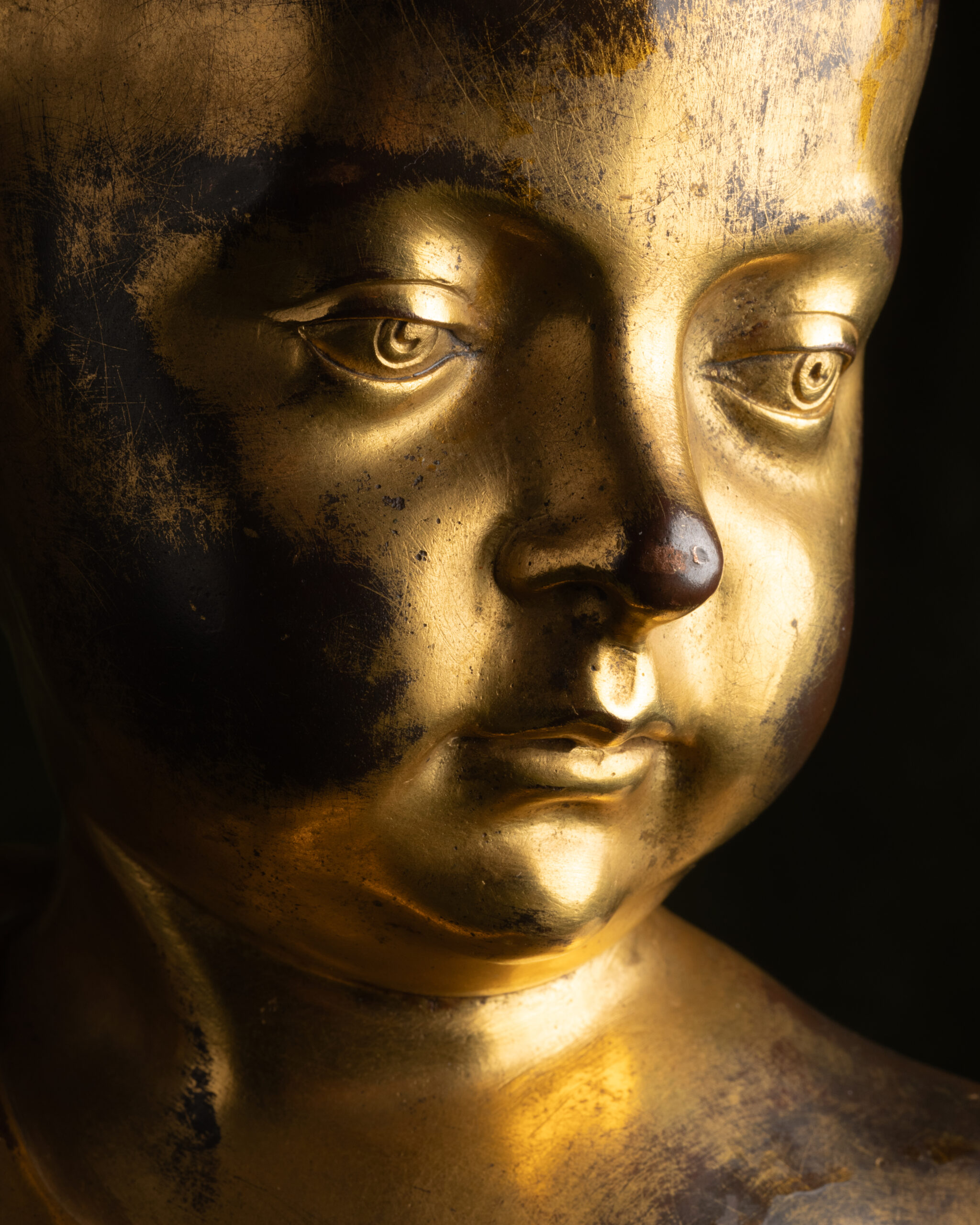
As for the dating of the present bronze and the one from the Russian Imperial collections, it is noteworthy that they share the same treatment of the iris, in the form of an incised spiral, which is typical of bronze portraits from the second half of the 17th century. A bust, also in gilt bronze, of Louis XIV by or after Coysevox, also preserved in the Wallace Collection in London, and undoubtedly related to a bronze bust of the same king presented by Coysevox at the Salon of 1699, is the closest work, in terms of technique and style, to these two bronzes. Since gilt bronze busts of this type are, on the one hand, remarkably rare in public collections, and the use of an incised spiral as an iris is, on the other hand, characteristic of sculpted portraits from the second half of the 17th century onwards, this parallel supports a later dating than that proposed at the 1967 exhibition, namely the late 17th century and not the late 16th.
Literature
Louis Gonse, La Sculpture française depuis le XIVe siècle, Paris, 1895; Émile Molinier, “Un buste d’enfant du XVIe siècle,” in Monuments et mémoires de la Fondation Eugène Piot, vol. 6, no. 1, 1899; Jean Babelon, Germain Pilon, Paris, 1927; Charles Terrasse, Germain Pilon, Paris, 1930; Henry-René d’Allemagne, La maison d’un vieux collectionneur, vol. II, Paris, 1948; Bronzes de la Renaissance de Donatello à François Duquesnoy, Brussels, 1967; Pierre Chevallier, Henri III, roi shakespearien, Paris, 1985; Jean-René Gaborit, Geneviève Bresc-Bautier et al., Sculpture française II. Renaissance et Temps Modernes, Paris, 1998; Robert Wenley, French Bronzes in the Wallace Collection, London, 2002; Geneviève Bresc-Bautier, Guilhem Scherf et al., Les Bronzes français de la Renaissance au Siècle des lumières, Paris, 2008.
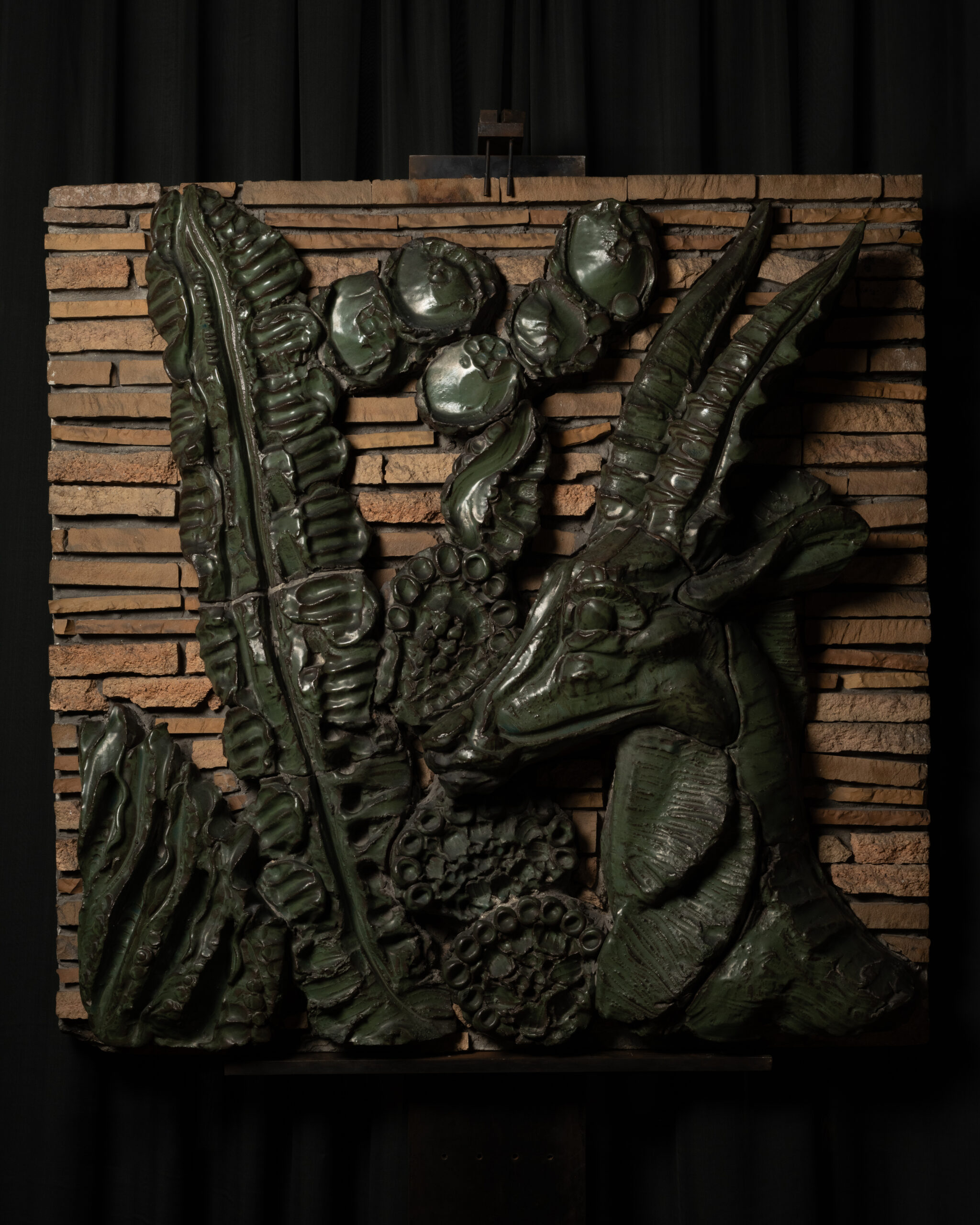
High-Relief Modello of the Antilocapra by Jean Mayodon
High-Relief Modello of the Antilocapra by Jean Mayodon
Glazed ceramic France ca. 1935 [Dimensions — to add]
Jean Mayodon’s personal collection (at least 1938 – his death, 1967) — Mayodon family — Private collection (held over 20 years).
Fig. 1, « Paquebot Pasteur » stamp, sold « 25 000 euros sans surcharge », in « Philatélie : Grande Armée, guerre de 1870-1871, 1 franc vermillon, « Paquebot Pasteur », pièces vedettes des prochaines ventes », Le Monde, May 19, 2019.
On June 9, 1980, sank the Filipina Saudia, off the coast of the Indian Ocean. This forty-year-old liner, which had left Jeddah to reach Manila, had had an eventful life and many owners. The Filipina Saudia I had been named so when it was acquired in 1976. Before, it was known as the Regina Magna ; but Regina Magna was not the real name of the ship. It had been named this way five years earlier, in 1971, upon its acquisition by the Greek shipowner Chandris. But what Chandris had bought that year was a ship called the Bremen, and ‘Bremen’ was a name that had been given in 1957 by the Norddeutscher Lloyd to a truly mythical ship : the Pasteur.
Fig. 2, The Pasteur at the arsenal of Saint-Nazaire, in La Science et la Vie, p. 163.
The SS Pasteur, a French liner 695 ft long, 87 ft wide, capable of carrying at least 26,500 tons, with 50,000 HP to cross the South Atlantic with 850 passengers on board, at a service speed of 22.5 knots. On her maiden voyage, the Pasteur was set to sail for Buenos Aires. Departure was planned on 14 September 1939. But the war prevented her from doing so : in August 1939, she returned to Saint-Nazaire to be transformed. Nearly a year later, after the German invasion of May 1940, she left for Brest. There she was loaded with a large quantity of gold, 213 tons from the vaults of the Banque de France, to be delivered to Halifax. After Halifax, she sailed to New York, to be loaded with weapons and ammunition, and sailed back to Halifax. This is when the British took control of her. They sent her to England. There, she was transformed a second time, to carry troops. Now a trooper, the former liner travelled between Southampton and Quebec. She also brought reinforcements to Suez after the German assault on El Alamein.
After returning under French control in October 1945, there was nothing left, of course, of the luxurious facilities that had made the fame ofthe Pasteur and those who designed her. Her once revered swimming pool, which before the war had featured in many advertisements and magazines, was then used to store soldiers’ rations. And even after the war the Pasteur kept sailing the Atlantic and Indian oceans. She made stops in Indochina and Africa until 1957. This is when she was sold, painfully and with some scandals, by the French government, looking for savings and for liquidity. The Pasteur was then acquired by Norddeutscher Lloyd, now Hapag-Lloyd, and became the Bremen.
In the months leading up to her inauguration, the Pasteur‘s first trip was advertised at great expense in the major magazines and newspapers. One article of Le Temps said that :
Passengers will find all the comfort they need : a library with thousands of books, an orchestra, movie screenings and ballrooms. Sports were particularly thought about on a ship set to sail under a heavenly climate and calm weather. An entire deck, 425 ft long, has been dedicated to sports, including a tennis court, all possible deck games, a bar and a lounge — perhaps the most successful innovation on board. Covered in raffia and bleached hemp rope, with 54 picture windows opening directly onto the sea, it is a real floating club. A dedicated staircase connects the lounge to the rooms of mechanotherapy and hydrotherapy, and to a superb swimming pool, adorned with a large 23 ft high decorative ceramic panel by Mayodon.
Fig. 3, The Pasteur’s Swimming Pool, in À Bord des paquebots. 50 ans d’arts décoratifs, Paris, 2011, p. 235.
Designed by the architects Maillard and Raguenet, the Pasteur was meant to be a sumptuous, lavish, almost paroxysmal enterprise : lightings by Perzel and Ingrand, ironwork by Subes, furniture by Majorelle and Leuleu, and — last but not least — a gigantic swimming pool (fig. 3) designed by Georges Hennequin and enhanced by a monumental bas-relief by Jean Mayodon, one of the greatest ceramists of his time.
About the swimming pool, Raymond Lestonnat, the ‘naval pundit’ of the leading weekly publication L’Illustration, wrote :
And what about the pool ? True magic. Lit up with diffused light, a submarine light, so to speak. The walls and floor are covered with glazed stone. Two terraces with a view on the sea, connected to the pool so the bathers can grab a drink at the bar without having to walk by the clothed tourists of the deck. Even the great and fashionable resorts are not so well equipped.
Jean Mayodon already a well-known ceramist when he was chosen to decorate the Pasteur’s swimming pool, famous especially for his ‘rich bestiary’ of swans, peacocks, horses, lions, gazelles. He had exhibited at most major shows, including the Salon d’Automne and the Palais Galliera. He was also a rising star at the prestigious Manufacture de Sèvres.
Jean Mayodon devant ses œuvres (1925), dans Gérard Landrot, Mayodon, Luxembourg, 2004, p. 67.
Born in 1893, Jean Mayodon began his career as a painter, and a painter he never ceased to be. An art critic, Ernest Tisserand, wrote in 1928 : ‘Apart from the fact that Mayodon, for ten years of his life, was almost exclusively concerned with painting on canvas, he reveals himself, in all his current works, as the only painter of frescoes that we have today’. Jean Mayodon himself confirmed this painter’s spirit in an interview quoted by Gérard Landrot : ‘I still have in my hand all the drawings and ornaments I used to do when I was a decorative painter. I love nudes and animals, and above all gaudy colours.’
It was around the age of 19, in 1912, that Mayodon began to work with ceramics. He was so evidently gifted that decorative artist Henri Hamm noticed him the very same year, and helped him exhibit his first works at the Salon d’Automne.
Mayodon’s fame in the 1920s was mainly due to his iconic vases, colourful and often gilt, with shapes inspired by Greek red-figure ceramics. At the time, Jean Mayodon was, so to speak, the leading ceramist to whom the greatest architects and decorators of the period turned, from Jules Leleu to Ruhlmann, not forgetting Porteneuve, Subes and Printz.
At the beginning of the 1930s, when he designed his first sketches for the huge bas-relief of the Pasteur — most likely in 1935 — Mayodon was somehow still rising : the Manufacture de Sèvres, undoubtedly the most famous porcelain factory in Europe since it was founded in 1756 — where he had trained under Ambroise Milet, and of which he would become artistic director in 1941 — had taken him onto its prestigious artistic board a year earlier, in 1934. But it was also, for Jean Mayodon, what could be said his ‘monumental period’ : once a decorative artist, who had crafted sumptuous but discreet pieces chosen to enhance interiors designed by great architects, Mayodon was now creating immense sculptures, works of fine art that, while still designed to fit into carefully designed interiors, could now have a life of their own and exist for their own sake. Between 1931 and 1938, Mayodon produced several monumental panels and reliefs : a large relief for the Dubly apartment, decorated by Ruhlmann ; the large relief for the Golden Age in 1936 ; and another large relief, with several panels, for the World’s Fair 1937. In other words, Jean Mayodon was clearly an artist at his technical acme when he agreed to supply the monumental relief for the Pasteur’s, and designed the Antilocapra modello.
The monumental haut-relief of Le Pasteur, baked in a large fire, is 30 ft high (a total of 23 ft according to the article in Le Temps, which probably does not include the underwater part of the relief, cf. pl. I), and had as its subject the flora and fauna of South America. The composition was bronze-green against a background of beige to pinkish red, a colour chosen by the architect Georges Hennequin, who had undertaken to line the walls of the pool with terracotta bricks. Now lost — no one knows if it was dismantled or destroyed during one of the Pasteur‘s many conversions, or if it sank with the ship in 1980 — nothing remains of Mayodon’s masterpiece, apart from the illustrations (fig. 3) and photographs (pl. II) of the pool ; and apart, of course, from the prototypes designed by the artist in the years leading up to the Pasteur’s inauguration.
This modello, representing an earlier version of the final high relief, is therefore one of the last remnants of what is perhaps the masterpiece of one of the greatest ceramists of the 20th century. Very similar in style and technique to the large Hunting Scene on held at the Musée Despiau-Wlérick in Mont-de-Marsan, this modello came from a private collection, where it was held for over 20 years. It previously belonged to the Mayodon family, having been in Jean Mayodon’s personal collection from at least 1938 until his death in 1967.
Literature
Ernest Tisserand, « Mayodon, Jean. Peintre et céramiste », in L’Art et les artistes. Revue mensuelle d’art ancien et moderne, Paris, 1928. Le Temps, « Le Paquebot « Pasteur » », August 29, 1939. Le Monde, « Sous le nom de « Bremen », la troisième unité de notre flotte concurrencera l’ « Île-de-France » sur l’Atlantique », July 19, 1957. Le Monde, « Le « Pasteur » est arrivé à Brême », Octobre 1st, 1957. Le Monde, « Première escale d’un transatlantique allemand en France depuis dix-neuf ans », July 26, 1958. Gérard Landrot, Mayodon, Luxembourg, 2004. Judith Miller, Art Deco, London, 2005. Frédéric Ollivier, Aymeric Perroy and Franck Sénant, À Bord des paquebots. 50 ans d’arts décoratifs, Paris, 2011. Olivier Le Bihan, Céramique d’artiste. Derain, Dufy, Matisse, Miró, Picasso…, Milano, 2012. Nicole Blondel, Céramique. Vocabulaire technique, Paris, 2014. Le Monde, « Philatélie : Grande Armée, guerre de 1870-1871, 1 franc vermillon, « Paquebot Pasteur », pièces vedettes des prochaines ventes », May 19, 2019.
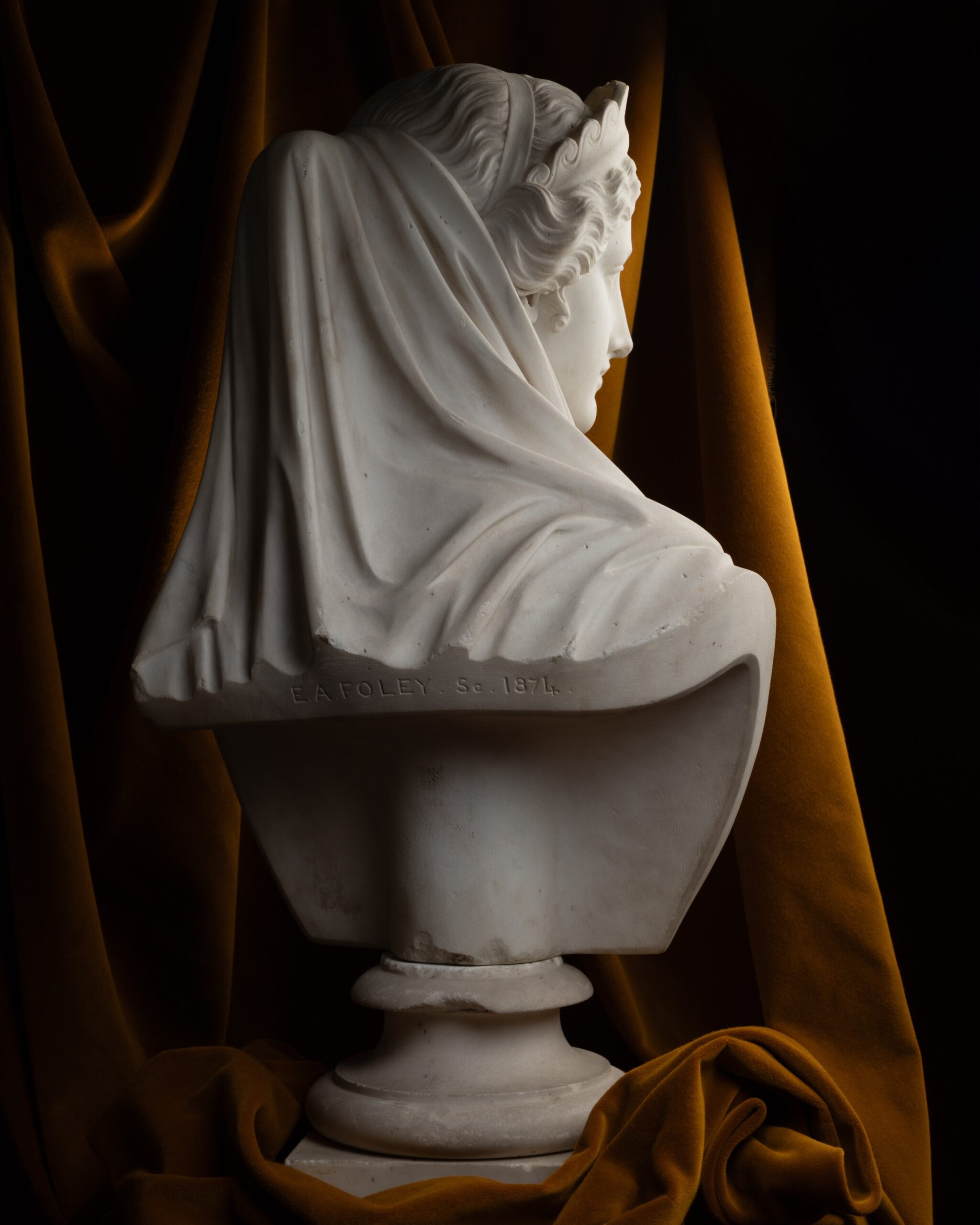
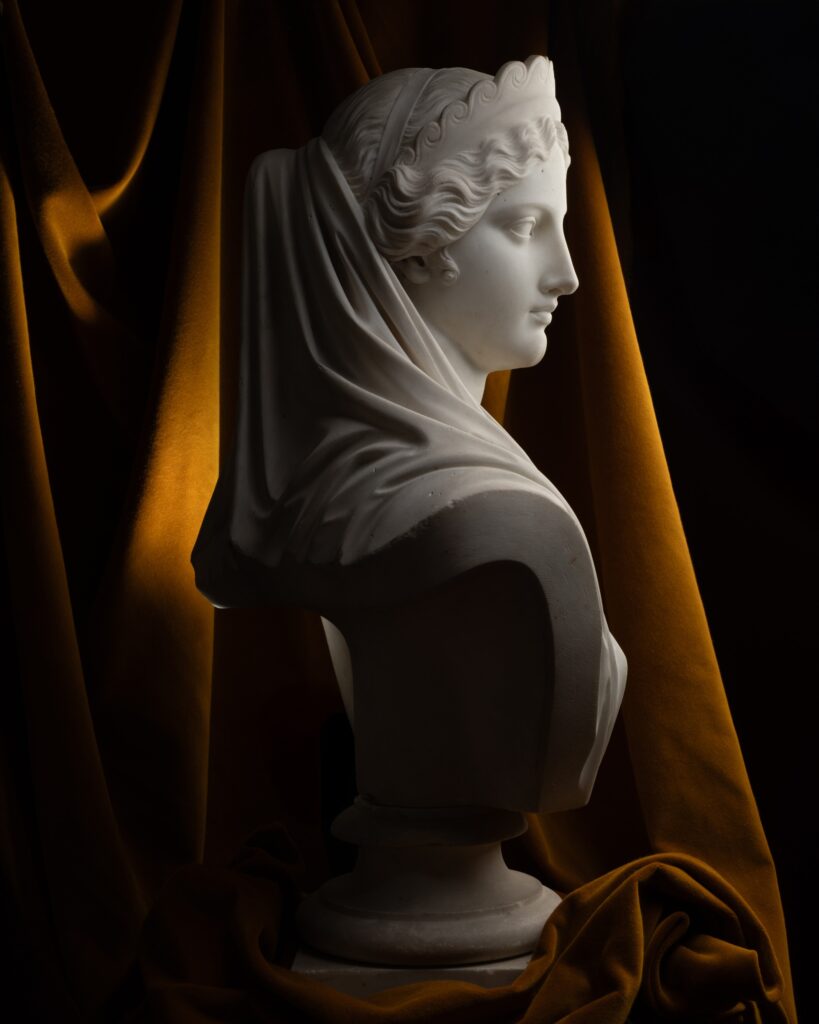
Carrara marble London 1874 26 x 16.55 x 9.85 in. (66 x 42 x 25 cm)
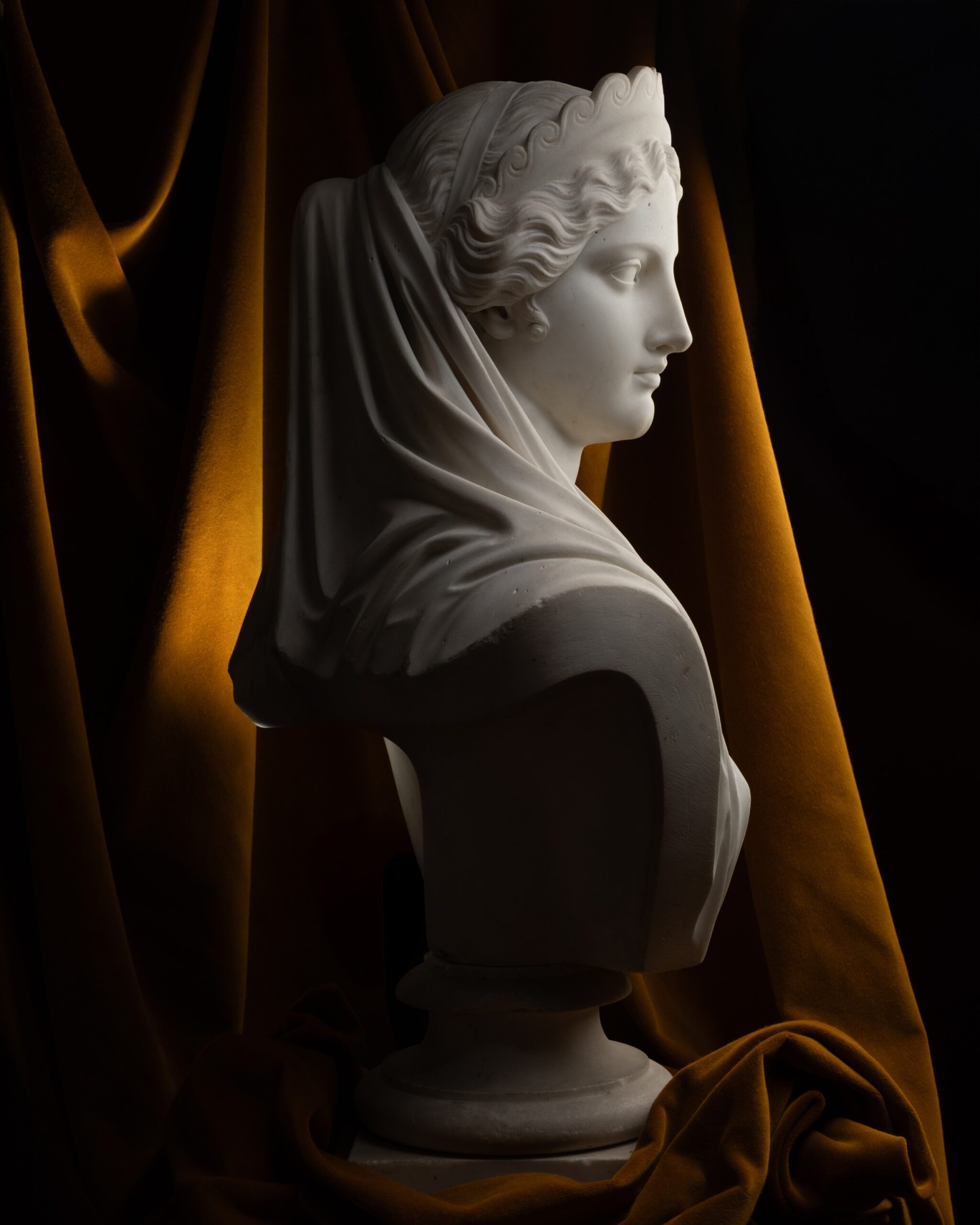
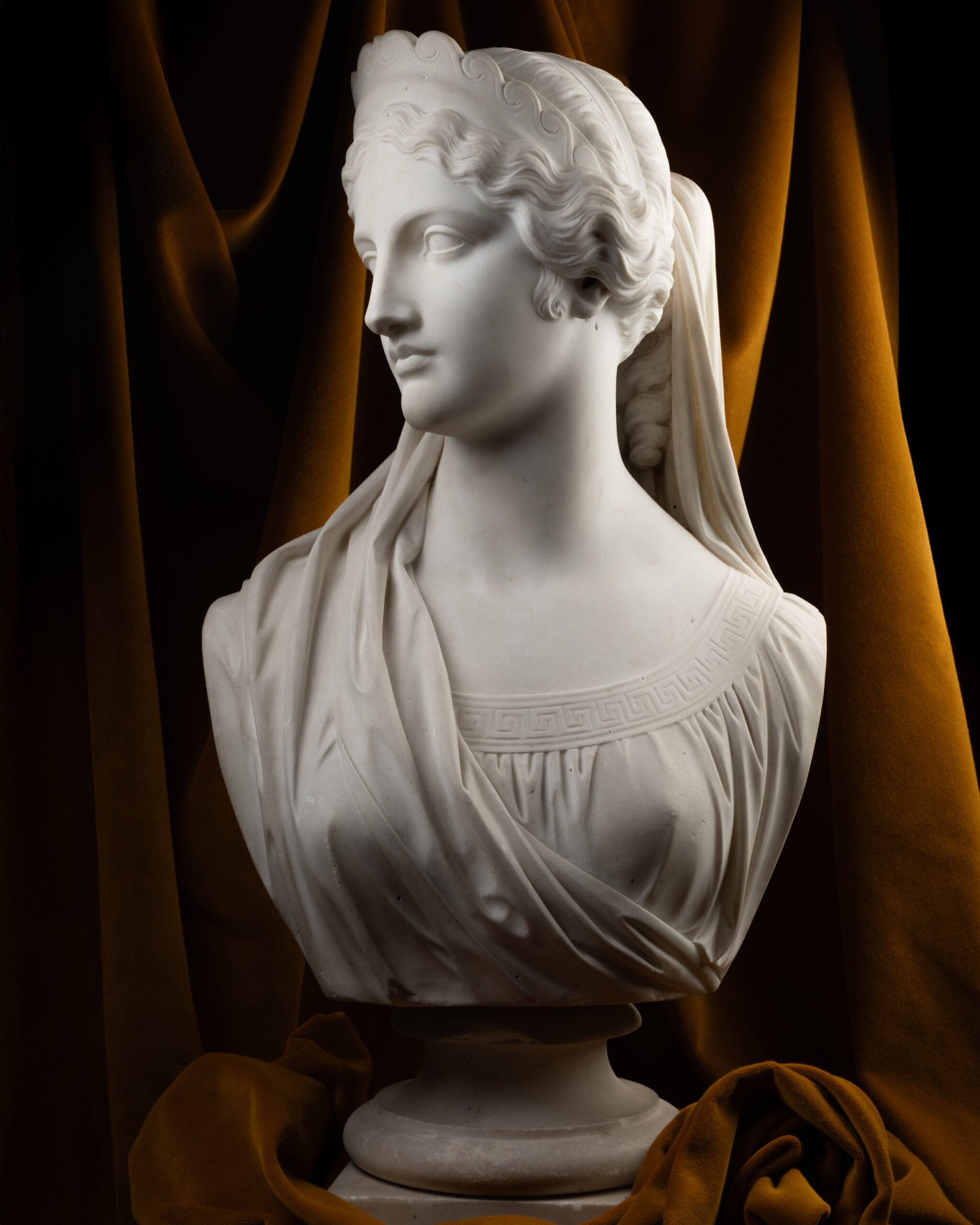
This bust of Helen of Troy bears the signature of a tormented artist. Edward Arlington Foley, who signed : “E. A. Foley. Sc. 1874.”, was born in Dublin in 1814, trained at the Royal Dublin Society and under now-forgotten Irish sculptors, his kinsman Benjamin Schrowder and John Smyth. Unable to establish himself as a sculptor in Ireland, he soon settled in London, specialised in portrait busts, and began exhibiting at the Royal Academy in 1834, where “his busts, with several graceful ideal works, appeared almost every year down to 1873.” Among the busts displayed at the institution’s exhibitions are busts of Samuel Lover of 1839, now at the National Portrait Gallery, of the singer Catherine Hayes in 1855, which he sculpted and exhibited again in 1861, the nymph Oenone in 1869, Penelope in 1870, and a Morning Star in 1873, an allegory most mysterious and haunting inspired by Milton :
“Hail bounteous May that dost inspire Mirth and youth, and warm desire…”
Yet Edward Arlington Foley took his own life the following year, in the month in May. The Annals of journalist Joseph Irving report that on May, 10,
“Drowned in the Regent’s Canal, Edward A. Foley, sculptor…”
And a record from that year recounts that Edward Foley, who had recently taken to go on long walks late at night, left his home near Mornington Crescent shortly before midnight. A man saw him by the canal around two in the morning : he was seated on the railing of the Albert Road Bridge, his legs hanging over the waters. The man passed by, then heard a loud noise : Foley was gone, and he was dead by the time he was pulled from the water.
A brief biographical note from the National Gallery of Dublin’s archives, reveals that Foley, failing to pay child support, was imprisoned for debt at the end of 1873. Though Edward exhibited almost continuously at the Royal Academy, he seems to have always worked in the shadow of his younger brother, John Henry Foley, a full member of the Academy and arguably one of the most celebrated British sculptors of the Victorian era. The beauty of this bust is the work of an artist in dire and penniless.
It is the scenes, highly celebrated in the first half of the 19th century, engraved by Tommaso Piroli after the drawings of John Flaxman to illustrate a 1805 edition of the Iliad and the Odyssey, that inform the iconography of this bust : when Aphrodite, disguised as a Phrygian servant and wearing the pilos, leads Helen into Pâris’ chamber in the third book of the Iliad, Helen wears a veil over her hair and a diadem adorned with so-called ‘Vitruvian’ scrolls, akin to that of our bust. Flaxman’s Penelope, by contrast, throughout the Odyssey, is crowned with a slightly taller diadem featuring a frieze of anthemia.
As Canova, who chose to depict Helen with the Phrygian pilos, Foley was fond of ideal heads. This is shown by his Penelope, Œnone, and Hermione — from Shakespeare’s Winter’s Tale, not Euripides’ Andromache — exhibited at the Royal Academy. These Greek queens and deities allowed him to sculpt some ideal beauty, which is rare in Victorian statuary, where female portraits were, moreover, uncommon. Edward Foley had previously exhibited a Helen of Troy at the Royal Academy in 1866, though it is impossible to determine how that work differed from the present work.
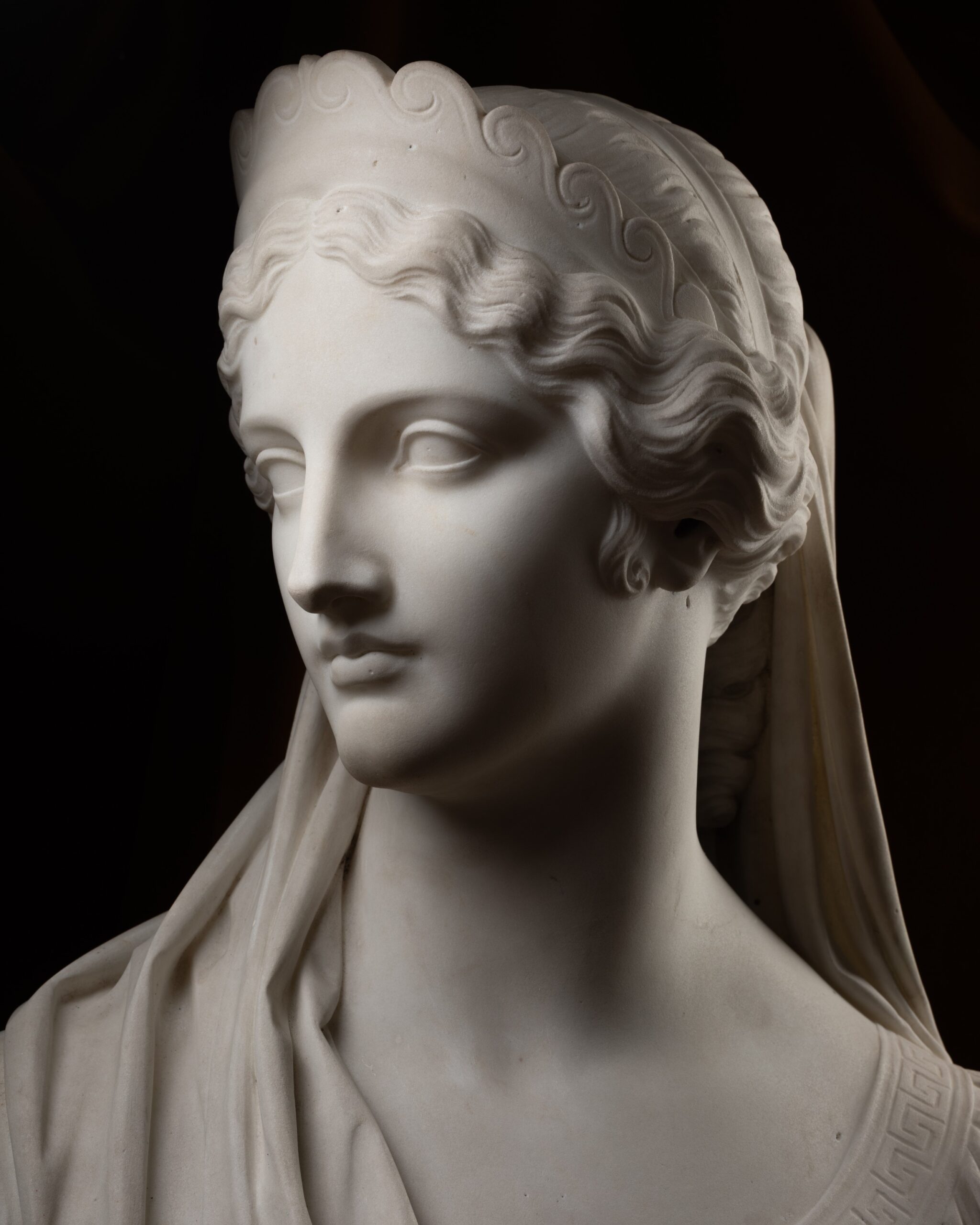
Thus, this bust of Helen of Troy, dated 1874, signed a few months at most before the sculptor took his own life, is most likely his final work. With this Helen, Foley puts to an end a series of ideal beauties begun eight years earlier with the same subject. It is arguably, as a matter of skill and technique, his most accomplished work : in a true feat of artistry, he managed to sculpt the sumptuous curls of Canova’s Venus Hope, though half concealed beneath an ample veil. Helen’s face, closely resembles another bust : his latest work preserved in public collections, that is a Portrait of a Young Girl dated 1873, held at the National Gallery of Ireland, which, like our Helen, reveals in the girl’s face and the rendering of her clothing the ultima maniera of the sculptor.
Literature
The Exhibition of the Royal Academy, 1873. The 105th., 1873 ; Joseph Irving, Supplement to the Annals of our Time, Londres, 1879 ; Algernon Graves, The Royal Academy of Arts. A Complete Dictionary of Contributors and their Work from its Foundation in 1769 to 1904, vol. 3, London, 1905 ; Walter George Strickland, A Dictionary of Irish Artists, Dublin, 1913 ; John Turpin, “The Career and Achievement of John Henry Foley, Sculptor (1818-1874)”, in Dublin Historical Record, vol. 32, n° 2, march 1979 ; Katherine Eustace, Canova. Ideal Heads, Cambridge, 1997.
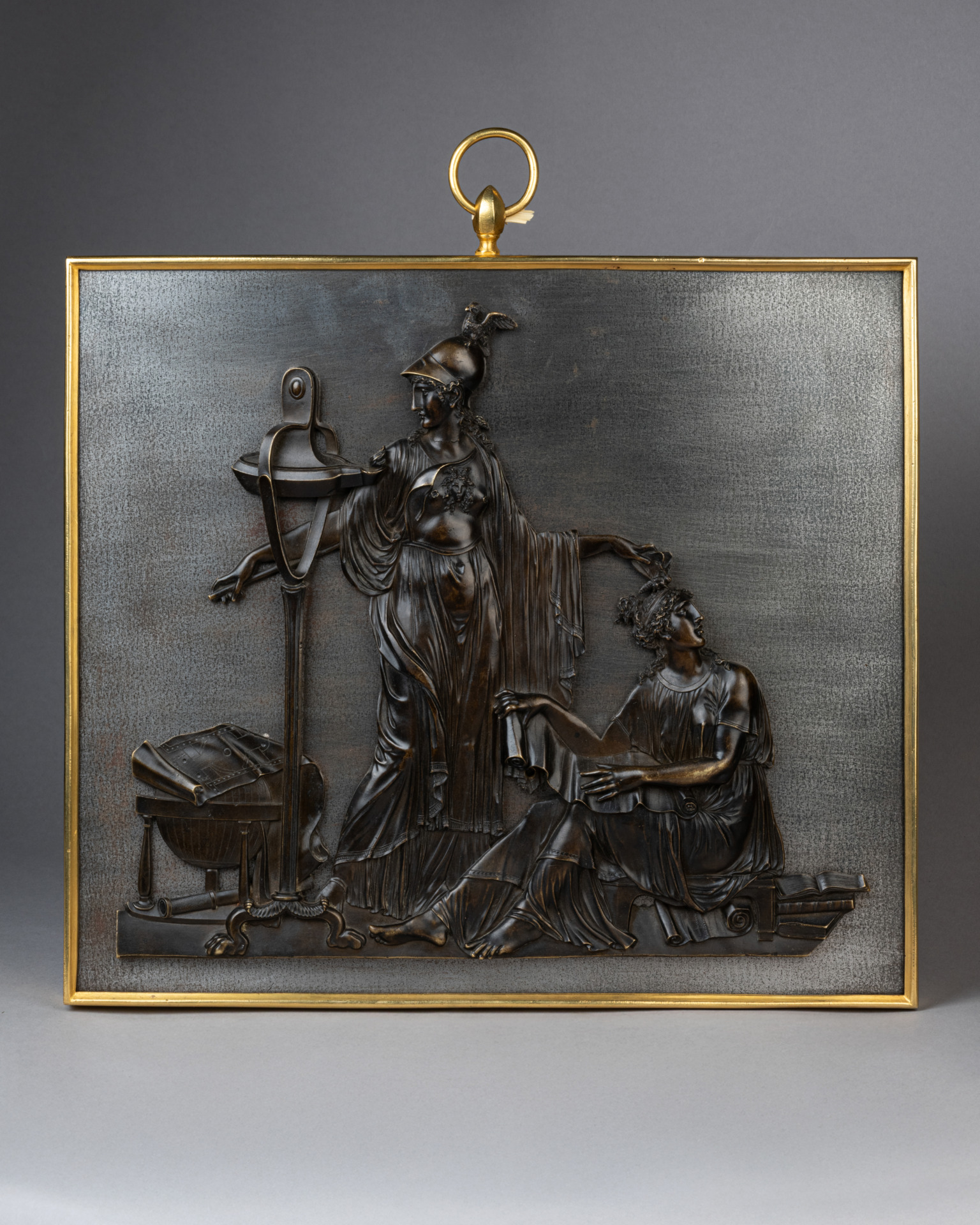
A Bronze Relief depicting Reason guiding Science through Conscience
Patinated bronze France 1790-1810 34 x 31 cm
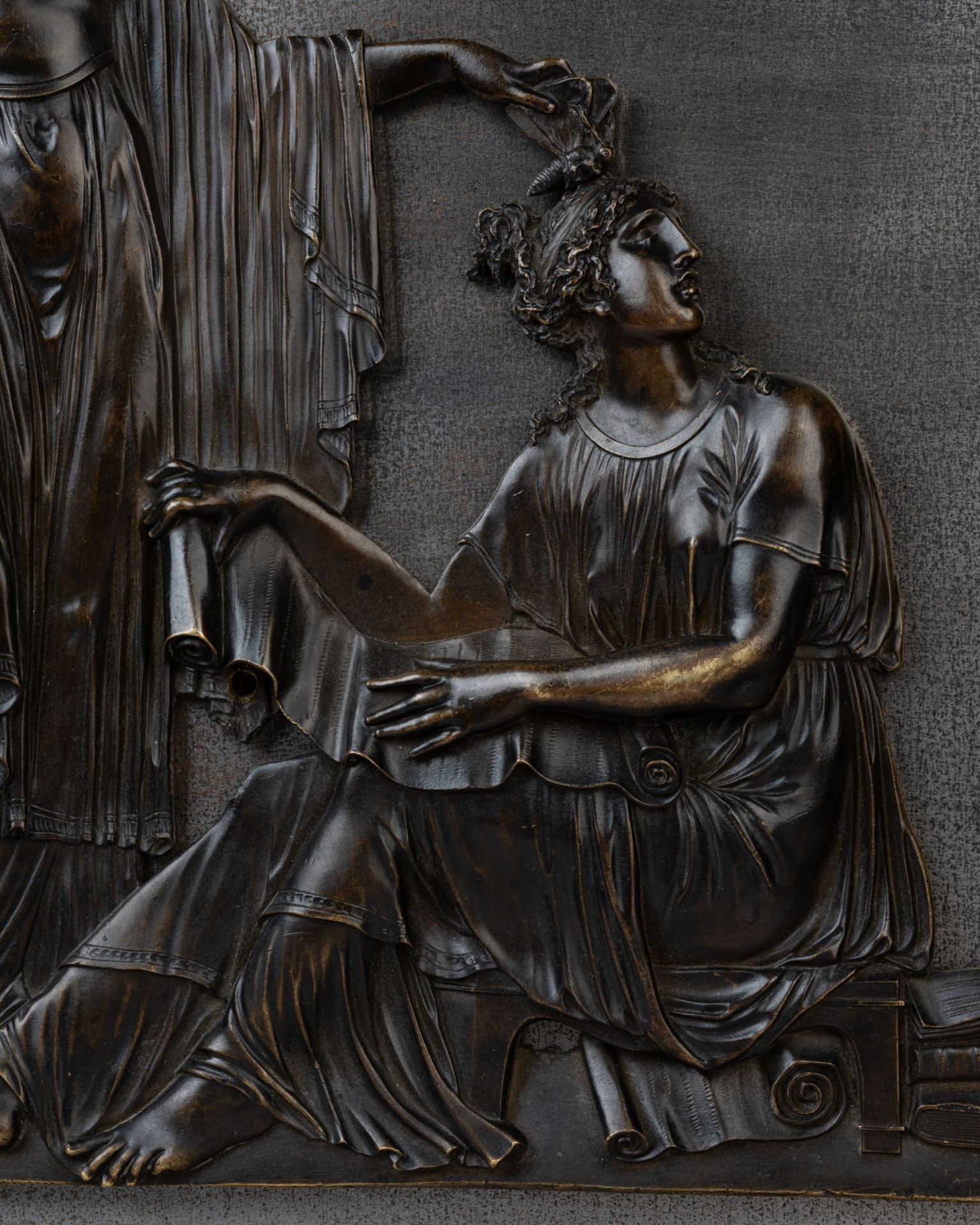
The gesture of Minerva, placing a butterfly on the head of another woman, is borrowed from a type of ancient sarcophagus where Athena, or Minerva, breathes the soul into Protoplasm, i.e. the first man fashioned by Prometheus. Such a sarcophagus, from the collections of Camille Borghese, has been in the Louvre since 1807, where Minerva’s gesture is simplified so that the wings of the characteristic butterfly cannot be distinguished.
On a Capitoline sarcophagus of the same type, however, where, as in the Louvre, Prometheus, seated, holds, with his left hand, the Protoplasm standing on his lap on whose head Minerva, on his right, places a hand, the butterfly, which she holds by both wings, is clearly visible. Berthel Thorvaldsen repeats the same gesture in a series of bassorilievi, probably conceived in Rome around 1806-1807 and listed in the catalog of the Thorvaldsen Museum in Copenhagen as Minerve granting the soul to the human being created by Prometheus.
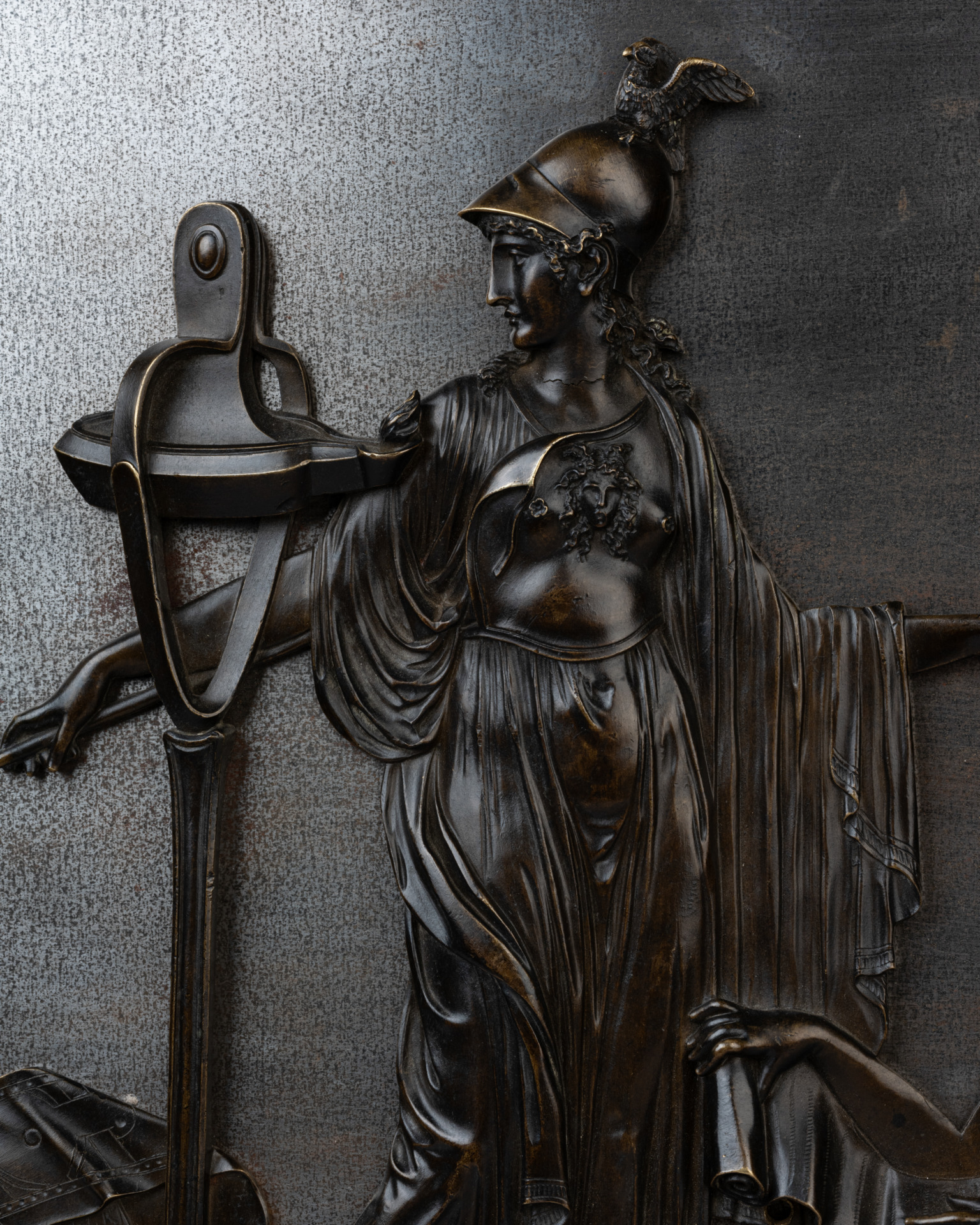
Here, then, is a rare but not unprecedented motif, thus adapted to the iconography of the Republic and the Enlightenment: Minerva, allegory of Reason or Wisdom, and who wears the aegis on her breast, places a butterfly on the head of a young woman, in whom we should no doubt see a personification of the Sciences — surrounded by books, a globe, a telescope, and an oil lamp signifying by whose light one lights up on nights of study. Minerva thus represents Reason guiding the Sciences by means of the soul, so to speak — and to quote Pantagruel‘s famous quote — “conscience, without which science would be but the ruin of the soul.”
The origin of this relief is not known: its dimensions and patina make it unlikely that it was intended as an applique for the base of a clock or a frieze for a mantelpiece. The remarkable quality of the modelling and chasing, in particular the panneggio bagnato of Phidias and Arogacrite — here a demonstration of virtuosity and also a reference to the Athena Parthenos – supports the hypothesis of a relief conceived as a work of art in its own right, although the position of the seated woman suggests a continuation of the scene on the right, which is confirmed by the shape of the terrace.
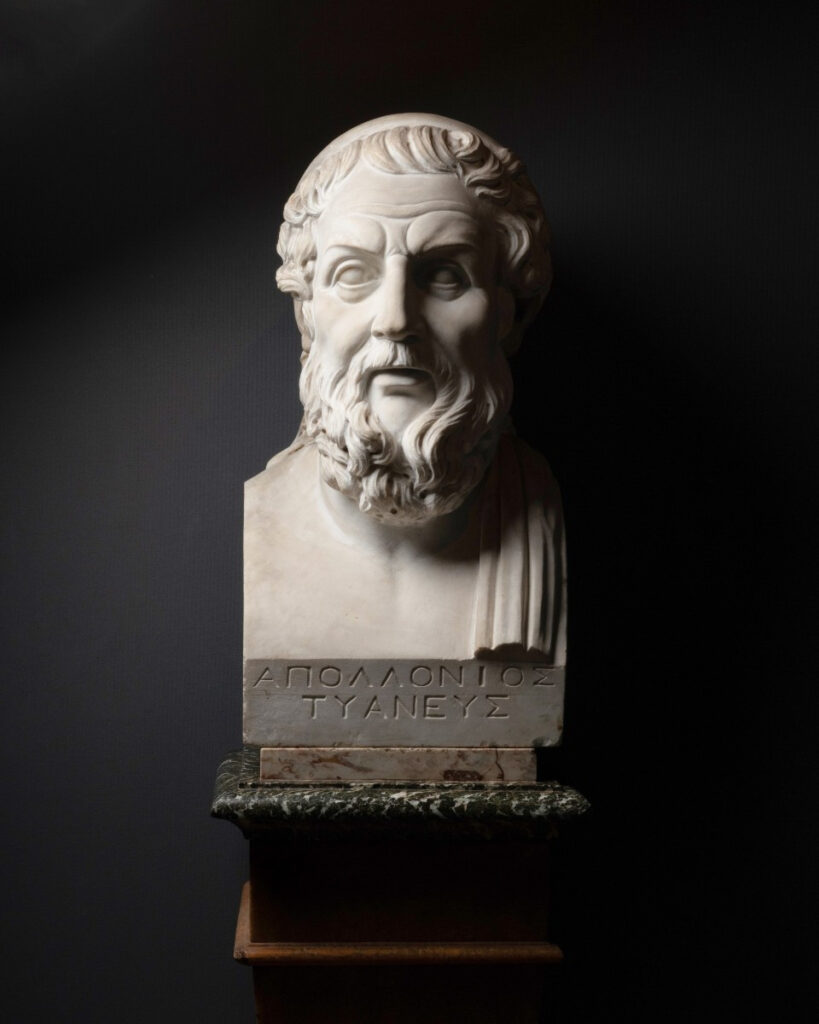
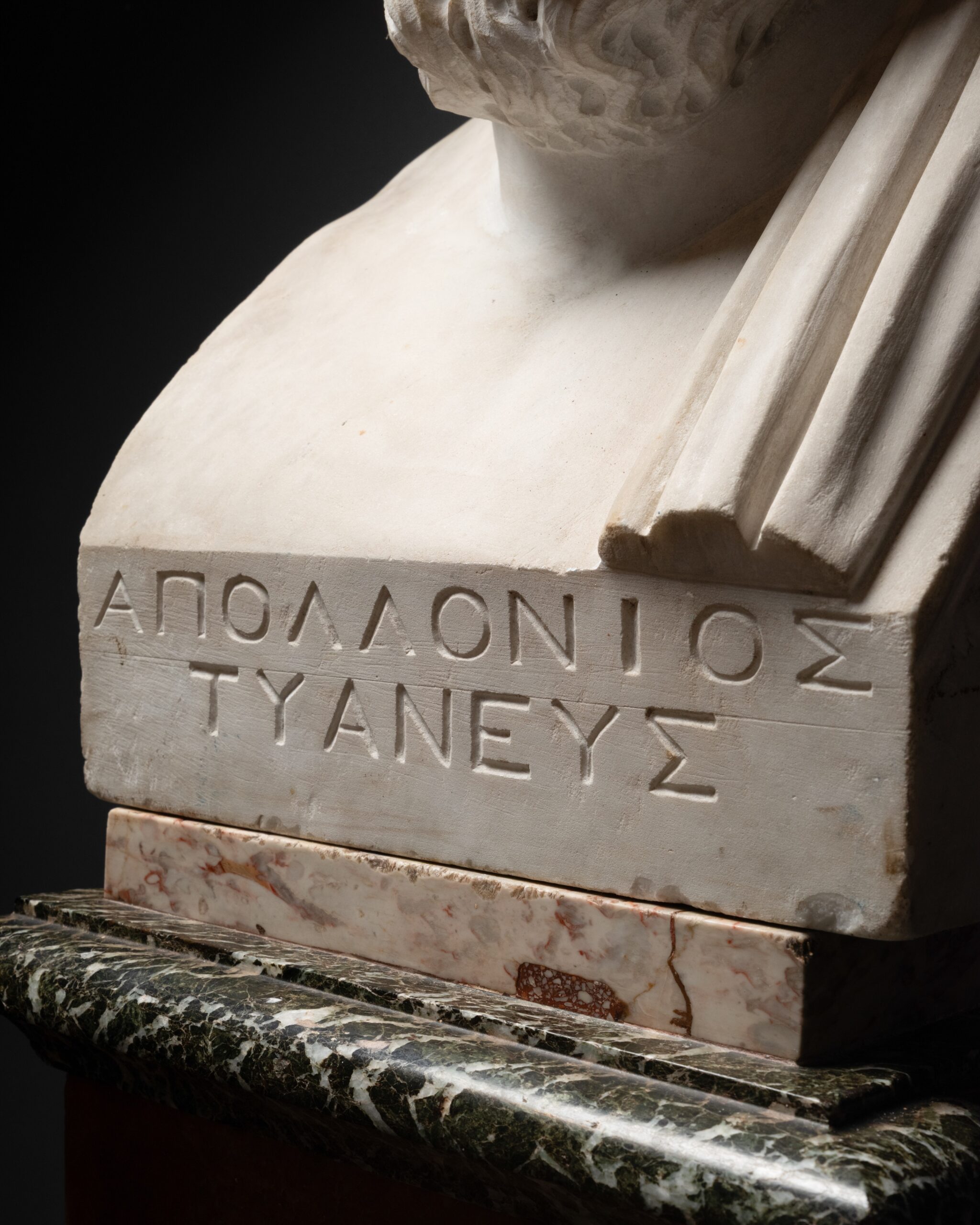
Bust Formerly Identified As Apollonius Of Tyana, Attributed To Carlo Albacini
Bust formerly identified as Apollonius of Tyana, attributed to Carlo Albacini.
Marble Italy 1780-1790 29 x 59 x 24 cm (11.4 x 23.2 x 9.4 in)
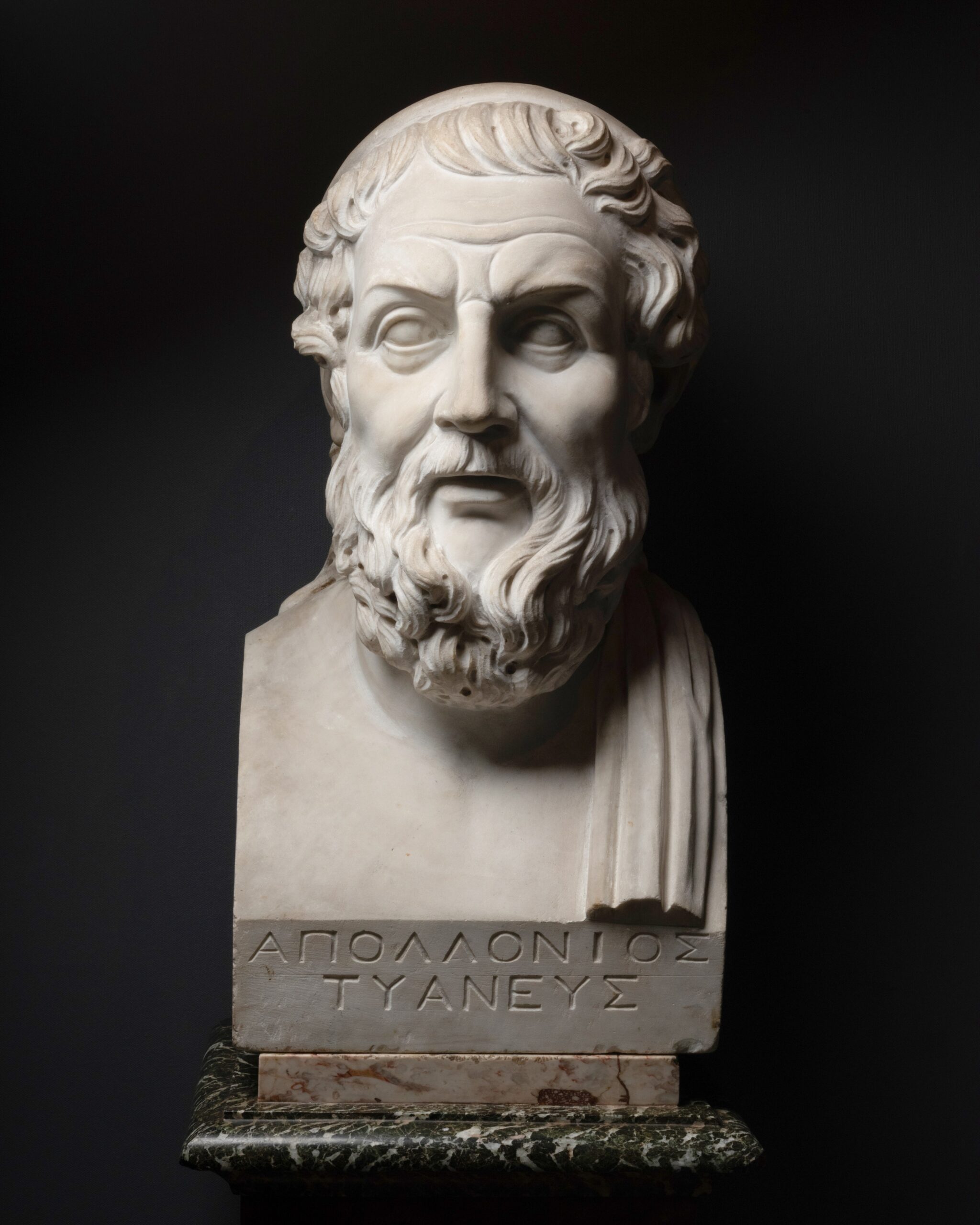
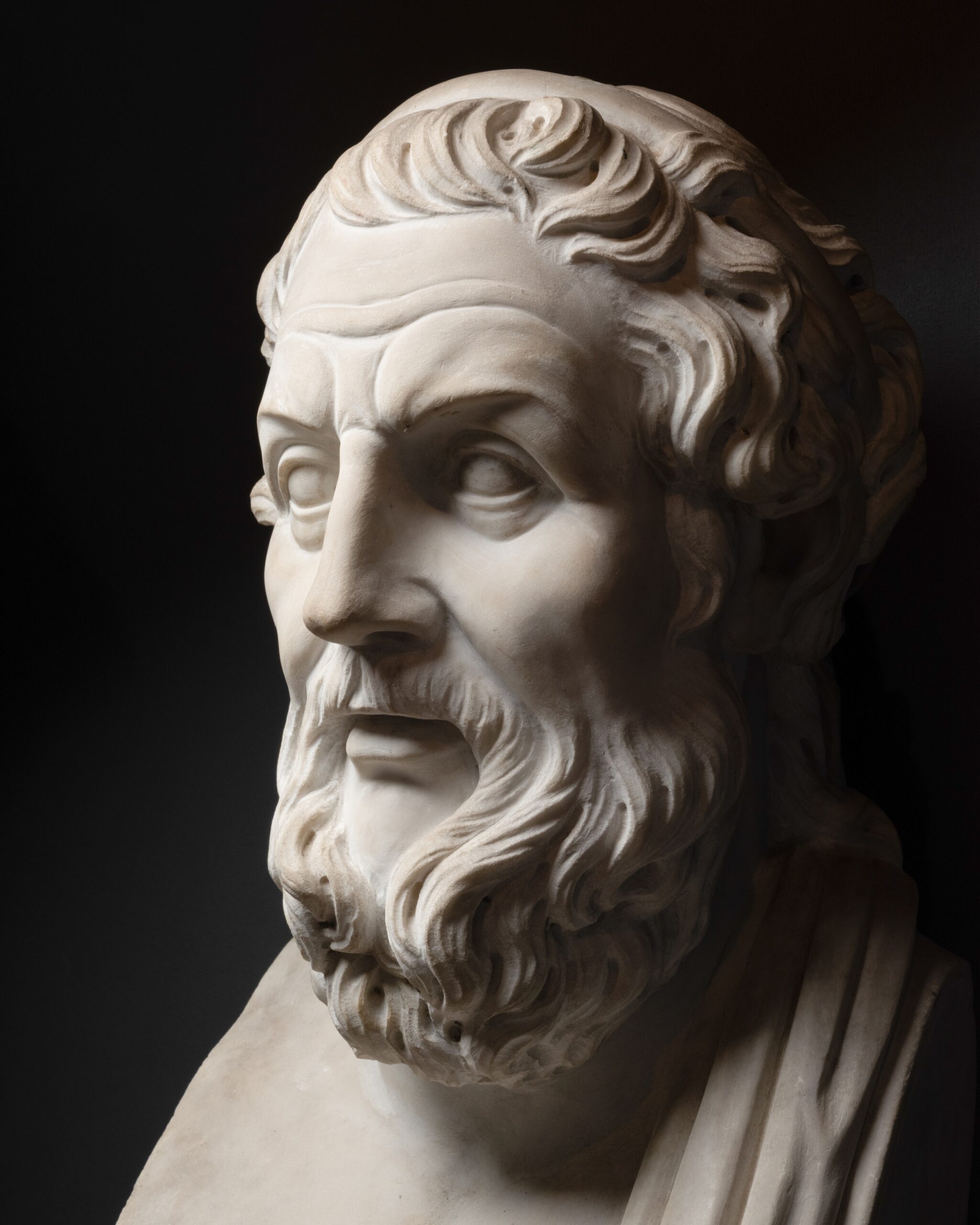
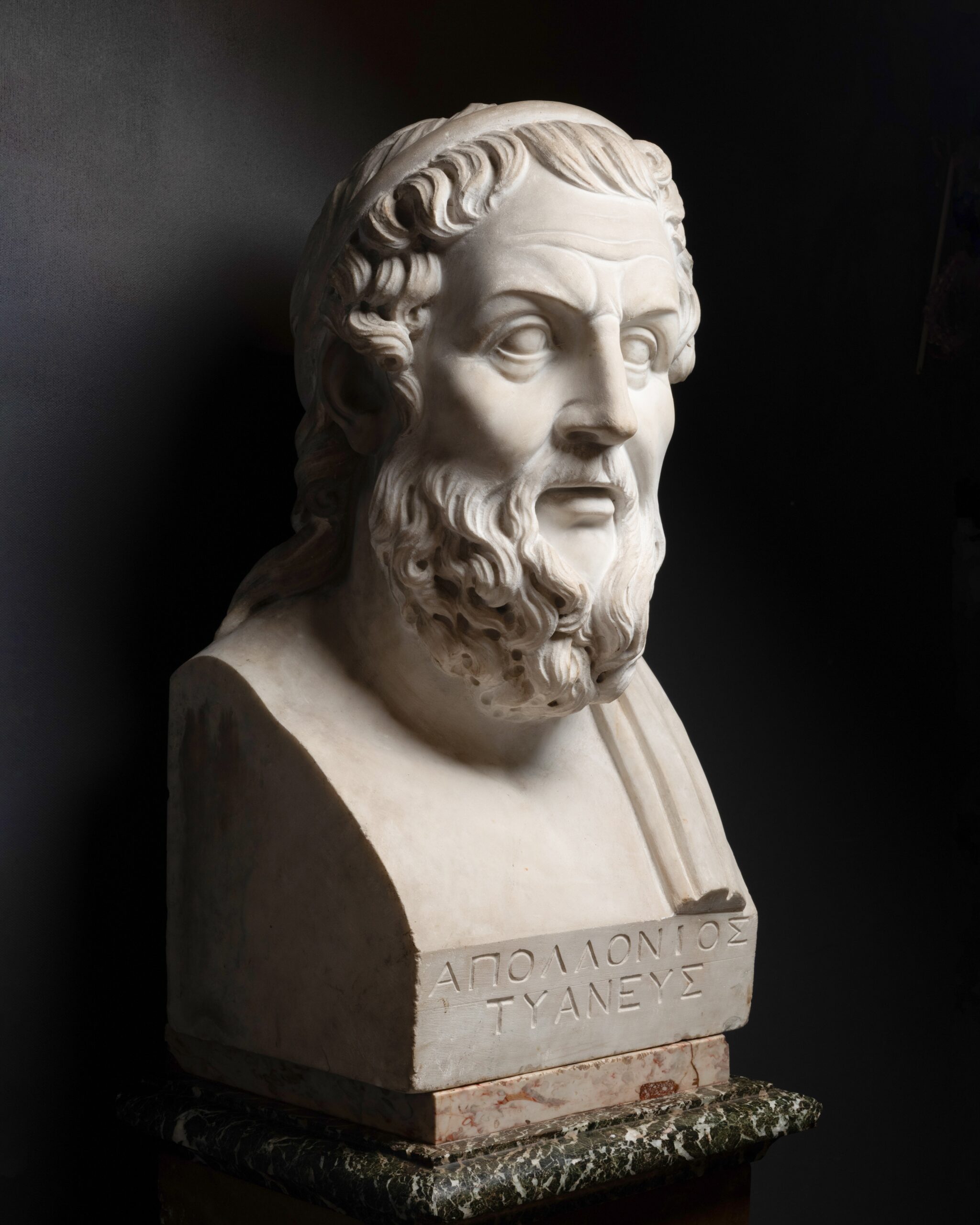
This bust, carved from white Carrara marble, depicts the bearded face of an elderly man, his head turned slightly to the right. He wears a thick rolled headband, or taenia, crowning an abundant head of hair that falls onto the nape of the neck. The eyes are large and deeply set but not incised, conveying the vacant gaze associated with blindness. The bust terminates in the form of a herm and features a Greek inscription on the chest. The technical virtuosity of the execution lies in its rigorous fidelity to the Severe style of the antique prototype. The precision of the proportions suggests the use of a pointing machine, or compasso, allowing for a near-perfect imitation of the ancient model held in the Stanza dei Filosofi of the Capitoline Museums.
For much of the 17th and 18th centuries, this type of portrait was identified as Apollonius of Tyana, a Neo-Pythagorean ascetic born in Cappadocia at the beginning of the Christian era. In a brief, eloquent, yet stern account of his life, the archaeologist Ennio Quirino Visconti wrote that Apollonius : “affected in truth a great severity of morals and led a hard and ascetic life […], traveled through the various provinces of the Roman Empire, and even other countries so that everyone might admire his virtues; and he was particularly committed to restoring the rites of pagan worship. He went twice to Rome, where it is said he endured some persecutions; and after making his most common residence in several cities of Asia, particularly Smyrna and Ephesus, he concealed his final moments, being over ninety years old, from the knowledge of his disciples, likely so that his death would have the appearance of an apotheosis. […] A certain Hierocles dared, two centuries later, to oppose this hero of paganism to the divine legislator of the Christians. This act of impudence prompted Eusebius, Bishop of Caesarea, to write a refutation of Hierocles, which proves—by the considerations he feels obliged to maintain for the person of Apollonius—to what extent the memory of the Pythagorean was venerated in the world.”
The identification of this type of portrait as Apollonius dates back to the mid-17th century and Leonardo Agostini, superintendent of antiquities in Rome under Alexander VII. Agostini had drawn a parallel between the features of a bust of this type and a profile appearing both on a contorniate medallion and on one of the gems in the Fulvio Orsini collection. Ennio Quirino Visconti definitively corrected this attribution in the early 19th century based on numismatic evidence from Amastris, reclassifying portraits of this type as one of the four primary Hellenistic portraits of Homer.
As for the present bust, an imitation after the Capitoline bust, it must be attributed to Carlo Albacini and his workshop. Albacini lived from 1756 to 1759 alongside Bartolomeo Cavaceppi in the artists’ quarter of Rome. He appears to have remained in his master’s immediate circle during the peak of Cavaceppi’s career, from the 1760s to the early 1770s. At this time, Albacini began undertaking restorations for English clients and dealers who were also patrons of Cavaceppi, notably Charles Townley and William Blundell, as well as the Earl of Lansdowne, Thomas Mansel-Talbot and James Smith Barry.Albacini’s reputation as a sculptor and restorer was then second only to that of Cavaceppi, restorer to Popes Benedict XIV and Clement XIII and supervisor of some of the most significant restorations of the marbles in the Museo Pio-Clementino. It is unsure whether Albacini himself performed restoration work on the Capitoline Homer-Apollonius herm that served as the model for this bust. However, an inventory of plaster casts sold by Albacini’s son, Filippo, in 1838, mentions three copies of “Apollonius of Tyana.” One of these is a replica of a herm of the same type, formerly in the collection of José Nicolás de Azara, the Spanish ambassador to Rome, and now held in the Prado.
Mispelling of the name Απολλωνιος τυανευς (Apolloniôs tyaneys), here spelled Απολλονιος τυανευς (Apollonios tyaneys).
The most compelling evidence regarding the context of the bust’s execution lies in the Greek inscription visible on the portrait. The name Apollonius derives from Apollo, which in Ancient Greek requires an unaccented omicron in the first syllable and an accented omega in the second. The sculptor of this bust made the error of writing the second “o” of Apollonius with an omicron instead of an omega. Remarkably, a similar error is found on another bust reputed to represent Apollonius of Tyana — a once famous, now-lost bust that belonged to Giuseppe Valletta before passing to the Earls of Pembroke at Wilton House. Regarding Albacini, it is known that he and his assistants were accustomed to adding the names of the presumed subjects to the busts, both on restored works and on replicas : “The base was also generally provided with an inscription in Greek letters, giving the supposed identity of the subject. It is only in very few cases that modern scholarship would agree with these identifications (e.g. ‘Carneades’ and ‘Periander’ are probably correct identifications, but ‘Herodotus’ is in fact Aristogeiton, and ‘Pittacus’ may represent Miltiades), and several are portraits of anonymous Greeks, confidently (but without justification) identified by the modern inscription as, for example, Theocritus, Heraclitus, Theophrastus, and Heracles.”
The presence of this spelling error suggests a common iconographic or philological source shared by the restorer of the Wilton House bust and the sculptor of the present work. It links these two pieces not by form—since one indeed represents Apollonius while the other actually depicts Homer—but by the shared intellectual climate of their creation. Both testify to the pre-scientific enthusiasm for ancient marbles that characterized the history of early modern European collecting, a period when the eagerness to possess antiquities, or failing that, their imitations, often outweighed archaeological rigor.Given the rarity of the Apollonius type, it is highly improbable that such an error in identification and inscription would have been committed after Visconti overturned Agostini’s thesis. This places the bust in the earliest phase of modern “anticomanie,” specifically in the 1780s—the period when the marbles of the Azara collections were being restored by Albacini.
Literature
See Ennio Quirino Visconti, Iconographie grecque, Paris, 1808 ; Henry Stuart Jones, A Catalogue of the Ancient Sculptures preserved in the Municipal Collections of Rome. The Sculptures of the Museo Capitolino, Oxford, 1912 ; Anton Hekler, Greek and Roman Portraits, London, 1912 ; Gisela Richter, The Portraits of the Greeks, London, 1965 ; Glenys Davies, “The Albacini Cast Collection. Character and significance”, in Journal of the History of Collections, III, no. 2, 1991 ; Edgar Peters Bowron and Joseph Rishel, Art in Rome in the Eighteenth Century, Philadelphia, 2000.
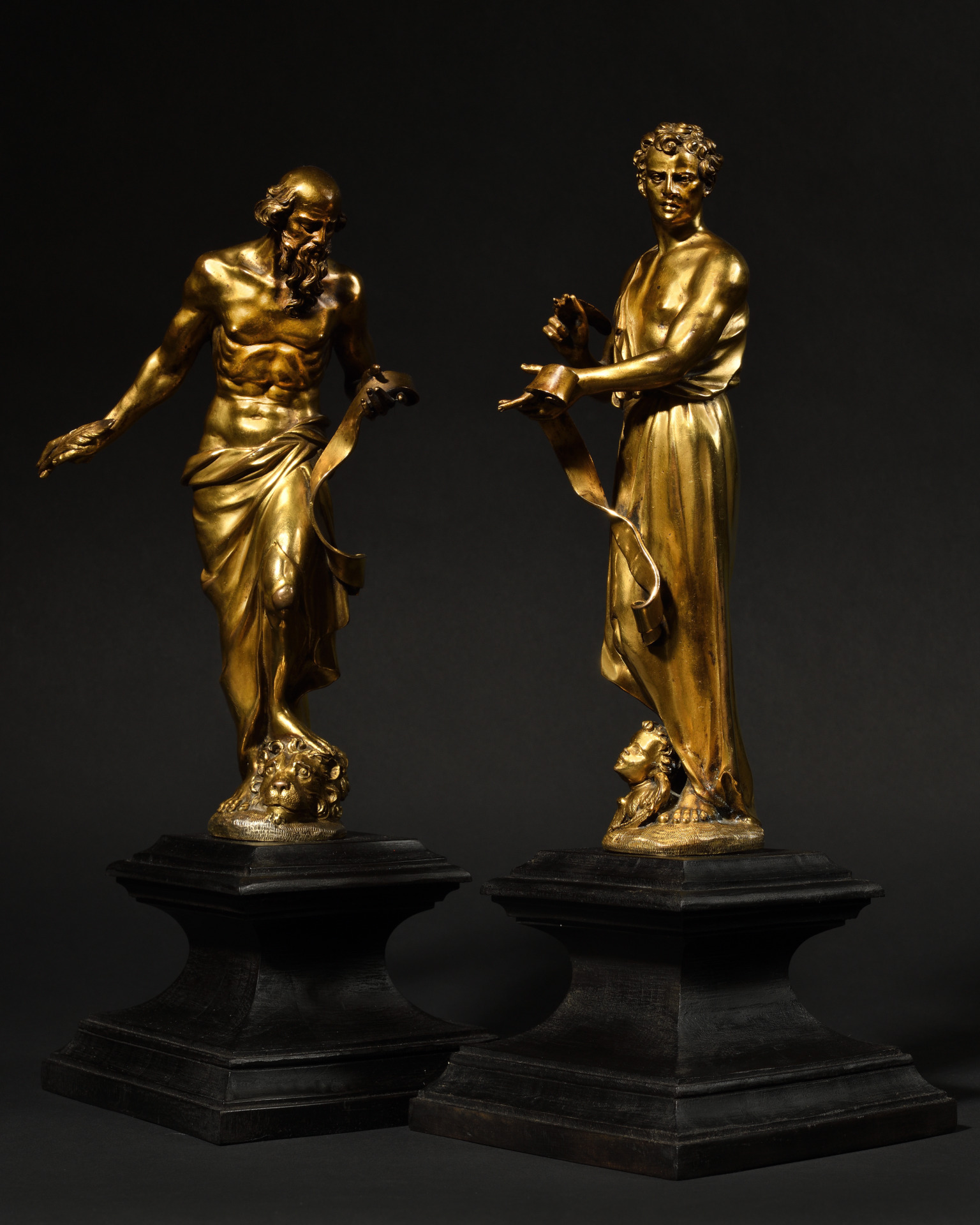
Saint Mark and Saint Matthew, by the Master of Ciechanowiecki
Saint Mark and Saint Matthew, by the Master of Ciechanowiecki
Mercury-gilt bronze, base sealed with silver-soldered copper Northern Italy or Germany 17th century h. 22 cm (8.6 in., without accessories)
Saint Mark: possibly the Camillo Castiglioni collection, then David David-Weill; Saint Mark and Saint Matthew: collection of Jacques Favre de Thierrens.
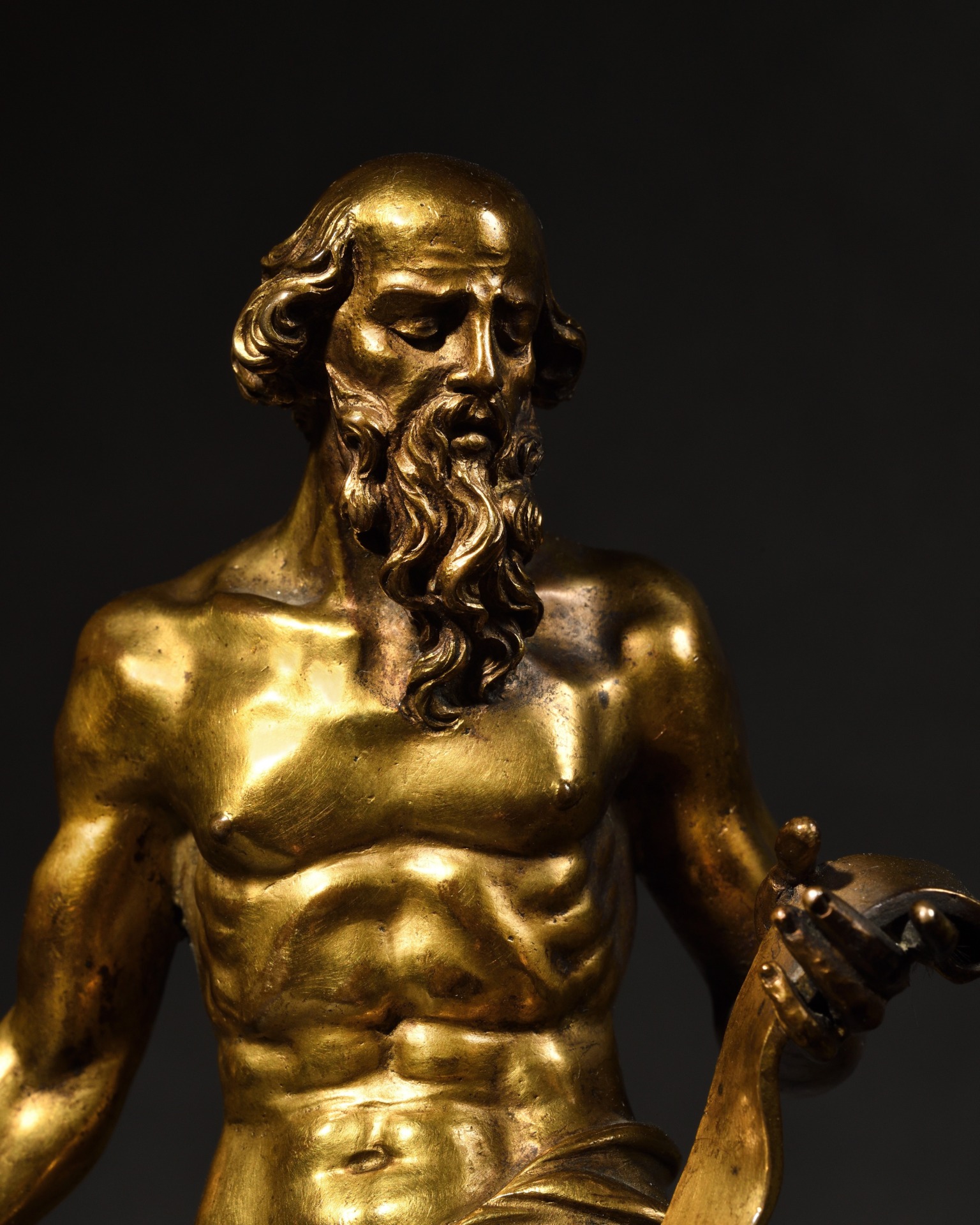
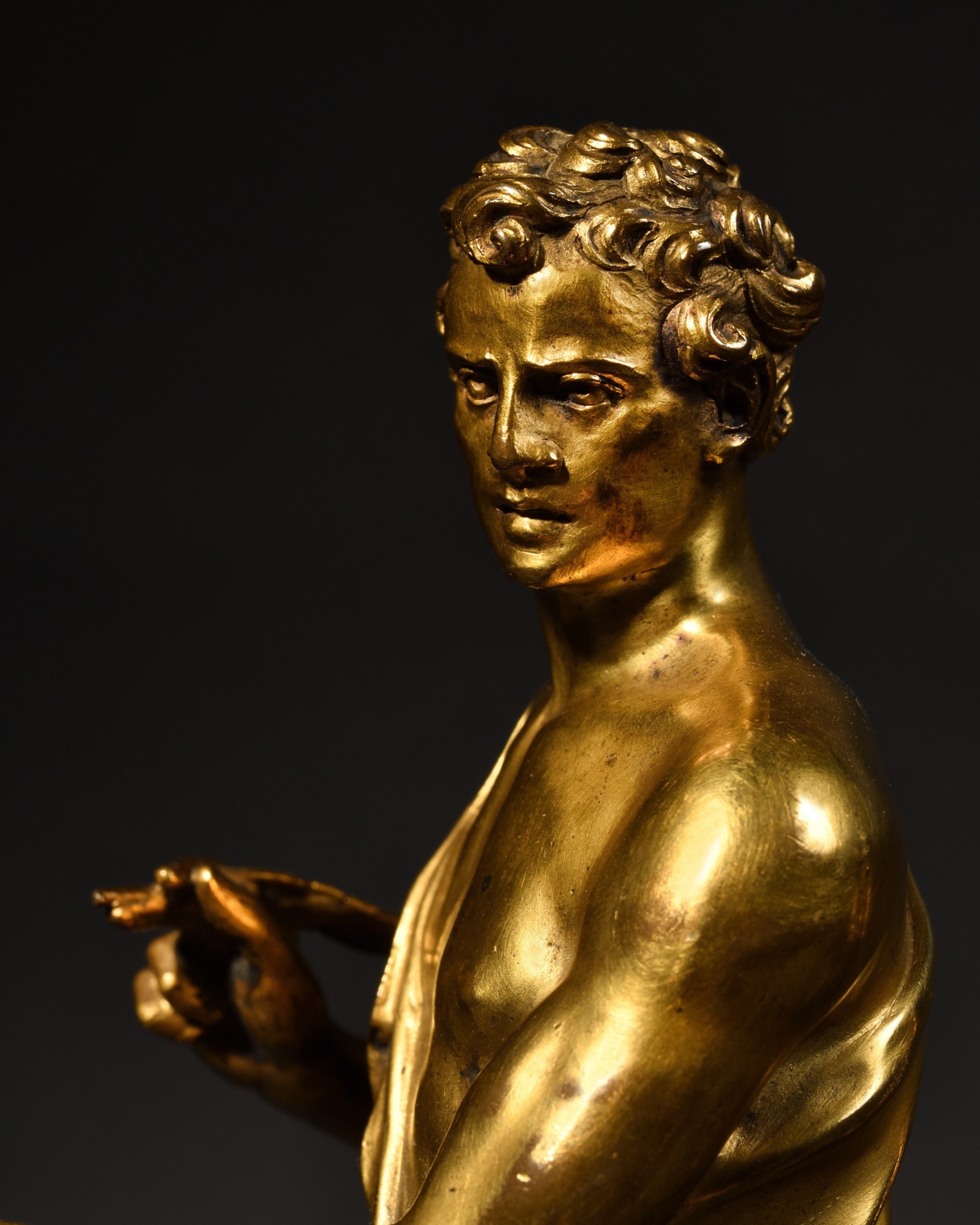
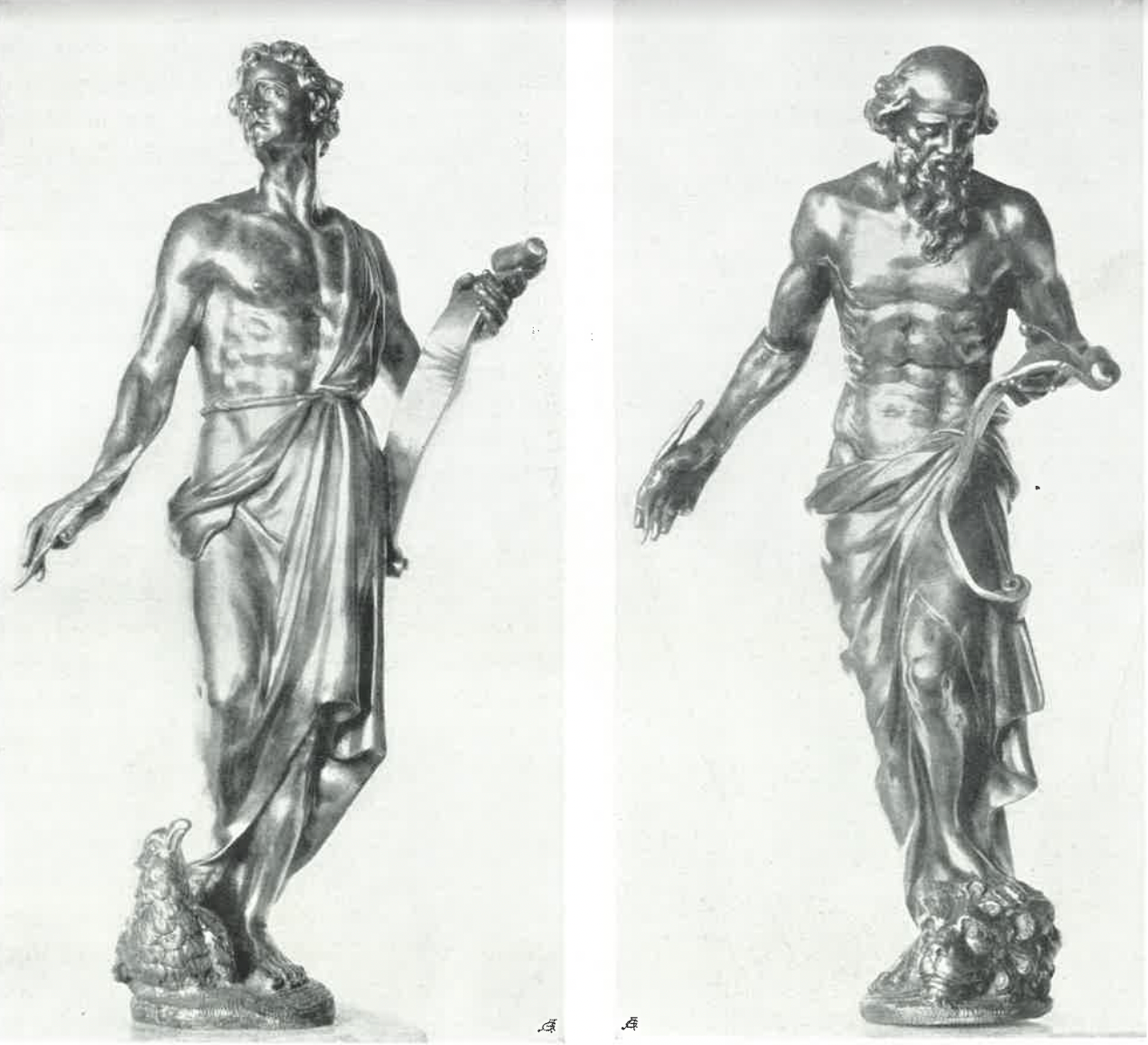
These two gilded bronze sculptures depict two of the Evangelists. They are identifiable by their attributes: the lion for Saint Mark, the winged man for Saint Matthew, and each holds a scroll in one hand and a quill in the other. The extraordinary refinement of the sculpture and the care given to every detail attest to the talent of an artist whose name remains unknown to this day.
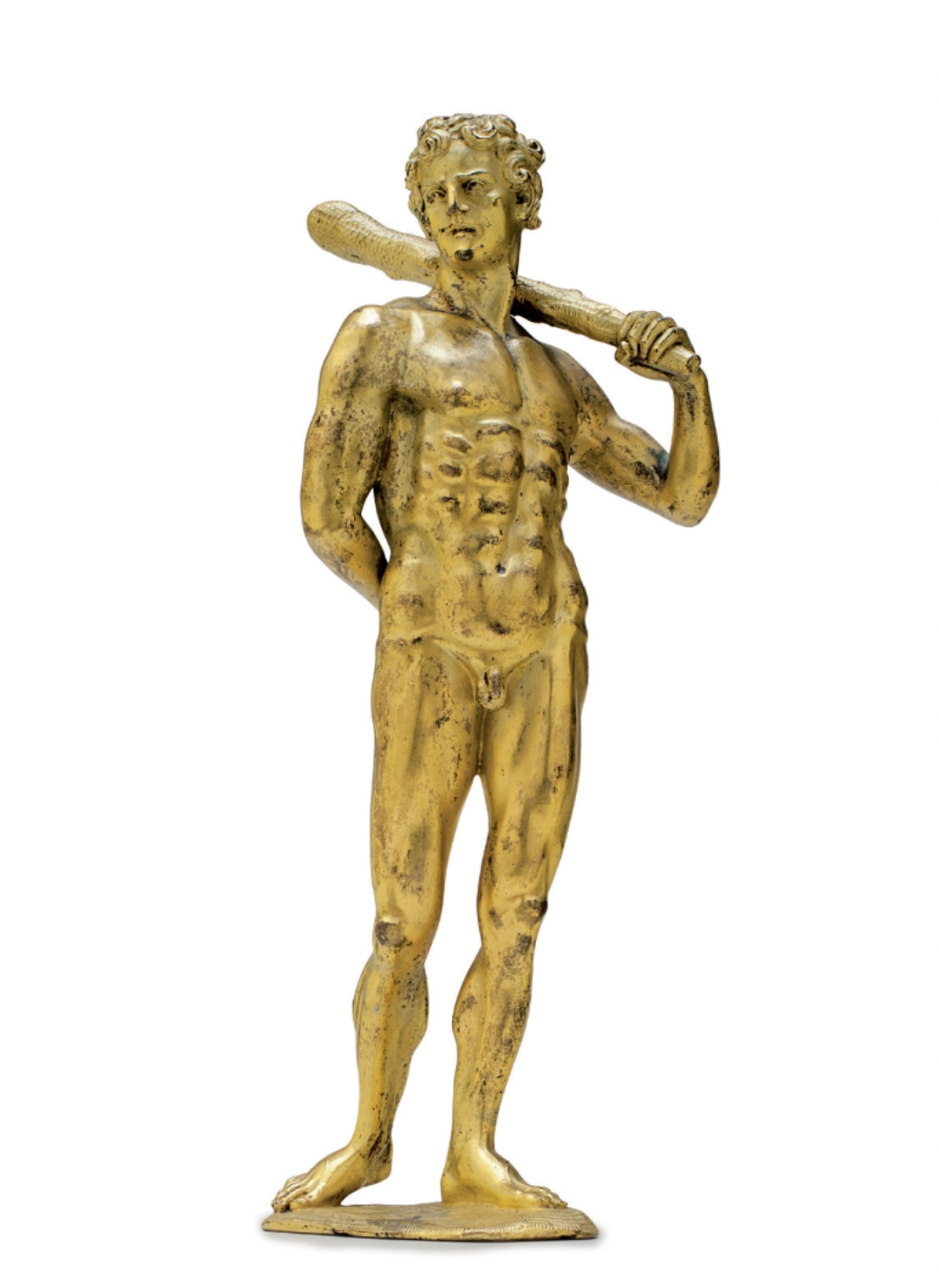
Fig. 1 — Young Hercules, Master of Ciechanowiecki. Christie’s, 4 July 1989, lot 128 — sold for £85,000.
Nevertheless, these two figures can be integrated into the body of works brought to light by Andrew Ciechanowiecki from the 1960s onwards. This patron, gallerist and bronze specialist had identified a group of around forty sculptures that all appeared to have been made by the same hand. The artist behind these works is today known as the “Master of Ciechanowiecki” or the Master of the Fitzwilliam Museum, as part of Ciechanowiecki’s collection had been placed on deposit at that museum for a number of years.
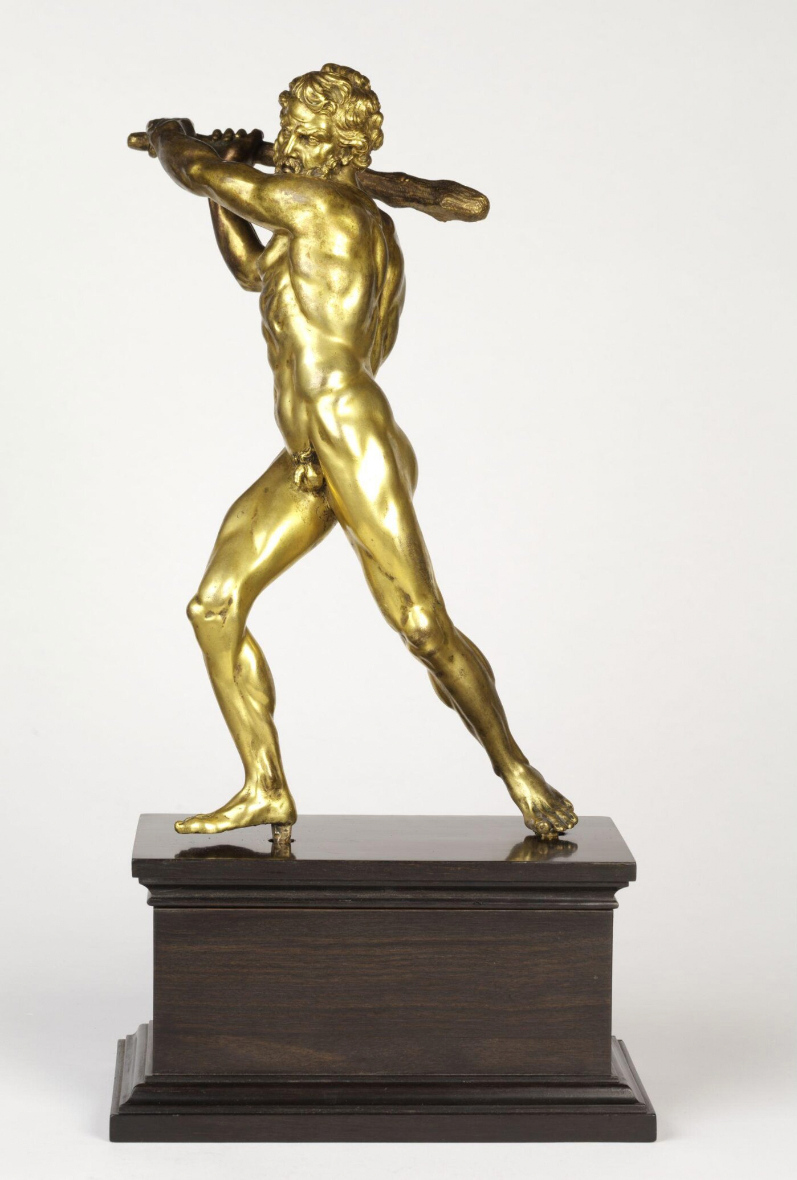
Fig. 2 — Hercules, attributed to the Master of Ciechanowiecki. Victoria and Albert Museum, h. 33.3 cm.
The characteristics shared by these works have been described by several specialists, beginning with Ciechanowiecki himself in his correspondence (Doc. 1). This letter reveals his difficulty in pinpointing a geographical region for these bronzes, so thoroughly do the works appear to synthesise the styles and techniques employed in Italy, Germany, Flanders and France during the 17th century.
Doc. 1 — Lettre de A.S. Ciechanowiecki à K. Lankheit. Extrait de Białonowska, M. (2012). Andrzej Stanisław Ciechanowiecki. Collectionneur, marchand et mécène, Lublin. Pages 79-81.
“In January 1969 A. S. Ciechanowiecki asked Klaus Lankheit: The bronze of which I enclose a photograph has been a headache to me for some time. I had originally seen it in the circle of Hubert Gerhard, then moved towards the idea of an unidentified Flemish master, by whom a group of works could be assembled, including the very pretty bronze in the Huntington collection in San Marino and a gilt group in my own collection […]. This is still my opinion but one or two colleagues have suggested that it may be around 1700 and have again pointed towards Florence. I am not at all convinced by this suggestion […]. In response, Klaus Lankheit confirmed the dating: “Die Figur gehört in die Epoche um 1700. Die Faltengebung könnte in der Tat für Soldani sprechen, inc drängt sich mir das Französische in der Figur sehr Stark auf.” The correspondence shows that at the end of the 1960s, A. S. Ciechanowiecki had a certain number of statuettes in his collection, which allowed him to draw conclusions about their attribution after observing their common features. It is also known that from the very beginning the collector and researchers saw in the works of an unknown master both features of Italian sculpture, mainly Florentine, and South German, French and even Flemish.”
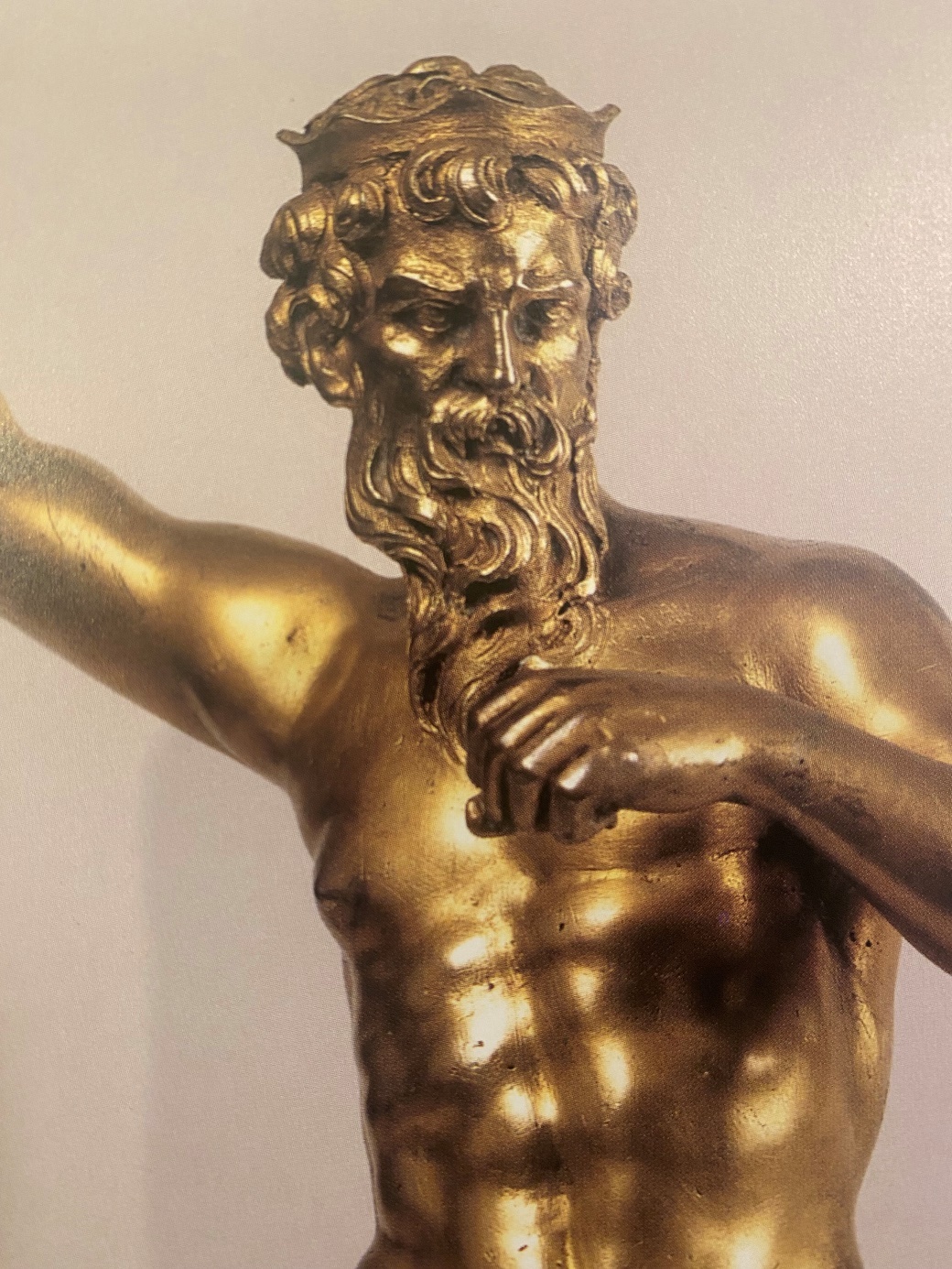
Fig. 3 — Neptune, Master of Ciechanowiecki. Museo Civico Amedeo Lia, La Spezia, h. 22 cm.
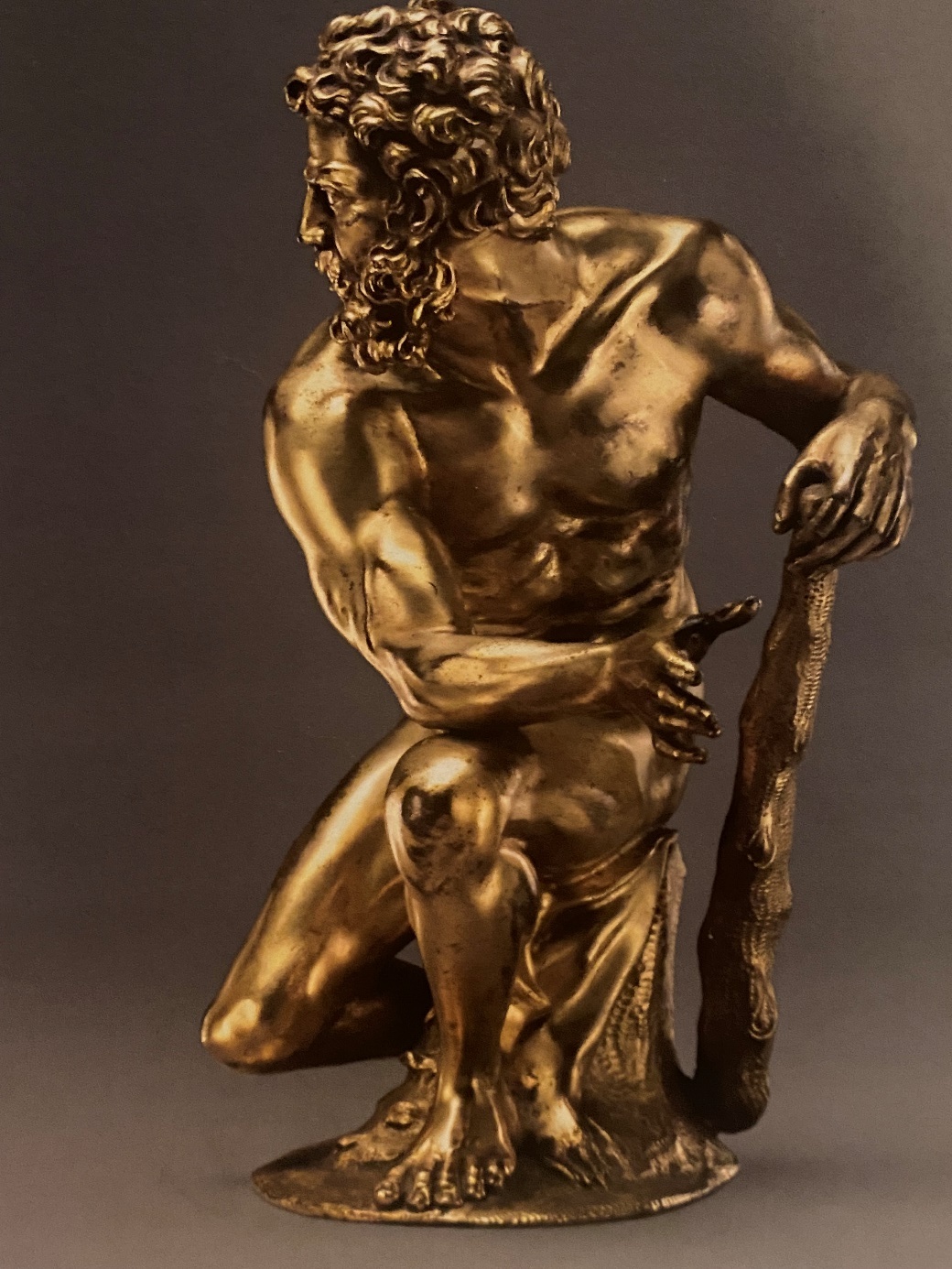
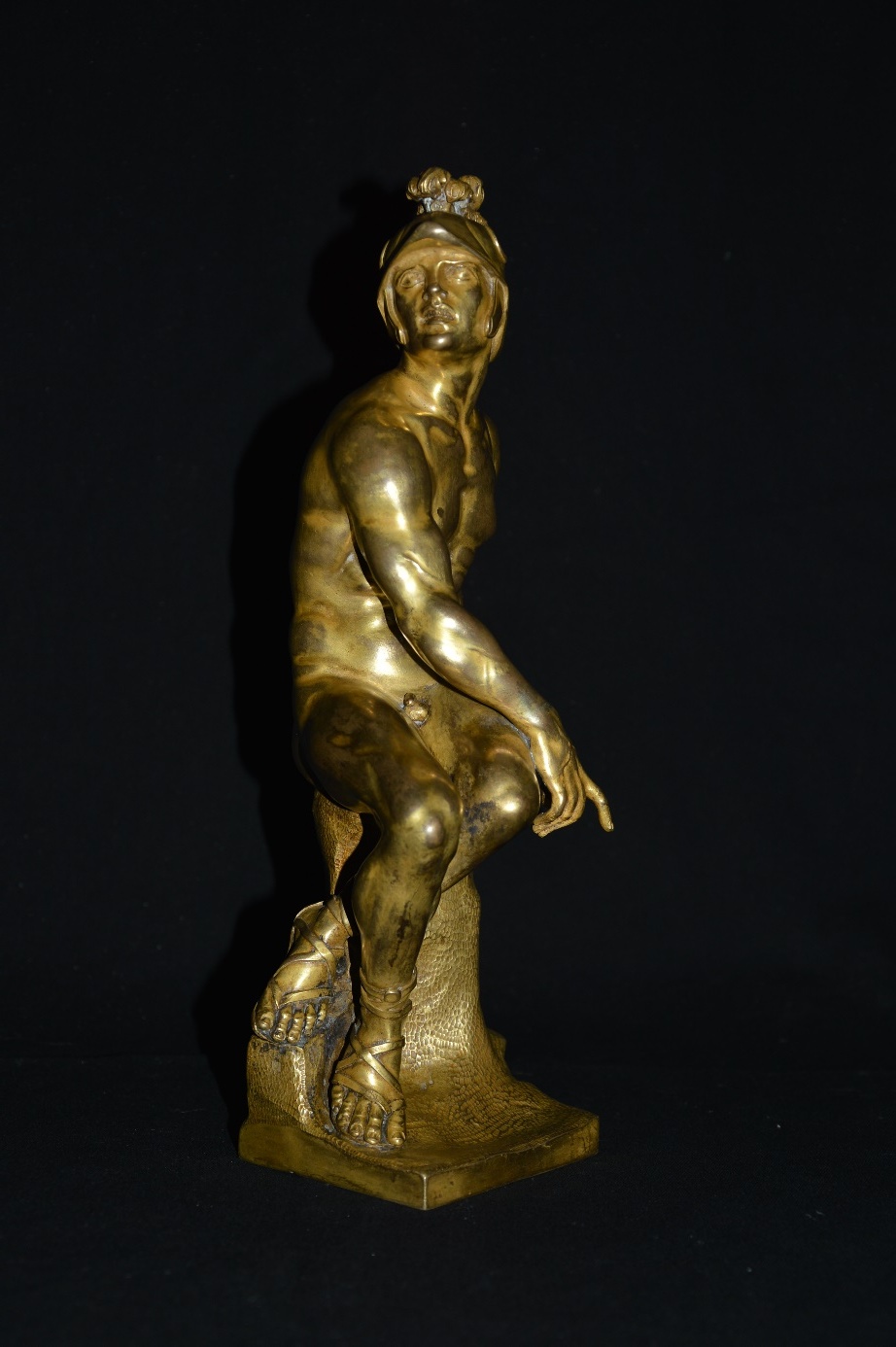
It has thus been possible to isolate a number of shared characteristics that allow one to identify the hand of this master. These include their small size (averaging around twenty centimetres), the frequent use of gilt bronze, an exceptionally fine level of chasing throughout, and a delicacy in the treatment of surfaces that calls to mind the work of a goldsmith. Then there is the hair of the figures, composed of thick, curling locks that fall heavily over the forehead (as in the model of a young Hercules commonly attributed to the Master of Ciechanowiecki, Fig. 1). The barely incised irises, the furrowed, pronounced brows (Fig. 2 and 3), and the high, prominent cheekbones (Figs. 1, 4 and 5). The lean, powerful musculature, which betrays an excellent knowledge of anatomy, is heightened by predominantly frontal and dramatic poses that reflect a distinctly Baroque sensibility. Attention to detail — such as veins and fingernails (Figs. 4 and 5) — combined with the wide variety of chasing techniques employed (notably on the bases of most sculptures) creates contrast between the textures depicted.
Fig. 4 — Seated Hercules, Master of Ciechanowiecki, Italy, Rome, 2nd half of the 16th century, h. 15.2 cm.
The fact that certain elements appear so strikingly similar (the faces of the Hercules, Fig. 1, and our Saint Matthew) and that some sculptures present variations in pose suggests that the artist created separate components that were then assembled onto the main figure: arms, head, hands and accessories were likely cast from individual moulds, allowing the artist to vary the composition without having to create an entirely new model. All of these elements have led the specialists who have grappled with this genuine puzzle to associate the master with an artist active in the first half of the 17th century, who probably worked in Rome or Florence and was influenced by the styles of Giambologna, Bernini and Adriaen de Vries. The techniques employed suggest that the master may have been a German goldsmith trained in Augsburg, a major centre of gilt bronze sculpture at the time. In terms of style, the work shows a strong influence of Italian Mannerism, and more specifically that of an artist who would have worked in Rome during the 17th century.
Fig. 5 — Mars, attributed to the Master of Ciechanowiecki. Private collection.
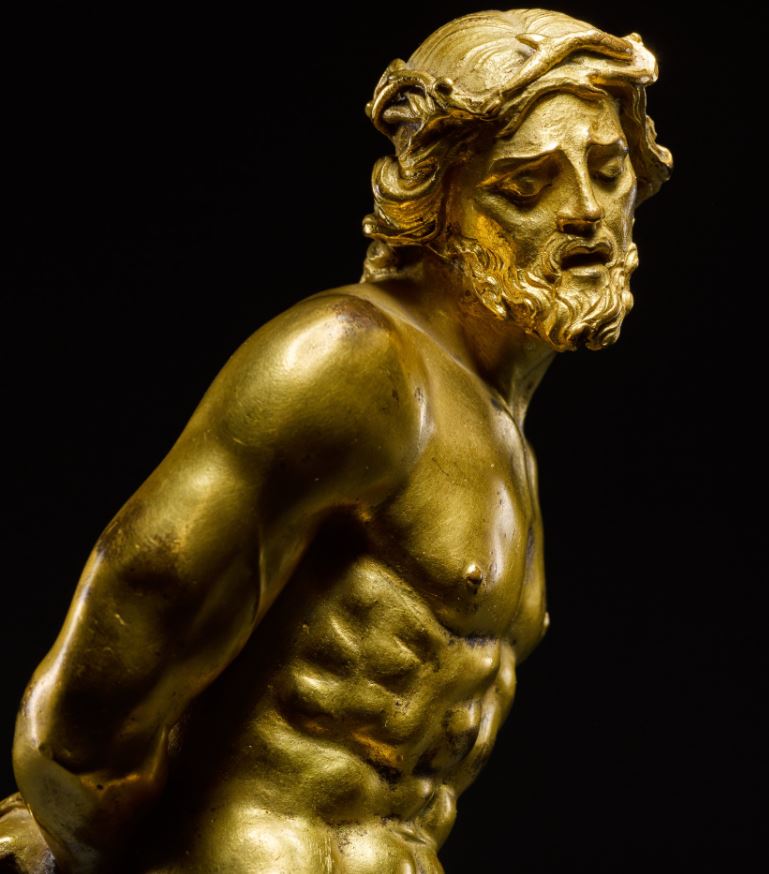
A Christ at the Column (Figs. 6) sold at Sotheby’s London in December 2021 can also be associated with this corpus: it shares similar dimensions with the pieces previously discussed, and its expression, the treatment of the drapery, the handling of the base, and the rendering of the musculature are all comparable. It has been linked to the Italian sculptor Alessandro Algardi, as this model of Christ was traditionally attributed alternately to Algardi and Duquesnoy, with experts never having reached agreement. This example illustrates how significant artistic exchanges between artists of different nationalities were during this period: a model attributed to a Frenchman and an Italian was taken up by the Master of Ciechanowiecki, an artist who was probably German.
Fig. 6 — Christ at the Column, follower of Alessandro Algardi, Italy, Rome or Southern Germany, 17th century, h. 21 cm. Sotheby’s London, 7 December 2021.
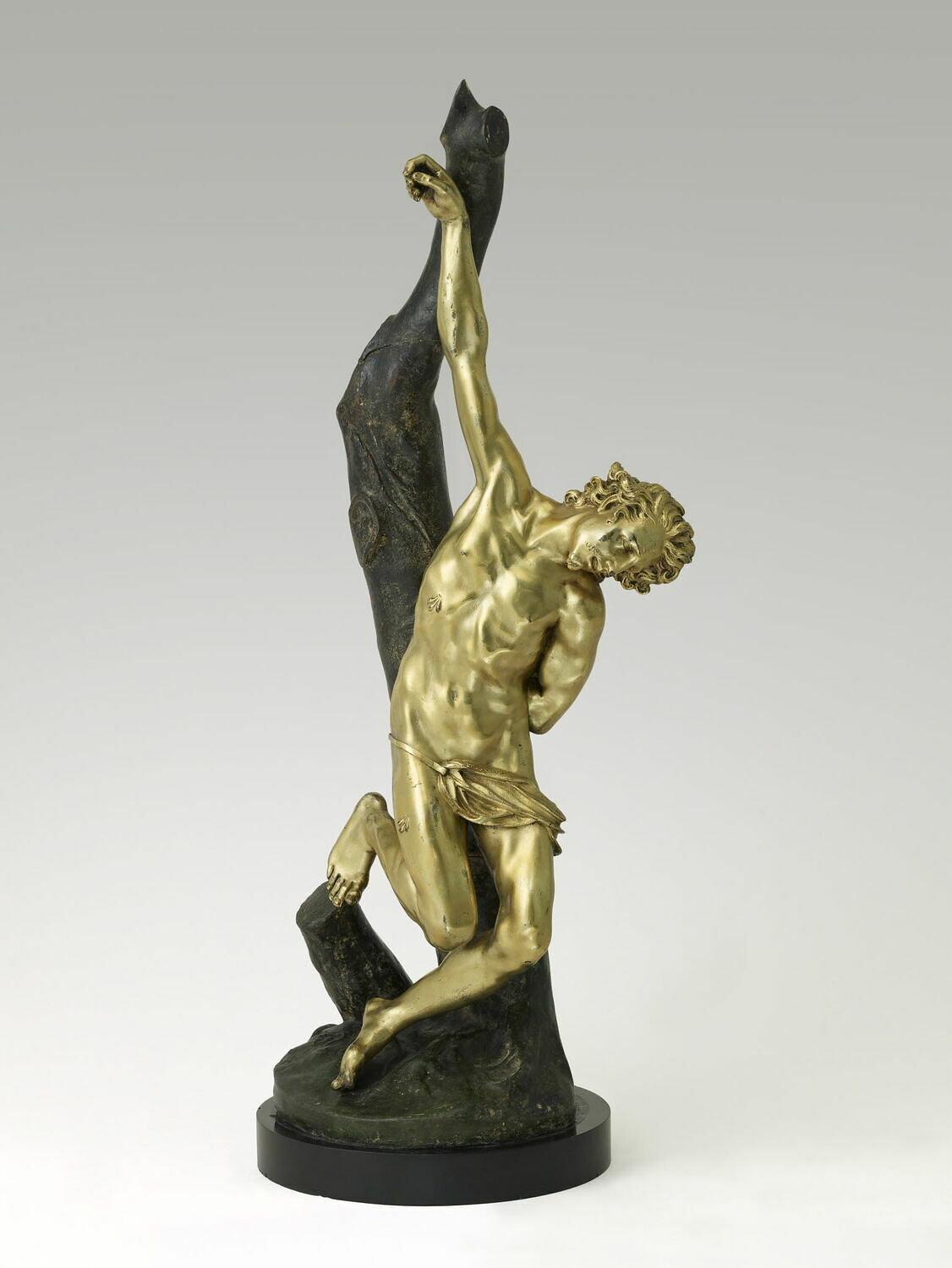
There is a Saint John the Baptist (Fig. 7) in the Louvre that has been attributed to a German artist by the name of Georg Petel, nicknamed the “German Michelangelo.” This work could be associated with the corpus attributed to the Master of Ciechanowiecki. Petel, German by origin, visited Italy and almost certainly France, and built his career in Augsburg in the context of the Counter-Reformation. Furthermore, as a friend of Rubens and Van Dyck, he was acquainted with the sculptures of Giambologna and Bernini. It is possible that the Master of Ciechanowiecki belonged to this artist’s circle.
Fig. 7 — Saint Sebastian, formerly attributed to Georg Petel. Musée du Louvre.
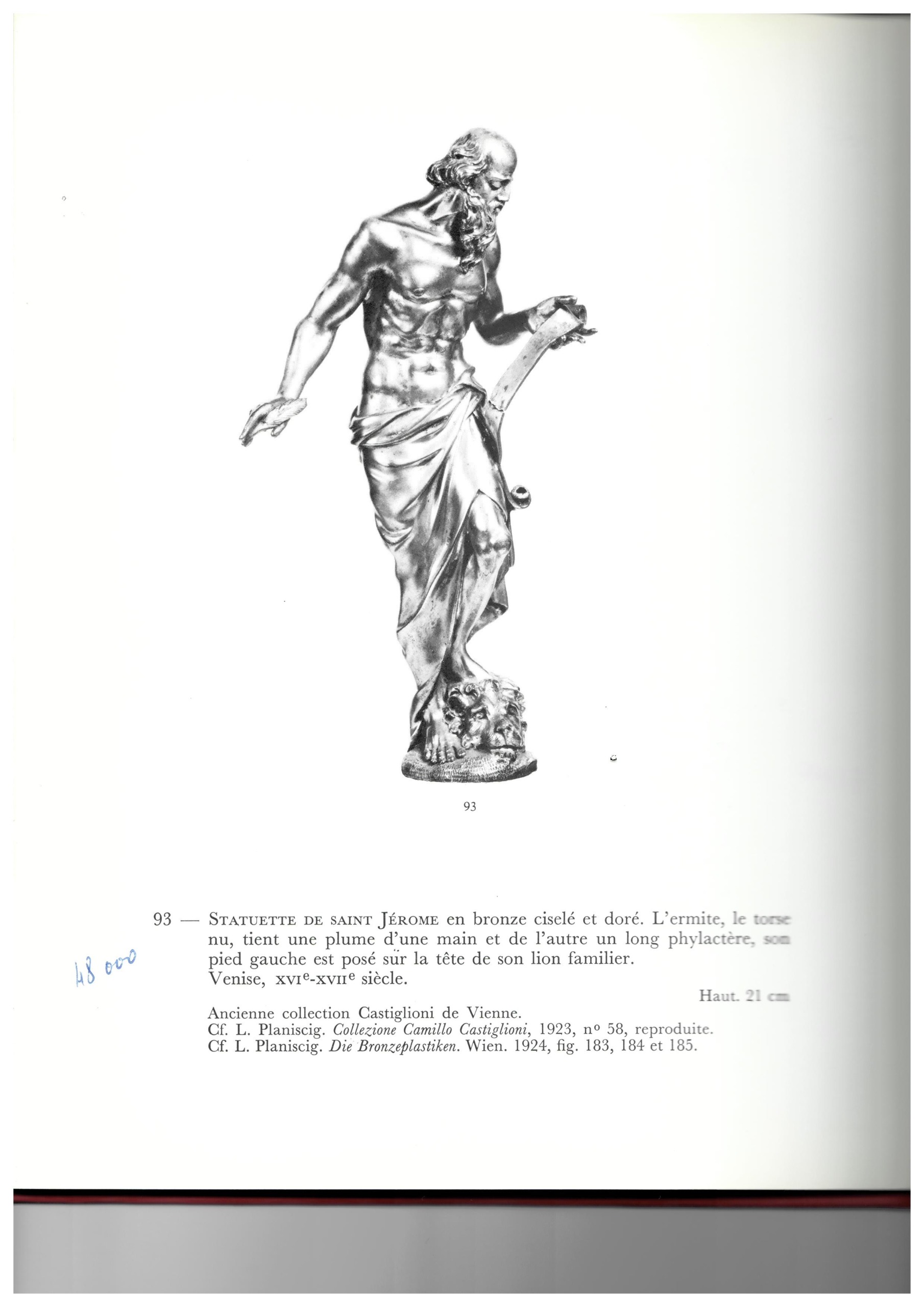
What is in any case certain is that our master’s models were produced in variants, known across different periods and reproduced with varying degrees of success. In the case of our Evangelists, a Saint John and a Saint Mark were sold in 1925 (Fig. 8); they formed part of the prestigious Camillo Castiglioni collection and had been attributed to Tiziano Aspetti by Leo Planiscig. The Saint Mark from the Castiglioni collection subsequently appeared as a Saint Jerome in the David David-Weill collection, sold in Paris on 16 June 1971 (Fig. 8). Another Saint John is known in the collection of the Minneapolis Institute of Art, though that piece is of mediocre quality and considerably later in date, as is a Saint Matthew held by the Royal Palace Museum in Warsaw.
Fig. 8 — Saint John and Saint Mark, attributed to Tiziano Aspetti. Camillo Castiglioni collection, sold in 1925.
In light of all these elements, we can confidently state that this pair of sculptures represents an extremely significant landmark in art history: combining characteristics of both Italian and German sculpture, of Mannerism and the Baroque, these are works of geographical and stylistic transition — witnesses to the extraordinary vitality of the artistic world at the turn of the 17th century, despite the prevailing climate of political turmoil.
Fig. 9 — Lot 93, “Collection D. David-Weill” sale, Ader, Paris, 16 June 1971.
Literature
See Białonowska, M. (2012). Andrzej Stanisław Ciechanowiecki. Collectionneur, marchand et mécène, Lublin, pp. 79-81; Warren, J., Bewer, F. G., Cosentino, L., & Dorment, R. (2010). Beauty & Power: Renaissance and Baroque Bronzes from the Peter Marino Collection, Wallace Collection, p. 54; Avery, C. (1998). Sculture, bronzetti, placchette, medaglie, Museo Civico Amedeo Lia, La Spezia, n. 97; Planiscig, L. (1921). Venezianische Bildhauer der Renaissance, Schroll, p. 591; sale catalogue, Collection D. David-Weill, Ader, Paris, 16 June 1971, lot 93.
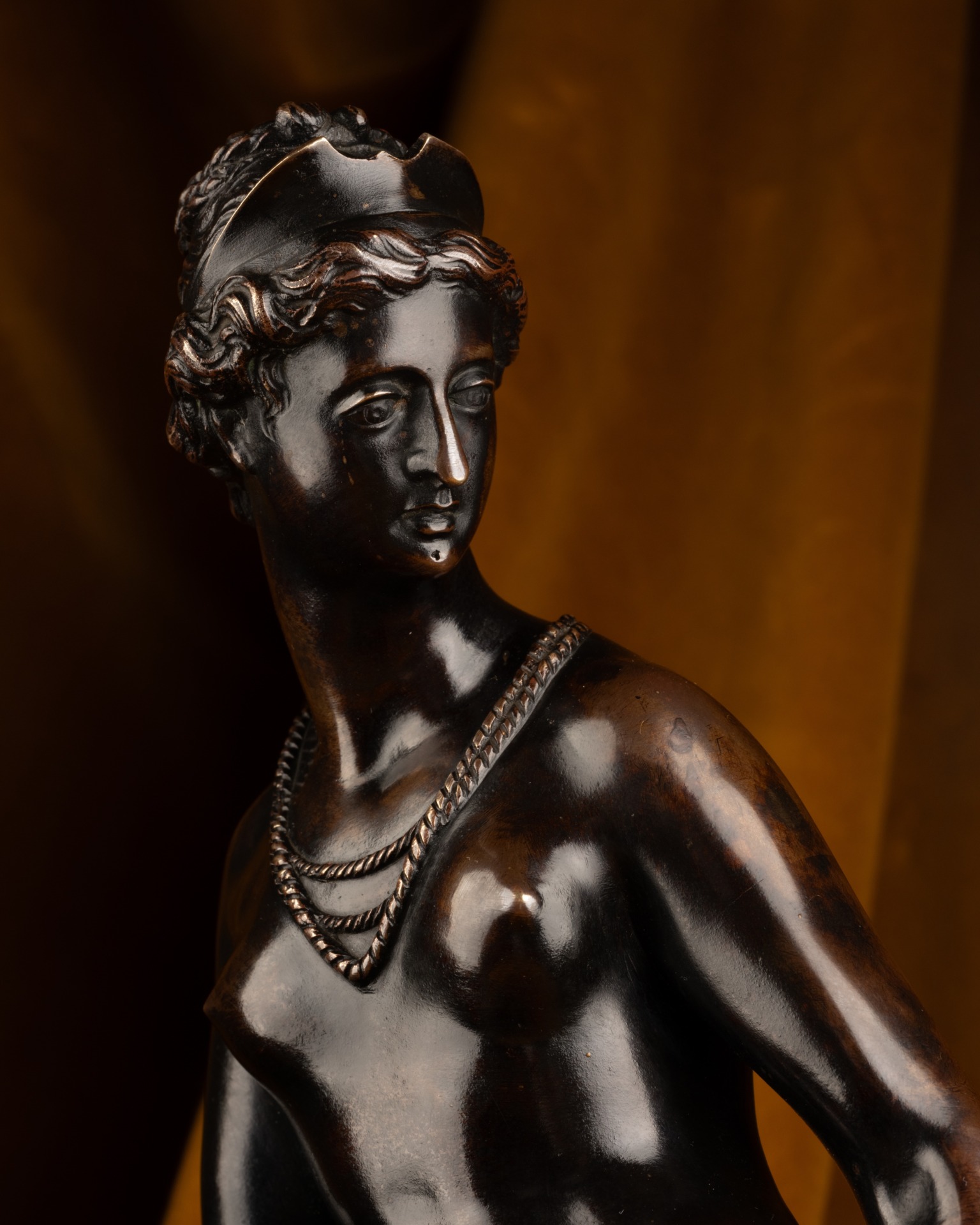
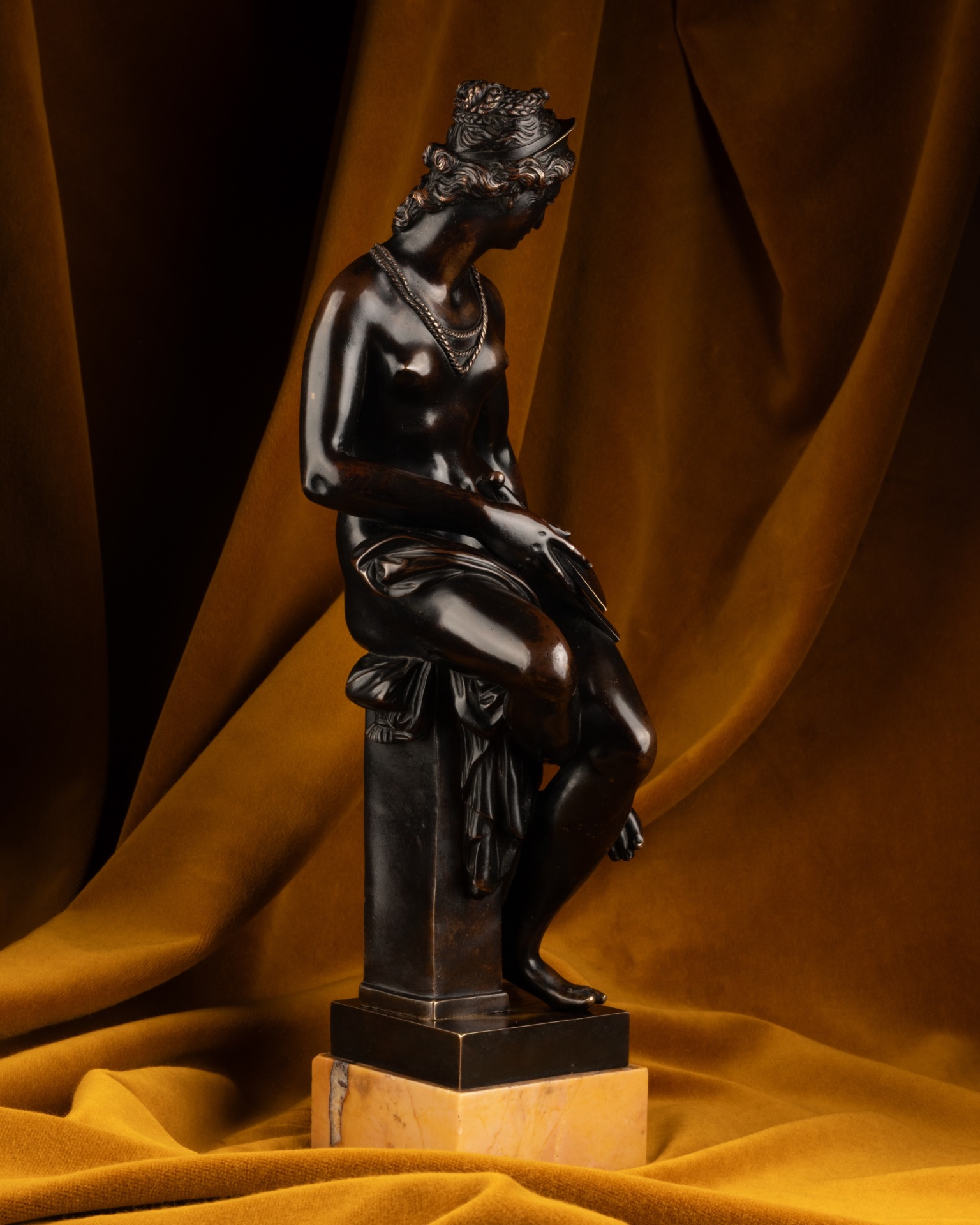
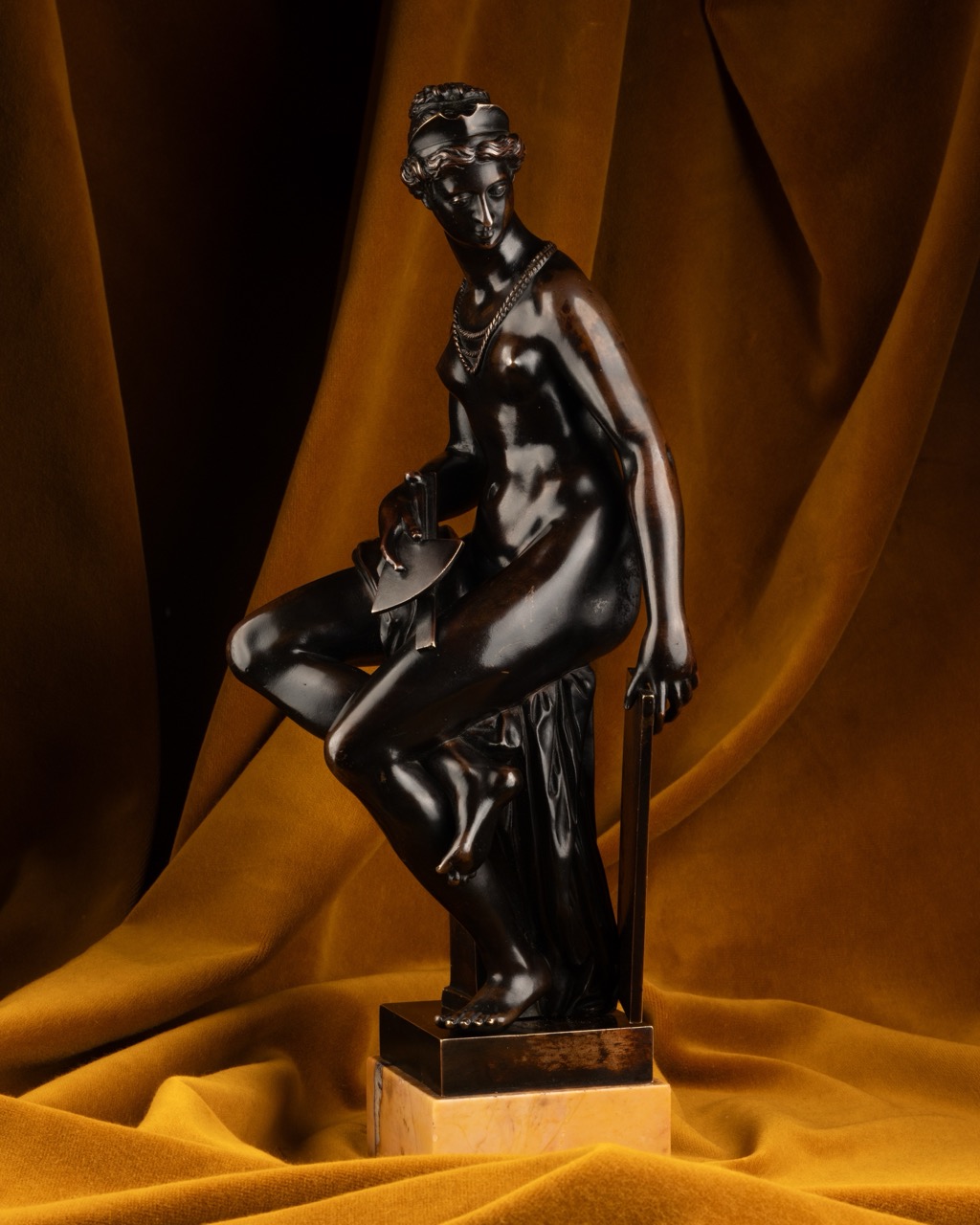
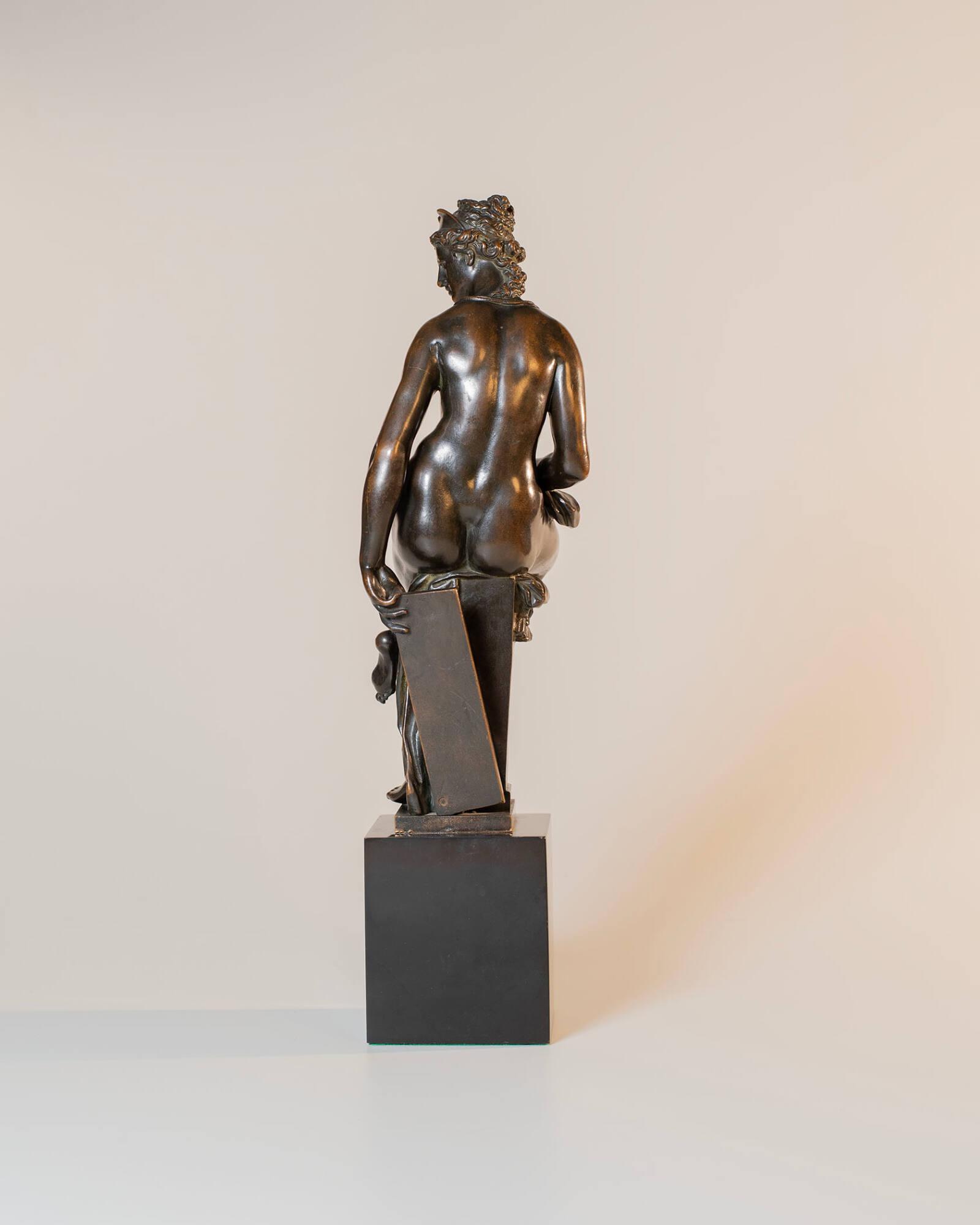
Allegory of Architecture, after Giambologna
Allegory of Architecture, after Giambologna
Bronze Low Countries Late 17th century h. 36 cm (14.25 in.)
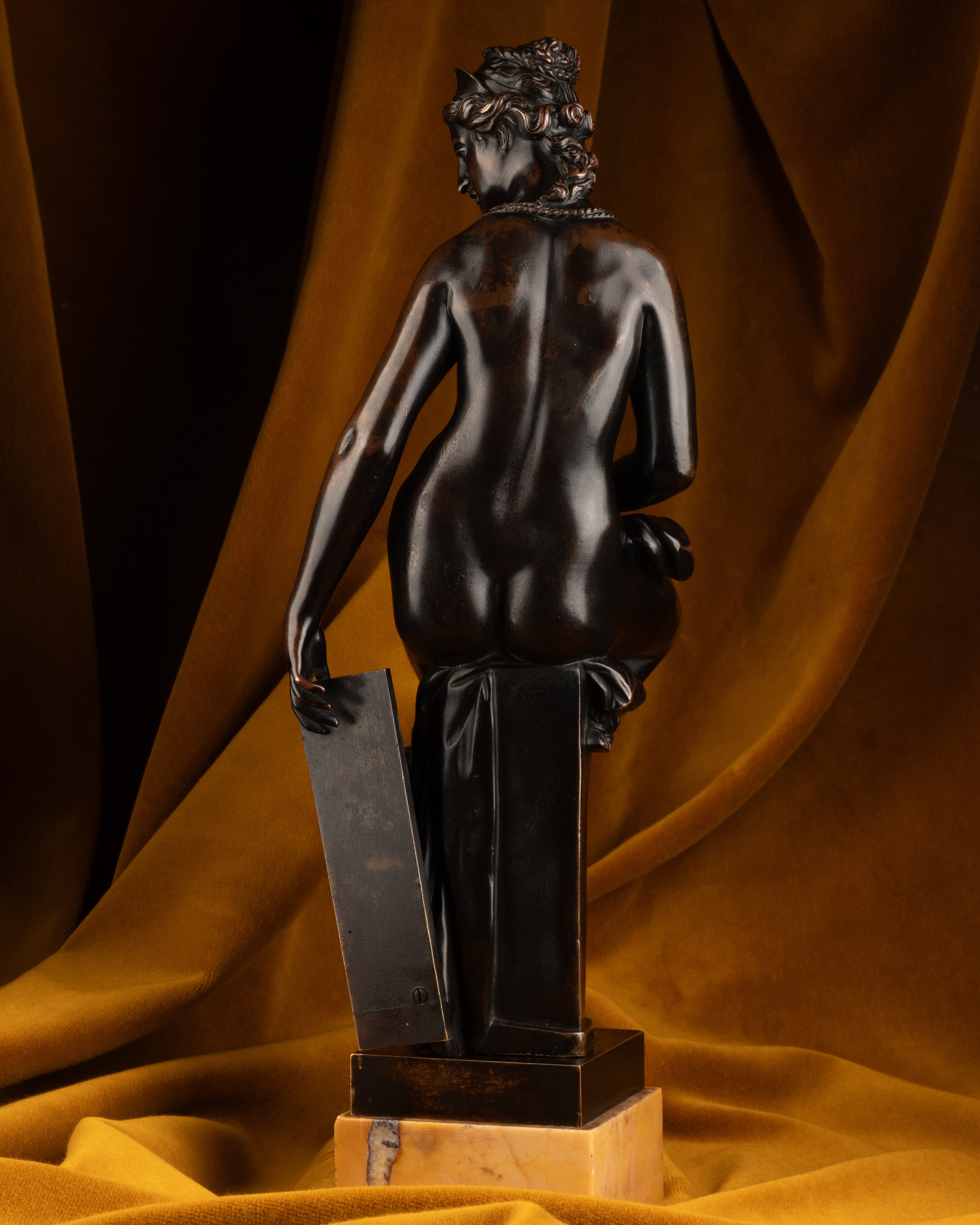
The first mention of Giambologna’s Architecture appears in 1611 in the inventory of Markus Zäch’s collection in Augsburg, where it is described as una donna a sedere che rappresenta l’architettura (“a seated woman representing architecture”). This is undoubtedly the allegory of Architecture, sometimes titled Geometry, as it already appears in The Cabinet of Cornelis van der Geest, painted in 1628 by Willem van Haecht, and later in the Gallery of Girardon engraved by René Charpentier in the early 18th century: seated, wearing a diadem, holding a compass and square in her right hand, and an oblong tablet in her left. “There is a sharp contrast, notes Weihrauch, between the instruments, with their stiff, geometrical shapes, and the softly undulating surfaces and fluid lines of her nude, symmetrical body”.
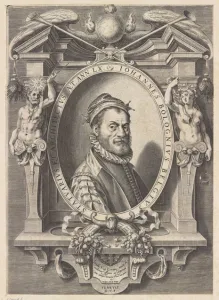
fig. 1. Gijsbert van Veen, Giovanni da Bologna (1589), Herzog Anton Ulrich Museum, Braunschweig. Engraving on paper, 11.3 × 8.1 in.
Giambologna himself practiced as an architect and seemed to value that status. He is titled Statuarius et Architectus in a 1589 portrait engraved (fig. 1) by Gijsbrecht van Veen, and is shown with the tools of an architect in another portrait attributed to Hans von Aachen, as well as in the frescoes by Federico Zuccaro painted beneath the dome of Santa Maria del Fiore. Despite this tendency to place his status as architect on equal footing with that of sculptor, it remains unclear which major architectural projects can truly be attributed to him, apart from the Salviati Chapel in the Church of San Marco in Florence.
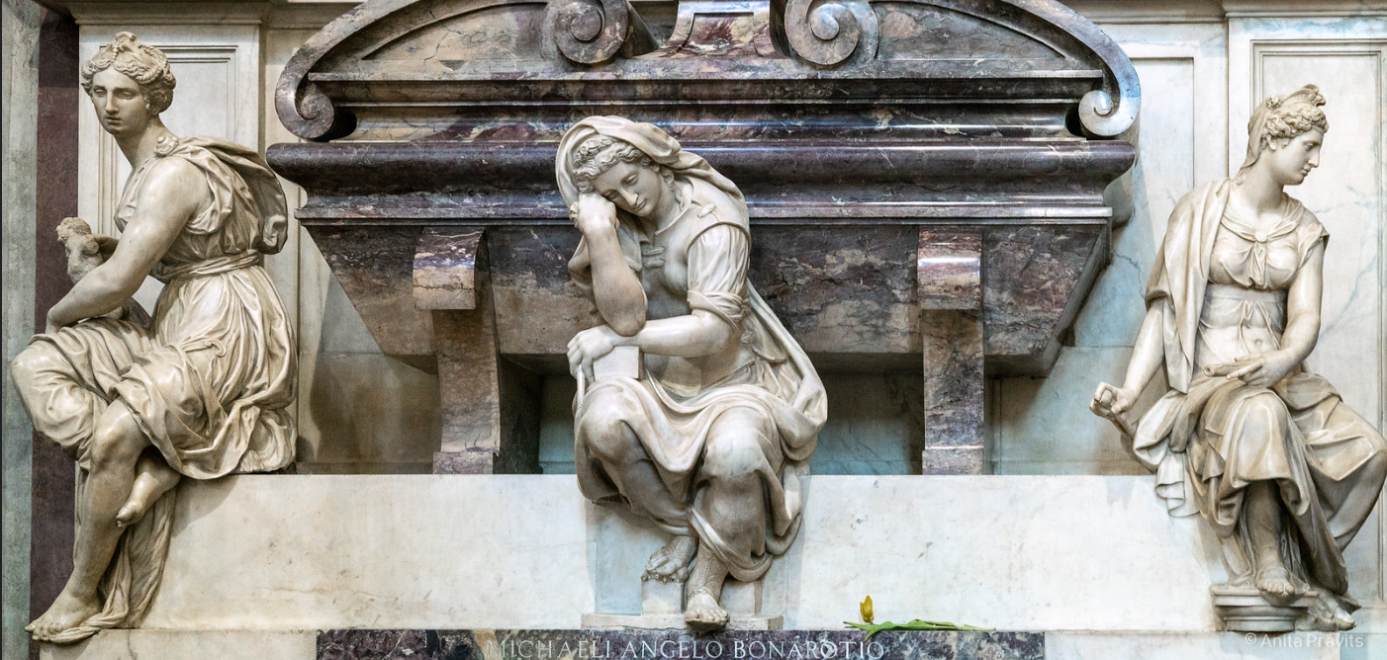
It is likely that Giambologna’s Allegory was inspired by the Allegory of Architecture completed by Bandini (fig. 2) based on Vasari’s drawings in 1568 for Michelangelo’s tomb at Santa Croce. Whether Giambologna’s model was originally conceived as a monumental marble or a small bronze remains unanswered. The marble version of Architecture now in the Bargello—mentioned in the Boboli Gardens in 1789 and first attributed to Giambologna by Supino in 1898—was long the subject of controversy. Weihrauch deemed the work too weak in both technique and composition to be by the master, suggesting instead that it was the work of one of his assistants. Keutner, dating the marble to the early 1570s, even named Franqueville as a plausible candidate. Radcliffe, who initially supported the traditional view that the marble preceded the bronze, eventually sided with Weihrauch, even proposing that it was a mechanically enlarged copy of the bronze.
fig. 2. Battista Lorenzi, Valerio Cioli, and Giovanni Bandini, Painting, Sculpture, and Architecture (1568), Basilica of Santa Croce, Florence.
The only signed version of Architecture, and the only one unanimously recognized as autograph, is the bronze in the Museum of Fine Arts in Boston. Technical analyses conducted by Glinsman and later Bewer have shown that it is a leaded tin bronze with trace amounts of zinc, antimony, nickel, silver and iron, cast in a single piece using the indirect lost wax process. According to Bewer, the patina was altered long after the piece left Giambologna’s workshop.
The Boston bronze serves as the prototype for the first of two known groups of casts. It is distinguished by specific features: a plumb line hanging from the figure’s neck, which explains the taut shape of the necklace, and a crossbar completing the square held by the allegorical figure. The earliest representations of Architecture — those by Willem van Haecht and René Charpentier mentioned above — belong to this group. Both the alloy composition of the autograph Boston bronze and the caption in Girardon’s gallery, which refers to a bronze figure by Giambologna repaired by Susini, confirm that this first group is strictly Italian and Florentine.
fig. 3. Edwaert Collier, Vanitas Stilleben (ca. 1665), Rheinisches Landesmuseum, Bonn. Oil on canvas, 44.6 × 39.0 in.
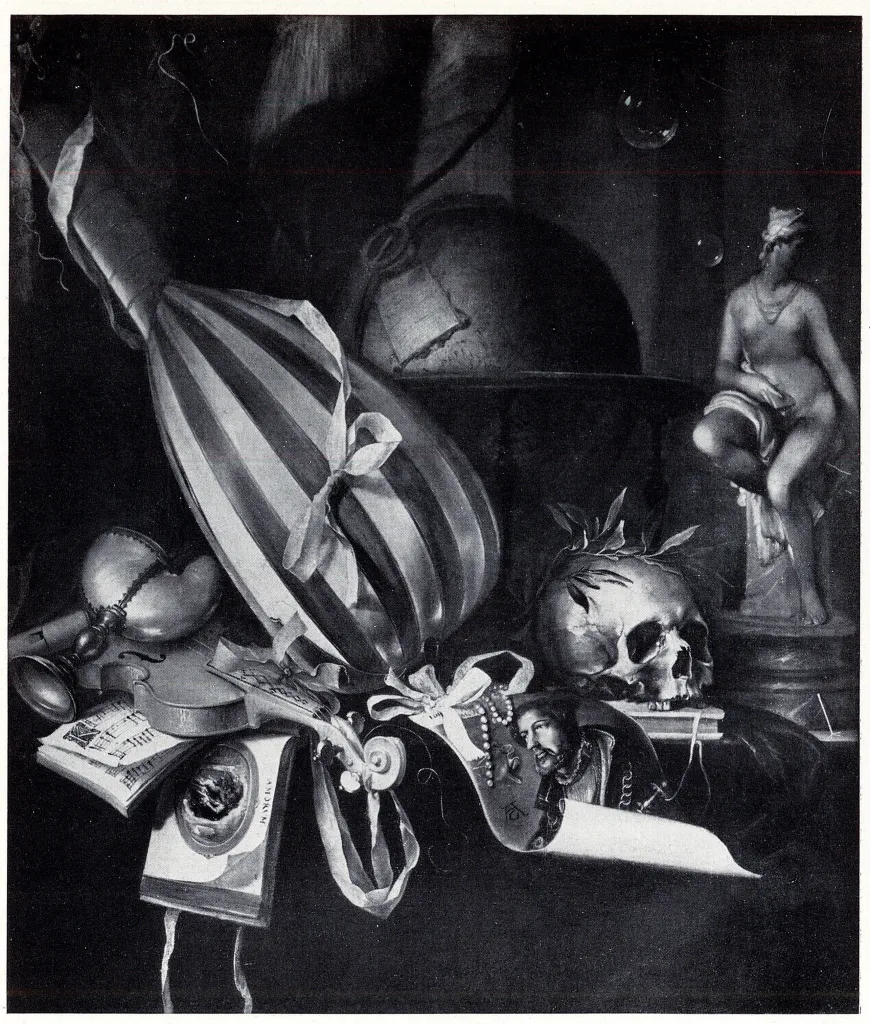
The bronze examined here belongs to a second group of casts, which differs from the first in two details: the plumb line and the square’s crossbar are missing. This type of Architecture first appears in a still life by Edwaert Collier (fig. 3) dated ca. 1665. Two examples related to it, held in public collections—the Metropolitan Museum of Art and the Toledo Museum of Art—have been dated by Avery and Schlegel to the late 17th or early 18th century.
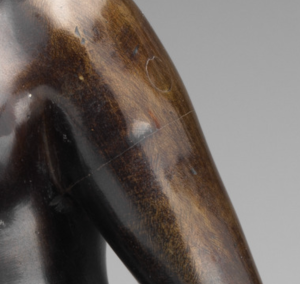
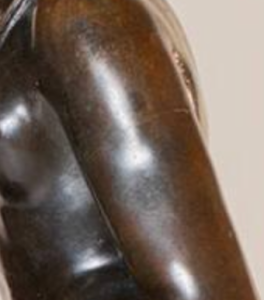
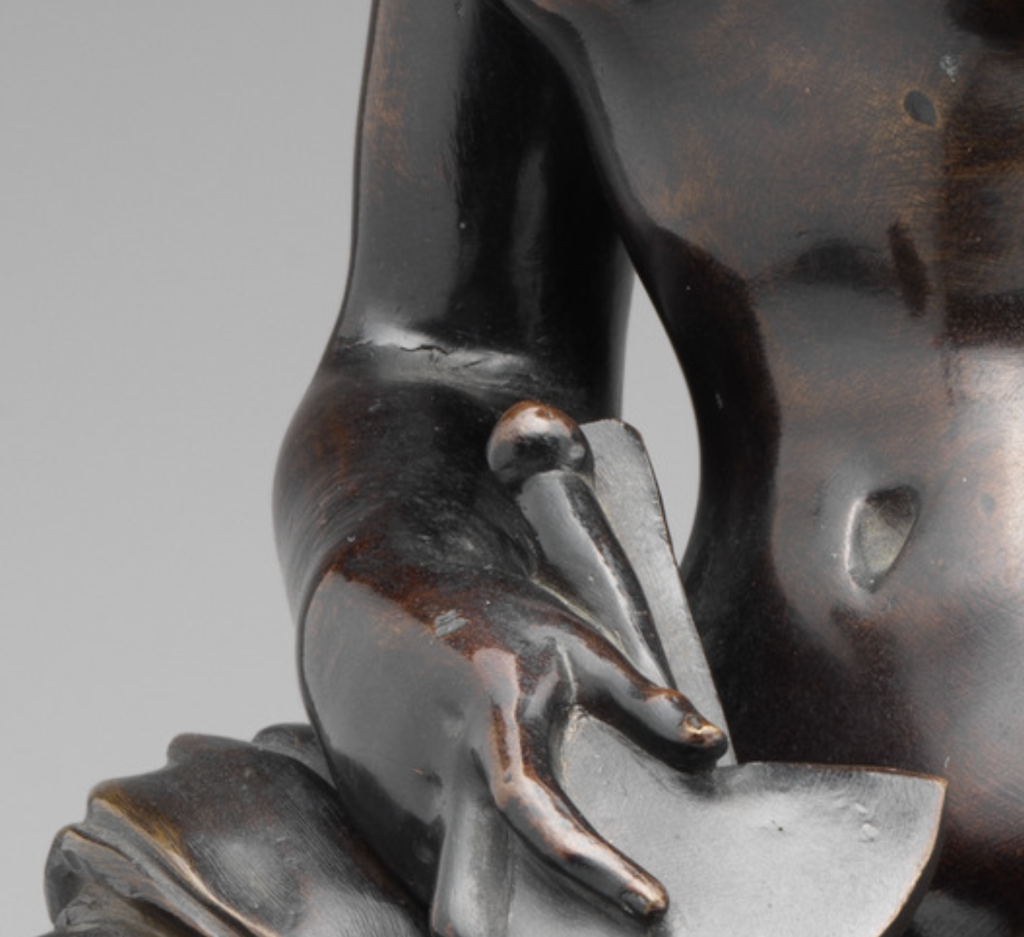
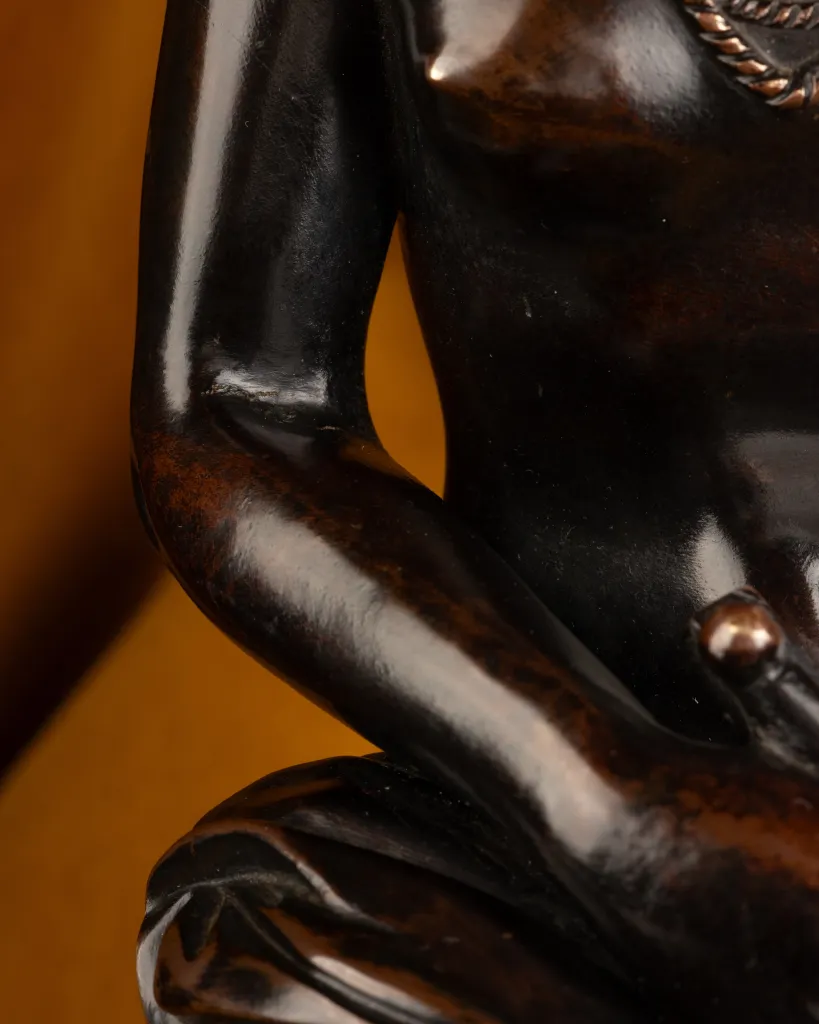
fig. 4. Detail of the left arm and shoulder of the Metropolitan Architecture.fig. 5. Detail of the left arm and shoulder of the Toledo Architecture.fig. 6. Detail of the casting defect in the inner right elbow of the Metropolitan Architecture.fig. 6. Detail of the casting flaw in the inner right elbow of our Architecture.
The bronze studied here shares with the Metropolitan and Toledo bronzes several stylistic and technical characteristics that securely place it within the second group. All three examples feature the same face, slightly less idealized than those of the first group, a similar reddish-brown patina, a casting seam on the left arm and a peg at the left shoulder (fig. 4-5), as well as a casting flaw at the inner elbow (fig. 6-7). The figure and pedestal were cast as a single unit, while the base was cast separately. The left arm, likely cast solid and separately — as indicated by the seam — introduces slight variations in the tilt of the tablet. In both the Toledo bronze and the one studied here, the tablet is attached at the back with a screw to correct an angle between the tablet and the base that might otherwise be too obtuse and compromise the balance of the whole.
After Giovanni Bologna, Architecture (late 17th century-early 18th century), Toledo Museum of Art. h. 35,3 cm.
The figure, except for the left arm, was cast using the indirect lost-wax method, which explains the identical form, assembly, and casting defects found in this example and those from the Metropolitan and Toledo. The interior of the bronze retains parts of the armature used to support the wax and core before casting. Technically speaking, this is not a bronze per se but a brass alloy—mainly composed of copper and zinc with low traces of tin and lead—further supporting a northern origin, as already suggested by the presence of a second-group bronze in Edwaert Collier’s still life. Similar alloys have been found in several works by northern bronze artists, especially in those by Willem Danielsz. van Tetrode, Hendrick de Keyser, and the circle of Arent van Bolten. Hackenbroch and Draper, in their entries for the Architecture in the Metropolitan’s and Untermyer Collection’s respective catalogues, also suggest a northern or possibly French origin, though based on different grounds. Inventories published by Bredius confirm the presence of Italian plaster models — as early as the second quarter of the 17th century, particularly those by Giambologna or Michelangelo — in the workshops of certain founders, goldsmiths, and sculptors in the Low Countries.
Literature
Wilhelm von Bode, “Gian Bologna und seine Thätigkeit als Bildner von Kleinbronzen”, in Kunst und Künstler. Illustrierte Monatsschrift für bildende Kunst und Kunstgewerbe, Berlin, 1911; Edwin Hipkiss, “Architecture by Giambologna”, in Bulletin of the Museum of Fine Arts, vol. 38, no. 227, June 1940; Elisabeth Dhanens, Jean Boulogne, Brussels, 1956; Hans Weihrauch, “Giovanni Bologna (1529–1608): ‘Die Architektur’”, in Die Kunst und das Schöne Heim, May 1958; Franz Rademacher, Rheinisches Landesmuseum, Bonn. Verzeichnis der Gemälde, Cologne, 1959; Yvonne Hackenbroch, Bronzes, Other Metalwork and Sculpture in the Irwin Untermyer Collection, London, 1962; Hans Weihrauch, Europäische Bronzestatuetten. 15.–18. Jahrhundert, Brunswick, 1967; Bavarian National Museum Guide 1. Bronze Sculpture. Acquisitions from 1956–1973. Hans R. Weihrauch zum 65. Geburtstag, Munich, 1974; William Wixom, Renaissance Bronzes from Ohio Collections, Cleveland, 1975; James David Draper, “Sculpture. Renaissance and Later”, in Highlights of the Untermyer Collection, New York, 1977; Charles Avery and Daniel Anthony Radcliffe, Giambologna (1529–1608), Sculptor to the Medici, London, 1978; Charles Avery, Giambologna. The Complete Sculpture, Oxford, 1987; Daphne Barbour and Lisha Glinsman, “An investigation of Renaissance casting practices as a means for identifying forgeries”, in Conservation Research, Washington, 1993; Francesca Gabrielle Bewer, A Study of the Technology of Renaissance Bronze Statuettes, vol. I, London, 1996; Michael Hall and Charles Avery, Giambologna (1529–1608). Comment s’attacher l’âme d’un prince. La sculpture du Maître et de ses successeurs, Paris, 1999; Sophie Baratte, Geneviève Bresc-Bautier et al., Les Bronzes de la Couronne, Paris, 1999; Shelley Sturman, “A Group of Giambologna Female Nudes: Analysis and Manufacture”, in Studies in the History of Art, vol. 62, 2001; Beatrice Paolozzi Strozzi et al., Giambologna. Gli dei, gli eroi, Florence, 2006; David Bourgarit, Jane Bassett, Francesca Bewer, Peta Motture et al., Guidelines for the Technical Examination of Bronze Sculpture, Los Angeles, 2023.
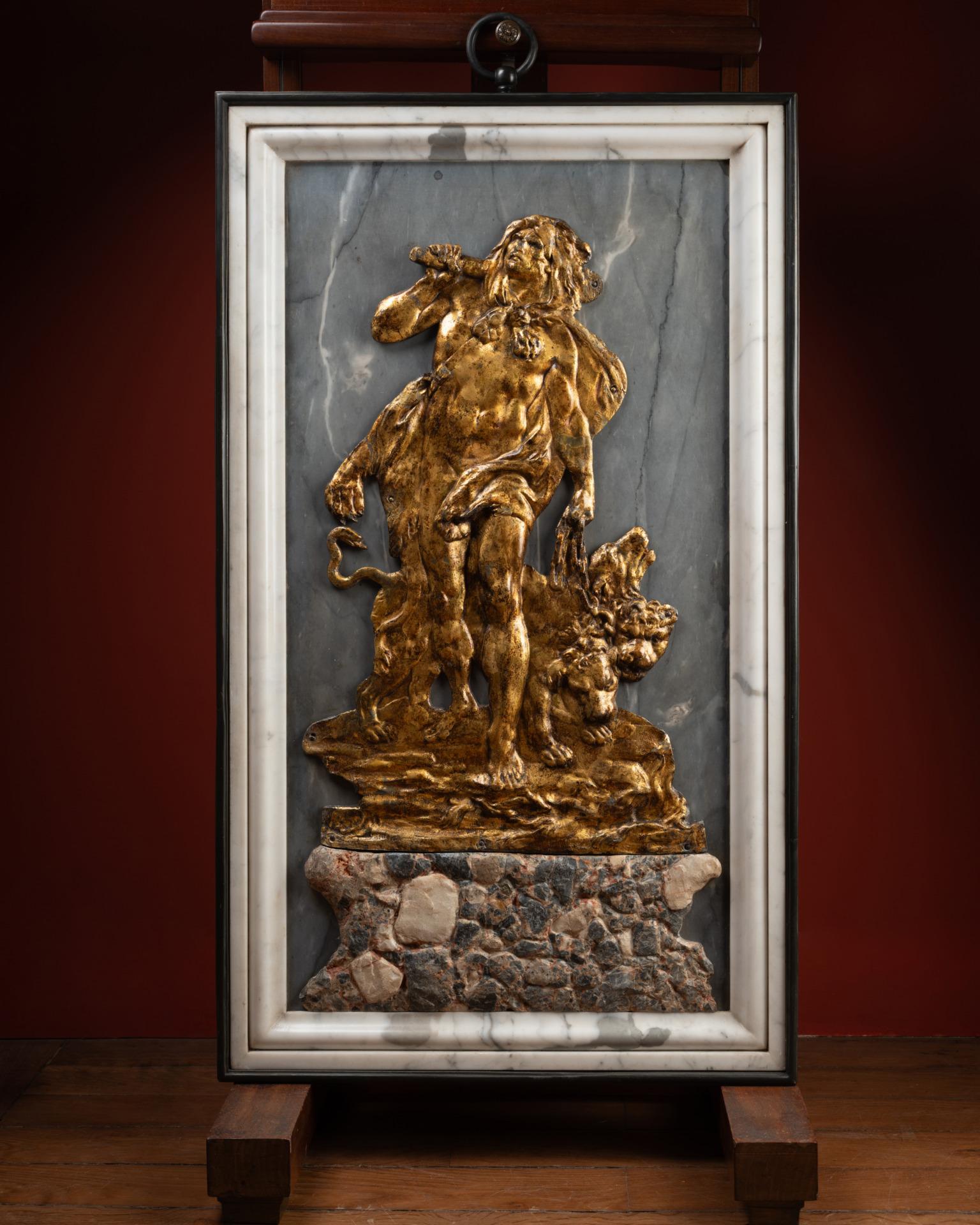
Hercules Chaining Cerberus, after Augustin Pajou
Hercules Chaining Cerberus, after Augustin Pajou
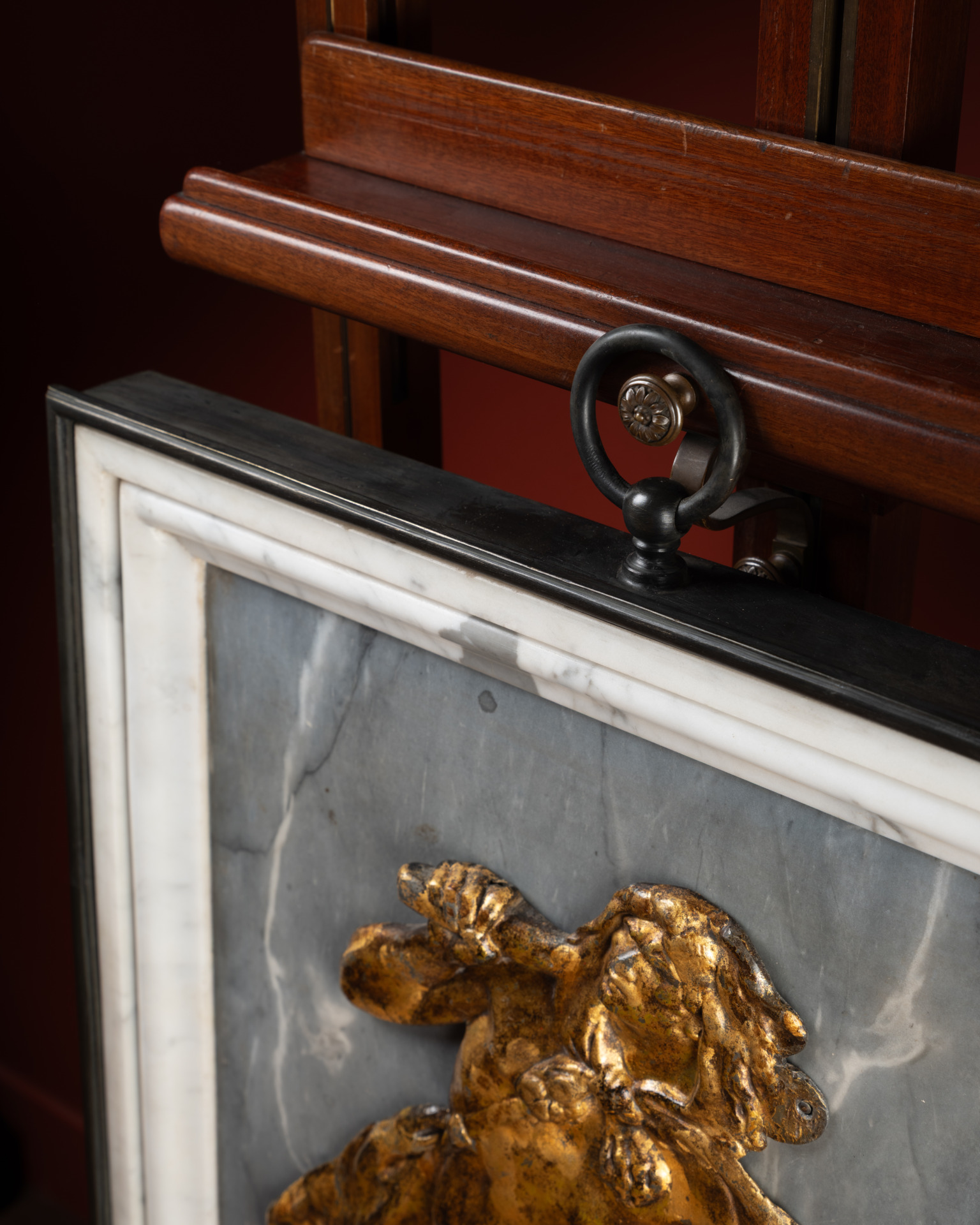
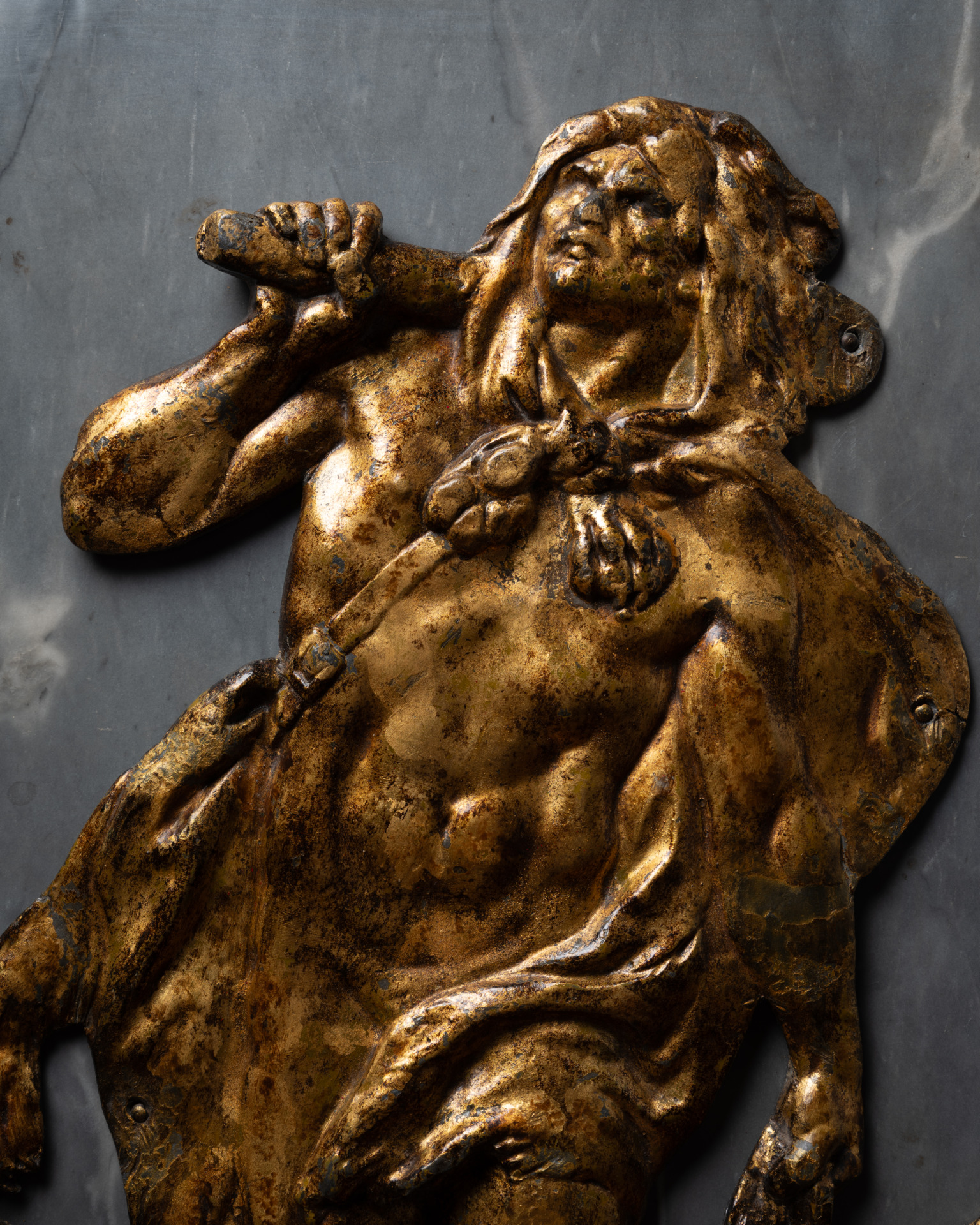
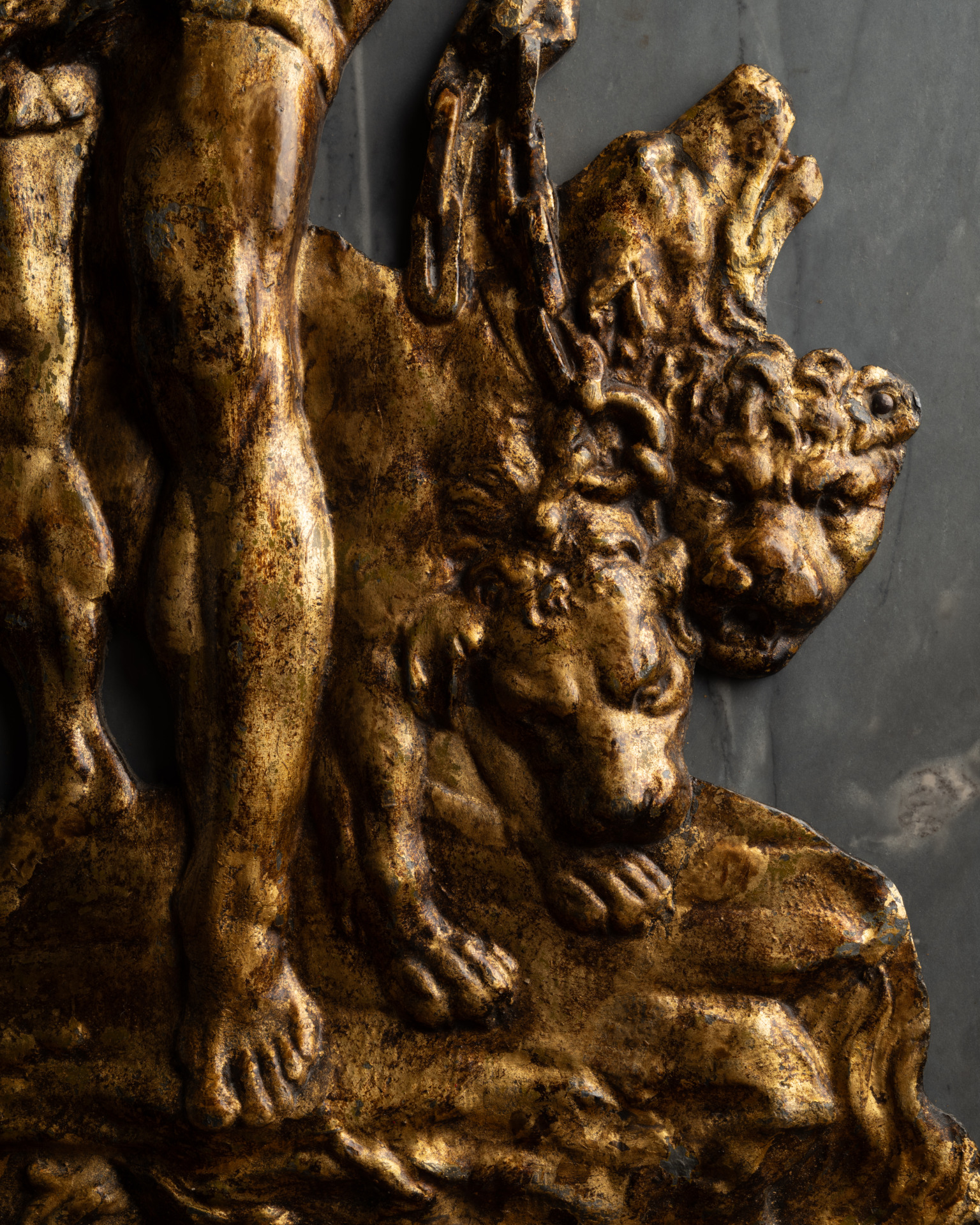
Gilt lead, turquin blue marble, white Carrara marble, imperial breccia, patinated bronze France 19th century 87 x 51 cm (34.25 x 20 in.)
A 1774 drawing by William Chambers shows that the Marquis de Voyer owned a fine piece of cabinetry housing a stove-fireplace, its panels adorned with a pair of medallions depicting Orpheus in the Underworld and Hercules Chaining Cerberus.
Pajou was tasked with creating several portraits for the Hôtel de Voyer d’Argenson, along with architectural sculptures and decorative elements. Given that the artisans who worked on the Hôtel d’Argenson are well-documented and nearly all renowned, the medallions sketched by Chambers are widely attributed to Pajou himself.
The Hôtel de Voyer d’Argenson, also known as the Hôtel de la Chancellerie d’Orléans, stood opposite the Palais Royal on what is now rue de Valois. Acquired in 1702 by Philippe, Duke of Orléans, it was originally just a house owned by the Duke’s valet de chambre. A grand mansion, designed by Germain Boffrand, was later built on the site. The property changed hands over time: it passed to Mademoiselle de Séry, briefly the Duke’s mistress; then to the Duke of Chartres, Louis d’Orléans, son of the Regent; and finally to Marc-René de Voyer d’Argenson, Marquis de Voyer, who had it revamped between 1760 and 1770 by Charles de Wailly.
This relief, likely created after the work at the Hôtel d’Argenson, echoes the composition and vibrant polychromy of the four bas-reliefs Pajou crafted for the overdoors of the mansion’s salon. Those works, inspired by the four elements, feature mythological scenes in gilded plaster on mixtion, set against a deep blue stucco background. The “subdued” gilding of the metal in this relief seems to mirror the plaster of Pajou’s Pluto, Proserpina, Boreas, and Cybele figures, exquisitely modeled with the glow of “aged gold,” while a refined turquin blue marble plaque takes the place of the blue stucco. Though the colors used in this relief were fairly typical of the neoclassical era, it stands out with a marble-simulated rock — almost rocaille in its whimsy — serving as a striking promontory for Hercules.
Literature
John Harris, ‘Sir William Chambers and his Parisian album’ in Architectural History, Londres, 1963 ; James David Draper et Guilhem Scherf, Pajou, Paris, 1997.
Allegory of Autumn by Jan Claudius de Cock
Allegory of Autumn, by Jan Claudius de Cock
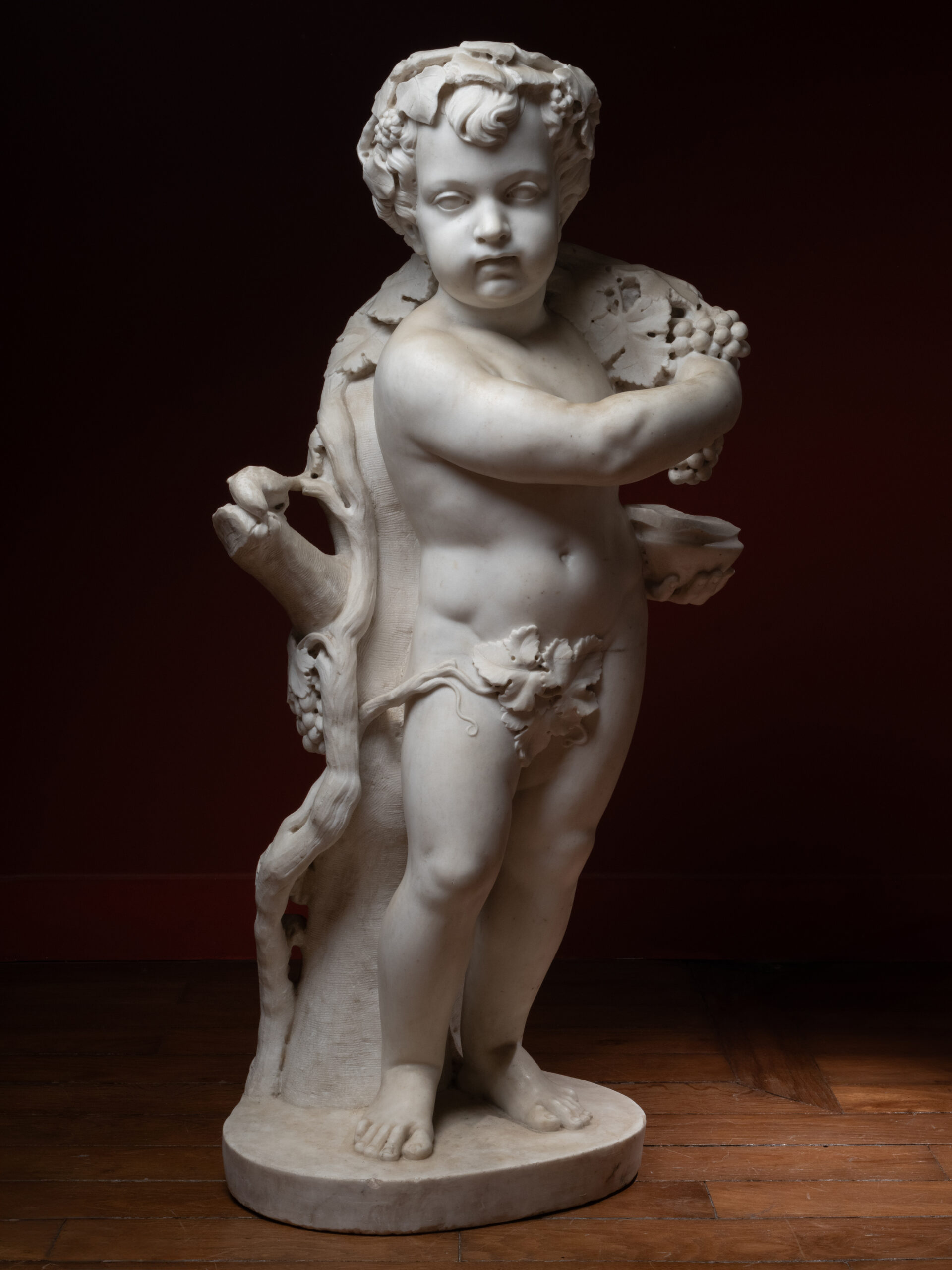
Marble Antwerp ca. 1705-1710 h. 94 cm (37 in.)
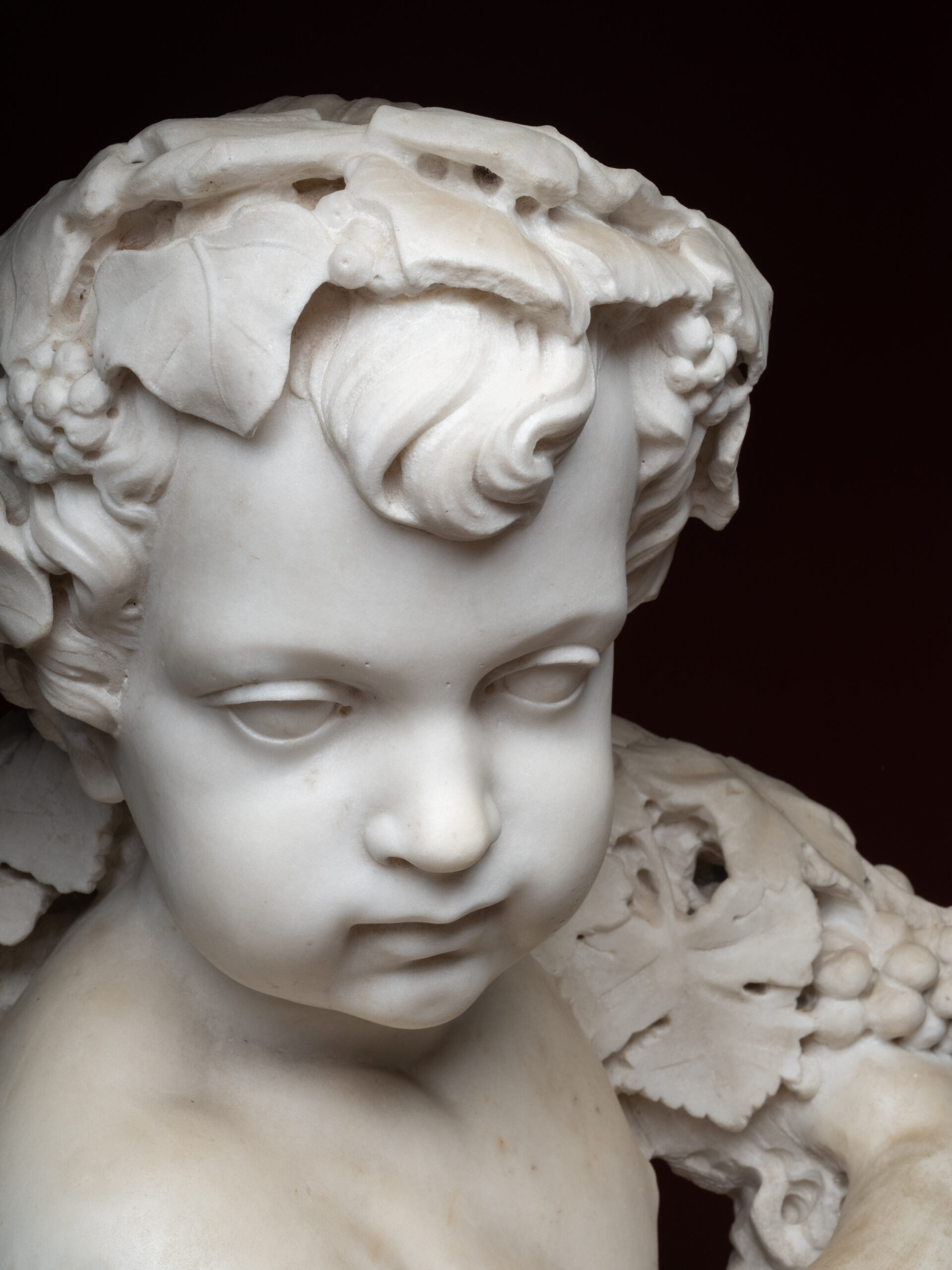
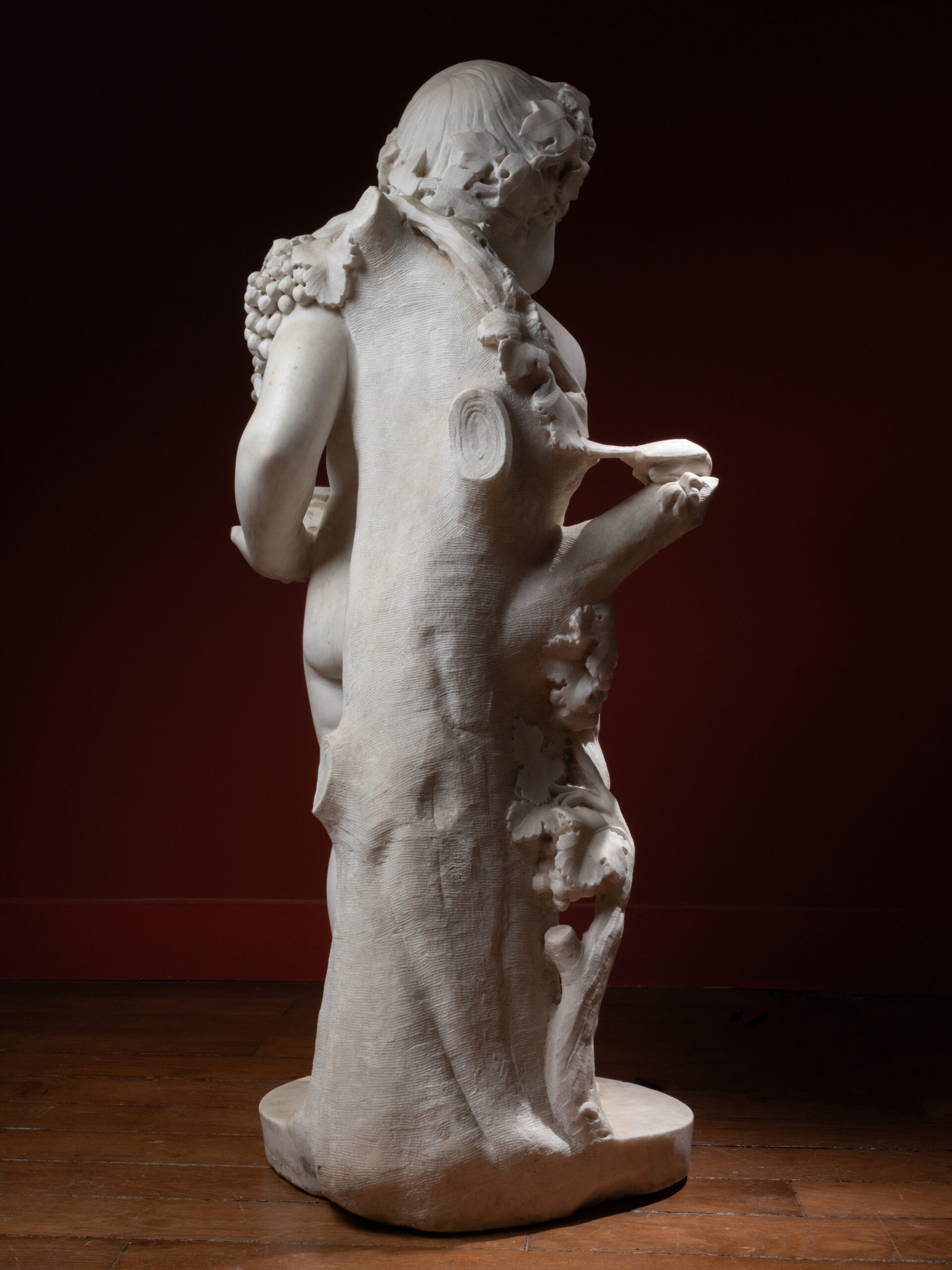
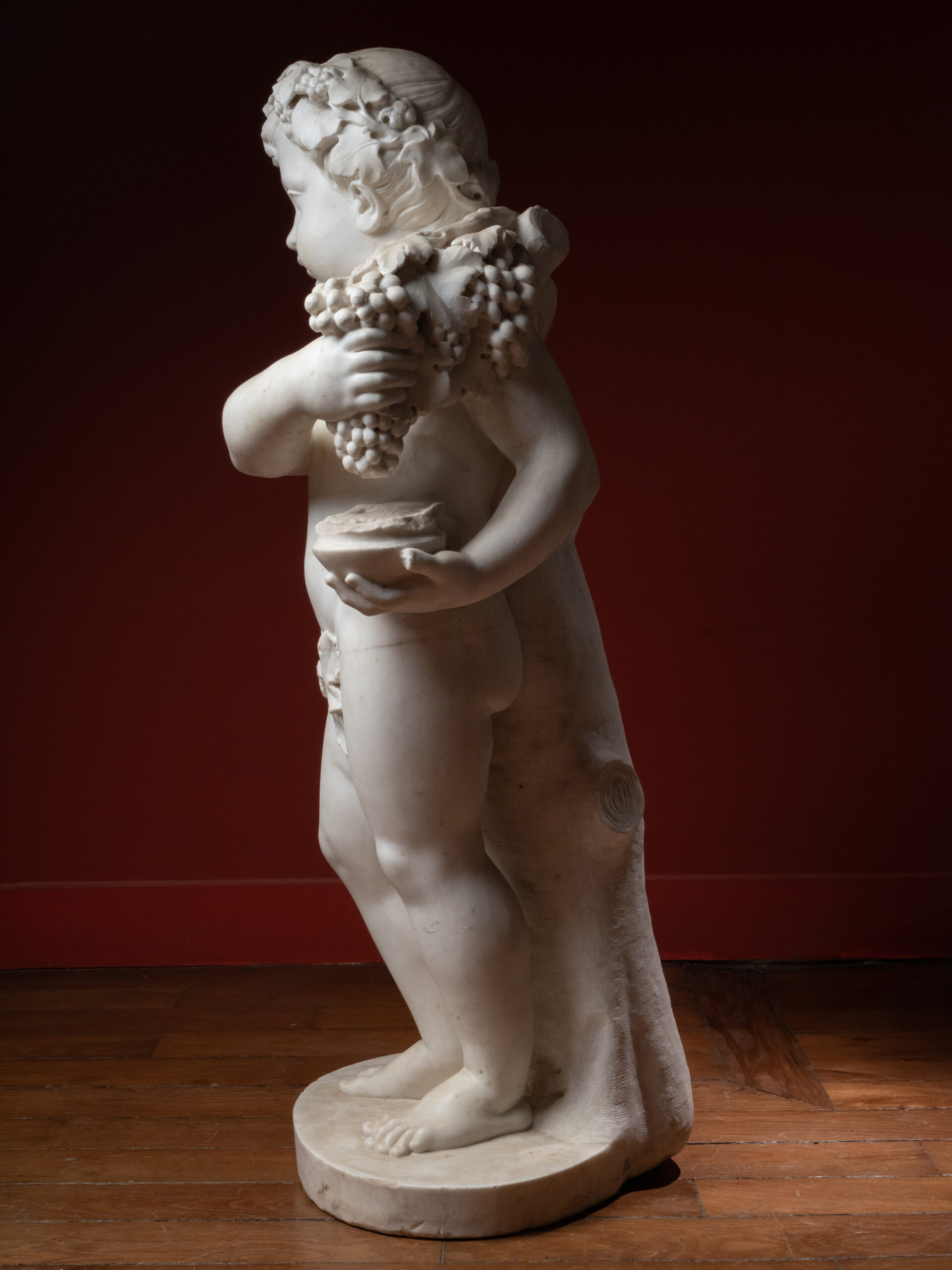
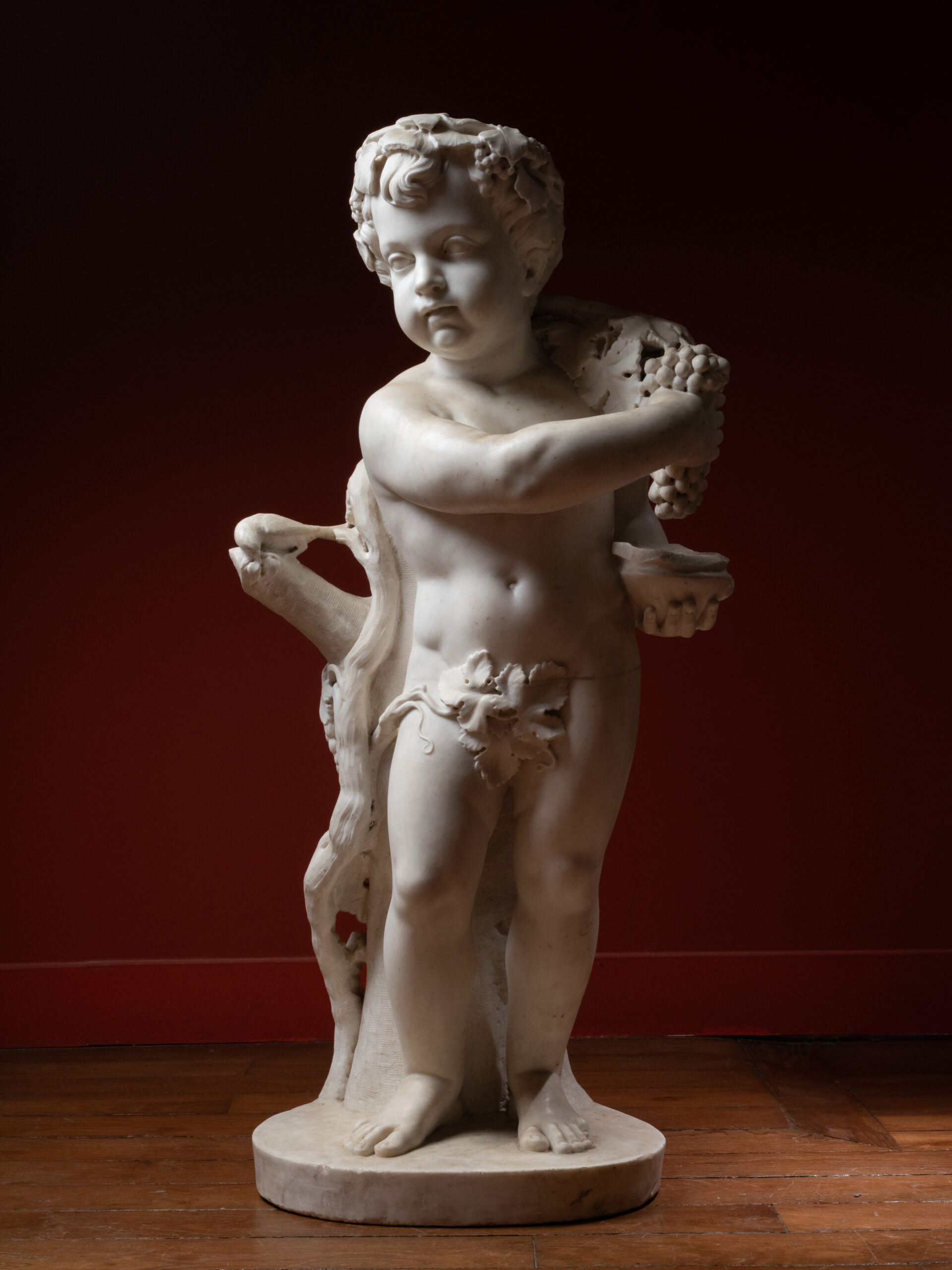
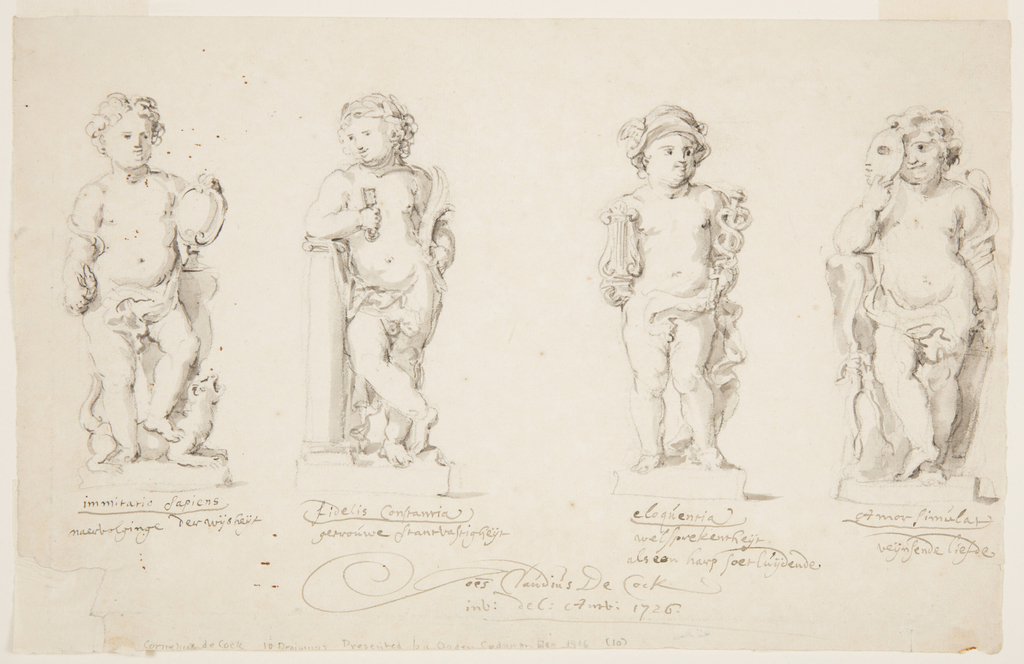
This exceptional grapes-and-vines-wearing marble allegory of Autumn is attributed to Jan Claudius de Cock, a Flemish sculptor and draughtsman born in 1667. Greatly influenced by François Duquesnoy, Jan Claudius, a member of the Antwerp Guild of Saint Luke ca. 1688-1689, specialised in small marble and terracotta figures of children, mostly representing allegories of virtues, lands, elements or seasons.
Jan Claudius de Cock, Drawing, projects for statues : Wisdom, Constancy, Eloquence, Cupid disguised (1726), Cooper Hewitt Museum, New York City ; crayon, pen, ink, brush, watercolor on paper, 20,9 x 32,9 cm.
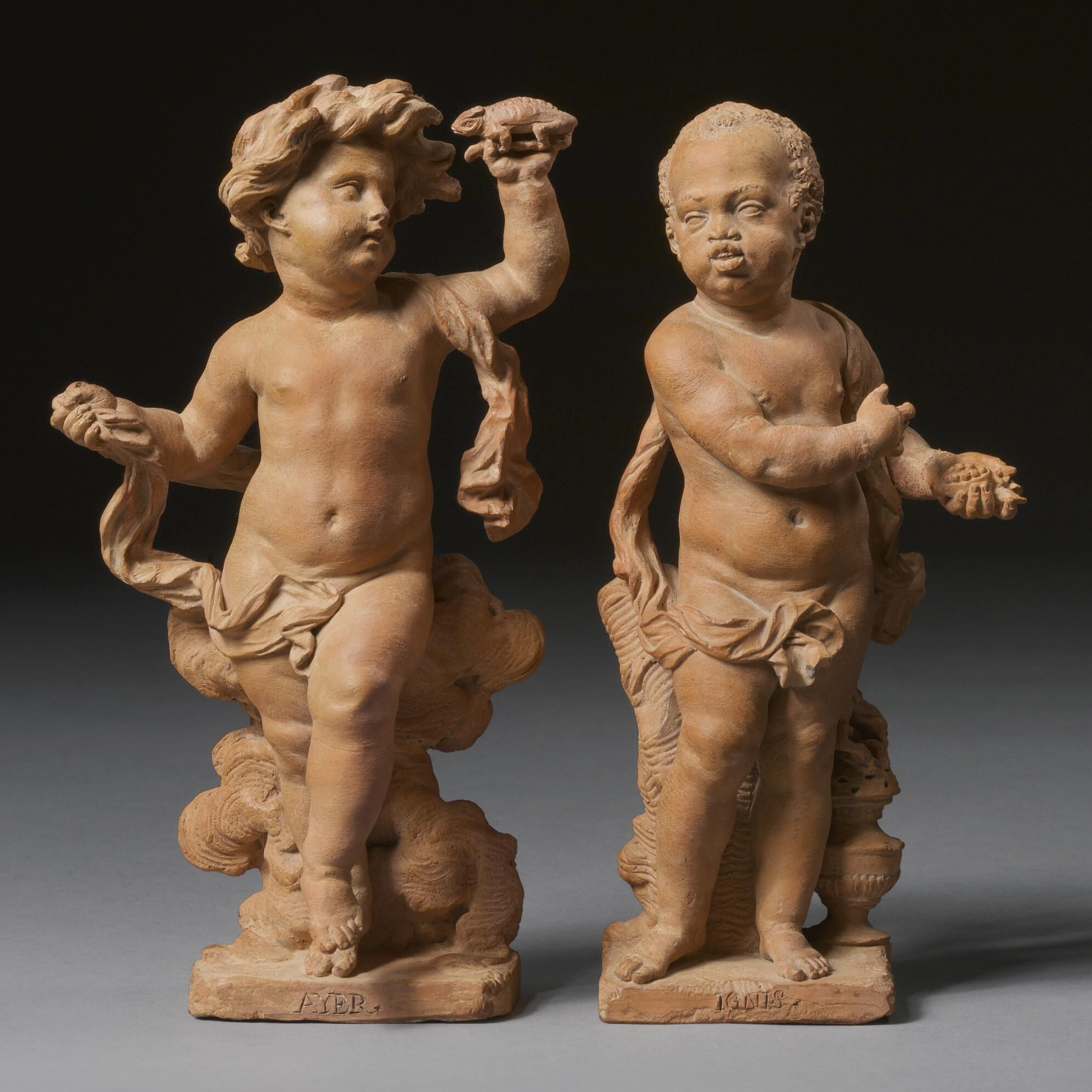
Rijksmuseum’s Allegory of Africa (1704) is the earliest known marble of this kind, followed by a War Crowning Peace (1710) whose terracotta is now at the Stedelijk Museum in Breda. Notably, a pair of terracotta figures depicting Air and Fire, dated ca. 1705, one of which shows the same gesture as the present marble. Jan Claudius’ terracotta sculptures were typically prototypes, studies, concetti meant to be an early step of his creative process. Yet the marble figures for which these two terracotta are unrecorded and it is uncertain whether they were ever turned to marble.
Jan Claudius de Cock, A Pair of Figures representing Air and Fire (ca. 1705), Gallery Tomasso, London ; terracotta, 27 cm high.
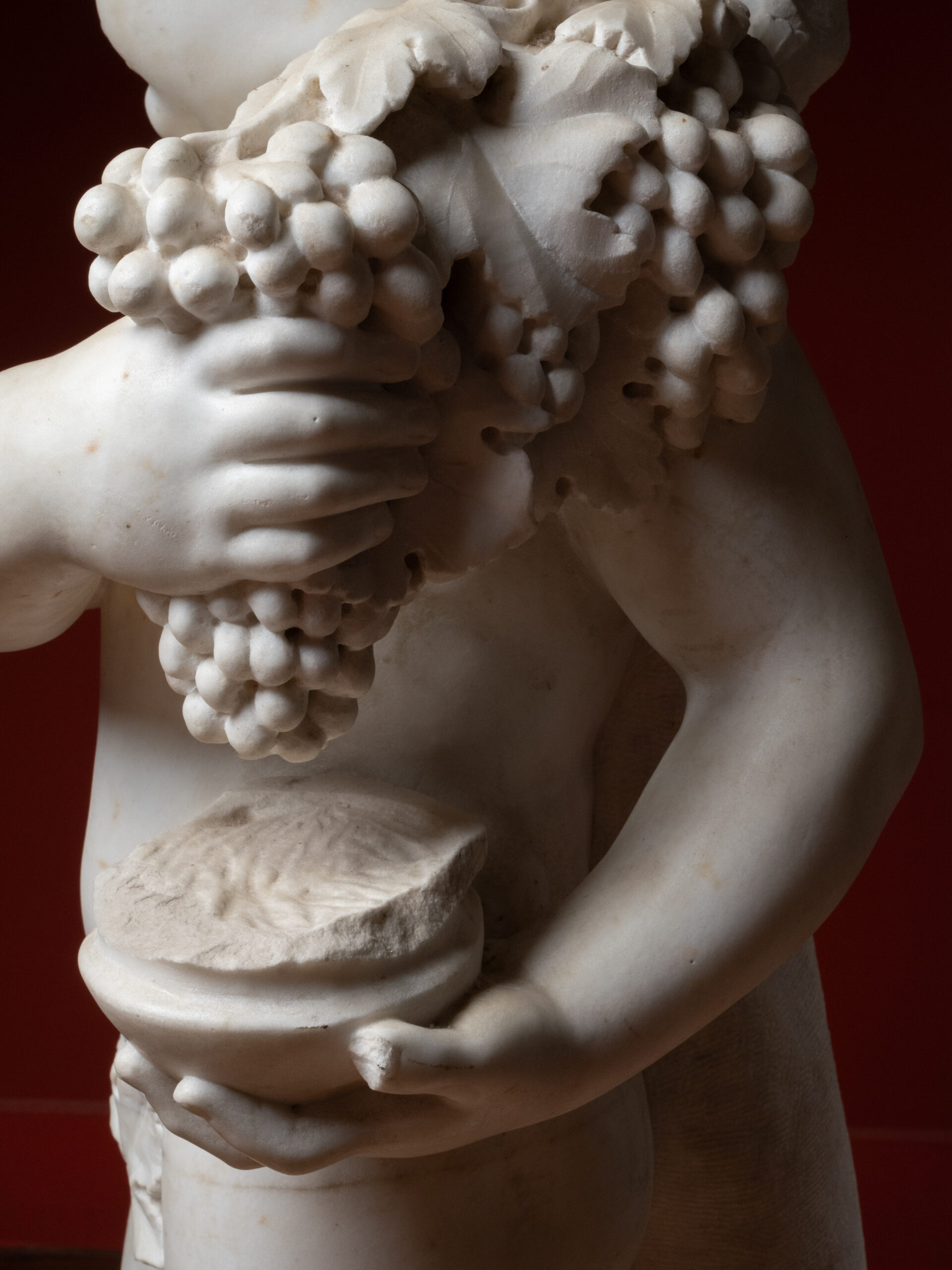
It is plausible that the terracotta models were repurposed, with Jan Claudius adapting the composition of Fire for another commission, or using some elements for another project. In doing so, he retained the tree trunk as a structural component of the contrapposto and turned the pomegranate into a bowl to contain the wine.
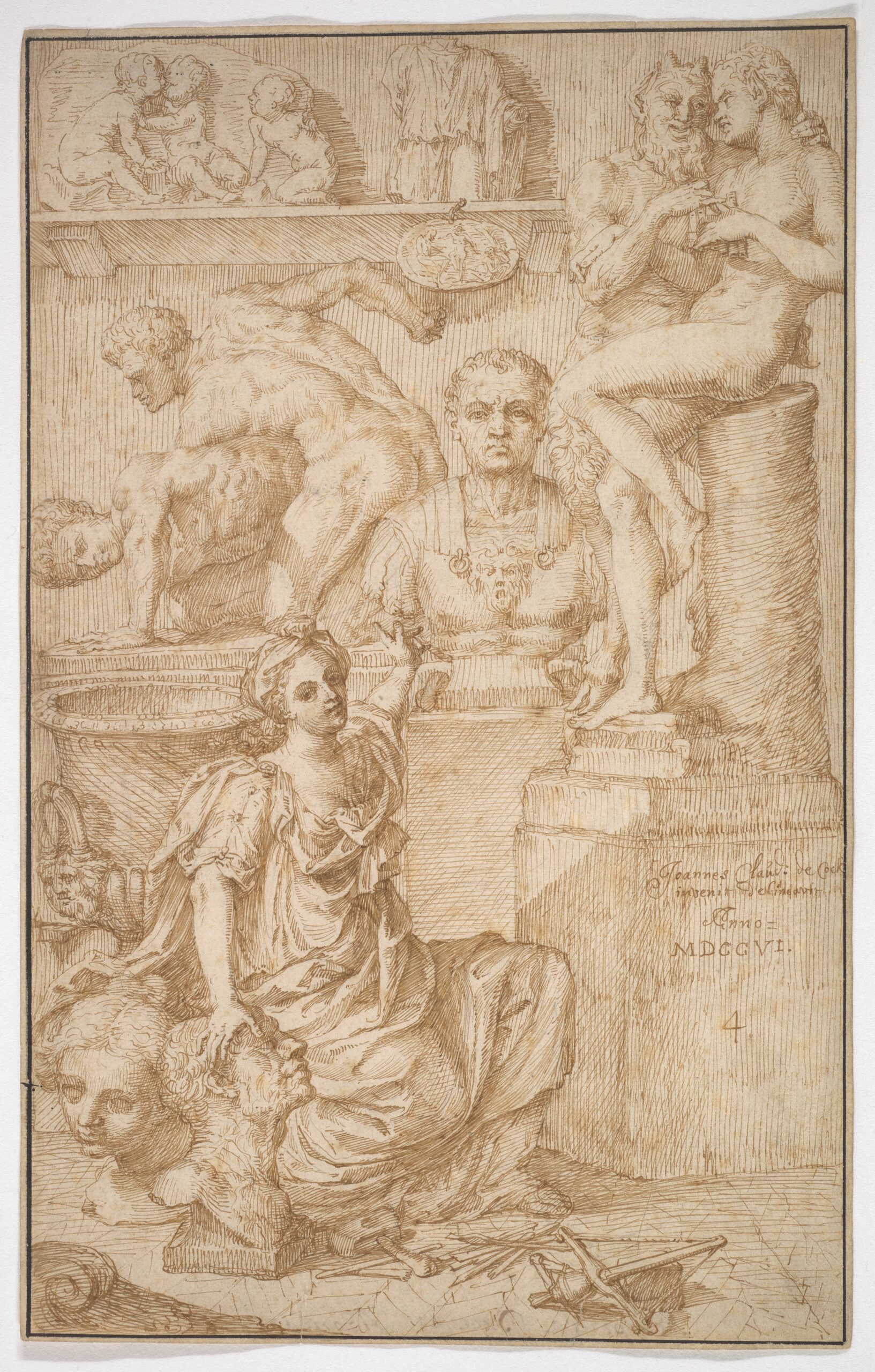
A distinctive feature of Jan Claudius’ work is the streak-like motifs as a naturalist way to render the texture of wood bark. While these are merely suggested in the terracotta model of Fire, they are rendered in exceptional detail in our marble sculpture. This stylistic trait also appears in his engravings and drawings, such as the Metropolitan Museum’s Allegory of Sculpture (1704).
Jan Claudius de Cock, Allegory of Sculpture (1704), Metropolitan Museum, New York City ; pen and brown ink on paper, 31,7 x 19,5 cm.
Jan Claudius’ early sculptures were typically created for grand decorative schemes, often as components of monuments commissioned for princes and nobles. By the 1720s, however, he also turned to larger, life-sized and more traditional sculptures for altarpieces, such as Saints James and Peter for the Meurs monument (ca. 1723) and stone figures for a Calvary at Saint Paul’s Church in Antwerp (ca. 1734).
The technical, stylistic, and contextual elements provide compelling evidence for attributing this Allegory of Autumn to Jan Claudius de Cock, created during his 1705–1710 period.
Literature
P. Verhaegen, ‘Un groupe en marbre du sculpteur De Cock’, in Annales de la société royale d’archéologie de Bruxelles, Bruxelles, 1898 ; J. Leeuwenberg and W. Halsema-Kubes, Beeldhouwkunst in het Rijksmuseum, Amsterdam 1973 ; E. Dhanens, R. De Roo and al., La Sculpture au siècle de Rubens dans les Pays-Bas méridionaux et la principauté de Liège, Bruxelles, 1977 ; T. Clifford, Scultura II, London, 2009.
Gilt bronze Putto, circle of Jacopo Sansovino
Gilt bronze Putto, circle of Jacopo Sansovino
Gilt bronze Veneto ca. 1580 h. 13,5 cm (5.3 in.)
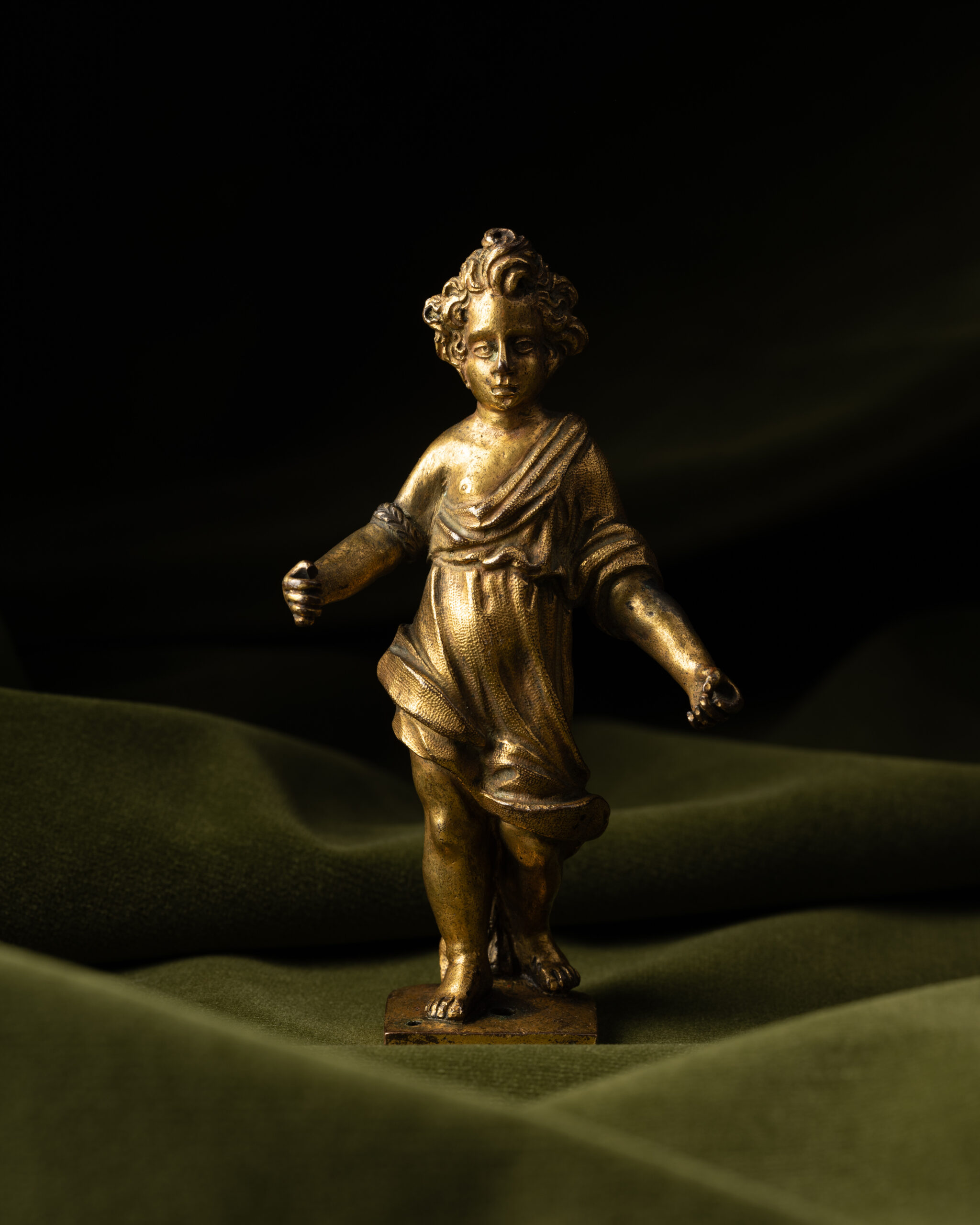
The Victoria and Albert Museum holds a set of seven gilt-bronze statuettes attributed to Roccatagliata: seven putti playing an assortment of musical instruments, most likely salvaged from the bronze ornamentation of an important cabinet. The present statuette — comparable to the London bronzes in scale, gilding, and the form of its base — almost certainly served the same decorative function on a piece of furniture, and, like them, would originally have held a musical instrument.
It lacks, however, the liveliness and movement characteristic of Roccatagliata’s work. Furthermre, an affinity with a gilt-bronze putto in the Palazzo Venezia, Rome, of about 1580, points instead to an earlier conception, one nearer the bronze sculpture of Jacopo Sansovino’s workshops, with their graver postures and weighty drapery. Several gilt-bronze statuettes of this type, older in manner than Roccatagliata’s, have been assigned to sculptors in Sansovino’s orbit, among them Girolamo Campagna and Camillo Mariani. Firm attribution, however, of Venetian bronzes from the later sixteenth century is, in most cases, an unrealistic ambition, given how sculptors’ workshops in Venice were then organized. Sansovino himself, writing to Ercole II d’Este, Duke of Ferrara, in 1550, concedes that he customarily left his assistants to design his bronzes in full, works he more often than not never touched; the chasing, the finishing, even the modeling of the clay or wax prototype might pass through several hands. Even so, the type of the present putto, its gilding, its stance, and its relationship to the statuettes cited above together warrant an attribution to the circle of Jacopo Sansovino and a date in the third quarter of the sixteenth century.
Literature
Antonio Santangelo, Museo di Palazzo Venezia. Catalogo delle sculture, Rome, 1954; Wolfgang Wolters and Norbert Huse, The Art of Renaissance Venice. Architecture, Sculpture and Painting. 1460–1590, Chicago, 1990; Pietro Cannata, Museo nazionale del Palazzo di Venezia. Sculture in bronzo, Rome, 2011.