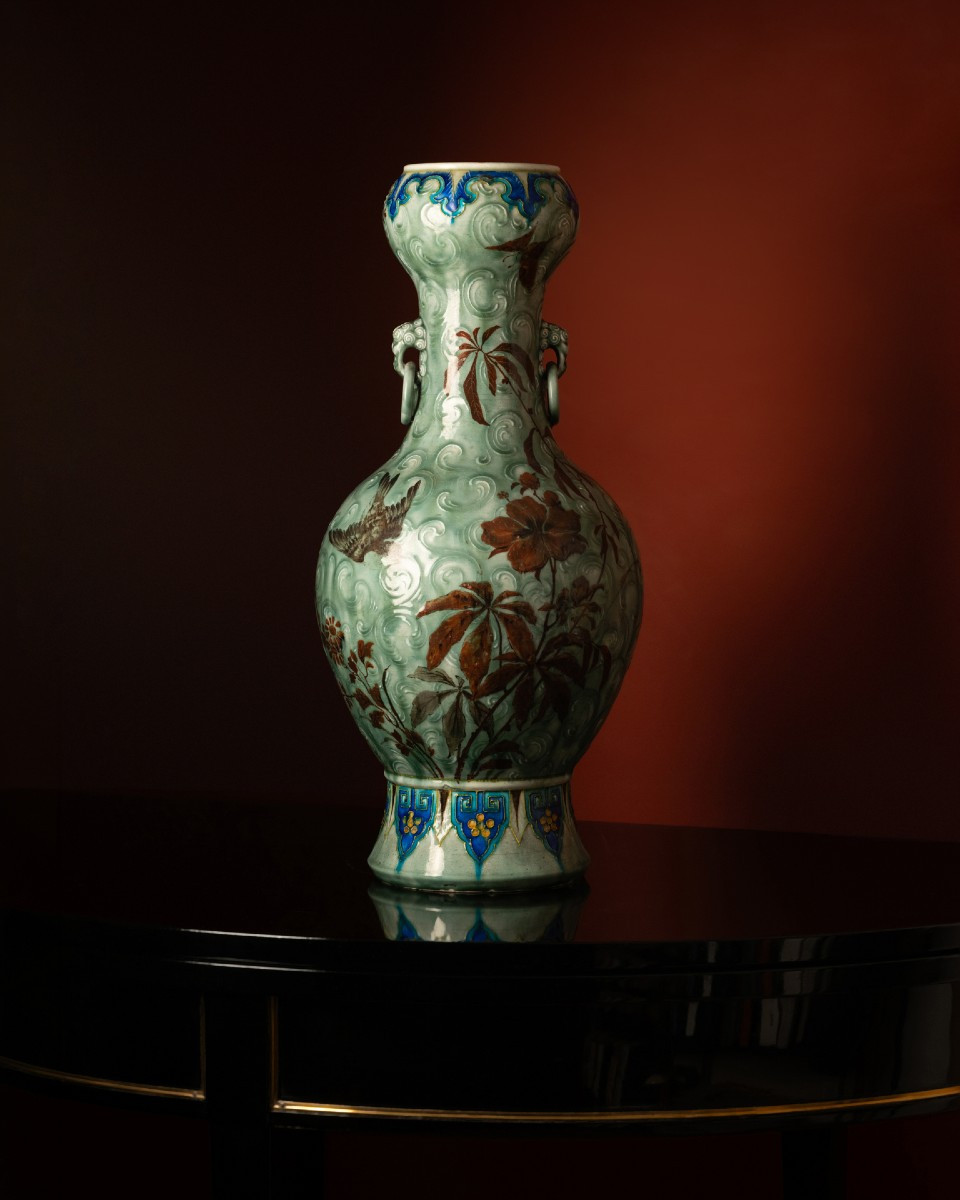
A Large “Garlic-Head” Vase in Celadon and “Bleu Deck”, by Théodore Deck, with Decoration Attributed to Éléonore Escallier
A Large “Garlic-Head” Vase in Celadon and “Bleu Deck”, by Théodore Deck, with Decoration Attributed to Éléonore Escallier
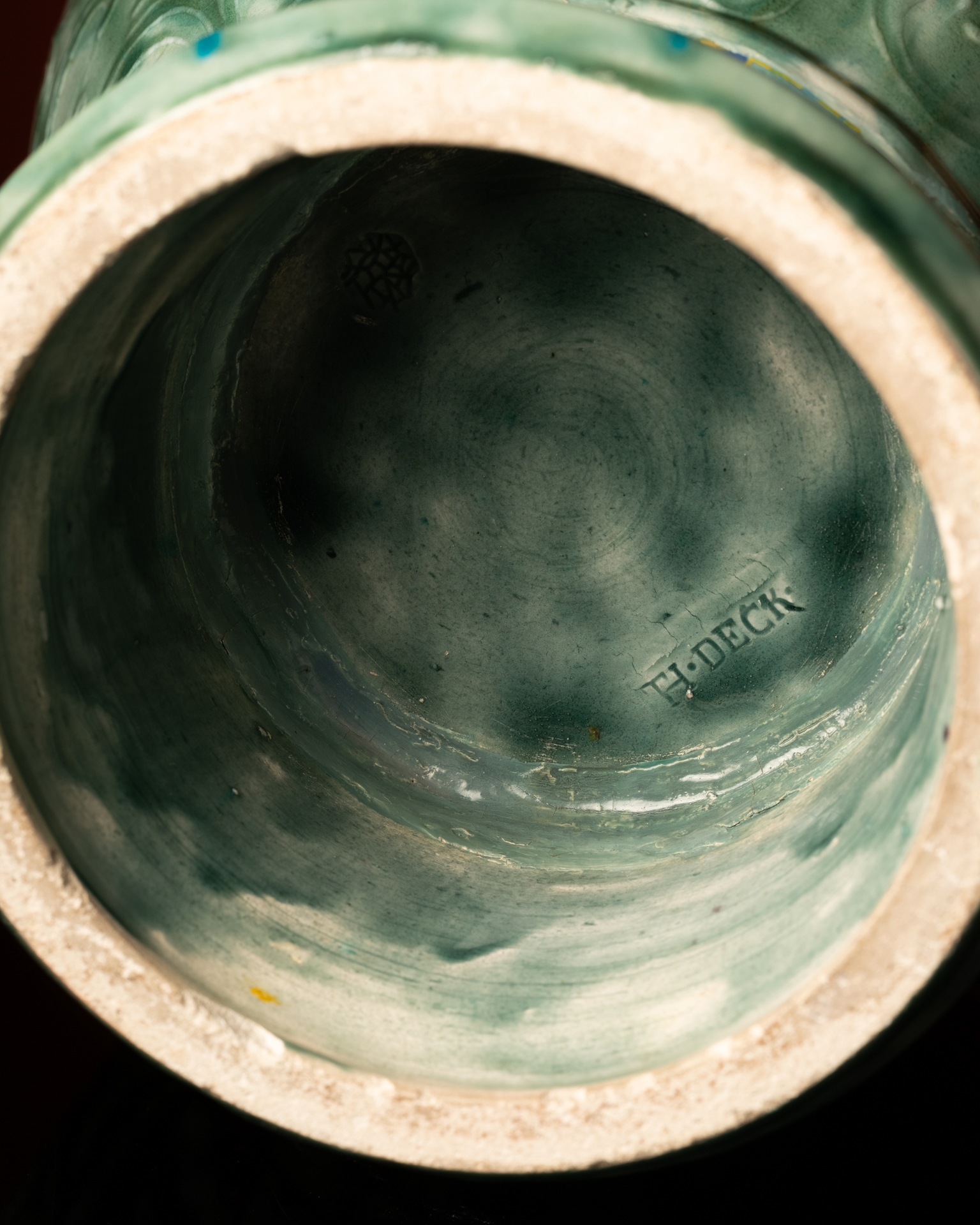
Glazed earthenware with underglaze decoration, “TH. DECK” impressed France 1869-1880 h. 56 cm (22 in.)
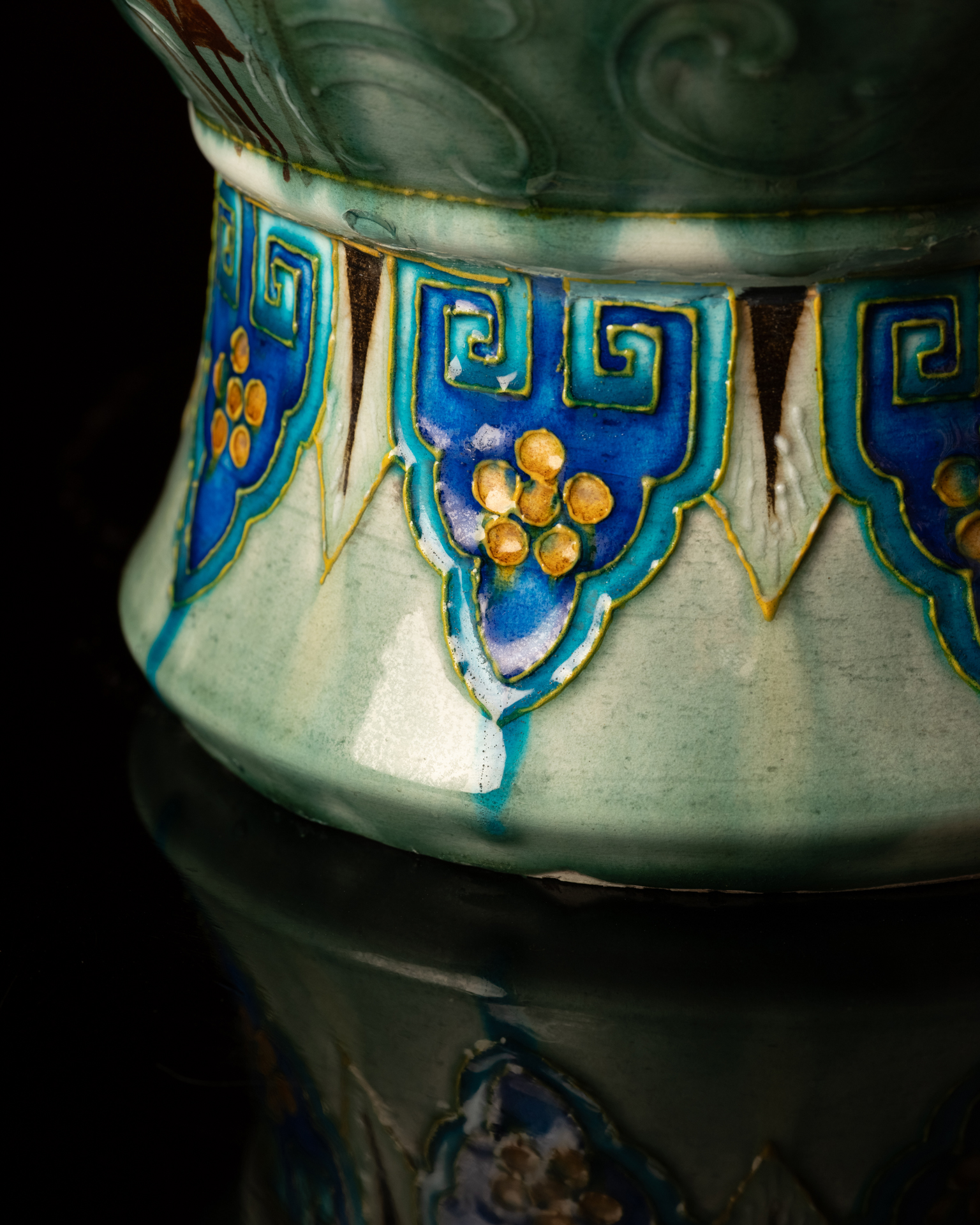
Born in 1823 in Guebwiller, Alsace, a chemist and sculptor by training, Théodore Deck distinguished himself at the International Exhibitions of 1862 and 1867 for his vases and services inspired by Oriental ceramics, and notably for having uncovered the secret of a turquoise blue on par with that found in Iznik ceramics, known ever since as “bleu Deck”. As early as 1869, he repeated this technical achievement by recreating the celadon of Chinese porcelain, confirming his preeminence within French ceramics at the exhibitions of 1871 and 1873.
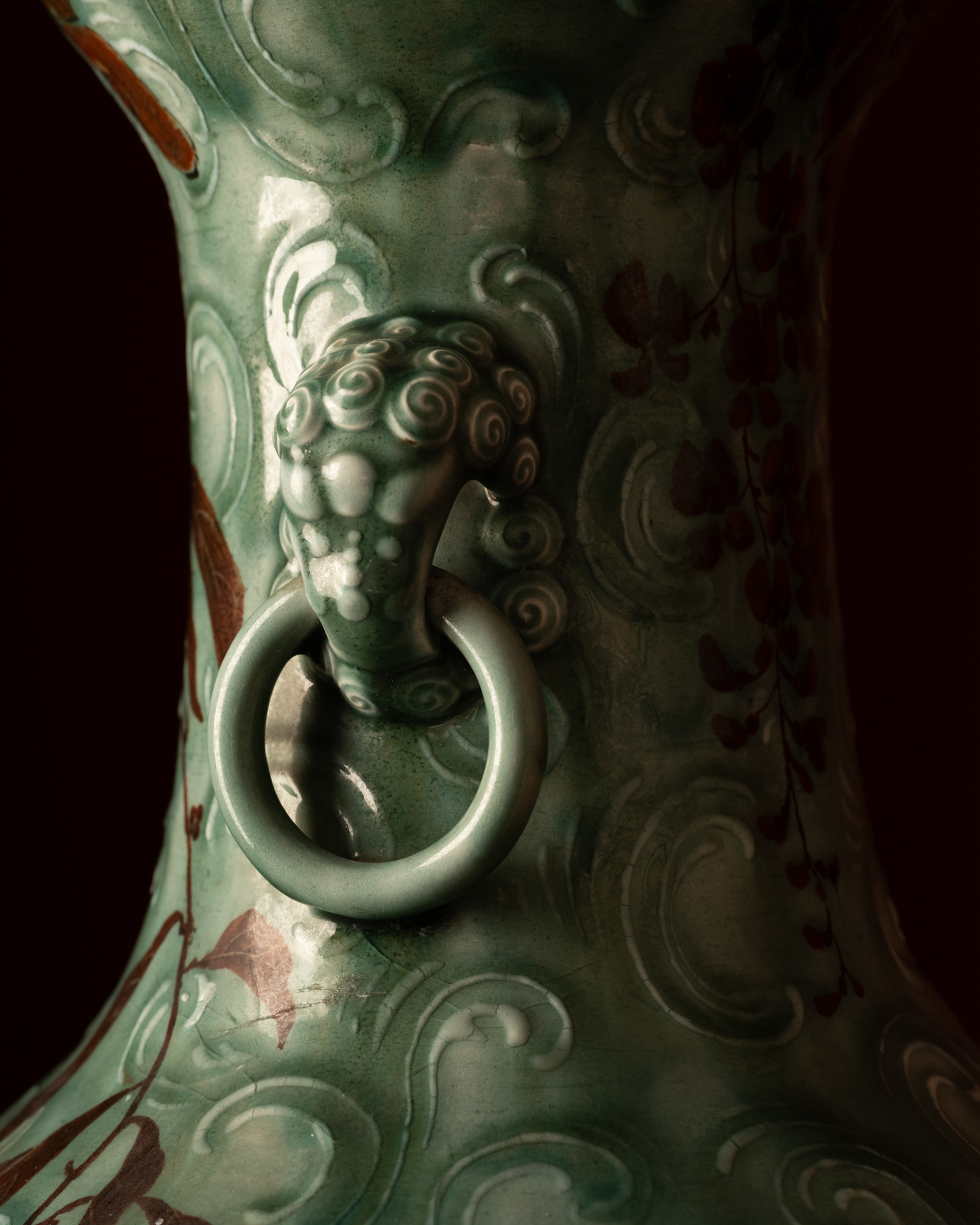
The present vase, whose shape is inspired by the suantouping — i.e. “garlic-head” vases, a form documented since at least the Yuan dynasty — essentially synthesises all of Théodore Deck’s technical feats: a celadon glaze with relief decoration, featuring a scene of a bird in flight among foliage, adorned with a frieze of leiwen and chrysanthemums in polychrome cloisonné of indigo, ochre, and “bleu Deck”, while the neck is decorated with ring-handles featuring stylized shi (獅) masks, or guardian “Fo” lions.
The decoration of a similar vase, exhibited in London in 2002, is attributed to Éléonore Escallier, a French painter born in 1827, famous in the last third of the 19th century for her still lifes of flowers and fruit as well as animal paintings primarily featuring birds. Escallier was one of the first painters to establish a long-term collaboration with Théodore Deck, for whom she executed similar scenes of birds among branches; he later hired her at the Manufacture de Sèvres as a decorative painter in 1874. A vase from this manufacture, now held at the Mobilier National and decorated by her hand, features a bird motif very similar to the one on the present vase.
Literature
See Margaret Medley, The Chinese Potter. A Practical History of Chinese Ceramics, Oxford, 1982 ; Judy Rudoe, Decorative Arts 1850–1950. A Catalogue of the British Museum Collection, London, 1991 ; Bernard Bumpus, Théodore Deck Céramiste, London, 2002.
A Holy Water Gilt Bronze Stoup
A Holy Water Gilt Bronze Stoup
Mercury-gilt bronze, tin soldering Late 16th century h. 17 cm (6.5 in.)
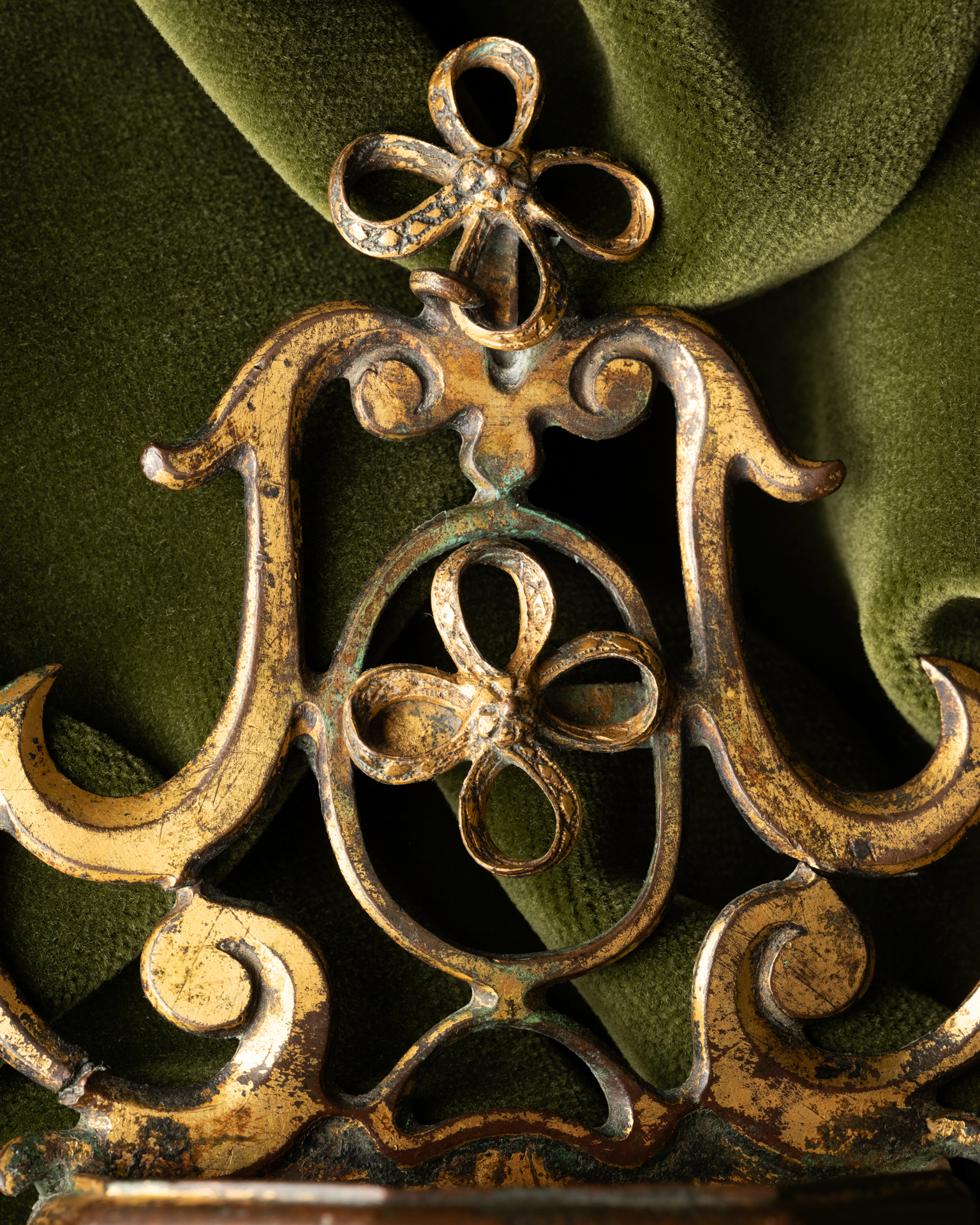
A holy water stoup in mercury-gilt bronze, composed of several separately gilt parts joined by tin soldering. The chased decoration on the quaterfoils and base carries echoes of late Gothic — rosettes and compartments — alongside Renaissance scrollwork. Two of the compartments bear an applied medium-relief figure depicting the same man in late 16th-century dress, wearing a ruff and hat. Their presence, surprising on a liturgical object, may be explained by a heraldic function intended by its patron.
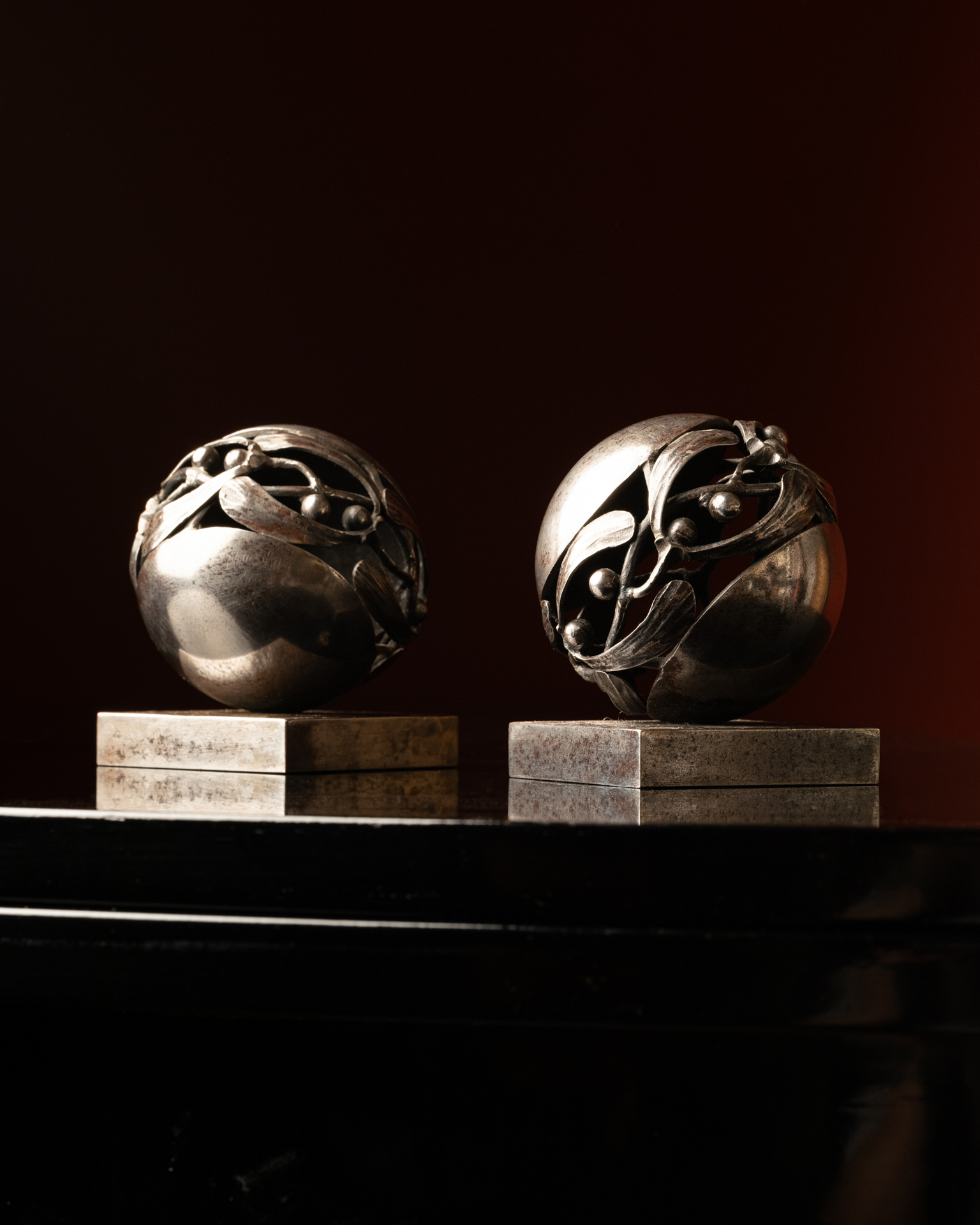
Pair Of “boule De Gui“ Or Mistletoe Paperweights, Signed Edgar Brandt
Pair Of “boule De Gui“ Or Mistletoe Paperweights, Signed Edgar Brandt
Wrought iron France ca. 1921-1924 9,6 x 8 x 8,3 cm (3.78 x 3.15 x 3.27 in.)
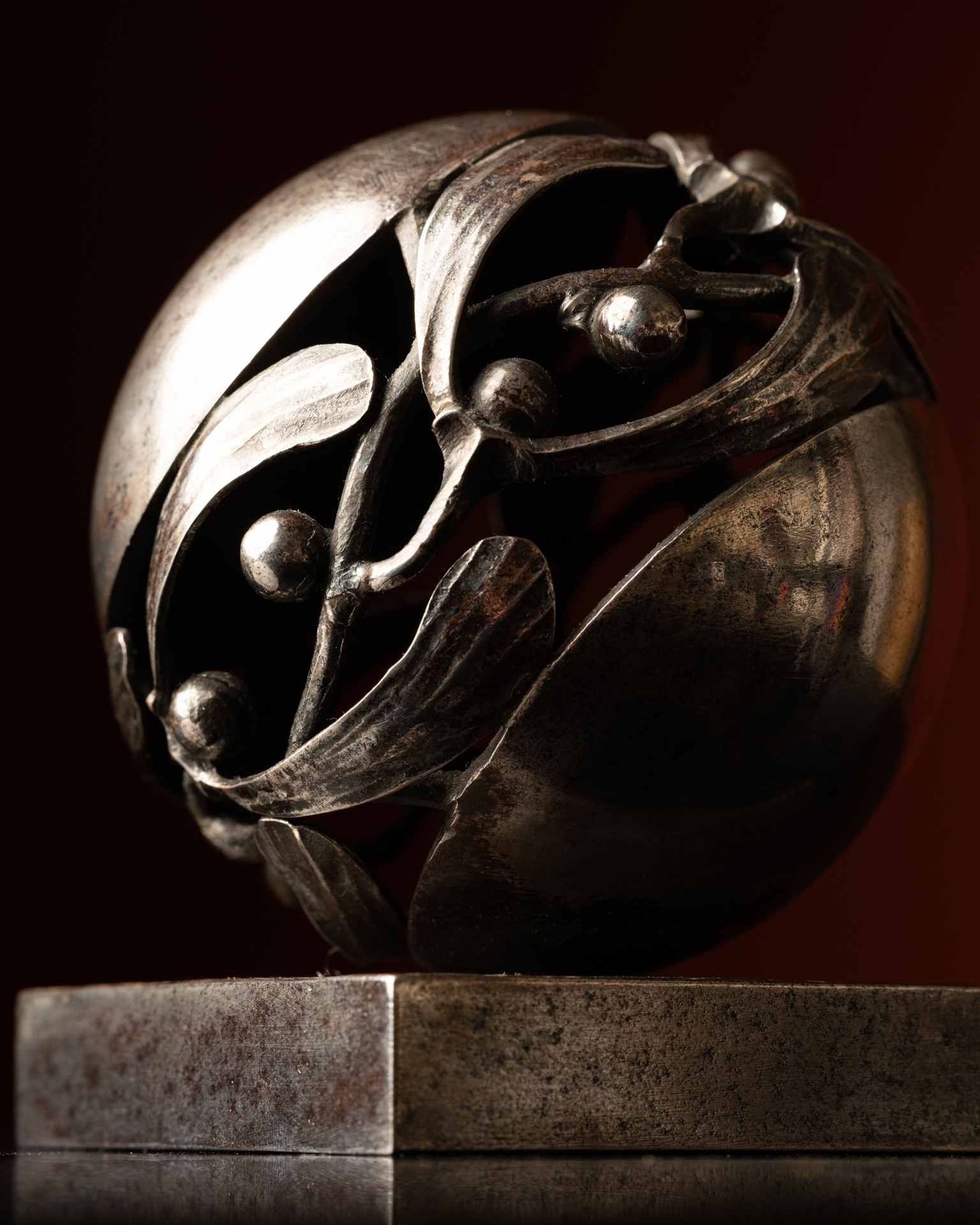
Edgar Brandt, writes Joan Kahr, “often gave gifts of ashtrays, blotters, letter openers, and bookends. At Christmas, valued clients and visitors of distinction received wrought-iron paperweights in the form of balls decorated with mistletoe. Often the recipient’s initials were engraved on the gift along with the name of the maker. Like the mistletoe plant, which is slow in growth but very persistent, Edgar Brandt fashioned his career one step at a time, steadfastly believing in his ability and his purpose.”
This pair of wrought-iron paperweights, also signed “E. Brandt”, is part of this relatively intimate production often gifted by Brandt during the first half of the 1920s. Joan Kahr, a specialist and biographer of Brandt, illustrates an identical paperweight in her monograph, which she dates to 1921.
Literature
See Joan Kahr, Edgar Brandt. Art Deco Ironwork, New York, 2010.
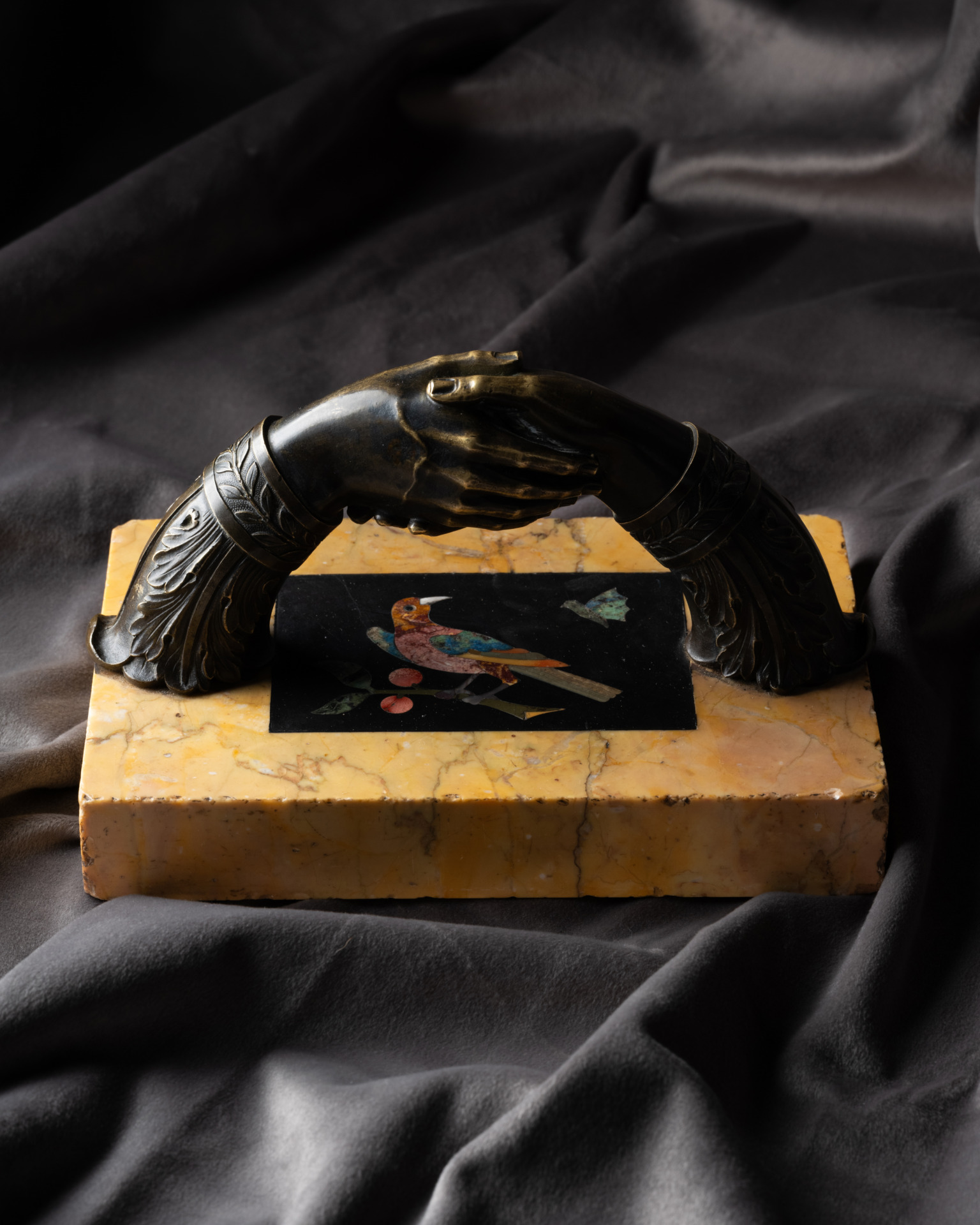
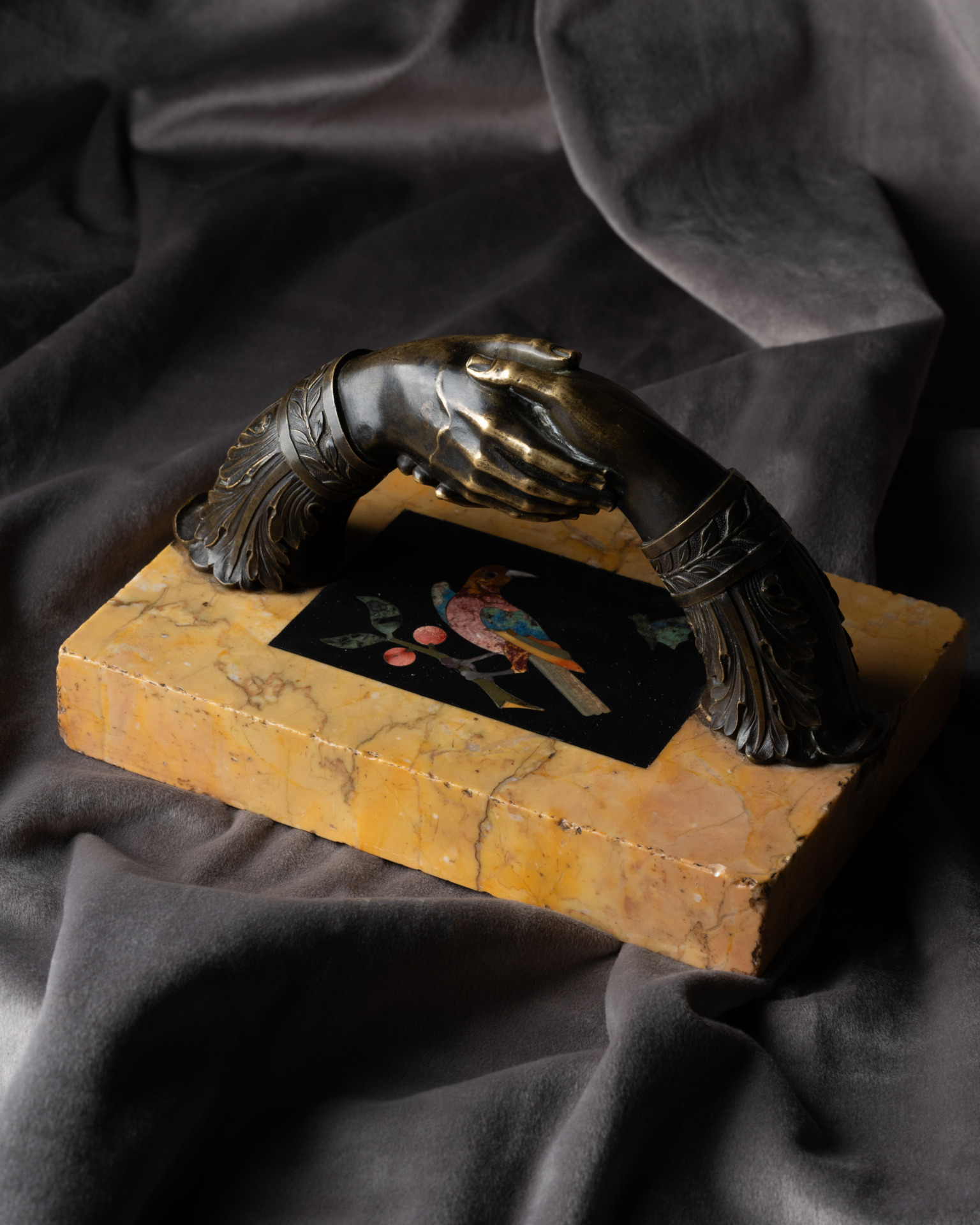
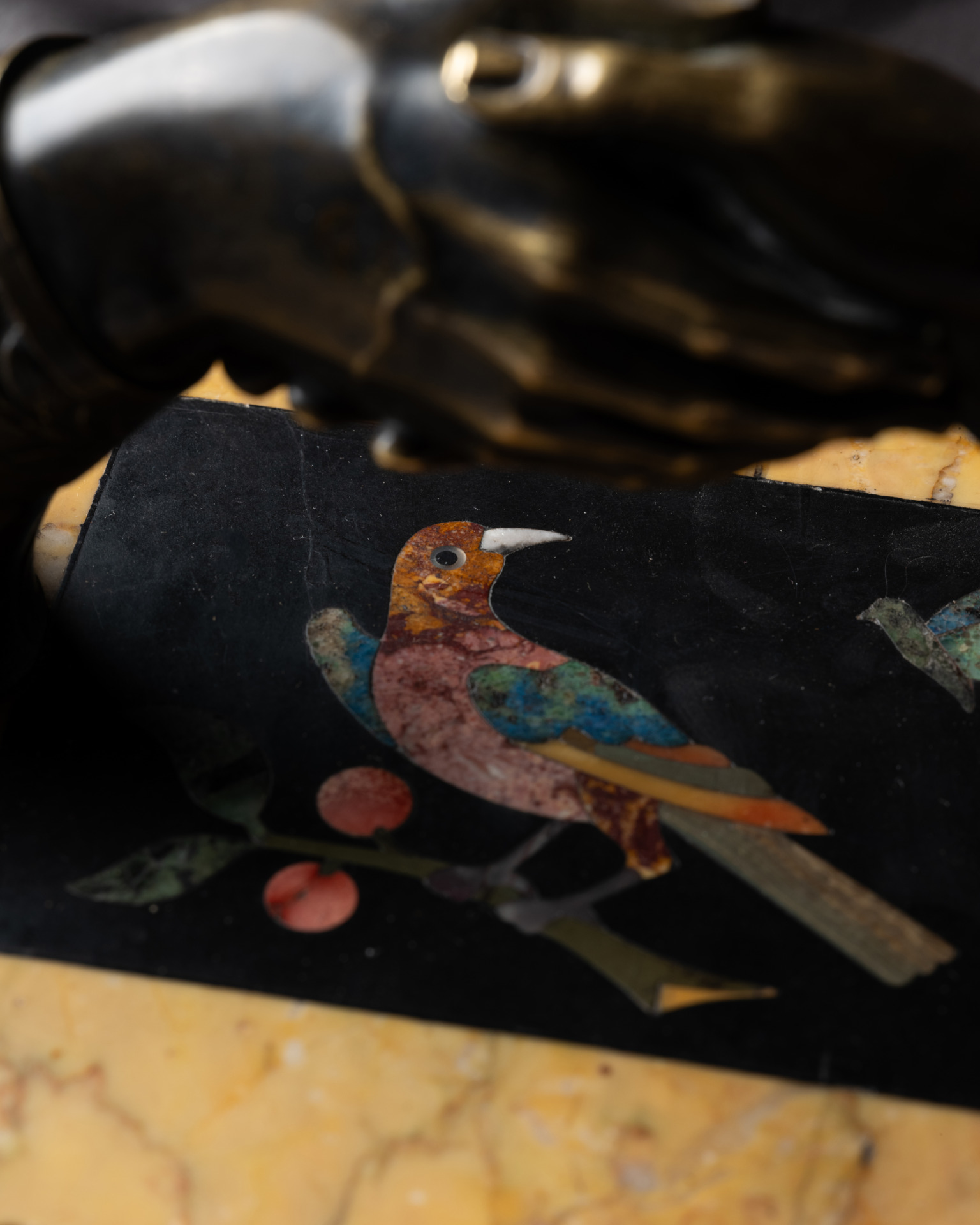
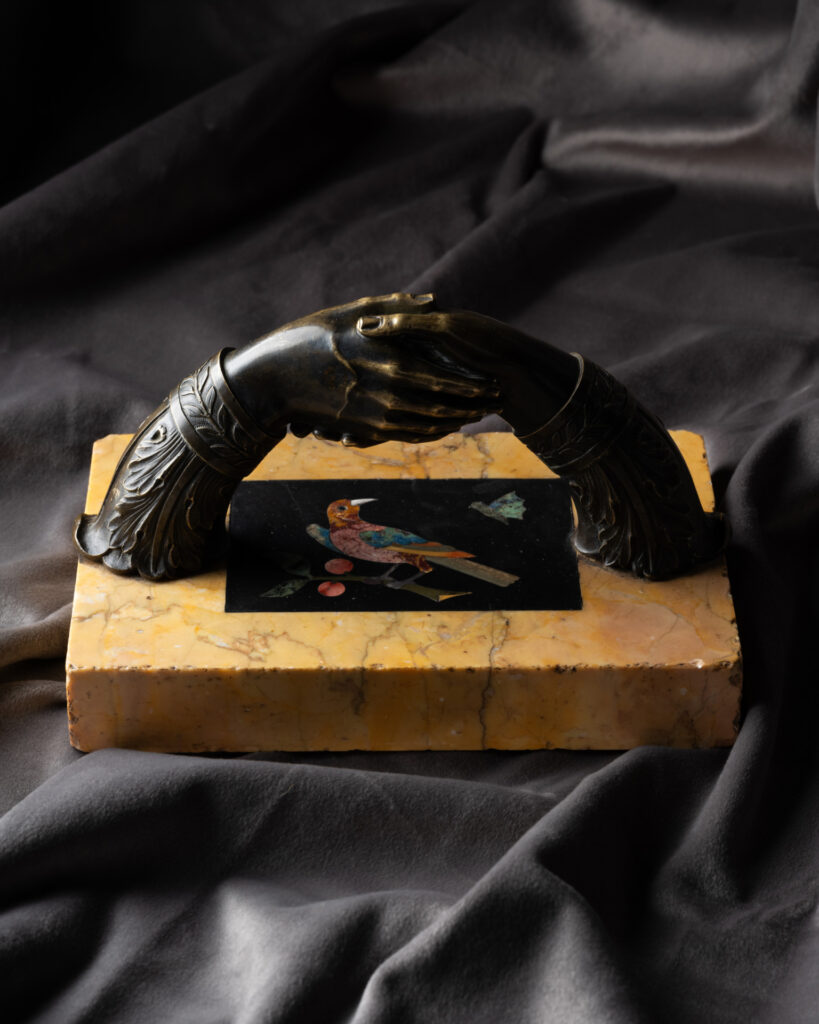
Patinated bronze, nero di Belgio and giallo antico marbles, pietre tenere Rome 1820–1850 12 x 18 x 12.5 cm (4.7 x 7.1 x 4.9 in.)
Several paperweights featuring this same motif of clasped hands have been associated with the Neo-Gothic and Troubadour styles; consequently, they have been attributed to the Bourbon Restoration, specifically the reign of Charles X. While the sober and masterful bronze casting does indeed seem to belong to this period (the second quarter of the 19th century), the stylised laurel friezes and acanthus leaves decorating the cuffs refer instead to an ancient model.
This style draws from Roman votive or utilitarian bronzes, of the kind of Roman votive hands or of the beautiful nucifrangibulum in the Archaeological Museum of Taranto. It reproduces the motif of the dextrarum iunctio — the joining of right hands — ancestor of the modern handshake and a gesture that, in Rome, solemnised a symbolic and at times legal union, whether between legitimate spouses or the Augusti of the Tetrarchy.
The bronze hands rest on a plaque of pietre tenereintarsia, with a core of nero di Belgio and giallo Antico marble, which further supports the hypothesis of a production from the Grand Tour industry.
The casting of the bronzes (actually a brass with a dark patina) is of high quality; the backgrounds were matte-finished with a mat à la pointe, and the veins of the acanthus leaves are, overall, elegantly chased. The giallo marble shows some chips and minor losses.
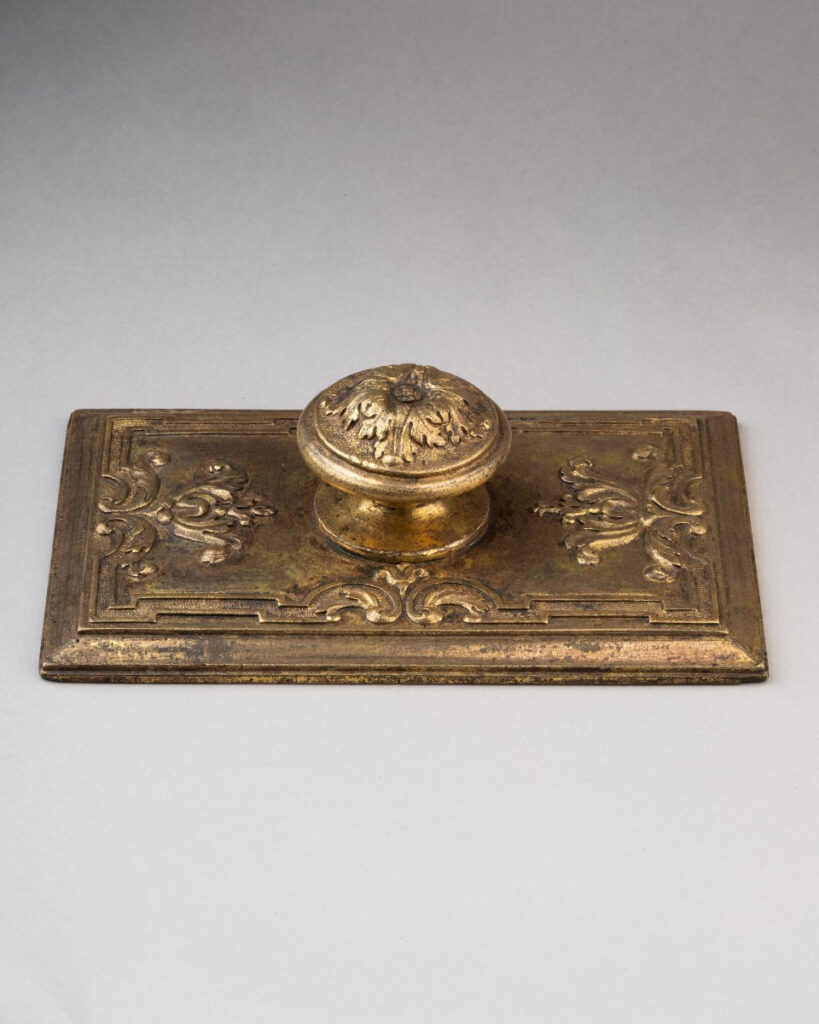
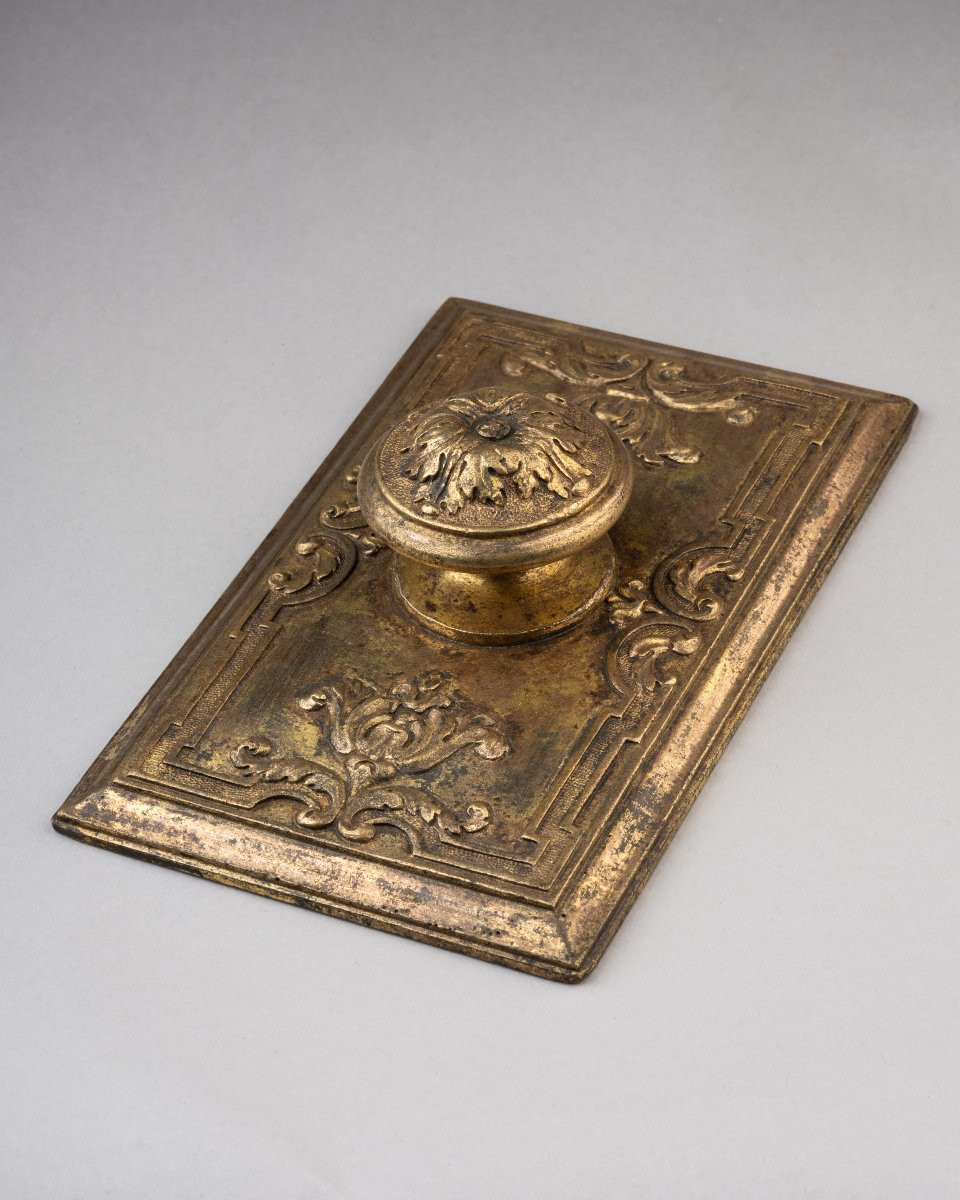
Louis XIV Paperweight Gilt bronze France ca. 1695–1710 4.5 x 17 x 10.5 cm (1.75 x 6.75 x 4.15 in.)
The partial chasing of this paperweight creates a contrast between broad burnished surfaces and cartouche grounds matted with a pointed tool, combined throughout with elegant symmetrical rinceaux. It thus relates to the rare documented gilt bronzes and so-called serrurerie works of the late Louis XIV period, notably the highly wrought lock plates executed around 1710 by Ducoudray and Desjardin for the royal tribune of the Chapel at Versailles.
The gilding, though of very fine quality, is heavily worn; this wear reveals pronounced copper-toned reflections, possibly indicative of mercury gilding.
A paperweight of the same type, belonging to the National Trust, is preserved at Clandon Park, the luxurious Palladian country house designed by Giacomo Leoni for Thomas Onslow, 2nd Baron Onslow, who had travelled in France in 1698.
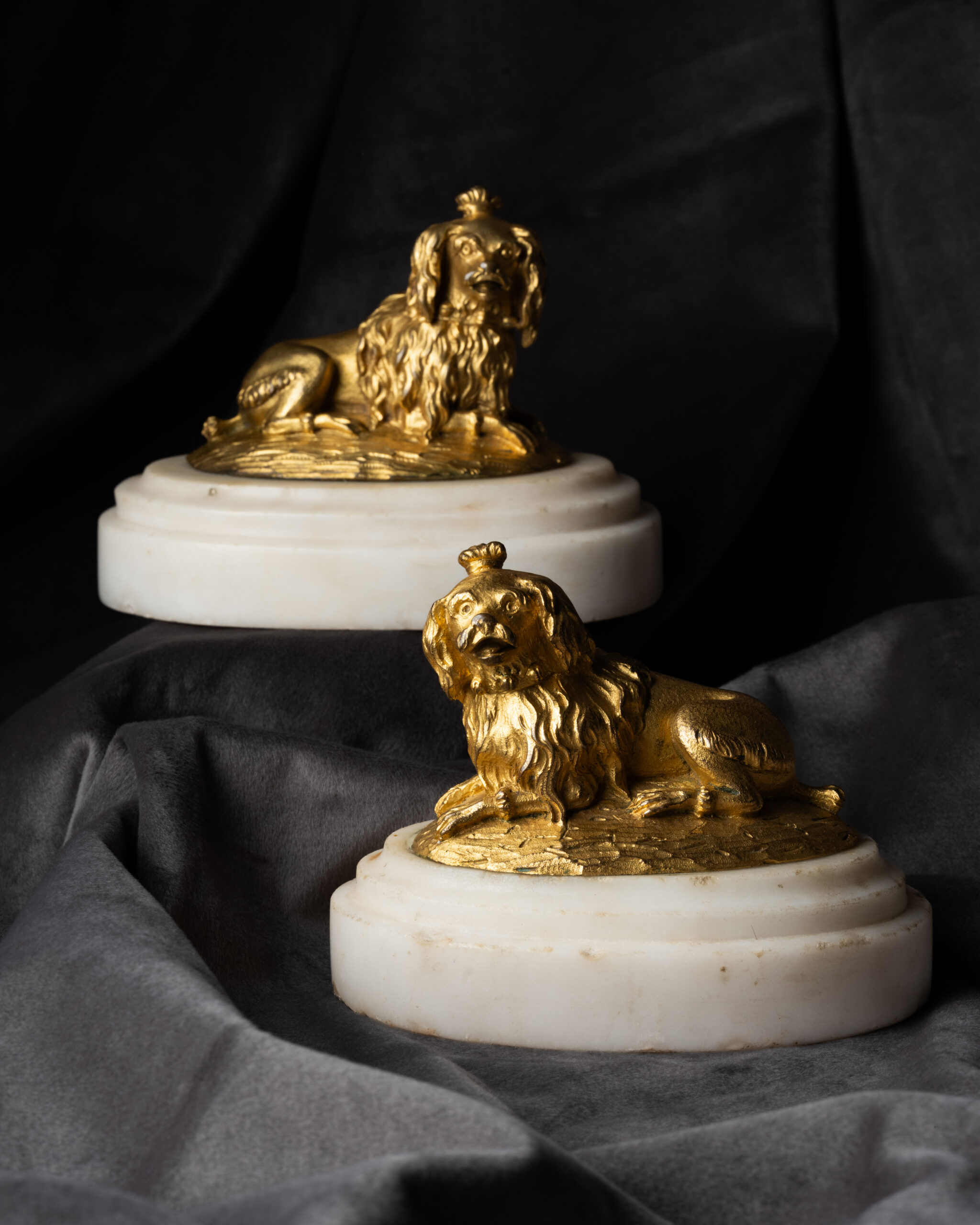
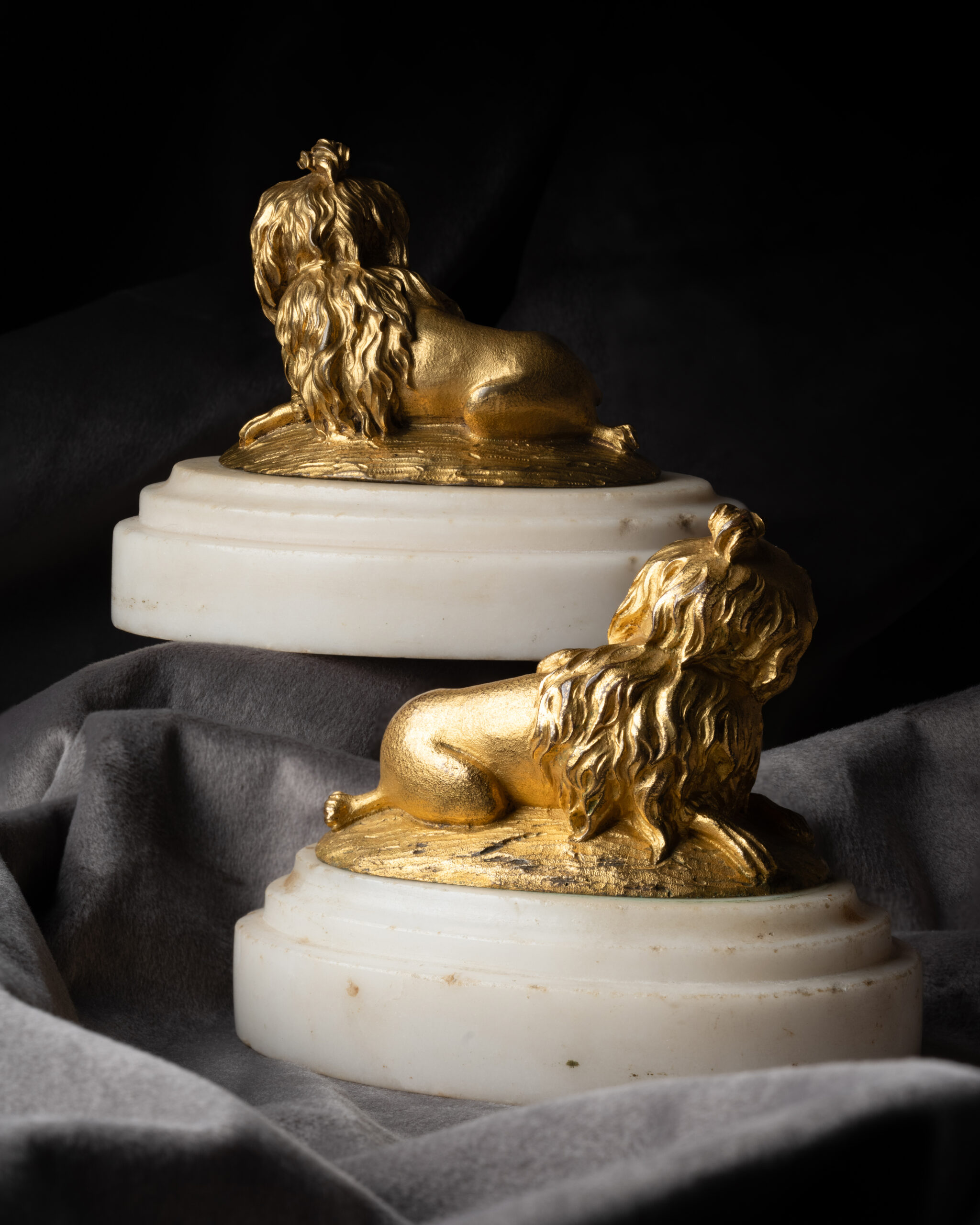
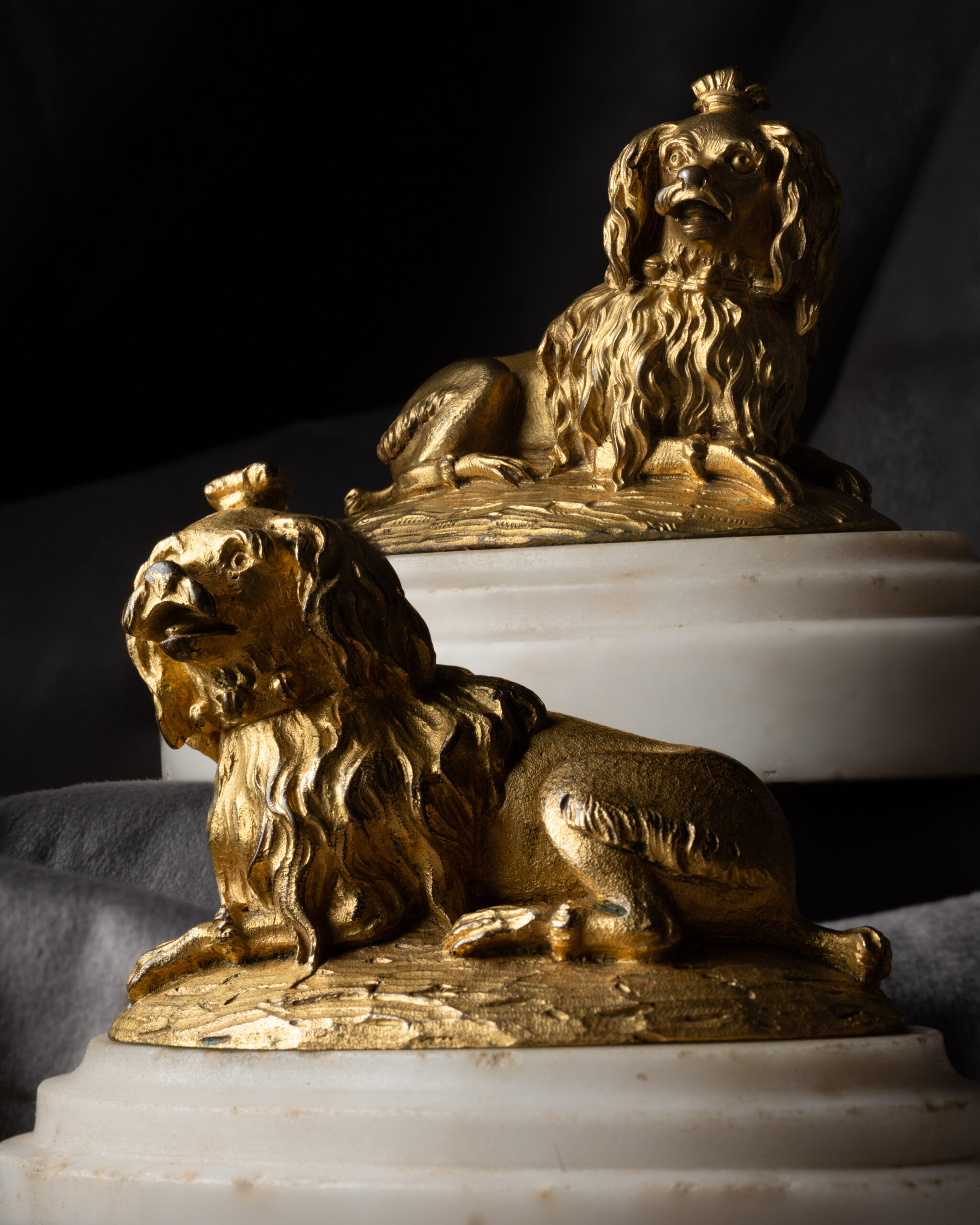
Two Gilt Bronze Dogs Known As Those Of The Marquise De Pompadour
Two Gilt Bronze Dogs known as those of the Marquise de Pompadour
Gilt bronze Late 18th century France 10 x 11 cm (3.9 x 4.3 in.)
Many bronze dogs of this style have been identified — without much justification — as the pets of Marie-Antoinette or the Marquise de Pompadour. It is true that, in this case, the two dogs bear a certain resemblance to Inès and Mimi, the Marquise’s favorite dogs. They were immortalised in portraits by Christophe Huet, known today through several engravings by Étienne Fessard held at the Cabinet des Estampes. Inès and Mimi were also engraved based on drawings by Boucher in the Suite d’estampes gravées par madame la marquise de Pompadour d’après les pierres gravées de Guay. In these, the resemblance is no less striking, though ultimately inconclusive. All that can be said with certainty is that several similar or closely related models existed during the last two-thirds of the 18th century ; it can be assumed that the domestic animals used as models belonged to the great collectors of that era. Furthermore, the 1770 inventory of Philippe Caffiéri mentions “a firedog with a dog and a cat”, and a similar object was noted in the 1755 posthumous inventory of his father, Jacques Caffiéri. This is why, by tradition, gilt bronze statuettes representing dogs or cats — especially when they show such advanced modeling and chasing as seen here — have been attributed to the Caffiéri family.
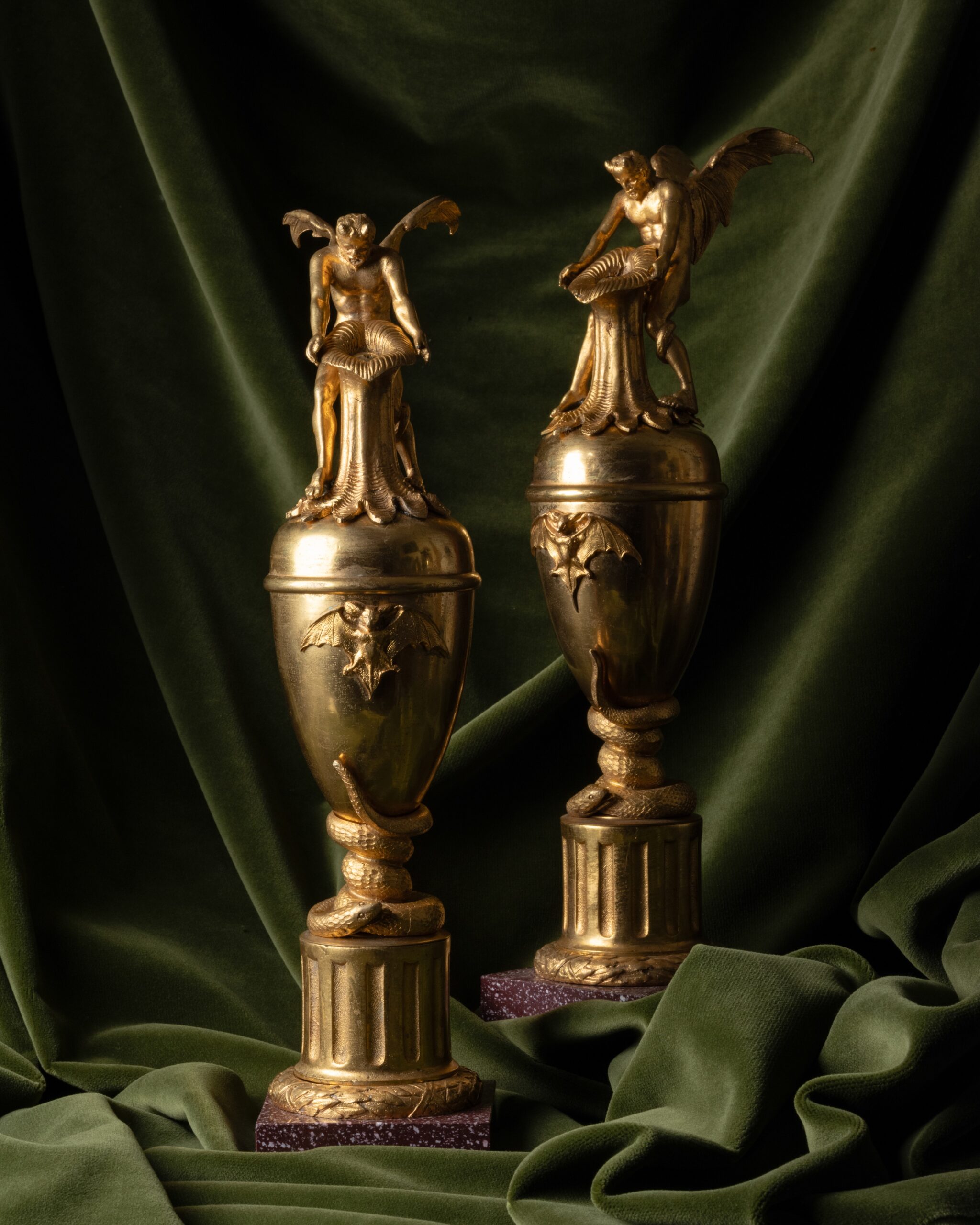
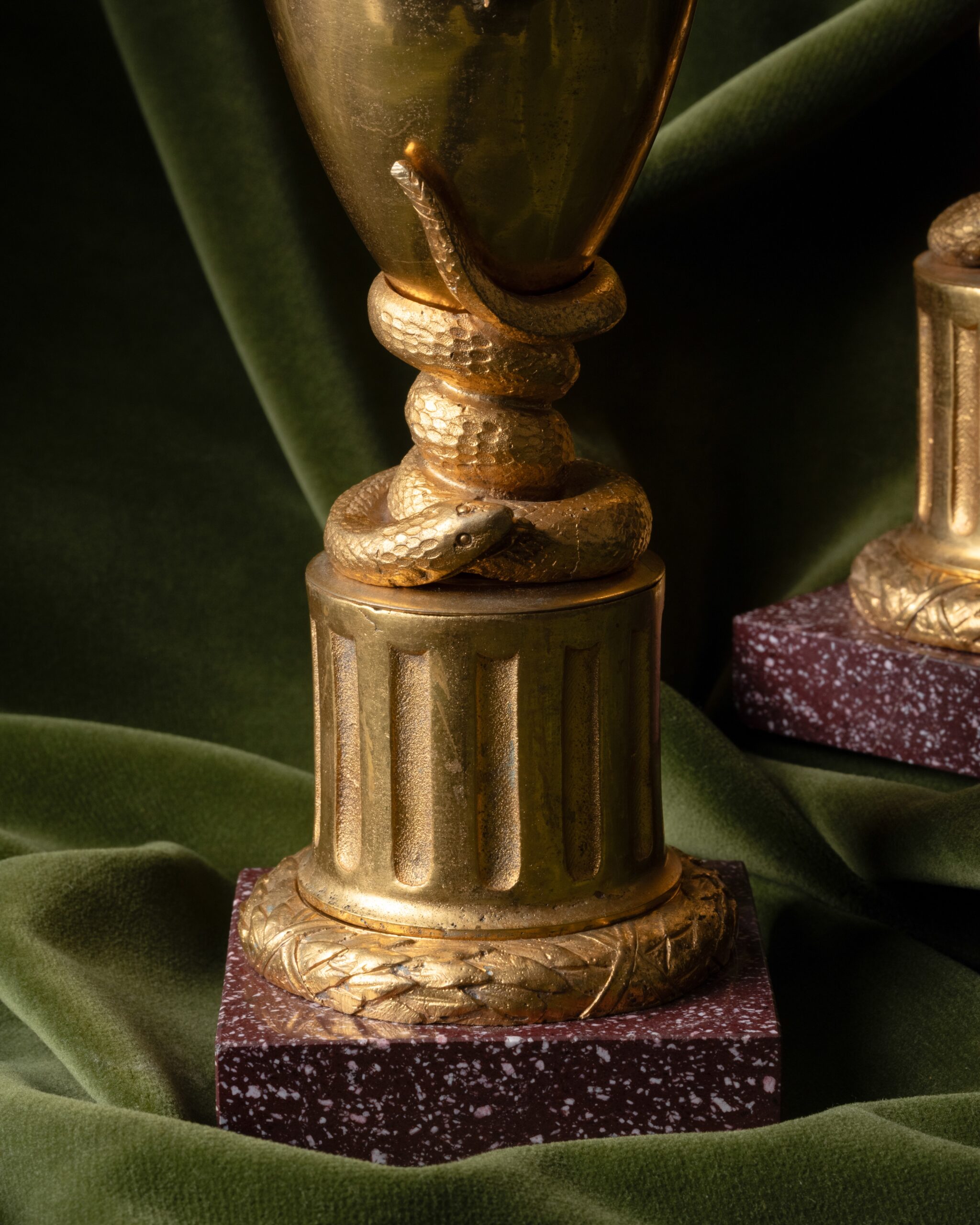
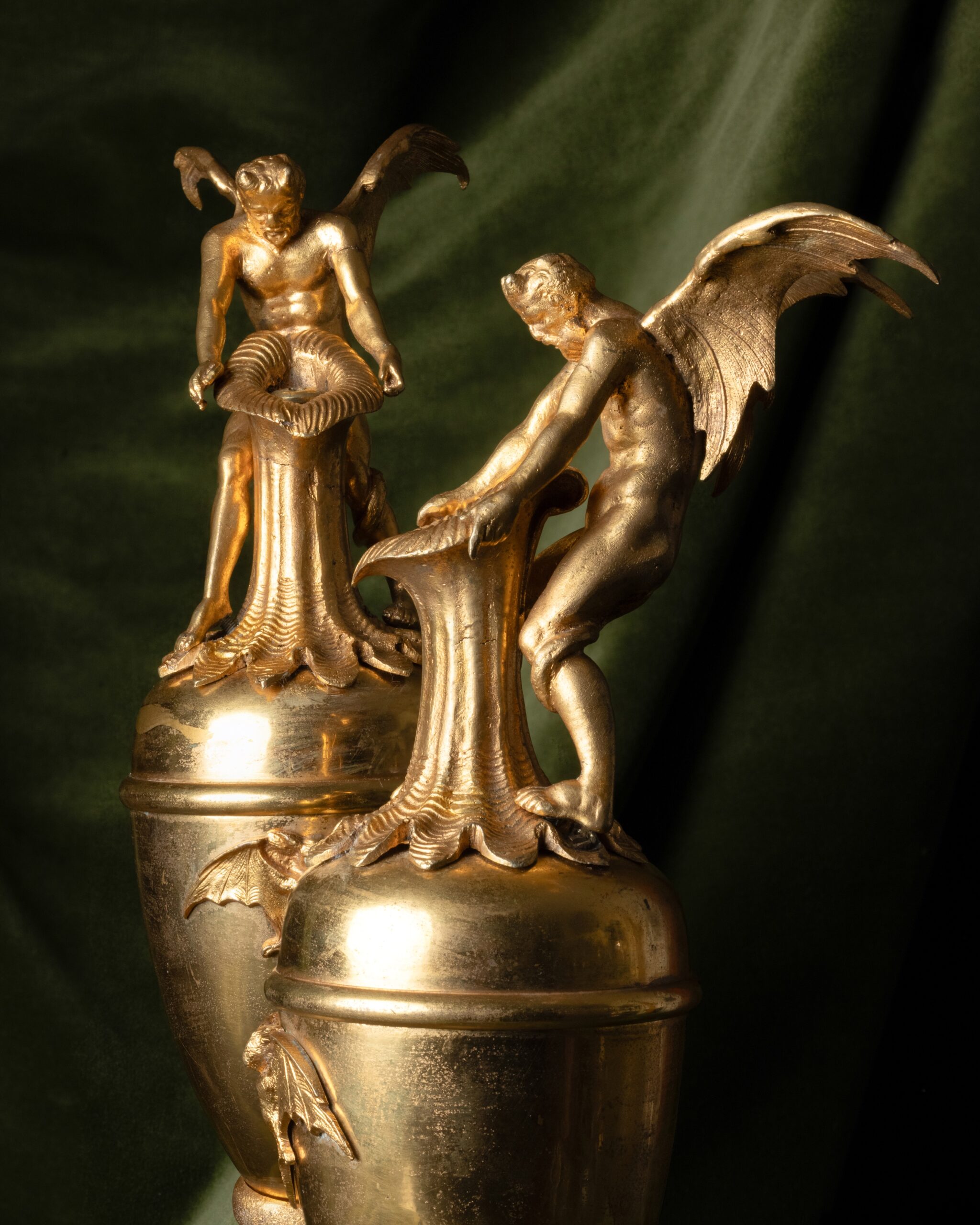
‘Vases aux chauves-souris’ by Jean-Jacques Feuchère
‘Vases aux chauves-souris’ by Jean-Jacques Feuchère.
Gilt bronze, Egyptian porphyry France 1834-1852 h. 35 cm (13.8 in.)
The first occasion on which Feuchère exhibited his famous Satan was at the Salon of 1834, where it was displayed alongside “the pair of vases that go with it”. This entire grouping, of pure Romanticism, was drawing directly upon literary sources such as Milton’s Paradise Lost, Goethe’s Faust, and Dante’s Inferno and embraced the Romantic liking for accursed figures. Feuchère’s Satan figure itself, inspired by Dürer’s Melancholia, adopts the pose of the Romantic poet — “Le coude au genou, le menton dans la main ” — a pose later echoed by Carpeaux and Rodin. Along with other figures of the time, such as Jean-Jacques Flatters’s Milton’s Rebellious Angel of 1827 and Marochetti’s 1831 Rebellious Angel, the work firmly established themes of melancholy and evil as central to Romantic art.
The present pair of decorative vases, the vases aux chauves-souris (bat vases), with its shiny gilding and porphyry base, differs from the dark, patinated version exhibited at the Louvre alongside the Satan. Though authoritative, the Louvre ensemble may not be the one exhibited in 1834. With its winged devilish figures, the snake swirling around the pieduccio of the vase, it is nevertheless a fantastic testament for the original taste of the second third of the 19th century.
Although not as famous as his contemporaries Barye or Carpeaux, Jean-Jacques Feuchère was a quintessential Romantic personality of the time. The son of the chaser Jacques-François Feuchère, he was largely self-trained, supporting himself in his youth by working for goldsmiths and finishing bronzes. His extensive historical study manifested in his prolific output across many techniques — metalwork, painting, drawing, and lithography — and in his varied designs for clocks, candelabra, and other decorative objects, often inspired by Renaissance artists. This “exasperating universality” (Baudelaire) led him to execute major public works, including the relief Crossing of the Pont d’Arcole for the Arc de Triomphe in 1833 and 1834 and statues for the fountain, Place de la Concorde. Feuchère maintained a large circle of artistic friends, including Barye and Daumier, and was protected by influential patrons such as the Duke of Orléans and Prince Demidoff. His eclectic taste extended to his role as a collector. Feuchère died poor while possessing an enormous and varied art collection. The Satan ensemble, with its accompanying decorative vases, remains perhaps his most complex and interesting work, epitomising the literary and aesthetic interests of Romantic sculptors in the 1830s.
Literature
See Daniel Alcouffe and al., Un âge d’or des arts décoratifs. 1814-1848, Paris, 1991 and Peter Fusco in The Romantics to Rodin. French Nineteenth-Century Sculpture from North American Collections, 1980.
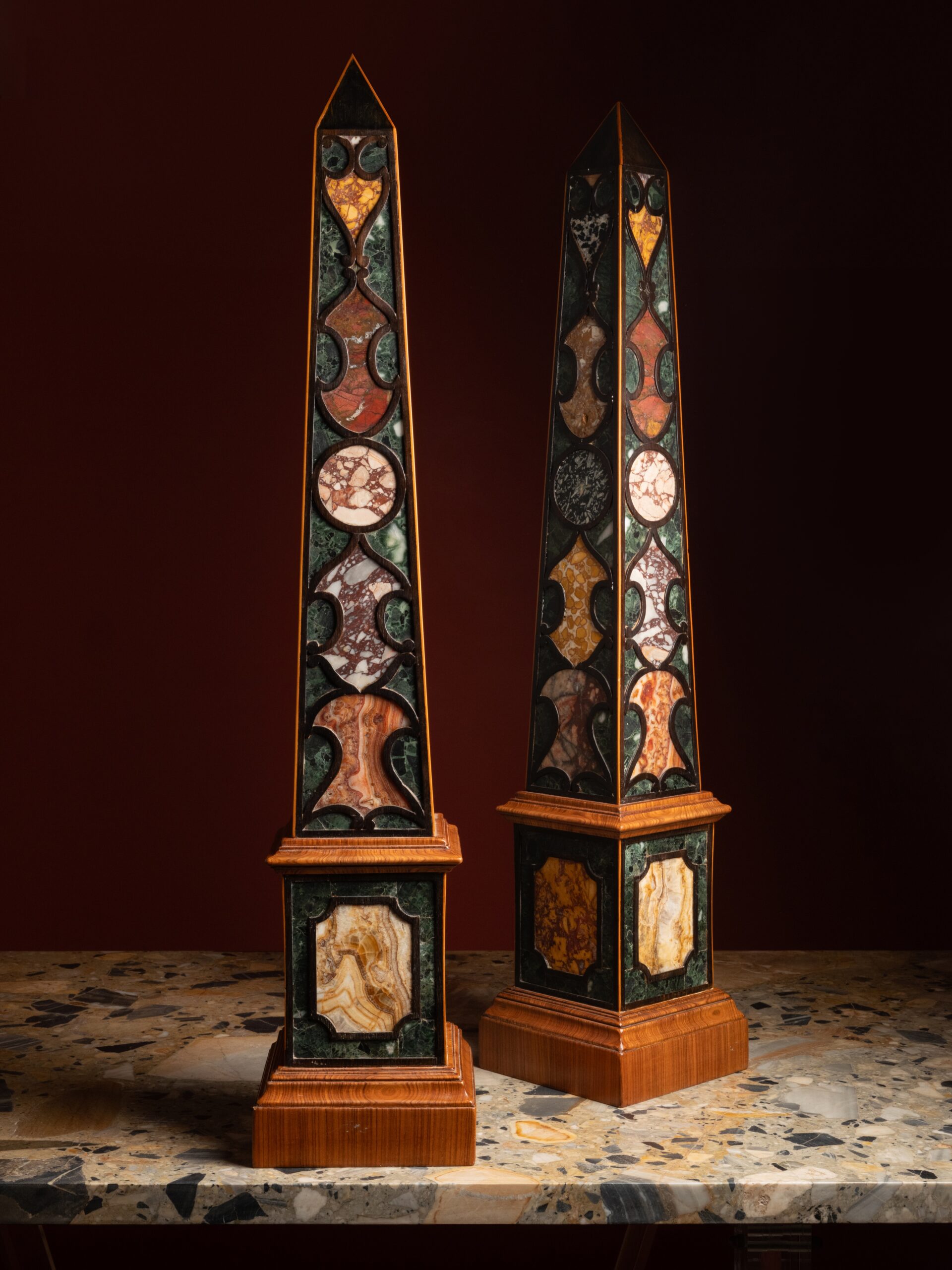
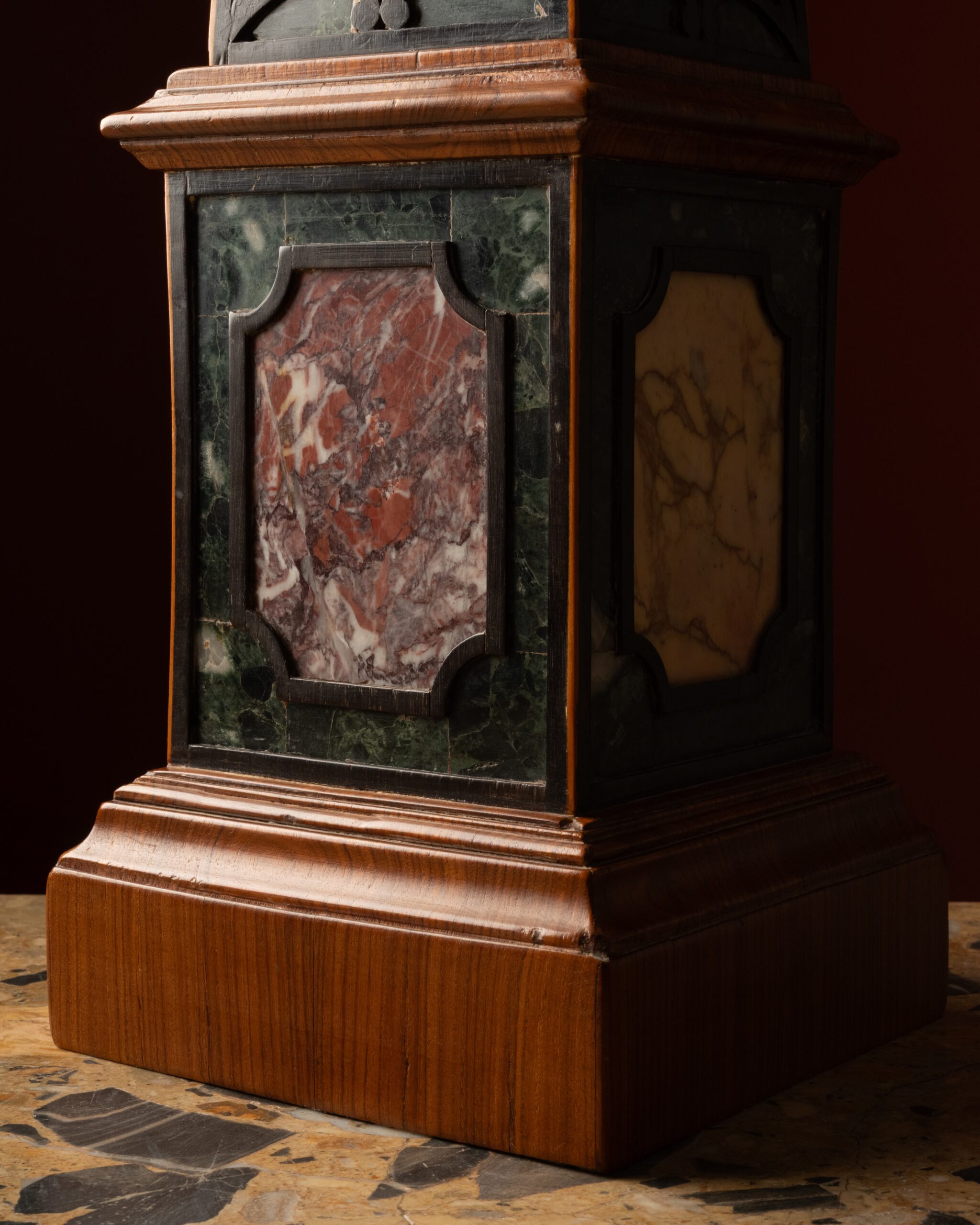
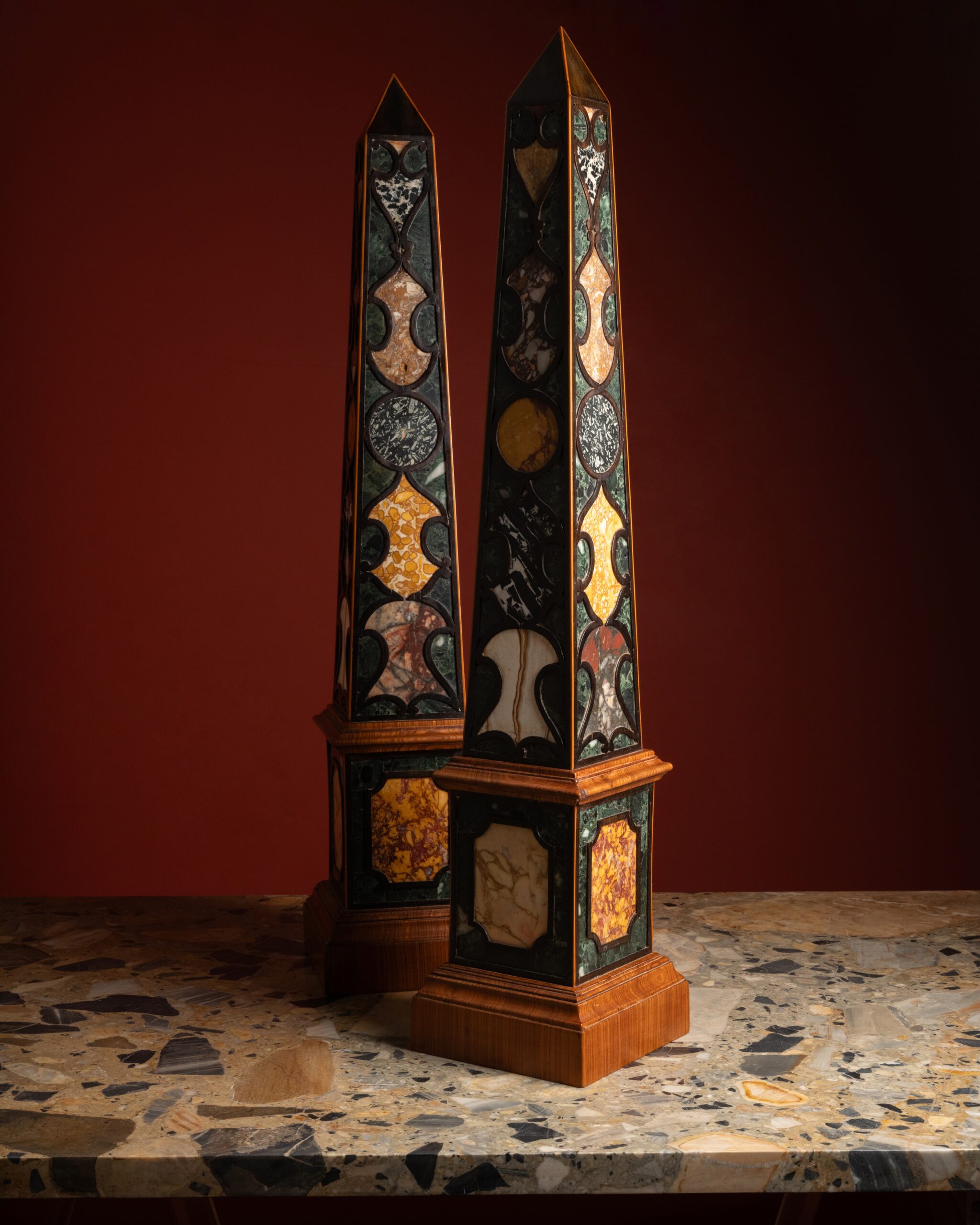
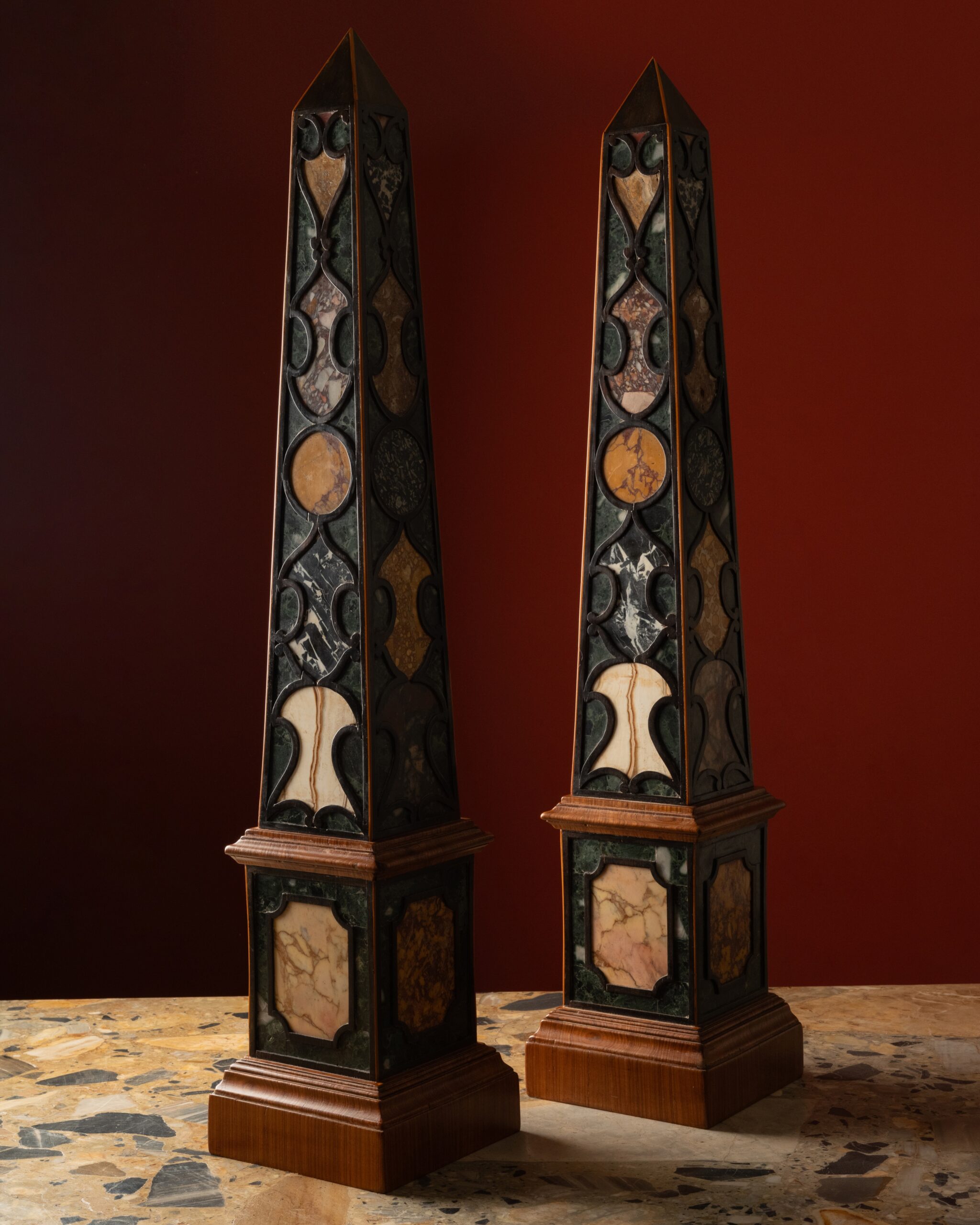
A Pair Of Large Hardstone Inlaid Obelisks By Renzo Mongiardino
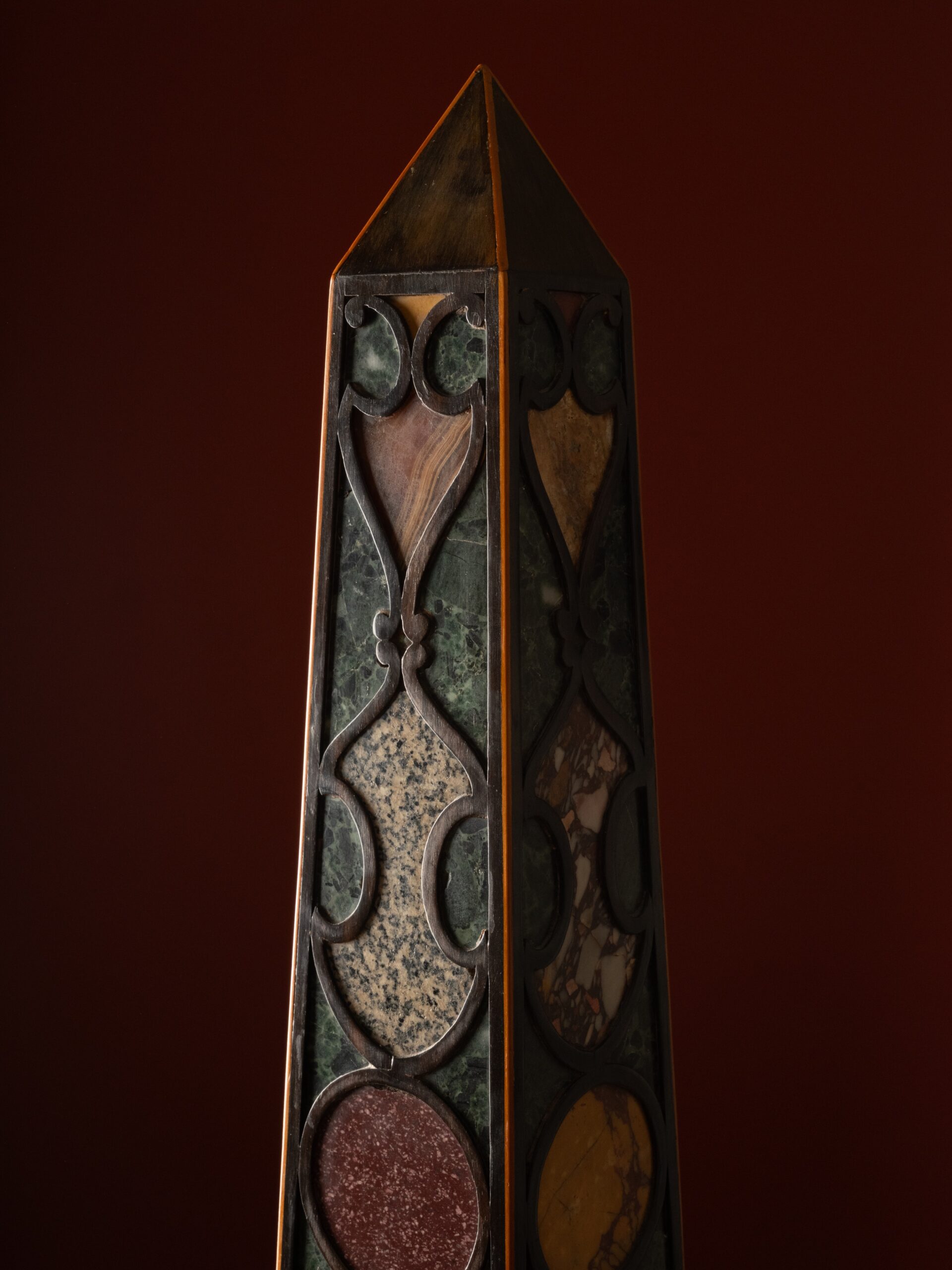
A Pair of Varnished and Ebonised Wooden Obelisks with Hardstone Inlay, by Renzo Mongiardino
Varnished and blackened wood, marble, breccia, granite, porphyry, and alabaster Milan 1970s 80 cm x 16 cm (31.5 x 6.3 in.)
It is to Renzo Mongiardino, the celebrated Italian decorator of the second half of the twentieth century, that the design of these obelisks is owed. An architect of theatrical temperament and the scenographer of Zeffirelli’s Romeo and Juliet, Mongiardino became internationally renowned for his stage sets and interior designs. Among his distinguished patrons were Gianni and Marella Agnelli, Aristotle Onassis, Lee Radziwill, Guy and Marie-Hélène de Rothschild, Gianni Versace, Valentino Garavani, and Princess Firyal of Jordan, for whom he created interiors epitomising his characteristic style, marked by precision, a taste for trompe-l’œil, and the maximalist richness of Mannerist and Baroque inspiration.
As is often the case in stage and film design, Mongiardino frequently created bespoke objects and furnishings for his interiors. These pieces, often interspersed with genuine antiques, were typically executed by Milanese artisans — cabinetmakers and stone inlayers trained in the techniques of pietre dure and tenere, in the tradition of Renaissance opifici. His baroque taste for illusionism was frequently accompanied by an interest in imaginary architectural forms, a tendency reflected in his recurring use of obelisks.
A similar pair of obelisks, inlaid with pietre dure, was indeed designed and installed by Mongiardino in the Zanussi apartments in Milan in the late 1970s. The present pair — inlaid with marble, breccia, granite, porphyry, and alabaster — stands apart from other known Mongiardino obelisks by its construction in natural varnished wood, only partially heightened with black: a variation on Mongiardino’s more common obelisks, which are typically executed entirely in ebonised wood.
Sources
Martina Mondadori Sartogo, Renzo Mongiardino. A Painterly Vision, New York, 2017.
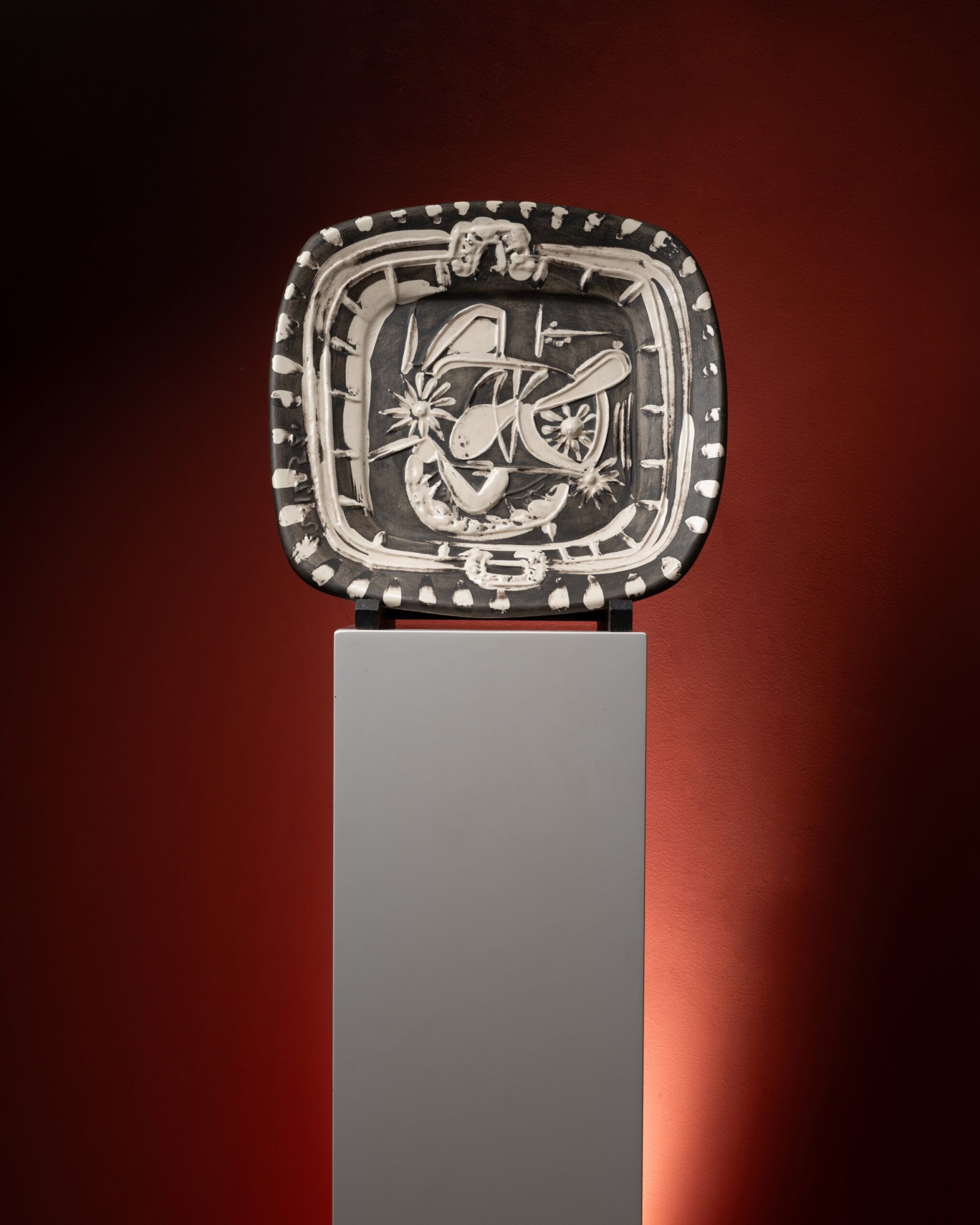
Still Life with Spoon, by Pablo Picasso
Still Life with Spoon, by Pablo Picasso
Partially glazed white earthenware dish painted in grey and white France 33,5 x 33,5 cm (13 x 13 in.)
The Still Life with Spoon is one of the few original ceramic pieces that, according to Pierre Cabanne, were designed by Pablo Picasso on December 22, 1952, at Madoura, the workshop Picasso moved in after an impromptu visit with his then lover Françoise Gilot in the South of France in 1946.
It seems that Picasso, after four years spent in war-time Paris — years marked by dark and tragic works such as Still Life with Ox Skull in 1942 or Skull in 1943 — found a refuge of sorts, far from Paris, often away from painting, and concerned with more peaceful subjects. The famous words Picasso said to Malraux thus take on their full meaning. Malraux said to Picasso :
“You spoke about the theme of death, regarding Goya’s Tres de Mayo. You’ve depicted pregnant women since… how long ? Is The Embrace from 1905 ?
— 1903.
— Birth and creation are perhaps as profound, as unsettling as death — and for the same reasons.
— I’ll walk down with you : I’m going to Saint-Germain-des-Prés.”
In the very dark staircase, his voice behind me turned pleasant again :
“I forgot to show you my plates. I’ve made plates, did they tell you ? They’re very nice. (His voice turns serious.) You can eat off them.”
Ceramics, thus, may well form the most representative part of Picasso’s work in the immediate post-war period. They are certainly one of its most significant facets.
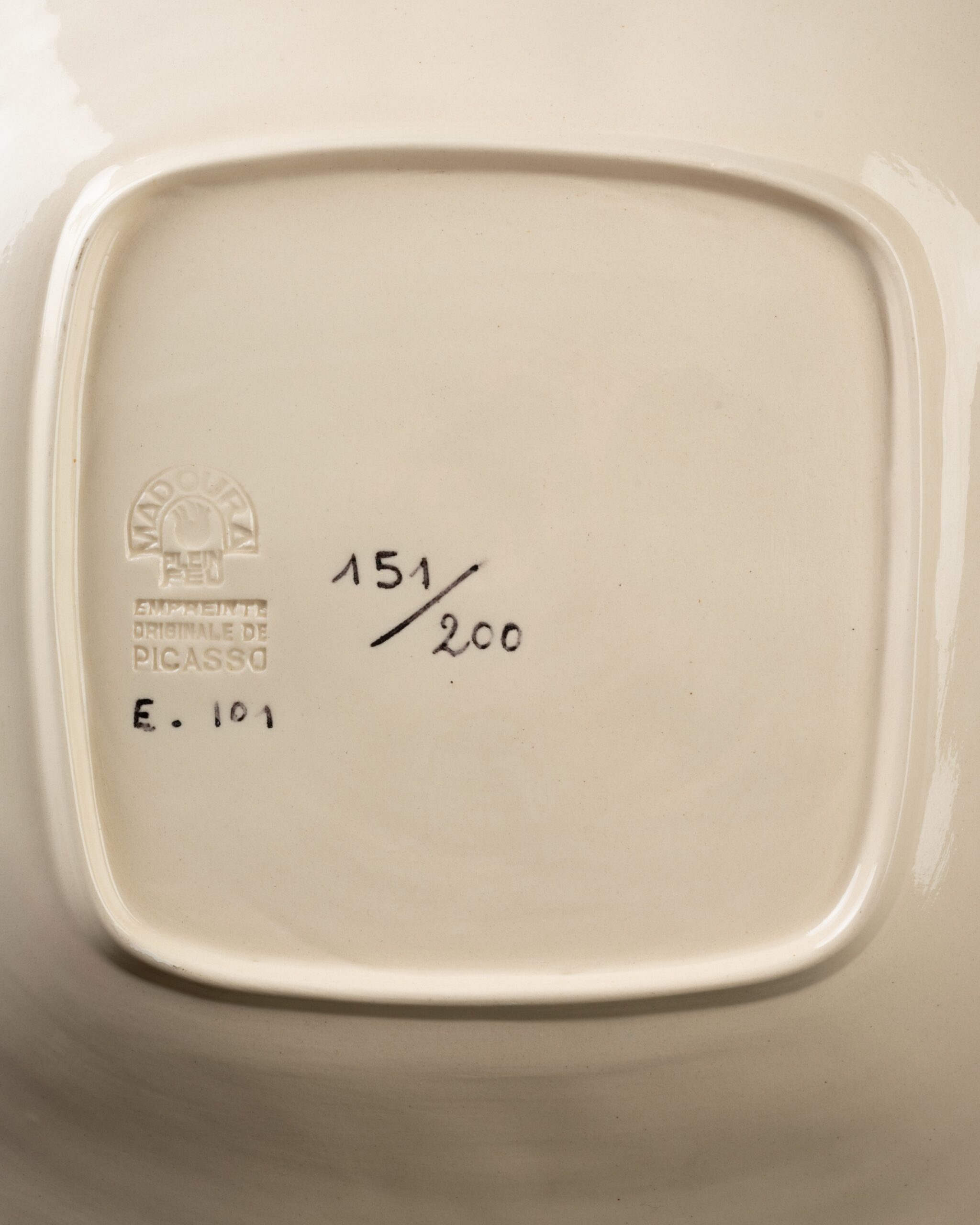
This version of Still Life with Spoon is stamped : “Madoura plein feu” and “Empreinte originale de Picasso.” This is because one of the first catalogues of Picasso’s ceramic work, compiled by Georges Ramié, who personally oversaw Picasso’s production at Madoura, distinguishes at least three categories of original ceramics : unique works, individually modeled and perfected by Picasso; “original imprints,” obtained by stamping from a plaster matrix designed by Picasso, with editions personally approved by him; and “authentic replicas,” produced by Madoura’s potters based on Picasso’s models, but without the artist’s direct involvement.
This version of Still Life with Spoon belongs to the second category of Picasso’s original ceramic works and bears the number 151, from a limited edition of 200 copies.
Literature
Georges Ramié, Céramiques de Picasso, Paris, 1974 ; André Malraux, La Tête d’obsidienne, Paris, 1974 ; Pierre Cabanne, Le Siècle de Picasso, Paris, 1979 ; Alain Ramié, Catalogue of the Edited Ceramic Works. 1947-1971, Vallauris, 1988 ; Paul Bourassa, ‘Rencontres avec la céramique’, in Picasso et la céramique, Paris, 2004.
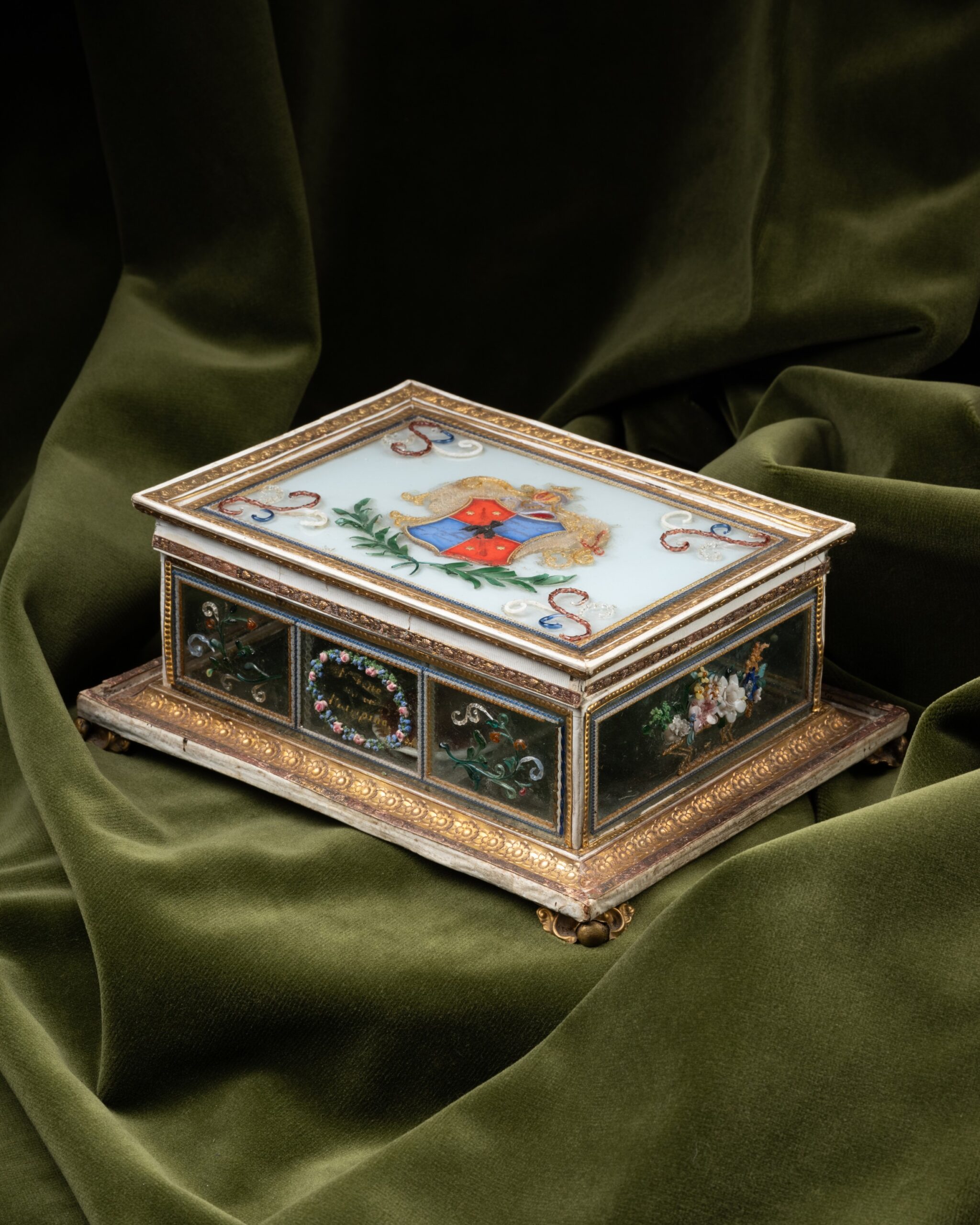
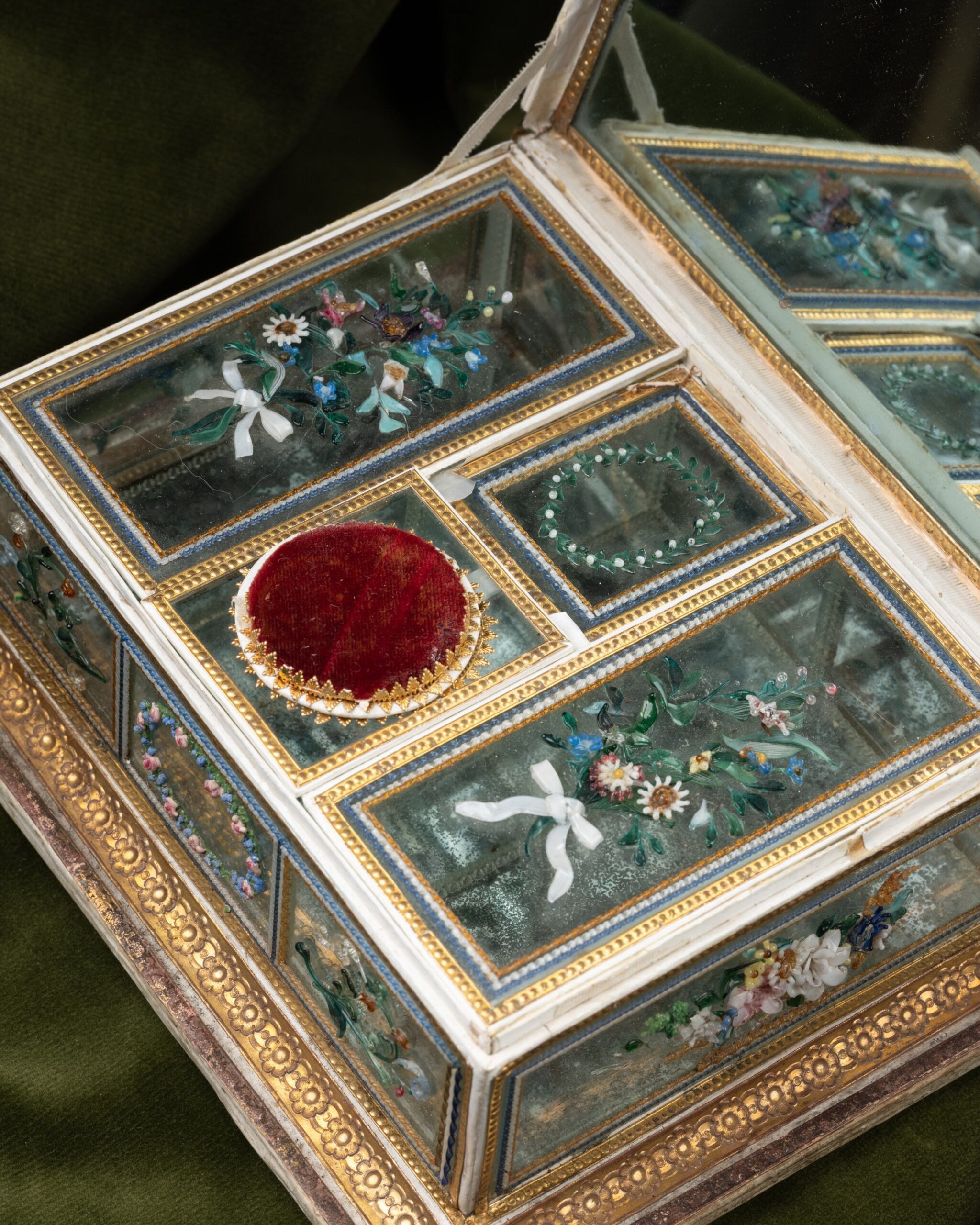
Antique Spun Glass Casket
Antique Spun Glass Casket
Spun glass, glass, mirror, gilt metal, velvet France Mid-19th century 9 x 20 x 16 cm (3.55 x 7.85 x 6.30 in.)
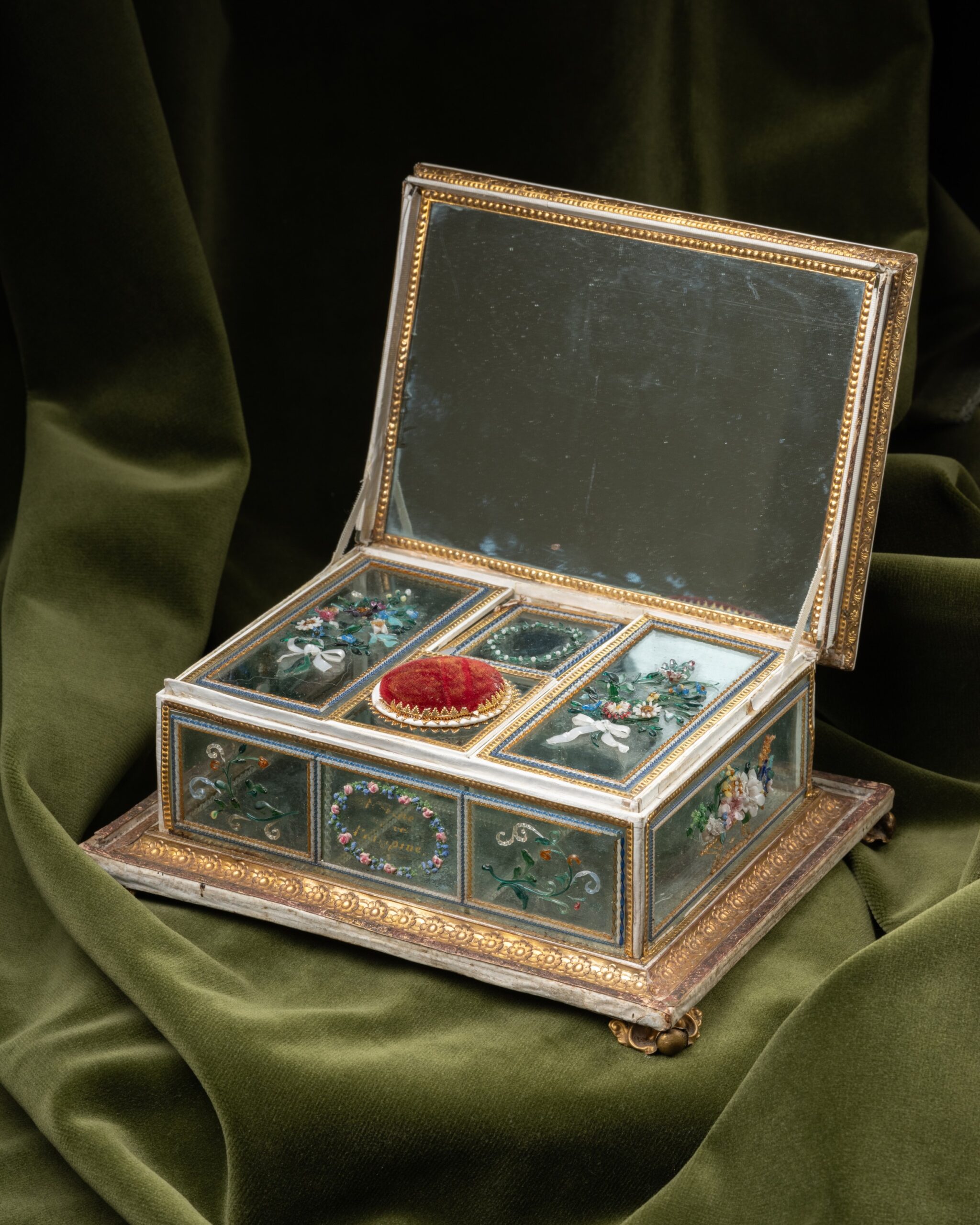
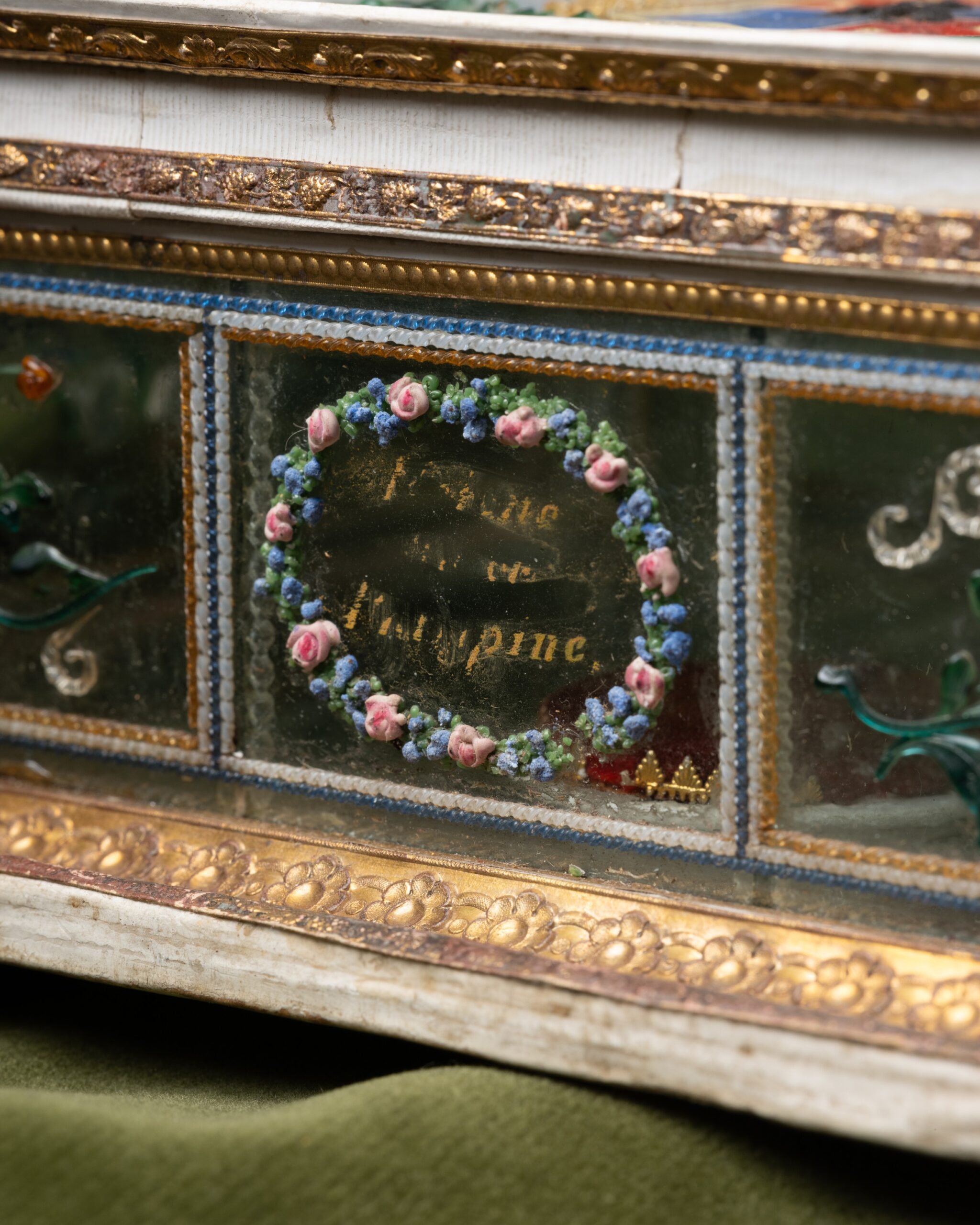
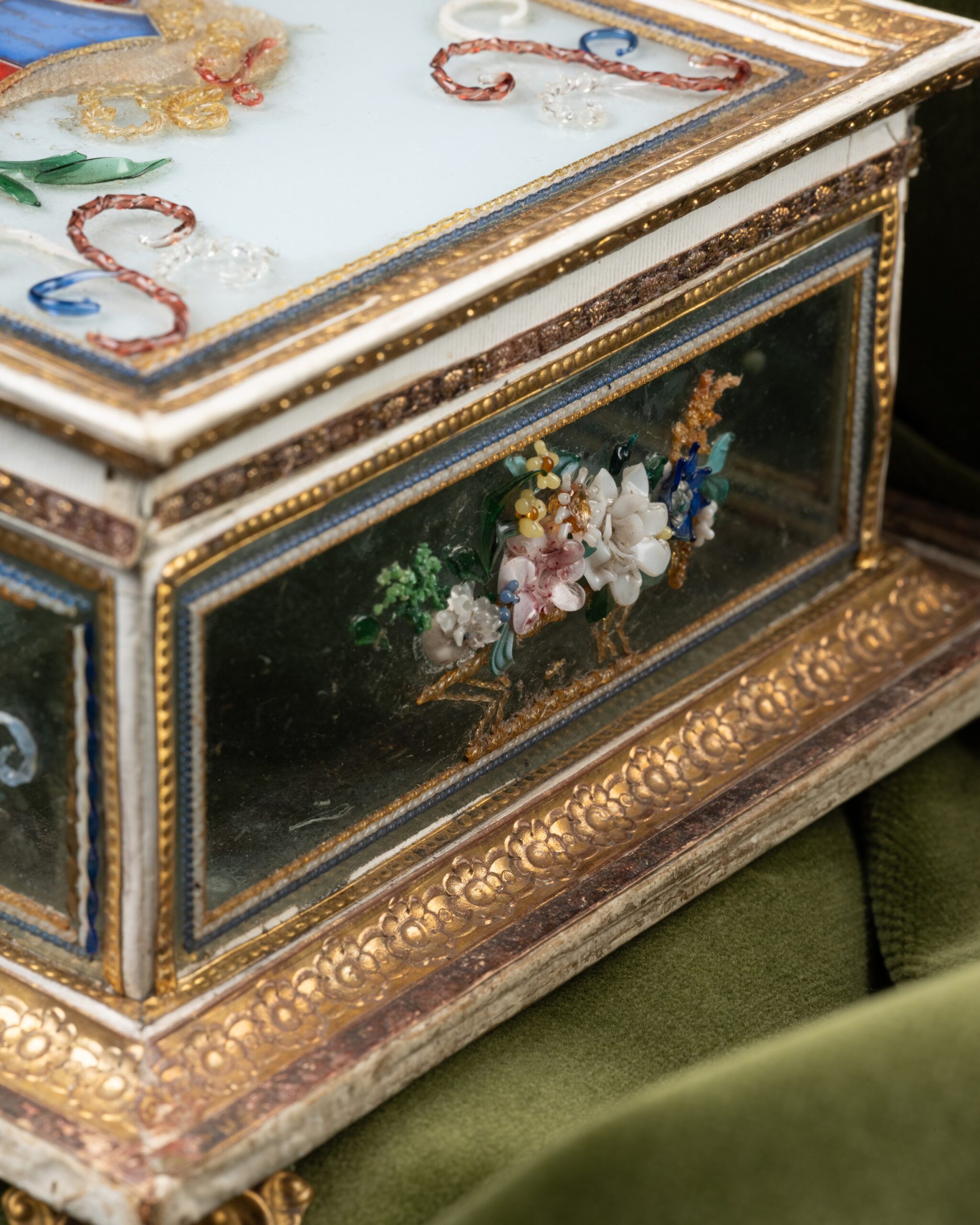
Housed in its original case, this spun glass casket features translucent glass panels and mirrors decorated with spun glass patterns of flowers, garlands, and bouquets. The frame is set with gilded metal bands, and the inside of the box is divided into four compartments, intended for storing a set of accessories and embellished with spun glass ornaments.
A coat of arms is on the lid, and a dedication appears on the facade of the casket, though both are illegible. This casket was most certainly a gift for a young woman, and was probably crafted by a skilled glassmaker from the Nevers region in the mid-19th century.
The box remains intact, with some minor losses. A crack is on the glass case.