A collection of champlevé vases and cups, by Ferdinand Barbedienne
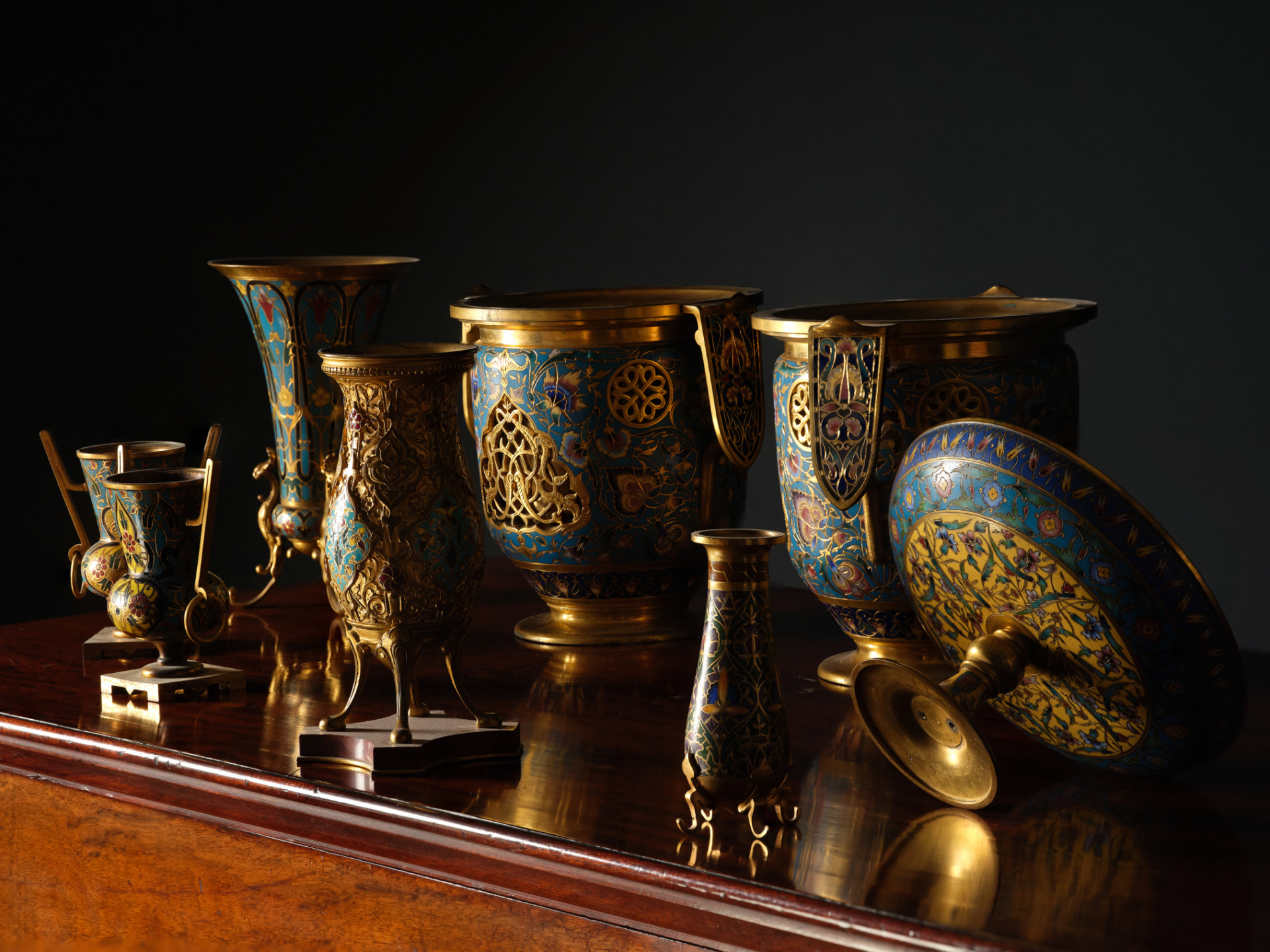
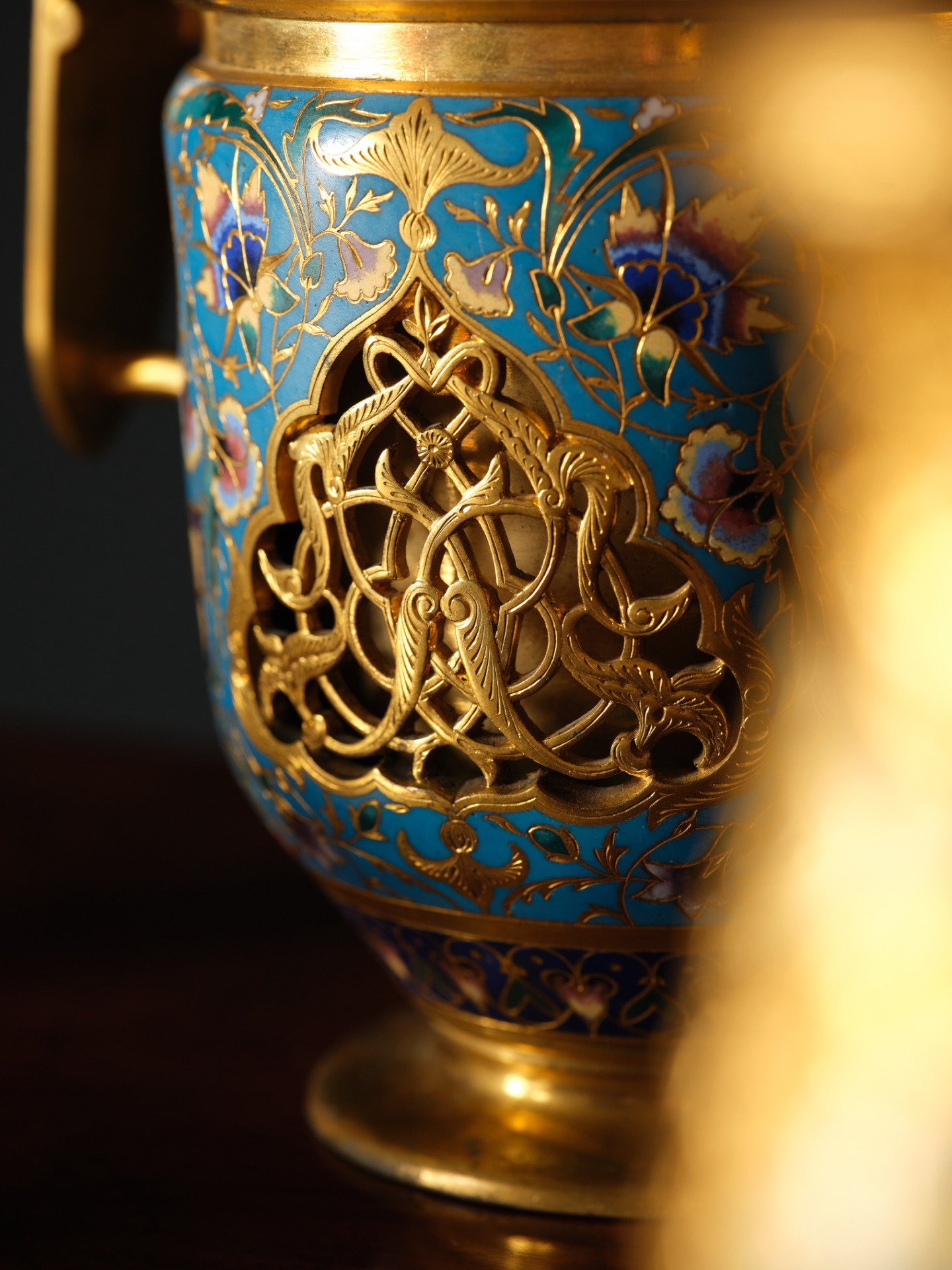
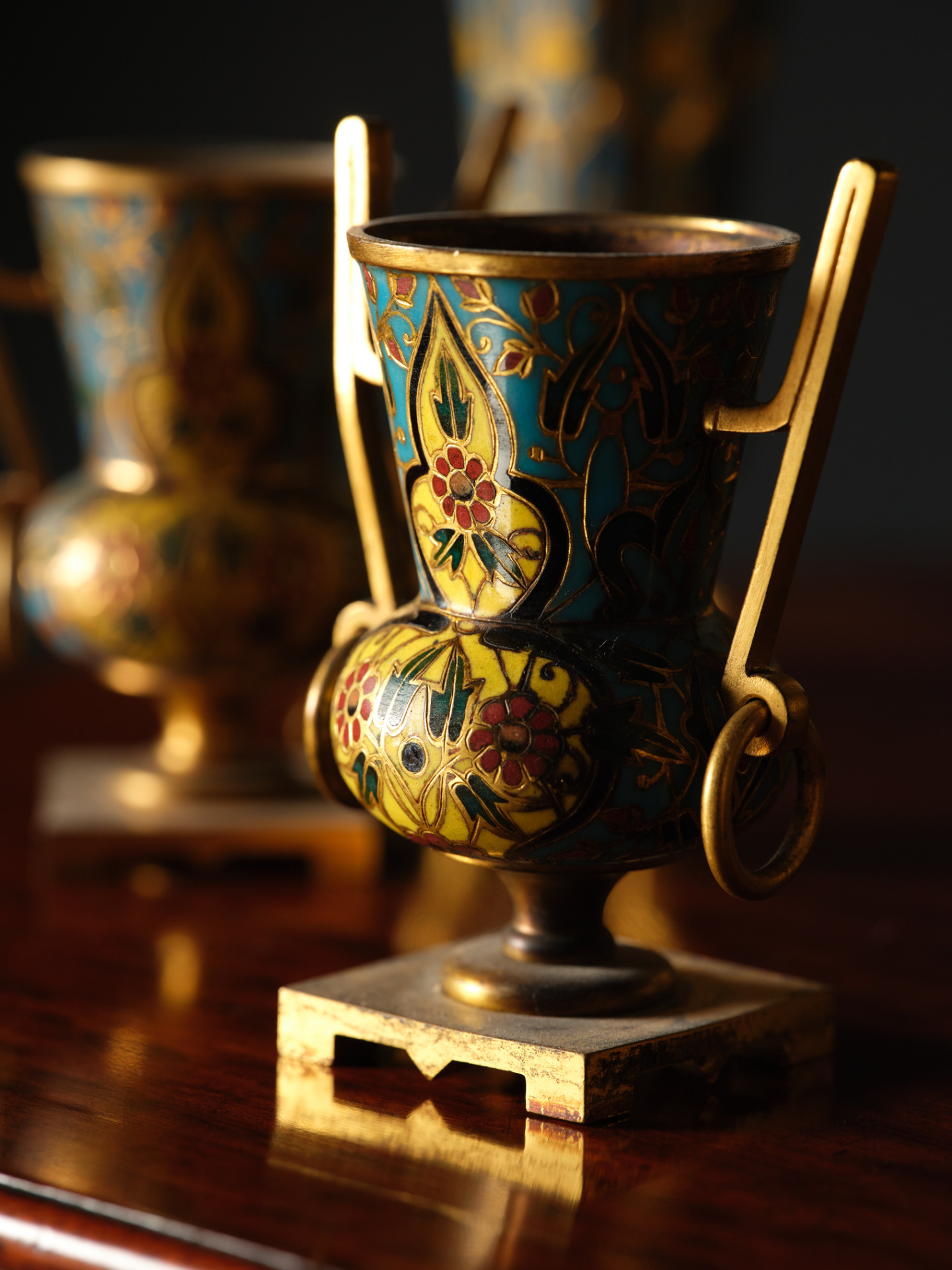
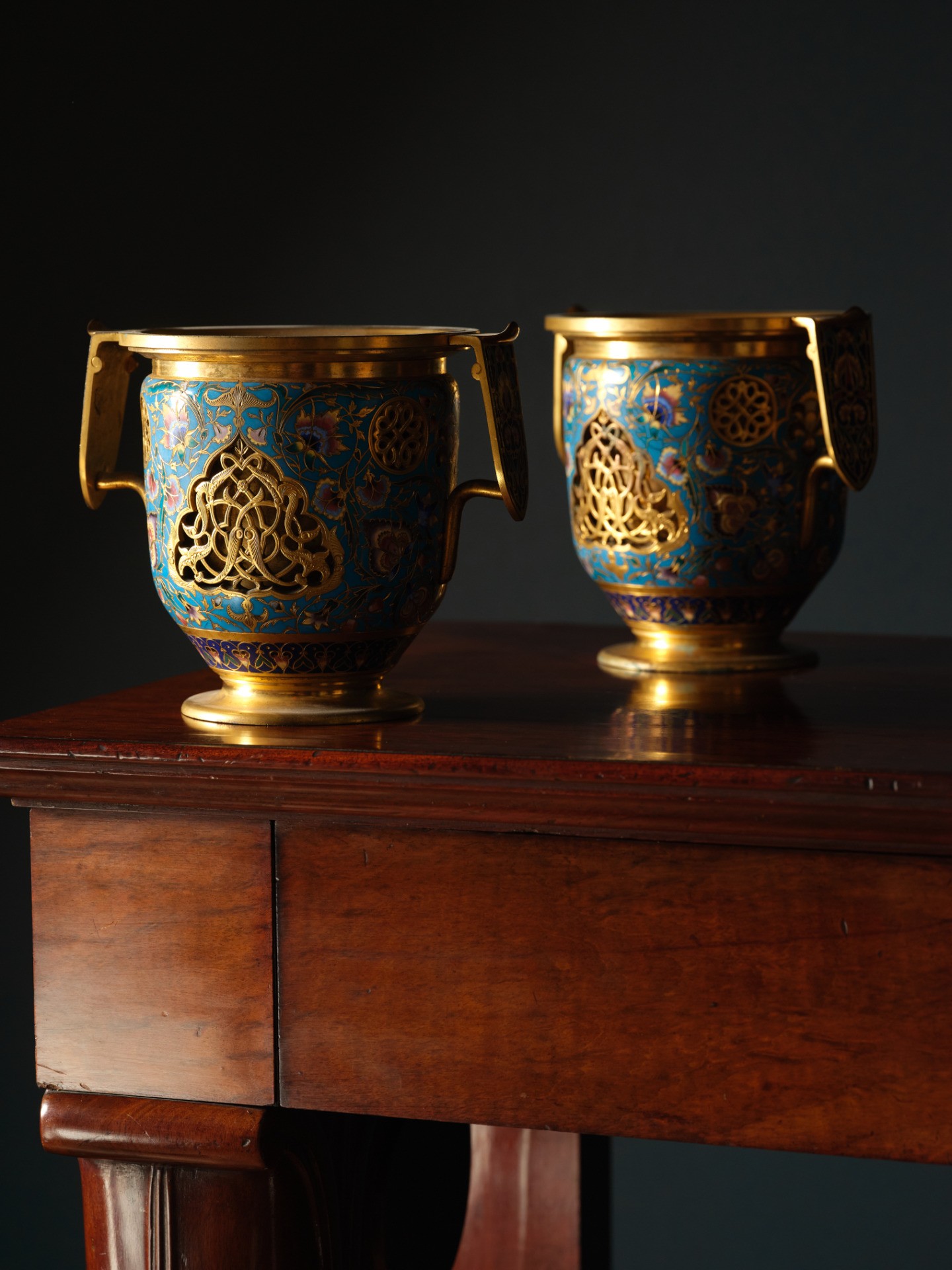
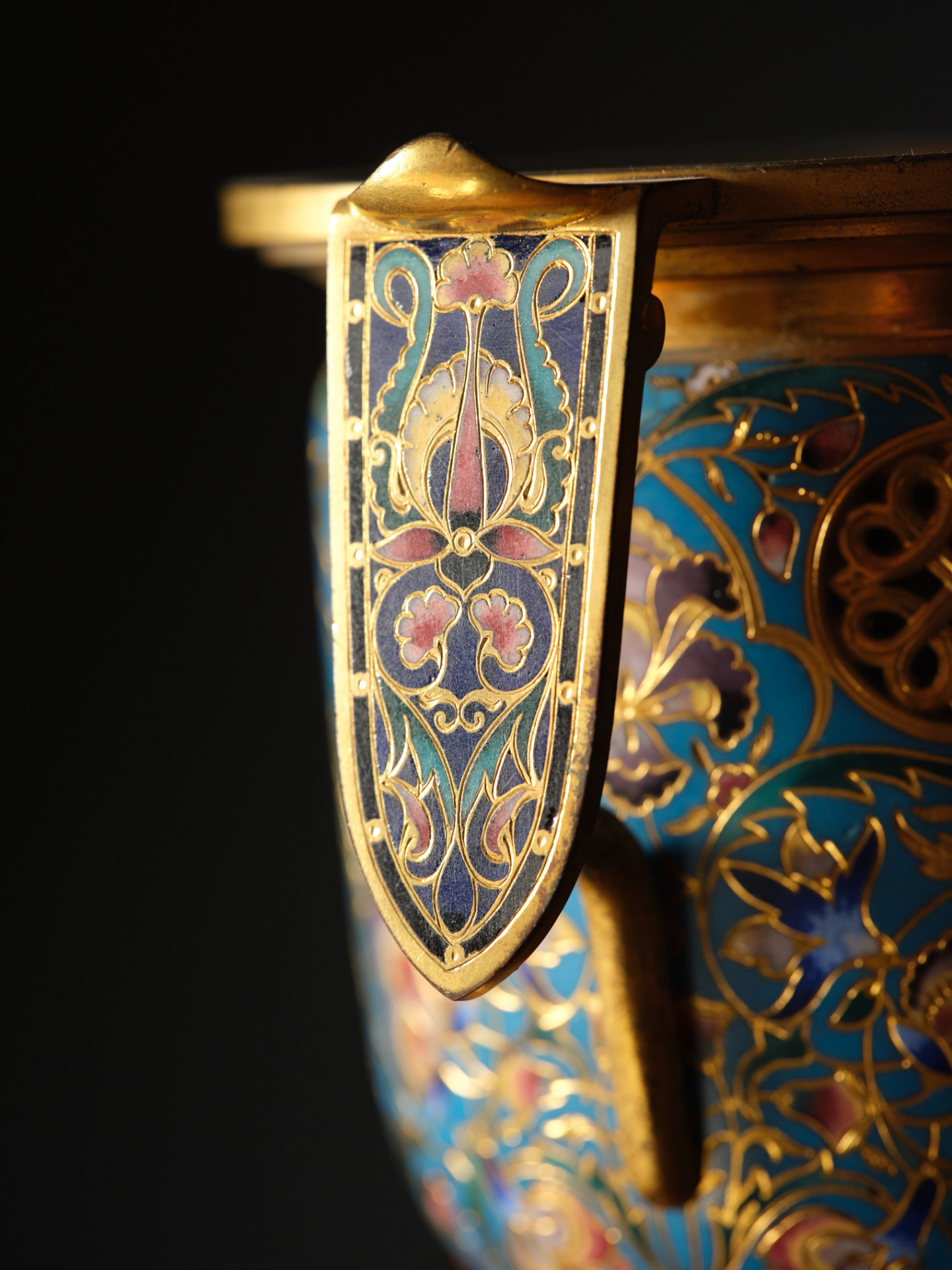
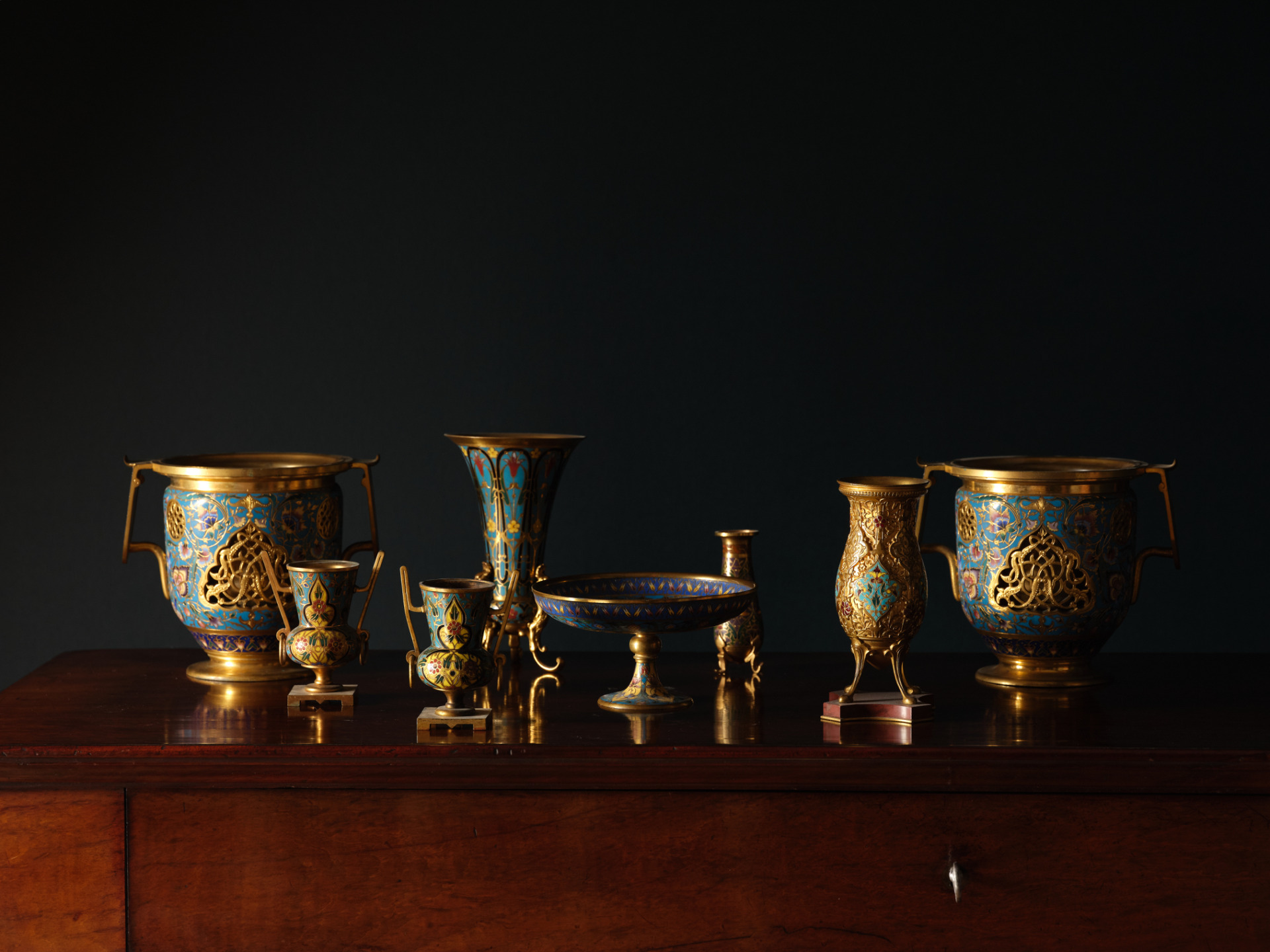
A few pieces of this type, most of them dated to the late 1860s, are preserved in the Musée d’Orsay, the Victoria and Albert Museum and the Metropolitan Museum of Art, New York: bowls, cups and tripod vases of gilt bronze, decorated on yellow and blue grounds with graceful foliate and floral motifs. The polychromy of these motifs, achieved with coloured and graduated enamels, imitates the hues of leaves and flower petals. The pieces bear, like the present group, the signature of Ferdinand Barbedienne, who founded one of the largest French manufactories of art bronzes with Achille Collas in 1838. At the International Exhibition of 1862 in London, the firm showed a collection of objects, among them a large tripod ‘a metal vase, the whole surface of which is covered with a Byzantine arabesque, similar in character to the illuminations found in Greek manuscripts of the eleventh or twelfth century’ (London 1987, p. 112).
Barbedienne appears to have imitated here the cloisonné enamels of China, not those of Byzantium, with which they are easily confused. Cloisonné is not an indigenous Chinese technique but one probably imported from the West in the fourteenth century, under the Yuan dynasty, by way of Byzantium (New York 2011, p. 8). The form of most of the vases discussed here does, indeed, recall Chinese decorative arts: two have a profile inspired by the gu 觚, two others by the touhu 投壺, and two more may be compared with the gui 簋. They were, in all likelihood, made in champlevé, a technique in which the metal is cut away in the shapes to be filled by each graduated tone or tint of enamel, itself obtained by the low-temperature fusion of a mixture of silicate and feldspar. In this process Barbedienne had made important progress: advances in casting enabled him to mould the cells directly instead of cutting the metal away. The technique was also practised in China—under the name zantai falang 鏨胎琺瑯—and had been so since at least the Tang dynasty (New York 2011, p. 6), albeit to ends other than Barbedienne’s (New York 2011, p. 8). In his work, champlevé takes the place of the method known as cloisons rapportées, that is applied cloisons (New York 2011, p. 184, n. 18).
Literature
See Art & Design in Europe and America. 1800-1900, exh. cat., London, 1987, and Cloisonné. Chinese Enamels from the Yuan, Ming, and Qing Dynasties, exh. cat., New York, 2011.