A Murano Gilt-Metal Mounted ‘Sapphire’ Glass Mirror
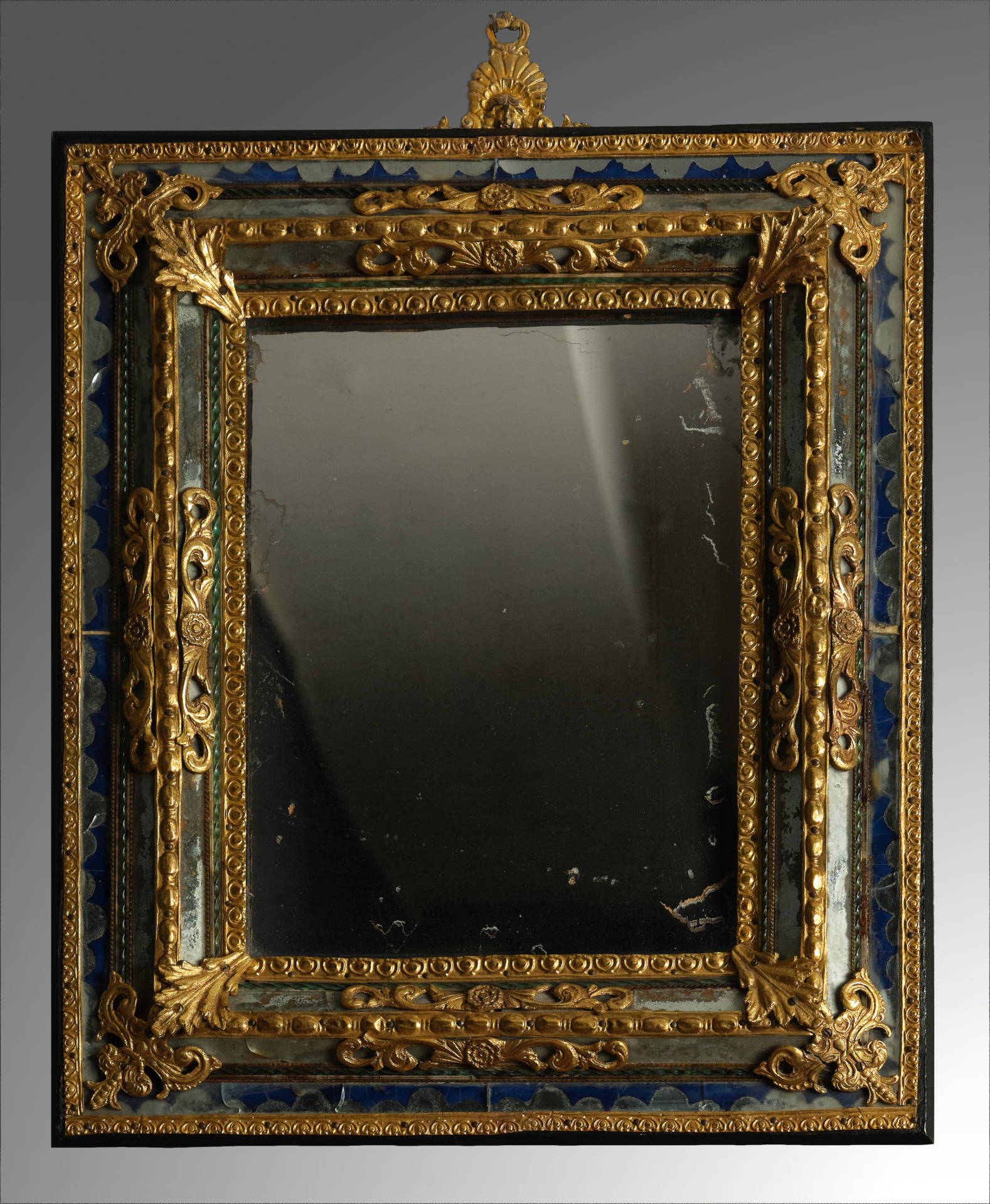
The frame of this mirror is formed of colored glass parcloses that ‘recall sapphire, topaz, ruby, and emerald, represented by appliqués of colored and fused glass’ (Gheltof 1888, p. 73), the whole enlivened with canes—or asticciole—of twisted glass and with floral motifs in gilt bronze and copper.
First appearing in Venice at the end of the 16th century and produced by Murano glassmakers until the mid-18th (Morazzoni 1951, p. 40), this type of frame was thus intended for the ‘wealthiest and most lavish clientele’ (Morazzoni 1951, p. 40 sq.). Morazzoni published a similar mirror, preserved in the Museo Vetrario in Murano, which certainly corresponds to the ‘Specchio in cornice dorata e riporti di vetro colorato’ listed as no. 939 in the museum’s catalogue, in the section devoted to Vetri muranesi del secolo XVIII, that is, 18th-century Murano glass (Gheltof 1888, p. 73). The present mirror may thus be dated to the early years of the 18th century: its twisted asticciole, its quasi-rocaille shells and gilt bronze and copper fusaroles, and its riporti of so-called sapphire or cobalt glass are unquestionably Muranese.
Literature
Giuseppe Marino Urbani de Gheltof, Catalogo del Museo civico vetrario di Murano, Venice, 1888; Giuseppe Morazzoni, Le cornici veneziane, Milan, 1951.