Allegories of the Moon and of Mars by Michelangelo Maestri after Udine and del Vaga
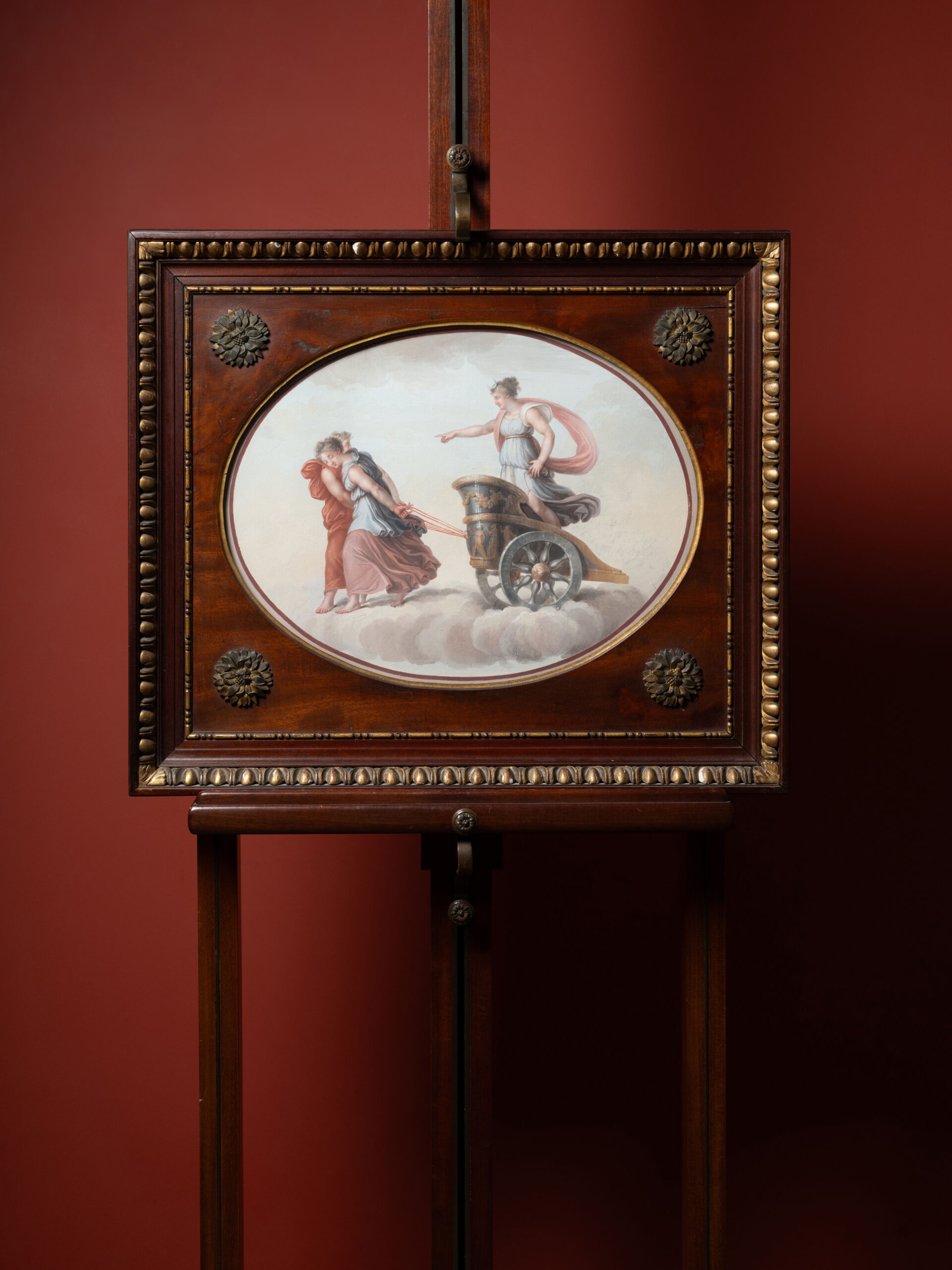
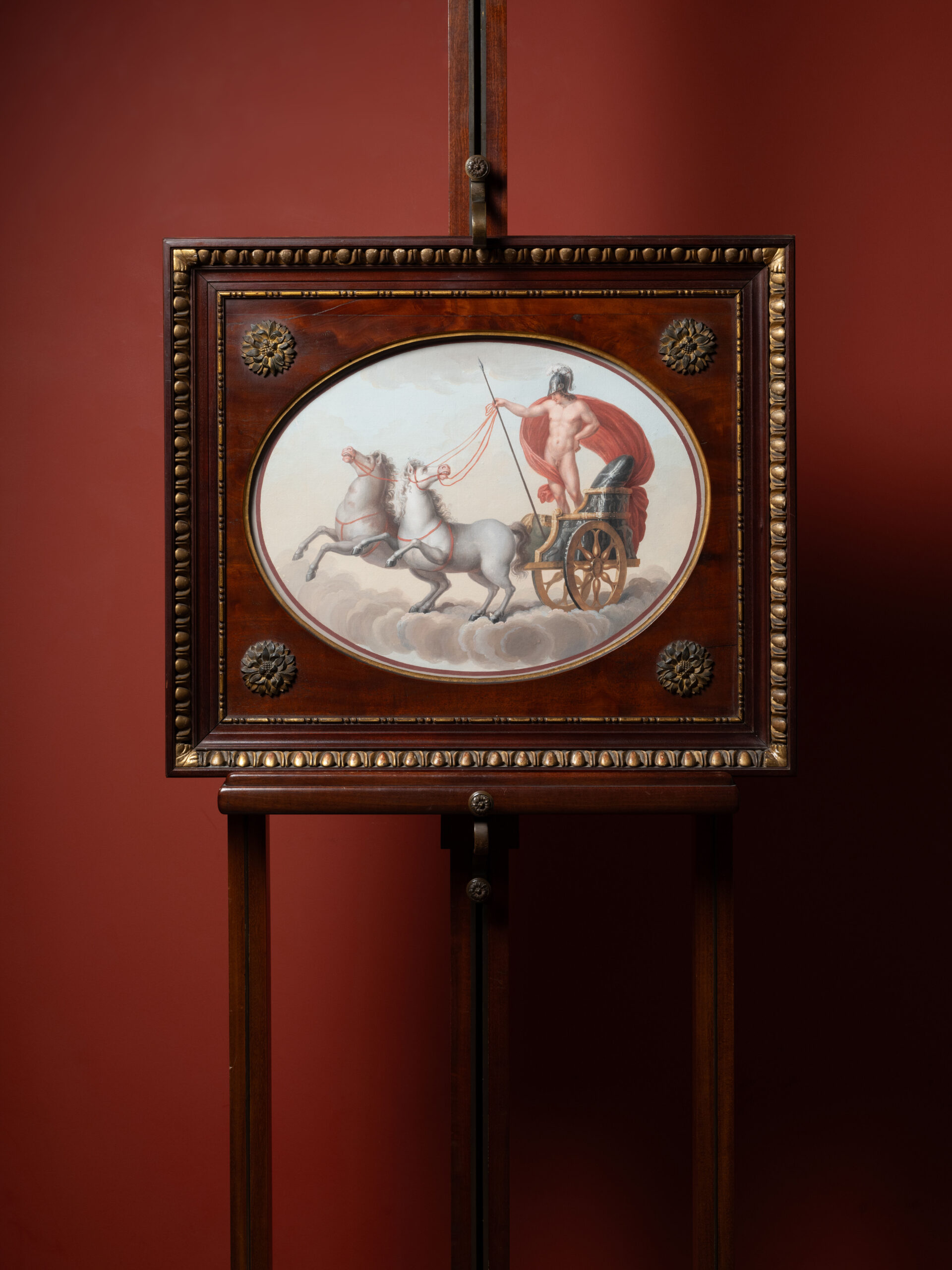
These two gouaches refer to a large group of subjects long attributed to Raphael, widely diffused at the end of the eighteenth century for a clientele of Grand Tourists — the European elites who travelled to Italy for its Greek and Roman antiquities and its most famous works of art, foremost among them those of Michelangelo and Raphael.
A series of twelve Greco-Roman deities, among them the present Mars and Diana, is known through a set of engravings by Carlo Lasinio, an engraver active in Florence at the close of the eighteenth century. A rarer and earlier set exists after the same model, the work of Roman rather than Florentine hands, engraved by Pietro Bettelini and Pietro Fontana. Established within the Roman artistic community, the two were close to Thorvaldsen and Canova, and counted in their circle the painter Michelangelo Maestri, whose signature appear on twelve prints published by Bettelini and Fontana now held in the British Museum. It is likely that the present paintings are likewise by Maestri, who died in Rome in 1812 and was known for his gouaches after Raphaelesque and Pompeian subjects.
The cycle of twelve gods is in truth a cycle of twelve “planets,” as Montagnani observes in his description of the engravings that record the composition of the frescoes in the Sala Borgia: the Volta della Sala Borgia nel Palazzo Vaticano ove sono espressi i Pianeti, le Ore del giorno, ed i segni del Zodiaco dell’immortal Rafaello Sanzio da Urbino. The figures here depicted are the Moon and Mars, the two celestial bodies nearest the Earth. As for the original frescoes, now lost, they were not conceived by Raphael, as was once believed, but by his pupils Giovanni da Udine and Perino del Vaga, in all likelihood following the master’s design.
Each gouache is set in an Empire mahogany frame carved with egg-and-dart friezes and applied at the corners with carved and gilded rosettes. Some cracks are visible on the frame.
Literature
Joseph Archer Crowe et Giovanni Battista Cavalcaselle, Raphael. His Life and Works, t. II, London, 1882 ; John Pope-Hennessy, Raphael, New York, 1970.